Disclosure: topratedkitchenware.com is reader-supported. When you buy through links on our site, we may earn an affiliate commission from Amazon and other retailers, at no extra cost to you.
Where to buy
Every pick in this guide to the best nontoxic non plastic coffee makers meets both halves of the brief at once: a stainless steel French press whose water path contains no plastic parts and no questionable coatings — just a steel chamber and a steel screen. Check the latest price on Amazon for the model that fits your household before you order.
- Secura French Press 34 oz — 34 oz insulated 304 stainless press, the complete plastic-free package
- Utopia Kitchen French Press 34 oz — 34 oz 304 steel press with 4-level filtration and spare filters
- MuellerLiving French Press 34 oz — 34 oz food-grade stainless press with a 4-filter stack, accessibly priced
- AgcKuzt French Press 34 oz — full stainless 34 oz press that travels without breakage worries
- Ziruma Stainless Steel French Press 34 oz — surgical-grade steel press explicitly built with no plastic or heavy metals
- Secura French Press 50 oz — 50 oz Secura steel press for plastic-free coffee at family scale
Read the full guide ↓
Introduction: the Best Nontoxic Non Plastic Coffee Makers
The search for the best nontoxic non plastic coffee makers is really two searches fused into one. “Non plastic” is the concrete half: you want a brewer with no plastic reservoir, no plastic brew basket, no plastic pod, and no plastic parts sitting in hot water. “Nontoxic” is the interpretive half: you want the materials that remain to be ones with a long, boring, well-documented record in food contact. A brewer that satisfies both halves at once is a short list, and at the top of it sits the stainless steel French press — which is why all six verified picks in this guide are steel presses.
It is worth pausing on why the double requirement eliminates so much of the market. Plenty of drip machines advertise a stainless carafe while routing water through a plastic reservoir, plastic tubing, and a plastic basket — metal where you look, plastic where the water actually travels. Plenty of “plastic-free” claims quietly exempt the lid, the handle insert, or the filter frame. A French press has nowhere to hide anything: the vessel is the brewer, the filter is a steel screen on a steel rod, and the whole mechanism comes apart in your hand for inspection. If a part were plastic, you would be holding it.
The six presses below are all double-wall insulated stainless steel, five in the everyday 34 oz size and one 50 oz family model. They differ in filtration depth — single-screen designs versus three- and four-layer stacks — in spare parts included, in steel specification from 304 food-grade to surgical-grade, and in brand depth. Those are the honest axes of choice in this category, and the reviews grade each pick on them.
One calibration before the picks: choosing plastic-free steel is a decision about minimizing variables, not an indictment of every other brewer. Food-contact plastics are regulated, and millions of people brew with them daily. This guide serves the reader who has decided they would rather not think about it — and for that reader, a steel press ends the question entirely. Our French Press Buying Guide Size Material And Plunger Design covers construction in more depth, and Best French Presses Coffee Makers surveys the wider family.
There is also a durability argument hiding inside the material one. A plastic-free steel press has no heating element to burn out, no pump to fail, no reservoir to crack, and no electronics to obsolesce. The same object that answers the materials question also tends to be the last coffee maker you buy for a very long time — its only wear part is a replaceable screen. Readers who came for “non plastic” often stay for “never think about my coffee maker again,” and the six picks below serve both motivations.
Key Takeaways
- The double brief — nontoxic and non plastic — is met by checking the entire water path, not the headline material: chamber, screen, plunger, and lid.
- All six picks are stainless steel French presses with steel screens, so hot water touches steel and nothing else.
- Beware partial answers elsewhere in the market: a steel carafe on a machine with a plastic reservoir and basket is not a plastic-free brewer.
- Five picks are 34 oz (about four mugs); the Secura 50 oz serves a full table in one brew.
- Four-layer filter stacks (Utopia Kitchen, Mueller, Ziruma) give the cleanest press cups in this pool.
- Complete the setup with a stainless kettle if you want the water path steel from the first pour to the last.
- Replacement screens are the only running cost in this entire category — no filters, no pods, no descaler, nothing else to buy.
In this guide
Quick Picks
Six all-steel presses, ranked by how completely and conveniently they deliver a plastic-free brew. Badges mark each model’s specialty within the field.
| Pick | Badge | Best for | Key detail | Link |
|---|---|---|---|---|
| Secura French Press 34 oz | Best Overall | Most households going plastic-free | 304 stainless, double-wall, 2 extra screens | Check on Amazon |
| Utopia Kitchen French Press 34 oz | Best Filtration | Cleanest cup, zero plastic | 4-level filtration, 2 extra filters, dishwasher safe | Check on Amazon |
| MuellerLiving French Press 34 oz | Best Value Design | Plastic-free on a budget | 4 filter screens, double insulated, dishwasher safe | Check on Amazon |
| AgcKuzt French Press 34 oz | Best for Camping and Travel | Plastic-free brewing anywhere | Full stainless build, 2 extra filters, dishwasher safe | Check on Amazon |
| Ziruma Stainless Steel French Press 34 oz | Best for Material Purists | The strictest material brief | Surgical-grade steel, 4-layer filter, measure marks | Check on Amazon |
| Secura French Press 50 oz | Best for Families and Groups | Households of four-plus drinkers | 50 oz (1.5 litre), 304 stainless, 2 extra screens | Check on Amazon |
How These Picks Were Chosen
We applied the keyword’s two tests in order. First, the plastic test: candidate brewers had to keep every part that touches hot water or brewed coffee free of plastic — chamber, filter, plunger assembly, and lid. That single filter removed every pod machine, nearly every automatic drip machine (a plastic reservoir or basket disqualified the whole unit, however steel its carafe), and any press with a plastic filter frame or lid insert. Second, the materials test: the remaining parts had to be stainless steel of a stated food-appropriate grade, verified through the product pool we confirm via the Amazon Creators API for every guide on this site.
Six presses passed both tests with verified listings, specifications, and images. We then ranked them on the practical axes: filtration construction (the pool spans single screens up to four-layer stacks), spare screens included, insulation (all six are double-wall), capacity, dishwasher rating, and the maker’s track record in steel presses specifically.
Two honesty notes. First, “nontoxic” has no certifying body; our use of it here means a water path made entirely of materials with long food-contact records, and we show our work so you can judge the claim yourself. Second, handles and exterior trim that never touch water or coffee were not treated as disqualifying anywhere in this category — what matters is the brew path, and on these six presses the brew path is steel end to end.
We also considered and set aside two neighboring categories, and the reasoning is worth recording. Glass presses with steel screens are genuinely plastic-free in the brew path and are fine products; this pool favors steel because double-wall insulation and drop resistance matter to most households, and the glass family is covered in our linked roundups. Stovetop moka pots are mostly metal but frequently include plastic handles and, in some models, internal parts that complicate the audit, and they brew a fundamentally different, concentrated style of coffee. Neither exclusion is a judgment — both are scope decisions, stated plainly so you can overrule them with full information.
The 6 Best Nontoxic Non Plastic Coffee Makers
Each review states the construction plainly — what the water touches, how the filter is built, and what living with the press is like — so you can verify the double brief pick by pick.
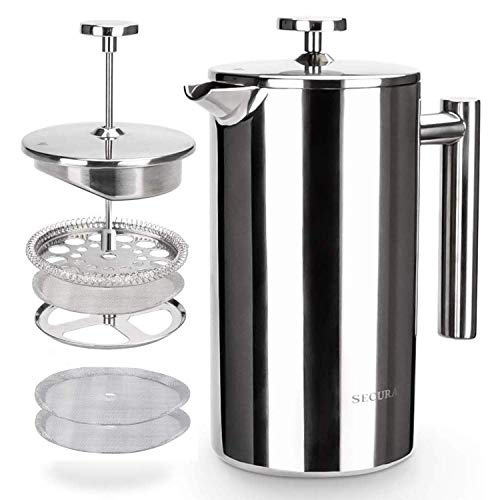
Secura French Press 34 oz
Badge: Best Overall
Strengths
- Entire brew path — chamber, plunger, screen, lid — is 304-grade stainless steel
- Two spare screens included, covering the one wear part for years
- Double-wall insulation keeps coffee hot without any warming plate or electronics
Trade-offs
- Steel wall hides the water level and the brewing coffee from view
- 34 oz maximum suits up to four mugs per brew
- Trace sediment in the last sip, as with all press brewing
At a glance
- Capacity: 34 oz (1 litre)
- Material: 304-grade stainless steel
- Insulation: Double-wall insulated
- Filtration: Steel screen, 2 extra screens included
- Finish: Silver
The Secura 34 oz is the cleanest answer to this keyword in the pool. Take it apart — it comes apart in seconds — and inventory the parts: a 304 stainless chamber, a stainless plunger rod and cross plate, stainless screens, a stainless lid. That is the entire machine. There is no reservoir to inspect, no tubing to wonder about, no basket material to look up. For a reader whose goal is to stop auditing their coffee maker, that completeness is the product.
Daily life with it is equally simple. The double wall keeps a second mug hot through breakfast and keeps the exterior comfortable to hold. The two included spare screens handle the one predictable maintenance event in a press’s life. Filtration is honest press filtration — a rich, full-bodied cup with a whisper of silt at the bottom.
Choose a different pick only for a specific reason: the 50 oz Secura below for crowds, the four-layer models for maximum sediment control, or the Ziruma for the highest steel specification. As the default plastic-free, worry-free press, this is the one.
Best for: Anyone who wants the plastic question settled in one purchase / Not suited for: Glass lovers who enjoy watching the brew, and households needing more than four mugs at once
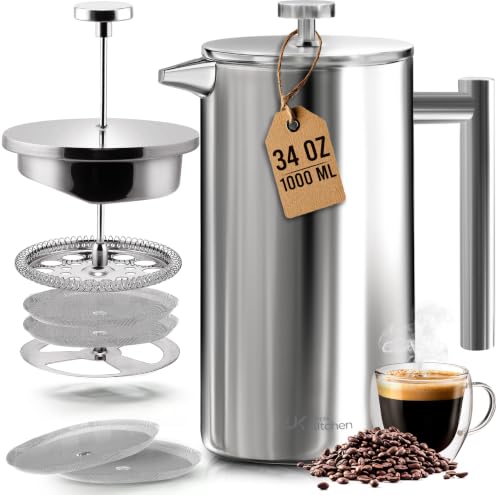
Utopia Kitchen French Press 34 oz
Badge: Best Filtration
Strengths
- 4-level steel filtration stack — the deepest filtering in this pool, and all of it metal
- 304 stainless double-wall body; no plastic anywhere in the brew path
- Dishwasher safe and rust-free, with two spare filters in the box
Trade-offs
- The layered stack takes a firmer push and a more thorough rinse
- 34 oz capacity, standard for the class
- Screens should be separated periodically so fines do not lodge between layers
At a glance
- Capacity: 34 oz
- Material: 304-grade stainless steel
- Insulation: Double-wall insulated
- Filtration: 4-level system, 2 extra filters included
- Care: Dishwasher safe, rust-free
Plastic-free brewing usually asks you to accept the French press’s one compromise — sediment — as the price of a simple water path. The Utopia Kitchen press reduces that price. Its 4-level filtration system stacks steel screens to catch progressively finer particles, producing the cleanest cup in this pool while keeping every filtering element metal. No paper, no plastic mesh, no pod: just layered steel doing progressively finer work.
The rest of the press honors the same brief: a 304-grade stainless, double-wall insulated body, a rust-free and dishwasher-safe rating, and two extra filters included so the stack can be refreshed when it eventually tires. For a plastic-free kitchen, the dishwasher rating matters — a brewer that is effortless to clean is one that stays in daily use instead of being replaced by the pod machine in a moment of weakness.
Expect a slightly firmer plunge than a single-screen press and give the stack an occasional separated scrub. That is the whole maintenance contract. In exchange you get the closest thing press brewing offers to a filtered cup, with a water path of exactly two materials: steel and coffee.
Best for: Drinkers who want plastic-free brewing with the least possible sediment / Not suited for: Those who want the absolute simplest mechanism to rinse and reassemble
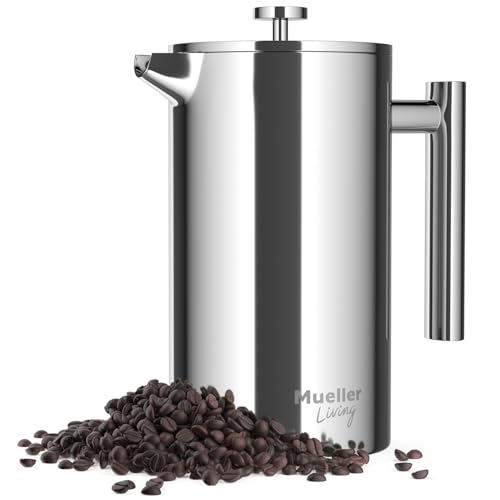
MuellerLiving French Press 34 oz
Badge: Best Value Design
Strengths
- Four-filter steel screen stack at the value end of the pool
- Double-insulated food-grade stainless body — no plastic in the water path
- Dishwasher safe and rust-free construction
Trade-offs
- Thinner brand support and spare-part ecosystem than the leaders
- 34 oz capacity like the rest of the standard field
- Plain finish compared with the premium-feeling picks
At a glance
- Capacity: 34 oz
- Material: Stainless steel, food grade
- Insulation: Double insulated
- Filtration: 4 filter screens
- Care: Dishwasher safe, rust-free
Going plastic-free does not require buying the most expensive press on the page. The MuellerLiving model pairs a four-filter steel screen stack with a double-insulated, food-grade stainless body at the accessible end of this pool’s pricing tiers, and its water path passes the same audit as every pick here: steel chamber, steel screens, steel plunger.
The four screens earn their place — the cup is noticeably cleaner than a basic single-screen press delivers — and the insulation and dishwasher-safe rating make it a realistic everyday brewer rather than a special-occasion one. For renters, students, and second-press buyers (one for home, one for the office), it is the pragmatic route into plastic-free coffee.
The compromises sit outside the cup: a smaller brand with a less proven long-term parts pipeline, and a plainer finish. Neither affects what the water touches. If your budget is the binding constraint, this pick removes the plastic without removing the filtration quality.
Best for: Budget-conscious buyers who refuse to compromise on materials or filtration / Not suited for: Buyers who prioritize decades-deep brand support

AgcKuzt French Press 34 oz
Badge: Best for Camping and Travel
Strengths
- Full stainless construction: nothing to break in transit, nothing plastic in the path
- Double-wall insulation keeps coffee hot in cold outdoor air
- Two extra filters included; dishwasher safe at home
Trade-offs
- Lesser-known brand with the shortest support track record here
- 34 oz is four cups — groups will re-brew
- Fewer published details than the big-brand picks
At a glance
- Capacity: 34 oz (4 cups)
- Material: Full stainless steel, food grade
- Insulation: Double-walled insulated
- Filtration: Steel filter, 2 extra filters included
- Care: Dishwasher safe
Plastic-free intentions often die at the trailhead, where the choices narrow to a plastic camp brewer or a fragile glass press. The AgcKuzt press — full stainless steel, double-walled, 34 oz — is built for exactly that gap, and its maker says so, pitching it for kitchen and camping alike. In a pack or a car box it is effectively indestructible, and its water path is the same steel-only story as every pick in this guide.
The double wall is the outdoor feature that matters most: cold air strips heat from a single-wall vessel quickly, while this press keeps a second cup properly hot through a slow campsite morning. Two spare filters are included, and at home it goes in the dishwasher like the rest of the pool.
The reservation is brand depth — AgcKuzt is not a long-established coffee name, so long-term spares are less certain than Secura’s. As a travel press, cabin press, or starter press for someone rough on gear, that is an acceptable trade for a brewer that can be dropped on a rock and used at breakfast anyway. See 6 Best French Press Coffee Makers For Home And Travel 2026 for more travel-first options.
Best for: Campers, RV users, and anyone who has broken a glass press / Not suited for: Buyers who want a heritage brand behind a daily-driver press
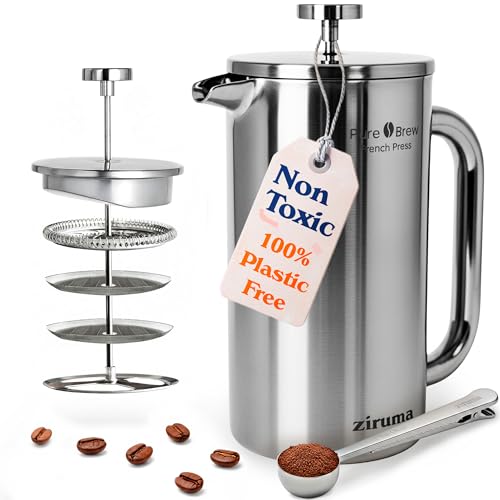
Ziruma Stainless Steel French Press 34 oz
Badge: Best for Material Purists
Strengths
- Surgical-grade stainless steel, the highest material specification available in a press
- Maker explicitly designs and markets the press around no plastic and no heavy metals
- 4-layer steel filter plus measurement marks etched for repeatable ratios
Trade-offs
- 304 food-grade steel already answers the safety question; the upgrade is refinement, not rescue
- 34 oz standard capacity
- Newer brand with a shorter track record
At a glance
- Capacity: 34 oz
- Material: Surgical-grade stainless steel
- Insulation: Double-wall insulated
- Filtration: 4-layer filter
- Extras: Measurement marks, dishwasher safe, portable
Some readers apply this keyword’s brief more strictly than others, and the Ziruma is the press built for them. It is the one model in the pool whose product name itself carries the nontoxic claim, backed by a specification that reads like an answer key: surgical-grade stainless steel, an explicit no-plastic and no-heavy-metals construction brief, a four-layer steel filter, double-wall insulation, and measurement marks on the body.
The marks are a small thing that solves a real steel-press annoyance — with an opaque wall you cannot see the fill level, so etched measures let you repeat your water ratio without dragging out a scale. The four-layer filter matches the pool’s best sediment control, and the whole unit is rated dishwasher safe.
Keep the steel hierarchy in perspective: 304 food-grade stainless, used by the other five picks, is a thoroughly proven food-contact material. Surgical grade adds corrosion resistance and finish quality. If you are the reader who wants the highest specification on every line of the sheet, this is your press — purchased for its completeness, not out of fear of the alternatives.
Best for: Material purists who want the highest steel spec and an explicitly plastic-free design brief / Not suited for: Anyone expecting a flavor difference from steel grade alone
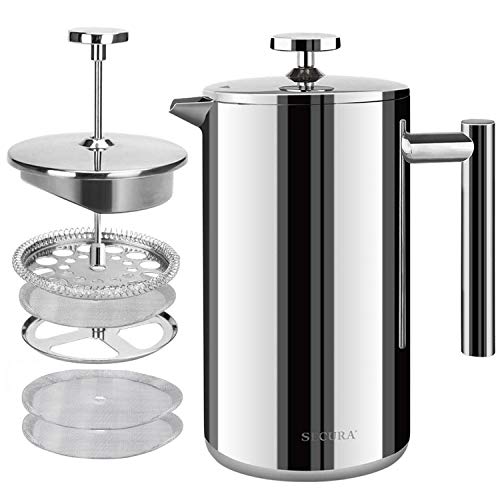
Secura French Press 50 oz
Badge: Best for Families and Groups
Strengths
- 50 oz capacity — about six mugs — with the same all-steel brew path as the 34 oz
- Double-wall insulation keeps a full batch at serving temperature
- Two spare screens included, as with the smaller Secura
Trade-offs
- A full batch must be poured off promptly; coffee left on grounds over-extracts
- Big and heavy when full — two hands, and not a travel pick
- Oversized for one or two drinkers
At a glance
- Capacity: 50 oz (1.5 litre)
- Material: 304-grade stainless steel
- Insulation: Double-wall insulated
- Filtration: Steel screen, 2 extra screens included
- Finish: Silver
Families hit a plastic-free fork in the road: brew small batches repeatedly, or buy a big automatic machine and re-open the materials question. The 50 oz Secura is the third option — the reference steel press scaled to 1.5 litres, enough for roughly six mugs in a single brew, with the same 304 stainless construction, double-wall insulation, and spare screens as our Best Overall pick.
The one technique rule matters more at this size: press and pour everything off at once. A large batch resting on its grounds keeps extracting and turns bitter, and there is more of it to go bitter. Decanted into mugs or a warmed vessel, a full steel press is the best plastic-free brunch coffee there is — no machine, no pods, no plastic in the path, and no second brewing shift.
Solo drinkers should pass: half-batches brew unevenly in an oversized vessel and full batches stale. But for the household that fills a table, this is the only pick in the pool that keeps the entire morning plastic-free in one go.
Best for: Families, shared houses, and small offices / Not suited for: Solo drinkers and couples, better served by the 34 oz presses
Comparison Table
All six pass the same two tests — no plastic in the water path, steel throughout — so the comparison turns on size, filtration, and spares.
| Pick | Format | Capacity | Standout trait | Link |
|---|---|---|---|---|
| Secura French Press 34 oz | French press | 34 oz | All-steel brew path | Check on Amazon |
| Utopia Kitchen French Press 34 oz | French press | 34 oz | 4-level steel filtration | Check on Amazon |
| MuellerLiving French Press 34 oz | French press | 34 oz | 4 filters, value tier | Check on Amazon |
| AgcKuzt French Press 34 oz | French press | 34 oz | Full steel, travel-ready | Check on Amazon |
| Ziruma Stainless Steel French Press 34 oz | French press | 34 oz | Surgical-grade steel | Check on Amazon |
| Secura French Press 50 oz | French press | 50 oz | Largest capacity in pool | Check on Amazon |
How to Choose a Nontoxic Non Plastic Coffee Maker
Audit the water path, part by part. For any brewer you are considering, list everything hot water or brewed coffee touches: reservoir, tubing, pump, basket, filter, carafe, lid. Then find the material of each. The presses in this guide make the audit trivial — chamber and screen, both steel — but the audit is the skill that protects you everywhere else, because marketing language will not do it for you. A “stainless” drip machine with a plastic reservoir fails this keyword’s brief; a steel press cannot fail it quietly, because every part is in your hand when you wash it.
Distinguish brew-path plastic from incidental plastic. A handle grip or an exterior trim piece that never meets water or coffee is a different matter from a plastic filter frame sitting in the brew. This guide’s picks keep the brew path entirely steel; when you evaluate other designs, spend your scrutiny where the heat and water are, since heat is what makes material choice consequential.
Steel grade, briefly and calmly: 304 food-grade stainless is the commercial-kitchen standard and fully answers the safety question; surgical-grade steel adds corrosion resistance and is a fair premium tiebreaker, as on the Ziruma. What you should not do is pay a fear premium. The difference between these presses in daily life is filtration and size, not safety.
Filtration is the cup-quality decision. Press brewing has no paper filter, so the screen stack is your only sediment control. The four-layer and four-filter designs here (Utopia Kitchen, Mueller, Ziruma) pour the cleanest cups; simpler screens pour the richest, siltiest ones. Match to your tolerance, and remember that grind discipline — coarse and even — does as much for clarity as hardware does.
Size honestly. Press “cups” run about 4 oz: 34 oz is four mugs, 50 oz is six. Buy for your routine, decant promptly, and let insulation — double-wall on all six picks — handle the second cup. If you are outfitting a fully plastic-free routine, finish the job with a stainless kettle, since the kettle is the other half of the water path; our How To Make French Press Coffee With A Clean Full Flavor guide covers the brewing routine that ties it together.
Do not overlook the exit question: what happens when something wears out? On these presses the answer is a screen — inexpensive, widely available for the established brands, and included as spares with several picks here. Compare that with a failed pump or cracked reservoir on a machine, which usually ends the product’s life entirely. A plastic-free routine built on a press is not just simpler on day one; it stays simple in year five, which is when most coffee equipment quietly becomes e-waste.
One last sizing nuance for households between the two formats: if you regularly brew for three or four people but occasionally host eight, the 34 oz press plus a willingness to brew a second batch beats owning the 50 oz for daily use. Fresh second batches taste better than one large batch held warm, and your everyday vessel stays the right size for your everyday life. Buy for the routine; improvise for the occasion.
How to Brew, Serve, and Care for a Plastic-Free Press
Brewing plastic-free is the same craft as brewing well. Dose at roughly 1:15 coffee to water — about 65 grams of coarse grounds for a full 34 oz press — and grind coarse and even. Pour water just off the boil over the grounds, wetting everything, and start the timer. At one minute, break the crust and skim the foam for a cleaner cup.
Steep to four minutes with the lid on and plunger up. Press slowly, stopping just above the grounds bed; forcing a press churns sediment and can spray hot coffee. Pour the entire brew off immediately into mugs or a warmed vessel — in a steel press the coffee stays hot, but it also stays in contact with the grounds until you decant, and extraction does not stop because the vessel is insulated.
Care is where steel rewards you. There are no descaling cycles, no reservoir to scrub, no hidden tubing. Rinse the press after use, knock grounds into the bin or compost rather than the drain, and wash the parts with warm soapy water or in the dishwasher where the maker allows. Once every week or two, unscrew the plunger and separate the screen stack for a real scrub — trapped oils are the main source of stale flavors, and a steel press makes removing them a five-minute job. How To Clean A French Press And Keep It Fresh Smelling has the deep-clean routine.
Storage and longevity are simple: dry the screens fully before reassembly, keep the spare screens that several of these picks include in a labeled bag, and expect the press itself to outlast every electronic brewer you have owned. There is nothing in it to fail except a screen, and screens are replaceable.
A word on water, since a plastic-free path deserves decent water in it. If your tap water is heavily chlorinated, a simple carbon filter pitcher or an under-sink filter improves flavor more than any equipment change in this guide — and if you choose a filter pitcher, steel and glass reservoir models exist for readers extending the same material logic. Brew with water you would happily drink cold; coffee is mostly water, and no press can upgrade what the kettle brings to it.
Serving matters more than new press owners expect. Warm the mugs with a splash of hot water while the press steeps, especially in winter; coffee poured into a cold ceramic mug drops in temperature immediately and tastes duller for it. Pour steadily and leave the final half-ounce in the press if you are serving someone sediment-averse — the fines concentrate at the bottom, and sacrificing the last sip is the oldest barista trick in the press world.
Troubleshooting
Problem: Coffee tastes bitter and stewed → it sat in the press after brewing. Decant the full batch right after pressing, even if the second cup will wait in a mug.
Problem: The cup is gritty → grind coarser and more evenly, skim at one minute, and pour the last ounce slowly or leave it behind — the fines settle at the bottom.
Problem: Coffee tastes flat or stale despite fresh beans → the screen stack is holding old oils. Separate the screens and scrub them, and rinse the press hot after every use.
Where Plastic Hides in “Metal” Coffee Makers
The most instructive exercise in this category is reading a mainstream drip machine’s parts list after seeing its “stainless steel” headline. The steel is usually the carafe and the housing panels. The reservoir is plastic. The tubing is plastic or silicone. The brew basket — the part holding grounds in near-boiling water — is very often plastic. None of this makes the machine non-compliant or dangerous; all of it makes the headline incomplete for a reader with this keyword’s brief.
Pod machines concentrate the issue: the water path is short, but the coffee itself brews inside a plastic or plastic-lined capsule at temperature and pressure. Reusable steel pods exist and are a genuine improvement for pod owners, but the machine’s own reservoir and internals remain what they are. The French press sidesteps the entire audit by having almost no parts. When the whole brewer fits in one hand and every piece of it is visibly steel, there is nothing left to hide.
Glass deserves its sentence as the other honest material: a glass press with a steel screen is plastic-free in the brew path too, and many classic designs qualify. This pool leans steel for durability and insulation, but the wider family is surveyed in 9 Best French Presses Glass And Stainless Steel 2026 and 6 Best French Presses For Coffee Lovers 2026.
The practical takeaway is a habit, not a purchase: whenever a product in this space leads with a material headline, flip to the parts list or the manual before you believe it. Manufacturers publish them, and the reservoir, basket, and filter materials are stated there in plain language. Thirty seconds of that reading is worth more than any badge on the box — and it is exactly the reading that the six presses in this guide survive without a single asterisk.
Building the Rest of a Plastic-Free Coffee Routine
The brewer is the centerpiece, but a routine has edges. The kettle is the big one: a stainless steel kettle — stovetop or electric with a steel interior — keeps the water path steel from the first heat to the final pour. Storage is next: whole beans keep well in a steel or glass canister with a tight lid, away from light and heat. Even the scoop and the serving vessel repay a material thought; a pre-warmed steel or ceramic server holds decanted press coffee beautifully.
None of this needs to happen at once, and none of it is about fear. It is about the quiet satisfaction of a routine with no asterisks: water, steel, coffee, heat, time. The six presses in this guide are the step that matters most, because they are where the water is hottest and the contact longest. Everything else is refinement.
There is a rhythm benefit too, which owners mention often and marketers never do. A manual, material-simple routine — kettle on, grounds in, four quiet minutes — has no boot-up, no descaling alerts, no pod inventory to manage. The plastic-free choice and the calmer morning turn out to be the same choice, which may be the real reason this keyword keeps growing.
It is also worth saying what plastic-free does not require: it does not require replacing everything you own this weekend, and it does not require purity about parts that never touch food or water. Readers burn out on all-or-nothing overhauls. The durable version of this project is sequential — brewer now, kettle when the old one dies, storage when you next organize the cabinet — and each step stands on its own merits even if you never take the next one.
Common Buying Mistakes
Judging by the headline material is mistake one. “Stainless steel coffee maker” on a drip machine usually describes the carafe. Audit the reservoir, basket, and filter before you believe a brewer is plastic-free.
Mistake two is exempting the kettle. A steel press fed from a plastic-interior kettle is a half-finished project — fine as a step, but know that it is one.
Mistake three is grinding fine. Most “the press makes bad coffee” stories are grind stories. Coarse, even grounds are non-negotiable for a clean press cup.
Mistake four is treating the insulated press as a storage pot. Double walls keep coffee hot and keep it extracting. Decant after pressing; drink the second cup from a mug.
Mistake five is oversizing. A 50 oz press for a one-person household produces waste or reheated coffee. The 34 oz presses exist because four mugs is the right batch for most homes.
Sixth, do not confuse “plastic-free” with “maintenance-free.” Steel asks little, but it asks something: screens scrubbed of oils, grounds knocked out rather than left to sit, parts dried before storage. The readers who love these presses in year three are the ones who built the small habits in week one — and the habits really are small, measured in seconds per day.
And a gentler final mistake: expecting the first cup to be perfect. Press brewing rewards two or three sessions of dialing in your grind and ratio. Judge any of these presses on your third morning, not your first — by then the routine is set, the ratio is yours, and the cup is the one you actually bought the press for.
Final Recommendation
The Secura 34 oz is our recommendation for most readers: the complete plastic-free water path, insulation, spare screens, and a specialist brand, in the size most households need. Take the Utopia Kitchen if sediment control tops your list, the Ziruma if you want the highest steel specification and an explicitly plastic-free design brief, the Mueller if budget binds, the AgcKuzt if the press will travel, and the 50 oz Secura if your mornings feed a table.
Every one of them reduces your coffee maker to two materials in the water path — steel and coffee — which is exactly what this keyword asks for.
If you are converting a whole household, a practical sequencing tip: replace the brewer first, live with it for a month, and only then decide whether the kettle and storage upgrades matter to you. Most readers find the press alone delivers the feeling they were after — a morning routine with nothing in it they have to wonder about — and the rest becomes optional polish rather than unfinished business.
Start with the brewer, brew a month of mornings, and notice how rarely you think about any of it afterward. That quiet — a hot, steel, two-material routine that simply works — is the real product being sold in this category, and every pick above delivers its own version of it.
Short on time? Start with the three picks our research kept circling back to: Secura French Press 34 oz, Utopia Kitchen French Press 34 oz and MuellerLiving French Press 34 oz. Each covers a different priority in this guide, and the detailed reviews above explain which one fits which kitchen.
Related guides
Frequently Asked Questions
What makes a coffee maker truly plastic-free?
Every part that touches hot water or brewed coffee — vessel, filter, plunger or basket, and lid — is made of a non-plastic material, typically stainless steel or glass. On the presses in this guide the brew path is steel chamber plus steel screen, with no hidden reservoir or tubing to audit.
Is stainless steel better than glass for a plastic-free press?
Both are inert, proven brew materials. Steel wins on durability and insulation — every pick here is double-walled — while glass lets you watch the brew. The choice is lifestyle, not safety.
Are plastic coffee makers unsafe?
Food-contact plastics are regulated, and we do not claim otherwise. Readers choose steel to minimize variables: steel does not degrade with heat cycling, absorb odors, or require tracking which polymer a part uses. It is a preference for simplicity, served honestly.
Does a French press need paper filters?
No — the steel screen is the filter, which is part of the appeal: no consumables at all. The trade is a little sediment, minimized by multi-layer screens, a coarse grind, and careful pouring.
What about the kettle — does it need to be plastic-free too?
For a fully steel water path, yes: a stainless kettle completes the setup. The press removes the brewer from the equation; the kettle is the other appliance the water touches while hot.
How long will a stainless steel press last?
Indefinitely, with screen replacements. There is no heating element, pump, or electronics to fail. Several picks here include spare screens in the box, and the screen is the only wear part.
Can I brew tea in these presses?
Yes — a press is an excellent loose-leaf brewer. Rinse the screen stack thoroughly between coffee and tea use, since retained coffee oils will flavor delicate teas.
What about silicone gaskets and seals — do they count as plastic?
Silicone is a distinct material from plastic, valued in food equipment for heat stability, and small seals appear in many brewers. The presses in this guide keep the brew path itself — chamber and filter — entirely steel, which is where hot water and coffee actually travel. If your brief excludes every polymer anywhere in a product, read each listing’s parts description closely before ordering.


