As an Amazon Associate, this site may earn an affiliate commission when you buy through a link on this page, at no extra cost to you.
The best pizza stones for ovens, at a glance
Pizza at home lives or dies on the surface it bakes on. A thin metal tray heats up fast, loses heat the moment cold dough touches it, and leaves you with a pale bottom and a top that is done before the base has even started. A pizza stone changes that equation entirely. It stores heat like a battery, releases it into the dough the instant the pizza lands, and keeps pulling moisture out of the crust while the top cooks. The result is the kind of bottom you can hear when you tap it — firm, speckled, holding its shape when you lift a slice. That is the whole point of owning a stone, and it is also the reason the choice is worth making carefully rather than grabbing the first round slab on the shelf.
The six stones below were chosen because each one answers a different version of the home pizza problem. One is the forgiving ceramic starter stone that forgives a rushed preheat. One is the heavy cordierite workhorse that has survived years of weekly pizza nights in ordinary home ovens. One is the glazed ceramic from a French maker that cleans like a baking dish and behaves like a stone. One is the cast iron pan that doubles as a roasting pan and never needs a conversation about thermal shock. One is the steel plate that cooks faster than any stone and appeals to anyone who measures pizza night in minutes. And one is the rectangular cordierite slab that finally fits a full-size pizza without trimming the dough to fit a circle.
Before the picks, a note on how this guide is built. Every stone here is a real product sold for home ovens, and every description is written from the stone’s material, weight, thickness, and shape rather than from marketing copy. No prices are quoted, because prices change and the honest signal is whether a stone earns its place in your oven week after week. Where a pick would suit a budget, mid-range, or premium position, that is stated in words. If a pick needs care — slow preheating, no soap, no sudden cold water — that is stated too, because a stone that cracks in the third month was not a bargain at any price.
The quick comparison table below gives you the shape of the field in one glance: material, thickness, shape, weight class, and what each stone does best. The detailed reviews that follow explain the reasoning behind each placement, including the trade-offs that do not show up in a product listing. Read the “what to look for” section first if you have never owned a stone, because it explains why thickness and preheat time matter more than brand, and why the stone you choose should match the way you actually make pizza — thin and fast, or thick and slow, or somewhere in between.
In this guide
Quick comparison: the six picks at a glance
The table below compares the six stones on the dimensions that matter in a home oven. Thickness is the single most useful number on a stone listing: a thicker stone stores more heat and recovers faster between pizzas, but it also takes longer to preheat and weighs more to move. Shape decides what fits in your oven and what shape your pizza takes. Weight class tells you whether you will slide the stone in once and leave it there, or lift it out for every cleaning.
| Pick | Material | Thickness | Shape | Weight class | Best for |
|---|---|---|---|---|---|
| Honey-Can-Do ceramic stone | Ceramic | Moderate | Round | Light to moderate | First stone, gentle learning curve |
| Unicook cordierite stone | Cordierite | Thick | Rectangular | Heavy | Weekly pizza nights, big pizzas |
| Emile Henry pizza stone | Glazed ceramic | Moderate | Round | Moderate | Easy cleaning, serving at the table |
| Lodge cast iron pizza pan | Cast iron | Thin but dense | Round | Heavy | Durability, multi-use cooking |
| Baking Steel Original | Steel | Thick plate | Rectangular | Very heavy | Fastest bakes, crispest bottoms |
| Old Stone Oven rectangular stone | Cordierite | Moderate | Rectangular | Moderate | Full-size pizzas in standard ovens |
What to look for in a pizza stone for your oven
Start with the material, because it decides almost everything else. Cordierite is the workhorse mineral in most serious stones. It tolerates high heat, absorbs moisture from dough, and resists the cracking that comes from repeated heating and cooling — up to a point. It is porous, which is exactly what you want for a dry, crisp bottom, and it is also why cordierite stones stain. Those dark patches are not dirt and not a defect. They are the record of pizzas past, and they do not affect performance. A cordierite stone that looks brand new after a year of use was probably never heated properly. Ceramic stones are smoother and often glazed on one side, which makes them easier to wipe clean and less prone to staining, but unglazed ceramic can be more brittle under thermal shock. Cast iron is a different animal altogether: it stores heat superbly, cannot crack from thermal shock in any normal kitchen scenario, and seasons over time like a skillet. Steel stores and transfers heat faster than any stone, which is why steel plates bake a pizza in noticeably less time — and why they also demand more attention, because the line between crisp and burnt is thinner.
Thickness is the second decision, and it is a genuine trade-off rather than a simple case of more being better. A stone around half an inch thick preheats in roughly half an hour and recovers reasonably well between pizzas. A stone approaching an inch thick holds far more heat and barely notices the second or third pizza, but it can take forty-five minutes to an hour to reach temperature, and it weighs enough that you will think twice before moving it. For a household that makes one or two pizzas on a Friday night, the thinner stone is the sensible choice. For a household that bakes four pizzas back to back for a crowd, the thicker stone earns its weight. There is no universal right answer, only the right answer for your pizza nights.
Thermal shock deserves its own paragraph because it is the way most stones die. A stone heated to oven temperature and then hit with cold water, or set down on a cold wet counter, can crack in a single moment. The same is true of a frozen pizza placed directly on a screaming-hot stone, or a stone pulled from a hot oven and set on a cold stone countertop. The rule is simple and absolute: heat the stone slowly with the oven, let it cool slowly in the oven, and never let cold liquid touch a hot stone. Stones that claim to resist thermal shock are describing a margin of safety, not an invitation to test it. Treat every stone as if it could crack, and it probably never will.
Shape and size come next, and they are more practical than they sound. Measure your oven rack before you buy. A round stone of fifteen inches fits most standard ovens with room for air to circulate, and a rectangular stone of similar dimensions uses the rack more efficiently and fits a full-size pizza without waste. But a stone that touches the oven walls blocks airflow and heats unevenly, so leave at least an inch of clearance on every side. If your oven runs small, a rectangular stone may actually be the safer fit, because it can sit with its long side front to back. If you make round pizzas and slide them with a peel, a round stone is the natural match. If you stretch dough freehand on a tray, a rectangular stone forgives an imperfect circle.
Preheat time is the hidden cost of a stone, and it should shape your expectations. A stone is not a tray you can use on a whim. It needs to be in the oven while the oven heats, and then it needs another fifteen to twenty minutes beyond the oven’s ready signal before it is genuinely ready. The oven’s thermostat measures air temperature; the stone lags behind. Baking on a stone that has not fully preheated is worse than baking on a tray, because the cold stone actively steals heat from the dough. Plan for a full preheat, use the time to stretch dough and prep toppings, and the stone will repay you. If you want pizza in fifteen minutes from a cold oven, a steel plate is the only option in this guide that comes close — and even steel needs a proper preheat.
Cleaning is where many first-time stone owners go wrong, and the rule is the opposite of what kitchen instinct says. Never use soap on an unglazed stone. The porous surface absorbs it, and the next pizza will taste of it. Scrape off stuck bits with a bench scraper or a stiff brush once the stone is cool, wipe with a barely damp cloth, and let it dry completely. Stains stay. That is fine. A glazed stone or a cast iron pan follows different rules — glazed ceramic can be washed like a dish, and cast iron wants the same seasoning care as a skillet — but the unglazed cordierite and ceramic stones in this guide all follow the no-soap rule. If the idea of a stained stone bothers you, choose the glazed pick or the cast iron pick and skip the porous ones.
Weight is the last practical consideration, and it matters more than the listings suggest. A thick cordierite slab or a steel plate can weigh as much as a small dumbbell. That is fine if the stone lives in the oven permanently, which many owners do — a stone left in the oven also steadies the oven’s temperature for everything else you bake. But if you plan to lift the stone out after every use, store it in a cupboard, and slide it back in for pizza night, a lighter stone is the kinder choice. Be honest about which kind of owner you are before you choose. The best stone is the one that is already in the oven when the dough is ready.
Finally, a word on the peel, because a stone without a way to get pizza onto it is a decoration. A wooden peel dusted with flour or cornmeal is the classic tool for launching a pizza onto a hot stone, and a thin metal peel is better for retrieving it. If you do not own a peel, a rimless baking sheet or a sheet of parchment paper works as a launchpad — slide the parchment and pizza onto the stone together, then pull the parchment out after a minute or two. Do not use a stone as a cutting board, and do not cut pizza directly on it; a knife on ceramic or cordierite dulls the knife and scars the stone. Use the stone for baking and the board for cutting, and both will last.
The best pizza stones for ovens, reviewed
Six stones, six different answers to the same question. Each review below follows the same shape: an opening that places the stone, a look at its strengths, an honest account of its trade-offs, and a clear statement of who it suits. The picks are ordered from the most forgiving starting point to the most specialized, so a first-time buyer can stop early and a serious home pizzaiolo can read to the end. None of these stones is the right answer for everyone. Each is the right answer for someone, and the reviews are written to help you recognize yourself in one of them.

Honey-Can-Do Ceramic Pizza Stone: the forgiving first stone
The Honey-Can-Do ceramic stone is the pick for anyone buying their first pizza stone, and it earns that place by being the least demanding stone in this guide. It is a round ceramic slab of moderate thickness, light enough to lift with one hand and lift out of the oven without a second thought, and it behaves exactly the way a first-time owner hopes a stone will behave: it heats evenly, it browns the bottom of a pizza without drama, and it does not punish a slightly rushed preheat with a crack. That forgiveness is the product of ceramic’s even heat distribution and a thickness chosen for balance rather than extremes. It stores enough heat to crisp a thin crust properly, and it recovers well enough for a second pizza, while still coming up to temperature in a reasonable time.
The crust this stone produces is the classic home-oven result done well: a bottom that is golden rather than pale, with a firm bite and a light crunch at the rim. It will not produce the leopard-spotted underside of a wood-fired oven, because no home oven stone will, but it closes most of the gap between a tray-baked pizza and a pizzeria pizza. The ceramic surface grips dough gently rather than letting it slide, which makes launching easier for a beginner who is still learning how much flour a peel needs. And because the stone is round and modestly sized, it fits standard ovens without the measuring anxiety that comes with a large rectangular slab.
Where this stone really wins is in the day-to-day experience of owning it. It is light enough that storing it in a cupboard and lifting it out for pizza night is a one-handed job. It is simple to maintain under the standard no-soap routine, and its smooth ceramic surface releases stuck cheese and flour more readily than a rough cordierite slab. For a household that makes pizza a few times a month and wants a stone that simply works, this is the lowest-friction way into stone baking.
Strengths: forgiving heat behavior and a gentle learning curve for first-time stone owners; even browning across the base of the pizza; light enough to handle and store easily; round shape fits standard ovens without measuring; smooth ceramic surface releases stuck food more readily than rough cordierite; a sensible moderate thickness that preheats in a reasonable time.
Trade-offs: ceramic is more vulnerable to thermal shock than cordierite, so the slow-heat and slow-cool rules matter more here than anywhere else in this guide; it stores less heat than the thicker cordierite and steel picks, so the third or fourth pizza in a row will bake a little slower than the first; it will stain and darken with use, like every unglazed stone; it is sized for one pizza at a time and will not fit a full-size rectangular pizza.
Who it suits: the first-time stone buyer, the occasional pizza maker, and anyone who wants a stone that is easy to lift, easy to store, and easy to live with. If you make pizza a few times a month and want a clear step up from a baking tray without committing to a heavy slab, start here. If you decide later that you want a thicker stone for back-to-back pizzas, this one still earns its keep as the everyday stone.
For a first stone that makes the jump from tray to stone feel easy rather than fiddly, check price on Amazon.
Unicook Heavy Duty Cordierite Pizza Stone: the weekly workhorse
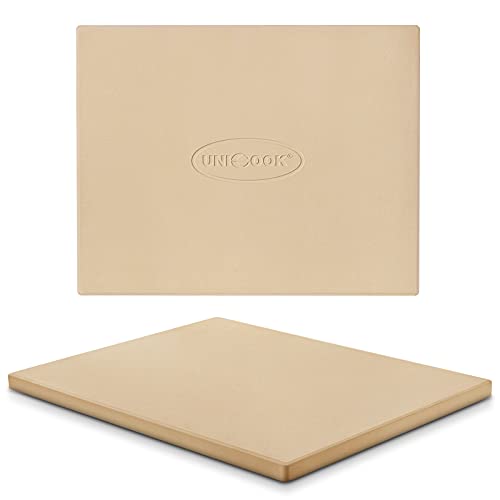
The Unicook cordierite stone is the workhorse of this guide, and it is built for the household where pizza night is a weekly ritual rather than an occasional treat. It is a thick rectangular slab of cordierite, the mineral that has become the default for serious home stones precisely because it handles heat the way a stone should: it absorbs moisture from the dough, holds temperature through the bake, and comes back for the next pizza without a long recovery. The rectangular shape is a deliberate choice, and it is the right one for a household that stretches dough to the size of the oven rack rather than trimming it to fit a circle.
What sets this stone apart in practice is heat retention. A thick cordierite slab at full temperature has an enormous amount of stored energy, and it gives that energy to the dough in the first minute of the bake — the minute that decides whether the bottom is crisp or soggy. The second pizza benefits almost as much as the first, and the third is not far behind. For a family baking three or four pizzas in a row, that consistency is the difference between a pizza night that feels professional and one that fades as the evening goes on. The stone’s rectangular shape also means each pizza can be as large as the oven allows, which matters when you are feeding a crowd and every inch of dough counts.
The cordierite surface is porous in the best sense: it pulls moisture out of the dough as it bakes, which is the mechanism behind a genuinely dry, crisp bottom. It will darken and stain with use, and that is not a flaw to manage but a sign the stone is doing its job. Owners who leave the stone in the oven permanently get a second benefit they did not pay for: the slab steadies the oven’s temperature for roasting and baking, smoothing out the thermostat’s swings.
Strengths: thick cordierite stores far more heat than thinner stones, so back-to-back pizzas bake consistently; rectangular shape fits full-size pizzas and uses the oven rack efficiently; porous surface draws moisture from dough for a drier, crisper bottom; proven durability under weekly high-heat use; leaving it in the oven steadies temperature for other baking too.
Trade-offs: heavy — this is a two-handed lift, and it is happiest living in the oven permanently; the long preheat is real, and rushing it wastes the stone’s main advantage; it stains and darkens permanently, which bothers owners who want their bakeware to look new; cordierite can still crack under thermal shock, so the no-cold-water rule is absolute; its size demands measuring the oven rack before buying.
Who it suits: the household that makes pizza every week, the host who bakes several pizzas in a row, and anyone who has already owned a thinner stone and felt its limits. If pizza night is a standing appointment in your home, this is the stone that keeps up with it. If you make pizza once a month, the weight and preheat time are more than you need.
For a thick cordierite slab that holds its heat through a whole pizza night, check price on Amazon.


Emile Henry Pizza Stone: the stone that cleans like a dish
The Emile Henry pizza stone comes from a French maker with a long history in ceramic bakeware, and it shows in the one thing that sets it apart: it is glazed. That glaze changes the ownership experience more than any other single feature in this guide. A glazed stone can be washed with soap and water like any other baking dish. It does not stain the way porous stones do. It goes from oven to table without apology, because it looks like a serving piece rather than a slab of workshop material. For a household that loves the idea of a stone but hates the idea of a stained, un-washable slab living in the oven, this is the pick that removes the objection.
The glaze does not mean the stone is a compromise on baking. Emile Henry’s ceramic is engineered for high heat, and the stone browns a pizza base properly, with a firm bottom and a crisp rim. The baking performance sits in the same class as the other ceramic and cordierite picks here — a genuinely better pizza than a tray, with the same even heat and the same need for a full preheat. What you trade for the glaze is a little of the moisture-wicking that a raw porous surface provides; a glazed surface does not pull water out of dough quite as aggressively as raw cordierite. In practice, the difference is modest, and it is more than repaid by the ease of cleaning and the confidence that comes from a stone you can actually wash.
The stone’s other quiet strength is its design. It is round, moderately thick, and shaped to be carried to the table, so a pizza can be baked and served on the same piece. That matters more than it sounds: a pizza that stays on its hot stone at the table stays crisp longer than one transferred to a cold plate, and the stone’s heat keeps the last slice as good as the first. For a household that eats pizza at the table rather than at the counter, that is a real, repeated benefit.
Strengths: glazed ceramic surface washes with soap and water like ordinary bakeware; resists staining and looks good enough to serve from at the table; even, reliable browning from a maker with deep ceramic expertise; moderate thickness preheats in a reasonable time; keeps pizza warm and crisp when served on the stone.
Trade-offs: the glaze means slightly less moisture-wicking than raw cordierite, so the very driest, most aggressive crust belongs to the porous picks; it sits in the premium tier, so the price of easy cleaning is real; like all ceramic, it needs the slow-heat and slow-cool discipline to avoid thermal shock; round shape limits pizza size to a circle.
Who it suits: the cook who wants a stone without the stained-slab aesthetic, the household that serves pizza at the table, and anyone who has been put off stone baking by the no-soap rule. If you value bakeware you can wash properly and present proudly, this is the stone for you. If you chase the driest possible crust above all else, the cordierite picks will edge it.
For a glazed stone you can wash, serve from, and actually enjoy owning, check price on Amazon.
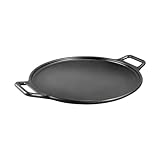

Lodge Cast Iron Pizza Pan: the stone that cannot crack
The Lodge cast iron pizza pan is the pick for anyone whose main worry about a stone is breaking it. Cast iron does not crack from thermal shock. It does not chip if it is knocked against the oven rack. It does not care if you set it down hot on a trivet or slide it under the broiler. It is, by a wide margin, the most durable surface in this guide, and it brings a second advantage no stone can match: when it is not baking pizza, it is a roasting pan, a baking pan, a griddle for flatbread, and a serving dish. A cordierite stone bakes pizza and bread. A cast iron pan bakes pizza and almost everything else.
The baking performance is genuinely strong. Cast iron stores heat as well as any material in this guide, and it releases it steadily into the dough, producing a bottom that is deeply browned and firmly crisp. The pan’s shallow rim helps here: it holds the dough’s shape while leaving the rim of the pizza exposed to the oven’s heat, so the cornicione puffs and colors properly. Because the pan is pre-seasoned, the surface is naturally nonstick enough for pizza dough, and it improves with use — the more you bake on it, the better it releases. Owners who already cook with cast iron will recognize the pattern immediately: a pan that starts good and gets better.
The weight is the honest cost. A cast iron pizza pan is heavy, and there is no version of this pick that is light. But that weight is also the reason it works: the mass is the heat battery. The practical answer is to treat the pan like a skillet that lives near the oven rather than a stone that lives in a cupboard. Many owners keep it on the stovetop or on a low shelf, slide it into the oven for pizza night, and use it for roasting vegetables or baking bread in between. The pan earns its storage space by being useful every week, not just on pizza night.
Strengths: virtually indestructible in normal kitchen use — no thermal shock cracking, no chipping, no fragility; excellent heat retention for deep browning; pre-seasoned surface that improves with use; multi-use across roasting, baking, and griddling, not just pizza; shallow rim supports the dough while letting the crust rim brown.
Trade-offs: heavy, and it stays heavy — lifting it in and out of a hot oven needs care and good oven mitts; it needs cast iron care, including drying promptly and occasional re-seasoning, rather than the scrape-and-wipe routine of a stone; it does not wick moisture the way porous cordierite does, so a very wet dough needs a drier hand with toppings; the round shape and fixed diameter limit pizza size.
Who it suits: the cook who already loves cast iron, the household that wants one pan to do many jobs, and anyone who has cracked a stone before and never wants to repeat the experience. If you want the toughest baking surface in this guide and a pan that earns its keep between pizza nights, this is your pick. If you want the lightest possible stone, look elsewhere.
For a cast iron pan that bakes pizza and outlasts every stone you will ever own, check price on Amazon.
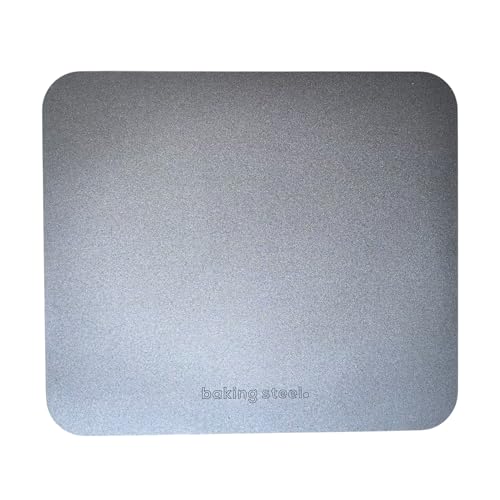
Baking Steel Original: the fastest bake in the guide
The Baking Steel Original is not a stone at all, and that is exactly why it is here. It is a thick plate of steel, and steel moves heat into dough faster than any ceramic or cordierite can. The practical result is a shorter bake and a bottom that is darker, crisper, and more aggressively browned than any stone in this guide produces at the same oven temperature. For a home baker chasing the closest possible approach to a pizzeria bake — a bottom with real color and a rim that puffs hard — steel is the most direct route. It is the specialist pick, and it is unapologetic about it.
The speed is the headline, but the consistency is the reason owners keep using it. Steel recovers heat quickly, so the second pizza bakes nearly as fast as the first, and the third is not far behind. The plate’s rectangular shape fills the oven rack efficiently, and its flat surface takes any shape of dough you stretch. It also has a second life that stone owners envy: it works as a griddle on the stovetop for flatbreads, searing, and anything else that benefits from a large, flat, screaming-hot surface. The steel arrives seasoned, and with use it develops the dark, slick patina that makes dough release cleanly.
The trade-offs are real and should be weighed honestly. Steel is the heaviest pick in this guide by a clear margin — this is a plate you slide into the oven and leave there, not one you lift out for every use. It is also the least forgiving: because it transfers heat so fast, the line between a perfectly crisp bottom and a burnt one is thinner than with a stone. A pizza left thirty seconds too long on steel shows it. And steel does not absorb moisture the way a porous stone does; it cooks by conduction, pure and simple, which means wet toppings and heavy sauces punish carelessness more than they do on cordierite. This is a tool for a baker who is paying attention.
Strengths: fastest heat transfer of any pick, producing the darkest, crispest bottoms in the shortest bake time; excellent recovery between pizzas; rectangular shape uses the oven rack efficiently; doubles as a stovetop griddle for flatbreads and searing; seasoned surface improves with use and lasts indefinitely.
Trade-offs: the heaviest pick in the guide — it lives in the oven, not in a cupboard; least forgiving of over-baking, since the margin between crisp and burnt is thin; does not wick moisture like porous stone, so wet toppings need restraint; premium tier pricing reflects the material and machining; needs steel care, including keeping it dry and lightly oiled.
Who it suits: the serious home pizza baker chasing pizzeria-level browning, the cook who bakes several pizzas in a row and values speed, and anyone who already owns a stone and wants to know what the next level looks like. If you want the fastest, darkest crust a home oven can produce and you are willing to watch the bake closely, this is the pick. If you want a forgiving first stone, start with the ceramic pick instead.
For the fastest, crispest bottom a home oven can produce, check price on Amazon.


Old Stone Oven Rectangular Pizza Stone: the full-size fit
The Old Stone Oven rectangular stone solves the most common complaint about round stones: the pizza never quite fits. A round stone of fifteen inches takes a pizza of about thirteen inches once you leave room for the rim. A rectangular stone of the same footprint takes a full-size pizza with room to spare, and for a household that stretches dough to the size of the oven rather than the size of a circle, that difference is the whole point. This is a cordierite slab in a rectangular shape, moderately thick, and it is the pick for anyone who has ever trimmed dough to fit a stone and resented it.
The baking performance is classic cordierite: steady, even heat, a porous surface that pulls moisture from the dough, and a bottom that comes out dry and firm with a satisfying crunch. The moderate thickness is a deliberate balance — thick enough to store real heat and recover between pizzas, thin enough to preheat in a reasonable time and lift without a struggle. It is the middle path between the light ceramic starter stone and the heavy workhorse slab, and for many households that middle path is exactly right. It handles a weekly pizza night without complaint and does not demand the permanent-oven-resident commitment of the thickest slabs.
The rectangular shape also changes how the stone is used. It fits a full-size pizza, but it also fits a loaf of bread, a tray of flatbreads, or two smaller pizzas side by side. That versatility matters in a kitchen where the stone is expected to earn its space. And because it is cordierite, it follows the standard stone rules: slow heat, slow cool, no soap, scrape and wipe. Owners who accept those rules get a stone that lasts for years and improves with every bake, its surface darkening into the seasoned look that marks a well-used stone.
Strengths: rectangular shape fits full-size pizzas without trimming dough; cordierite surface wicks moisture for a dry, crisp bottom; moderate thickness balances heat storage against preheat time and weight; versatile for bread and flatbreads as well as pizza; even, reliable heat across the whole slab.
Trade-offs: still a porous stone, so it stains permanently and needs the no-soap routine; it can crack under thermal shock, so the slow-heat and slow-cool rules apply; it is heavier than the round ceramic starter stone, though lighter than the thickest slab; the rectangular shape needs careful measuring to leave airflow clearance on all sides of the oven rack.
Who it suits: the household that stretches dough to the full size of the oven, the baker who wants one stone for pizza and bread, and anyone who has outgrown a round stone’s size limits without wanting the weight of the thickest slab. If your pizzas keep bumping into the edges of a round stone, this is the fix. If you make small personal pizzas, the round picks will serve you just as well.
For a rectangular cordierite stone that finally lets a full-size pizza fit, check price on Amazon.
How the six stones compare, side by side
The six stones fall into three natural groups, and recognizing which group you belong to makes the choice simpler than the table alone suggests. The first group is the forgiving starters: the Honey-Can-Do ceramic stone and the Old Stone Oven rectangular stone. Both are moderate in weight and thickness, both preheat in a reasonable time, and both reward a normal home pizza routine without demanding expertise. The difference between them is shape and surface: round ceramic that is light and gentle, or rectangular cordierite that wicks moisture harder and fits a bigger pizza.
The second group is the durable specialists: the Unicook thick cordierite slab and the Lodge cast iron pan. Both are heavy, both store enormous heat, and both are built for years of hard use. The Unicook is the better pure pizza stone — its porous surface dries a crust in a way cast iron cannot quite match — while the Lodge is the better all-round kitchen tool, doing duty as a roasting pan and griddle between pizza nights. Choose the Unicook if pizza is the job; choose the Lodge if you want one heavy pan to do many jobs and never worry about cracking again.
The third group is the two ends of the spectrum: the Emile Henry glazed stone and the Baking Steel. The Emile Henry is the easiest stone to own, because it washes like a dish and serves at the table; the Baking Steel is the most demanding and the most rewarding, because it bakes faster and browns harder than anything else in a home oven. They are opposites in temperament, and that is the point. One is for the cook who wants stone baking with the least friction; the other is for the cook who wants the closest thing to a pizzeria bake and is willing to work for it. There is no wrong choice between them — only a choice about which kind of cook you are.
Across all six, two truths hold. First, thickness and preheat time are a package: you cannot have a stone that stores a lot of heat and also heats up in ten minutes, so buy the thickness that matches your patience. Second, every stone in this guide will make a better pizza than a baking tray, and the differences between them are smaller than the difference between any of them and no stone at all. If you are choosing between two picks and cannot decide, choose the lighter one — you will use it more often, and a stone that is in the oven beats a stone that is in the cupboard.
| Quality | Ceramic starter | Thick cordierite | Glazed ceramic | Cast iron | Steel plate | Rectangular cordierite |
|---|---|---|---|---|---|---|
| Crust dryness | Good | Excellent | Good | Good | Very good | Excellent |
| Heat retention | Moderate | Excellent | Moderate | Excellent | Excellent | Good |
| Preheat time | Moderate | Long | Moderate | Moderate | Long | Moderate |
| Ease of cleaning | Moderate | Basic | Excellent | Moderate | Moderate | Basic |
| Forgiveness | High | Moderate | High | High | Low | Moderate |
| Weight | Light | Heavy | Moderate | Heavy | Very heavy | Moderate |
kitchen tools for making pizza
best pizza stones for home ovens
Getting the most from your stone: rack position, oven type, and the launch
Where the stone sits in the oven matters as much as which stone you buy. The lowest rack is the usual home for a pizza stone, and for good reason: heat rises, and the bottom of the oven is the hottest place in the box. A stone on the lowest rack gets the strongest heat from below, which is exactly what the bottom of the pizza needs, while the top of the pizza cooks from the ambient heat and the element above. If your oven has a bottom element that is exposed, keep the stone a rack above it rather than directly on the oven floor — direct contact with the element can create a hot spot that scorches one part of the pizza while the rest lags. In a gas oven, the stone also shields the pizza from the direct flame below, evening out a heat source that is naturally less uniform than an electric element. In an electric oven, the stone’s job is simpler: store the element’s heat and give it back steadily. Either way, the lowest rack is the starting point, and you should only move the stone up if the bottom is browning faster than the top.
The broiler is the home baker’s secret weapon, and it pairs with a stone in a way that surprises first-time users. A pizza baked on a hot stone with the broiler on for the last minute or two gets a top that bubbles and spots while the bottom stays crisp — the closest a home oven comes to the two-sided heat of a wood-fired oven. The technique needs care: watch the pizza constantly during the broiler finish, because the line between spotted and burnt is measured in seconds, and never leave the oven unattended with the broiler on. Used with restraint, it is the single biggest upgrade to a home pizza after the stone itself.
The launch — getting the pizza from the peel onto the hot stone — is the skill that separates a smooth pizza night from a mess. The classic failure is a pizza that sticks to the peel and folds on itself halfway onto the stone. The prevention is boring and reliable: dust the peel with flour, semolina, or cornmeal before stretching the dough on it, and give the peel a small shake before launching to confirm the pizza slides freely. If it sticks, lift the edge gently and throw a little more flour underneath rather than forcing it. Stretch the dough on the peel rather than on the counter and then trying to transfer it, because every transfer is a chance for the dough to stick or tear. When you launch, hold the peel at a shallow angle, touch its tip to the far side of the stone, and pull back in one smooth motion — quick and confident, not slow and hesitant. A slow pull lets the dough catch and drag; a quick pull leaves the pizza exactly where it should be.
Parchment paper is the beginner’s friend and deserves a fair hearing. Sliding a pizza on parchment onto the stone removes the launch anxiety entirely, and the paper can be pulled out after a minute or two once the dough has set. The trade-off is small: the parchment sits between the dough and the stone for that first minute, slightly softening the initial heat transfer. Most home bakers will never notice the difference, and a pizza launched cleanly on parchment beats a pizza folded on the stone every time. As you gain confidence, you can graduate to a bare peel. There is no shame in parchment, and there is no prize for a ruined launch.
Storage rounds out the routine. A stone that lives in the oven needs no storage at all, and that is the strongest argument for leaving it there. If you do store it, keep it flat, dry, and somewhere it will not be knocked — a stone leaning against a wall in a cupboard is a stone waiting to fall and crack. Never stack heavy pans on a ceramic or cordierite stone. Let the stone cool completely in the oven before moving it, and handle it with dry hands and a firm grip.
Frequently asked questions
Do I really need to preheat a pizza stone, or can I put the pizza on a cold stone?
You need to preheat it, and the preheat is not optional. A pizza stone works by storing heat and releasing it into the dough the moment the pizza lands. A cold stone does the opposite: it pulls heat out of the dough, and the bottom stays pale and soft while the top overcooks. Put the stone in the oven while the oven heats, then give it another fifteen to twenty minutes after the oven signals it is ready. That extra time is the difference between a stone that works and a stone that is just a heavy tray.
Why does my pizza stone have dark stains, and should I clean them off?
Dark stains on an unglazed stone are normal and permanent, and they are not a sign of dirt or damage. They are the record of oils and sugars that have seasoned into the porous surface over many bakes. You cannot scrub them out without damaging the stone, and you should not try. Scrape off stuck food, wipe with a barely damp cloth, and let the stone dry. If stains bother you, the glazed ceramic pick in this guide is the answer — it washes clean like a dish.
Can I use soap on a pizza stone?
Not on an unglazed stone. The porous surface absorbs soap, and the next pizza will taste of it. Use a bench scraper or stiff brush on a cool stone, then a barely damp cloth. The glazed ceramic stone and the cast iron pan follow different rules — the glazed stone can be washed with soap like ordinary bakeware, and cast iron wants the same drying and seasoning care as a skillet — but every raw cordierite and ceramic stone in this guide follows the no-soap rule.
What is the difference between cordierite, ceramic, cast iron, and steel for pizza?
Cordierite and ceramic are stones: they store heat and, when unglazed, pull moisture out of dough for a dry, crisp bottom. Cordierite tolerates heat and thermal stress better than ceramic, while ceramic is often smoother and lighter. Cast iron stores heat just as well, cannot crack from thermal shock, and doubles as a roasting pan, but it does not wick moisture the way a porous stone does. Steel transfers heat faster than any of them, so it bakes fastest and browns hardest, but it is the heaviest and least forgiving. The right material depends on whether you value dryness, durability, easy cleaning, or speed most.
Can I leave a pizza stone in the oven all the time?
Yes, and many owners do. A stone left in the oven steadies the oven’s temperature, which improves roasting and baking as well as pizza. The only cautions are practical: the stone adds weight to the rack, it will drip if something spills on it during another bake, and it needs to be out of the way if you need the rack space for a tall roast. If you leave it in, put it on the lowest rack so it does not block heat from reaching the rest of the oven. If you take it out after every use, store it flat in a dry place where it cannot be knocked or dropped.
The bottom line
A pizza stone is one of the rare kitchen purchases that changes a result you can taste on the first use. The choice is not about finding a single best stone, because there is not one — it is about matching a material, a thickness, and a shape to the way you actually make pizza. The forgiving ceramic starter suits the first-time buyer. The thick cordierite slab suits the weekly ritual. The glazed stone suits the cook who wants to wash their bakeware properly. The cast iron pan suits the cook who wants one tool for many jobs. The steel plate suits the baker chasing the fastest, darkest crust a home oven can give. And the rectangular cordierite stone suits the household whose pizzas keep outgrowing a round slab. Pick the one that matches your pizza nights, preheat it properly, and the next pizza you pull from the oven will tell you the money was well spent.