As an Amazon Associate, Top Rated Kitchenware may earn an affiliate commission when you buy through links on this page, at no extra cost to you. Every recommendation below is chosen on its own merits, and nothing here is paid placement.
Open the fridge, pour a glass of water from the dispenser, and take a sip. If the first thing you notice is a faint chemical taste, a whiff of something stale, or ice cubes that smell faintly of last week’s leftovers, the problem is almost never your water supply in general. It is the small cartridge sitting inside your refrigerator, doing a quiet job that only becomes obvious when it stops doing it well. A refrigerator water filter is one of the least glamorous parts of a kitchen, and one of the most consequential for daily life, because it touches every glass of water, every tray of ice, and every pot of coffee brewed from the dispenser.
The trouble is that buying one feels harder than it should. Search for a filter and you are met with a wall of look-alike cartridges, cryptic model numbers, and compatibility charts that seem written for appliance technicians rather than homeowners. Buy the wrong one and it simply will not fit, or worse, it will fit badly enough to leak slowly behind the fridge where nobody notices for weeks. Buy a cheap unbranded copy and you may get water that tastes fine for a month and then degrades, because the carbon inside was never certified to remove what the label implies it removes.
This guide cuts through that noise with a simple approach. We look at six filters built around the six refrigerator systems most American kitchens actually own: Samsung, LG, Whirlpool’s EveryDrop platform, GE, Frigidaire, and Bosch. Each pick is judged on the same four questions: does it fit its system exactly, is it certified by an independent body for the contaminants it claims to reduce, how long does it realistically last in a busy household, and does it keep water tasting clean through the whole cartridge life rather than just the first two weeks. No filter here is recommended on brand loyalty alone, and every trade-off is stated plainly, including the ones manufacturers would rather you overlooked.
One honest note before we start. A refrigerator filter is a point-of-use device. It improves the water coming out of your fridge dispenser. It does not turn hard water soft, it does not replace a whole-house system, and it cannot fix a supply problem like sediment-heavy well water on its own. What it can do, when matched correctly to your fridge and changed on schedule, is take the chlorine taste out, catch the particles and cysts that make water look and taste off, and keep your ice cubes tasting like water instead of like the inside of a freezer. That is a modest promise, and it is exactly the promise this guide holds each filter to.
What to look for in a refrigerator water filter
Shopping for a refrigerator filter is mostly an exercise in matching. Get the match right and everything else becomes a question of taste and budget. Get it wrong and nothing else matters, because the cartridge will not seat, will not seal, or will not be recognized by the fridge at all. Start with the match, then worry about certification, lifespan, and the small design details that decide whether changing the filter is a two-minute job or a twenty-minute wrestling match with a cramped compartment.
Match the filter to your exact refrigerator model
Every major refrigerator brand runs its filters as a system. Samsung’s HAF-QIN and HAF-CIN cartridges fit different Samsung models. LG’s LT1000P, LT700P, and LT800P look similar at a glance and fit completely different fridges. Whirlpool’s EveryDrop line uses numbered filters, and the number matters more than the brand on the box. GE’s RPWFE and MWF cartridges are not interchangeable. Frigidaire’s PureSource Ultra and PurePour lines split the brand’s own models. Bosch’s UltraClarityPro fits a specific set of Bosch and Thermador refrigerators. The pattern is consistent: within one brand, several cartridges exist, and each one belongs to a specific family of models.
The reliable way to match is to read the model number off your refrigerator, not the filter you are replacing. The model plate usually sits on the inside wall of the fresh-food compartment, on the door frame, or behind the lower crisper drawer. Write down the full model number, then check it against the manufacturer’s compatibility list for the filter you are considering. If your current cartridge has a part number printed on it, that is a useful cross-check, but it is not a substitute for the model number, because a previous owner or a well-meaning relative may have installed the wrong cartridge years ago and the fridge has been limping along with it ever since.
Two details deserve special attention. First, some cartridges carry a small RFID chip that the refrigerator reads before it will dispense water. GE’s RPWFE is the best-known example. A cartridge without the chip, even one that fits perfectly and filters beautifully, may trigger a warning or stop the dispenser entirely. If your fridge uses a chipped cartridge, a generic replacement that lacks the chip is not a bargain; it is a paperweight. Second, measure nothing and assume nothing about twist-and-lock orientation. Some cartridges install with a quarter turn, some push straight in, and some require a firm press until a click confirms the seal. A cartridge that is not fully seated is the single most common cause of slow leaks, and the leak often starts as a few drops a day that pool under the crisper drawer.
Understand what NSF certification actually certifies
NSF International is an independent organization that tests water filters against published standards, and its marks are the closest thing this category has to a shared language. Three standards matter most for refrigerator filters. NSF/ANSI 42 covers aesthetic effects: chlorine taste and odor, and particulate reduction. NSF/ANSI 53 covers health effects: lead, cysts, mercury, and a list of volatile organic compounds. NSF/ANSI 401 covers emerging contaminants such as certain pharmaceuticals and pesticides. A filter certified to 42 alone is a taste-and-odor filter. A filter certified to 42 and 53 is doing substantially more work. A filter that also carries 401 has been tested against the newest list of concerns.
Certification is specific, not general. A cartridge can be certified to reduce lead but not cysts, or chlorine but not mercury, and the exact list is published in the certification record. When you compare two filters, compare their certification lists, not their marketing copy. Two cartridges can both say “reduces lead” on the box while only one has been independently tested for it. The other may be relying on the general properties of activated carbon, which is a reasonable engineering expectation but not a tested claim.
There is also a practical point about counterfeits. Genuine manufacturer cartridges and reputable third-party cartridges carry verifiable certification marks. Counterfeit cartridges often copy the look of the mark without the testing behind it, and they are common in this category precisely because the product is small, cheap, and rarely examined closely. Buy from a seller you can trace, check that the certification mark matches the certifying body’s public listing, and treat a price far below the normal range as a warning sign rather than a lucky find.
Original manufacturer cartridges versus compatible replacements
This is the honest divide in the category, and it deserves a straight answer rather than a slogan. Original equipment manufacturer cartridges, the ones sold under the refrigerator brand’s own name, are the safest choice on fit and on certification. They were designed with the fridge, they carry the chip when the system needs one, and their certification record is public and specific. Their downside is price, and the fact that some brands price their cartridges as if the filter were a luxury good rather than a consumable.
Compatible replacements from reputable makers can be genuinely good. Some are made in the same factories, use the same carbon block technology, and carry the same NSF certifications. The best of them are honest about exactly which standards they are certified to, and they publish the list rather than hiding behind vague claims. Their downside is variance. The category has excellent compatible filters and terrible ones, and the difference is not visible from the outside of the box. A compatible cartridge that costs a third of the original and carries no verifiable certification is not saving you money; it is selling you a plastic housing with carbon of unknown quality.
The practical rule in this guide is simple. If your fridge needs a chipped cartridge, buy the original. If your fridge takes a plain twist-in cartridge, a certified compatible from a traceable maker is a reasonable way to save money, provided you verify the certification and the exact model fit. Never buy a cartridge whose only claim is a look-alike label and a low price. Water is the one thing in your kitchen you put inside your body every day; the filter that treats it is not the place to gamble on an unknown.
Filter life, the six-month cycle, and the indicator light
Most refrigerator filters are rated for six months or a set number of gallons, whichever comes first. The gallon figure is usually somewhere between two hundred and three hundred gallons, depending on the system. In a household that uses the dispenser for drinking water, cooking, and ice, the gallon limit often arrives before the calendar limit. In a household that rarely uses the dispenser, the calendar limit arrives first, and the cartridge still needs changing, because carbon that sits wet for months grows biofilm and loses capacity whether water flows through it or not.
The indicator light on your fridge is a timer, not a sensor. It counts months or gallons and then turns red. It does not test your water. Treating the light as a suggestion rather than a deadline is the most common mistake in this category, because a filter that has passed its life does not stop working loudly. It works worse quietly. The water tastes a little flatter, the ice smells a little more like the freezer, and the decline is gradual enough that you adapt to it instead of noticing it. Then you change the cartridge and the first glass tastes startlingly better, which is the moment you realize how long the old one had been failing.
One last factor that rarely appears on the box is water pressure. A refrigerator filter needs adequate household water pressure to work properly, and a cartridge that is doing its job will slow the flow slightly compared with no filter at all. That is normal. What is not normal is a dispenser that trickles. If the flow drops sharply after a change, the cartridge may be the wrong model, it may not be seated, or the household pressure may be low enough that the filter becomes a bottleneck. Check the seating first, then the model number, and only then consider whether the supply pressure needs attention. A filter that starves the ice maker of water will produce small, hollow cubes and eventually strain the inlet valve, which is a repair far more expensive than any cartridge.
Plan the change like any other household routine. Put it on the calendar the day you install a new cartridge. Keep one spare on the shelf so a red light never turns into a week of unfiltered water while you wait for a delivery. And flush a new cartridge properly: run several gallons through the dispenser and discard them before drinking, because new carbon sheds fine black particles at first. Those particles are harmless carbon dust, but they look alarming in a glass and they are easy to avoid with a proper flush.
In this guide
The best water filters for refrigerators, reviewed
Six systems, six cartridges, one standard of judgment. Each review below names the system it fits, the certifications that back its claims, and the household it serves best. Where a cartridge has a known weakness, it is stated in the open. The order is not a ranking from best to worst; it is the order of the systems themselves, because the right filter for your kitchen is the one that fits your refrigerator.
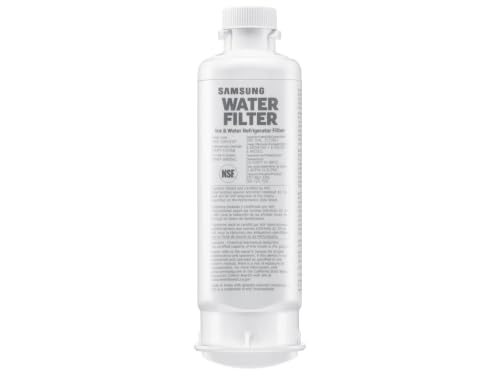
Samsung HAF-QIN: the dependable standard for most Samsung fridges
The HAF-QIN is the cartridge most Samsung refrigerator owners will encounter, and there is a reason it has become the default. It fits a broad swath of Samsung French-door and side-by-side models, installs with the familiar quarter-turn twist, and carries certification to NSF/ANSI 42 and 53, covering chlorine taste and odor, particulates, lead, cysts, and a set of volatile organic compounds. In daily use it is the quiet achiever of the category: water comes out tasting neutral and clean, ice cubes freeze clear and taste like nothing at all, and the cartridge holds that performance across its rated life rather than fading in the final month.
What makes the HAF-QIN easy to live with is how little it asks of you. The twist-in installation takes under a minute once you know the motion, and the seal is positive enough that you can feel it seat. Samsung’s filter indicator resets cleanly after a change, and the cartridge is widely stocked, which matters more than it sounds, because a filter you cannot find when the light turns red is a filter that stays in the fridge past its life. Availability is a feature, and the HAF-QIN has it.
Its performance on chlorine is its strongest suit. Homes on municipal water with a noticeable chlorine note will hear the difference immediately, and the improvement is stable: the carbon block is sized generously enough that the taste does not creep back in month five. Lead and cyst reduction are certified rather than merely implied, which puts it ahead of the many unbranded cartridges that fit Samsung fridges and claim similar results without the testing to prove it.
Strengths
Certified to NSF/ANSI 42 and 53 with a published, specific list of reductions. Fits a wide range of Samsung models, so the odds are good that it is the cartridge your fridge expects. Installation is a quick quarter-turn with a clear seating feel. Taste improvement is immediate and holds through the full six-month cycle. Widely available from traceable sellers, which keeps the replacement routine painless.
Trade-offs
The HAF-QIN is a mid-range cartridge on capacity, and in a household that draws heavily from the dispenser, the gallon limit can arrive before the six-month mark. It does not carry NSF/ANSI 401 certification, so if emerging contaminants are a specific concern for your household, it is not the most complete option on this list. And like all original Samsung cartridges, it costs more than the generic copies that fit the same housing, which is a real consideration if you change filters twice a year, every year.
Who it suits
The Samsung owner who wants the cartridge the fridge was designed around, with certified reductions and no compatibility surprises. It is the right default for most Samsung French-door kitchens, and the right choice for anyone who has been burned before by a generic cartridge that fit badly or faded early.
If your Samsung fridge uses the HAF-QIN system, start here and check price on Amazon.

LG LT1000P: the long-life option for LG French-door kitchens
The LT1000P is LG’s workhorse cartridge for its French-door lineup, and its defining trait is stamina. It is rated for a longer service interval than most refrigerator filters, and in practice it earns that service life: households that use the dispenser heavily report that the water still tastes clean in the final weeks of the cycle, which is exactly when cheaper cartridges start to fade. It carries NSF/ANSI 42 and 53 certification, covering chlorine, particulates, lead, cysts, and mercury, with a published reduction list that is unusually specific for the category.
LG’s design choice that matters most here is the push-in installation. There is no twist, no wrestling with a cramped compartment, and no uncertainty about whether the cartridge is seated. You push it in until it clicks, and the click is the confirmation. For a filter that lives in a tight space at the top of the fresh-food compartment, that simplicity is worth more than it sounds, especially for anyone who has ever contorted an arm around a shelf to rotate a cartridge a quarter turn in the dark.
The water quality is consistently good across the cycle. Chlorine taste disappears on the first glass after a change, and it stays gone. Ice quality is a quiet strength: cubes freeze without the cloudy centers and faint freezer taste that betray a tired filter. In homes where the dispenser supplies most of the household’s drinking water, the LT1000P’s longer life translates directly into fewer changes per year and fewer weeks spent wondering whether the filter is still working.
Strengths
Longer rated service life than most refrigerator cartridges, with taste performance that holds late into the cycle. NSF/ANSI 42 and 53 certification with a specific, published reduction list including lead, cysts, and mercury. Push-in installation with a clear click, no twisting in a cramped space. Excellent ice quality through the full life of the cartridge. Fits a large family of LG French-door models.
Trade-offs
LG runs several filter systems that look similar, and the LT1000P is not interchangeable with the LT700P or LT800P, so a careless order is an easy mistake. The cartridge is larger than some competitors, which can make the compartment feel crowded in smaller LG models. Its price sits at the upper end of the original-cartridge range, and because it lasts longer, some households forget the change date entirely and run it past its life, which erases the advantage.
Who it suits
The LG French-door owner in a household that drinks from the dispenser all day and wants a cartridge that lasts. It is the best fit for families, for homes where the ice maker runs constantly, and for anyone who values a long, stable service life over the lowest possible price.
For LG French-door fridges on the LT1000P system, this is the cartridge to check price on Amazon.

Whirlpool EveryDrop Filter 4: the certified all-rounder for Whirlpool and Maytag
Whirlpool’s EveryDrop Filter 4 is the cartridge that shows what a well-executed filter system looks like when the manufacturer treats certification as a feature rather than a footnote. It carries NSF/ANSI 42, 53, and 401 certification, which is the most complete certification set of any pick in this guide, covering chlorine and particulates, lead and cysts and mercury, and the emerging contaminants list that includes certain pharmaceuticals and pesticides. For a household that wants the broadest independently tested coverage from a refrigerator cartridge, this is the benchmark.
The EveryDrop line is also the most sensibly organized system in the category. The numbered filters, Filter 1 through Filter 6, correspond to specific Whirlpool, Maytag, Amana, and KitchenAid models, and the number is printed clearly on the cartridge and on the fridge’s own documentation. Filter 4 fits a wide range of side-by-side and French-door Whirlpool and Maytag models. Once you know your number, ordering is simple, and the risk of buying the wrong cartridge drops sharply compared with systems where the model names blur together.
In daily use, the Filter 4 is steady and unremarkable in the best sense. The water tastes clean from the first glass after a flush, the ice is clear, and the performance does not sag in the last month. The twist-in installation is straightforward, and the cartridge’s seal has a reputation for reliability that matters, because a slow leak behind a Whirlpool side-by-side is a repair bill waiting to happen.
Strengths
The most complete certification set in this guide: NSF/ANSI 42, 53, and 401. Clear numbered system makes it easy to order the right cartridge for your model. Consistent taste and ice quality across the full six-month life. Reliable twist-in seal. Broad availability, including through Whirlpool’s own channels and major retailers.
Trade-offs
The numbered system is only simple if you know your number, and many owners do not, because the number is not printed on the fridge door. Filter 4 is not interchangeable with the other EveryDrop numbers, so a guess is a wasted purchase. The cartridge is priced above the generic replacements that fit the same housing, and the 401 certification, while genuinely valuable, is broader coverage than many households need, which means you are paying for protection you may never call on.
Who it suits
The Whirlpool, Maytag, or Amana owner who wants the widest certified coverage available in a refrigerator cartridge. It is the strongest choice on this list for households that take water quality seriously and want the testing record to prove it.
If your fridge takes EveryDrop Filter 4, confirm your filter number first, then check price on Amazon.

GE RPWFE: the chipped cartridge done right for GE French-door fridges
The GE RPWFE is the most technically interesting cartridge in this guide, and the one where buying the original matters most. It carries a small RFID chip that the refrigerator reads before it will dispense water, and that chip is the reason generic copies so often fail in GE fridges. A cartridge without the chip may fit the housing perfectly and filter beautifully, and the fridge will still refuse to use it, or will flash a warning that sends owners searching for a fault that does not exist. The RPWFE is the cartridge the system expects, chip and all.
Beyond the chip, the RPWFE is a strong filter on its own merits. It is certified to NSF/ANSI 42 and 53, covering chlorine taste and odor, particulates, lead, cysts, and a list of volatile organic compounds, and GE publishes the reduction list in detail. The water it produces is clean and neutral, and the ice quality is consistently good. In GE French-door models, the cartridge sits in a compartment that is easier to reach than many competitors, and the twist-in installation gives a clear seating feel.
The RPWFE also carries a genuine convenience feature that most cartridges lack: the chip lets the fridge track the cartridge’s actual usage and warn you when it is approaching the end of its life, rather than relying on a simple timer. That is a small thing, but it removes the guesswork from the replacement cycle, and it means the warning arrives when the filter is actually spent rather than on an arbitrary date.
Strengths
RFID chip ensures the refrigerator recognizes the cartridge and the dispenser works without warnings. NSF/ANSI 42 and 53 certification with a detailed, published reduction list. Usage-based filter-life tracking through the chip, which is more accurate than a simple timer. Clean, neutral water and clear ice through the full cycle. Easy-to-reach compartment and positive twist-in seating.
Trade-offs
The chip is also the RPWFE’s weakness, because it locks you into the original cartridge at the original price. Compatible copies that lack the chip are not viable substitutes, and even compatible copies with a chip are a gamble, because the fridge’s firmware may not accept them. The RPWFE fits only the GE models designed for it, and it is not interchangeable with GE’s older MWF cartridge, so a wrong order is a common and expensive mistake. The cartridge’s price is among the highest in this guide, and there is no honest way around it.
Who it suits
The GE French-door owner whose fridge requires the RPWFE. If your model takes this cartridge, there is no sensible alternative to the original, and the money is better spent on the right cartridge once than on a cheaper copy that the fridge refuses to use.
For GE fridges on the RPWFE system, this is the one to check price on Amazon.

Frigidaire PureSource Ultra II: the easy-change pick for Frigidaire kitchens
The PureSource Ultra II is the cartridge for the large family of Frigidaire side-by-side and French-door refrigerators that use the PureSource Ultra system, and its best quality is how little friction it introduces into the replacement routine. It installs with a simple push-and-twist motion, it seats with a clear click, and the compartment is positioned where you can actually see what you are doing, which is more than can be said for some of its rivals. For households where the filter change falls to whoever happens to notice the red light, that ease matters.
On performance, the PureSource Ultra II is certified to NSF/ANSI 42 and 53, covering chlorine taste and odor, particulates, lead, cysts, and mercury. The water it produces is clean and neutral, and the improvement over an expired cartridge is immediate and obvious. It is a competent, honest filter: it does not claim the broadest certification set in the category, but everything it does claim is tested and published.
Frigidaire’s system is also one of the most forgiving on availability. The PureSource Ultra II is stocked widely, and because Frigidaire has used the system across many models and many years, the cartridge is easy to find and easy to verify. That matters for a consumable, because the best filter in the world is useless if you cannot buy it on the week you need it.
Strengths
Simple push-and-twist installation with a clear seating click and an accessible compartment. NSF/ANSI 42 and 53 certification with a published reduction list. Immediate, obvious taste improvement over an expired cartridge. Wide availability and a long-running, stable system, so finding the right cartridge is easy. Reasonable price for an original-manufacturer cartridge.
Trade-offs
The PureSource Ultra II does not carry NSF/ANSI 401 certification, so households specifically concerned about emerging contaminants will find broader coverage elsewhere in this guide. Frigidaire’s own naming is confusing, because the PureSource Ultra and PurePour lines look similar and fit different models, so a careless order can land you with the wrong cartridge. And like most original cartridges, it costs more than the generic copies, though the gap is smaller here than with some of its rivals.
Who it suits
The Frigidaire owner who wants a straightforward, reliable cartridge with no surprises. It is the right choice for busy households, for rentals and shared kitchens where the filter change is nobody’s favorite job, and for anyone who values an easy installation over the broadest possible certification list.
If your Frigidaire uses the PureSource Ultra system, this is the one to check price on Amazon.

Bosch UltraClarityPro: the premium fit for Bosch and Thermador
The UltraClarityPro is the cartridge for Bosch and Thermador refrigerators, and it behaves like a premium product in the ways that matter and in the ways that annoy. It fits a specific set of Bosch and Thermador models, it installs with a clean twist-in motion, and it carries NSF/ANSI 42 and 53 certification covering chlorine, particulates, lead, cysts, and mercury. The water it produces is excellent, neutral and clean, and the ice quality is among the best in this guide, with cubes that freeze clear and taste of nothing at all.
What sets the UltraClarityPro apart is its consistency. Bosch’s quality control on this cartridge is visibly tight: the housing, the seals, and the seating feel are precise, and the cartridge performs the same in month six as it does in month one. That consistency is the reason Bosch owners who have tried a generic copy usually come back to the original. A generic cartridge in a Bosch fridge tends to reveal itself in the small things, a seal that weeps slightly, a taste that fades a month early, a fit that is almost right.
The trade-off is the one that defines the premium tier of this category. The UltraClarityPro is expensive for a refrigerator cartridge, and it is not widely stocked outside Bosch and Thermador channels and major appliance retailers. In some regions, ordering it means waiting, and waiting means running an expired cartridge for another week. Plan ahead, keep a spare on the shelf, and the price becomes a predictable cost of owning a premium refrigerator rather than a recurring irritation.
Strengths
Excellent, consistent water and ice quality across the full six-month cycle. Its credentials under NSF/ANSI standards 42 and 53 are backed by a publicly listed set of tested contaminant reductions. Precise fit and sealing, with a clean twist-in installation. The most consistent performer in this guide from first glass to last. Designed specifically for Bosch and Thermador systems, with no compatibility ambiguity once the model is confirmed.
Trade-offs
The highest price in this guide relative to the competition, and the gap is not small. Limited availability outside Bosch and Thermador channels, which can mean waiting for a delivery. Fits only a specific set of Bosch and Thermador models, so it is irrelevant to most kitchens, and a wrong order is an expensive mistake. No NSF/ANSI 401 certification, so the broadest emerging-contaminant coverage sits elsewhere.
Who it suits
The Bosch or Thermador owner who bought a premium refrigerator and wants the cartridge that was designed for it. It is the right choice when fit precision and consistent performance matter more than saving money on a consumable.
For Bosch and Thermador fridges on the UltraClarityPro system, keep a spare on hand and check price on Amazon.
How the six compare at a glance
A table cannot tell you which filter to buy, because the answer is decided by your refrigerator. What it can do is show the shape of the choice once the system is fixed, so you can see what you are trading when you pick one cartridge over another within the same system, or when you weigh the original against a certified compatible.
| Filter | System | Certification | Service life | Installation | Best for |
|---|---|---|---|---|---|
| Samsung HAF-QIN | Samsung | NSF 42, 53 | About six months | Quarter-turn twist | Dependable all-round Samsung fit |
| LG LT1000P | LG French-door | NSF 42, 53 | Longer than most | Push-in with click | Heavy dispenser use, fewer changes |
| Whirlpool EveryDrop 4 | Whirlpool, Maytag, Amana | NSF 42, 53, 401 | About six months | Quarter-turn twist | Broadest certified coverage |
| GE RPWFE | GE French-door | NSF 42, 53 | About six months | Twist-in, RFID chip | GE fridges that require the chip |
| Frigidaire PureSource Ultra II | Frigidaire | NSF 42, 53 | About six months | Push-and-twist | Easiest change, busy households |
| Bosch UltraClarityPro | Bosch, Thermador | NSF 42, 53 | About six months | Twist-in | Premium fit and consistency |
Read the table with one caution in mind. Certification is not a score, and a filter with three standards is not automatically better than a filter with two. The third standard matters if the contaminants it covers matter to your household. For most homes on municipal water, the difference between a 42-and-53 cartridge and a 42-53-and-401 cartridge is smaller than the difference between a cartridge changed on time and a cartridge run three months past its life. The schedule matters more than the badge. Change the filter when the maker says to change it, and any of these six will serve you well. Run any of them a year, and none of them will.
Changing the filter without making a mess
The replacement itself is simple, and most of the mistakes people make are avoidable with a minute of preparation. Lay a towel under the filter compartment before you start, because the old cartridge holds water and it will drip when you remove it. Have the new cartridge out of its packaging and its protective caps off before you remove the old one, so the compartment is open for seconds rather than minutes. Turn the water supply off only if your fridge’s manual tells you to; most modern systems have an auto shut-off valve in the filter housing, and closing the supply is an unnecessary step that some owners forget to reverse.
Remove the old cartridge with the motion its system uses, twist or pull, and watch for the small O-ring on the housing. If the O-ring comes away with the old cartridge, retrieve it and seat it properly before installing the new one, because a missing O-ring is the most common cause of a slow leak after a change. Install the new cartridge firmly until it seats, and do not force it past the seating point. A cartridge that will not seat is almost always the wrong cartridge, and forcing it will damage the housing in a way that no filter can fix.
Flush the new cartridge before drinking from it. Run water through the dispenser into a large container and discard it, repeating until you have run several gallons through. The first water will look cloudy or carry fine black specks. That is carbon dust from the new cartridge, and it is harmless, but it is also entirely avoidable with a proper flush. Once the water runs clear, reset the filter indicator according to your fridge’s manual, and write the change date on a piece of tape on the cartridge or in your phone’s calendar. The indicator light is a timer, and the timer is only useful if you trust it, which means resetting it every single time.
Genuine versus compatible: how to spot a counterfeit cartridge
The counterfeit problem in refrigerator filters is worse than most buyers realize, and it is worth a few minutes of your attention, because a fake cartridge is not merely a waste of money. It is a plastic housing that looks right, fits well enough to install, and filters little or nothing, while you drink from it for six months believing the water is treated. The fakes are good at the outside of the box. They copy the colors, the fonts, and even the certification marks. What they cannot copy is the testing record, and that is where you catch them.
Start with the seller. A cartridge sold by the manufacturer, by a major appliance retailer, or by a traceable authorized seller is a known quantity. A cartridge sold by a storefront with no address, no phone number, and a name that reads like a random string of words is not. Price is the second signal. Original cartridges have a fairly narrow price band, and a listing far below it is not a bargain; it is a confession. No legitimate seller can afford to sell a certified carbon block cartridge for a third of the normal price, because the carbon, the housing, the certification testing, and the distribution all cost money.
Third, verify the certification. NSF International publishes a public listing of certified products, searchable by brand and model. If the cartridge claims NSF certification and does not appear in the listing, the claim is false. This check takes two minutes and it is the single most reliable test available to a buyer. The same applies to other certifying bodies. A mark on a box is a claim. A listing in the certifier’s database is evidence.
Fourth, inspect the cartridge itself when it arrives. Genuine cartridges have crisp printing, consistent molding, and seals that look engineered rather than improvised. Fakes often give themselves away in the details: slightly blurry text, a cap that fits loosely, a gasket that looks like it was cut by hand, or a weight that feels wrong in the hand because the carbon block inside is smaller than it should be. None of these signs is proof on its own, but two or three of them together are a strong warning.
The safest policy is simple and cheap. Buy original cartridges from traceable sellers, or buy compatible cartridges only from makers who publish their certification and can be found in the certifier’s listing. If a deal looks too good to be true, it is, and the cost of discovering that is not the price of the cartridge. It is six months of drinking water you believed was filtered.
When a new filter does not fix the taste
Sometimes you change the cartridge, flush it properly, and the water still tastes off. That is frustrating, and it is also informative, because it tells you the filter was not the problem, or not the only problem. A refrigerator filter can only treat the water that reaches it. If the problem is upstream, no cartridge will solve it.
The first thing to check is the water line itself. The plastic or copper line that runs from the wall to the fridge can harbor taste problems of its own, especially in older installations where the line has been in place for a decade. A line that has never been flushed can carry stale water, and a line with a saddle valve that is only partly open can restrict flow enough that the water sits in the line and picks up a stale taste. If the water from the kitchen tap tastes fine but the dispenser water does not, and a new filter has not helped, the line is the prime suspect.
The second suspect is the dispenser and ice maker themselves. The reservoir, the tubing inside the door, and the ice bin can all accumulate the tastes they are meant to carry away. Ice that has sat in the bin for weeks absorbs freezer odors no matter how good the filter is, and the fix is to empty the bin, wipe it down, and let it refill with fresh ice. The dispenser nozzle and drip tray can grow a thin film that affects the first seconds of every pour. Cleaning them is a five-minute job that solves a surprising number of taste complaints.
The third possibility is the water supply itself. If the tap water tastes strongly of chlorine, sulfur, or metal, a refrigerator filter will improve it, but it will not make it taste like spring water. Filters are rated for specific reductions at specific concentrations, and a supply problem that exceeds those concentrations needs a different solution, such as a whole-house filter or a dedicated under-sink system. The refrigerator cartridge is the last step in the chain, not the whole chain.
Finally, consider the possibility that the taste is not in the water at all. A fridge that needs cleaning, food stored uncovered, or a spill that was never fully wiped up can all put odors into the air inside the compartment, and the dispenser draws from that same air. Clean the fridge, cover the food, replace the baking soda box, and then judge the water again. More than one household has replaced three filters chasing a taste that was coming from an uncovered onion in the crisper drawer.
Storing the spare cartridge you will be glad you bought
A refrigerator filter is one of the few kitchen consumables you can predict to the week. The cartridge you install today will need replacing in about six months, and the household that keeps a spare on the shelf changes it on time, while the household that orders when the light turns red usually runs the old cartridge for another fortnight. Buying the spare at the same time as the current cartridge is the simplest habit in this entire category, and it removes the two most common causes of an overdue change: forgetting, and waiting for a delivery.
Store the spare the way you would store any sealed food-contact product. Keep it in its original packaging, in a cool, dry cupboard, away from cleaning chemicals and anything with a strong smell, because the packaging is a barrier, not a vault, and carbon is an absorber by design. Do not store cartridges in a hot garage or in direct sun on a windowsill. Heat and ultraviolet light degrade plastic housings and gaskets over time, and a spare that has spent two summers in a hot garage may seal poorly when its turn finally comes. A dated spare also makes the six-month rhythm self-enforcing.
Frequently asked questions
How often should I really change my refrigerator water filter?
Every six months, or when the rated gallon capacity is reached, whichever comes first. That is the maker’s specification, and it exists because activated carbon loses capacity gradually, not all at once. A household that uses the dispenser heavily will reach the gallon limit before the calendar limit, and a household that rarely uses the dispenser still needs to change on the calendar, because a wet carbon block that sits for months grows biofilm and loses effectiveness even without water flowing through it. The indicator light is a timer, not a water test, so treat the six-month mark as a deadline, not a suggestion.
Can I use a cheaper compatible filter instead of the original?
Sometimes, and with a clear condition. If your fridge takes a plain twist-in cartridge with no RFID chip, a compatible cartridge from a reputable maker with verifiable NSF certification can be a good way to save money. Verify the certification against the certifying body’s public listing, confirm the exact model fit, and buy from a seller you can trace. If your fridge uses a chipped cartridge, like GE’s RPWFE, a compatible copy without the chip will not work, and the original is the only sensible choice. Never buy a cartridge whose only selling points are a look-alike label and a low price.
Why does my water taste worse right after I install a new filter?
It almost always means the new cartridge was not flushed properly. Fresh carbon sheds fine black dust and trapped air on first use, and both affect taste and appearance. Run several gallons through the dispenser and discard them before drinking, and the water should run clear and taste neutral. If the taste persists after a proper flush, check that the cartridge is fully seated and that you installed the correct model for your fridge, because a cartridge that is almost right can restrict flow and produce stale-tasting water.
Does a refrigerator filter soften hard water?
No. A refrigerator filter improves taste and reduces specific contaminants like chlorine, lead, and cysts, but it does not remove the dissolved minerals that make water hard. If your water leaves scale on the kettle and spots on the glasses, the answer is a water softener or a different treatment system, not a different refrigerator cartridge. Expecting a fridge filter to soften water is the most common misunderstanding in this category, and it leads people to blame a good filter for a job it was never designed to do.
What should I do with the old filter?
Let it drain into the sink, wrap it in a bag, and dispose of it with household waste, unless your area runs a cartridge recycling program. Some manufacturers and retailers offer take-back schemes for used cartridges, and they are worth using when available, because the housing is mostly plastic and the carbon inside is spent. Do not try to clean and reuse a cartridge. Activated carbon cannot be regenerated at home, and a washed cartridge is a cartridge that filters nothing while looking like it filters something.
best 12 volt car refrigerators
best ice makers water
The right refrigerator water filter is not the most expensive one, and it is not the one with the longest list of claims on the box. It is the cartridge that fits your refrigerator exactly, carries certification you can verify, and gets changed on the day the calendar says to change it. Pick the one built for your system, keep a spare on the shelf, and the glass of water from your own fridge will taste the way water is supposed to taste: like nothing at all.