Disclosure: topratedkitchenware.com is reader-supported. When you buy through links on our site, we may earn an affiliate commission from Amazon and other retailers, at no extra cost to you.
Where to buy
All six sinks below are stainless steel undermounts, verified against manufacturer data, and chosen to show exactly where money matters when you hunt the best prices on stainless steel kitchen sinks: steel gauge, alloy, sound treatment, drainage design, and whether the sink works as a workstation. Each links to its Amazon listing so you can confirm the current configuration and included parts, which is where stainless sink prices are really decided.
- SANYCASA 30 Inch Undermount Workstation Sink, 11 Gauge Stainless Steel
- KRAUS KHU100-30 Stainless Steel 30 Inch 16 Gauge Undermount Kitchen Sink
- cozhao 30 Inch Undermount Kitchen Sink, 18 Gauge 304 Stainless Steel
- MAYESAR 28 Inch Undermount Kitchen Sink, 16 Gauge, 9 Inch Deep
- KRAUS KWU110-32 Stainless Steel 32 Inch Undermount Workstation Sink
- KRAUS KHU100-32 Stainless Steel 32 Inch 16 Gauge Undermount Kitchen Sink
Read the full guide ↓
When you narrow a search to the best prices on stainless steel kitchen sinks, the listings start to blur together: same silver bowls, same smiling stock photos, wildly different prices. The differences are real, but they hide in the specification lines. One sink is pressed from thin steel that rings like a drum and dents when a skillet slips. Another is built from thick 16 gauge stock with sound pads, drainage grooves, and corners finished so food cannot hide. A third adds a workstation ledge and included accessories that change how the whole kitchen works. Learning to read those specification lines is the difference between finding a genuine bargain and buying a shiny disappointment.
This guide decodes the stainless market using six verified sinks that span its honest range: a compact 28 inch model, three 30 inch options at different gauges, and two 32 inch models including a full workstation. You will learn what gauge actually does, why the 304 alloy designation matters, which features are worth their premium, and which savings are safe to take. By the end, the price on any stainless listing should read like an open book.
Key Takeaways
- Gauge is the single strongest price and quality signal in stainless: lower number, thicker steel, better dent resistance and quieter performance.
- Look for 304 stainless where the alloy is stated; it is the food-grade standard this category is judged by.
- Sound pads and drainage grooves are functional, not cosmetic, and they separate pleasant sinks from annoying ones at any price.
- Included accessories change the real price: a cutting board, roll-up rack, or drain assembly in the box is money you do not spend later.
- Workstation ledges command a premium that pays off only if you prep at the sink and need the counter space.
- The 30 inch, 16 gauge undermount remains the value benchmark against which every other stainless deal should be measured.
In this guide
Quick Picks
| Pick | Badge | Why it stands out | Link |
|---|---|---|---|
| SANYCASA 30 Inch Workstation | Thickest Steel | 11 gauge (3mm) build with integrated ledge and superior drain | Check on Amazon |
| KRAUS KHU100-30 | Best Value Benchmark | 16 gauge TRU16, rounded corners, channel grooves, NoiseDefend pads | Check on Amazon |
| cozhao 30 Inch | Best Budget Stainless | 304 steel, 18 gauge, handmade modern bowl, drain assembly included | Check on Amazon |
| MAYESAR 28 Inch | Best Compact Stainless | 16 gauge, 9 inch deep, brushed finish, rounded corners | Check on Amazon |
| KRAUS KWU110-32 Workstation | Best Workstation Package | 16 gauge, integrated ledge, cutting board and roll-up rack included, NoiseDefend | Check on Amazon |
| KRAUS KHU100-32 | Best Large Classic | 32 inch 16 gauge TRU16 bowl with grooves and sound pads | Check on Amazon |
How These Picks Were Chosen
Every pick was verified against manufacturer data before inclusion, and every specification quoted in this guide, gauge, alloy, size, included accessories, comes from that verified data rather than from marketing summaries. In a category where a single unstated gauge can halve the steel in a bowl, that discipline is the whole ballgame. We selected the six to isolate the price variables: two workstation designs at different gauges, the classic 30 and 32 inch Kraus bowls, a budget 304 model with its drain included, and a compact deep model for smaller cabinets.
We weighted the factors owners actually feel after the first month: dent resistance when cookware lands, noise when water and dishes hit the bowl, how completely the bowl drains, how fast corners clean, and how much extra hardware the purchase still requires. Aesthetics matter, but brushed stainless all looks alike in photographs; the ownership experience is where these sinks diverge, and it is where your money should be aimed.
This is research-led guidance built from specifications, manufacturer documentation, and recurring owner feedback patterns, not laboratory testing. We state each sink’s limitation plainly, including where a thinner gauge is a deliberate, acceptable trade for a lower total spend. If your search widens beyond a single specification, the companion roundup at Best Quality Sinks For Kitchen covers the wider quality field, while Best Quality Stainless Steel Kitchen Sinks goes deeper on the quality markers used here.
The 6 Best Prices on Stainless Steel Kitchen Sinks
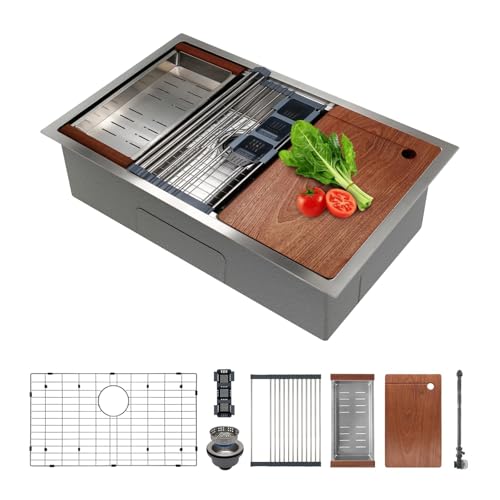
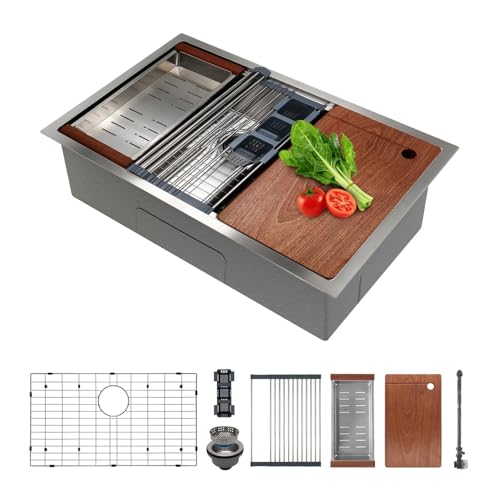
SANYCASA 30 Inch Undermount Workstation Sink, 11 Gauge
Badge: Thickest Steel
Strengths
- 11 gauge (3mm) stainless steel, far thicker than residential norms
- Integrated ledge converts the bowl into a working prep station
- Superior drain design aimed at fast, complete emptying
Trade-offs
- Sits in a higher tier than plain bowls, so value depends on workstation use
- Heavy; mounting and support must be done properly
- Ledge trims a little open bowl width compared with a plain rim
Mini spec box: Size: 30 inches. Mount: undermount. Material: stainless steel, 11 gauge (3mm). Bowl: single with integrated ledge. Style: multifunctional workstation set.
Start the gauge lesson here, because the SANYCASA makes it physical. Eleven gauge steel is 3mm thick, roughly double the substance of the thin bowls at the bottom of the market, and you feel it the moment a heavy pot lands: a low, solid note instead of a clang, and no flex under load. Dents that thin sinks collect in their first year simply have a much harder time happening here. If a sink’s price is justified by material, this is what justified looks like.
The integrated ledge completes the package. Boards and racks ride the ledge so prep, rinsing, and draining happen over the bowl, containing mess and freeing counter space. Combined with the maker’s superior drain design, the whole sink is engineered around workflow rather than appearance, which is why it anchors the top of this list despite not being the cheapest way to buy a 30 inch bowl.
The honest caveat is that both headline features reward a specific user. Occasional cooks in spacious kitchens are paying for steel thickness they will rarely challenge and a ledge they will rarely load. For them, the benchmark Kraus below is the sharper buy. For daily cooks in compact kitchens, this sink’s price buys capability no accessory can retrofit.
Best for: serious cooks who want commercial substance at home / Not suited for: light-use kitchens that do not need a workstation

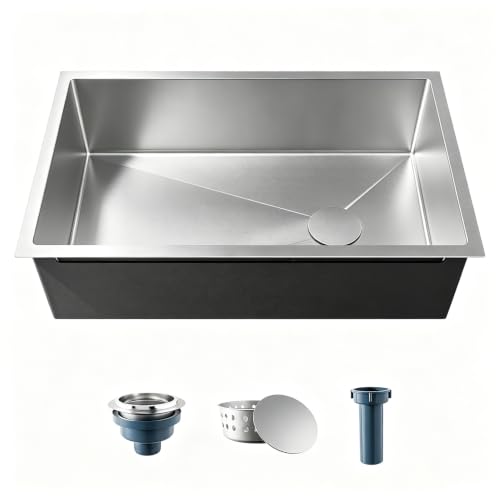
KRAUS KHU100-30 Stainless Steel 30 Inch Undermount Sink
Badge: Best Value Benchmark
Strengths
- 16 gauge TRU16 steel, the gauge experienced buyers target
- Rounded corners and channel grooves for cleaning and drainage
- NoiseDefend pads keep the bowl civilized under load
Trade-offs
- No workstation ledge
- Confirm included accessories for the configuration you order
- 30 inch bowl angles the largest pans
Mini spec box: Size: 30 inches. Mount: undermount. Material: stainless steel, 16 gauge TRU16. Bowl: single. Features: rounded corners, channel grooves, NoiseDefend pads.
Every category has a benchmark product, the one whose specification defines fair value, and in stainless sinks it is this formula: 30 inches, 16 gauge, sound pads, drainage grooves, cleanable corners. The KHU100-30 is that benchmark in physical form. When any other listing costs noticeably more, it should be able to point to a feature this sink lacks, a ledge, a bundle, a bigger bowl. When a listing costs noticeably less, it should have to admit which part of this specification it gave up.
Use it that way even if you buy something else. Compare the cozhao below and you can see its trade precisely: thinner 18 gauge steel in exchange for a lower tier and an included drain. Compare the workstations and their premium resolves into ledges and accessories. Shopping with a benchmark turns a confusing market into a set of clear, priced decisions, which is the real skill behind finding the best prices in this category.
As an ownership proposition it is equally calm: standard size, standard mount, a finish that suits any kitchen, and detailing aimed at the three daily annoyances of stainless, grime, puddles, and noise. There is very little to regret here, which is exactly what a benchmark should offer.
Best for: most kitchens, and as the comparison standard for all others / Not suited for: buyers who specifically want workstation function

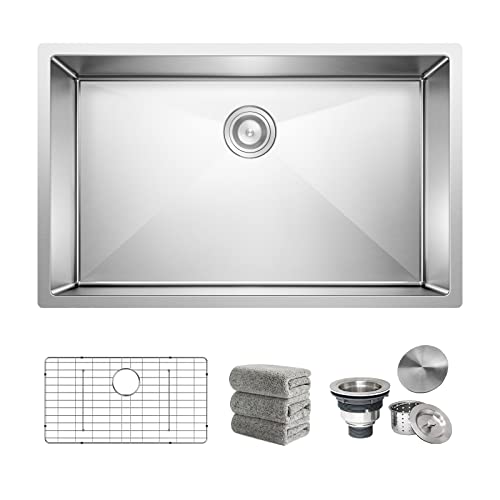
cozhao 30 Inch Undermount Kitchen Sink, 304 Stainless Steel
Badge: Best Budget Stainless
Strengths
- 304 stainless steel alloy stated plainly by the manufacturer
- Drain assembly included, so the working total stays low
- Handmade modern single bowl styling
Trade-offs
- 18 gauge steel is thinner and livelier than 16 gauge
- Protect the bowl with a grid from day one
- Fewer brand refinements than the Kraus models
Mini spec box: Size: 30 inches. Mount: undermount. Material: 304 stainless steel, 18 gauge. Bowl: single. Included: drain assembly. Style: handmade, modern.
The cozhao demonstrates the respectable way to build a budget stainless sink: keep the alloy honest at 304, accept 18 gauge steel, and include the drain assembly so the buyer is not ambushed by required extras. Plenty of listings at this end of the market hide the alloy or the gauge entirely; this one states both, which lets you make the trade with open eyes.
What does the thinner steel mean in practice? The bowl will be somewhat more prone to flex and noise, and heavy cookware deserves a grid under it. For a normal household load, plates, glasses, saucepans, the weekly pasta pot, that is a manageable compromise, especially in a refresh project where the budget is shared across the whole kitchen. The handmade modern styling also gives it a crisper look than pressed budget bowls usually manage.
Buy it as a deliberate value play, not as a benchmark-beater. If your cooking is heavy and daily, the step up to 16 gauge is the better long-term spend. If your project is a sensible refresh, a rental you maintain well, or a first kitchen, the cozhao puts real 304 stainless and a proper drain in place without drama. Buyers weighing brand-led alternatives in this size can also scan Best Quality Kitchen Sinks Moen for how brand ecosystems frame the same decision.
Best for: budget-conscious refreshes that still want honest materials / Not suited for: heavy daily cooking without a protective grid

MAYESAR 28 Inch Undermount Kitchen Sink, 16 Gauge
Badge: Best Compact Stainless
Strengths
- Full 16 gauge steel in a compact 28 inch footprint
- 9 inch deep bowl preserves working capacity
- Brushed finish and rounded corners simplify upkeep
Trade-offs
- Large pans wash at an angle in the narrower bowl
- Not a fit for wide cabinets where a bigger sink is possible
- Handmade character means subtle unit variation
Mini spec box: Size: 28 x 18 inches. Mount: undermount. Material: stainless steel, 16 gauge. Bowl: single, 9 inches deep. Finish: brushed. Corners: rounded.
Compact sinks are where weak specifications usually hide, because manufacturers assume small-kitchen buyers are captive. The MAYESAR refuses that logic: it keeps the 16 gauge steel of the full-size benchmark and uses a 9 inch depth to give the smaller bowl genuine capacity. A stock pot sits properly in this sink, which is more than many shallow compact models can claim.
The brushed finish is the right choice for the size, too. In a small kitchen the sink is always in view, and brushed steel hides the minor water marks of daily life far better than a mirror polish. Rounded corners keep the cleaning loop fast, which matters when the sink doubles as prep space, as compact-kitchen sinks always do.
On price, the MAYESAR’s value is partly what it avoids: no cabinet widening, no countertop rework, no project creep. If your cabinet accepts a 30 inch sink, buy the width. If it does not, this is the stainless to buy, full specification in a footprint that respects your kitchen as it is.
Best for: compact kitchens that refuse to compromise on steel / Not suited for: wide cabinets with room for a larger bowl

KRAUS KWU110-32 Stainless Steel 32 Inch Undermount Workstation Sink
Badge: Best Workstation Package
Strengths
- 16 gauge TRU16 steel with an integrated accessory ledge
- Cutting board and roll-up rack included in the package
- NoiseDefend soundproofing across a wide 32 inch bowl
Trade-offs
- Premium tier; the package only pays if you use the accessories
- 32 inch width needs a correspondingly wide cabinet
- Accessories need storage when they are not riding the ledge
Mini spec box: Size: 32 inches. Mount: undermount. Material: stainless steel, 16 gauge TRU16. Bowl: single with integrated ledge. Included: cutting board, roll-up rack. Features: NoiseDefend soundproofing.
The KWU110-32 is the complete workstation argument in one box. Kraus pairs the benchmark 16 gauge TRU16 build with an integrated ledge, then includes the cutting board and roll-up rack that make the ledge useful from the first day. That inclusion is the price story: workstation sinks that sell the ledge but not the tools quietly push the real cost into a second order, while this package is honest about what the full system requires.
In a working kitchen the system earns its shelf space. The board turns the sink into a chopping station with scraps falling straight into the bowl or disposal, and the roll-up rack is a draining board, a trivet, and extra counter in one rollable tool. At 32 inches the bowl still swallows the cookware that workstation cooks tend to own, so the ledge never feels like it stole the sink.
Compare it directly with the SANYCASA to see the two workstation philosophies. The SANYCASA spends its premium on extreme steel thickness; the Kraus spends its on a balanced build plus the accessories. Neither is wrong. Choose thickness if your cooking is heavy and your counters are adequate; choose the Kraus package if your counters are the constraint and you want the system complete on day one. The quality-first version of this comparison continues in Best Quality Kitchen Sinks.
Best for: counter-short kitchens wanting a complete workstation system / Not suited for: buyers who will leave the accessories in a drawer

KRAUS KHU100-32 Stainless Steel 32 Inch Undermount Sink
Badge: Best Large Classic
Strengths
- Benchmark 16 gauge TRU16 build in a wider 32 inch bowl
- Rounded corners and channel grooves scale up gracefully
- NoiseDefend pads keep a big bowl from sounding big
Trade-offs
- No ledge or included workstation accessories
- Needs a wide cabinet and cutout
- Verify grid and accessory configuration when ordering
Mini spec box: Size: 32 inches. Mount: undermount. Material: stainless steel, 16 gauge TRU16. Bowl: single. Features: rounded corners, channel grooves, NoiseDefend pads.
The KHU100-32 is the benchmark formula at family scale. Everything that makes the 30 inch version the value standard, the TRU16 steel, the cleanable corners, the grooved draining floor, the sound treatment, is present here, wrapped around a bowl wide enough to lay a sheet pan flat. For households whose cookware has outgrown a 30 inch sink, this is the straightforward, no-regrets upgrade path.
Price-wise it illustrates the healthiest pattern in the stainless market: within a manufacturer’s classic line, width costs a modest step rather than a leap. The expensive mistakes happen when buyers jump categories accidentally, paying workstation money for a plain bowl or designer money for a standard specification. Knowing the benchmark specification protects you from both errors.
It lacks only the ledge. If over-sink prep matters to you, the KWU110-32 above is the same family thinking with the workstation layer added. If you simply want a big, quiet, durable bowl that will outlast several faucets, this is the stainless classic to buy, and its plain-spoken specification is why it closes this list.
Best for: families upsizing from a 30 inch sink / Not suited for: narrow cabinets or workstation seekers
Comparison Table
| Sink | Size | Gauge | Ledge | Included extras | Link |
|---|---|---|---|---|---|
| SANYCASA Workstation | 30 in | 11 gauge (3mm) | Yes | Workstation set | Check on Amazon |
| KRAUS KHU100-30 | 30 in | 16 gauge TRU16 | No | Check configuration | Check on Amazon |
| cozhao 30 | 30 in | 18 gauge, 304 steel | No | Drain assembly | Check on Amazon |
| MAYESAR 28 | 28 x 18 in | 16 gauge | No | 9 inch deep bowl | Check on Amazon |
| KRAUS KWU110-32 | 32 in | 16 gauge TRU16 | Yes | Cutting board, roll-up rack | Check on Amazon |
| KRAUS KHU100-32 | 32 in | 16 gauge TRU16 | No | Check configuration | Check on Amazon |
How to Choose a Stainless Sink: Reading the Specification Like a Buyer
Begin with gauge and refuse to buy any stainless sink that will not state it. Sixteen gauge is the quality target for a primary kitchen: thick enough to resist dents, feel solid, and stay quiet with padding. Eighteen gauge is a legitimate budget specification when the alloy is honest and a grid will protect the bowl, as the cozhao shows. Anything thinner belongs in a laundry or utility role, not under your main faucet. At the other extreme, very thick builds like the 11 gauge SANYCASA are specialty products for cooks who genuinely challenge their equipment.
Next, confirm the alloy where it is stated. The 304 designation signals the chromium and nickel balance that gives stainless its corrosion resistance and food safety reputation. Not every good sink prints the alloy in its headline, Kraus sells its steel under the TRU16 name, but a listing that states neither gauge nor alloy is asking you to buy blind, and blind is never the best price.
Then price the system, not the bowl. Drain assembly, grid, and any workstation accessories belong in the comparison total. The KWU110-32 looks premium until you price a plain workstation plus its board and rack separately; the cozhao looks plain until you notice its drain is included. This single habit, totaling the system, eliminates most false bargains in the category.
Size and mount come next, and they are constraints rather than preferences. Measure the cabinet interior, confirm the minimum cabinet size the manufacturer states, and remember that undermount sinks need a suitable solid countertop. Within the size that fits, choose depth thoughtfully: deeper bowls contain mess and stack dishes, shallower bowls are kinder to reach into. The MAYESAR’s 9 inch depth shows the compact end of that trade done well.
Finally, weigh the soft features honestly. Sound padding matters in open-plan homes where the kitchen shares air with the living room. Channel grooves matter if you hate puddled bowls. Rounded corners matter if you are the person who cleans the sink, which is to say they matter. None of these should outrank gauge and fit, but between two sinks of equal steel and size, they are exactly where the better daily experience hides. For a professional-spec perspective beyond residential norms, Best Professional Freestanding Kitchen Sinks covers a different installation class, and Best Quality Copper Kitchen Sinks explores the main alternative material.
How to Install and Care for Stainless Steel
Undermount installation follows a strict order: template the cutout, dry-fit the bowl, seal the flange with a continuous silicone bead, and support the sink mechanically with clips, rails, or a cradle. The heavier the sink, and the workstations here are heavy, the more the support system matters, because a filled bowl is a serious load hanging under a stone edge. Let sealant cure fully, then fit the drain assembly, align the trap without sideways stress, and test every joint with a long water run and a dry paper towel.
Daily care is where stainless repays or punishes its owner. Rinse the bowl after use, wipe it dry when you can, and clean along the grain with a soft sponge and mild detergent. Never leave steel wool pads or cast iron soaking in the bowl for long periods, since both can leave marks that look like rust on the surface. Avoid harsh abrasive powders and chloride-heavy cleaners left sitting on the finish. A bottom grid is the single best care investment: it cushions impacts, keeps grit from grinding across the floor of the bowl, and makes the sink quieter in the bargain.
Water spots deserve a calm word. They are mineral deposits, not damage, and they wipe away with a soft cloth; a brushed finish like the MAYESAR’s hides them better between wipes. If your water is hard, a quick squeegee or towel pass after the evening wash-up keeps any stainless sink looking close to new, and an occasional pass with a stainless-safe cleaner restores the grain’s even tone.
Troubleshooting mini-guide. Problem: the bowl sounds loud and tinny → check that the sound pads are in place and add a bottom grid; most noise is impact energy the grid absorbs. Problem: water stands in a corner instead of draining → verify the sink was installed level, since the drainage grooves can only work with gravity’s cooperation. Problem: faint marks that look like rust appear → they are almost always surface deposits from cookware or water, and gentle cleaning with a non-abrasive stainless cleaner removes them without harming the bowl.
What Stainless Buyers Ask About Price, Answered Plainly
Why does the same-looking sink vary so much in price? Because steel is sold by weight and finishing is sold by labor. A 16 gauge bowl contains meaningfully more steel than an 18 gauge one, an 11 gauge bowl contains dramatically more, and features like ledges, grooves, pads, and included hardwood boards each add manufacturing steps. The market is more rational than it looks once the specification is visible, which is why this guide insists on verified data over photographs.
Where is it safe to save? On brand story when the specification is identical and verified, on width when your cabinet is small anyway, and on workstation features you will not use. Where is it unsafe to save? On gauge for a primary kitchen, on the drain hardware a sink requires, and on installation quality. A stainless sink is a decade-long fixture installed with sealant and plumbing; the cost of redoing a false economy dwarfs the saving that created it.
Hard Water, Soft Water, and What Your Tap Does to Stainless
Your water supply quietly shapes what a stainless sink costs you in effort. Hard water leaves mineral scale wherever droplets dry, which is why owners in hard-water regions see spotting sooner and wipe more often. The deposits are cosmetic and removable, but they reward two habits: drying the bowl after the evening wash, and choosing a brushed finish, like the MAYESAR’s, that diffuses the look of deposits between cleanings. If your home has a softener, expect the opposite experience: fewer spots, and a finish that stays close to its showroom tone with minimal attention.
Chlorides deserve a mention because they are the one household chemistry stainless genuinely dislikes. Salt residue, bleach-heavy cleaners left sitting, and even some dishwasher detergents puddled in the bowl can mark the surface if they are allowed to dwell. The defense is boring and total: rinse the bowl after use, never use the sink as a soaking tub for cleaning chemicals, and wipe up spills of salty foods rather than leaving them overnight. None of the sinks on this list needs special products to thrive; they need rinsing, which is free.
How Stainless Ages: The Ten-Year View
A stainless sink does not wear out so much as it records its life. The first year writes fine lines from sliding cookware, which settle into the soft, even patina that experienced cooks recognize as a working sink’s honest face. Quality steel takes this patina gracefully because its surface is uniform; thin or poorly finished steel records the same years as a patchwork of dull spots and stubborn marks. This is the long-game argument for buying verified gauge and finish in the first place: the sink you see in year ten is the specification you chose in week one.
Two events define most sinks’ aging. The first is the arrival of a bottom grid, early or late; early grids keep the floor’s finish close to new, while late grids merely stop the recording. The second is a change in household intensity, a baby, a teenager who cooks, a parent moving in, which suddenly doubles the bowl’s workload. Sinks bought with headroom, in gauge, depth, and width, absorb those changes without complaint. Sinks bought at the minimum announce them. When you compare prices, you are really choosing which of those futures to fund, and the difference is usually smaller than the regret.
Stainless and the Rest of the Kitchen: Finishes, Appliances, and Light
A stainless sink does not sit in a vacuum; it sits in a room full of other metals and finishes, and part of getting your money’s worth is a bowl that harmonizes instead of arguing. Brushed stainless is famously diplomatic: it echoes stainless appliances without demanding an exact match, sits calmly beside chrome faucets, and tolerates warmer metals in lighting and hardware because its tone is neutral and its texture is matte. That diplomacy is a hidden saving, because a sink that clashes with the room eventually pressures owners into changing things that were never broken.
Light plays a role too. Under-cabinet lighting rakes across a sink’s surface and reveals both its quality and its condition, which is flattering to a well-kept brushed finish and merciless to a neglected one. If your kitchen has strong task lighting over the sink, and most good kitchens do, the case for a finish that ages gracefully, and for the wipe-down habit that keeps it that way, gets stronger. The sink is the most lit work surface in the room; buy and maintain it like it will be seen, because it will be, every evening.
What to Do the Week Your New Sink Arrives
Treat the delivery week as part of the purchase. Unbox promptly and inspect the bowl under real light: rim straightness, corner finishing, and surface evenness are all visible before installation and negotiable before it, and much harder to discuss after the sink is sealed under stone. Dry-fit the drain assembly by hand to confirm the threads and parts agree, and stage the grid or accessories so the installer is never waiting on a component. Photograph the specification label for your records.
Then protect the schedule. Confirm the countertop template appointment, confirm the installer’s support plan for your specific bowl, and keep the old sink functional until the new one is truly ready to go in, because kitchens punish optimism about timelines. A household that handles this week calmly starts its relationship with the new sink the right way: as a planned upgrade, not a plumbing emergency with better marketing.
A Short History of Why Stainless Won the Kitchen
Stainless earned its dominance honestly. It arrived from commercial kitchens, where health codes and hard use eliminated almost every rival, bringing with it a set of virtues domestic buyers eventually wanted for themselves: it does not chip, it does not absorb, it tolerates heat and impact, and it can be formed into bowls of almost any geometry. The residential market then spent decades refining the commercial original for the home, adding sound padding for quiet houses, brushed finishes for living-room-adjacent kitchens, and sizes tuned to domestic cabinets. When you buy a well-specified stainless sink today, you are buying the mature end of that evolution, which is part of why the benchmark models feel so settled: the category has had a long time to learn what a kitchen sink should be.
That history also explains the market’s price spread without any mystery. The commercial original was thick, plain, and expensive in material. Residential pressure pushed in two directions at once: thinner, cheaper bowls for the budget end, and feature-rich systems, ledges, grooves, pads, bundles, for the quality end. Both directions are visible in this list, from the cozhao’s honest economy to the SANYCASA’s near-commercial mass, and knowing the history lets you place any new listing on that map within seconds of reading its specification.
Stainless Sink Myths That Distort Prices
Three myths reliably part shoppers from their money. The first says thicker is always better, full stop; in truth, gauge past the benchmark buys diminishing returns for most households, and the money is often better spent on the grid, the faucet pairing, or the installation quality that this guide keeps emphasizing. The second myth says a famous logo guarantees the specification; in truth, every brand sells a range, and the model-level data, not the badge, decides what lands under your counter. The third myth says a sink on a dramatic promotion must be a bargain; in truth, a discounted sink in the wrong size or an unstated gauge is a discounted mistake, and the discount merely reduces the cost of the lesson.
Against those myths, keep the boring virtues: read the gauge, total the system, measure the cabinet, verify the box. Stainless rewards the methodical buyer more reliably than almost any other kitchen category, because its quality is written in numbers that anyone can learn to read in an afternoon, and this list was built to teach exactly that reading.
Matching a Stainless Sink to Your Cooking Personality
End the search where it should have begun: with your own hands. The baker who lives by the sheet pan needs width before anything. The sauce maker who simmers all afternoon needs depth and a bowl that tolerates a heavy pot parked in it for hours. The weeknight sprinter needs drainage and corners that clean in seconds, because their sink is a pit stop, not a destination. The entertainer needs capacity and quiet in equal measure. Every pick on this list is the right answer to one of those personalities and a compromise for the others, and the prices only sort themselves once you know which cook is shopping. Name the cook, and the market’s fog lifts: gauge, size, and system fall into an order that no promotion can improve on.
A Note on Buying for a Household You Have Not Met Yet
Some stainless sinks are bought for kitchens whose main cook is still hypothetical: the first apartment that will later host a partner, the house that will later host children, the downsized condo that will later host grandchildren on weekends. For those purchases, versatility is the specification that matters most. A 30 inch single bowl at benchmark gauge adapts to nearly every future the kitchen might meet, which is why it recurs in this guide as the default recommendation. Specialty sizes and systems serve known needs beautifully; the classic serves unknown needs safely. When the future is genuinely unwritten, buy the sink that keeps the most futures open, and let the household, when it reveals itself, find a bowl ready for it.
The Last Filter: Your Countertop’s Opinion
Every undermount on this list ultimately answers to the countertop above it. Stone and quartz welcome these bowls and reward them with the flush, quiet installation the format promises. If your counters are solid and your cabinets measure up, the stainless decision is purely about the bowl. If either condition fails, the wisest price in this entire guide is the one you do not pay yet, while the kitchen is made ready for the sink it deserves.
Common Buying Mistakes
- Buying a stainless sink without a stated gauge or alloy, and discovering thin, lively steel after installation.
- Comparing bowl prices while ignoring drain assemblies, grids, boards, and racks that complete the system.
- Paying a workstation premium for a kitchen where nobody preps at the sink.
- Choosing width by headline dimension instead of interior bowl size and cabinet measurement.
- Cleaning stainless across the grain with abrasive pads, roughening the finish so it marks more easily forever.
- Leaving cast iron or steel wool soaking in the bowl and blaming the sink for the marks.
- Under-supporting a heavy workstation sink during undermount installation.
Final Recommendation
Measure everything against the benchmark first: the KRAUS KHU100-30 at Check on Amazon. If your kitchen is counter-short and you cook daily, choose a workstation: the complete KRAUS KWU110-32 package at Check on Amazon, or the ultra-thick SANYCASA at Check on Amazon if steel substance is your priority.
On a disciplined budget, the cozhao delivers honest 304 stainless with its drain included. In a compact cabinet, the MAYESAR keeps full 16 gauge quality at 28 inches. And for a big classic bowl, the KHU100-32 is the benchmark scaled up. Read the gauge, total the system, measure the cabinet: do those three things and the price you find will be the right one.
Frequently Asked Questions
What gauge stainless steel sink should I buy?
For a primary kitchen, 16 gauge is the widely recommended target: it balances dent resistance, quietness, weight, and price. Eighteen gauge is acceptable for lighter use and tighter budgets when the alloy is a stated 304 and a grid protects the bowl. Very thick specialty builds exist for cooks who want commercial substance, as the 11 gauge pick on this list shows.
What does 304 stainless steel mean?
It names the alloy: a chromium and nickel balance known for corrosion resistance and food safety, and the standard serious buyers look for in kitchen sinks. A manufacturer stating 304 plainly, as the cozhao does, is giving you a verifiable quality signal. Some brands use their own steel names, such as Kraus TRU16, which pairs the alloy story with a gauge commitment.
Are sound pads and drainage grooves worth paying for?
Yes, because you experience them daily. Pads like Kraus NoiseDefend deaden the drum effect of water and cookware on steel, which matters greatly in open-plan homes. Channel grooves keep the bowl draining fully instead of leaving standing water to spot and smell. Between two sinks of equal gauge, these features are a rational place for a modest premium.
Do I need a bottom grid for a stainless sink?
It is the most recommended accessory in the category. A grid cushions the bowl floor against heavy pans, prevents grit from being ground across the finish, raises dishes out of rinse water, and reduces noise. With thinner 18 gauge bowls it moves from recommended to close to essential. Factor its cost into any sink that does not include one.
Is a workstation sink worth the premium over a classic bowl?
Only if the ledge will work weekly. In counter-short kitchens, boards and racks riding the ledge add real prep space and contain mess over the bowl, which justifies the step up, especially in complete packages like the KWU110-32. In spacious kitchens where prep happens at the counter, a classic bowl like the KHU100-32 delivers the same washing experience without the extra system to store and clean.
How do I stop water spots on stainless steel?
Water spots are mineral deposits left when droplets dry, and they are cosmetic. A brushed finish hides them best, and a habit of rinsing then wiping the bowl dry after the last wash of the day prevents most of them. For buildup, use a soft cloth and a stainless-safe cleaner, always working with the grain, never across it with anything abrasive.
Can a stainless undermount sink work with any countertop?
Undermount installation needs a solid, water-resistant countertop such as stone, quartz, or solid surface, with a properly finished cutout edge and mechanical support for the bowl. Laminate countertops are generally not suitable for undermount sinks because the cut edge cannot be sealed reliably against water. Confirm your countertop material before falling for any undermount deal, however good the price looks.