Disclosure: topratedkitchenware.com is reader-supported. When you buy through links on our site, we may earn an affiliate commission from Amazon and other retailers, at no extra cost to you.
Where to buy
Quality in stainless steel is measurable, and every sink below publishes the measurements that matter. These are the best quality stainless steel kitchen sinks our audit produced: gauge, alloy or branded steel standard, sound treatment, drainage design, and included hardware, all on the record. From an 11 gauge workstation to the benchmark 16 gauge classics and a complete workstation package, these six verified undermounts define what quality means in this material. Each links to its Amazon listing for a current configuration check.
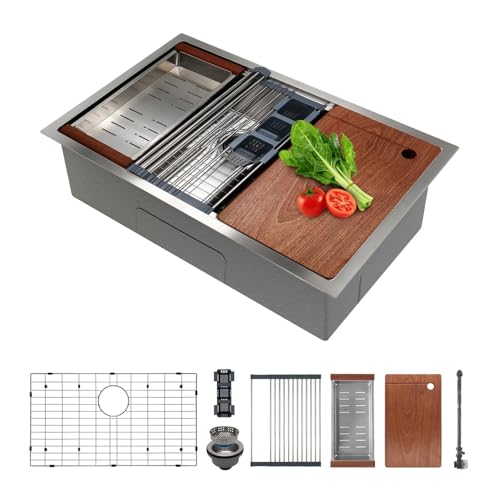
- SANYCASA 30 Inch Undermount Workstation Sink, 11 Gauge Stainless Steel
- KRAUS KHU100-30 Stainless Steel 30 Inch 16 Gauge Undermount Kitchen Sink
- cozhao 30 Inch Undermount Kitchen Sink, 18 Gauge 304 Stainless Steel
- MAYESAR 28 Inch Undermount Kitchen Sink, 16 Gauge, 9 Inch Deep
- KRAUS KWU110-32 Stainless Steel 32 Inch Undermount Workstation Sink
- KRAUS KHU100-32 Stainless Steel 32 Inch 16 Gauge Undermount Kitchen Sink
Read the full guide ↓
The best quality stainless steel kitchen sinks share a trait that has nothing to do with shine: their manufacturers publish the numbers. Gauge. Alloy. The name of the sound treatment. The accessories in the box. Stainless is an engineered material, and its quality lives entirely in those engineering decisions, in how thick the bowl is drawn, how its corners are finished, how its floor persuades water to leave, and how completely its underside is padded against the drum-skin acoustics of thin metal.
This guide reads those decisions across six verified sinks. You will meet the extremes first: a workstation drawn from 11 gauge steel that behaves more like equipment than furniture, and the 16 gauge TRU16 Kraus bowls that define the residential benchmark. You will also meet an honestly specified 304 value model, a compact sink that refuses to dilute its specification, and a workstation package whose included board and rack show what a complete quality system looks like. By the final section you will be able to audit any stainless listing in under a minute.
Key Takeaways
- Gauge is destiny in stainless: 16 gauge is the quality benchmark, 18 gauge is a lighter honest option, and 11 gauge is specialty heavy-duty territory.
- Alloy transparency matters: a stated 304 or a branded standard like TRU16 lets you verify what you are buying.
- Sound pads, channel grooves, and rounded corners are functional quality systems, not styling.
- Workstation quality includes the accessories: a ledge without its board and rack is an unfinished system.
- Compact size is no excuse for thin steel; the 28 inch pick here keeps full 16 gauge construction.
- Care is part of the specification: grain-direction cleaning and a bottom grid preserve the finish quality you paid for.
In this guide
Quick Picks
| Pick | Badge | Why it stands out | Link |
|---|---|---|---|
| SANYCASA 30 Workstation | Ultimate Steel Thickness | 11 gauge (3mm), integrated ledge, superior drain design | Check on Amazon |
| KRAUS KHU100-30 | Benchmark Quality | 16 gauge TRU16, rounded corners, channel grooves, NoiseDefend | Check on Amazon |
| cozhao 30 Inch | Honest Specification Value | 304 alloy stated, 18 gauge, drain assembly included, handmade | Check on Amazon |
| MAYESAR 28 Inch | Compact Quality Standard | 16 gauge, 9 inch deep, brushed finish, rounded corners | Check on Amazon |
| KRAUS KWU110-32 Workstation | Complete Workstation System | 16 gauge TRU16, ledge, cutting board and roll-up rack included | Check on Amazon |
| KRAUS KHU100-32 | Large Bowl Benchmark | 32 inch 16 gauge TRU16 with grooves and NoiseDefend pads | Check on Amazon |
How These Picks Were Chosen
Admission to this list required published fundamentals. Every pick states its gauge in verified manufacturer data; the alloy or steel standard is stated or branded; sound and drainage features are named systems rather than adjectives; and included hardware is itemized. That bar excluded the large population of stainless sinks whose listings substitute photography for specification, because a quality guide cannot endorse what it cannot verify.
Within that verified field, we selected for range with intent. Two gauges anchor the list, 16 as the benchmark and 11 as the heavy-duty extreme, with one honest 18 gauge model to show where a lighter specification is acceptable and why. Two formats, classic bowl and workstation, show how quality expresses itself in pure washing space versus working systems. Three sizes, 28, 30, and 32 inches, cover the cabinets real kitchens have.
The method is research-led: verified specifications, manufacturer documentation, and long-term owner feedback patterns, synthesized without any claim of laboratory testing. Each review names its sink’s limitation, because steel quality is a set of trades and a guide that hides them serves nobody. The undermount-specific companion is Best Quality Stainless Steel Undermount Kitchen Sinks, and the consumer-research angle is covered in Best Quality Stainless Steel Undermount Kitchen Sinks Consumer Report.
The 6 Best Quality Stainless Steel Kitchen Sinks
SANYCASA 30 Inch Undermount Workstation Sink, 11 Gauge
Badge: Ultimate Steel Thickness
Strengths
- 11 gauge (3mm) steel, the thickest construction in this category
- Integrated ledge for a true over-sink workstation
- Superior drain design for fast, complete drainage
Trade-offs
- Heaviest bowl here; support and handling need respect
- Premium tier positioning
- Ledge trims open bowl width slightly
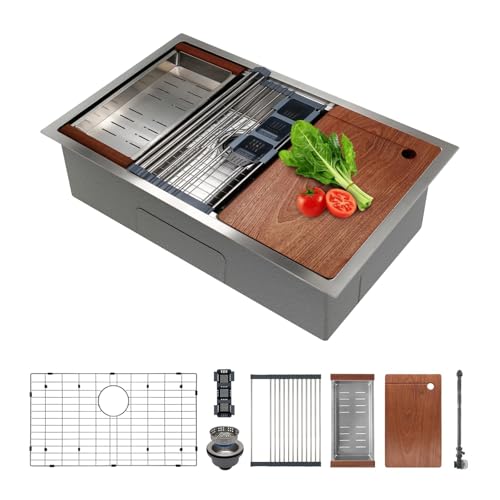
Mini spec box: Size: 30 inches. Mount: undermount. Material: stainless steel, 11 gauge (3mm). Bowl: single with integrated ledge. Style: multifunctional workstation set.
Begin with mass. At 3mm, the SANYCASA’s steel is thick enough that the usual stainless compromises recede: the bowl does not flex under a full stock pot, dropped cookware meets resistance instead of a dent, and the acoustic character is a low thud rather than a ring. This is what happens when a sink is specified like equipment, and for households whose kitchens work at near-professional intensity, it is a legitimate definition of best quality.
The workstation ledge is engineered into that mass rather than clipped onto it, so boards and racks ride a rim that shares the bowl’s solidity. Paired with a drain design the maker positions as superior, the whole product reads as a system for people who prep, cook, and clean in high volume and measure quality in decades.
The caveats are weight and necessity. Installers must support this bowl properly, and households with gentle cooking patterns will never cash the check its thickness writes. Quality maximalism is still a choice, not an obligation, and the benchmark below exists precisely for buyers who want excellence without extremity.
Best for: high-intensity kitchens wanting maximum steel / Not suited for: light-use homes or fragile install situations

KRAUS KHU100-30 Stainless Steel 30 Inch Undermount Sink
Badge: Benchmark Quality
Strengths
- 16 gauge TRU16 steel, the proven residential standard
- Rounded corners and channel grooves engineered in
- NoiseDefend sound pads across the bowl
Trade-offs
- No workstation ledge
- Confirm accessory configuration at ordering
- 30 inch bowl angles the largest pans
Mini spec box: Size: 30 inches. Mount: undermount. Material: stainless steel, 16 gauge TRU16. Bowl: single. Features: rounded corners, channel grooves, NoiseDefend pads.
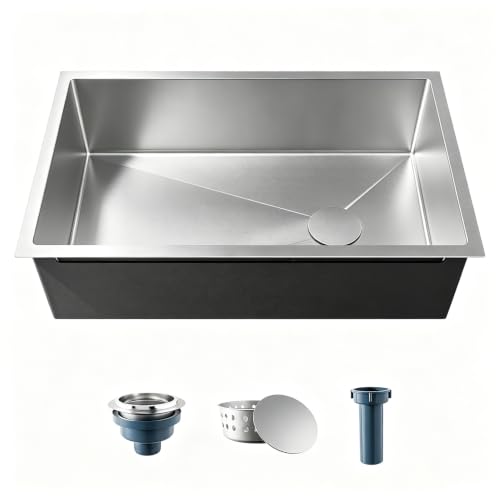
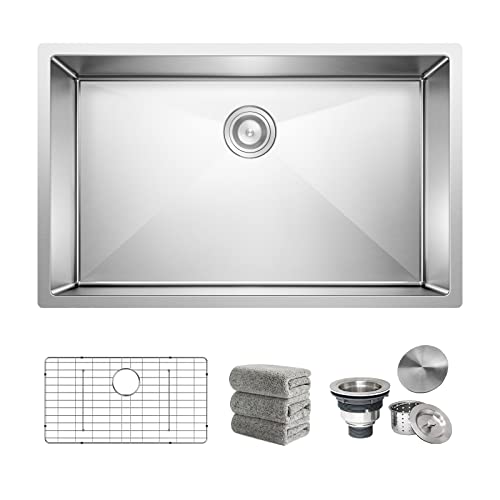
The KHU100-30 is what the benchmark looks like when a manufacturer sweats every system at once. TRU16 steel gives the bowl its dent-resistant substance. The corners are rounded so a cloth, not a brush, does the cleaning. The floor’s channel grooves keep rinse water honest, moving it to the drain instead of letting it sheet into puddles. NoiseDefend pads quiet the whole operation. Remove any one system and the sink is merely good; together they are the definition of the class.
Its 30 inch size is part of the quality story too, because it fits the standard cabinet run without forcing project changes, and a sink that installs cleanly into the kitchen as designed delivers its quality without collateral costs. For remodelers, that compatibility is worth as much as another gauge step.
Nothing here is exotic, and that is the point. Benchmark quality is the disciplined execution of known-good decisions, verified in the specification. If you buy one sink from this list without further deliberation, the deliberation-free choice is this one.
Best for: most kitchens wanting proven, complete quality / Not suited for: workstation or oversized-bowl briefs

cozhao 30 Inch Undermount Kitchen Sink, 304 Stainless Steel
Badge: Honest Specification Value
Strengths
- 304 stainless alloy published plainly
- Drain assembly included, completing the install set
- Handmade modern bowl with crisp geometry
Trade-offs
- 18 gauge steel, the lightest here
- Grid protection strongly recommended
- Fewer named feature systems than Kraus models
Mini spec box: Size: 30 inches. Mount: undermount. Material: 304 stainless steel, 18 gauge. Bowl: single. Included: drain assembly. Style: handmade, modern.
A quality list needs an honesty test case, and the cozhao passes a test many pricier listings fail: it tells you exactly what it is. The alloy is 304, the food-grade standard. The gauge is 18, stated rather than buried. The drain assembly is included, so the working purchase is complete. A buyer can respect that specification or reject it, but nobody is deceived by it, and in this market that transparency is itself a quality attribute.
The handmade construction elevates the bowl beyond its tier’s norms, with the squared, modern geometry that fabricated sinks achieve and pressed sinks approximate. In service, the correct mental model is a lighter instrument: perfectly capable for ordinary family loads, happier with a grid beneath heavy cookware, and somewhat livelier acoustically than the 16 gauge class.
Include it in a quality guide? Yes, with its brief stated plainly. Not every quality purchase is a maximum purchase; some are correct purchases, where the specification matches the household’s actual demands and the maker’s honesty lets the match be made confidently. For a refresh, a rental held to a good standard, or a first serious kitchen, the cozhao is that correct purchase.
Best for: transparent value in a standard kitchen / Not suited for: buyers seeking benchmark thickness

MAYESAR 28 Inch Undermount Kitchen Sink, 16 Gauge
Badge: Compact Quality Standard
Strengths
- Full 16 gauge construction at 28 inches
- 9 inch depth preserves genuine capacity
- Brushed finish and rounded corners for easy care
Trade-offs
- Large pans sit at an angle
- Only sensible where cabinet width requires it
- Subtle handmade variation
Mini spec box: Size: 28 x 18 inches. Mount: undermount. Material: stainless steel, 16 gauge. Bowl: single, 9 inches deep. Finish: brushed. Corners: rounded.
The MAYESAR’s quality argument is refusal: refusal to thin the steel because the sink is small, refusal to shallow the bowl because the footprint is compact. Sixteen gauge and 9 inches deep in a 28 inch undermount is a specification that respects small kitchens as real kitchens, and owners of galleys and apartments will recognize how rarely the market bothers.
Depth is doing quiet quality work here. It contains splashing during high-flow rinses, stacks a meal’s dishes without a countertop overflow, and lets a stock pot sit submerged properly. The brushed finish supports the same daily reality, softening the visibility of water marks in a sink that is perpetually on display, while rounded corners keep the cleaning pass short.
If your cabinet takes a 30 inch sink, buy the 30 inch sink; width is its own quality. But when the cabinet says 28, this is the standard to demand, and any compact alternative should have to explain why its steel is thinner or its bowl shallower than this one.
Best for: compact kitchens holding the quality line / Not suited for: cabinets with room for a larger bowl

KRAUS KWU110-32 Stainless Steel 32 Inch Undermount Workstation Sink
Badge: Complete Workstation System
Strengths
- 16 gauge TRU16 steel with integrated ledge
- Cutting board and roll-up rack included
- NoiseDefend soundproofing in a wide 32 inch bowl
Trade-offs
- System only pays when accessories are used weekly
- Wide cabinet required
- Accessories need a storage home between uses
Mini spec box: Size: 32 inches. Mount: undermount. Material: stainless steel, 16 gauge TRU16. Bowl: single with integrated ledge. Included: cutting board, roll-up rack. Features: NoiseDefend soundproofing.
Workstation quality is system quality, and the KWU110-32 is the complete-system exemplar. The foundation is benchmark-grade: TRU16 16 gauge steel and NoiseDefend soundproofing in a 32 inch bowl. The ledge is integrated, machined to carry accessories level over the bowl. And the accessories are actually in the box: a cutting board for the prep station and a roll-up rack that serves as drainer, trivet, and bonus counter. Too many workstation listings sell the rail and rent you the railway; Kraus sells the working system.
In a counter-short kitchen the daily choreography justifies it completely. Produce rinses in the rack, the board hosts the knife work with scraps sweeping into the bowl, pots drain where they were washed. The sink stops being a hole in the counter and becomes the counter’s hardest-working section, which is a quality-of-life upgrade no thicker steel alone can deliver.
Set it against the SANYCASA to see the fork in workstation philosophy: extreme material versus complete system at benchmark material. Both are defensible definitions of quality. Your kitchen’s constraint, cookware abuse or counter scarcity, should make the choice. The composite-material version of this same comparison lives in Best Quartz Kitchen Sinks.
Best for: counter-short kitchens wanting the full workstation system / Not suited for: kitchens with abundant counters and rare sink prep

KRAUS KHU100-32 Stainless Steel 32 Inch Undermount Sink
Badge: Large Bowl Benchmark
Strengths
- Benchmark systems scaled to a 32 inch bowl
- 16 gauge TRU16 steel with grooves and rounded corners
- NoiseDefend pads tame a large bowl’s acoustics
Trade-offs
- No ledge or bundled workstation accessories
- Wide cabinet and cutout required
- Verify grid configuration when ordering
Mini spec box: Size: 32 inches. Mount: undermount. Material: stainless steel, 16 gauge TRU16. Bowl: single. Features: rounded corners, channel grooves, NoiseDefend pads.
Scaling a good design is harder than it looks: widen a bowl and its floor wants to puddle, its voice wants to boom, its corners collect more of everything. The KHU100-32 holds the benchmark line at 32 inches by carrying the full system set with it: TRU16 steel for substance, channel grooves sized to move a larger bowl’s water, rounded corners that keep the bigger perimeter cleanable, and NoiseDefend treatment so family-scale cleanup does not sound like percussion practice.
For households graduating from a 30 inch sink, this is the conservative, correct upgrade: same maker philosophy, same care routine, meaningfully more room. Sheet pans lie flat, the roaster soaks without theatrics, and two cooks can share the station without a traffic jam.
It deliberately stops short of the workstation tier. If the ledge life appeals, the KWU110-32 is waiting one review up. If your brief is a big, quiet, durable bowl executed to the benchmark standard, this is the closing argument of the list and a fitting one.
Best for: families upsizing within the benchmark class / Not suited for: narrow cabinets or ledge seekers
Comparison Table
| Sink | Size | Gauge | Ledge | Quality signature | Link |
|---|---|---|---|---|---|
| SANYCASA Workstation | 30 in | 11 gauge (3mm) | Yes | Maximum steel mass | Check on Amazon |
| KRAUS KHU100-30 | 30 in | 16 gauge TRU16 | No | Benchmark systems | Check on Amazon |
| cozhao 30 | 30 in | 18 gauge, 304 | No | Stated alloy, drain included | Check on Amazon |
| MAYESAR 28 | 28 x 18 in | 16 gauge | No | Deep compact bowl | Check on Amazon |
| KRAUS KWU110-32 | 32 in | 16 gauge TRU16 | Yes | Board and rack included | Check on Amazon |
| KRAUS KHU100-32 | 32 in | 16 gauge TRU16 | No | Benchmark at scale | Check on Amazon |
How to Choose Quality Stainless: A One-Minute Audit
Audit any stainless sink in this order. One: find the gauge. Sixteen is the benchmark, 18 is a lighter budget specification, and no stated gauge is a failed audit. Two: find the alloy or steel standard. A printed 304 or a branded commitment like TRU16 means the maker is standing behind the material; silence is information too. Three: look under the bowl, figuratively, for sound treatment, because an unpadded steel bowl in an open-plan home is a daily tax on everyone’s patience.
Four: trace the water. Grooves or a properly sloped floor should promise a bowl that empties fully, and rounded corners should promise a bowl that cleans fully. Five: total the system. Drain assembly, grid, and any workstation tools belong in the comparison, because quality ownership begins with a complete installation, not a bowl and a shopping list. Six: confirm the fit, cabinet minimum, countertop suitability for undermount, and bowl interior against your largest pan. A quality sink in the wrong size is the wrong sink.
Notice what the audit never asks: how shiny the photo is, how famous the logo is, or how many adjectives the headline stacks. Stainless quality is a specification discipline, and the six sinks above pass the audit at different sizes, gauges, and system levels, which is exactly the range a useful guide should cover. For the ratings-research perspective on this category, Best Ratings For Kitchen Sinks examines how to read owner feedback without being misled by it.
How to Install and Care for Stainless So the Quality Lasts
Installation is the quality step owners control least and suffer from most when it is skimped. Template the countertop cutout from the manufacturer’s own template. Dry-fit the bowl and check the reveal. Seal the flange with a continuous bead of quality silicone. Support the sink mechanically, with clips, rails, or a cradle, sized for the heaviest load the bowl will ever hold, which for the workstations here is considerable. Plumb the drain assembly exactly as directed, align the trap without sideways stress, cure the sealant fully, and leak-test with a long water run and a dry paper towel at each joint.
Care is a short liturgy. Rinse the bowl after use. Wash with a soft sponge and mild detergent, moving along the grain, never across it with anything abrasive. Wipe dry when the day’s work is done if your water is hard, and let a bottom grid stand between the steel and your heaviest, grittiest cookware. Keep steel wool out of the bowl as a resting place, and rinse away salty or acidic residue rather than leaving it overnight. Follow that routine and a 16 gauge finish will look close to new for many years; neglect it and even the thickest steel will look tired, because finish quality is maintained, not bought once.
Troubleshooting mini-guide. Problem: water spots keep appearing → they are mineral deposits from drying droplets; wipe the bowl dry after the last rinse and use a brushed-finish-friendly cleaner for buildup. Problem: the bowl sounds louder than expected → verify the pads are intact and add a grid, which absorbs the impacts that excite the steel. Problem: faint discoloration near the drain → clean gently with a non-abrasive stainless cleaner along the grain; it is almost always surface residue, not failing steel.
Steel, Sound, and Water: The Three Quality Systems Explained
It helps to see a stainless sink as three systems sharing one bowl. The steel system is structure: gauge and alloy deciding dent resistance, solidity, and corrosion behavior. The sound system is comfort: pads and mass deciding whether cleanup is a murmur or a drum solo, a factor open-plan homes feel at full strength every evening. The water system is hygiene: floor geometry, grooves, and corner radii deciding whether the bowl empties and cleans completely or hosts puddles and grime lines. Listings that brag about one system while hiding the others are telling a partial story.
The picks here were chosen because each is honest about all three systems at its level. The SANYCASA maxes the steel system and adds a working ledge. The Kraus classics balance all three deliberately. The cozhao states its lighter steel openly and completes its water system with an included drain. The MAYESAR refuses to shrink any system with its size. Judge any future candidate the same way and the category becomes refreshingly legible.
Pressed, Handmade, and Fabricated: How Stainless Bowls Are Made
Stainless bowls reach their shape by different roads, and the road leaves fingerprints on quality. Pressed bowls are drawn from a sheet in a die, which is efficient and produces smooth, generous curves, but the drawing process stretches the steel, and the corners and floor of a deeply drawn bowl can end up thinner than the sheet it started from. Handmade or fabricated bowls are cut, folded, and welded, which preserves the sheet’s gauge through the body of the sink and produces the crisp, squared geometry visible in picks like the cozhao and the MAYESAR. Neither method is automatically superior, but they explain why two sinks with the same stated gauge can feel different in the hand, and why handmade models carry the modern, architectural look that pressed bowls approximate.
Welding and finishing are where fabricated quality is decided. A well-made handmade bowl has welds ground and blended until the corners read as one surface, with a grain direction kept consistent so light moves evenly across the steel. Poor finishing leaves visible seams and cross-grain patches that catch both light and grime. When you examine product photography, look at the corners rather than the center of the bowl; the corners are where the maker’s care, or its absence, is documented most honestly.
The Finish Question: Brushed, Satin, and Why Grain Direction Rules Your Life
Nearly every quality residential stainless sink wears a brushed or satin finish, and the choice is functional before it is aesthetic. Brushing scores the surface with thousands of fine parallel lines that scatter light, hiding the small scratches and water marks of daily service inside a texture that already contains lines. A mirror polish, by contrast, has nowhere to hide anything, which is why it belongs in showrooms more than in family kitchens. Between the picks here, the brushed finishes are the ones that will look most consistent in year five, because their texture forgives the record of use instead of publishing it.
The grain those lines create becomes your cleaning compass. Every wipe, every scrub, every restoration pass should travel with the grain, because cross-grain abrasion cuts new lines at odds with the finish and slowly turns an even surface cloudy. This single habit explains most of the difference between two identical sinks in different homes after five years. Quality, in stainless, is partly metallurgy and partly choreography, and the choreography is entirely learnable in one evening.
How to Compare Two Stainless Sinks Side by Side in the Store or on the Screen
Put two candidate listings next to each other and interrogate them in a fixed order, because order prevents the eye from being captured by photography. First the numbers: gauge, alloy or steel standard, interior bowl dimensions, depth. Then the systems: sound treatment named or absent, drainage features named or absent, corner treatment described or vague. Then the box: drain assembly, grid, boards, racks, each explicitly included or explicitly not. Then the obligations: minimum cabinet size, countertop requirements, and any installation hardware the maker expects you to supply. A sink that survives this interrogation with specifics at every step is a quality candidate; a sink that answers with adjectives is a photograph with a price.
Weight is a useful proxy when it is published, because steel is sold by mass and a heavier bowl of the same size is usually a thicker one. Handling tells the same story in person: a quality bowl feels reluctant to flex when you press its floor, its rim feels finished rather than sharp, and its underside shows padding applied with intent rather than as an afterthought. Online, the verified specification has to carry this judgment for you, which is why this guide built its entire list from published data and why you should be suspicious of any listing that asks you to guess.
Stainless in Different Kitchen Styles: Making the Material Belong
Stainless is the rare material that is native to several design languages at once. In a modern kitchen it reads as precision, especially in handmade geometry with tight corners. In a traditional kitchen it reads as the professional’s tool, a quiet utility note against warm cabinetry. In a transitional kitchen it is the bridge, metallic enough for the appliances, soft enough in a brushed finish for painted wood. The practical consequence for quality buyers is freedom: you do not have to choose between the sink that performs and the sink that belongs, because a well-specified brushed undermount belongs almost everywhere.
The one setting that asks stainless a harder question is the full farmhouse interior, where an apron front in fireclay or a hammered metal may be the design’s whole point. Even there, plenty of beloved farmhouse kitchens run a stainless undermount behind a cabinet panel front, keeping the room’s look and the material’s practicality at once. Style should arbitrate between good options; it should never be allowed to demote the specification, because the room’s photograph fades and the bowl’s daily behavior does not.
The Accessories Audit: Grids, Boards, Racks, and Strainers Ranked by Usefulness
Accessories reveal a manufacturer’s theory of ownership, and they deserve the same audit as the bowl. The bottom grid ranks first for any stainless sink: it protects the floor, quiets impacts, and creates a draining level, which is why its absence from a box should always be priced into a comparison. Workstation tools rank second where a ledge exists, with the roll-up rack the most versatile of the family, serving as drainer, trivet, and counter extension in one object that stores in a drawer, and the cutting board close behind for households that genuinely prep over the sink. The KWU110-32’s inclusion of both is the completeness standard for its class.
Strainers and drain trim rank third: unglamorous, but the drain is the sink’s hardest-working joint, and maker-matched parts fit and seal the way generic parts promise to. Decorative extras rank last and should be bought, if at all, after a month of living with the sink, when you know which gaps are real. The audit’s lesson mirrors the whole guide: usefulness that recurs weekly is quality, and everything else is inventory. Buy the bowl for its steel, the system for its tools, and let the accessories prove themselves in that order.
Disposals, Strainers, and the Drain: The Stainless Sink’s Working End
Every stainless sink in this guide ultimately answers to its drain, the hardest-working joint in the kitchen. If a garbage disposal hangs from it, the flange fit and the bowl’s rigidity around the opening matter daily, because a disposal is a vibrating, weighty appliance bolted to the thinnest decision in the sink. Thicker bowls carry that duty with less drama, one more practical reason gauge shows up in a quality audit. Confirm compatibility before installation, use the flange the disposal maker specifies, and let the installer torque and test the assembly under a full bowl of water, not an empty one.
If your household runs a strainer instead, quality lives in fit: a basket that seats flush, strains honestly, and lifts out without a wrestling match. Maker-matched drain hardware, included with picks like the cozhao or bundled completely by others in this category’s wider family, removes the guesswork from both paths. The drain is where a sink’s specification meets your plumbing’s reality, and treating it as part of the product, rather than an afterthought bought in a panic, is one of the clearest habits separating quality installations from ordinary ones.
Why This Category Rewards the Patient Perfectionist
Stainless sinks are an unusual consumer category: the product is simple, the variables are few, and every one of them is published by the honest makers. That makes the category a gift to the methodical buyer. There is no software version to chase, no compatibility ecosystem to lock into, no fashion cycle that will date a brushed bowl next year. There is only steel, geometry, sound, water, and hardware, each measurable, each comparable, each stable across a decade of service. A buyer willing to spend one focused hour with the audit in this guide can purchase with a confidence that most categories never permit at any price.
So take the hour. Lay your largest pan on the counter and measure it. Open the cabinet and measure that too. Read three specifications all the way to the gauge line. Total one complete system, bowl, drain, grid, and tools, and compare it against one other. The six sinks above will be waiting at the end of that hour, and whichever of them your measurements select, you will know exactly why it is yours, which is the deepest definition of a quality purchase this guide can offer.
Reading Owner Feedback on Stainless Sinks Without Being Mislead
Owner feedback is a river worth fishing carefully. The useful signals are specific and physical: a bowl that dented under a named pan, corners that collect a named residue, a finish that spotted in a named water condition, an installation that fought a named cabinet. Those reports, repeated across households, describe the steel and geometry you are actually buying. The noise in the river is equally recognizable: complaints about a sink being smaller than the photograph suggested, which is a measurement failure, or about water spots on any stainless whatsoever, which is a property of the material rather than the model. Read for the physics and forgive the photography, and the crowd’s experience becomes a genuine extension of the specification audit this guide is built on.
Apply the same lens in reverse when feedback glows. Praise that names a system, the grooves that keep a bowl dry, the pads that quiet a disposal, the grid that saved a finish, corroborates the engineering story in a way that five adjectives never could. Between the maker’s published numbers and the owners’ published physics, a careful buyer can know a stainless sink remarkably well before it ever meets their countertop, and that foreknowledge is the real product of a guide like this one.
One Bowl, Many Decades: A Closing Perspective on Steel
Stand back from the specifications for a moment and consider what a stainless sink actually is in a home’s life. It will likely outlast the faucet above it, the disposal below it, and possibly the countertop around it. It will host first apartments’ ramen and fiftieth anniversaries’ roasting pans with the same indifferent competence. Materials that serve that long deserve to be chosen on evidence, and steel, uniquely among sink materials, publishes its evidence in numbers anyone can learn. That is the deepest reason this guide exists in its present form: not to sell you thickness, but to hand you the literacy that makes thickness, alloy, and system legible, so the bowl you choose is the bowl you meant to choose, for all the decades it will spend proving it.
A Field Test You Can Run in Any Showroom
If you handle these sinks in person, run the same three tests on each. Press the bowl floor firmly with your palm and feel for flex. Tap the bowl wall with a knuckle and listen for the difference padding and gauge make. Slide a fingertip around a corner and judge whether a cloth would follow it cleanly. Thirty seconds per sink, no instruments required, and the ranking you form will track the specification audit in this guide closely enough to confirm that the numbers and the metal are telling the same story.
And If the Budget Forces One Compromise
Sometimes the audit ends with a budget that cannot fund every preference, and then the order of surrender matters. Give up width before gauge if your cookware tolerates it, because a narrower thick bowl outperforms a wider thin one daily. Give up the workstation before the benchmark systems, because ledges are features while drainage and quiet are foundations. Give up brand romance before everything, because the steel does not know what logo rode in on the box. Compromise in that order and the sink you install will still be, in every way that recurs daily across years of breakfasts, dinners, and celebrations in your home, a genuinely quality sink for everyone.
Common Buying Mistakes
- Buying stainless with no stated gauge and discovering thin steel after installation.
- Treating 18 gauge and 16 gauge as interchangeable in a heavy-use primary kitchen.
- Ignoring sound treatment in an open-plan home.
- Paying for a workstation ledge without confirming the accessories are included.
- Cleaning across the grain with abrasives and permanently roughening the finish.
- Under-supporting a heavy workstation bowl during undermount installation.
- Comparing headline sizes instead of interior bowl dimensions and cabinet minimums.
Final Recommendation
The benchmark is the recommendation for most buyers: the KRAUS KHU100-30 at Check on Amazon, or its 32 inch sibling at Check on Amazon when the cabinet and cookware call for width. For a complete workstation system, the KWU110-32 at Check on Amazon is the quality pick, while the SANYCASA serves buyers who define quality as maximum steel.
Compact kitchens should hold out for the MAYESAR’s full specification, and honest refreshes can choose the cozhao with confidence in its stated brief. Run the one-minute audit on anything else you consider, and buy the sink whose numbers you can verify.
Frequently Asked Questions
What gauge is best for a quality stainless steel kitchen sink?
Sixteen gauge is the established benchmark for a primary kitchen: thick enough for strong dent resistance and a solid feel, and well matched to sound padding. Eighteen gauge suits lighter use and tighter budgets when the alloy is a stated 304 and a grid protects the bowl. Specialty builds go thicker still, as the 11 gauge workstation here shows, for cooks who want commercial-grade mass.
What does TRU16 mean on a Kraus sink?
It is Kraus’s branded steel standard, pairing its stainless construction with a 16 gauge commitment, as in the KHU100-30 and KHU100-32. The practical meaning for a buyer is verification: the maker is stating the thickness class plainly rather than leaving the bowl’s substance to guesswork, which is exactly the transparency a quality audit looks for.
Why do quality stainless sinks cost more than basic ones?
Steel is bought by weight and finishing by labor. Thicker gauges use more material, sound padding and drainage grooves add manufacturing steps, rounded corner finishing takes time, and complete packages include hardware and accessories that basic bowls omit. The price gap between a verified 16 gauge system sink and an unspecified thin bowl is mostly the cost of those real differences.
How important is sound padding really?
In a closed-off kitchen, modest. In an open-plan home, where the sink shares air with dining and living space, it is one of the most felt quality features there is. Systems like NoiseDefend deaden the impact noise of water and cookware on steel. Dropping a pan into an unpadded thin bowl explains, in one second, why the padding exists.
Can a compact kitchen have a genuinely high quality sink?
Yes, and the MAYESAR on this list is the proof: 16 gauge steel, a 9 inch deep bowl, brushed finish, and rounded corners at 28 inches. Size limits bowl width, nothing more. Refuse compact models that use dimension as an excuse for thin steel or shallow bowls, because the specification does not have to shrink with the footprint.
What is the difference between a workstation sink and a regular sink?
A workstation sink has an integrated ledge along the bowl that carries accessories, cutting boards, racks, colanders, above the sink, turning it into a prep station. The KWU110-32 includes its board and roll-up rack; the SANYCASA builds its ledge into exceptionally thick steel. Regular bowls wash just as well but offer no over-sink working level, so the choice depends on counter space and cooking habits.
How do I keep a quality stainless finish looking new?
Rinse after use, clean with a soft sponge and mild detergent along the grain, wipe dry in hard-water homes, and use a bottom grid so heavy cookware and grit never grind directly on the floor of the bowl. Avoid abrasive pads and powders, and do not leave steel wool or cast iron sitting wet in the bowl for long periods. Consistency, not intensity, preserves the finish.