Disclosure: topratedkitchenware.com is reader-supported. When you buy through links on our site, we may earn an affiliate commission from Amazon and other retailers, at no extra cost to you.
Where to buy
This guide to the best ratings for kitchen sinks takes a different approach from most roundups: instead of printing scores that drift every week, it shows you which sinks earn strong owner feedback for identifiable reasons, and how to read that feedback like an analyst. Each name below links to its Amazon listing, where you can see the live feedback for yourself and check the latest price on Amazon for the exact model you are reading about.
- SANYCASA 30 Inch Undermount Workstation Sink — Best Heavy-Gauge Workstation. Best for cooks who want the thickest steel class in this list and a ledge to work on.
- KRAUS KHU100-30 30 Inch 16 Gauge Undermount Sink — Best Classic 30 Inch. Best for renovators who trust a long-running design with rounded, easy-clean corners.
- cozhao 30 Inch Handmade Undermount Sink — Best No-Frills Modern. Best for buyers who want a clean handmade look and a drain assembly in the box.
- MAYESAR 28 Inch Undermount Kitchen Sink — Best Compact Fit. Best for smaller cabinets that still deserve 16-gauge steel and a deep bowl.
- KRAUS KWU110-32 32 Inch Undermount Workstation Sink — Best Overall. Best for prep-heavy cooks who want the ledge, board and rack system.
- KRAUS KHU100-32 32 Inch 16 Gauge Undermount Sink — Best Family Classic. Best for family kitchens that want quiet, proven, easy-clean steel at full size.
Read the full guide ↓ for badges, honest trade-offs, a comparison table and a plain-English method for reading sink feedback without being misled by it.
Introduction: What “Best Ratings” Should Actually Mean for a Sink
Anyone searching for the best ratings for kitchen sinks is really asking a trust question: which sinks do owners still praise after the installation dust settles, and which ones generate the slow drip of complaints about dents, noise, standing water and finishes that give up early? This guide answers that question the honest way. It does not print fixed scores or counts, because those numbers change constantly and a figure copied into an article is stale the week it is published. Instead, it identifies the six sinks whose verified specifications line up with the things owners consistently reward — thick steel, real soundproofing, drainage that works, corners that clean easily, and complete kits that install without a second shopping trip — and it teaches you to verify the live feedback yourself on each listing.
That distinction matters more for sinks than for almost any other kitchen purchase. A sink is installed under a counter and expected to serve for a decade or more; early enthusiasm means little, while patterns in long-term feedback mean a great deal. When you read owner comments on any of these listings, read for themes rather than totals. Repeated mentions of a quiet bowl point to soundproofing doing its job. Repeated relief about easy cleaning points to corner radius and finish. Repeated frustration, when it appears in this category, usually clusters around shipping damage, installers unfamiliar with undermounts, or expectations set by photographs rather than dimensions — all three of which this guide helps you pre-empt.
All six picks below are undermount single bowls in stainless steel, spanning 28 to 32 inches, chosen because their verified specifications predict the ownership experience that strong feedback describes. If your shortlist thinking starts from construction science rather than sentiment, our explainer on Best Ratio For Kitchen Sinks Chrome Over Nickel covers the alloy side of why some steel earns its reputation, while this guide stays focused on the feedback itself: what to look for, what to discount, and which sinks give you the least to forgive.
Key Takeaways
- Read ratings for themes, not totals: repeated comments about noise, drainage and cleaning tell you more than any single score.
- The specifications that predict happy owners are consistent — heavier gauge steel, soundproofing pads, rounded corners and sloped, grooved floors.
- Complete kits earn disproportionately warm feedback because they remove second purchases and mismatched drains.
- Most sink complaints trace back to shipping, installation or wrong-size ordering — all preventable before you buy.
- Check live feedback on the listing at the moment you order; never trust a score printed in an article, including this one.
- Size honesty matters: a 28 inch bowl delights a small kitchen and frustrates a batch cook, and feedback reflects the match, not just the sink.
In this guide
Quick Picks
Six picks, six distinct jobs. The badges below are used again in the detailed reviews, so you can track a favourite from this summary straight to its full assessment, its strengths and trade-offs, and its honest limitation.
| Pick | Badge | Who it suits | Listing |
|---|---|---|---|
| SANYCASA 30 Inch Workstation Sink | Best Heavy-Gauge Workstation | Cooks who want exceptionally thick steel and an integrated ledge | Check on Amazon |
| KRAUS KHU100-30 Undermount Sink | Best Classic 30 Inch | Renovators who want proven Kraus quality in a smaller footprint | Check on Amazon |
| cozhao 30 Inch Handmade Sink | Best No-Frills Modern | Buyers who want 304 stainless, handmade lines and the drain included | Check on Amazon |
| MAYESAR 28 Inch Undermount Sink | Best Compact Fit | Smaller cabinets needing 16-gauge steel and a 9 inch deep bowl | Check on Amazon |
| KRAUS KWU110-32 Workstation Sink | Best Overall | Prep-heavy cooks who will use the ledge, board and rack daily | Check on Amazon |
| KRAUS KHU100-32 Undermount Sink | Best Family Classic | Families wanting quiet, easy-clean steel at full 32 inch size | Check on Amazon |
How These Picks Were Chosen
This guide is research-led. Every candidate was checked against its manufacturer’s verified Amazon listing, and only models whose listings confirm the core attributes of a mainstream kitchen sink search — undermount installation, a single-bowl format and stainless construction suited to daily family use — were kept as linked picks. Specifications in the reviews come from those verified listings alone; where a listing does not state a figure, the review leaves it out.
The selection then applied a feedback-prediction filter. Across sink categories, the ownership comments that age best attach to a recognisable spec pattern: steel at the heavier end of the residential range, sound treatment under the bowl, drainage engineered into the floor rather than left to a flat sheet, corners shaped for a sponge, and — where accessories matter — kits that arrive complete. Models matching that pattern were shortlisted; models whose listings were thin, contradictory or accessory-dependent without disclosure were not. The result is a list built to be verified: open any listing, read its recent owner feedback, and you should find the themes each review below predicts, from the SANYCASA’s solidity to the MAYESAR’s fit for compact cabinets.
One more honesty note: feedback volume itself skews perception. A long-running model accumulates comments across many production years, while a newer model may have a smaller but more current set. Neither is automatically better. Read the most recent stretch of comments for the current product, read the oldest stretch for durability signals, and weight detailed comments — the ones describing a specific install, pan or cleaning routine — far above one-line verdicts. Readers planning a swap rather than a new build will find the same discipline applied in Best Replacement Kitchen Sinks, where fit against an existing cutout becomes the dominant theme in owner feedback.
The 6 Picks Behind the Best Ratings for Kitchen Sinks
Each review follows the same honest pattern: what the sink is, its badge, three strengths, three trade-offs, the specifications confirmed in its verified listing, who it suits and who it does not, and a link to check the latest price on Amazon.
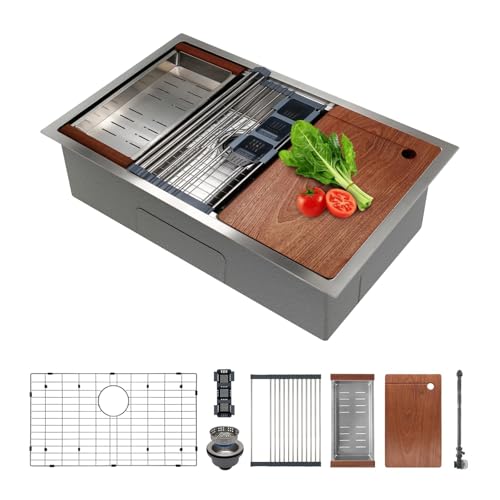
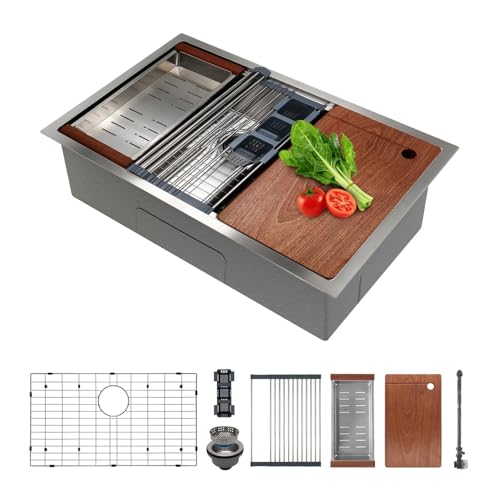
SANYCASA 30 Inch Undermount Workstation Sink
Badge: Best Heavy-Gauge Workstation
Strengths
- Listed at 11 gauge (3mm) stainless steel — substantially thicker than typical residential bowls.
- Integrated ledge makes it a multifunctional workstation for over-bowl prep.
- A superior-drain design focus addresses the standing-water complaint head-on.
Trade-offs
- Very thick steel means a heavier bowl to handle and support during installation.
- A newer name than the heritage brands here, so its long-term feedback record is still being written.
- Workstation accessories must match the ledge geometry.
Mini spec box
- Size: 30 inch undermount
- Steel: 11 gauge (3mm) stainless steel
- Design: single bowl, integrated ledge workstation
- Drainage: superior drain design
On paper, the SANYCASA makes the boldest specification claim in this list: steel listed at 11 gauge, a full 3mm, which is the territory of commercial fabrication rather than domestic sinks. Thickness is the attribute owners describe in tactile language — solidity, a muted thud, a bowl that does not flex when a full stockpot lands in it — and it is also the attribute most resistant to buyer’s remorse, because it cannot be faked by a photograph. Add the integrated ledge, which turns the bowl into a workstation in the modern pattern, and a design brief that calls out drainage as a headline feature, and you have a sink whose spec sheet reads like a direct reply to the category’s common complaints.
The balanced view is about track record rather than construction. Established brands accumulate feedback across many years and model revisions; a newer entrant asks you to weight its specification more heavily and its history less. For buyers comfortable with that trade — and the specification here is genuinely exceptional — this is the most interesting sink in the list. Its honest limitation is weight and novelty: plan the install with proper support, and read its recent feedback closely at order time, as this guide advises for every pick.
Best for: specification-led buyers who want maximum steel and a workstation ledge / Not suited for: buyers who only trust models with a decade of feedback behind them

KRAUS KHU100-30 30 Inch 16 Gauge Undermount Sink
Badge: Best Classic 30 Inch
Strengths
- 16-gauge TRU16 steel in a compact 30 inch footprint.
- Rounded corners for genuinely easy cleaning — a theme owners reward.
- Channel grooves guide water to the drain; NoiseDefend pads keep it quiet.
Trade-offs
- No workstation ledge and no bundled accessories in the listing.
- Thirty inches is a real constraint for oversized pans.
- The classic look will not satisfy zero-radius design chasers.
Mini spec box
- Size: 30 inch undermount
- Steel: 16-gauge TRU16 stainless steel
- Design: single bowl, rounded corners
- Drainage: channel grooves
- Soundproofing: NoiseDefend pads
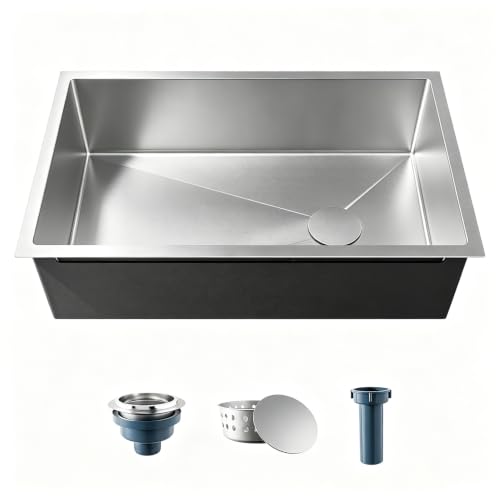
The KHU100-30 is what a safe recommendation looks like: a long-running Kraus pattern — TRU16 steel, grooved floor, rounded corners, NoiseDefend pads — executed at 30 inches for the enormous number of kitchens whose cabinets will not take a 32. Feedback for classic models like this tends to be boring in the best possible way: it installed as expected, it cleans easily, it is quiet, it still looks good. In sink ownership, boring is a five-star personality trait, because the alternatives — drama about dents, puddles and drumming — are what fill complaint sections.
Choose it when your renovation is about reliability at a sensible size, and accept its honest limitations with open eyes: there is no ledge to prep over, accessories such as a grid are separate purchases, and a truly large roasting pan will overhang. Within those bounds, this is the sink least likely to generate a regretful sentence in anyone’s feedback, which is exactly the property this guide exists to find. If your kitchen is smaller still — a galley or an RV-adjacent compact build — the themes in Best Rv Kitchen Sinks about matching bowl size to cabinet reality are worth a read before you order anything.
Best for: renovators who want proven, quiet quality at 30 inches / Not suited for: cooks who need workstation features or maximum pan room

cozhao 30 Inch Handmade Undermount Sink
Badge: Best No-Frills Modern
Strengths
- The listing states 304 stainless steel explicitly — a grade buyers can reason about.
- Handmade construction gives crisp, modern lines.
- Drain assembly is included, covering the essential connection.
Trade-offs
- 18-gauge steel is a step thinner than the 16-gauge picks here.
- No grid or other accessories are listed as included.
- Handmade corners need deliberate cleaning attention.
Mini spec box
- Size: 30 inch undermount
- Steel: 18-gauge 304 stainless steel
- Design: handmade, single bowl, modern style
- Included: drain assembly
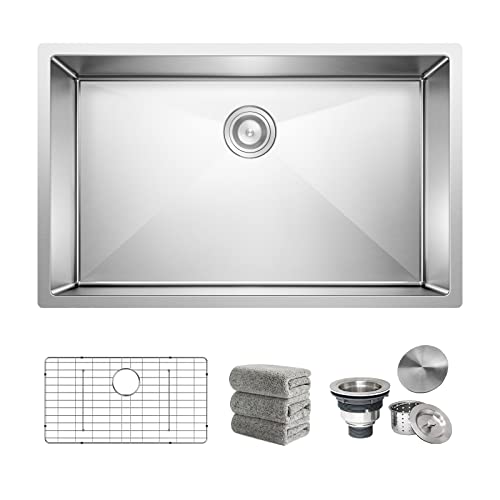
The cozhao earns its place by stating the two things a research-led buyer wants stated: the steel grade, listed plainly as 304 stainless, and the gauge, listed plainly as 18. That transparency is itself a quality signal — makers who publish checkable specifications invite the kind of scrutiny that keeps feedback honest. The handmade format delivers the squared, contemporary profile that photographs so well in modern kitchens, and the included drain assembly means the box contains the one accessory every install truly needs.
The trade-offs are the handmade category’s usual ones. Eighteen-gauge steel gives back some dent resistance and acoustic weight compared with the 16-gauge bowls here, and tighter corners collect what rounded corners shed. Neither is a defect; both are the price of the look, and owners who choose this style knowingly tend to rate it warmly precisely because the sink matches the kitchen they designed. Add a grid, keep a corner brush by the faucet, and the ownership story writes itself kindly.
Best for: modern kitchens that want a stated 304 grade and crisp handmade lines / Not suited for: buyers who prioritise the thickest steel above style

MAYESAR 28 Inch Undermount Kitchen Sink
Badge: Best Compact Fit
Strengths
- 16-gauge steel at a genuinely compact 28 x 18 inch size.
- A full 9 inch depth keeps soaking and stacking practical despite the smaller footprint.
- Rounded corners and a brushed finish are the easy-care combination.
Trade-offs
- The smallest bowl in this list — half sheets and big pans are a squeeze.
- Handmade styling means corners are tighter than the Kraus classics.
- Accessory ecosystem is thinner than the big brands’.
Mini spec box
- Size: 28 x 18 inch undermount
- Steel: 16-gauge stainless steel
- Design: single bowl, handmade, brushed finish, round corner
- Depth: 9 inch
Small sinks are where feedback turns harsh fastest, because a bowl that is too small punishes its owner at every meal. The MAYESAR avoids the usual compact-sink trap — thin steel and toy dimensions — by pairing a real 28 by 18 inch footprint with 16-gauge steel and a full 9 inch depth. That depth is the quiet hero: plates stack, a saucepan soaks without dominating the bowl, and splashing stays inside. The brushed finish and rounded corners complete an easy-care brief that suits the smaller kitchens, in-law suites and compact remodels this size exists for.
Its honest limitation is arithmetic. Twenty-eight inches will not swallow a roasting pan with handles, and a household that batch-cooks will outgrow it no matter how well it is made. Judge it, as its happiest owners clearly do, as a compact sink executed properly rather than as a small version of a big sink. For households weighing compact steel against other hard-wearing options, the durability discussion in Best Scratch Resistant Kitchen Sinks adds useful context on finishes that forgive daily use.
Best for: compact kitchens, suites and small remodels wanting real steel quality / Not suited for: batch cooks who need to soak oversized pans flat

KRAUS KWU110-32 32 Inch Undermount Workstation Sink
Badge: Best Overall
Strengths
- 16-gauge TRU16 steel with NoiseDefend soundproofing.
- Integrated ledge with cutting board and roll-up rack included.
- Full 32 inch bowl suits family cooking and big pans.
Trade-offs
- The ledge system ties accessory replacements to the same maker.
- It occupies a premium tier within this list.
- Cooks who never prep over the sink pay for a feature they will not use.
Mini spec box
- Size: 32 inch undermount
- Steel: 16-gauge TRU16 stainless steel
- Design: integrated ledge workstation, single bowl
- Included: cutting board and roll-up rack
- Soundproofing: NoiseDefend
The KWU110-32 appears in this guide for the same reason it anchors quality roundups: its specification stack — thick TRU16 steel, branded soundproofing, a workstation ledge with the board and rack in the box — maps one-to-one onto the features owners praise after months of use. Workstation feedback follows a recognisable arc: scepticism at purchase, then conversion, as chopping over the bowl, rinsing onto the rack and parking hot pans off the counter becomes the household’s default choreography. In small and medium kitchens, that reclaimed counter space is the benefit owners describe most vividly.
The counterweight is commitment. A ledge sink is a system, and its accessories are sized to it; if your household genuinely never preps at the sink, the simpler KHU100 models deliver the same steel philosophy without the ecosystem. Buy the workstation because your cooking will use it, and it will likely become the most complimented fixture in your kitchen — buy it as a novelty, and it is merely a very good bowl with furniture.
Best for: prep-heavy cooks and smaller counters that need the sink to multitask / Not suited for: buyers who want a plain bowl and no accessory system

KRAUS KHU100-32 32 Inch 16 Gauge Undermount Sink
Badge: Best Family Classic
Strengths
- 16-gauge TRU16 steel at full family size.
- Rounded corners and channel grooves make cleaning and draining effortless.
- NoiseDefend pads keep a busy family bowl civilised.
Trade-offs
- No ledge, board or rack — accessories are separate decisions.
- The classic profile is understated rather than design-forward.
- Needs the cabinet width a 32 inch bowl requires.
Mini spec box
- Size: 32 inch undermount
- Steel: 16-gauge TRU16 stainless steel
- Design: single bowl, rounded corners
- Drainage: channel grooves
- Soundproofing: NoiseDefend pads
Every category has a default recommendation — the model a knowledgeable friend names first — and in family-size stainless undermounts the KHU100-32 fills that role. Its virtues are the unglamorous ones feedback rewards year after year: steel thick enough to shrug off family cookware, corners a tired parent can clean in the dark, grooves that carry the evening’s rinse water away instead of leaving it to spot, and pads that keep the whole performance quiet enough for a sleeping house.
Nothing about it chases a trend, and that is the recommendation. If your shortlist process has become an exhausting comparison of ledges, bundles and gauges, this is the sink that lets you stop: confirm the cabinet, add a grid if your cookware is heavy, and get on with the renovation. Households browsing the wider market before deciding may enjoy the range survey in Best Selection Of Kitchen Sinks, but most who start there and value proven calm end up back at a classic like this one.
Best for: families who want the proven default in quiet, easy-clean steel / Not suited for: buyers who want workstation features or a statement design
Comparison Table
One view of all six: size, steel and the feedback theme each pick is built to earn. Use it to build a shortlist of two, then read those two detailed reviews closely.
| Pick | Size | Steel | Defining feature | Badge | Listing |
|---|---|---|---|---|---|
| SANYCASA Workstation | 30 inch | 11 gauge (3mm) | Thickest steel, integrated ledge, superior drain | Best Heavy-Gauge Workstation | Check on Amazon |
| KRAUS KHU100-30 | 30 inch | 16-gauge TRU16 | Rounded corners, grooves, NoiseDefend | Best Classic 30 Inch | Check on Amazon |
| cozhao Handmade | 30 inch | 18-gauge 304 | Stated grade, handmade lines, drain included | Best No-Frills Modern | Check on Amazon |
| MAYESAR 28 Inch | 28 x 18 inch | 16-gauge | Compact size, 9 inch depth, brushed finish | Best Compact Fit | Check on Amazon |
| KRAUS KWU110-32 | 32 inch | 16-gauge TRU16 | Workstation ledge, board and rack included | Best Overall | Check on Amazon |
| KRAUS KHU100-32 | 32 inch | 16-gauge TRU16 | Classic bowl, grooves, NoiseDefend | Best Family Classic | Check on Amazon |
How to Choose a Sink That Owners End Up Praising
Match the bowl to the cabinet and the cooking, in that order. Feedback turns negative fastest when size is wrong, and size is the one thing no quality of steel can fix. Measure the cabinet interior, respect the manufacturer’s minimum cabinet size, and then walk your largest pan to the tape measure: roasting pans with handles, not sheet pans, set the true requirement. The spread in this list — 28, 30, 32 inches — exists because American kitchens genuinely differ, and each size has a household it will delight.
Buy steel by gauge, then check the silencing. Sixteen gauge is the residential quality benchmark; the SANYCASA’s listed 11 gauge is an outlier for buyers who want solidity above all. Whatever the gauge, look for named sound treatment — pads such as NoiseDefend — because noise is the complaint owners least expect and most resent in an open-plan home. A sink you can hear through a wall will collect the kind of feedback no brand wants, and no amount of beautiful photography compensates.
Read floors and corners like an owner, not a shopper. Grooves and slope decide whether the bowl rinses itself or keeps a puddle; corner radius decides whether cleaning is a wipe or a chore. Rounded corners with a grooved floor — the Kraus classic pattern — is the combination long-term feedback rewards most consistently, while handmade square corners reward design-led buyers who accept a brush in the cleaning kit.
Count the whole kit before comparing tiers. A grid protects the floor, a drain assembly must match your plumbing, and workstation accessories only fit their own ledge. Bundles and included drains change the real comparison between two sinks at different tiers, and feedback often reflects the completeness of the box as much as the bowl itself. Decide your accessory list first; then compare sinks as total installations.
How to Install an Undermount Sink and Keep It Earning Praise
Most negative sink feedback that mentions installation is really about sequence, so here is the sequence done properly:
- Inspect the bowl on arrival, before the counter appointment — check corners and rim for shipping damage while a swap is still painless.
- Dry-fit under the cutout, agree the reveal with your fabricator, and confirm the cabinet interior clears the bowl and its clips.
- Seal with a continuous bead of quality silicone, lift the sink into place, and fit mounting hardware evenly, snugging in rotation.
- Brace the bowl from below while the sealant cures for a full day; thick steel bowls are heavy, and patience here prevents the slow sag that opens seal lines.
- Connect drain and disposal, fill the bowl to the brim, and inspect every joint dry-handed before the first real wash.
Keeping the praise coming is mostly habit. Rinse and wipe after heavy use, dry the bowl in hard-water homes, clean with the grain, and keep a grid under heavy cookware. Twice a year, look at the seal line and the connections below with a torch; five quiet minutes is the entire maintenance programme of a well-chosen stainless sink.
Troubleshooting, in the pattern that solves most calls:
- Problem: the bowl sounds hollow and loud → check that sound pads are intact beneath, and that the disposal mount is snug; both are quick under-sink fixes.
- Problem: water lingers in a corner → confirm the bowl sits level and the drain is clear; a slow drain makes even a well-sloped floor look lazy.
- Problem: fine scratches multiply in the first months → introduce or reposition the bottom grid, and switch scouring to a soft sponge used with the grain; the finish will settle into an even patina.
What Low Ratings Usually Complain About — and How These Picks Pre-Empt It
Read enough sink feedback and the complaints sort themselves into a short, predictable list. Shipping dents lead it, which is why arrival inspection appears in the install steps above and why heavier-gauge bowls — harder to dent in the first place — dominate this guide. Noise follows, answered here by named pad systems on the Kraus picks and by sheer steel mass on the SANYCASA. Standing water is third, addressed by grooved floors and a drain-focused design. Cleaning resentment is fourth, answered by rounded corners and brushed finishes. Size regret is fifth and entirely self-inflicted, which is why this guide repeats the tape-measure advice until it becomes reflex.
The pattern underneath the pattern is encouraging: almost none of the recurring complaints are about sinks wearing out. They are about mismatches — of size, of expectation, of installation care — that a careful buyer can eliminate before ordering. That is the real service a ratings-led guide can perform: not laundering scores, but converting other owners’ hindsight into your foresight.
How Feedback Changes Over a Sink’s Life
Early feedback is about arrival and installation; mature feedback is about the hundredth spaghetti night. Weight your reading accordingly. Comments written after long ownership that mention cleaning ease, quiet and an unmarked floor are the strongest evidence a listing can offer, because those are the qualities time tests. Conversely, treat breathless first-week praise of appearance as the weakest evidence — every sink in this guide is beautiful on day one. The models above were chosen because their specifications predict the mature verdict: thick steel does not get thinner, grooves do not stop draining, rounded corners do not get harder to wipe. Buy the specification, verify the sentiment live, and your own feedback in a year is likely to read like the comments that persuaded you.
A Practical Method: Scoring a Sink Listing in Ten Minutes
Here is the exact routine this guide’s researchers apply, offered so you can repeat it on any listing — including the six above — before you commit. Minute one and two go to the specification block: confirm the gauge, the dimensions, the minimum cabinet size and what is actually included in the box. If any of those four is missing or vague, treat the listing itself as a warning sign, because a maker who will not state a gauge is asking you to buy thickness on faith. Minutes three and four go to the questions section, which is where owners ask the things brochures avoid — disposal compatibility, grid availability, whether the bowl takes a standard drain — and where unanswered or evasively answered questions tell their own story.
Minutes five through seven belong to the critical comments, read deliberately rather than defensively. Sort for the detailed, specific complaints and sort them into the three buckets this guide uses: shipping, installation and mismatch. Shipping complaints are about the courier, not the sink — though a pattern of them may argue for ordering with time to spare. Installation complaints usually describe sequence errors this guide’s how-to section exists to prevent. Mismatch complaints — too small, too loud, wrong style for the kitchen — are the ones to project onto your own household honestly: if a reviewer batch-cooks in a compact bowl and hates it, and you batch-cook too, that comment is a personal warning regardless of the sink’s quality.
The final three minutes go to the positive comments, but read them as a sceptic. Praise that names a mechanism — the pads, the grooves, the grid, the ledge — is evidence; praise that names only a feeling is weather. Count mechanism-praise themes for each sink on your shortlist and you will usually find the decision makes itself: the sink whose praised mechanisms match your household’s actual pain points is your sink. This method takes ten minutes, requires no expertise, and converts the wisdom of hundreds of strangers into something close to personal experience.
Why Every Pick Here Is a Single Bowl — and What Feedback Says About That
An observant reader will notice that all six picks share a format: one large single bowl rather than a divided double. That is not an accident of the pool; it reflects where owner satisfaction in this category has concentrated. The single bowl’s feedback story is consistent — sheet pans lie flat, stockpots fit whole, a slow-cooker insert and a colander coexist — and its critics make one fair point, which is that washing and rinsing simultaneously requires a small basin or a different rhythm. Households that grew up with double bowls sometimes miss the division for the first month and then, by most accounts, stop missing it the first time a roasting pan goes in flat.
The workstation ledge, fitted to two picks here, is best understood as the single bowl’s answer to that old division: instead of splitting the bowl permanently, it layers a temporary second zone above it — board, rack, rinsing space — that appears when you prep and vanishes when you need the full bowl. Feedback for ledge systems skews enthusiastic among smaller kitchens for exactly this reason. If your household’s habits genuinely centre on a permanent wash-and-rinse split, shop the double-bowl category deliberately rather than forcing a single bowl to imitate one; but for the majority pattern of modern cooking — big pans, batch prep, a dishwasher doing the routine work — the single bowl is the format owners rate as the right default, and it is the format this guide stands behind.
Five Ways Sink Feedback Misleads — and the Antidote to Each
The showroom photograph trap. Owners occasionally rate a sink down because the delivered bowl does not gleam like the listing photography. All working stainless develops a softer, lived-in sheen; that is the material being itself, not a defect. Antidote: judge listings by their specification block, and expect your sink to look like a tool you use daily — because it is one.
The installer trap. A meaningful share of angry sink feedback describes leaks, sagging or seal failures that belong to installation, not manufacture. An undermount lives or dies by its seal, its clips and its curing patience. Antidote: separate the product from the fitting when you read, and follow the install sequence in this guide — or hire the fabricator who mounts sinks every week.
The wrong-kitchen trap. A compact bowl reviewed by a household of six tells you about arithmetic, not quality. Antidote: filter every comment through the reviewer’s household size and cooking style, and only import verdicts from kitchens that resemble yours.
The accessory trap. Some feedback praises or blames a sink for a grid, board or drain that was bought separately, expected wrongly, or never included. Antidote: read the “included” line of the verified listing — the reviews in this guide quote it exactly — and score the box, not the assumption.
The early-verdict trap. Sinks reveal themselves slowly. A finish verdict at week one and a drainage verdict at year three are different genres of evidence. Antidote: sort for longevity language — “after a year”, “still”, “daily since” — and let those comments carry the most weight in your decision, exactly as this guide weighted specification patterns that predict them.
Common Buying Mistakes
- Trusting a score printed in an article. Scores drift constantly; always verify live feedback on the listing at the moment you order.
- Reading only the happiest comments. The critical comments contain the operational truth — read them for themes you can pre-empt.
- Ordering by photograph without measuring. Size regret is the most common and most avoidable sink complaint.
- Skipping the arrival inspection. Shipping damage discovered after the counter appointment becomes your problem instead of a courier’s.
- Ignoring noise until the first disposal run. Soundproofing is decided at purchase and lived with for a decade.
- Comparing bowls without comparing boxes. Grids, drains and ledge accessories change the real value of every tier.
Final Recommendation
For the strongest all-round ownership story, start with the KRAUS KWU110-32: thick steel, real soundproofing and a workstation system owners grow to rely on. Choose the SANYCASA if maximum steel thickness is your personal definition of quality, the KHU100-30 or KHU100-32 for proven classic calm at 30 or 32 inches, the cozhao for a stated 304 grade in a handmade profile, and the MAYESAR when the cabinet, not preference, sets the size. Whichever you choose, do the final verification this guide keeps recommending: open the listing, read the recent feedback for the themes each review predicts, and check the latest price on Amazon on the day you order.
If you want a fast answer, start with one of these three and read its detailed review above: KRAUS KWU110-32 Workstation Sink, SANYCASA 30 Inch Workstation Sink, KRAUS KHU100-32 Undermount Sink. Between them they cover the most common households this guide serves, and each links to its listing so you can verify its live feedback today.
One last piece of ratings wisdom is worth carrying to every future purchase in this category: the sinks that owners praise longest are rarely the ones that dazzled them first. They are the ones that quietly removed friction — a bowl that drains itself, corners that forgive a tired evening, steel that shrugs off the dropped pan, silence where there used to be drumming. Choose for the thousandth ordinary Tuesday, verify the feedback with your own eyes, and the rating you eventually leave will sound a great deal like the ones that guided you here.
Frequently Asked Questions
Why doesn’t this guide print star scores for each sink?
Because printed scores go stale immediately and mislead more than they inform. Feedback totals shift with every new owner comment, so a number frozen into an article would quietly stop describing the product. Instead, this guide identifies the specifications that reliably produce satisfied owners and sends you to each listing to verify the current feedback yourself — a two-minute check that is worth more than any copied figure.
What should I look for when I read owner feedback on a sink listing?
Look for repeated themes in detailed comments: noise, drainage, cleaning, denting and installation. One comment is an anecdote; the same observation across many owners is data. Weight long-ownership comments most heavily, read the critical comments for problems you can pre-empt — size, shipping, install sequence — and treat appearance-only praise as background colour rather than evidence.
Which specification best predicts a sink owners stay happy with?
Steel gauge, closely followed by soundproofing. Thick steel resists the dents and flex that generate regret, and pads prevent the daily noise that wears on a household. After those two, drainage design and corner radius decide the cleaning experience, which is why the picks in this guide cluster around heavier gauges, named pad systems, grooved floors and rounded corners.
Is a workstation sink actually better, or just busier?
It is better for households that prep at the sink and merely busier for those that do not. The ledge, board and rack convert the bowl into counter space, which small and medium kitchens feel immediately. If your cooking happens entirely on the counter, a classic bowl such as the KHU100-32 delivers the same steel quality without the system — an honest either/or, not an upgrade ladder.
How much does size really matter compared with brand?
More. A correctly sized sink from a competent maker will out-satisfy a famous badge in the wrong dimensions every week of its life, because size errors are experienced at every single use. Measure the cabinet, respect the minimum cabinet size in the listing, test your largest pan against the bowl dimensions, and only then compare brands and features within the size that fits.
Should I choose a newer sink with little feedback or an older model with plenty?
Neither automatically. A long feedback history proves a design has survived contact with real kitchens across many production runs, which is genuine evidence. A newer model may carry a stronger specification — the SANYCASA’s listed 11-gauge steel in this guide is exactly that case — but asks you to lean harder on the specification and on recent comments. The balanced method is the one used here: shortlist by specification first, then let live feedback arbitrate between the finalists, weighting detailed and long-ownership comments above volume alone.
Can a heavy-gauge sink still scratch and mark?
Yes — gauge buys dent resistance and solidity, not immunity from surface marks. Stainless finishes develop fine lines with use, which a bottom grid, soft cleaning tools and a with-the-grain routine keep fine, even and largely invisible. Owners who expect this patina rate their sinks happily for years; owners promised a permanently mirror-perfect bowl are the ones who feel misled, which is why this guide sets the expectation plainly.