Disclosure: topratedkitchenware.com is reader-supported. When you buy through links on our site, we may earn an affiliate commission from Amazon and other retailers, at no extra cost to you.
Where to buy
This guide to the best replacement kitchen sinks is built for the way replacements actually happen: an old bowl is tired, cracked, stained or simply wrong for how you cook now, and the new one has to live with your existing counter, cabinet and plumbing. Each name below links to its Amazon listing, where you can confirm dimensions against your measurements and check the latest price on Amazon for the exact model you are reading about.
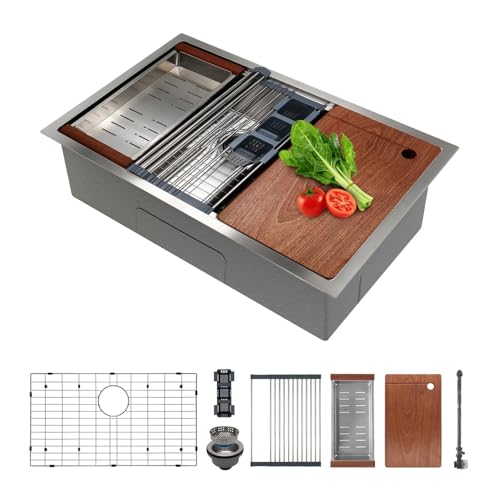
- KRAUS KWU110-32 32 Inch Undermount Workstation Sink — Best Overall Replacement. Best for upgrading a standard 32 inch opening into a full workstation.
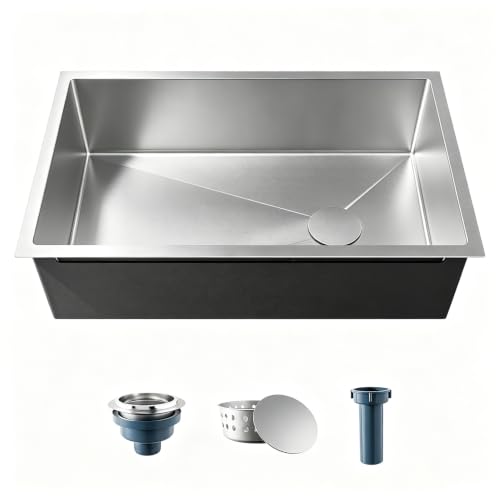
- KRAUS KHU100-32 32 Inch 16 Gauge Undermount Sink — Best Like-for-Like Classic. Best for swapping a worn family bowl for quiet, proven steel.
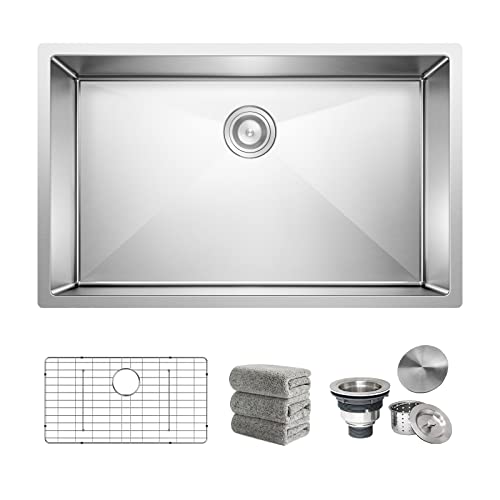
- Oxwiser 30×18 Inch Undermount Sink Bundle — Best for Smaller Cabinets. Best when the existing cabinet limits you to 30 inches and you need the full kit.
- Delironexu 30 Inch Handmade Undermount Sink — Best Lower-Tier Swap. Best for a style refresh on a tighter budget with the drain kit included.
- Oxwiser 32×18 Inch Undermount Sink Bundle — Best Complete-Kit Replacement. Best for a one-box family-size swap with grid and drain included.
- KRAUS KHU640-33 33 Inch Undermount Sink — Best Size-Up Replacement. Best when the remodel widens the cabinet run and the pans demand it.
Read the full guide ↓ for measuring instructions, badges, honest trade-offs, a comparison table and the replacement sequence that avoids the classic mid-project surprises.
Introduction: Replacing a Sink Is a Fitting Problem First, a Shopping Problem Second
The best replacement kitchen sinks are not simply the best sinks — they are the best sinks that fit the hole, cabinet and plumbing you already own. That is the mindset this guide is written in. A first-time install starts from a blank counter; a replacement starts from evidence: an existing cutout with fixed dimensions if the counter stays, a cabinet interior with fixed width and depth, a drain position that your new bowl’s drain should ideally respect, and a faucet and disposal you may be keeping. Every pick below is a stainless steel undermount single bowl in the 30 to 33 inch band where most American replacements land, and every review is written against replacement realities — what it swaps into, what it upgrades, and what it demands.
Undermount replacements carry one special truth worth stating before any shopping: if your existing sink is undermounted beneath a stone or quartz counter, the counter’s cutout is already cut, and it governs everything. A new bowl must cover that opening correctly with the reveal you want, which usually means matching or slightly exceeding the old bowl’s footprint and confirming the new model’s template against the actual hole — not against the old sink’s marketing name. If your counter is also being replaced, the constraint relaxes and the cutout is made to suit the new sink, which is the moment to consider sizing up or adding a workstation ledge. This guide covers both paths and flags which picks suit each.
All specifications quoted — dimensions, gauge, included drains and grids — come from each manufacturer’s verified listing, because in replacement work a guessed dimension is not a small error; it is a returned sink and a kitchen out of service. Measure twice with the method in the how-to section, match your numbers against the listings linked from every review, and the swap itself becomes the straightforward weekend-grade project it should be. If your replacement is happening in a compact second kitchen or a vehicle-adjacent build, the sizing discipline in Best Rv Kitchen Sinks is a useful extreme case of the same measure-first thinking.
Key Takeaways
- Measure the existing cutout, cabinet interior and drain position before shopping — those three numbers choose the sink, not the catalogue.
- If the counter stays, the new bowl must suit the existing cutout and reveal; if the counter goes, size and features open up.
- Complete bundles simplify replacements: a matched drain assembly and grid in the box remove the two most common mid-swap shopping trips.
- Heavier-gauge replacements feel like an upgrade every day — thickness, soundproofing and drainage are the improvements owners notice most.
- Keep or replace the disposal flange and drain as a deliberate decision, and check alignment before the old sink comes out.
- Inspect the new bowl on arrival while the old sink still works — a replacement discovered damaged mid-swap is a kitchen emergency.
- Photograph the old installation before disconnecting anything; those pictures are your map for reassembly, your record of the drain position, and your evidence if any part of the project is later questioned by an installer, a landlord or your own memory at midnight.
In this guide
Quick Picks
Six picks, six distinct jobs. The badges below are used again in the detailed reviews, so you can track a favourite from this summary straight to its full assessment, its strengths and trade-offs, and its honest limitation.
| Pick | Badge | Who it suits | Listing |
|---|---|---|---|
| KRAUS KWU110-32 Workstation Sink | Best Overall Replacement | Standard openings upgrading to a ledge workstation | Check on Amazon |
| KRAUS KHU100-32 Undermount Sink | Best Like-for-Like Classic | Worn 32 inch bowls replaced with quiet, proven steel | Check on Amazon |
| Oxwiser 30×18 Undermount Bundle | Best for Smaller Cabinets | 30 inch limits needing grid and drain in the box | Check on Amazon |
| Delironexu 30 Inch Handmade Sink | Best Lower-Tier Swap | Style refreshes wanting handmade lines and a drain kit | Check on Amazon |
| Oxwiser 32×18 Undermount Bundle | Best Complete-Kit Replacement | Family-size swaps wanting everything in one box | Check on Amazon |
| KRAUS KHU640-33 Undermount Sink | Best Size-Up Replacement | Remodels widening the run to a full 33 inch bowl | Check on Amazon |
How These Picks Were Chosen
This is a research-led guide. Every candidate was checked against its manufacturer’s verified Amazon listing, and only models whose listings confirm the core attributes of a mainstream replacement search — stainless steel construction, undermount installation, single-bowl kitchen format in standard residential sizes — were kept as linked picks. Dimensions, gauges and box contents in the reviews are quoted from those verified listings; where a listing does not state a figure, the review leaves it out, because replacement buying punishes invented numbers faster than any other kind.
Shortlisting then weighted the replacement virtues. Size coverage came first: the list spans 30, 32 and 33 inch bowls so that real cabinets — not idealised ones — find a match. Completeness came second, because a swap that stalls for a drain assembly or a grid turns a day project into a week of washing up in the bath; two picks here are full bundles and a third includes its drain kit. Upgrade value came third: a replacement should feel better than the sink it replaces, so gauge, soundproofing, drainage geometry and modern formats such as the workstation ledge all counted. Finally, maker depth mattered — a replacement is a decade-long commitment, and established programmes with consistent models are safer custodians of it.
What this guide cannot do is see your cutout. That part is yours, and the how-to section below turns it into a fifteen-minute measuring routine with a tape, a torch and a phone camera. Do that routine first, and the six reviews that follow become a matching exercise rather than a gamble. Readers still deciding whether the wider market holds something closer to their exact opening will find the range mapped in Best Selection Of Kitchen Sinks, though for the great majority of standard cabinets, the answer is already on this page.
The 6 Best Replacement Kitchen Sinks for Standard American Cabinets
Each review follows the same honest pattern: what the sink is, its badge, three strengths, three trade-offs, the specifications confirmed in its verified listing, who it suits and who it does not, and a link to check the latest price on Amazon.

KRAUS KWU110-32 32 Inch Undermount Workstation Sink
Badge: Best Overall Replacement
Strengths
- Upgrades a standard 32 inch opening into a workstation with ledge, board and roll-up rack included.
- 16-gauge TRU16 steel and NoiseDefend soundproofing — the two upgrades owners feel most.
- A like-size swap for many existing 32 inch undermounts when the counter is renewed.
Trade-offs
- The ledge needs its accessories; replacements come from the same maker.
- If the existing counter stays, the cutout must suit this bowl’s template — verify before ordering.
- A premium tier within this list.
Mini spec box
- Size: 32 inch undermount
- Steel: 16-gauge TRU16 stainless steel
- Design: integrated ledge workstation, single bowl
- Included: cutting board and roll-up rack
- Soundproofing: NoiseDefend
Most replacements are timid: same size, same format, newer steel. The KWU110-32 is the ambitious version — a swap that uses the disruption of replacement day to change what the sink is. If your old 32 inch bowl comes out and the counter is being renewed or the cutout verified, this workstation goes back in its place with an integrated ledge, a cutting board and a roll-up rack, converting dead bowl space into prep space your kitchen did not have before. Underneath the concept, the fundamentals are the strongest in this list: true 16-gauge TRU16 steel and NoiseDefend padding, so the new sink is quieter and more solid than the one it replaces, not merely newer.
The replacement-specific caution is templating. A workstation bowl’s rim and ledge geometry must be matched to the cutout by the fabricator, and if your counter stays, that conversation happens before ordering, with the manufacturer’s template in hand. Households replacing purely because the old bowl is worn, with no appetite for a format change, will find the classic Kraus below the calmer route. But for the common renovation pattern — new counter, standard cabinet, a cook who preps constantly — this is the replacement that makes the whole project feel worthwhile.
Best for: renovating households upgrading a standard opening into a workstation / Not suited for: like-for-like swaps under a kept counter without template verification

KRAUS KHU100-32 32 Inch 16 Gauge Undermount Sink
Badge: Best Like-for-Like Classic
Strengths
- The classic 32 inch pattern most standard cabinets and cutouts were built around.
- 16-gauge TRU16 steel with NoiseDefend pads — a clear upgrade over thin, loud old bowls.
- Rounded corners and channel grooves fix the two complaints old sinks generate most: cleaning and pooling.
Trade-offs
- No ledge and no bundled accessories; a grid is a separate, worthwhile purchase.
- Under a kept counter, confirm the template against your actual cutout.
- Understated looks — an upgrade in use, not in drama.
Mini spec box
- Size: 32 inch undermount
- Steel: 16-gauge TRU16 stainless steel
- Design: single bowl, rounded corners
- Drainage: channel grooves
- Soundproofing: NoiseDefend pads
If your old sink is a worn, thin, drumming 32 inch bowl and your goal is simply the same kitchen made noticeably better, the KHU100-32 is the replacement this guide would hand you first. It keeps the familiar footprint and single-bowl format, then upgrades everything the old sink got wrong: the steel is a full 16-gauge TRU16, the underside is padded against noise, the floor is grooved so rinse water leaves instead of loitering, and the corners are rounded so the cleaning grudge your old sharp-cornered bowl earned never forms.
Because it is a classic pattern, installers know it, fabricators have cut for it, and the swap story is as uneventful as replacement day gets. The honest limitations are appetite-based: there is no workstation system and no box of extras, so add a grid to the order if your cookware is heavy, and expect admiration for how the kitchen feels rather than how the sink photographs. In replacement buying, that trade — drama for daily ease — is usually the right one, and it is why this model anchors the middle of the list.
Best for: like-for-like 32 inch swaps that want a real quality upgrade / Not suited for: households using replacement day to change format or size

Oxwiser 30×18 Inch Undermount Sink Bundle
Badge: Best for Smaller Cabinets
Strengths
- A 30 x 18 inch footprint that fits the smaller cabinets many older kitchens actually have.
- Five-item bundle includes grid, drain assembly, drain cap and towel — no mid-swap parts hunt.
- 16-gauge steel, so the smaller replacement does not mean a flimsier one.
Trade-offs
- Thirty inches will not take oversized pans flat.
- Bundle accessories are functional grade rather than premium grade.
- Confirm your existing drain position suits a standard single-bowl layout.
Mini spec box
- Size: 30 x 18 inch undermount
- Steel: 16-gauge stainless steel
- Design: single bowl
- Included: bottom grid, drain assembly, drain cap, towel (5-item bundle)
Older homes and modest remodels often hide a constraint the catalogues ignore: the cabinet is simply not wide enough for the fashionable sizes. The Oxwiser 30×18 exists for that reality, and as a replacement it brings a second gift — completeness. The five-item bundle means the grid that protects the new floor, the drain assembly that connects it and even the cap and towel arrive together, so the swap does not pause while someone drives to a plumbing aisle with a wet cabinet and a deadline.
The steel is a proper 16 gauge, which matters doubly in a replacement: the household downsizing from a tired big-name bowl will not feel they have traded down in substance. Judge its limits honestly — a 30 inch bowl is a working compromise, and the bundled extras are there to function rather than to be admired — and for the enormous number of kitchens built around this cabinet class, it is the most sensible replacement on the page. Owners protecting a new finish from day one will appreciate the thinking in Best Scratch Resistant Kitchen Sinks, where the grid habit this bundle builds in is treated as the first rule of ownership.
Best for: smaller-cabinet replacements wanting a complete one-box swap / Not suited for: cooks who need to soak oversized pans flat

Delironexu 30 Inch Handmade Undermount Sink
Badge: Best Lower-Tier Swap
Strengths
- Handmade squared profile refreshes a dated kitchen’s look in a single swap.
- Fully stated 30 x 18 x 9 inch dimensions make cutout matching straightforward.
- Drain kit included, so the essential connection is covered.
Trade-offs
- 18-gauge steel — if your old sink was 16 gauge, know that this trades some solidity for style and tier.
- No additional accessories are included, as the listing states plainly.
- Tighter handmade corners need a brush in the cleaning kit.
Mini spec box
- Size: 30 x 18 x 9 inch undermount
- Steel: 18-gauge stainless steel
- Design: handmade, single bowl, brushed finish
- Included: drain kit (no additional accessories)
Some replacements are not about failure at all — the old sink works, but the kitchen has been repainted, re-handled and re-lit around it, and the bowl now looks like a photograph from another decade. The Delironexu is the refresh swap: a handmade, brushed, squared-profile bowl whose crisp lines modernise the sink run in one move, at a lower tier, with dimensions stated to the inch so matching it to a renewed counter or a verified cutout is a calm exercise rather than a guess.
Go in with the trade named plainly. The steel is 18 gauge, so a household replacing a heavy old bowl will hear and feel a lighter instrument; the box contains the drain kit and, honestly stated, nothing more, so a grid is a sensible companion order. For a style-led refresh in a 30 inch cabinet — a rental turnaround, a pre-sale renovation, a galley that cooks lightly — those are fair prices for the look, and the 9 inch depth keeps the bowl properly useful while it modernises the room.
Best for: style-refresh replacements in 30 inch cabinets on a tighter budget / Not suited for: households expecting a solidity upgrade over a heavy old bowl

Oxwiser 32×18 Inch Undermount Sink Bundle
Badge: Best Complete-Kit Replacement
Strengths
- Full 32 x 18 inch family size in 16-gauge steel.
- The complete five-item bundle: grid, drain assembly, drain cap and towel in the box.
- A single open bowl replaces divided old bowls with room for every pan.
Trade-offs
- No workstation ledge for over-bowl prep.
- Bundle extras are practical grade, chosen for function.
- Verify cabinet width and, under a kept counter, the cutout before ordering.
Mini spec box
- Size: 32 x 18 inch undermount
- Steel: 16-gauge stainless steel
- Design: single bowl
- Included: bottom grid, drain assembly, drain cap, towel (5-item bundle)
The family-size Oxwiser is the replacement for households whose old divided bowl has been annoying them for years: out goes the two-compartment compromise that fits no pan ever made, and in comes a single 32 by 18 inch bowl in 16-gauge steel with the whole supporting kit in the same box. The grid protects the new floor from the first dropped pan, the drain assembly matches the bowl without a compatibility hunt, and the swap reads as one purchase, one delivery, one project.
Against the Kraus classics it trades brand depth and named soundproofing for completeness and tier; against its own smaller sibling it simply adds the room family cooking uses. Its honest limitation is the absence of a ledge system, so households planning to prep over the bowl should look at the workstation at the top of this list instead. For everyone else — especially anyone whose replacement is motivated by an old bowl that is simultaneously worn, divided and undersized — this bundle is the pragmatic centre of the replacement market, and its popularity pattern is easy to understand when you compare it with the wider field in Best Selling Kitchen Sinks.
Best for: families replacing a worn divided bowl with one complete kit / Not suited for: cooks who want a workstation ledge over the bowl

KRAUS KHU640-33 33 Inch Undermount Sink
Badge: Best Size-Up Replacement
Strengths
- Thirty-three inches of single bowl — the size-up that makes roasting pans fit flat.
- Rounded corners and channel grooves keep the big bowl easy to clean and quick to drain.
- NoiseDefend pads tame the acoustics of a large steel expanse.
Trade-offs
- 18-gauge steel — a step thinner than the 16-gauge Kraus models here.
- Only viable when the remodel provides the cabinet and cutout for it; not a kept-counter swap for smaller openings.
- No ledge and no bundled accessories in the verified listing.
Mini spec box
- Size: 33 inch undermount
- Steel: 18-gauge stainless steel
- Design: single bowl, rounded corners
- Drainage: channel grooves
- Soundproofing: NoiseDefend pads
Every remodel has one moment of permission — the cabinets are out, the counter is being cut, and a bigger sink is suddenly possible. The KHU640-33 is for that moment. Thirty-three inches takes the roasting pan, the full sheet and the preserving kettle that a lifetime of standard bowls made awkward, and it does so in the classic Kraus pattern of rounded corners, grooved floor and padded underside, so the big bowl cleans and drains like a smaller one and sounds like a civilised one.
The disciplines are real. This is not a replacement for a kept counter with a smaller cutout, and its 18-gauge steel is a step lighter than the 16-gauge Kraus bowls — a grid is a wise companion, especially under preserving loads. But judged as the size-up it is designed to be, executed during the one renovation window that allows it, it converts the most common long-term kitchen complaint — the pan that never fit — into a problem the household simply no longer has.
Best for: full remodels widening the sink run for serious pan room / Not suited for: kept-counter swaps or cabinets under the required width
Comparison Table
One view of all six: size, steel and the replacement job each pick does best. Use it to build a shortlist of two, then read those two detailed reviews closely.
| Pick | Size | Steel | Defining feature | Badge | Listing |
|---|---|---|---|---|---|
| KRAUS KWU110-32 | 32 inch | 16-gauge TRU16 | Workstation ledge, board and rack included | Best Overall Replacement | Check on Amazon |
| KRAUS KHU100-32 | 32 inch | 16-gauge TRU16 | Rounded corners, grooves, NoiseDefend | Best Like-for-Like Classic | Check on Amazon |
| Oxwiser 30×18 Bundle | 30 x 18 inch | 16-gauge | Grid, drain, cap and towel included | Best for Smaller Cabinets | Check on Amazon |
| Delironexu 30 Inch | 30 x 18 x 9 inch | 18-gauge | Handmade look, drain kit included | Best Lower-Tier Swap | Check on Amazon |
| Oxwiser 32×18 Bundle | 32 x 18 inch | 16-gauge | Full kit at full family size | Best Complete-Kit Replacement | Check on Amazon |
| KRAUS KHU640-33 | 33 inch | 18-gauge | Widest bowl, rounded corners, NoiseDefend | Best Size-Up Replacement | Check on Amazon |
How to Choose a Replacement Sink That Actually Fits Your Kitchen
Decide the counter question first, because it decides everything else. Keeping the counter means the cutout is law: measure it precisely, understand your current reveal, and choose a bowl whose template the fabricator confirms against that hole. Replacing the counter means freedom — the cutout is made for the new sink — and that freedom is when sizing up to 33 inches or adopting a workstation ledge becomes sensible rather than wishful.
Measure the cabinet, not the counter. The cabinet interior must clear the new bowl’s outside dimensions plus its mounting hardware, with room for the disposal and plumbing below. Older cabinets surprise people: face frames, centre stiles and lazy-susan hardware all steal inches the brochure width promised. The manufacturer’s stated minimum cabinet size for your chosen model is the number to satisfy, verified with your own tape inside your own cabinet.
Respect the drain position. A new bowl whose drain sits close to the old one’s position reconnects with minimal plumbing surgery. Single-bowl replacements for old single bowls are usually kind; replacing a divided bowl changes the drain geometry by design, so budget the trap adjustment into the project rather than discovering it with the old sink already out.
Upgrade deliberately. A replacement is the one moment when gauge, soundproofing and drainage can all improve at once for the life of the kitchen. Moving from a thin, loud bowl to a padded 16-gauge model is the upgrade owners describe as transformative, and it costs no extra labour — the labour is identical whichever bowl goes in. Choose the bowl your next decade wants, not merely the one your last decade had. Households comparing formats beyond this shortlist will find the single-bowl case argued fully in Best Single Basin Kitchen Sinks, which is the format every pick in this guide shares.
How to Replace an Undermount Kitchen Sink, Step by Step
First, the measuring routine — do this before ordering anything:
- Photograph everything under the sink: drain position, disposal, supply lines, clips. These photos are your reassembly reference.
- Measure the existing bowl’s outside length and width, then the cutout itself if the counter is staying, and note the reveal style you have now.
- Measure the cabinet interior width and depth at the sink’s mounting height, checking for stiles, frames or hardware that intrude.
- Record the drain’s position relative to the bowl’s centre and the wall; compare it with the new model’s stated drain placement.
- Confirm the new model’s minimum cabinet size and template against all four measurements before you order.
Then the swap itself, in the order that prevents emergencies:
- Inspect the new sink on arrival — corners, rim, finish — while the old sink still works and a replacement can still be sent.
- Shut off the water, disconnect supplies, disposal and drain, and support the old bowl before releasing its clips; undermount bowls are heavier than they look.
- Clean the counter’s underside and mating surface completely; old sealant residue is the enemy of the new seal.
- Dry-fit the new bowl, confirm the reveal, then seal with a continuous silicone bead, clip evenly in rotation, and brace from below for a full day’s cure.
- Reconnect drain and disposal — a new drain assembly from a bundle removes the flange-matching guesswork — fill the bowl to the brim, and inspect every joint with a dry hand before normal use resumes.
Troubleshooting, in the pattern that solves most calls:
- Problem: the new bowl rocks or sits unevenly → old sealant or debris remains on the mating surface, or clips were tightened one side at a time; reseat on a clean surface, snugging in rotation.
- Problem: a slow leak appears at the drain days later → the flange seal or the disposal mount needs reseating; dry everything, remake the joint with fresh sealant, and retest with a full bowl.
- Problem: the disposal vibrates more than before → check its mounting ring is fully locked and that the new bowl’s drain alignment is not straining the connection; correct alignment first, then judge the vibration.
Replacement Scenarios: Matching the Pick to the Project
The worn-out workhorse. The old bowl is dented, loud and stained at the corners, the counter is staying and the cabinet is standard. This is the KHU100-32’s home ground — same footprint class, every weakness answered. The tired rental or pre-sale refresh. The kitchen needs to look current quickly and the budget is real: the Delironexu’s handmade profile modernises the run at a lower tier, or an Oxwiser bundle adds the “everything new in the box” confidence buyers notice. The growing family. The divided bowl no longer fits the cooking: the Oxwiser 32×18 bundle converts it to one big, protected, complete bowl in a single purchase. The full renovation. Counters and cabinets are open: that is the workstation’s moment, or the 33 inch size-up if pans rule your cooking. Naming your scenario honestly is the fastest route through this list — replacements fail when a household buys for the project it wishes it were doing instead of the one on the calendar.
Working With the Counter and Cabinet You Already Have
A kept stone or quartz counter is an asset worth planning around. Its cutout was polished for the old bowl’s reveal, and a replacement in the same size class with a compatible rim will sit in it beautifully; your fabricator can confirm template compatibility from the manufacturer’s drawings before you spend anything. What a kept counter cannot do is shrink or grow its hole cheaply — resizing a stone cutout in place is specialist work with real risk — so kept-counter projects should shortlist by fit first and features second, exactly as this guide’s 30 and 32 inch picks allow.
Cabinets deserve the same respect. A replacement bowl a half-inch too ambitious for the cabinet turns installation day into carpentry day, and plumbing that must move costs more than plumbing that reconnects. The picks here were chosen inside the standard residential envelope precisely so that most real cabinets — including the older, narrower ones the Oxwiser 30×18 serves — find a match without structural persuasion. Measure honestly, choose inside your numbers, and the replacement stays the satisfying upgrade it should be rather than becoming the renovation’s problem chapter.
What to Keep, What to Retire: The Parts Around the Bowl
A sink replacement is also an audit of everything attached to the old bowl, and deciding each item in advance keeps project day calm. The faucet usually survives: check its reach against the new bowl’s depth and width — a deeper or wider bowl may want a pull-down spray to reach its corners — and replace its supply lines while access is easy, because lines are cheap and leaks are not. The garbage disposal usually survives too, but its mounting assembly should be inspected honestly; a corroded or wobbling mount transplanted under a new bowl imports the old kitchen’s problems into the new one. The drain assembly is the item this guide retires by default: it is the hardest-working seal in the system, it is inexpensive relative to the project, and two of the picks here include a new one matched to the bowl, which removes the decision entirely.
The old bowl itself has a few honourable exits. Stainless steel is recyclable, and scrap yards accept sinks readily; a bowl in genuinely good cosmetic shape can serve a utility room, a workshop or a donation channel that outfits community kitchens. What it should not do is linger in the garage as a monument to indecision while its cabinet successor does the work. Photograph the old installation before removal — those pictures, taken for the reassembly reference described in the measuring routine, double as the record that lets you answer any future question about what was there and how it was plumbed.
The First Month With the New Bowl
Replacement owners judge their project in the first month, and the pattern of that month is worth knowing in advance. Week one is comparison week: every rinse is measured against the old sink, and the upgrades this guide prioritised — the silence of pads, the solidity of gauge, the disappearance of standing water — announce themselves immediately and pleasantly. This is also the week to run the honest tests: fill the bowl and check the joints below one more time, run the disposal under load, and confirm the seal line is dry and even all the way around.
Weeks two to four are habit formation. A bottom grid, if your pick included or received one, becomes invisible infrastructure. The wipe-down rhythm establishes itself, especially in hard-water homes. If the replacement changed your format — a divided bowl become single, a plain bowl become a workstation — this is when the new choreography stops feeling new: pans lie flat without the old mental calculation, or the ledge board becomes the default chopping place because it is simply the most convenient surface in the room. A replacement chosen by measurement and installed by sequence reaches the end of its first month as the kitchen’s new normal, which is the entire ambition of the project — and the standard against which the picks in this guide were chosen.
Common Buying Mistakes
- Shopping before measuring. Cutout, cabinet and drain position choose the sink; the catalogue merely nominates candidates.
- Assuming same nominal size means same fit. Templates and rim geometry vary between makers — verify against the actual cutout.
- Ordering before the new bowl can be inspected. Discover damage while the old sink still works, never mid-swap.
- Forgetting the drain and disposal plan. Flanges, assemblies and alignment are decisions, and bundles make two of them for you.
- Replacing like with like when the old sink’s flaws were the point. Use the swap to fix gauge, noise and drainage, not just the date of manufacture.
- Skipping the cure time. A bowl loaded and plumbed before its seal sets is a slow leak with good PR.
Final Recommendation
Start where your project starts. If the counter is renewed and the cabinet is standard, the KRAUS KWU110-32 turns replacement day into a genuine upgrade — workstation, thick steel, quiet bowl. If the swap is like-for-like under a kept counter, the KHU100-32 is the calm, proven answer, subject to the template check every kept-counter project owes itself. Smaller cabinets point to the Oxwiser 30×18 bundle; families escaping a divided bowl point to its 32 inch sibling; style refreshes on a budget point to the Delironexu; and full remodels with pan ambitions point to the 33 inch KHU640-33. In every case: measure first, inspect on arrival, and let the install sequence — not optimism — set the pace.
If you want a fast answer, start with one of these three and read its detailed review above: KRAUS KWU110-32 Workstation Sink, KRAUS KHU100-32 Undermount Sink, Oxwiser 32×18 Undermount Bundle. Between them they cover the upgrade, the classic swap and the complete-kit routes, and each links to its listing so you can check dimensions and the latest price on Amazon today.
Above all, remember what makes replacement buying different from every other purchase in the kitchen: the room itself grades your homework. A sink chosen against real measurements, real cabinet limits and a real drain position installs cleanly, seals once and serves for years, while a sink chosen from a photograph spends its life reminding you of the tape measure you skipped. Your old bowl has already taught you what your household needs — a little more room, a little less noise, corners that forgive — so let it have the last word, choose its successor accordingly, and enjoy the rare renovation project that finishes exactly when it promised to, with the kitchen back in service and the new bowl already feeling like it was always there.
Frequently Asked Questions
Can I replace an undermount sink without replacing the countertop?
Often, yes — provided the new bowl suits the existing cutout. The replacement must cover the opening correctly with an acceptable reveal, which generally means staying in the same size class and having a fabricator confirm the new model’s template against your actual cutout before you order. If the match works, the counter stays, the swap is contained, and only the plumbing below is disturbed.
How do I know what size replacement sink I need?
Measure three things: the existing bowl’s outside dimensions, the cutout itself if the counter stays, and the cabinet interior at mounting height. Then compare those numbers with the new model’s stated dimensions and minimum cabinet size in its listing. The picks in this guide span 30, 32 and 33 inches because those cover the great majority of standard American cabinets — one of your three measurements will tell you which band you are in.
Should I replace the drain assembly and disposal flange too?
Replacing the drain assembly with the sink is usually wise — seals age, finishes mismatch, and a fresh assembly guarantees compatibility with the new bowl. That is why the bundle picks in this guide, which include the drain assembly, simplify replacements so effectively. A disposal can usually be kept, but its flange and mounting should be inspected and reseated carefully during the swap.
Can I change from a double bowl to a single bowl when I replace?
Yes, and it is one of the most popular replacement upgrades — every pick in this guide is a single bowl for exactly that reason. The work involved is plumbing rather than carpentry: the drain position changes when two bowls become one, so the trap arrangement below needs adjusting. Under a renewed counter the cutout is simply made for the new bowl; under a kept counter, template verification matters even more.
How long should a replacement take from old sink out to new sink in?
The physical swap is measured in hours, but the honest project includes a full day of sealant curing with the bowl braced before plumbing is loaded and used. Plan the kitchen around that cure — a day of washing up elsewhere — rather than rushing it, because a seal disturbed early is the most common cause of the slow leaks that appear weeks later.
My old sink is a drop-in. Can I switch to an undermount as a replacement?
Only with counter work, and often only with a new counter. A drop-in’s cutout is typically larger and rougher than an undermount’s polished opening, and laminate counters — the most common drop-in partners — are poor candidates for undermounting because their substrate dislikes moisture at the exposed edge. If your renovation already includes a stone, quartz or solid-surface counter, the switch is straightforward and every pick in this guide becomes available to you. If the counter stays, a quality drop-in replacement is the honest route, and the measuring discipline in this guide applies to it unchanged.
Is it worth upgrading gauge and soundproofing during a replacement?
It is the best-value upgrade in the whole project, because the labour is identical whichever bowl you install. Moving from a thin, unpadded bowl to a 16-gauge, soundproofed model changes the kitchen’s daily feel — quieter, more solid, easier to drain and clean — for the entire life of the installation. If budget forces a choice, put the money in the bowl’s steel and pads before any accessory.