Disclosure: topratedkitchenware.com is reader-supported. When you buy through links on our site, we may earn an affiliate commission from Amazon and other retailers, at no extra cost to you.
Where to buy
This guide to the best selection of kitchen sinks is built the way a good showroom is built: a deliberate range — two materials, three formats and sizes from compact to full family width — so you can compare real alternatives side by side instead of scrolling an endless wall of near-identical bowls. Each name below links to its Amazon listing, where you can confirm the verified specifications and check the latest price on Amazon for the exact model you are reading about.
- Miuara 30 Inch White Fireclay Farmhouse Sink — Best Farmhouse Selection. Best for kitchens that want a glazed apron-front bowl with rated resistances.
- Miuara 33 Inch White Fireclay Farmhouse Sink — Best Large Farmhouse. Best for wide farmhouse runs that need the resistant surface at full size.
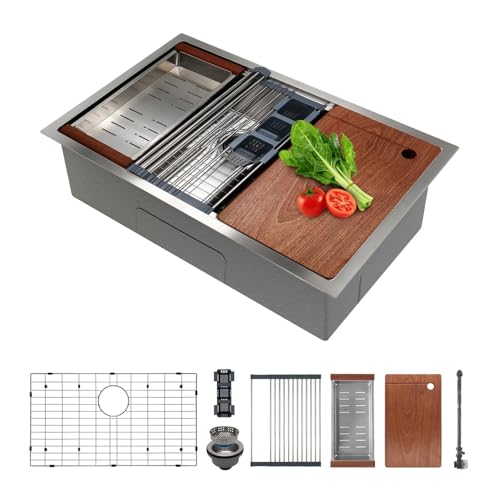
- SANYCASA 30 Inch Undermount Workstation Sink — Best Workstation Selection. Best for cooks who want exceptionally thick steel and an integrated ledge.
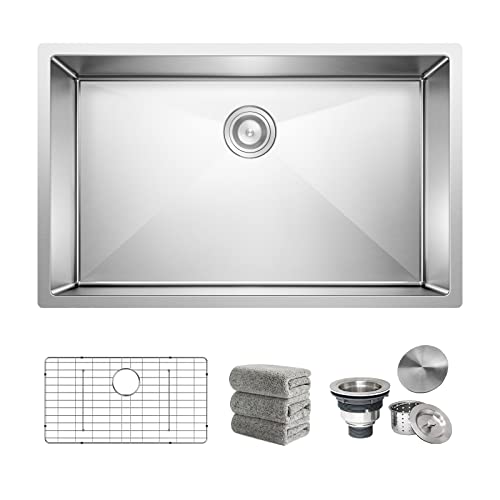
- KRAUS KHU100-30 30 Inch 16 Gauge Undermount Sink — Best Classic Undermount. Best for renovators who want proven, quiet, easy-clean steel.
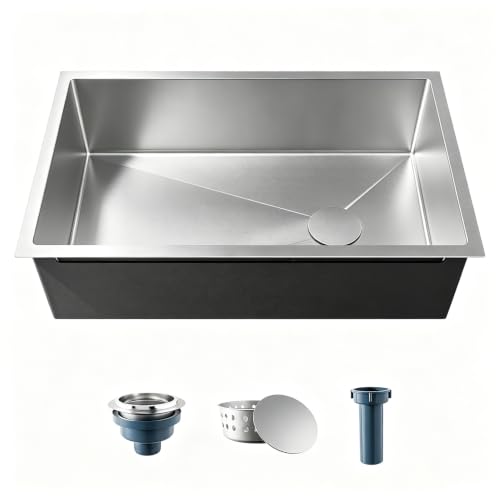
- cozhao 30 Inch Handmade Undermount Sink — Best Modern Handmade. Best for contemporary kitchens wanting a stated 304 grade and crisp lines.
- MAYESAR 28 Inch Undermount Kitchen Sink — Best Compact Selection. Best for smaller cabinets that still deserve 16-gauge steel and real depth.
Read the full guide ↓ for badges, honest trade-offs, a comparison table and a method for browsing any sink selection — this one or a showroom’s — without drowning in it.
Introduction: How to Shop a Selection Without Being Shopped by It
The best selection of kitchen sinks is not the biggest one; it is the one organised around the decisions a buyer actually has to make. Material first — the warmth and permanence of glazed fireclay against the toughness and repairability of stainless steel. Format second — an apron-front farmhouse statement, a disappearing undermount bowl, or a workstation that turns the sink into counter space. Size third — the honest arithmetic of your cabinet and your largest pan, which in this selection runs from a compact 28 inches to a full 33. A selection that spans those axes with quality at every point, as this one does, lets a household find its sink by elimination rather than by exhaustion.
That is the spirit in which these six were assembled. Two fireclay farmhouse bowls cover the glazed-material route at the two sizes farmhouse kitchens actually use. Four stainless undermounts cover the steel route in its main dialects: the heavy-gauge workstation, the classic rounded-corner bowl, the modern handmade profile with a stated grade, and the compact deep bowl for smaller cabinets. Every specification quoted comes from the manufacturer’s verified listing — dimensions, gauges, stated resistances, included parts — because a selection is only useful if its entries can be trusted at face value while you compare them.
Use the guide in the order the decisions come. Read the material comparison in the buying-guide layer and settle fireclay versus steel. Then read the two or three reviews inside your material, at your size, and let the badges point you: workstation or classic, handmade or compact. The rest of the apparatus — the comparison table, the install and care guidance, the mistakes list — exists to protect that shortlist from the two classic selection errors: buying the beautiful bowl that does not fit, and buying the fitting bowl whose daily behaviour you will dislike for a decade. Readers browsing an even wider field, including regional showrooms such as those surveyed in Best Selection Of Kitchen Sinks Portland, can carry the same three-decision method with them; it scales from six sinks to six hundred.
Key Takeaways
- Shop a selection by decisions, not by scrolling: material, then format, then size — in that order.
- This selection spans glazed fireclay and stainless steel, farmhouse and undermount formats, and 28 to 33 inch sizes.
- Fireclay offers a hard, rated-resistant surface and a style anchor; steel offers toughness, lighter weight and format variety.
- Within steel, the dialects matter: workstation ledge, classic rounded corners, handmade profile, compact depth.
- Every entry here is a single bowl — the format modern cooking, with its sheet pans and stockpots, keeps choosing.
- Verify each finalist against your cabinet’s measured interior and its maker’s minimum cabinet size before ordering.
In this guide
Quick Picks
Six picks, six distinct jobs. The badges below are used again in the detailed reviews, so you can track a favourite from this summary straight to its full assessment, its strengths and trade-offs, and its honest limitation.
| Pick | Badge | Who it suits | Listing |
|---|---|---|---|
| Miuara 30 Inch Fireclay Farmhouse Sink | Best Farmhouse Selection | Kitchens wanting a glazed apron-front bowl with rated resistances | Check on Amazon |
| Miuara 33 Inch Fireclay Farmhouse Sink | Best Large Farmhouse | Wide farmhouse runs needing the resistant glaze at 33 inches | Check on Amazon |
| SANYCASA 30 Inch Workstation Sink | Best Workstation Selection | Cooks wanting 11-gauge-class steel and an integrated ledge | Check on Amazon |
| KRAUS KHU100-30 Undermount Sink | Best Classic Undermount | Renovators wanting proven, quiet, grooved and rounded steel | Check on Amazon |
| cozhao 30 Inch Handmade Sink | Best Modern Handmade | Contemporary kitchens wanting a stated 304 grade, drain included | Check on Amazon |
| MAYESAR 28 Inch Undermount Sink | Best Compact Selection | Smaller cabinets wanting 16-gauge steel and a 9 inch depth | Check on Amazon |
How These Picks Were Chosen
This is a research-led selection, assembled from verified listings. Every candidate’s Amazon listing was checked, and only models whose listings confirm their core attributes — material, format, dimensions and construction — were kept as linked entries. Specifications in the reviews are quoted from that verified data alone; where a listing does not state a figure, the review omits it rather than filling the gap with a plausible guess, because a selection built on guesses misleads at exactly the moment of comparison.
Curation then followed the three-decision structure of the introduction. Material coverage was required to be real, not token: the fireclay entries carry their maker’s explicit resistance ratings and reversible farmhouse formats, while the steel entries span the category’s genuine variety rather than repeating one pattern four times. Size coverage was required to match American cabinets as they exist — 28 inches for the compact end, 30 as the versatile middle, 33 at the farmhouse top — with the workstation and classic bowls holding the centre where most households land. Format coverage completed the brief: apron-front, undermount, workstation-ledge and handmade profiles all appear, so the selection can actually arbitrate the choices buyers bring to it.
What was excluded matters as much. Divided double bowls do not appear, because the single-bowl format — argued fully in Best Single Basin Kitchen Sinks — is where this category’s satisfaction has concentrated, and a curated selection should say so rather than pad itself with the format fewer kitchens now choose. Exotic materials without verified listings behind them were likewise left out. The result is six sinks that can be compared honestly in an afternoon, which is what a selection is for.
The 6 Sinks in This Best Selection of Kitchen Sinks
Each review follows the same honest pattern: what the sink is, its badge, three strengths, three trade-offs, the specifications confirmed in its verified listing, who it suits and who it does not, and a link to check the latest price on Amazon.
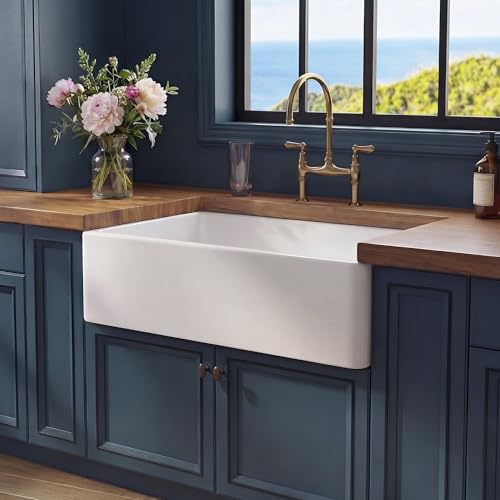
Miuara 30 Inch White Fireclay Farmhouse Sink
Badge: Best Farmhouse Selection
Strengths
- Fireclay surface rated by its maker as resistant to stain, crack, heat and scratch.
- Reversible single bowl lets the apron presentation be chosen at installation.
- Fitting flexibility across apron-front and drop-in (undermount) presentations, per the listing.
Trade-offs
- Fireclay is heavy — cabinet support must be planned, not assumed.
- A hard glaze can chip under a severe point impact where steel would dent.
- The apron front is a style commitment for the whole kitchen.
Mini spec box
- Size: 30 x 18 inch farmhouse
- Material: fireclay, reversible single bowl
- Rated resistances (per listing): stain, crack, heat and scratch
- Installation: apron front or drop-in (undermount)
The selection’s fireclay route begins here: a 30 by 18 inch farmhouse bowl whose glazed surface carries the most explicit durability brief in the guide. Fireclay is ceramic made serious — a dense body, fired hard, finished in a glaze that resists the stains, scratches and heat events of daily cooking and wipes clean without abrasives. In a selection context its role is clarity: if your kitchen’s direction is farmhouse, cottage or warmly traditional, this is the entry the rest of the list must beat, and most steel entries will not beat it on surface permanence or on presence.
The reversible bowl is a thoughtful detail — the apron can be presented in the profile that suits the cabinetry — and the listing’s fitting flexibility widens the projects it can join. Its cautions are material truths, stated plainly so the comparison stays honest: it is heavy and wants engineered support, and its hard surface trades steel’s denting forgiveness for a chip risk under genuinely violent impacts. Within a selection, that is exactly the kind of defined character a buyer can decide about — and for farmhouse kitchens, this remains the benchmark entry.
Best for: farmhouse and traditional kitchens wanting a rated, glazed surface / Not suited for: unreinforced cabinets or minimalist steel-led designs

Miuara 33 Inch White Fireclay Farmhouse Sink
Badge: Best Large Farmhouse
Strengths
- The same rated resistances — stain, crack, heat and scratch — at a full 33 x 18 inches.
- Reversible single bowl with the same fitting flexibility as its smaller sibling.
- A wide glazed floor that takes family pans without recording them.
Trade-offs
- The heaviest entry in the selection; support planning is essential.
- Needs the wide cabinet run its dimensions promise.
- Apron styling anchors the room’s design direction.
Mini spec box
- Size: 33 x 18 inch farmhouse
- Material: fireclay, reversible single bowl
- Rated resistances (per listing): stain, crack, heat and scratch
- Installation: apron front or drop-in (undermount)
Scale the farmhouse idea to 33 inches and it stops being an accent and becomes the kitchen’s architecture. This Miuara carries the identical fireclay brief as the 30 inch — the maker’s rated resistance to stain, crack, heat and scratch, a reversible single bowl, flexible fitting — across a floor wide enough for the roasting pan, the preserving kettle and the evening’s accumulation to coexist. In selection terms it answers the question the smaller farmhouse raises: yes, the glazed route scales, and the surface’s behaviour does not change as the pans get bigger.
What does change is the project around it. A 33 inch fireclay bowl is a significant object: the cabinet run must be wide and properly supported, the installation benefits from professional hands, and the apron will set the room’s stylistic terms for everything else in it. Buyers for whom those are features — a forever kitchen, a farmhouse renovation done once and done properly — will find this the most complete expression of the material in the guide. Buyers counting it as a casual swap should reread the smaller entries with fresh respect.
Best for: wide farmhouse renovations wanting rated resistance at full scale / Not suited for: compact runs or casual replacement projects
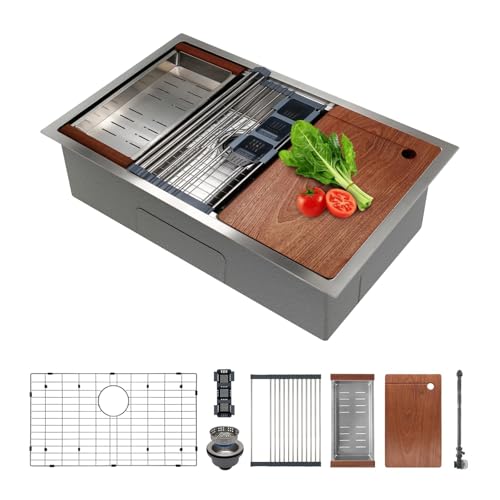
SANYCASA 30 Inch Undermount Workstation Sink
Badge: Best Workstation Selection
Strengths
- Steel listed at 11 gauge (3mm) — the thickest construction in this selection.
- Integrated ledge converts the bowl into a multifunctional workstation.
- Superior-drain design focus addresses standing water directly.
Trade-offs
- Heavy steel means deliberate support at installation.
- Ledge accessories must match the workstation’s geometry.
- A newer name than the selection’s heritage brand.
Mini spec box
- Size: 30 inch undermount
- Steel: 11 gauge (3mm) stainless steel
- Design: single bowl, integrated ledge workstation
- Drainage: superior drain design
The steel side of the selection opens with its most assertive entry. The SANYCASA’s listed construction — 11 gauge, a full 3mm of stainless — is the kind of specification that reorders a comparison, because thickness underwrites everything else an owner feels: the absence of flex, the muted impact of heavy cookware, the sense that the fixture is carved rather than folded. Onto that substance it builds the workstation format, an integrated ledge that turns the bowl’s rim into a working shelf system, and a drainage brief that treats standing water as a defect to be designed out.
In a selection, this is the entry for the specification-led buyer — the one who reads listings the way this guide does and wants the numbers to lead. Its honest caveats are about ecosystem and history rather than substance: ledge accessories follow the maker’s geometry, and a newer brand asks you to weight its verified specification over a long public track record. Households comfortable with that exchange get the most heavily built sink in the guide, in the format modern prep cooking keeps voting for — a pattern the wider market data in Best Selling Kitchen Sinks reflects from its own angle.
Best for: specification-led buyers wanting maximum steel and a workstation / Not suited for: buyers who only trust long-established brand names

KRAUS KHU100-30 30 Inch 16 Gauge Undermount Sink
Badge: Best Classic Undermount
Strengths
- 16-gauge TRU16 steel from the selection’s most established sink programme.
- Rounded corners and channel grooves — the easy-clean, fast-drain pairing.
- NoiseDefend pads keep a 30 inch bowl quiet in open-plan homes.
Trade-offs
- No ledge and no bundled accessories; a grid is a separate purchase.
- Classic styling is understated rather than declarative.
- Thirty inches limits oversized pan work compared with wider entries.
Mini spec box
- Size: 30 inch undermount
- Steel: 16-gauge TRU16 stainless steel
- Design: single bowl, rounded corners
- Drainage: channel grooves
- Soundproofing: NoiseDefend pads
Every good selection needs its centre of gravity — the entry against which the more specialised options define themselves — and the KHU100-30 is this one’s. Kraus’s classic pattern assembles the virtues that decades of sink ownership have validated: true 16-gauge TRU16 steel, a floor grooved so water and grit leave together, corners rounded so cleaning is a wipe, and pads that keep the bowl’s voice down. Nothing in it is experimental, and that is its function in the list: it is the known-good against which a buyer can price the workstation’s ambition, the handmade’s style and the fireclay’s permanence.
Choose it when the renovation’s goal is a kitchen that simply works beautifully for a decade — the quiet default, in the versatile 30 inch size that fits the broadest range of standard cabinets. Its limitations are the absence of theatre: no ledge to demonstrate, no apron to anchor a style, no extreme specification to quote. Selections need entries like this precisely because most households, after touring the exciting options, discover that the centre of gravity was their address all along.
Best for: renovators wanting the proven classic at the versatile 30 inch size / Not suited for: buyers seeking a workstation system or a style statement

cozhao 30 Inch Handmade Undermount Sink
Badge: Best Modern Handmade
Strengths
- The listing states its steel grade outright: 304 stainless.
- Handmade construction gives the crisp, squared profile modern kitchens want.
- Drain assembly is included, covering the essential connection.
Trade-offs
- 18-gauge steel — thinner than the selection’s 16-gauge and 11-gauge entries.
- Tighter handmade corners need deliberate cleaning.
- No grid or further accessories are listed as included.
Mini spec box
- Size: 30 inch undermount
- Steel: 18-gauge 304 stainless steel (grade as stated in the verified listing)
- Design: handmade, single bowl, modern style
- Included: drain assembly
The cozhao is the selection’s contemporary accent: a handmade bowl whose squared lines belong to the slab-front, handleless school of kitchen design, and whose listing does something refreshingly direct — it states the steel’s grade, 304, in plain text. In a comparison exercise that transparency has real value, because it lets the buyer reason about the material itself rather than about adjectives, and it sets a standard of candour the rest of any showroom should be held to.
Its place in the range is honestly bounded. The steel is 18 gauge, so the solidity contest goes to the Kraus and SANYCASA entries; the corners are handmade-tight, so the cleaning contest goes to the rounded classics; and its accessory story begins and ends with the included drain assembly. What it wins is the look-and-honesty contest at 30 inches, which for a design-led kitchen is not a consolation prize but the actual brief. Selections exist so that trade-offs like these can be made knowingly, and this entry makes its own with unusual clarity. Steel-focused browsers can continue the comparison in Best Single Bowl Stainless Kitchen Sinks, where this handmade profile meets its brushed siblings head-on.
Best for: modern design-led kitchens wanting a stated grade and crisp lines / Not suited for: buyers prioritising maximum gauge or effortless corners

MAYESAR 28 Inch Undermount Kitchen Sink
Badge: Best Compact Selection
Strengths
- 16-gauge steel at a genuinely compact 28 x 18 inch footprint.
- A full 9 inch depth keeps the small bowl practical for soaking and stacking.
- Brushed finish and rounded corners — the forgiving, easy-care combination.
Trade-offs
- The smallest bowl in the selection; large pans will overhang.
- Handmade format means a smaller accessory ecosystem.
- Not a candidate for wide cabinet runs that could take more sink.
Mini spec box
- Size: 28 x 18 inch undermount
- Steel: 16-gauge stainless steel
- Design: single bowl, handmade, brushed finish, round corner
- Depth: 9 inch
A selection that only serves big kitchens is a selection that fails half its readers, so the MAYESAR holds the compact end — and holds it properly. Twenty-eight by eighteen inches is the footprint that fits the smaller standard cabinet, the galley, the in-law suite and the modest remodel, and this bowl refuses the usual compact compromises: the steel is a full 16 gauge, the depth is a full 9 inches, the finish is brushed for forgiveness and the corners are rounded for cleaning. It is a small sink specified like a big one, which is rarer in this category than it should be.
Its boundary is arithmetic and should be respected: households that cook with roasting pans and batch trays will find 28 inches a daily negotiation, and for them the selection’s 30 and 33 inch entries exist. But judged inside its brief — the compact kitchen that still cooks seriously — it has no weak point to apologise for, and it completes the selection’s promise: every size in the range is represented by a sink its buyer will not need to make excuses for.
Best for: compact kitchens, suites and small remodels wanting full-quality steel / Not suited for: batch cooks who need oversized pans to lie flat
Comparison Table
One view of the whole selection: material, size and the decision each entry exists to answer.
| Pick | Material | Size | Defining feature | Badge | Listing |
|---|---|---|---|---|---|
| Miuara 30 Fireclay | Fireclay | 30 x 18 inch | Rated resistances, reversible apron bowl | Best Farmhouse Selection | Check on Amazon |
| Miuara 33 Fireclay | Fireclay | 33 x 18 inch | Rated resistances at full width | Best Large Farmhouse | Check on Amazon |
| SANYCASA Workstation | Stainless, 11 gauge (3mm) | 30 inch | Integrated ledge, superior drain | Best Workstation Selection | Check on Amazon |
| KRAUS KHU100-30 | Stainless, 16-gauge TRU16 | 30 inch | Grooves, rounded corners, NoiseDefend | Best Classic Undermount | Check on Amazon |
| cozhao Handmade | Stainless, 18-gauge 304 stated | 30 inch | Handmade lines, drain included | Best Modern Handmade | Check on Amazon |
| MAYESAR 28 Inch | Stainless, 16-gauge | 28 x 18 inch | Compact size, 9 inch depth | Best Compact Selection | Check on Amazon |
How to Choose From a Selection: The Three Decisions in Order
Decision one: material. Fireclay gives you a hard glazed surface with maker-rated resistance to stains, scratches, cracks and heat, a substantial presence and a style anchor — at the cost of weight, support planning and a chip risk under violent impact. Stainless gives you toughness that dents rather than chips, lighter installation, the widest format variety and a finish that ages into patina — at the cost of surface lines that must be managed by grid and habit. Neither is the “better material” in the abstract; each is better for a definable kitchen, and this selection stocks both at full quality so the decision is about your room, not about availability.
Decision two: format. Apron-front makes the sink the kitchen’s visual anchor and suits farmhouse and traditional design. Classic undermount disappears under the counter and lets the worktop lead. Workstation undermount adds the ledge, converting the bowl into prep space — the format to choose when counters are scarce and cooking is serious. Handmade undermount sharpens the lines for contemporary cabinetry. Format is the decision your eyes will re-make every morning, so let the kitchen’s design language, not a feature list, cast the deciding vote.
Decision three: size, settled by measurement. The cabinet interior and the manufacturer’s minimum cabinet size are hard constraints; your largest pan is the soft one that should still be honoured. This selection’s ladder — 28, 30, 33 inches — exists because those constraints land differently in different homes, and the correct response to a constraint is a size that fits it, not a wish that it were otherwise. Measure first, then let the first two decisions choose freely inside the size that fits. Brand-led browsers who arrive with a maker in mind — the following around names such as those in Best Sinks For Kitchen Franke — will find the same three decisions waiting underneath the badge; the method outlasts any particular shortlist.
How to Install and Care for the Sink You Select
Whichever entry wins, the installation principles rhyme. For undermount steel: clean mating surfaces, a continuous silicone bead, clips snugged evenly in rotation, support from below for a full day’s cure, then plumbing, a brim-full test and a dry-handed inspection of every joint. For fireclay farmhouse bowls: engineered cabinet support built before the bowl arrives, careful levelling, and the same sealing discipline at every joint — with the additional rule that the bowl’s weight is a two-person, planned lift, never an improvisation.
- Confirm the cabinet interior and minimum cabinet size against the chosen model’s listing before ordering.
- Inspect the bowl on arrival — glaze, corners, rim — while an exchange is still painless.
- Build or verify support appropriate to the material: clips and bracing for steel, structural support for fireclay.
- Seal, mount evenly, cure fully, then connect drain and disposal.
- Test with a full bowl, inspect dry-handed, and only then call the installation finished.
Care follows the material. Fireclay asks for prompt wiping of strong colours, soft cleaning tools and respect for its hardness — lift pans, do not drop them. Steel asks for the rinse-and-dry habit, with-the-grain cleaning, and a grid under heavy cookware in the bowls that welcome one. Both ask for a twice-yearly glance at seals and connections below. None of it is onerous, and all of it is cheaper than the alternative.
Troubleshooting, in the pattern that solves most calls:
- Problem: water spots cloud a steel bowl daily → hard-water film, not damage; adopt the evening dry-wipe and the sheen returns.
- Problem: a grey streak appears on white fireclay → metal transfer from a pan base; a baking-soda paste lifts it without touching the glaze.
- Problem: the new bowl seems louder than the old kitchen promised → check the disposal mount and, on steel, that under-bowl pads are undisturbed; both are minutes-long corrections.
Reading a Selection Like a Showroom Manager
Professionals who stock sinks think in terms of coverage: does the range answer every legitimate brief a customer can bring? Test this selection against the briefs. The farmhouse brief: answered twice, at two sizes, with rated surfaces. The modern brief: answered by the handmade cozhao with its stated grade. The serious-cook brief: answered by the workstation’s ledge and the SANYCASA’s exceptional gauge. The safe-renovation brief: answered by the Kraus classic. The small-kitchen brief: answered by the MAYESAR’s full-quality compact bowl. A range that answers every brief with a defensible product — and refuses to stock entries it cannot defend — is what “best selection” should mean, in a guide or in a store.
The same test disciplines your own browsing anywhere else. When a showroom or a marketplace page offers forty bowls, ask which brief each one answers; the duplicates reveal themselves, the gaps reveal themselves, and the effective selection shrinks to the handful that were ever really candidates. That handful is where your time belongs — comparing verified specifications, checking your measurements, reading the honest trade-offs — exactly the work this guide has done for its six.
Selection Stories: Five Kitchens, Five Answers
Abstract ranges become clear when they meet real rooms, so here is the selection at work. The first kitchen is a farmhouse renovation in a wide galley: the owners cook from their own garden, the cabinetry is painted timber, and the sink must be the room’s anchor. The three decisions run in seconds — fireclay, apron-front, and the run is wide — and the Miuara 33 inch is the answer the selection was built to give, with its rated glaze taking a decade of preserving pans in stride. The second kitchen is a city condo with nine feet of counter, total: material is steel for weight and installation simplicity, format is the workstation because counter space is the scarcest asset in the home, size is 30 inches — the SANYCASA, with its ledge doing the work of the counter the condo does not have.
The third kitchen is a family renovation on a disciplined budget, where the goal is not a statement but an absence of regrets: steel, classic undermount, 30 inches — the Kraus KHU100-30, chosen precisely because every one of its virtues is boring and permanent. The fourth is a designer’s own kitchen, all slab fronts and shadow gaps, where the sink must match the architecture’s crispness and the owner reads specifications for pleasure: the cozhao, handmade lines and a stated 304 grade, accepted with its thinner gauge as the price of the profile. The fifth is a basement suite built for a parent, compact and serious: the MAYESAR, because a small kitchen deserves the same gauge and depth as a large one. Five rooms, five different sinks, one selection — that is what coverage means when it is working.
The Lifetime View: What Each Entry Asks of You Over Ten Years
A selection is usually judged on purchase day, but its entries diverge most interestingly across a decade, and a wise buyer prices the years, not the afternoon. The fireclay pair ask for two things: correct support on day one, and ordinary care thereafter — no dropping of cast iron, prompt wiping of strong colours — and in exchange they promise a surface that looks close to its first year in its tenth, with the apron’s presence ageing into the room’s character. The workstation asks for loyalty to its accessory geometry and repays it with a prep system that reorganises how the kitchen works; its thick steel asks almost nothing else. The Kraus classic asks for a grid purchase and the rinse-and-dry habit, and repays with the quietest ownership story in the list — nothing to manage, nothing to explain, a bowl that simply continues.
The handmade cozhao asks for a corner brush and a tolerant eye toward its tighter geometry, repaying with the selection’s sharpest looks and its most transparent specification. The compact MAYESAR asks only that its household respect its dimensions — cook within them, and it will never feel like a compromise; outgrow them, and no quality of steel can rescue the arithmetic. Read across the five, the pattern is the guide’s closing argument: there is no free lunch and no bad pick here, only exchanges, stated in advance. A selection earns the word “best” when its exchanges are this legible — when a buyer can see, before money moves, exactly what each sink will ask and exactly what it will give.
Accessories and Ecosystems: The Hidden Layer of Every Selection
Two sinks with identical bowls can be different purchases once their ecosystems are counted, and a mature selection makes that layer visible. The workstation entry builds its ecosystem into the product: the ledge is a standard the accessories follow, so boards and racks are a system rather than a shopping list. The classic Kraus leaves its ecosystem open — grids, racks and drains are separate, standard-fitting decisions, which suits owners who already own pieces they love. The cozhao includes the one accessory that is not optional, its drain assembly, and leaves the rest to the buyer. The fireclay pair shift the accessory question sideways: their essential companion purchase is not a rack but the cabinet work beneath them, planned once and permanent.
The practical method is to write your accessory list before comparing any two finalists: grid or no grid, board or no board, drain included or sourced, support built or existing. Cost the list qualitatively against each finalist — included, standard, proprietary, structural — and the selection’s apparent order often reshuffles honestly. A bowl that looked like the premium option can become the economical one once its included drain and ledge kit are counted, while a bowl that looked like the bargain can quietly accumulate a grid, a drain assembly and a support upgrade until it costs the project more than the flagship ever asked. None of this arithmetic needs prices to work: it needs only the discipline of counting completeness alongside construction, which is the habit that separates buyers who compare sinks from buyers who compare purchases. This is also where a household’s existing possessions vote: a beloved grid in a standard size argues for the classic bowl it fits; a counter already crowded with boards argues against the workstation’s furniture, however elegant. The best selection is the one whose hidden layer you have read before the delivery arrives, and this guide has tried to keep that layer on the page, in the open, for all six entries.
Common Buying Mistakes
- Shopping the whole market instead of your three decisions. Material, format and size narrow forty candidates to three finalists in minutes.
- Letting a photograph outrank a measurement. The cabinet interior is the selection’s first filter and it is not negotiable.
- Comparing bowls without comparing boxes. Included drains, grids and ledge accessories change the real completeness of each entry.
- Choosing a material for its showroom day. Glaze and steel age differently; choose the ageing you will enjoy living with.
- Treating the compact entry as a lesser entry. A full-quality 28 inch bowl beats a compromised 32 in the kitchen it actually fits.
- Skipping the arrival inspection. Selections are only as good as the delivered unit — check it while exchange is easy.
Final Recommendation
Work the three decisions and the selection resolves itself. Farmhouse material and standard size point to the Miuara 30 inch; farmhouse at full width points to its 33 inch sibling. Steel with maximum substance and a workstation format points to the SANYCASA; steel as a proven classic points to the Kraus KHU100-30; steel as a modern design statement points to the cozhao; and a compact cabinet points, without apology, to the MAYESAR. Every route ends at a sink whose specifications were verified before it was listed here — which is the whole difference between a selection and a pile.
If you want a fast answer, start with one of these three and read its detailed review above: Miuara 30 Inch Fireclay Farmhouse Sink, SANYCASA 30 Inch Workstation Sink, KRAUS KHU100-30 Undermount Sink. Between them they cover the farmhouse, the workstation and the classic routes through this selection, and each links to its listing so you can check the latest price on Amazon today.
And if the browsing itself has been the exhausting part, take the method as the guide’s real gift: three decisions, in order, honestly answered, will cut any catalogue, showroom or marketplace down to the two or three sinks that were ever truly yours to choose between. The six here were selected so that whichever of them survives your three decisions, the kitchen that receives it gets a verified, defensible, decade-worthy bowl, chosen for the room it will actually serve — which is all that the phrase “best selection” has ever honestly meant, in any showroom, catalogue or guide.
Frequently Asked Questions
What makes a sink selection “the best” rather than just the biggest?
Coverage with quality at every point. A strong selection spans the real decisions — material, format and size — with entries that can each be defended on verified specifications in plain language, the way this guide’s six can. A big selection full of near-duplicates and unverifiable claims offers more scrolling, not more choice. Judge any range by whether each entry answers a distinct brief well.
Should I choose fireclay or stainless steel?
Choose fireclay for a hard, glazed, maker-rated resistant surface and a farmhouse presence, accepting its weight and support needs. Choose stainless for toughness, lighter installation and format variety — workstation, classic or handmade — accepting that its finish ages into a managed patina. Both materials in this selection are represented at full quality, so the deciding factors are your kitchen’s style, your cabinet’s structure and your cleaning personality.
Is a single bowl really better than a double bowl?
For the way most households now cook, yes: sheet pans lie flat, stockpots fit whole, and a dishwasher handles the routine separation a second bowl once provided. Every entry in this selection is a single bowl for that reason. Households whose habits genuinely centre on simultaneous washing and rinsing in two permanent zones should shop the double-bowl category deliberately — but they are now the exception the market designs around, not the rule.
How do I know which size in the selection fits my kitchen?
Measure the cabinet interior at the sink’s mounting height and compare it with the minimum cabinet size stated in each model’s listing; then test your largest pan against the bowl dimensions. The ladder in this guide — 28, 30 and 33 inches — covers the standard range: compact cabinets land on the MAYESAR, the broad middle on the 30 inch entries, and wide farmhouse or remodelled runs on the 33 inch Miuara.
What does a workstation ledge actually add?
A working surface inside the sink’s footprint: boards, racks and colanders ride on the ledge above the bowl, so prep, rinsing and draining happen over the sink instead of consuming counter. In the SANYCASA entry here it is paired with exceptionally thick steel and a drainage-focused design. Kitchens short on counter space feel the benefit daily; kitchens with abundant counters may prefer the classic bowl’s simplicity.
How many sinks should a good shortlist contain?
Two or three. Fewer than two means a decision was skipped — usually the material or format decision was never honestly made — and more than three means the decisions are being avoided rather than taken, because a properly worked material-format-size sequence eliminates most of any range on contact. Use the full selection to make the decisions, as this guide is structured to help you do, and then spend your comparison energy where it belongs: on the verified specifications, measurements and trade-offs of the two or three finalists that survive.
Can I mix a farmhouse sink with a modern kitchen?
You can, and designers do — a white fireclay apron can be a deliberate contrast in a contemporary room — but treat it as the commitment it is. The apron front is the most visible surface in the sink run and will set terms for hardware, lighting and cabinet colour around it. If that anchor role excites you, the Miuara entries are your route; if it does not, the undermount steel entries will disappear into your design instead, which is their own kind of elegance.