Disclosure: topratedkitchenware.com is reader-supported. When you buy through links on our site, we may earn an affiliate commission from Amazon and other retailers, at no extra cost to you.
Where to buy
The picks below are the verified selection behind this guide to the best single bowl stainless kitchen sinks. Four are stainless models with full listings linked; two are popular fireclay farmhouse bowls that we review in full for contrast but deliberately do not link, because this guide’s promise is stainless only. Each linked name takes you to its Amazon listing, where you can check the latest price on Amazon, confirm dimensions and inclusions, and read the newest owner feedback. Start with the most complete stainless package: Check on Amazon.
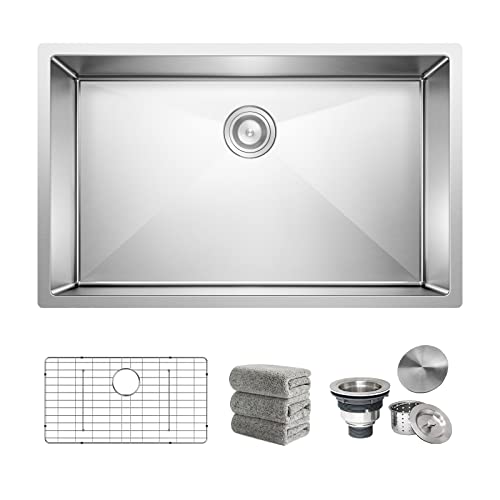
- Oxwiser 32×18 Inch Undermount Kitchen Sink Set, 16 Gauge, 5 Item Bundle
- KRAUS KHU640-33 33 Inch 18 Gauge Undermount Kitchen Sink
- Miuara Farmhouse Sink 30 x 18 Inch White Fireclay — reviewed below, prose-only (fireclay, not stainless)
- Miuara Farmhouse Sink 33 x 18 Inch White Fireclay — reviewed below, prose-only (fireclay, not stainless)
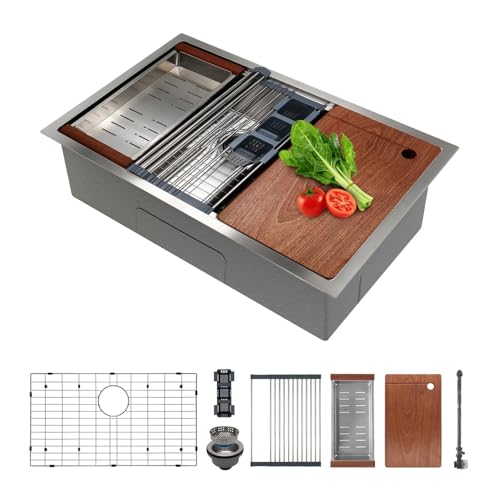
- SANYCASA 30 Inch Undermount Workstation Kitchen Sink, 11 Gauge
- KRAUS KHU100-30 30 Inch 16 Gauge Undermount Kitchen Sink
Read the full guide ↓ for the gauge and grade decisions that define a stainless bowl, the honest fireclay comparison, and the care routine that keeps brushed steel looking even for years.
There is a reason the search for the best single bowl stainless kitchen sinks is really two searches wearing one coat. The first is about layout: one uninterrupted bowl that fits the pans modern cooking uses. The second is about metal: which gauge, which grade, which finish, and which maker builds a bowl that still feels solid after years of cast iron and disposals. This guide answers both. Four verified stainless undermounts — a complete 32 inch bundle, a 33 inch wide bowl, an exceptionally thick 11 gauge workstation, and a rounded-corner 30 inch classic — carry the linked recommendations. Two white fireclay farmhouse sinks are reviewed in full as prose-only contrasts, because many shoppers cross-shop them against steel and deserve an honest account of what they would be choosing instead; they carry no links and no photos here, in keeping with this guide’s stainless-only promise.
That transparency matters because stainless shopping is full of vague metal language. Listings that will not state a gauge or a grade are asking you to buy a mystery, and every linked pick in this guide states its specification in its verified title: 16 gauge, 18 gauge, 11 gauge (3mm), TRU16 construction, 304 grade where claimed. You will find detailed reviews with strengths and trade-offs, a comparison table, a buying guide that teaches the metal before the models, and a how-to layer on installation and the specific care brushed stainless rewards. Sizing questions that sit underneath this search — which width for which cabinet — are treated at length in our guide to Best Size Kitchen Sinks, and this guide assumes you will measure before you fall for any particular bowl.
Key Takeaways
- Gauge is the headline specification in stainless: lower is thicker, and this list spans 18 gauge value steel up to an 11 gauge (3mm) workstation.
- Four picks are linked stainless models; the two Miuara fireclay farmhouse bowls are reviewed prose-only because they are not stainless.
- Complete bundles like the Oxwiser set include the grid and drain hardware that protect and finish a steel bowl.
- Rounded corners (Kraus KHU100-30, KHU640-33) clean fastest; handmade and workstation profiles trade a little upkeep for looks or function.
- Brushed finishes hide daily marks better than polished ones, and a bottom grid is the cheapest finish insurance in the category.
- Choose width by cabinet and cookware together: 30, 32, and 33 inch bowls serve different kitchens, not better or worse ones.
In this guide
Quick Picks
| Pick | Badge | Size and build | Link |
|---|---|---|---|
| Oxwiser 32×18 Sink Set | Best Overall | 32 x 18 inch, 16 gauge stainless, 5 item bundle with grid and drain assembly | Check on Amazon |
| KRAUS KHU640-33 | Best Extra Wide | 33 inch, 18 gauge stainless, rounded corners, NoiseDefend pads | Check on Amazon |
| Miuara Farmhouse Sink 30 Inch | Best Fireclay Alternative (prose-only) | 30 x 18 inch, white fireclay, reversible single bowl, apron front or undermount | See review |
| Miuara Farmhouse Sink 33 Inch | Best Large Fireclay Alternative (prose-only) | 33 x 18 inch, white fireclay, reversible single bowl, apron front or undermount | See review |
| SANYCASA 30 Inch Workstation Sink | Best Heavy Gauge | 30 inch, 11 gauge (3mm) stainless, integrated ledge workstation | Check on Amazon |
| KRAUS KHU100-30 | Best for Easy Cleaning | 30 inch, 16 gauge TRU16 stainless, rounded corners, NoiseDefend pads | Check on Amazon |
The table’s honesty is the guide in miniature: if a row has no link, it is because the bowl is not stainless, and we would rather show you the comparison cleanly than pretend a fireclay sink belongs in a stainless ranking. Readers planning a full project rather than a single purchase will find these same widths framed by cabinet work in our notes on Best Sinks For Kitchen Remodel.
How These Picks Were Chosen
The stainless field was screened on verifiable metal: a stated gauge in every case, construction details such as TRU16 steel and NoiseDefend sound treatment where the maker publishes them, and dimensions that place each bowl in a real cabinet class. We favoured drainage design and corner geometry that owners can maintain, and we included one complete bundle because the grid-and-drain completeness genuinely changes the ownership experience of a steel bowl. Models with unstated gauges or vague alloy language were excluded from the linked picks regardless of visibility, because a stainless guide that cannot tell you the steel has failed at its only job.
The two fireclay bowls were included under a deliberate rule: they are among the single bowls shoppers most often weigh against steel, they are legitimate well-specified products in their own material, and excluding them would leave the comparison half-told. They are reviewed from their verified specifications with the same strengths-and-trade-offs structure, but they receive no Amazon link and no image in this article, and the final recommendation does not pretend they are stainless finalists. This is a research-led comparison, not a hands-on test, and performance throughout is framed by specification and reported owner experience.
The 6 Best Single Bowl Stainless Kitchen Sinks — Plus the Fireclay Contrast

Oxwiser 32×18 Inch Undermount Kitchen Sink Set
Badge: Best Overall
Strengths
- 16 gauge stainless single bowl at a family-scale 32 x 18 inches.
- Five item bundle — grid, drain assembly, drain cap, towel — completes the steel bowl’s supporting system.
- The included grid protects the brushed floor from the first day.
Trade-offs
- Requires the wider base cabinet class.
- Handmade-style bowl corners need more attention than rounded designs.
- Bundle assumes you want the standard accessory set.
Mini spec box: Mount: undermount. Size: 32 x 18 inch. Material: 16 gauge stainless steel. Bowl: single bowl. Bundle: sink, bottom grid, drain assembly, drain cap, towel (5 items).
The Oxwiser 32 inch set is the stainless single bowl as a finished system rather than a bare shell. The bowl hits the specification most households should aim for — 16 gauge steel, which is thick enough to feel machined under a heavy pan and to deaden the ring that thinner bowls produce — across a 32 inch floor that takes roasting pans and sheet trays without negotiation. What elevates the set is that the two accessories a steel bowl most needs arrive in the same box: the bottom grid that keeps cookware from grinding the floor’s finish, and the drain assembly that completes the install without a parts run.
In daily use, this is the pick that behaves like the category’s brochure promises. The single bowl swallows a day of cooking, the grid keeps the floor’s brushed finish even, and the size means the washing-up tub method works with room to spare. The honest costs are the wider cabinet requirement and corners that want a brush more often than the rounded Kraus bowls below. For a family remodel that wants the stainless decision finished — bowl, steel, protection, plumbing — in one order, this set is the guide’s centre of gravity.
Best for: families who want a complete, thick-steel, big-bowl package. / Not suited for: standard-width cabinets or rounded-corner devotees.

KRAUS KHU640-33 33 Inch Undermount Kitchen Sink
Badge: Best Extra Wide
Strengths
- 33 inch single bowl — the widest stainless floor here — with rounded, buildup-resistant corners.
- Channel grooves manage drainage across the broad floor.
- NoiseDefend pads keep a large steel surface quiet.
Trade-offs
- 18 gauge steel is a tier below the 16 gauge picks for dent resistance.
- Needs a genuinely wide cabinet.
- Grid is a separate purchase — and at this size, a near-mandatory one.
Mini spec box: Mount: undermount. Size: 33 inch. Material: 18 gauge stainless steel. Bowl: single bowl, rounded corners. Features: channel grooves for draining, NoiseDefend pads.
The KHU640-33 is the width extremist of the stainless field, and it earns its place by solving the problems width creates. A 33 inch floor is a stage: two large items soak side by side, a preserving day fits in one load, and the bowl can serve as the kitchen’s utility space during big cooks. Kraus supports the span with rounded corners that keep the long perimeter quick to wipe, channel grooves that give water a path off the broad floor, and NoiseDefend padding that stops a large thin surface from behaving like a drum under the disposal.
The specification trade is stated plainly in its title: 18 gauge construction, where the Oxwiser and KHU100-30 use 16. In practice that means placing rather than dropping cast iron, and fitting the grid that this bowl’s size makes essential anyway. Households that cook in volume and handle equipment reasonably will experience the width daily and the gauge rarely, which is the right exchange rate for this pick. Households with rough handling should take the same budget to the 16 gauge 32 inch set above and surrender an inch they will miss less than the solidity.
Best for: high-volume kitchens with a wide cabinet run. / Not suited for: standard cabinets or rough-handling households.
Miuara Farmhouse Sink 30 x 18 Inch White Fireclay (Prose-Only)
Badge: Best Fireclay Alternative (prose-only)
Strengths
- White fireclay apron front gives a kitchen a focal point no steel bowl attempts.
- Reversible single bowl; can install as apron front or undermount.
- Maker specifies resistance to stain, crack, heat, and scratch.
Trade-offs
- It is not stainless — the reason it is reviewed without a link in this guide.
- Heavy; apron installation needs a support frame in the cabinet.
- Hard, glossy surface is unforgiving to dropped glassware.
Mini spec box: Mount: apron front or undermount (per listing). Size: 30 x 18 inch. Material: white fireclay. Bowl: reversible single bowl. Properties (per maker): resistant to stain, crack, heat, and scratch.
This review exists because the comparison is real: a meaningful share of shoppers who start by searching for a stainless single bowl end up standing in front of a white fireclay farmhouse sink, wondering whether the material they planned on is the material they actually want. The Miuara 30 inch is the strongest form of that temptation. Its bowl is a proper 30 by 18 inch single volume, its fireclay surface wipes to a bright gloss that shows none of steel’s water spotting, and its reversible design with apron-front or undermount installation gives a renovation two ways to use it.
What you would be trading away is steel’s forgiveness. Fireclay is heavy and wants a framed support; its hardness, which resists scratching, also means a dropped pan corner or a falling glass meets an unyielding surface; and the white that looks so calm in photographs reports every coffee splash until wiped. None of that makes it a lesser sink — it makes it a different one, with a different care contract. We review it fully here so the comparison is honest, and we leave it unlinked because this guide’s linked promise is stainless. If your heart settles on fireclay after reading both sides, shop it as its own category with its own support planning, rather than as a steel substitute.
Best for: farmhouse kitchens choosing fireclay deliberately, with cabinet support planned. / Not suited for: anyone whose brief is stainless — or whose cabinet cannot be framed for the weight.
Miuara Farmhouse Sink 33 x 18 Inch White Fireclay (Prose-Only)
Badge: Best Large Fireclay Alternative (prose-only)
Strengths
- 33 x 18 inch fireclay bowl: the farmhouse format at full family scale.
- Reversible single bowl with apron front or undermount installation options.
- Same maker-specified resistance to stain, crack, heat, and scratch.
Trade-offs
- Not stainless; prose-only in this guide by design.
- The heaviest installation discussed here; framing is mandatory.
- White upkeep and glassware caution apply across a larger, more visible bowl.
Mini spec box: Mount: apron front or undermount (per listing). Size: 33 x 18 inch. Material: white fireclay. Bowl: reversible single bowl. Properties (per maker): resistant to stain, crack, heat, and scratch.
The 33 inch Miuara scales the fireclay argument to the kitchens that need it most: wide cabinet runs, family-volume cooking, and designs where the apron front is meant to anchor the whole room. The bowl’s extra width is functional as well as visual — the largest pans fit, a holiday wash-up fits, and the front’s proportions look deliberate across a broad run of cabinetry. As with its 30 inch sibling, the reversible bowl and dual installation paths keep the design flexible for different project shapes.
The planning burden scales with the bowl. This is the heaviest sink in the guide, and its support framing, countertop templating order, and two-person handling should be settled with your installer before the order is placed — the kind of project sequencing our renovation guide covers for wide-format sinks generally, at Best Sinks For Kitchen Renovation. In daily use, owners of big fireclay bowls praise the bright, quiet-about-spots surface and the sheer room; they also accept a wiping routine steel never asks for. Reviewed, fairly, as the fireclay alternative at full size — and left unlinked here, because a stainless guide should keep its links stainless.
Best for: wide farmhouse builds that want fireclay at family scale. / Not suited for: stainless briefs, unmodified cabinets, or narrow runs.
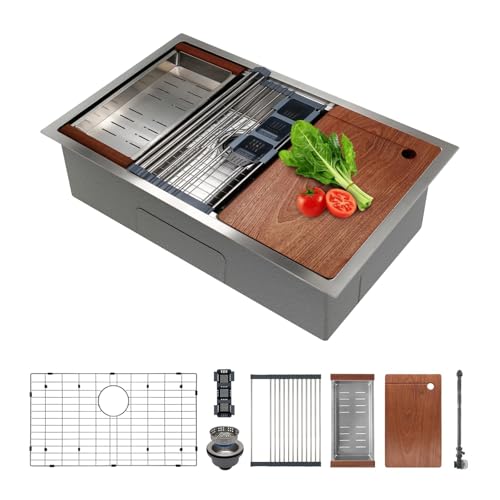
SANYCASA 30 Inch Undermount Workstation Kitchen Sink
Badge: Best Heavy Gauge
Strengths
- 11 gauge (3mm) stainless steel — by far the thickest metal in this guide.
- Integrated ledge workstation with a Superior Drain design.
- 30 inch footprint fits the most common cabinet class despite the commercial-grade build.
Trade-offs
- Heavy for an undermount; support rails and a careful install are essential.
- Ledge edges add cleaning steps a plain bowl avoids.
- Premium positioning follows from the steel; value shoppers should look at 16 gauge.
Mini spec box: Mount: undermount. Size: 30 inch. Material: stainless steel, 11 gauge (3mm). Bowl: single bowl with integrated ledge. Style: multifunctional workstation set.
The SANYCASA is the answer to a question most stainless guides never ask: what if the steel itself is the feature? At 11 gauge — a full 3mm shell — this bowl is built closer to commercial kitchen equipment than to residential norms, and the difference announces itself in every interaction. A cast iron pan set down firmly produces a thud, not a ring. The walls do not flex when a full stockpot lands. The integrated ledge, machined into that heavy frame, supports sliding workstation accessories without the slightest sense of strain, and the Superior Drain design moves water out of a bowl that lesser steel would leave feeling ponderous.
The format around the metal is equally considered: a 30 inch single bowl that fits standard cabinets, with the workstation ledge converting the top of the bowl into prep space — the configuration island and galley kitchens exploit best, a point developed in our island sink guide at Best Sinks For Kitchen Islands. The costs are weight and commitment. This sink should be installed with real support, ideally by someone who has hung heavy undermounts before, and the ledge’s tracks join your cleaning routine permanently. For households that keep a sink for decades and use it hard every one of those days, the SANYCASA’s steel is not an extravagance; it is the specification the rest of the category is measured against.
Best for: hard-use households that want commercial-grade steel in a standard footprint. / Not suited for: light installs, minimal budgets, or ledge-sceptics.

KRAUS KHU100-30 30 Inch Undermount Kitchen Sink
Badge: Best for Easy Cleaning
Strengths
- 16 gauge TRU16 steel: the premium residential standard, done properly.
- Rounded corners and channel grooves make it the fastest bowl here to clean and drain.
- NoiseDefend pads keep daily use quiet.
Trade-offs
- No ledge, no bundle; grid and accessories are separate.
- 30 inches is the standard bowl, not the widest.
- Understated design; it performs rather than performs for guests.
Mini spec box: Mount: undermount. Size: 30 inch. Material: 16 gauge TRU16 stainless steel. Bowl: single bowl, rounded corners. Features: channel drain grooves, NoiseDefend sound pads.
The KHU100-30 is the stainless bowl for people who have cleaned the alternatives. Its rounded corners are a maintenance philosophy: no seams, no tight radii, nowhere for the grey film of daily cooking to establish itself. A sponge follows the curve, the channel grooves walk water to the drain, and the bowl returns to an even brushed calm in under a minute. Wrapped around that geometry is Kraus’s TRU16 construction — 16 gauge steel with NoiseDefend padding — which gives the standard 30 inch footprint a dense, quiet, machined feel that value-tier bowls cannot imitate.
It is deliberately the least theatrical pick in this guide: no ledge system, no bundle, no farmhouse front. What it offers instead is the highest ratio of daily satisfaction to daily effort in the stainless field, in the size that fits the most kitchens. Add a grid — the one accessory it leaves to you — and the ownership experience is complete. If your stainless decision comes down to living with the bowl rather than admiring it, this is the one the evidence keeps pointing to.
Best for: households that rank easy cleaning and quiet solidity first. / Not suited for: workstation seekers or buyers who want accessories included.
Comparison Table
| Pick | Size | Material / gauge | Standout trait | Link |
|---|---|---|---|---|
| Oxwiser Set 32 | 32 x 18 inch | Stainless, 16 gauge | Complete bundle, big bowl | Check on Amazon |
| KRAUS KHU640-33 | 33 inch | Stainless, 18 gauge | Widest steel floor, rounded corners | Check on Amazon |
| Miuara Farmhouse 30 | 30 x 18 inch | White fireclay | Apron front alternative (prose-only) | See review |
| Miuara Farmhouse 33 | 33 x 18 inch | White fireclay | Large farmhouse alternative (prose-only) | See review |
| SANYCASA Workstation | 30 inch | Stainless, 11 gauge (3mm) | Thickest steel, integrated ledge | Check on Amazon |
| KRAUS KHU100-30 | 30 inch | Stainless, 16 gauge | Rounded corners, easiest upkeep | Check on Amazon |
How to Choose a Single Bowl Stainless Kitchen Sink
Learn the metal first, because in this category the metal is the product. Gauge measures thickness and runs backwards: 18 gauge is the value standard, 16 gauge is the premium residential standard, and the SANYCASA’s 11 gauge (3mm) is commercial territory. Thickness buys three things — dent resistance, stiffness under load, and quietness — and it buys them in that order of visibility. Grade is the second word to know: 304 stainless, the grade named in several verified listings in this category, is the composition households want for corrosion resistance in a wet, acidic environment. A listing that states neither gauge nor grade is telling you something; listen.
Finish is the third decision, and it is about honesty rather than beauty. Brushed finishes — the finish across this guide’s steel picks — diffuse light across fine grain lines, which makes water spots and micro-scratches recede visually. Polished or mirror finishes photograph dramatically and report every fingerprint. For a bowl that will be used three times a day, brushed is the working finish. Corner geometry is the fourth: rounded corners clean in a pass and suit households that want the sink to disappear into the routine; handmade squared corners gain a little floor and a modern profile at the cost of a brush habit; ledges add a workstation at the cost of tracks to wipe.
Then size, by cabinet and cookware together, and completeness, by temperament. The 30 inch bowls fit the standard cabinet class; 32 and 33 inch bowls need the wider class and repay it in pan capacity. Bundles suit buyers who want the grid and drain settled; bare bowls suit buyers assembling their own system. Notice what is not on this decision list: brand theatre and feature counts. In stainless, the specification sheet is the review — which is why this guide keeps returning to it.
How to Install and Care for a Stainless Single Bowl
Installation follows the undermount standard, with one emphasis for the heavier picks: support. Dry-fit the bowl to the fabricated cutout, seal the flange with a continuous silicone bead, and carry the sink on rails or a harness system — for the 11 gauge SANYCASA this is not a suggestion but the substance of the install — then cure, plumb, and leak-test with a dry paper towel at every joint. Confirm the disposal stack before the counter is sealed: bowl depth, disposal body, and trap must coexist inside the cabinet you actually own.
Stainless care is a short liturgy. Wash with warm water, a soft sponge, and dish soap; wipe along the grain, never across it; rinse food acids the day they land; and dry the bowl at day’s end when you can, because most “staining” on stainless is actually dried mineral and soap film sitting on the surface. A baking soda paste lifts dull patches, and a grid prevents the scratch patterns that make a floor look tired. Keep steel wool, scouring powders, and bleach-based cleaners for other jobs; the brushed finish you are protecting is a texture, and abrasives rewrite it unevenly.
Troubleshooting in the patterns owners report: Problem: white spots and a cloudy film → dried water residue; wash, rinse thoroughly, and towel dry along the grain, and the finish evens out. Problem: fine scratches seem to multiply in the first month → they are the steel’s rite of passage; they soften into the overall patina, and a grid stops most new ones at the source. Problem: the bowl rings when the disposal runs → check that the sound pads are intact and that the sink is firmly supported; a grid also damps contact noise. Problem: water lingers in a corner → verify level at the supports before blaming the bowl’s slope, especially on the wider floors.
Reading a Stainless Listing Like a Metallurgist
A short field guide to listing language will save buyers more money than any single recommendation. “Stainless steel” alone, with no gauge and no grade, is a warning, not a description. A stated gauge without a grade is better; a stated grade — look for 304 in the specification — without a gauge is incomplete in the other direction. Construction names such as TRU16 signal a maker’s thicker-steel programme and are worth more than adjectives like “premium” or “commercial-style,” which carry no measurable content. Sound treatment should be described as pads or coating on the exterior; a silent listing usually means a loud bowl. Included items should be enumerated — the Oxwiser bundle’s five named items are the model of how this should read — because “accessories included” without a list is how a bare bowl acquires a bundle’s price.
Dimensions deserve the same scepticism. Exterior width is the number in the headline; interior floor dimensions are the numbers your pans will meet. Bowl depth should be stated, as the Delironexu-class listings in this category state theirs, because depth decides splash behaviour and the disposal stack. And when a listing in a stainless search turns out to be fireclay — as the Miuara pair honestly are — treat it the way this guide does: a legitimate alternative in another material, to be chosen deliberately with its own support and care contract, never as an accidental substitute discovered on install day.
Sound: Why Big Steel Bowls Drum, and How Makers Quiet Them
Noise is the complaint that separates satisfied stainless owners from disappointed ones, and it is almost entirely a specification story. A wide, flat sheet of steel is a drumhead by physics: running water, a disposal’s vibration, and the clink of cutlery all excite it, and the thinner the sheet, the more freely it rings. This is why gauge and sound treatment travel together in serious listings. The Kraus bowls in this guide pair their steel with NoiseDefend pads — dense material applied to the bowl’s exterior that absorbs vibration instead of broadcasting it — and the effect is the difference between a sink that sounds like equipment and one that sounds like a container.
Buyers can audit a listing for sound honesty in seconds. Look for named sound treatment, look for gauge, and be suspicious when neither appears, because a quiet bowl is engineered, never accidental. At home, three additions close whatever gap remains: a bottom grid, which stops direct metal-on-metal contact for most daily items; a firmly supported mount, since a loosely hung bowl amplifies its own vibration; and a disposal installed with its mounting seated properly, because a surprising share of “loud sink” complaints trace to the disposal’s fit rather than to the sink at all. The 18 gauge KHU640-33 in this guide is the instructive case: its padding is doing real work to keep a large, thinner bowl civilised, and with a grid fitted, most households will never hear the gauge difference they feared.
The Stainless Decade: How Each Tier Ages in a Real Kitchen
Project each tier in this guide forward ten years and the choice sharpens. The 16 gauge bowls — the Oxwiser set and the KHU100-30 — age the most gracefully of the mainstream options: their floors, protected or not, resist the denting that telegraphs rough use, their sound stays muted, and their brushed finish settles into the even patina that reads as “well kept” rather than “worn.” These are the sinks that still feel like the right purchase when the kitchen around them is repainted twice.
The 18 gauge KHU640-33 trades a little of that armour for its extra inch of width, and its decade depends more on household behaviour: in a place-and-rinse household with a grid, it will look and sound close to the 16 gauge bowls at year ten; in a drop-and-stack household, small dents and a busier floor will tell the story of its thinner steel. Neither outcome is a failure — the second is simply the visible record of a value choice honestly made. The SANYCASA’s 11 gauge shell plays a different decade entirely: it is the sink most likely to outlast the countertop it is mounted under, and its owners should choose its ledge format carefully, because they will be living with that format for a very long time. That longevity is the real argument for heavy steel — not the first week’s impression, but the fifteenth year’s.
Across all tiers, the decade is kinder to owners who adopt the two cheap rituals this guide keeps recommending: the grid, which decides what touches the floor, and the evening dry-down, which decides whether water spends the night on the finish. Stainless rewards those rituals more visibly than any other common sink material, because its surface keeps a faithful record — of care, in an even glow, or of neglect, in spots and scratches that were all preventable.
Workstation Steel vs Plain Steel: Placing the Ledge in a Stainless Brief
One format question survives every specification check in this guide, and it deserves its own short treatment: whether your stainless bowl should carry a workstation ledge. The ledge’s case is strongest exactly where stainless is strongest — in hard-working kitchens where the sink is a production surface, not a receptacle. A ledge in thick steel, as the SANYCASA builds it, supports boards and racks without flex, keeps prep waste falling into the bowl instead of onto the counter, and effectively lengthens a short counter run. For galley kitchens, island kitchens, and small-space remodels, that is a functional transformation, not a styling option.
The plain bowl’s case is the mirror image: fewer edges, faster cleaning, and nothing about the format that can date or be outgrown. The KHU100-30’s rounded interior will clean in a minute a decade from now, and its owners will never once think about ledge tracks. Households should decide by auditing a week of real cooking. If produce is rinsed, chopped, and staged in sequence most days, the ledge will be used constantly and its cleaning cost is a fair trade. If most meals are assembled on counters and the sink’s job is washing what cooking produced, the plain bowl’s simplicity compounds daily. Both answers are stainless answers; the metal does not care which format carries it, but your routine will, every single evening.
A word about resale and the next owner, because stainless choices echo past your own tenure. A mainstream 16 gauge single bowl in a standard size is the closest thing to a universally approved kitchen fixture: it photographs neutrally, it suits the next household’s cookware without negotiation, and its specification reads as quality to any buyer who checks. Exotic formats — the widest bowls, the heaviest workstations — delight the households they were chosen for and ask the next household to share the same priorities. That is not an argument against choosing them; it is an argument for choosing them with open eyes, in a home you expect to keep, where the decade view in the section above can actually play out under your own hands.
Common Buying Mistakes
First, buying stainless by photograph and discovering the gauge afterward; the metal specification is the product, and it is printed for every serious listing. Second, choosing mirror-polished finishes for a working kitchen and spending a year chasing fingerprints. Third, skipping the grid, then attributing the floor’s scratch pattern to poor steel rather than to unprotected contact. Fourth, hanging a heavy-gauge undermount on clips alone. Fifth, measuring the cabinet’s door instead of its interior before ordering a 32 or 33 inch bowl. Sixth, cross-shopping fireclay on looks alone, without pricing the support framing and the care routine into the decision — the Miuara reviews above exist to make that trade explicit rather than accidental.
Final Recommendation
For most households, the stainless answer is the Oxwiser 32×18 Sink Set: 16 gauge steel, a family-size bowl, and the grid and drain included. If easy cleaning outranks size, take the KRAUS KHU100-30 and its rounded corners; if steel thickness itself is your priority, the SANYCASA stands alone; if width is the priority, the KHU640-33 is waiting. And if the fireclay reviews above quietly won the argument, honour that — as a deliberate fireclay purchase with planned support, not as a detour from this list’s links.
Frequently Asked Questions
What gauge stainless is best for a single bowl kitchen sink?
Sixteen gauge is the sweet spot for most households: thick enough for dent resistance, stiffness, and quietness, without the weight and premium of commercial gauges. Eighteen gauge is a legitimate value choice for careful households. The 11 gauge (3mm) SANYCASA sits beyond the usual scale for buyers who want the steel itself to be the sink’s defining feature and are willing to install it accordingly.
What does 304 stainless steel mean, and does it matter?
It is the alloy grade most associated with quality kitchen equipment, valued for corrosion resistance in an environment of water, salt, and food acids. It matters as a verifiable specification: a listing that names its grade, as several in this category do, is giving you something checkable, while a listing that says only “stainless” is asking for trust. Pair a named grade with a named gauge and you know what you are buying.
Why are two fireclay sinks reviewed in a stainless guide?
Because shoppers cross-shop them constantly, and an honest comparison serves the stainless decision better than silence. The Miuara bowls are reviewed in full from their verified specifications — with their strengths, their weight and support demands, and their care contract stated plainly — but they carry no links or images here, because this guide’s linked recommendations are stainless only. If fireclay wins your decision, buy it as its own planned category.
How do I keep a stainless bowl from looking scratched?
You do not prevent fine scratches entirely; you manage them. A bottom grid stops most pan contact, soft sponges replace abrasive tools, and cleaning along the grain keeps the scratch pattern aligned with the brushed texture so it reads as patina rather than damage. Within the first year, a well-kept bowl’s finish settles into an even, slightly softened look that most owners find more attractive than the showroom glare.
Is a workstation ledge worth it in a stainless sink?
It is worth it if your prep genuinely flows across the sink — rinsing, chopping, and staging in sequence — and if your counters are tight enough that the ledge’s extra surface changes how the kitchen works. The SANYCASA executes the idea in the heaviest steel here, which suits daily use. If your counters are generous and your prep happens there, a plain bowl like the KHU100-30 gives you the same steel with less to clean.
What size stainless single bowl fits a standard cabinet?
The 30 inch class is the standard-cabinet answer, and two picks here — the SANYCASA and the KHU100-30 — serve it at very different gauges and characters. The 32 and 33 inch bowls need the wider cabinet class. Measure the cabinet interior and confirm the listing’s minimum cabinet size before ordering any of them; width is the one specification that cannot be adjusted after delivery.
Should I choose a bundle or buy the grid and drain separately?
Choose the bundle if the included items are the ones you would buy anyway — the Oxwiser set’s grid and drain assembly are the standard choices for its bowl, and having them arrive fitted to the sink removes two compatibility questions from the project. Buy separately if you have a specific grid style, strainer, or disposal flange in mind, or if your plumbing needs a non-standard drain. Either way, decide before the countertop is fabricated, because the drain position and hardware belong in the install plan from the start, not in a delivery that arrives after the stone is cut.
Can I mix a stainless sink with a fireclay or composite second sink?
Yes, and larger kitchens do it often: a stainless main bowl for its forgiveness and a smaller prep sink in another material where its duties are lighter. The pairing works because each material is assigned the work it suits — steel takes the cast iron and the volume, the second sink takes rinsing and staging. If you are planning an island prep sink alongside a main stainless bowl, match the drain hardware family where you can, so strainers and accessories interchange, and expect the two surfaces to ask for slightly different cleaning habits. The combination is a sign of a kitchen designed around actual use rather than around a single material story.
What is the difference between an island prep sink and a main sink?
Role and scale. A main sink is sized and specified for the kitchen’s whole washing load — the largest pans, the gathering cleanup, the disposal — which in this guide means the 30 to 32 inch picks with sound treatment. A prep sink is a satellite: it exists to put water where prep happens, to rinse produce and fill a pot near the cooktop’s orbit, and it succeeds at 28 inches because its loads are small and frequent rather than large. Kitchens with both should specify them differently on purpose; kitchens with only an island sink should buy the main-sink specification without hesitation, because every job in the kitchen will eventually arrive at that one bowl.
Do stainless sinks rust?
Quality stainless in a kitchen grade resists corrosion effectively, and what owners sometimes call rust is usually surface contamination — iron particles from a scouring pad or a left-wet steel can — sitting on the surface rather than the bowl itself failing. It lifts with a baking soda paste and gentle rubbing along the grain. Avoid steel wool entirely, rinse strong acids promptly, and the bowl’s own surface will stay sound for the life of the kitchen.