Disclosure: topratedkitchenware.com is reader-supported. When you buy through links on our site, we may earn an affiliate commission from Amazon and other retailers, at no extra cost to you.
Where to buy
The six sinks below are the verified picks behind this guide to the best size kitchen sinks — a deliberate spread of 28, 30 and 32 inch undermount bowls, so you can match the sink to your cabinet, your cookware and the way you actually wash up. Each name links to its Amazon listing, where you can check the latest price on Amazon, confirm the exact dimensions and cabinet requirements, and read the newest owner feedback before you commit. If you want the heaviest-gauge bowl in the group, start here: Check on Amazon.
- SANYCASA 30 Inch Undermount Kitchen Sink, 11 Gauge Stainless Steel Workstation
- KRAUS KHU100-30 30 Inch 16 Gauge Undermount Kitchen Sink
- cozhao 30 Inch Undermount Kitchen Sink, 18 Gauge 304 Stainless Steel
- MAYESAR 28 Inch Undermount Kitchen Sink, 16 Gauge, 28 x 18
- KRAUS KWU110-32 32 Inch Undermount Workstation Sink with Ledge
- KRAUS KHU100-32 32 Inch 16 Gauge Undermount Kitchen Sink
Read the full guide ↓
Ask ten renovators what the best size kitchen sinks are and you will hear ten confident answers, because sink size is not a single number — it is a negotiation between your cabinet width, your largest pan, your countertop depth and how many people cook at once. A sink that swallows a half-sheet pan flat can still be the wrong sink if it forces a cabinet modification you did not budget for, and a compact bowl that fits a narrow base cabinet can feel generous if its depth and corners are well designed. This guide treats size as the primary decision it is. We compare six verified undermount sinks across the three sizes that cover the overwhelming majority of American kitchens — 28, 30 and 32 inches — and we show the measuring method that tells you which of those sizes your kitchen can actually take, before you fall in love with any particular model.
The short version: most kitchens land happiest at 30 inches, serious cooks with wide cabinets graduate to 32, and 28 is the smart answer when the cabinet, not the cook, sets the limit. But the long version matters, because the difference between sizes is not just two inches of width. Bowl depth, corner radius, ledge systems and drain position all change how a given width performs, and two sinks with identical outside dimensions can wash very differently. If counter space is tight and you are also weighing genuinely compact bowls, our companion guide to Best Small Kitchen Sinks covers the smaller end of the market, while this guide stays with the mainstream sizes most remodels are built around.
Key Takeaways
- Start from the cabinet, not the catalogue: a 30 inch sink typically needs a 33 inch base cabinet, a 32 inch sink a 36 inch cabinet, and a 28 inch sink can work in a 30 to 33 inch cabinet — always confirm against the manufacturer’s stated minimum.
- Width is only one dimension. Bowl depth around 9 to 10 inches and tight, easy-clean corners change daily usability as much as two extra inches of width.
- For most households the 30 inch single bowl is the balanced answer; the KRAUS KHU100-30 is the reference point in this group.
- Frequent sheet-pan and stockpot washing justifies 32 inches — the KRAUS KWU110-32 adds a workstation ledge that turns the extra width into prep space.
- Gauge matters at every size: 16 gauge is the durable mainstream, the SANYCASA’s 11 gauge (3mm) steel is exceptionally heavy, and 18 gauge is the lighter, value-tier choice.
- Measure your largest pan diagonally before ordering. If it cannot lie flat or rest at a stable angle, size up or choose a workstation ledge that holds it above the bowl.
In this guide
Quick Picks
| Pick | Badge | Why it stands out | |
|---|---|---|---|
| SANYCASA 30 Inch Workstation Sink | Best Heavy-Gauge Build | 30 inch single bowl in exceptionally thick 11 gauge (3mm) stainless steel, integrated ledge workstation | Check on Amazon |
| KRAUS KHU100-30 | Best Overall Size Balance | 30 inch, 16 gauge TRU16 steel, rounded corners, channel grooves, NoiseDefend pads | Check on Amazon |
| cozhao 30 Inch Undermount Sink | Best Value at 30 Inches | 30 inch, 18 gauge 304 stainless steel, handmade modern bowl, drain assembly included | Check on Amazon |
| MAYESAR 28 Inch Undermount Sink | Best for Smaller Cabinets | 28 x 18 inch, 16 gauge, 9 inch deep handmade bowl, brushed finish, round corners | Check on Amazon |
| KRAUS KWU110-32 | Best Large Workstation | 32 inch, 16 gauge TRU16 steel, integrated ledge, cutting board and roll-up rack included | Check on Amazon |
| KRAUS KHU100-32 | Best Classic 32 Inch | 32 inch, 16 gauge TRU16 steel, rounded corners, channel grooves, NoiseDefend pads | Check on Amazon |
How These Picks Were Chosen
This is a research-led guide, not a hands-on lab test, and we would rather say that plainly than dress up desk research as workshop time. We built the shortlist from manufacturer specifications verified through the Amazon Creators API — every ASIN, title and dimension in this article comes from that verified pool — then cross-read owner feedback patterns for the issues that repeat across hundreds of kitchens: denting, drain slope, corner cleaning, cabinet fit surprises and noise. Sinks were kept in the list only if their stated size, gauge and configuration were internally consistent and matched a real, orderable listing.
Because the keyword here is size, we weighted dimensional honesty above everything else. A pick had to state its outside width clearly, sit in one of the three mainstream size bands, and pair that width with a sensible depth and bowl geometry. We also deliberately kept three brands and three gauges in the mix — 11, 16 and 18 gauge — because the best size kitchen sinks conversation is incomplete if it pretends width is the only variable. Where a sink’s size comes with a trade-off, such as a workstation ledge that needs the full bowl width to work, the review says so directly.
One scope note: every pick here is an undermount, single bowl, stainless steel sink. That is where the verified market for these sizes is strongest, and undermount installation is what most stone and solid-surface countertops are cut for. If your project calls for a drop-in or an apron-front bowl, the measuring method in the buying guide still applies — only the mounting chapter changes. Readers focused on quiet bowls specifically may also want our research on Best Sound Deadened Kitchen Sinks, since several picks here carry dedicated sound pads.
The 6 Best Size Kitchen Sinks
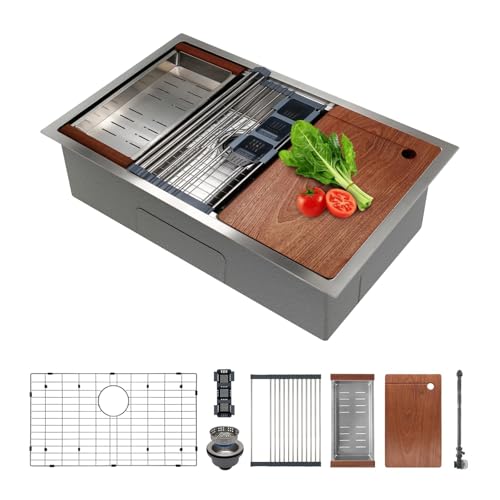
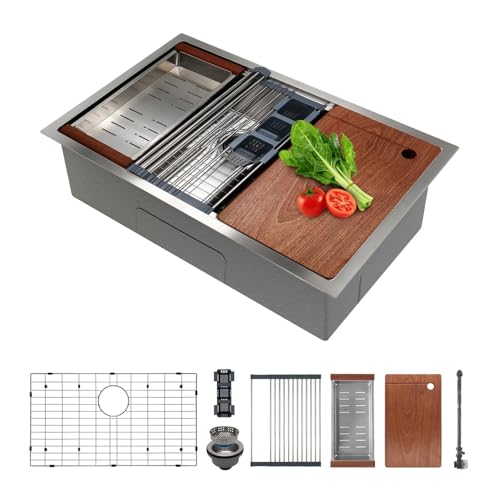
SANYCASA 30 Inch Undermount Kitchen Sink — 11 Gauge Workstation
Badge: Best Heavy-Gauge Build
Strengths
- 11 gauge (3mm) stainless steel is dramatically thicker than the 16 or 18 gauge norm, shrugging off dropped pans and resisting dents.
- Integrated ledge turns the 30 inch width into a workstation, holding accessories over the bowl so prep happens above the sink, not beside it.
- Single bowl at the most versatile size: flat room for sheet pans and roasting tins in a standard cabinet footprint.
Trade-offs
- Very heavy steel makes the sink itself heavy — undermount clips and adhesive carry more load, so installation help is wise.
- The ledge narrows the open bowl slightly at the top; the very largest stockpots still wash at an angle.
- Workstation format rewards buying into ledge accessories; as a plain bowl it gives back some of its advantage.
Mini spec box
- Size: 30 inch width, undermount
- Material / gauge: stainless steel, 11 gauge (3mm)
- Bowl: single bowl, integrated ledge workstation
- Drain: Superior Drain design (per manufacturer title)
Thirty inches is where most kitchens should start their thinking, and the SANYCASA makes the strongest possible case for staying there. The headline is the steel: 11 gauge, a full 3mm thick, is closer to commercial fabrication than to residential norms, and it changes the character of the sink. It feels immovable in the best way — a cast-iron skillet set down hard does not flex the floor of the bowl, the sides do not oil-can when a full pot of pasta water lands, and the whole sink has the damped, solid sound that thinner sinks only imitate with pads. If your household is hard on equipment, that thickness is a decade-long argument.
The integrated ledge is the second half of the design. Rails formed into the bowl hold a cutting board, drying rack or colander over the sink, which effectively answers the size question sideways: instead of needing a wider sink, you use the 30 inches you have in two layers. Produce rinses in a colander suspended over the bowl while the bowl itself holds the roasting pan soaking below. During a big cooking session that layering is worth more than two extra inches of width, and it is why this sink competes with 32 inch models despite its standard footprint.
Who should choose it? Cooks in standard 33 inch cabinets who cook seriously and keep equipment for a long time. The honest limitation is weight and commitment: an 11 gauge undermount is not a casual Saturday swap, the cabinet and countertop support must be sound, and the workstation concept pays off most when you actually use ledge accessories. As a pure, plain bowl it is excellent but slightly over-built for a light-use kitchen.
Best for: hard-use family kitchens in a standard cabinet that want workstation function without going wider / Not suited for: weak or damaged cabinet bases, or anyone planning a drop-in install

KRAUS KHU100-30 — 30 Inch 16 Gauge Undermount Sink
Badge: Best Overall Size Balance
Strengths
- The reference 30 inch format: fits the common 33 inch cabinet, swallows sheet pans, leaves sane counter space either side.
- 16 gauge TRU16 steel is the durable mainstream — thick enough for family abuse, light enough for straightforward install.
- Rounded corners and channel grooves make the bowl easy to wipe and quick to drain; NoiseDefend pads keep wash-up civilised.
Trade-offs
- No workstation ledge, so prep-over-the-sink needs a separate over-sink rack.
- Rounded corners give up a little flat floor area compared with tight-radius handmade bowls.
- Single bowl means soaking and rinsing share one space — no divider for households that prefer separation.
Mini spec box
- Size: 30 inch width, undermount
- Material / gauge: TRU16 stainless steel, 16 gauge
- Bowl: single bowl, rounded corners
- Features: channel grooves for draining, NoiseDefend soundproofing pads
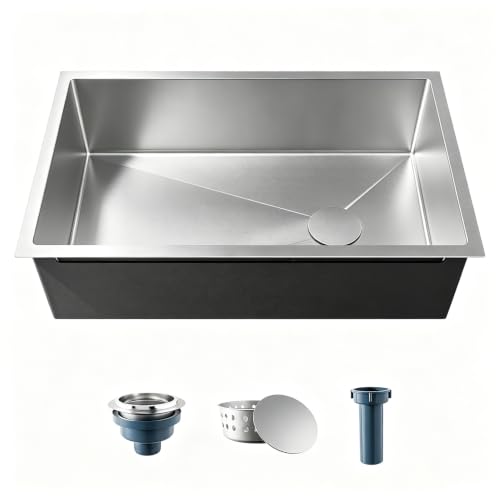
If this guide had to reduce the best size kitchen sinks question to one answer for the median American kitchen, it would be a 30 inch sink built like this one. The KHU100-30 pairs the most forgiving width with the most sensible gauge, and then sweats the details that decide whether a sink is pleasant on day 300 rather than day one. The rounded corners are the quiet heroes: crumbs and coffee grounds wipe out in one pass instead of being excavated from tight angles, and the channel grooves in the floor keep water moving toward the drain instead of pooling under a drying pan.
NoiseDefend padding matters more in a 30 inch family sink than spec sheets suggest, because this is the sink that will host everything — the morning rinse, the disposer grinding potato peelings, the stack of dinner plates at 9 p.m. Padded steel turns those sounds from a clang into a thud, which in an open-plan home is a quality-of-life feature, not a luxury. Households comparing quiet options in depth can cross-check our findings in the guide to Best Sound Proof Kitchen Sinks, where this model’s pad system is the reference point.
The size balance deserves one more paragraph, because it is the heart of this pick. At 30 inches, a half-sheet pan lies flat, a tall stockpot stands upright for filling, and the sink still leaves a standard 33 inch cabinet with normal proportions — the dishwasher, pull-out trash and sink base coexist the way kitchen designers assume. Go wider and something else in the kitchen usually pays; go narrower and the sheet pan starts living at an angle. For a household that cooks most nights and entertains occasionally, this is the size that never argues back.
Best for: the majority of family kitchens replacing a sink during a countertop or full remodel / Not suited for: cooks who specifically want a workstation ledge, or cabinets narrower than the stated minimum

cozhao 30 Inch Undermount Kitchen Sink — 18 Gauge 304 Stainless Steel
Badge: Best Value at 30 Inches
Strengths
- Full 30 inch single bowl at the value end of the market, in proper 304 stainless steel.
- Handmade, modern squared styling gives a contemporary look that usually costs more.
- Drain assembly included in the box, which keeps the total project cost honest.
Trade-offs
- 18 gauge steel is thinner — more prone to flex, noise and denting than the 16 and 11 gauge picks here.
- Squared handmade corners look sharp but need a touch more attention when cleaning.
- Fewer bundled accessories than the workstation or bundle picks; plan on a grid as a separate purchase.
Mini spec box
- Size: 30 inch width, undermount
- Material / gauge: 304 stainless steel, 18 gauge
- Bowl: single bowl, handmade modern design
- Included: drain assembly
Not every remodel can put its money into the sink, and the cozhao exists for the sensible version of that decision: keep the important dimension — a full 30 inch single bowl — and accept a lighter gauge to get there. The 304 stainless specification matters here. It confirms the alloy grade you want for corrosion resistance in a wet, salty, acidic environment, which is the part of a budget sink you should never trade away. The handmade styling, with its crisper corners and modern profile, also means the value choice does not look like one once it is under the counter.
The trade-off is real and should be entered with open eyes. Eighteen gauge steel is noticeably livelier: a heavy pan set down firmly can flex the floor, running water sounds brighter, and the bowl will show the years sooner in a hard-use kitchen. Mitigations exist — a bottom grid spreads loads and protects the floor, and careful habits cost nothing — but if your household includes teenagers slinging cast iron, the 16 gauge picks in this guide are the wiser spend. For a couple, a rental upgrade, a first home or a laundry-adjacent second kitchen, the calculus flips and this sink’s size-per-money is hard to argue with.
One practical note on fit: because it is a standard 30 inch undermount, it drops into the same cabinet and cut-out conversation as the KRAUS 30 inch models, so value shopping does not force any compromise on the remodel plan itself. Confirm the drain position and your disposer clearance underneath, as with any undermount, and budget the savings toward a good faucet — the pairing you touch every day.
Best for: value-led remodels, first homes and lighter-use kitchens that still want a full-size bowl / Not suited for: heavy cast-iron households or anyone who prioritises the quietest, most dent-resistant bowl

MAYESAR 28 Inch Undermount Kitchen Sink — 16 Gauge, 28 x 18
Badge: Best for Smaller Cabinets
Strengths
- 28 x 18 inch footprint fits cabinets that cannot take a 30 inch sink, without dropping to bar-sink compromises.
- 16 gauge steel keeps durability at the level of the bigger picks — the saving is in width, not in build.
- 9 inch depth and round corners: deep enough for pots, easy to wipe clean.
Trade-offs
- The largest sheet pans will not lie completely flat; expect to wash them at a slight angle.
- Handmade styling with a brushed finish shows water spotting a little more than satin finishes.
- Less elbow room for two-person wash-up than the 30 and 32 inch models.
Mini spec box
- Size: 28 x 18 inch, undermount
- Material / gauge: stainless steel, 16 gauge
- Bowl: single bowl, 9 inch deep, handmade
- Finish: brushed, round corner design
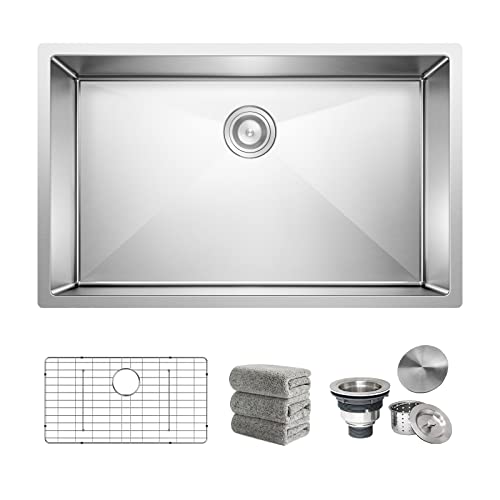
The MAYESAR is the answer to the most common sizing problem in real remodels: the cabinet is what it is. Townhouses, older homes with 30 inch sink bases, galley kitchens and condos regularly rule out the standard 30 inch sink, and the lazy alternatives — a tiny prep sink or a cramped double bowl — punish you every day. A 28 inch single bowl in full 16 gauge steel is the grown-up compromise. You lose two inches of width and keep everything else: depth for stockpots, a single uninterrupted floor for roasting pans at a modest angle, and steel thick enough to take family use.
Depth deserves emphasis at this size. A shallow small sink is a splash machine, but 9 inches of bowl contains the spray from a faucet washing greens or rinsing a blender jar, and it lets a dinner’s worth of plates stack without teetering above the counter line. The round corners continue the theme of a small sink that behaves like a big one: no grit traps, a single wipe with a sponge clears the perimeter, and the brushed finish hides the small scuffs that accumulate in any working bowl. Readers whose kitchens are small in every dimension, not just cabinet width, will find the broader small-space discussion in our guide to Best Small Kitchen Sinks useful alongside this pick.
Measure twice before choosing it for the opposite reason — do not buy a 28 to save money in a kitchen that fits a 30. The price difference between sizes is small next to a decade of daily use, and the two inches are genuinely missed at holiday scale. But when the cabinet tape measure says 28 is the size, this is how to buy it without resentment: full gauge, full depth, honest corners.
Best for: 30 to 33 inch cabinets, galley kitchens, condos and older homes where a 30 inch sink will not fit / Not suited for: wide-cabinet kitchens that would use the extra width of a 30 or 32 inch bowl daily

KRAUS KWU110-32 — 32 Inch Undermount Workstation Sink
Badge: Best Large Workstation
Strengths
- 32 inch bowl plus integrated ledge: the included cutting board and roll-up rack work over the sink, multiplying prep space.
- 16 gauge TRU16 steel with NoiseDefend soundproofing — big-bowl capacity without big-bowl clang.
- Sheet pans, grill grates and oversize roasters lie flat, the core promise of the 32 inch class.
Trade-offs
- Needs a wide cabinet (typically 36 inch) — measure before falling for it.
- A big single bowl uses more water for small soak jobs unless you use a basin inside it.
- The ledge system works best with the included and matching accessories; it is a small ecosystem.
Mini spec box
- Size: 32 inch width, undermount
- Material / gauge: TRU16 stainless steel, 16 gauge
- Bowl: single bowl with integrated ledge
- Included: cutting board and roll-up drying rack; NoiseDefend soundproofing
Thirty-two inches is the size for cooks whose equipment outgrew the standard bowl — the half-sheet pans, the 16 inch roasting pan with handles, the grill grates in June. The KWU110-32 takes that width and adds the feature that makes large sinks earn their footprint: an integrated ledge running the length of the bowl, fitted here with a cutting board and a roll-up rack in the box. Prep flows in one direction — board over the sink, trimmings swept straight in, rinsed produce draining on the rack — and the counter stays clear for the work that actually needs counter.
Underneath the theatre, the fundamentals are right. Sixteen gauge TRU16 steel keeps the big floor from drumming, NoiseDefend pads tame the acoustics of a large hollow box (large thin sinks are the loudest objects in a kitchen; this one is engineered not to be), and the single bowl has no divider to catch pan handles. In size terms it asks for a 36 inch cabinet in most installations, which is the true gatekeeper: if the cabinet run allows it, the sink will repay the space every day; if it does not, no amount of wanting makes the cut-out fit.
The honest limitation of any 32 inch single bowl is small-job inefficiency — filling it to soak two mugs is wasteful, and reaching across a wide, deep bowl is a real ergonomic consideration for shorter cooks. A simple washing-up bowl inside the sink solves the first; a test reach at a showroom, or a tape-measure mock-up at home, answers the second. For keen stainless shoppers comparing the wider field, our roundup of Best Ss Kitchen Sinks puts this model in its material context.
Best for: serious home cooks with 36 inch cabinets, bakers and entertainers washing oversize cookware / Not suited for: narrow cabinets, water-miser households that rarely wash large items

KRAUS KHU100-32 — 32 Inch 16 Gauge Undermount Sink
Badge: Best Classic 32 Inch
Strengths
- The KHU100 formula at full width: 16 gauge TRU16 steel, rounded corners, channel grooves, NoiseDefend pads.
- Flat, uninterrupted floor for the largest pans — no ledge, no steps, nothing to work around.
- Rounded corners keep a big bowl quick to clean; grooves keep the floor draining.
Trade-offs
- No workstation ledge or included accessories — a simpler sink by design.
- Same wide-cabinet requirement as any 32 inch undermount.
- Big-bowl water use for small jobs, as with all large single bowls.
Mini spec box
- Size: 32 inch width, undermount
- Material / gauge: TRU16 stainless steel, 16 gauge
- Bowl: single bowl, rounded corners
- Features: channel grooves for draining, NoiseDefend soundproofing pads
Some cooks look at a workstation ledge and see a system they will use daily; others see ledges, boards and racks as clutter colonising a bowl they want empty. The KHU100-32 is for the second group, at full size. It takes the proven KHU100 recipe — 16 gauge TRU16 steel, genuinely rounded corners, drainage channels pressed into the floor, full NoiseDefend padding — and stretches it to 32 inches of unobstructed bowl. A roasting pan and a saucepan soak together; a sheet pan lies flat with room to spare; the evening’s entire wash-up fits in one load.
The cleaning experience is where this design quietly wins years of goodwill. Big sinks fail their owners when corners harbour grime and floors puddle, and both details are handled here: the corner radius is generous enough for a sponge to sweep through, and the grooves give water a path so the floor dries instead of spotting. In a large bowl those are not niceties — they are the difference between a sink that feels hygienic and one that always looks faintly tired.
Choose it over the KWU110-32 if your prep happens on the counter and your sink is purely for washing at scale; choose the workstation if you want the sink to join the prep line. Either way, verify the cabinet — 32 inch undermounts generally want a 36 inch base — and check the rear drain position against your disposer and storage plans underneath, since a wide bowl rearranges the under-sink map.
Best for: large households and keen cooks who want maximum plain bowl volume in durable steel / Not suited for: anyone wanting ledge accessories, or cabinets below the stated minimum width
Comparison Table
| Pick | Size | Material / gauge | Standout trait | |
|---|---|---|---|---|
| SANYCASA Workstation 30 | 30 inch | Stainless, 11 gauge (3mm) | Heaviest steel, integrated ledge | Check on Amazon |
| KRAUS KHU100-30 | 30 inch | Stainless TRU16, 16 gauge | Balanced all-rounder, NoiseDefend | Check on Amazon |
| cozhao Undermount 30 | 30 inch | 304 stainless, 18 gauge | Value size, drain assembly included | Check on Amazon |
| MAYESAR Undermount 28 | 28 x 18 inch | Stainless, 16 gauge | Smaller cabinets, 9 inch depth | Check on Amazon |
| KRAUS KWU110-32 | 32 inch | Stainless TRU16, 16 gauge | Workstation ledge, board + rack | Check on Amazon |
| KRAUS KHU100-32 | 32 inch | Stainless TRU16, 16 gauge | Maximum plain bowl, rounded corners | Check on Amazon |
How to Choose the Right Size Kitchen Sink
Work through the decision in the order the constraints actually bind. First, the cabinet: open the sink base, measure the interior width between the side walls, and subtract the room the cabinet frame and plumbing need. Manufacturers state a minimum cabinet size for every sink — a 30 inch undermount commonly asks for a 33 inch cabinet, a 32 for a 36, and the MAYESAR’s 28 inch bowl is the pick here designed for tighter bases. Never reverse-engineer from the sink you like; the cabinet number is physics, not preference, and installers cannot stretch it.
Second, your largest cookware. Take the biggest pan, roaster or board you wash weekly and measure its diagonal. It should either lie flat on the bowl floor or rest at a shallow, stable angle with its handles inside the rim. Flat is better for soaking and for stacking a wash-up load; a slight angle is acceptable for items washed one at a time. If your signature dish involves a half-sheet pan several times a week, the 32 inch picks stop being a luxury. If your largest regular item is a 12 inch skillet, a 28 or 30 will never once feel small.
Third, depth and ergonomics. Bowl depth around 9 to 10 inches contains splashing and stacks plates, but every extra inch of depth is an inch your back bends or your arms reach down. Shorter cooks and anyone with back trouble should treat very deep bowls cautiously and consider that the counter height adds to the total drop. Fourth, think about the second layer: a workstation ledge effectively enlarges any size by adding a working surface above the bowl, which is why the 30 inch SANYCASA competes with plain 32 inch sinks for keen cooks.
Finally, gauge as a size-adjacent decision: larger bowls flex more, so width argues for thicker steel. At 32 inches, 16 gauge should be your floor; at 30, 16 is ideal and 18 acceptable for light use; the SANYCASA’s 11 gauge is in a class of its own. Stainless quality questions — grades, finishes, scratch behaviour — are covered in depth in our guide to Best Ss Kitchen Sinks Scratching, which pairs naturally with the sizing decision made here.
How to Measure, Install and Care for a Kitchen Sink
Measuring, step by step. (1) Measure the cabinet interior width and depth, and note any braces or drawer boxes above the bowl area. (2) Measure your existing cut-out if the countertop stays — an undermount’s rim must overlap the opening correctly, and a new sink rarely matches an old cut-out by luck. (3) Check front-to-back: standard counters are about 25 inches deep, and the sink’s front-to-back dimension plus faucet placement must fit with the faucet holes or deck behind it. (4) Mock up the bowl with cardboard at the size you are considering and put your largest pan inside; five minutes of theatre prevents a decade of annoyance. (5) Confirm under-sink logistics: disposer position, water lines, and whether a pull-out trash bin shares the cabinet.
Installation overview. Undermount sinks are bonded and clipped to the underside of the countertop, with the countertop usually templated and cut before the sink is set. This is professional territory when stone is involved: the sink must be supported independently (clips, rails or a harness), sealed continuously, and left to cure before the disposer hangs from it. If you are replacing like-for-like size in an existing cut-out, a confident DIYer with a helper can manage the swap — sinks are heavy, awkward and always heavier once sealant is involved. Never let an undermount hang from adhesive alone, and never overtighten drain fittings into a steel bowl.
Daily care. Rinse and wipe the bowl after heavy use, dry it when you can (water spots are cosmetic but relentless), and clean with a soft cloth and mild detergent or a paste of baking soda for marks. Avoid steel wool and undiluted bleach on stainless, lift — don’t drag — cast iron across the floor, and use the bottom grid if your sink came with one. A weekly once-over of corners and the drain rim keeps the bowl looking new far longer than any deep-clean regime.
Troubleshooting. Problem: water pools in one corner instead of draining → check that the sink was set level and that the bowl floor’s grooves are free of debris; slight pooling in handmade bowls can be eased by wiping toward the drain and confirming the drain assembly is fully tightened. Problem: the bowl sounds tinny with running water → add or reposition sound pads on the underside and confirm the disposer is mounted snugly, since a loose mount amplifies vibration. Problem: scratches seem to multiply in the first months → this is normal stainless behaviour; fine scratches blend into a uniform patina over time, and using a grid plus rinsing grit off pan bottoms slows the process considerably.
Sink Size and the Rest of the Kitchen: Faucets, Counters and Workflow
A sink does not work alone, and size choices echo through the rest of the kitchen. A 32 inch bowl wants a faucet with genuine reach — the spout should land near the centre of the bowl, which on a wide sink means checking the faucet’s forward reach specification, not just its height. Pull-down spray heads forgive a lot here and are the natural partner for wide single bowls, letting you aim water into the corners the fixed stream misses. On a 28 inch sink, by contrast, an oversized commercial-style faucet can overwhelm the bowl and splash; scale the faucet to the sink, not to the showroom.
Countertop workflow matters as much. The landing zones either side of the sink — where dirty dishes arrive and clean ones drain — shrink as the sink grows, especially in a fixed-length run. A workstation ledge quietly returns that space by moving draining and prep over the bowl, which is why keen cooks in medium kitchens often choose a 30 inch workstation over a plain 32. Dishwasher position completes the triangle: the classic arrangement puts the dishwasher immediately beside the sink so rinsed plates travel inches, not steps, and a wider sink can push the dishwasher one cabinet further away. Sketch the whole run at tape-measure scale before ordering any of it.
Single Bowl vs Double Bowl at Each Size
Size cannot be separated from bowl configuration, because a 32 inch double bowl and a 32 inch single bowl are different tools. Divided bowls dedicate space to two simultaneous jobs — soak on one side, rinse on the other — but each side is then smaller than the whole, and the largest pans fit in neither. At 28 and 30 inches that compromise is severe: a divided 30 gives you two bowls that each struggle with a sheet pan. At 32 a low-divide design becomes more defensible, yet the verified market at these sizes, reflected in this guide’s picks, has moved decisively to the single bowl plus accessories model: one full-size space, subdivided temporarily by a rack, a basin or a ledge when the task wants it, and restored to full size when it does not.
The households that should still consider a divider are those whose wash-up rhythm truly is two jobs at once every day — hand-washing delicate glassware while dinner soaks, in a home without a dishwasher doing the heavy lifting. Everyone else gets more from the uninterrupted floor. And if soaking space is the concern, a simple plastic basin inside a single bowl replicates the second bowl for the twenty minutes it is needed, then goes back in the cupboard. Flexibility beats fixed partitions at every size in this guide.
Common Buying Mistakes
- Buying the sink before measuring the cabinet. The minimum cabinet size is a hard constraint; discovering a mismatch after the countertop is cut is the most expensive mistake in this category.
- Judging size by width alone. Depth, corner radius and drain position change how big a sink feels; a deep 28 can out-wash a shallow 30.
- Forgetting the diagonal test. If your biggest pan does not fit flat or at a stable angle, you will resent the sink weekly. Measure the pan, not your optimism.
- Choosing thin steel to save money at large sizes. Flex and noise grow with bowl size; at 32 inches, dropping below 16 gauge is a false economy.
- Ignoring the faucet pairing. A wide bowl with a short-reach faucet leaves dead corners you have to chase with the spray head forever.
- Planning no landing space. The widest sink in a short run leaves nowhere for dishes to arrive or drain; count the counter inches as part of the size decision.
Final Recommendation
For most kitchens, start — and usually finish — at 30 inches: the KRAUS KHU100-30 is this guide’s balanced recommendation, with the right gauge, quiet pads and easy-clean corners in the size that fits standard cabinets and full-size pans alike. If your cooking is heavy-duty and you love the workstation idea, the SANYCASA’s 11 gauge ledge sink is the same footprint with the volume turned up. When the cabinet allows 32 inches and your pans demand it, take the KRAUS KWU110-32 for prep-over-the-sink workflow, or the KHU100-32 for pure bowl. And when the cabinet says 28, buy the MAYESAR without a backward glance — full gauge and full depth make it a real sink, not a compromise. Size is the one sink decision you cannot accessorise your way out of later, so measure honestly and buy once.
Frequently Asked Questions
What is the most common kitchen sink size?
The 30 inch single bowl is the closest thing to a standard for American family kitchens. It fits the common 33 inch sink base cabinet, takes sheet pans flat, and pairs with standard faucet reaches. Smaller kitchens step down to 28 inches; large kitchens and keen cooks step up to 32 or beyond.
How do I know what size sink my cabinet can take?
Check the sink manufacturer’s stated minimum cabinet size and compare it with your cabinet’s outside width, then confirm the interior clearances — side walls, braces and plumbing — with a tape measure. As a working rule, allow roughly three inches beyond the sink’s width: 28 inch sinks for 30–33 inch cabinets, 30 inch sinks for 33 inch cabinets, 32 inch sinks for 36 inch cabinets. The manufacturer’s figure always wins over the rule of thumb.
Is a 32 inch sink too big for a small kitchen?
It is too big if the cabinet run cannot give it a 36 inch base or if the counter landing space either side disappears. In a compact kitchen, a 28 or 30 inch sink with a workstation ledge usually serves better than a plain wide bowl, because the ledge returns prep and draining space the wide sink consumed.
Does bowl depth matter as much as width?
Nearly. Depth around 9 to 10 inches contains splashing, stacks a full wash-up load and hides soaking pans below the counter line. Beyond that, extra depth costs back comfort. Width decides what fits; depth decides how the sink behaves while you use it — weigh both, using your largest pan and your own height as the tests.
Can I replace a double bowl sink with a single bowl of the same size?
Usually yes in outside dimensions, but the countertop cut-out is the deciding factor for undermounts: single and double bowls often have different interior shapes, and an existing cut-out may expose gaps or leave insufficient rim overlap. Have the cut-out measured against the new sink’s template before ordering, and budget for a countertop adjustment if they do not match.
What gauge should I choose at each size?
Sixteen gauge is the safe mainstream at 28, 30 and 32 inches. Eighteen gauge is acceptable at 30 inches for lighter use and tighter budgets, but gets lively at 32. The SANYCASA’s 11 gauge is far beyond residential norms — choose it for dent resistance and solidity, not because ordinary sinks require it.
Will a bigger sink use more water?
Only if you fill it. A washing-up basin inside a large bowl uses the same water as a small sink for small jobs, while giving you the full bowl when the roasting pan arrives. In practice, households with large single bowls report the basin habit forms within a week.