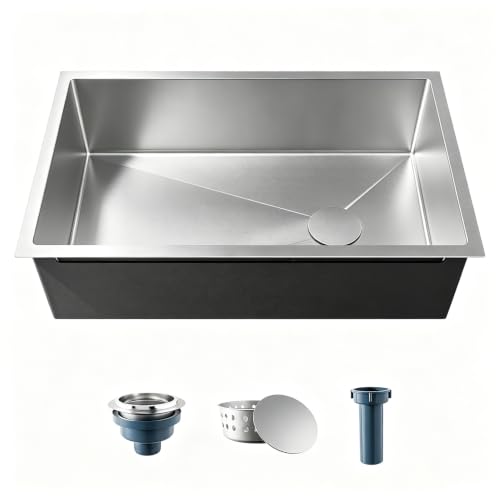
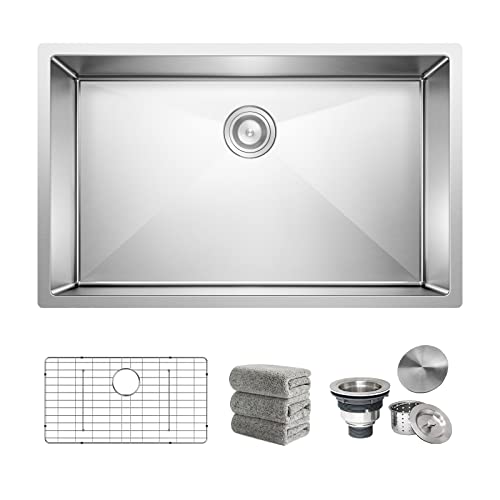
Disclosure: topratedkitchenware.com is reader-supported. When you buy through links on our site, we may earn an affiliate commission from Amazon and other retailers, at no extra cost to you.
Where to buy
The picks below are the verified shortlist behind this guide to the best ss kitchen sinks — “ss” being the trade shorthand for stainless steel, the material that dominates serious kitchens. Four picks are stainless steel and fully linked; two are fireclay farmhouse sinks included as the non-steel alternative readers always ask about, reviewed in full but presented prose-only because they are not stainless steel. Each linked name leads to its Amazon listing, where you can check the latest price on Amazon, confirm gauge, grade and dimensions, and read the newest owner feedback. Start with the heaviest stainless bowl in the group: Check on Amazon.
- Miuara Farmhouse Sink 30 x 18 Inch White Fireclay Apron Front (prose-only — fireclay, not stainless steel)
- Miuara Farmhouse Sink 33 x 18 Inch White Fireclay Apron Front (prose-only — fireclay, not stainless steel)
- SANYCASA 30 Inch Undermount Kitchen Sink, 11 Gauge Stainless Steel Workstation
- KRAUS KHU100-30 30 Inch 16 Gauge Undermount Kitchen Sink
- cozhao 30 Inch Undermount Kitchen Sink, 18 Gauge 304 Stainless Steel
- MAYESAR 28 Inch Undermount Kitchen Sink, 16 Gauge, 28 x 18
Read the full guide ↓
Search for the best ss kitchen sinks and you are really asking a material question: is stainless steel still the right stuff for a kitchen sink, and if so, which version of it deserves your money? The short answer has not changed in decades. Stainless steel dominates because it is the only common sink material that is simultaneously light enough to install anywhere, tough enough for cast iron, indifferent to boiling water, repairable in its finish and available at every size and tier. But “stainless” is a family, not a specification — grades, gauges and finishes separate a sink that will look tired in three years from one that will outlast the kitchen around it, and this guide exists to draw those lines precisely.
We compare four verified stainless picks across the full spread of the material’s modern range: an extraordinary 11 gauge workstation, the 16 gauge TRU16 mainstream at its best, an honest 18 gauge in proper 304 alloy, and a compact 16 gauge for smaller cabinets. Alongside them, reviewed in full but kept prose-only, are two fireclay farmhouse sinks — because the most common question in ss shopping is “or should I get fireclay instead?”, and a guide that refused to answer it would be dodging. The steel deep-dives cover grade (what 304 means), gauge (why lower numbers are thicker), finish behaviour and the scratch patina that our companion research on Best Ss Kitchen Sinks Scratching treats in full.
Key Takeaways
- Stainless steel remains the default for good reason: light, tough, heat-proof, hygienic and available in every size — the question is which stainless, not whether.
- Grade first: 304 stainless (named in the cozhao’s verified title) is the alloy you want for corrosion resistance; KRAUS’s TRU16 is its branded 16 gauge line.
- Gauge runs backwards — lower is thicker. The SANYCASA’s 11 gauge (3mm) is exceptional; 16 gauge is the durable mainstream; 18 gauge is the value tier.
- The KRAUS KHU100-30 is the classic ss answer: 16 gauge TRU16, NoiseDefend pads, rounded corners, standard 30 inch size.
- The two Miuara fireclay picks are reviewed prose-only: excellent sinks, but they are ceramic, not ss, and this guide does not pretend otherwise.
- Stainless scratches — all of it, at every tier — and then settles into an even patina; a bottom grid and grit discipline manage the process.
- SS is the easiest sink material to live with hygienically: non-porous, heat-proof and indifferent to the dyes and acids of real cooking.
In this guide
Quick Picks
| Pick | Badge | Why it stands out | |
|---|---|---|---|
| Miuara Farmhouse Sink 30 Inch (fireclay) | Best Non-Steel Alternative | 30 x 18 inch white fireclay, reversible single bowl — prose-only, not stainless steel | Reviewed below |
| Miuara Farmhouse Sink 33 Inch (fireclay) | Best Large Non-Steel Alternative | 33 x 18 inch white fireclay, reversible single bowl — prose-only, not stainless steel | Reviewed below |
| SANYCASA 30 Inch Workstation Sink | Best Overall SS | 30 inch, 11 gauge (3mm) stainless steel, integrated ledge workstation | Check on Amazon |
| KRAUS KHU100-30 | Best Classic SS | 30 inch, 16 gauge TRU16 steel, NoiseDefend pads, rounded corners, channel grooves | Check on Amazon |
| cozhao 30 Inch Undermount Sink | Best Value SS | 30 inch, 18 gauge 304 stainless steel, handmade modern bowl, drain assembly included | Check on Amazon |
| MAYESAR 28 Inch Undermount Sink | Best Compact SS | 28 x 18 inch, 16 gauge, 9 inch deep handmade bowl, brushed finish | Check on Amazon |
How These Picks Were Chosen
This is a research-led guide built on verified data: every ASIN, title, gauge and grade claim here comes from the Amazon Creators API pool, checked on the date recorded in the sources file. For an ss keyword the screening was material-honest by design. Stainless picks had to state their credentials in the verified title — gauge always, grade where the manufacturer declares it — and the two fireclay sinks in the assigned pool were handled under the brief’s core-attribute rule: the keyword specifies stainless steel, fireclay is a different material, so those picks are reviewed in full as the alternative they are, with no Amazon link and no image, and the reason recorded in the sources file.
Within the steel picks we deliberately kept the whole gauge ladder — 11, 16 and 18 — because an ss guide that showed only one gauge would hide the category’s central trade-off. We also kept the size spread (28 and 30 inches) and both construction styles (pressed bowls with rounded corners, handmade bowls with crisper geometry), since ss buyers cross-shop those constantly. Owner feedback was read in aggregate for the material-specific story: corrosion surprises (rare, and usually grade-related), denting, finish behaviour and the long patina settling that defines stainless ownership. The misspelt doorway into this same material, Best Stainles Steel Kitchen Sinks, leads to the identical shortlist logic from another angle.
The 6 Best SS Kitchen Sinks
Miuara Farmhouse Sink 30 x 18 Inch — White Fireclay (Prose-Only: Not Stainless Steel)
Badge: Best Non-Steel Alternative
Strengths
- Dense fireclay never rings, never shows water spots, and its glaze resists stains, heat and scratches in daily service.
- Reversible single bowl with apron-front presence; the manufacturer also allows drop-in or undermount fitting.
- A genuinely different ownership experience: no patina management, no metallic sound, a surface that rinses clean-looking.
Trade-offs
- It is ceramic, not ss — the reason it appears here without a link or image, as the comparison readers ask for.
- Heavy, needing a properly supported cabinet; chips are possible from severe edge impacts.
- The white farmhouse look directs the whole kitchen’s style in a way neutral steel does not.
Mini spec box
- Size: 30 x 18 inch, apron front (also drop-in/undermount per manufacturer)
- Material: white fireclay — NOT stainless steel
- Bowl: reversible single bowl
- Properties: resistant to stain, crack, heat and scratch (per manufacturer title)
Every ss guide owes its readers this review, because fireclay is the alternative that comes up in every showroom conversation. The Miuara 30 is the form at its most persuasive: a broad apron front in clean white, a reversible bowl that lets you choose a plainer or more detailed face, and a glazed ceramic surface with a completely different daily personality from steel — quiet under impact, indifferent to water spotting, resistant to the stains and heat of serious cooking. Households that choose it are usually choosing a kitchen style and a soundscape as much as a sink, and on those terms it is superb.
Why is it prose-only here? Because this guide’s keyword is stainless steel, and honesty in a buying guide starts with calling materials by their names. Fireclay’s strengths do not make it ss, any more than steel’s lightness makes it ceramic. We review it in full so the comparison is available where readers are making it, and we link only the picks that are what the keyword asks for. If your heart is set on the apron front in steel instead, that specific cross-shop lives in our Best Stainless Farmhouse Kitchen Sinks guide.
The ownership caveats travel with the material wherever it is sold: plan the cabinet support for real weight, treat the rim with the respect ceramic asks for, and expect a chip — not a dent — if the worst drop happens. Within those terms, this is the strongest non-steel answer in the category, included here at full length because an ss decision made without it is only half-informed.
Best for: farmhouse-style kitchens that want ceramic quiet and presence / Not suited for: anyone who came here for stainless steel — read the four linked picks below
Miuara Farmhouse Sink 33 x 18 Inch — White Fireclay (Prose-Only: Not Stainless Steel)
Badge: Best Large Non-Steel Alternative
Strengths
- Fireclay’s silent, spot-free surface at full family scale — 33 inches of bowl.
- Reversible bowl and apron-front presence sized for wide cabinet runs.
- Stain, crack, heat and scratch resistance per the verified specification.
Trade-offs
- Not stainless steel — prose-only in this guide by the material rule.
- The heaviest install in this article; the sink base is a planned structure, not a standard cabinet.
- Wide footprint demands a wide run; no use forcing it into a standard kitchen.
Mini spec box
- Size: 33 x 18 inch, apron front (also drop-in/undermount per manufacturer)
- Material: white fireclay — NOT stainless steel
- Bowl: reversible single bowl
- Properties: resistant to stain, crack, heat and scratch (per manufacturer title)
The 33 inch Miuara scales the fireclay argument to the households with the most washing to do. Everything the 30 inch model offers — the non-ringing ceramic, the stain- and heat-resistant glaze, the reversible apron face, the surface that looks clean after a rinse — is present here across a third more bowl, sized for the roasting pans and sheet trays of a big family’s cooking. If the farmhouse kitchen in your plans is a wide one, this is its natural centrepiece, and its silence at scale is something no steel sink of any gauge fully reproduces.
It is prose-only for the same stated reason as its sibling: the keyword is ss, this is ceramic, and the guide keeps the categories clean. The comparison is still worth making explicitly for large-kitchen planners, because at 33 inches the steel alternative in this guide’s family — wide undermounts in 16 gauge — trades blows with fireclay on everything except sound and spotting, where ceramic wins, and weight and cabinet simplicity, where steel wins by a distance. That is the whole decision, and it is a project decision (new build or full remodel versus replacement) more than a product one.
Plan accordingly: engineered support, a wide base, a delivery path for a very heavy object, and a grid or mat habit to protect the glaze from the one accident ceramic cannot forgive. Households in a position to plan all that get a sink that will anchor the kitchen visually and acoustically for decades. Households replacing a sink in an existing kitchen should take the same budget of attention to the stainless picks below, which ask nothing structural of anyone.
Best for: wide farmhouse remodels planned from the cabinet up / Not suited for: stainless steel shoppers and standard-cabinet replacements
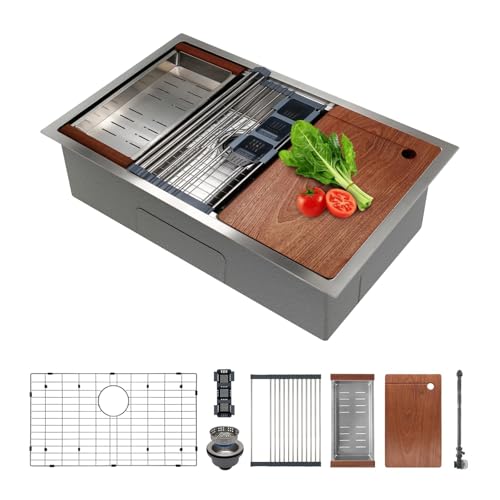
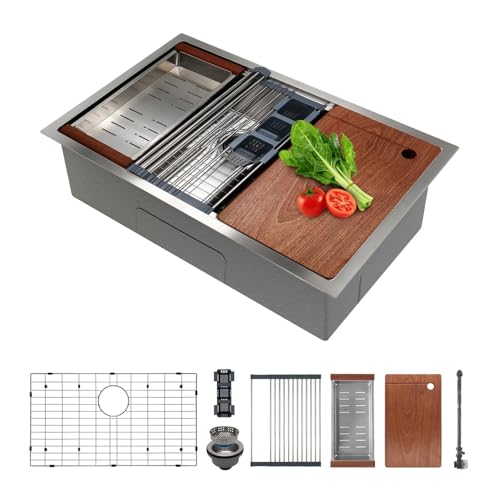
SANYCASA 30 Inch Undermount Kitchen Sink — 11 Gauge Stainless Steel Workstation
Badge: Best Overall SS
Strengths
- 11 gauge (3mm) stainless steel — the thickest ss in this guide by a wide margin; dents, flex and ring are all but designed out.
- Integrated ledge turns the bowl into a workstation with accessories riding over the sink.
- Standard 30 inch single bowl: the mainstream footprint with commercial-grade substance.
Trade-offs
- Heavy steel means a heavy sink — undermount support and a helper are part of the plan.
- The ledge narrows the bowl’s top opening slightly; the largest pots still angle in.
- Over-built for genuinely light-use kitchens, which will never cash its durability.
Mini spec box
- Size: 30 inch width, undermount
- Material / gauge: stainless steel, 11 gauge (3mm)
- Bowl: single bowl, integrated ledge workstation
- Drain: Superior Drain design (per manufacturer title)
The SANYCASA is what stainless steel looks like when the gauge question is answered with both hands. Eleven gauge — a full 3mm of steel — is territory residential sinks almost never visit, and living with it reframes what ss can be: a bowl floor that does not notice a cast-iron skillet arriving, walls with a damped, knock-like voice instead of a ring, and a general sense that the sink is part of the building rather than an appliance in it. For heavy-use households, that is not luxury; it is the end of a category of worry. Our Best Stainless Kitchen Sinks For Heavy Use research ranks this construction at the top for exactly that reason.
The workstation ledge completes the design’s argument. Rails formed into the bowl carry boards, racks and colanders over the water, so the standard 30 inch footprint works in two layers and prep flows across the sink instead of competing for counter. Paired with the steel’s mass, the ledge accessories sit with unusual stability — nothing rattles on 3mm rails — and the whole station feels like a piece of commercial equipment that happens to live in a home.
Who should not buy it: light-use kitchens paying for durability they will never test, and any installation whose cabinet or counter support is questionable — this sink’s weight must be carried properly, full stop. For everyone else in the ss market, it is the summit of the material in this guide: the thickest steel, a working ledge, a standard footprint. If your budget reaches it, the search can honestly stop here.
Best for: heavy-use family kitchens that want the most substantial stainless sink available / Not suited for: light-use kitchens or installations with doubtful support

KRAUS KHU100-30 — 30 Inch 16 Gauge TRU16 Undermount Sink
Badge: Best Classic SS
Strengths
- The category’s reference recipe: 16 gauge TRU16 stainless, the gauge-grade combination the quality mainstream is built on.
- NoiseDefend pads deaden the bowl; rounded corners and channel grooves keep it clean and draining.
- Standard 30 inch size with sheet-pan capacity — the ss default, done properly.
Trade-offs
- No ledge and no bundled grid — a classic bowl, accessorised by you.
- Single bowl format only.
- Its very correctness is unglamorous next to the workstation and fireclay theatre elsewhere in this guide.
Mini spec box
- Size: 30 inch width, undermount
- Material / gauge: TRU16 stainless steel, 16 gauge
- Bowl: single bowl, rounded corners
- Features: channel grooves for draining, NoiseDefend soundproofing pads
Ask what a stainless steel kitchen sink should be, in the abstract, and the KHU100-30 is the answer the category gives. Sixteen gauge TRU16 steel — thick enough to resist dents and sound composed, light enough to install without ceremony. A 30 inch single bowl that fits the standard cabinet and the standard sheet pan alike. Rounded corners that a sponge sweeps in one motion, drainage grooves that keep the floor moving water instead of filming it, and NoiseDefend padding that takes the ring out of the steel’s voice. Nothing is missing and nothing is showing off; it is the platonic ss sink, manufactured.
That correctness compounds over years of ownership. The finish settles into the even patina all good stainless develops, the corners never become the grime archaeology that tight-radius bowls can, and the size never argues with a new pan or a holiday load. In the aggregate owner feedback for this long-running model, the recurring theme is absence — of complaints, of surprises, of the sink ever being the topic at all — which for a fixture you use twenty times a day is the highest available praise.
Choose it when the brief is simply “the best standard ss sink” and the kitchen is a normal, busy one. Choose the SANYCASA when you want to spend past correctness into substance, the cozhao when value leads, and the MAYESAR when the cabinet is smaller. The KHU100-30’s role in this guide is the benchmark the others are measured against — and benchmarks earn that status by being right about everything that matters.
Best for: most households wanting the definitive mainstream stainless sink / Not suited for: workstation seekers or cabinets below the standard minimum

cozhao 30 Inch Undermount Kitchen Sink — 18 Gauge 304 Stainless Steel
Badge: Best Value SS
Strengths
- Named 304 stainless steel — the grade that matters for corrosion resistance — at the value end of the ss market.
- Full 30 inch handmade single bowl with modern, crisp geometry; nothing about the size is value-tier.
- Drain assembly included in the box.
Trade-offs
- 18 gauge is the lightest steel here: more flex, more ring, sooner denting under abuse.
- Handmade corners need a deliberate wipe to stay pristine.
- No grid bundled; plan one to protect the floor’s finish.
Mini spec box
- Size: 30 inch width, undermount
- Material / gauge: 304 stainless steel, 18 gauge
- Bowl: single bowl, handmade modern design
- Included: drain assembly
The cozhao teaches the right lesson about where value in ss actually lives. It economises on gauge — 18, the light tier — and refuses to economise on the two things that cannot be upgraded later: the alloy and the dimensions. The verified title names 304 stainless steel, the chromium-nickel grade whose corrosion resistance is the entire point of the material in a wet, salty, acidic bowl; a sink can be thick and still rust if the grade is wrong, and this one is right. And the bowl is a full 30 inch handmade single, with the crisp modern geometry that usually signals a higher tier, plus the drain assembly in the box so the project’s true cost is visible up front.
Living with it is a fair trade honestly entered. The steel is livelier — a firm pan landing flexes the floor slightly, running water sounds brighter, and the surface will record hard use sooner than the 16 gauge picks. A bottom grid, the standard ss companion, answers most of that in one purchase: loads spread, impacts soften, the floor’s finish is protected through the years when a new sink scratches fastest. For couples, first homes, rental upgrades done properly and second kitchens, the arithmetic is compelling: correct grade, full size, tailored looks, and the savings available for the faucet you touch every day.
Heavy-use families should step up to 16 gauge without resentment — the upgrade path inside ss is exactly what this guide’s ladder is for. But nobody should skip the cozhao’s tier out of snobbery about the number 18: in the right household it is not a compromise sink, it is the correctly specified one. Grade right, size right, price honest — that is a value pick with its priorities in order.
Best for: value-led remodels, first homes and lighter-use kitchens wanting proper 304 steel at full size / Not suited for: cast-iron-heavy households that will feel the light gauge daily

MAYESAR 28 Inch Undermount Kitchen Sink — 16 Gauge, 28 x 18
Badge: Best Compact SS
Strengths
- Full 16 gauge stainless in a 28 x 18 inch footprint — compact in width only, not in substance.
- 9 inch depth keeps a smaller bowl splash-controlled and stackable.
- Round corners and brushed finish: easy cleaning, honest wear.
Trade-offs
- The largest sheet pans rest at an angle rather than flat.
- Brushed finishes show water spotting more readily than satin.
- Less comfortable for simultaneous two-person wash-up.
Mini spec box
- Size: 28 x 18 inch, undermount
- Material / gauge: stainless steel, 16 gauge
- Bowl: single bowl, 9 inch deep, handmade
- Finish: brushed, round corner design
Compact ss sinks have a shabby tradition of being compact in every way — thinner steel, shallower bowls, apologetic construction — as if a smaller cabinet implied a smaller commitment. The MAYESAR breaks the tradition cleanly. Its footprint is 28 x 18 inches for the cabinets that cannot take 30, and everything else is full-size thinking: 16 gauge steel, a proper 9 inch depth that keeps faucet spray inside the bowl and lets a real wash-up stack, and round corners that wipe clean in one pass. It is the ss sink for galley kitchens, condos and older homes that refuse to accept a lesser material life for a two-inch difference.
The brushed finish suits the brief. In a compact, hard-working bowl, a brushed surface hides the small scuffs of daily use within its grain and asks only for a wipe to look intentional; it will show water spots between wipes, as brushed finishes honestly do, and in exchange it never shows the swirl-map that a mirror finish would. Paired with the depth, the whole sink has a workmanlike completeness that bigger kitchens spend more to achieve.
The boundary is purely dimensional: the biggest sheet pans angle rather than lie flat, and two cooks washing together will negotiate elbows. If your cabinet takes 30 inches, buy 30 inches — the MAYESAR exists for the kitchens where the tape measure has already decided, and for those kitchens it is not the consolation prize but the correct specification: real ss, real gauge, real depth, at the size that fits. Compact-kitchen planners will also want our undermount-focused survey in Best Stainless Kitchen Undermount Sinks.
Best for: smaller cabinets and compact kitchens that refuse to compromise on steel quality / Not suited for: wide cabinets with daily sheet-pan washing
Comparison Table
| Pick | Size | Material / gauge | Standout trait | |
|---|---|---|---|---|
| Miuara Farmhouse 30 (fireclay) | 30 x 18 inch | White fireclay | Non-steel alternative — prose-only | Reviewed above |
| Miuara Farmhouse 33 (fireclay) | 33 x 18 inch | White fireclay | Large non-steel alternative — prose-only | Reviewed above |
| SANYCASA Workstation 30 | 30 inch | Stainless, 11 gauge (3mm) | Thickest steel, workstation ledge | Check on Amazon |
| KRAUS KHU100-30 | 30 inch | Stainless TRU16, 16 gauge | Classic recipe, NoiseDefend pads | Check on Amazon |
| cozhao Undermount 30 | 30 inch | 304 stainless, 18 gauge | Right grade at value tier | Check on Amazon |
| MAYESAR Undermount 28 | 28 x 18 inch | Stainless, 16 gauge | Compact size, full gauge and depth | Check on Amazon |
How to Choose an SS Kitchen Sink
Work the specification in the order it affects your decade: grade, gauge, geometry, finish. Grade is the corrosion question — 304 stainless, named outright in the cozhao’s title, is the alloy benchmark for kitchen sinks, with the chromium and nickel content that keeps a wet bowl from tea-staining and pitting; branded equivalents like KRAUS’s TRU16 line stake their reputation on the same territory. If a listing will not say what its steel is, that silence is information. Gauge is the substance question: 16 for durability and composure, 18 for value in lighter service, and specialty thicknesses like 11 gauge for households that want the question closed permanently.
Geometry decides the daily feel. Pressed bowls with rounded corners (the KHU100 pattern) clean fastest and forgive the most; handmade bowls with crisp, near-square corners look architectural and hold slightly more, at the cost of deliberate corner wiping. Depth around 9 inches is the splash-and-stack sweet spot. Drain position and grooves matter quietly: a floor that sheds water dries clean, while a floor that ponds films and spots.
Finish is the cosmetic contract. Brushed finishes hide wear within their grain and show water spots; satin finishes balance the two; all stainless develops fine scratches that merge into an even patina — a process our Best Ss Kitchen Sinks Scratching guide covers in the depth it deserves, including the grid habits that slow it. And keep the fireclay question honest in your own deliberation: if the apron-front look and ceramic silence call to you, they are a legitimate different answer — just buy them as what they are, in a project that can support them, rather than as a substitute line in an ss shortlist. One last check belongs in every ss purchase, whatever the tier: open the box before the countertop appointment, lay a straight edge across the flange, run a hand over the bowl floor for transit dents, and confirm the drain opening and included hardware match your plan. Five minutes of inspection at home is free; the same discovery on installation day costs a reschedule and a real, entirely avoidable installation headache.
How to Install and Care for a Stainless Steel Sink
Installation essentials. Undermount ss sinks bond and clip to the counter’s underside with mechanical support carrying the load; the flange must sit flat and fully sealed, and the assembly should cure before a disposer hangs from it. Check the sink for transit damage and flange flatness on arrival — steel this thin at the rim can be bent by a dropped carton corner, and a bent flange will never seal or sit right. Confirm drain alignment with your disposer and trap before the sealant stage, while adjustments are still free.
Daily and weekly care. Rinse after use, wipe down when you can, and dry the bowl when the day allows — most “stainless maintenance” is really water-spot management, and it is optional cosmetically. Clean with mild detergent or a baking-soda paste on a soft cloth, always with the grain. Never use steel wool or undiluted bleach; rinse grit off pan bottoms before they slide across the floor; keep the bottom grid in place if you have one. Once in a while, a stainless-specific cleaner restores the factory brightness in minutes.
Troubleshooting. Problem: rust-coloured spots appear → they are almost always surface contamination (a wet steel can or wool pad left in the bowl) rather than the sink rusting; clean with a baking-soda paste and the spots lift with the contaminant. Problem: the bowl looks scratched within weeks → normal early patina formation; the fine lines blend into uniformity with time and grid use slows new ones. Problem: water films and spots persist → check the floor’s drainage and your water hardness; a final rinse-and-wipe habit, or a water softener upstream, ends the cycle.
Why Stainless Won: A Short Material History for Shoppers
Stainless steel’s dominance is not fashion; it is an accumulation of practical victories. It replaced enamelled cast iron by being a fraction of the weight with none of the chipping glaze, replaced early plastics by ignoring boiling water and pan heat entirely, and outlasted composite fashions by being the material commercial kitchens — the harshest testing ground on earth — never stopped specifying. A material that survives restaurant service, where sinks are abused by professionals at volume, brings a presumption of competence to the home that no newcomer has matched.
Its modern refinement has been in the details this guide keeps returning to: pad systems that civilised its voice, handmade fabrication that sharpened its looks, ledges that turned it into a workstation, and gauge offerings from honest value to the SANYCASA’s near-commercial plate. The fireclay revival is real and, for the right kitchen, right — ceramic’s quiet and presence are genuine goods. But note what fireclay asks in return: structural cabinets, careful handling, a style commitment. Stainless asks for a wipe. For most households, in most decades, that exchange rate is why the ss shelf is the long one in every showroom, and why this guide’s four linked picks will still look like the safe centre of the category in ten years. Materials fashions will keep arriving — composites, ceramics, coatings — and each will win its kitchens honestly; stainless simply starts every one of those contests holding the titles for weight, toughness, hygiene and price-spread simultaneously, a combination no challenger has yet assembled in a single bowl.
SS Finishes Compared: Brushed, Satin and the Handmade Look
Finish is where stainless stops being a specification and becomes a daily visual experience, and the choices behave differently enough to matter. A brushed finish carries a directional grain that absorbs small scuffs into itself — the MAYESAR wears it — at the price of showing water spotting more readily between wipes, since dried droplets sit visibly on the grain’s matte field. A satin finish, the KHU100’s territory, splits the difference: smoother and slightly more reflective, it sheds spots a little better and shows scratches a little more honestly until the patina evens them out. Neither is superior; they are different treaties with the same two facts of stainless life, water and wear, and the right choice is the treaty whose cost you mind less.
Construction style overlays the finish question. Pressed bowls, formed from a single sheet, carry the generous rounded corners that clean fastest and suit the classic ss look. Handmade bowls, fabricated from cut and welded sheet, deliver the crisp, near-square geometry of contemporary kitchens — the cozhao and the SANYCASA’s ledge design live here — with flat floors and tailored walls that photograph beautifully and ask for a deliberate corner wipe in exchange. In both styles the steel is the same family of material; what changes is the maintenance rhythm and the visual temperature of the room. Choose with your cleaning habits, not just your eyes: the sink you wipe happily is the sink that looks good in year five.
Pairing an SS Sink With Counters, Faucets and Appliances
Stainless is the great mediator of kitchen materials, which is part of why it won. Against stone and quartz it reads as professional equipment; against timber it warms into farmhouse-modern; against white cabinetry it disappears into brightness, and against dark cabinetry it provides the one reflective note that keeps the room awake. Few pairings genuinely fail, but two deserve thought. A mirror-bright ss finish beside brushed-nickel hardware can clash in undertone — match the faucet’s finish family to the sink’s, or deliberately contrast with matte black, which stainless accommodates gracefully. And in a kitchen already full of stainless appliances, a handmade sink’s crisper geometry distinguishes the sink zone from the appliance wall better than another pressed curve would.
The faucet pairing is functional as well as visual: the spout’s reach should land water near the bowl’s centre, its height should clear your tallest pot, and its spray head — the tool that actually washes a single bowl — should feel like the main event rather than an afterthought. In ss kitchens the pull-down faucet has become the default for good reason: it turns the whole bowl into a washable surface and rinses the corners that fixed streams miss. Buy the sink and faucet as one decision and the pair will feel designed; buy them months apart from different logics and the seam shows every day.
Common Buying Mistakes
- Buying “stainless” without a grade. If the listing will not name its alloy, assume the economy grade and price your expectations accordingly; 304 or a reputable branded line is the standard to hold.
- Reading gauge backwards. Lower numbers are thicker steel. An 18 gauge sink is lighter than a 16, whatever the marketing adjectives say.
- Expecting a scratch-free life. All stainless scratches and then patinas evenly; choose your finish and grid habits for the process instead of fighting it.
- Comparing a fireclay price to an ss price as if they were one category. The cabinet work, support and installation around fireclay belong in its true cost.
- Letting the bowl outrun the cabinet. Even in ss, size is governed by the base cabinet’s minimum — measure before the heart decides.
- Skipping the grid to save a little. In stainless ownership the grid is finish insurance, noise control and load-spreading in one inexpensive object.
Final Recommendation
For the definitive mainstream ss purchase, take the KRAUS KHU100-30: 16 gauge TRU16 steel, NoiseDefend pads, easy-clean corners and the standard 30 inch footprint — the recipe the category itself would choose. If your household is hard on equipment and the budget allows, the SANYCASA 30 Inch Workstation Sink is the same idea in 11 gauge with a working ledge, and it is this guide’s pick of picks. Value-led buyers should take the cozhao’s correct 304 grade at full size, smaller cabinets the MAYESAR’s full-gauge 28, and farmhouse dreamers should follow the Miuara reviews honestly — as a different material, in a project built for it. Stainless earned its dominance one practical victory at a time; buy the version of it that matches your kitchen’s demands and it will repay you daily.
Frequently Asked Questions
What does “ss” mean when shopping for kitchen sinks?
It is the trade and listing shorthand for stainless steel. When a keyword or a category says ss, it is specifying the material — which is why this guide treats material as the core attribute: the four linked picks are all stainless steel, and the two fireclay sinks in the pool are reviewed prose-only as the non-ss alternative.
What is the best grade of stainless steel for a kitchen sink?
304 is the benchmark alloy for residential sinks — the grade named in the cozhao’s verified specification — offering the corrosion resistance a wet, salty bowl demands. Branded lines such as KRAUS TRU16 compete in the same territory. The practical rule: buy a sink whose grade is stated, and be wary of listings that hide behind the word “stainless” alone.
Which is better, 16 gauge or 18 gauge?
Sixteen gauge is thicker, deader-sounding, more dent-resistant and the right default for family kitchens. Eighteen gauge is lighter and less expensive, entirely serviceable in lighter-use homes, especially over a grid. The SANYCASA’s 11 gauge shows how far the principle extends — but for most buyers the 16 versus 18 decision is the real one, and it should be made by how hard your household lands its pans.
Does stainless steel rust?
Proper 304 stainless in normal kitchen service does not rust through; the rust-coloured spots owners occasionally see are surface contamination from other steel objects left wet in the bowl, and they clean off with a baking-soda paste. Chloride abuse — undiluted bleach left standing, steel wool scrubbing — can mark any stainless, which is why the care rules in this guide are short and worth following.
Will a stainless sink scratch, and can I prevent it?
It will scratch — every stainless sink does — and the scratches blend into an even patina that most owners stop noticing within the first year. You manage the process rather than prevent it: a bottom grid, rinsing grit off pan bottoms, lifting rather than dragging cast iron. Our dedicated scratching guide covers the full picture, including which finishes show the process least.
Stainless steel or fireclay — which should I choose?
Stainless for lightness, format choice, easy installation in standard cabinets and all-round toughness at any tier. Fireclay for inherent quiet, a spot-free glazed surface and farmhouse presence — at the cost of weight, cabinet engineering and chip risk. They are both legitimate; they are not interchangeable, which is why this guide reviews the fireclay pair honestly but links only the steel.
How long does a stainless steel sink last?
Decades, in normal service — stainless sinks routinely outlast the countertops and cabinets around them, and the material does not wear out so much as accumulate patina. Gauge and grade decide the cosmetic trajectory: heavier, better-grade steel looks composed for longer. It is one of the few kitchen purchases where “buy once” is a literal description of most owners’ experience.
Is a stainless sink a good match for a busy family kitchen?
It is the match the category was built around. Stainless takes boiling water, frozen food thawing, cast iron, dye-heavy foods and the general percussion of family cooking without a care protocol for any of them, and its surface is non-porous and hygienic in the way health-conscious households want at the exact station where food is washed. Choose 16 gauge for the full family treatment, keep a grid in the bowl, and the sink becomes the kitchen’s least demanding major fixture — which, in a busy house, is the highest compliment a material can earn.