Disclosure: topratedkitchenware.com is reader-supported. When you buy through links on our site, we may earn an affiliate commission from Amazon and other retailers, at no extra cost to you.
Where to buy
The six sinks below are the verified picks behind this guide to the best sinks for kitchen islands — bowls chosen for the visibility, plumbing, and social geometry that make island installation different from a wall run. Each name links to its Amazon listing, where you can check the latest price on Amazon, confirm dimensions and inclusions, and read the newest owner feedback. Start with the island pick that does the most jobs at once: Check on Amazon.
- SANYCASA 30 Inch Undermount Workstation Kitchen Sink, 11 Gauge
- KRAUS KHU100-30 30 Inch 16 Gauge Undermount Kitchen Sink
- cozhao 30 Inch Undermount Kitchen Sink, 18 Gauge 304 Stainless Steel
- MAYESAR 28 Inch Undermount Kitchen Sink, 16 Gauge
- KRAUS KWU110-32 32 Inch Undermount Workstation Kitchen Sink
- KRAUS KHU100-32 32 Inch 16 Gauge Undermount Kitchen Sink
Read the full guide ↓ for the island-specific decisions — main sink or prep sink, seating clearances, floor-routed plumbing and venting, and the workstation logic that islands reward more than any other location in the kitchen.
An island sink lives a different life from a wall-run sink, and the best sinks for kitchen islands are chosen by different rules. The bowl faces the room, so it is on display from every seat. It often shares the island with stools, which means splashes and knee space enter the design. Its plumbing arrives through the floor rather than the wall, and its venting needs a deliberate answer. And because the island is where cooks perform for an audience — family on stools, guests with glasses in hand — the sink’s workflow matters socially as well as functionally: prep should face the conversation, and cleanup should not turn its back on the room. This guide compares six verified undermount single bowls from 28 to 32 inches and reads each one through that island lens.
The six picks divide into island roles. Two are workstations whose ledges convert the bowl into a prep stage — the format islands reward most, because island counters are shared with seating and serving and every square inch of dedicated prep surface counts double. Two are plain rounded bowls that keep the island calm and easy to clean. One is a compact 28 inch bowl for small islands and secondary prep positions, and one is a value-tier 30 inch bowl for islands built on a budget. Around the reviews you will find a comparison table, a buying guide on island sizing and placement, and a how-to layer covering island installation realities, venting questions to raise with your plumber, and the daily routine of a sink that lives in public view. If the island is part of a larger project, our renovation guide at Best Sinks For Kitchen Renovation places these same decisions inside a full-kitchen timeline.
Key Takeaways
- Decide the island sink’s job first: a main sink needs a 30–32 inch bowl; a prep or secondary sink can thrive at 28 inches.
- Workstation ledges earn more on islands than anywhere else, because island counter space is shared with seating and serving.
- All six picks are undermount, which keeps the island’s counter line clean and lets crumbs sweep straight into the bowl.
- Island plumbing comes through the floor and needs a venting plan — raise island vent options with your plumber before cabinets are set.
- Protect seating: bowl position, faucet height, and depth decide whether stool sitters get splashed; deeper bowls splash less.
- Measure the island’s cabinet, not just its countertop; island bases are often narrower than the stone above them suggests.
In this guide
Quick Picks
| Pick | Badge | Size and build | Link |
|---|---|---|---|
| SANYCASA 30 Inch Workstation Sink | Best Overall for Islands | 30 inch, 11 gauge (3mm) stainless, integrated ledge workstation | Check on Amazon |
| KRAUS KHU100-30 | Best for Easy Cleaning | 30 inch, 16 gauge TRU16 steel, rounded corners, NoiseDefend pads | Check on Amazon |
| cozhao 30 Inch Undermount Sink | Best Value Pick | 30 inch, 18 gauge 304 stainless steel, drain assembly included | Check on Amazon |
| MAYESAR 28 Inch Undermount Sink | Best for Small Islands | 28 x 18 inch, 16 gauge, 9 inch deep, brushed finish | Check on Amazon |
| KRAUS KWU110-32 Workstation Sink | Best Large Workstation | 32 inch, 16 gauge TRU16 steel, ledge, cutting board and roll-up rack included | Check on Amazon |
| KRAUS KHU100-32 | Best for Large Islands | 32 inch, 16 gauge TRU16 steel, rounded corners, NoiseDefend pads | Check on Amazon |
Notice the pattern: no drop-ins, no divided bowls, nothing that interrupts the island’s surface or its workflow. The island is prime real estate, and every pick here treats it that way. Shoppers still working out whether the island takes the main sink at all will find the sizing logic expanded in our guide to Best Size Kitchen Sinks.
How These Picks Were Chosen
We screened the verified undermount field against island criteria specifically, not general sink criteria. First, format: single bowls only, because an island sink alternates between prep, washing, and staging within a single meal, and a divider fights all three. Second, workflow: workstation models were weighted up, because the island’s shared counter makes over-sink prep disproportionately valuable. Third, presence: an island bowl is visible from seated eye level across the room, so finishes that stay calm under scrutiny — brushed steel, even lines — were favoured over anything fussy. Fourth, the unglamorous filters applied everywhere in this programme: stated gauge, drainage design, sound treatment, and inclusions verified from product data, with owner feedback read for the complaints island owners actually file — splash reach, noise in an open plan room, and ledges that collect crumbs in public view.
One limit deserves stating: no sink choice can fix an island’s infrastructure. If the rough plumbing, venting, or electrical layout is wrong, the best bowl in this guide will still disappoint, which is why the how-to section spends as much time on what happens under the island as in it. This is a research-led guide; performance claims rest on verified specifications and reported owner experience, not on invented laboratory testing.
The 6 Best Sinks for Kitchen Islands
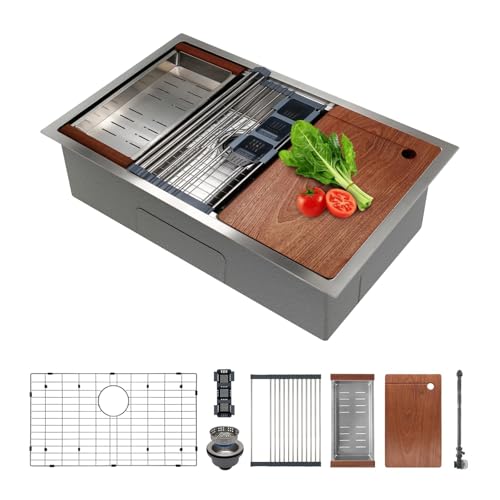
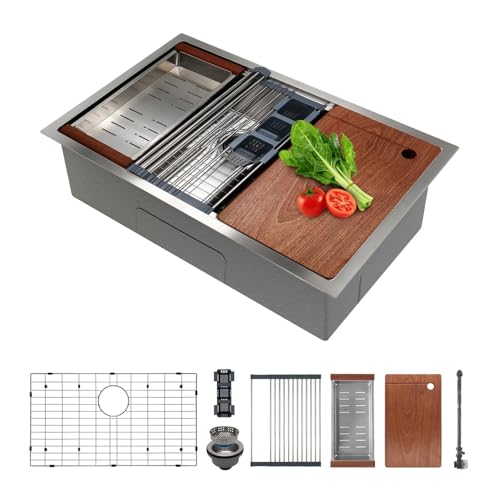
SANYCASA 30 Inch Undermount Workstation Kitchen Sink
Badge: Best Overall for Islands
Strengths
- Integrated ledge turns the island bowl into a prep stage facing the room.
- 11 gauge (3mm) stainless steel — commercial-grade solidity that reads as quality up close.
- 30 inch footprint fits standard island cabinets while doing main-sink duty.
Trade-offs
- Heavy undermount; island cabinet support must be planned, not assumed.
- Ledge tracks need a wipe routine, in full view of your guests.
- Premium positioning for the steel.
Mini spec box: Mount: undermount. Size: 30 inch. Material: stainless steel, 11 gauge (3mm). Bowl: single bowl with integrated ledge. Style: multifunctional workstation set.
The SANYCASA is the island sink as centrepiece appliance. On an island, the workstation ledge stops being a convenience and becomes the layout’s engine: produce is rinsed in the bowl, chopped on the board above it, and staged on the ledge while the island’s counter stays clear for serving and for the audience’s elbows. The cook faces outward the entire time, which is the social geometry islands are built for. Underneath the workflow, the 11 gauge (3mm) steel gives the installation a density that guests register subconsciously — nothing flexes, nothing rings, and the disposal’s work stays a murmur in an open-plan room where a thin bowl would broadcast it.
The island-specific cautions are weight and visibility. A 3mm steel undermount must hang from real support inside the island cabinet, and that support belongs in the cabinet plan, not in an install-day improvisation. And because the bowl is on stage, the ledge’s tracks join your visible cleaning routine; a ten-second wipe after prep keeps the stage set. For households whose island is the kitchen’s true centre — cooking, homework, coffee, conversation — this is the pick that treats the sink as the island’s main event rather than its utility corner.
Best for: islands that serve as the kitchen’s main prep and social hub. / Not suited for: lightly built island cabinets or buyers who dislike ledge upkeep.

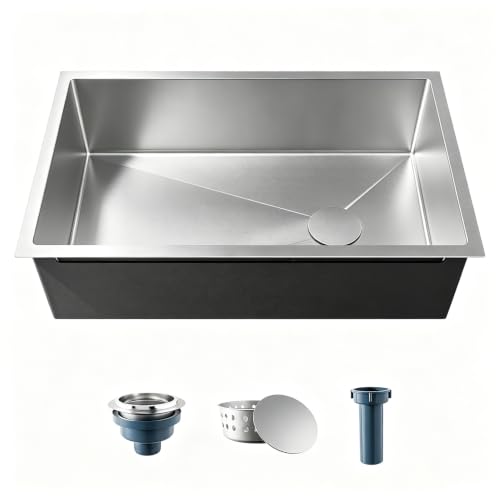
KRAUS KHU100-30 30 Inch Undermount Kitchen Sink
Badge: Best for Easy Cleaning
Strengths
- Rounded corners wipe clean in one pass — vital for a bowl on public display.
- 16 gauge TRU16 steel with NoiseDefend pads keeps open-plan noise down.
- Channel grooves move water to the drain, so the visible bowl dries evenly.
Trade-offs
- No workstation ledge; prep happens on the island counter.
- Grid and accessories are separate purchases.
- Plain design; it calms an island rather than starring on it.
Mini spec box: Mount: undermount. Size: 30 inch. Material: 16 gauge TRU16 stainless steel. Bowl: single bowl, rounded corners. Features: channel drain grooves, NoiseDefend sound pads.
Not every island wants a stage. In kitchens where the island is primarily seating, serving, and homework — with the heavy cooking happening along the wall — the sink’s best quality is discretion, and the KHU100-30 is the discreet professional. Its rounded corners and drain grooves mean the bowl that guests see is a bowl that always looks recently cleaned, because it nearly always is: a single sponge pass restores it. The NoiseDefend treatment matters doubly in open-plan spaces, where a disposal’s growl travels to the sofa; here it stays a background event.
At 30 inches in 16 gauge TRU16 steel, it still does full main-sink duty when the island carries the kitchen’s only sink — sheet pans fit, stockpots fill, and the single bowl handles a dinner party’s washing in stride. What it will not do is host prep over the bowl, and island cooks who chop and rinse in sequence should step to a workstation pick instead. For the island-as-table layout, though, this calm, quiet, easy-clean bowl is the connoisseur’s choice, and its restraint tends to age better than any statement format.
Best for: seating-centred islands and open-plan kitchens that prize quiet and calm. / Not suited for: cooks who prep over the sink.

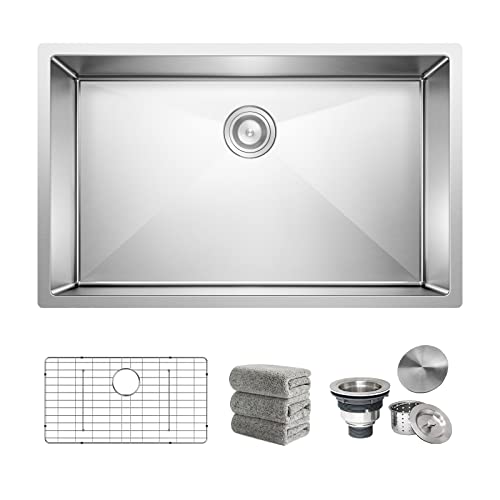
cozhao 30 Inch Undermount Kitchen Sink, 18 Gauge 304 Stainless Steel
Badge: Best Value Pick
Strengths
- Main-sink size and format at a value tier: 30 inch undermount single bowl in 304 stainless.
- Drain assembly included, simplifying an island install’s parts list.
- Handmade modern profile looks sharp against island stone.
Trade-offs
- 18 gauge steel is more audible in an open-plan room than the padded 16 gauge picks.
- Squared corners need a brush routine — visible corners, on an island.
- No grid included to protect the floor or damp contact noise.
Mini spec box: Mount: undermount. Size: 30 inch. Material: 18 gauge 304 stainless steel. Bowl: single bowl, handmade modern styling. Included: drain assembly.
Islands consume budgets — stone, cabinets, floor plumbing, seating — and the cozhao is the pick for the island that needs a real main sink without letting the bowl become another premium line item. It keeps the essentials intact: the full 30 inch single bowl format, 304 grade stainless, a handmade profile that looks intentional against a waterfall countertop, and the drain assembly in the box, which trims the parts coordination that island installs, with their floor-routed plumbing, particularly reward.
The value shows up where island life is least forgiving: sound and corners. An 18 gauge bowl in an open-plan room announces the disposal more than the padded Kraus picks do, and squared handmade corners sit in the room’s sightline, where their cleaning routine is public. Both are manageable — a grid damps contact noise and protects the floor, and a soft brush keeps corners honest — and neither diminishes the bowl’s core competence at washing, rinsing, and staging. For a budget island, a rental with an island layout, or a first phase of a phased kitchen, this is the rational centre of the island market.
Best for: budget-conscious islands that still need a full-size main sink. / Not suited for: noise-sensitive open plans or buyers who want rounded corners.

MAYESAR 28 Inch Undermount Kitchen Sink
Badge: Best for Small Islands
Strengths
- 28 x 18 inch footprint fits modest island bases and secondary prep positions.
- 16 gauge steel and a 9 inch deep bowl: splash control that protects stool sitters.
- Brushed finish and round corners keep a visible bowl low-maintenance.
Trade-offs
- As a main sink, the narrower floor makes the largest pans a tighter fit.
- Deep bowl plus disposal is a snug stack in a small island cabinet.
- Less staging room than the workstation formats.
Mini spec box: Mount: undermount. Size: 28 x 18 inch. Material: 16 gauge stainless steel. Bowl: single bowl, 9 inch deep, handmade. Finish: brushed, round corner.
Small islands and second-sink islands are where sink sizing gets honest, and the MAYESAR is built for exactly that honesty. At 28 inches it fits the modest island base that a 30 inch bowl would crowd, and its specification refuses the usual compact compromises: 16 gauge steel, a genuinely deep 9 inch bowl, and round corners that keep a publicly visible sink easy to maintain. As a prep sink at the island’s end — produce rinsed where it will be chopped, a water source where the cook actually stands — it is close to ideal.
The depth does double duty on an island. It contains the faucet’s splash in the direction that matters most — toward the seating side — and it lets tall pots fill without looming over the rim where guests can see the wobble. Households using it as a main sink in a small-island kitchen should accept the one geometric truth: the widest pans sit at a slight angle. Everyone else — the two-sink kitchens, the compact islands, the prep-position planners — gets a sink whose quality is a tier above its size class, which is precisely what a small island deserves, since its sink is proportionally more visible than a big island’s.
Best for: small islands, prep positions, and two-sink kitchens. / Not suited for: sole-sink duty for oversized-pan households.

KRAUS KWU110-32 32 Inch Undermount Workstation Kitchen Sink
Badge: Best Large Workstation
Strengths
- Full workstation system — ledge, cutting board, roll-up rack — included and island-ready.
- 32 inch single bowl in 16 gauge TRU16 steel with NoiseDefend soundproofing.
- Converts island prep into a performance the room can watch comfortably.
Trade-offs
- Needs a wide island cabinet; many islands are narrower than their counters suggest.
- Ledge and accessories add visible upkeep.
- Premium tier.
Mini spec box: Mount: undermount. Size: 32 inch. Material: 16 gauge TRU16 stainless steel. Bowl: single bowl with integrated ledge. Included: cutting board, roll-up rack. Features: NoiseDefend soundproofing.
On a large island, the KWU110-32 is the fullest expression of what an island sink can be. The workstation ledge stretches the prep zone across 32 inches of bowl: board over the basin for chopping, roll-up rack for staging and drying, and the whole sequence performed facing the room, with waste falling into the sink rather than migrating across the stone. The included accessories matter here even more than on a wall run, because island prep is public prep — a system that works from day one, with board and rack fitted to the ledge, keeps the performance smooth instead of improvised.
The bowl beneath is a serious 32 inch single volume in 16 gauge TRU16 steel, sound-treated for open-plan politeness. The gates are physical: the island cabinet must genuinely fit a 32 inch undermount — measure the base, not the overhanging stone — and the plumbing and disposal stack must be planned for the island’s floor-routed layout. Islands that clear those gates, in kitchens where cooking is the household’s entertainment, will find this the most capable and most enjoyed sink in the guide. Smaller islands should take the same idea at 30 inches in the SANYCASA, and small-island owners working with compact footprints will find kindred thinking in our guide to Best Small Kitchen Sinks.
Best for: large islands in cook-centric, open-plan kitchens. / Not suited for: narrow island bases or low-upkeep briefs.

KRAUS KHU100-32 32 Inch Undermount Kitchen Sink
Badge: Best for Large Islands
Strengths
- 32 inch rounded-corner bowl: maximum washing room with minimum cleaning effort.
- 16 gauge TRU16 steel, channel grooves, and NoiseDefend pads for open-plan manners.
- Calm, plain design that suits islands used heavily for seating and serving.
Trade-offs
- No workstation ledge.
- Wide cabinet required.
- Accessories, including the grid, are separate decisions.
Mini spec box: Mount: undermount. Size: 32 inch. Material: 16 gauge TRU16 stainless steel. Bowl: single bowl, rounded corners. Features: channel drain grooves, NoiseDefend sound pads.
The KHU100-32 is the large island’s plain-bowl answer, for kitchens where the island seats six, serves every buffet, and hosts the neighbourhood’s homework — and where the sink’s job is to absorb enormous washing loads while looking effortlessly tidy. The 32 inch floor takes the party’s roasting pans and trays in one load; the rounded corners and drain grooves return the bowl to a clean, dry, presentable state with a single pass; and the padded 16 gauge construction keeps the cleanup soundtrack low enough for conversation to continue over it.
Choose it over the same-size workstation when your island’s counter is genuinely available for prep — long islands with a cooktop elsewhere often are — and when the household’s centre of gravity is gathering rather than producing. Choose the workstation when prep space is the scarce resource. Both are right; the island’s social programme decides. Either way, confirm the cabinet width and the disposal stack before ordering, because a 32 inch bowl on an island is a commitment the floor plumbing makes semi-permanent.
Best for: large, gathering-centred islands that need big, calm washing capacity. / Not suited for: narrow bases or prep-over-sink workflows.
Comparison Table
| Pick | Size | Gauge | Island role | Link |
|---|---|---|---|---|
| SANYCASA Workstation | 30 inch | 11 gauge (3mm) | Main sink and prep stage | Check on Amazon |
| KRAUS KHU100-30 | 30 inch | 16 gauge | Calm main sink, easy cleaning | Check on Amazon |
| cozhao Undermount | 30 inch | 18 gauge | Value main sink | Check on Amazon |
| MAYESAR Undermount | 28 x 18 inch | 16 gauge | Small island / prep sink | Check on Amazon |
| KRAUS KWU110-32 | 32 inch | 16 gauge | Large workstation stage | Check on Amazon |
| KRAUS KHU100-32 | 32 inch | 16 gauge | Large calm main sink | Check on Amazon |
How to Choose a Sink for a Kitchen Island
Begin with the island’s programme, not with sinks. Write down what the island actually hosts: seating for how many, prep, cooking, serving, a second dishwasher’s worth of washing after gatherings? If the island carries the kitchen’s only sink, shop the 30 to 32 inch main-sink class and treat the choice with main-sink seriousness — gauge, sound treatment, and the workstation question all matter. If a wall sink exists and the island needs a supporting player, the 28 inch MAYESAR’s prep-sink profile is the smarter spend, and the budget difference belongs in the main sink or the faucet.
Placement is the second decision, and it is made in inches. Centre the bowl on the island’s working zone, not necessarily on the island itself; keep the faucet’s swing clear of seating sightlines where you can; and respect the knee space — the bowl and its plumbing live above and inside the cabinet, but a deep bowl plus disposal should not be planned where sitters’ knees need the room beneath an overhang on the other side. Bowl depth is a splash decision on islands: deeper bowls, like the MAYESAR’s 9 inch profile, keep water off the seating side, while shallower bowls ask the faucet’s arc to do that work. Finally, the infrastructure audit: island drains route through the floor, venting needs an island-appropriate solution your plumber approves, and many islands add electrical requirements for disposals and outlets. Settle those before the cabinet order, because the sink is the last and easiest part of an island to choose — and the most expensive to move.
A related planning note concerns who washes at the island after a gathering. In open-plan homes the island sink becomes the social cleanup station: one person washes, another dries from the seating side, and conversation continues across the bowl. That scene argues for two small specifications that cost nothing at ordering time — a faucet with a comfortable single-lever action for the washer, and enough bowl width that the dryer can set finished items on a rack at the bowl’s far end without reaching across the washer’s work. The 32 inch picks stage that scene naturally; the 30 inch workstations stage it with the ledge’s help. It is a small lens, but islands are social machines, and the sink is where their social life gets washed.
How to Install and Live With an Island Sink
Installation mirrors the standard undermount sequence — dry-fit, silicone seal, rail or harness support, cure, then drain and disposal — with island complications layered in. The drain and water lines arrive from below, so the cabinet’s floor and the trap geometry deserve a dry run before the countertop lands. Venting is the island’s signature plumbing question: without a wall to rise through, islands use dedicated venting arrangements that must satisfy your local code, and the time to agree on one with your plumber is at rough-in, not at trim-out. Support matters doubly for the heavy picks: the SANYCASA’s 3mm steel should hang from a planned support system inside the island base.
Living with an island sink is a visibility discipline. The bowl is furniture: wipe it down after prep, dry it after the evening wash, and keep the ledge tracks (on the workstations) on the same quick routine, because a gleaming island bowl reads as the kitchen’s centrepiece and a neglected one reads as its laundry basket. Sound discipline matters too — run the disposal in short bursts with cold water, and let the padded bowls do their quiet work during conversation rather than testing them mid-sentence.
Troubleshooting, island edition: Problem: stool sitters get splashed → check the faucet’s arc height against the bowl depth; a deeper bowl or a lower-arc faucet usually ends it, and a pull-down spray aimed into the bowl beats a tall fixed arc. Problem: the island bowl drains slowly → island traps and long horizontal runs are prone to lazy drainage; have the venting arrangement checked before assuming the sink is at fault. Problem: the bowl looks messy from the seating side → adopt the zone method (soak items in a tub at the far end, keep the near floor clear) and a grid, which visually organises the bowl’s contents. Problem: disposal vibration carries through the island → confirm the sink’s support and the disposal mount; a well-hung padded bowl should murmur, not buzz.
One more infrastructure point belongs in every island plan: the floor itself. Island plumbing penetrates the finished floor, and the cleanest projects coordinate the sink’s drain position with the floor’s structure and finish before either is finalised. On a slab, that coordination can decide the island’s exact position within a small tolerance; over a framed floor, it decides where blocking and access belong. Your plumber and cabinet installer should agree on the drain’s location to the inch before the island is anchored, because a sink — particularly a wide workstation whose drain sits amidships of a large bowl — cannot shuffle sideways once the stone is cut. This is unglamorous, decisive work, and it is the real difference between an island sink that feels inevitable and one that feels negotiated.
Main Sink or Prep Sink? Designing the Two-Sink Island Kitchen
The two-sink kitchen is the island layout’s deluxe form, and it changes what “best” means for the island position. When the wall run carries a full main sink, the island bowl’s job narrows to prep support: rinsing produce where it will be chopped, holding a colander during pasta nights, giving a second cook a water source that does not cross the first cook’s path. That job description rewards the MAYESAR’s compact depth or a workstation’s ledge at modest size, and it punishes oversizing — a 32 inch island bowl in a two-sink kitchen mostly stores air. When the island carries the only sink, the logic inverts completely: the island bowl is the kitchen’s washing headquarters, gatherings and all, and the 30 to 32 inch picks with their sound treatment and pan capacity are the correct scale of ambition.
Households planning from scratch should also weigh the social choreography. A main sink on the island lets the cook wash and prep while facing family and guests — the arrangement most open-plan kitchens are drawn for. A main sink on the wall keeps the island’s surface entirely for gathering and serving, with cleanup turned away from the audience. Neither is objectively better; they are different theories of what a kitchen evening feels like. Choose the theory first, and the sink — its size, its format, its position on this list — follows almost automatically. Full-project planners will find this choreography decision sequenced with cabinets and counters in our remodel guide at Best Sinks For Kitchen Remodel.
Island Finishes and Faucets: Designing for an Audience
An island sink is the only sink most guests will ever look into, which quietly changes the finish calculus. Brushed stainless — the finish across this guide’s picks — is the forgiving choice for public duty: it diffuses light, hides the evidence of a working kitchen between wipes, and pairs with any stone an island is likely to wear. The bowl’s silhouette matters at seated eye level too. Undermount installation keeps the rim invisible and the stone line unbroken, which is why every pick here mounts that way; a drop-in rim on an island reads as an interruption from every stool in the room.
The faucet is the island sink’s visible sculpture, and it should be chosen with the bowl as one composition. Height is the first variable: the arc must clear your tallest pot, but every extra inch of height is splash energy aimed at the seating side and visual bulk in the room’s sightlines. A pull-down spray reconciles the two — a moderate fixed height for looks, with reach and aim on demand for work. Finish coordination is the second variable: the faucet does not need to match the bowl’s steel exactly, but it should belong to the same family of tones as the island’s hardware and lighting, because on an island there is nowhere for a mismatched finish to hide. Finally, consider controls: a single-lever faucet that can be nudged with a wrist during messy prep is worth more on an island, where the cook is performing, than in a private wall run where nobody watches the flour-dusted choreography.
Island Sink Placement Patterns That Work
Three placements account for most successful islands, and each favours different picks from this guide. The centred main sink puts the bowl in the island’s middle with landing counter on both sides; it suits the workstation picks, because prep radiates symmetrically and two people can work the sink from opposite sides during gatherings. The end-position sink pushes the bowl toward one end of the island, consolidating plumbing at the end nearest the wall run and freeing a long uninterrupted stretch of stone for seating and serving; it suits the plain Kraus bowls, whose calm suits a serving island. The corner-offset prep sink, in two-sink kitchens, tucks the smaller MAYESAR-class bowl where the cook’s triangle wants water, leaving the island’s centre for a cooktop or for nothing at all.
What all three patterns share is a refusal to let the sink drift to wherever the cabinet plan had a gap. The bowl’s position decides where the cook stands, where the audience sits relative to splashes and steam, and where the evening’s washing accumulates in view. Decide it deliberately, with the seating plan and the wall kitchen’s layout on the same sketch, and then let the sink’s size follow the position’s logic: centre positions take the workstations, end positions take the calm bowls, and satellite positions take the compact depth of the 28 inch pick. Islands designed in that order — programme, position, product — are the ones whose owners stop thinking about the sink within a month, which is the highest compliment a kitchen fixture can earn.
Common Buying Mistakes
The signature island mistake is measuring the countertop instead of the cabinet: islands wear generous stone overhangs, and a bowl sized to the stone will not fit the base beneath it. Second is forgetting venting until the plumber is standing in the finished kitchen. Third is placing a shallow bowl and a tall faucet opposite seating and baptising the front row at every rinse. Fourth is buying a workstation for an island whose prep actually happens on a wall counter — the ledge becomes expensive staging for mail. Fifth is treating the island sink as a small decision because it is a familiar product; on an island, the sink is plumbed through the floor and sealed under stone, which makes it one of the least reversible choices in the room. Sixth is skipping sound treatment in an open-plan space, where the sink’s acoustics are the whole home’s acoustics.
Final Recommendation
For most islands carrying main-sink duty, the SANYCASA 30 Inch Workstation Sink is the island answer: heavy steel, a ledge that turns prep into the island’s main event, and a footprint standard cabinets accept. Scale the same idea up with the KRAUS KWU110-32 on a genuinely large island, choose the KHU100 bowls when calm and easy cleaning outrank prep theatre, the MAYESAR when the island is small or the sink is the second one, and the cozhao when the island budget needs relief. Measure the base, plan the venting, and let the island’s social programme pick the format.
Frequently Asked Questions
What size sink is best for a kitchen island?
For a main sink, the 30 to 32 inch class suits most islands: large enough for roasting pans and gathering-scale washing, small enough to leave counter for seating and serving. For a prep or second sink, 28 inches is the sweet spot — the MAYESAR’s size — because the job is rinsing and staging rather than volume washing. In all cases the island’s cabinet interior, not its countertop, sets the maximum.
Does an island sink need special plumbing?
It needs planned plumbing. Supply and drain lines route through the floor, and venting — which a wall sink borrows from the wall — requires an island-appropriate arrangement that meets your local code. None of this is exotic, but all of it belongs in the rough-in stage. Discuss the venting approach and the disposal’s electrical supply with your plumber before cabinets are ordered, and the sink install itself becomes routine.
Is a workstation sink good for an island?
It is the format islands reward most, because island counters are shared with seating and serving, so moving prep onto the sink’s ledge returns real surface to the room. The SANYCASA at 30 inches and the KWU110-32 at 32 inches are this guide’s workstation expressions, with the Kraus including its board and rack. If your island prep actually happens elsewhere, a plain bowl is the better buy — the ledge only earns when it is used.
How do I stop island sink splashes from reaching people sitting at the island?
Combine depth, arc, and aim. A deeper bowl contains the stream’s landing; a faucet arc proportioned to the bowl keeps the fall short; and a pull-down spray lets you direct water at items rather than dropping it from height. The 9 inch deep MAYESAR demonstrates the depth principle in this list. Also position the sink so its busiest side is not directly opposite the primary seating where the layout allows a choice.
Can an island sink have a garbage disposal?
Yes, and most island main sinks do. The considerations are the under-cabinet stack — bowl depth plus disposal plus trap inside an island base that may also house other systems — and the electrical supply for the disposal, which must be planned with the island’s wiring. Confirm both at rough-in. A padded bowl, like the Kraus picks with NoiseDefend treatment, keeps disposal use polite in an open-plan room.
Should the island sink match the main sink?
In a two-sink kitchen, matching material keeps the room coherent — stainless with stainless is the easy harmony — but matching size is unnecessary and usually wrong, since the two sinks have different jobs. Match the finish family, size each bowl to its role, and let the main sink carry the heavier specification. If the island sink is the only sink, there is nothing to match; give it the full main-sink treatment instead.
Can I add an island sink to an existing kitchen later?
Yes, but it is a project, not a purchase: the island needs floor-routed supply and drain lines, a code-compliant venting solution, and usually electrical work for a disposal, all of which involve opening the floor or the ceiling below. Kitchens with an accessible basement or crawlspace make the addition far easier than slab-on-grade homes. If a future island sink is even a possibility during a current renovation, ask your plumber about roughing in the lines while access is open — the capped pipes cost little during construction and preserve the option at a fraction of the retrofit price.
Do island sinks need a dishwasher nearby?
Functionally, the island sink and the dishwasher want to be neighbours wherever the kitchen’s layout allows it, because the rinse-scrape-load sequence crosses between them dozens of times a week. When the dishwasher must live on the wall run instead, an island main sink still works — households adapt with a scrape-and-carry routine — but the choreography is noticeably less fluid, and a large bowl that can hold a full load’s worth of staging, like the 32 inch picks, earns extra value. In two-sink kitchens the question usually resolves itself: the main sink keeps the dishwasher, and the island prep sink lives happily without one. Decide the pairing on the plan, because moving a dishwasher after the fact is a plumbing project, while choosing the right bowl size for the arrangement is free.
How deep should an island sink be?
Deep enough to contain your faucet’s splash on the seating side and to let your tallest pot sit comfortably — for most households that lands in the range this guide’s picks occupy, with the MAYESAR’s published 9 inch depth as a useful reference for what “deep” means in practice. Shallower bowls feel easier for long hand-washing but demand more care with faucet height; deeper bowls contain mess better but ask shorter users to reach further. Match the depth to the faucet you plan and the people who will stand there, and remember the under-island stack: depth plus disposal plus trap must fit the base together.
What are the electrical considerations for an island sink?
Islands typically need power for the garbage disposal and often for outlets serving the counter, and both belong in the electrical plan at rough-in, not as afterthoughts. Disposal switching — whether a wall-style switch, an air switch on the counter, or another arrangement your electrician and local code prefer — should be decided with the countertop material in mind, since some options require a hole in the stone. None of this changes which sink you choose from this guide, but all of it changes whether the installation day feels routine or improvised, and island projects reward the routine version disproportionately.
How much counter space should remain around an island sink?
Enough on at least one side to land a hot pan and stage a draining rack — in practice, plan a clear landing zone beside the bowl rather than centring the sink in a sea of small offcuts. Workstation ledges reduce the pressure, because staging happens over the bowl. When you sketch the island, draw the sink, the landing zone, and the seating overhang together; if all three fit honestly on paper, the layout will work in stone.