Disclosure: topratedkitchenware.com is reader-supported. When you buy through links on our site, we may earn an affiliate commission from Amazon and other retailers, at no extra cost to you.
Where to buy
The six sinks below are the verified picks behind this guide to the best single basin kitchen sinks — one uninterrupted bowl, sized and built for the way people actually cook and wash up. Each name links to its Amazon listing, where you can check the latest price on Amazon, confirm dimensions and included items, and read the newest owner feedback. Start with the most capable basin here: Check on Amazon.
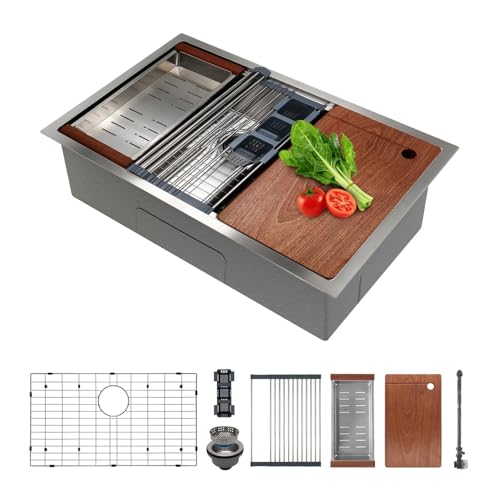
- KRAUS KWU110-32 32 Inch Undermount Workstation Kitchen Sink
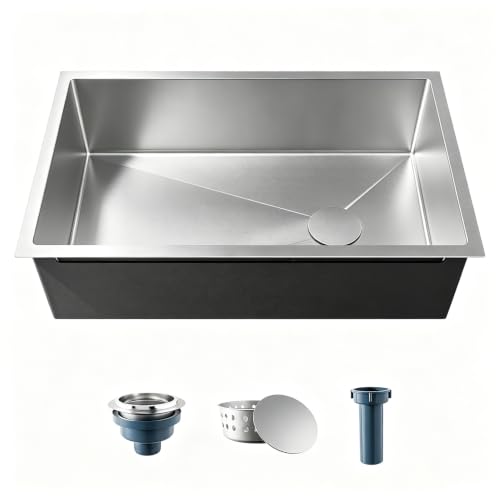
- KRAUS KHU100-32 32 Inch 16 Gauge Undermount Kitchen Sink
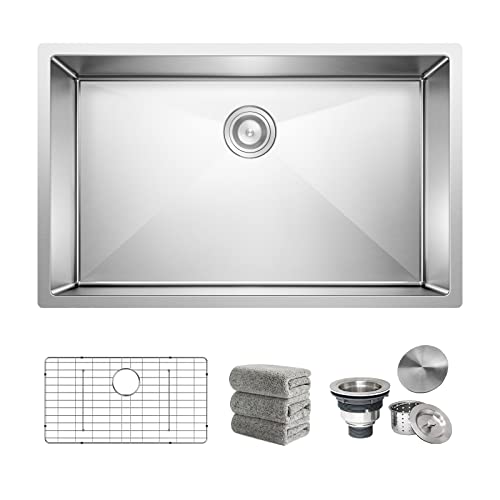
- Oxwiser 30×18 Inch Undermount Kitchen Sink Set, 16 Gauge, 5 Item Bundle
- Delironexu 30 Inch Undermount Kitchen Sink, 18 Gauge, Drain Kit Included
- Oxwiser 32×18 Inch Undermount Kitchen Sink Set, 16 Gauge, 5 Item Bundle
- KRAUS KHU640-33 33 Inch 18 Gauge Undermount Kitchen Sink
Read the full guide ↓ for the basin math that decides whether your biggest pans fit, the honest case for and against a single basin, and the setup and care routine that keeps one big bowl working like two.
Shoppers searching for the best single basin kitchen sinks have usually already lost patience with a divided sink. The divider that looked so organised in the showroom turns out to steal exactly the space a roasting pan, a sheet tray, or a stockpot needs, and one side of a double bowl is almost always too small for the items that matter most. A single basin reverses the logic: one large, uninterrupted volume that accepts whatever the meal produced, and lets you recreate a second compartment — with a simple washing-up tub or a rack — only on the days you actually want one. This guide compares six verified single basin undermount sinks from 30 to 33 inches, in both plain-bowl and workstation formats, and explains the sizing, depth, and gauge decisions that separate a basin you will love from one that merely looked big online.
The six picks share the essential architecture — single bowl, undermount, stainless steel — and differ in the ways that matter: width from 30 to 33 inches, 16 versus 18 gauge steel, rounded versus handmade corners, bare bowl versus complete bundle, and in one case a workstation ledge that turns the basin into a prep surface. You will find a quick picks table, a transparent account of how the selection was made, detailed reviews with strengths and trade-offs, a comparison table, a buying guide built around interior dimensions rather than headline numbers, and a how-to section covering installation, the two-zone washing method, cleaning, and troubleshooting. The single basin idea is developed further in our companion guide to Best Single Bowl Kitchen Sinks, which approaches the same layout from the bowl terminology most listings use.
Key Takeaways
- Judge a single basin by its interior floor dimensions, not its exterior width; the floor decides whether sheet pans and roasting trays sit flat.
- One large basin plus a removable washing-up tub reproduces everything a double bowl does, without permanently surrendering pan space.
- Depth is the second dimension of capacity: a 9 inch bowl contains splashes and tall pots that a shallow basin cannot.
- All six picks are undermount single bowls in stainless steel; they differ in width (30–33 inch), gauge (16 or 18), corner style, and what is included.
- Workstation ledges suit cooks who prep over the sink; plain rounded bowls suit households that prize the fastest cleanup.
- Measure your cabinet before choosing a width: 32 and 33 inch basins need the wider base cabinet class.
In this guide
Quick Picks
| Pick | Badge | Size and build | Link |
|---|---|---|---|
| KRAUS KWU110-32 Workstation Sink | Best Overall | 32 inch, 16 gauge TRU16 steel, ledge, cutting board and roll-up rack included | Check on Amazon |
| KRAUS KHU100-32 | Best for Easy Cleaning | 32 inch, 16 gauge TRU16 steel, rounded corners, NoiseDefend pads | Check on Amazon |
| Oxwiser 30×18 Sink Set | Best Complete Kit | 30 x 18 inch, 16 gauge, 5 item bundle with grid and drain assembly | Check on Amazon |
| Delironexu 30 Inch Undermount Sink | Best Value Pick | 30 x 18 x 9 inch, 18 gauge, handmade design, drain kit included | Check on Amazon |
| Oxwiser 32×18 Sink Set | Best Large Kit | 32 x 18 inch, 16 gauge, 5 item bundle with grid and drain assembly | Check on Amazon |
| KRAUS KHU640-33 | Best Extra Wide | 33 inch, 18 gauge steel, rounded corners, NoiseDefend pads | Check on Amazon |
Read the badges as workflow labels rather than ranks. The two Oxwiser sets differ only in width, which makes the cabinet measurement the entire decision between them; the two plain Kraus bowls differ in width and gauge; and the workstation stands apart as a different way of using the same single basin idea. If your shortlist started with material rather than layout, our notes on Best Single Bowl Stainless Kitchen Sinks sort the same field by steel specification.
How These Picks Were Chosen
We selected for the single basin brief specifically: every model had to offer one uninterrupted bowl with an interior floor large enough for a standard half-sheet pan, because a single basin that fails the pan test has surrendered its reason to exist. Verified specifications — exterior and bowl dimensions where published, gauge, drain and accessory inclusions, corner geometry, and sound treatment — were compared across the current undermount market, and owner feedback was read for the recurring single-basin themes: whether water drains or pools in a wide flat floor, whether the bowl feels cavernous or useful, and whether wide bowls stay quiet under a disposal.
Two filters did quiet work in the background. First, drainage: a wide single floor is unforgiving of poor slope, so models with channel grooves or a documented drain design were favoured, and models with repeated pooling complaints were cut. Second, completeness: because a basin this size is usually bought mid-remodel, we included both bare bowls from an established maker and complete bundles, so the list serves buyers who want to specify each part and buyers who want one box. What we did not do is test these sinks in a laboratory; this is a research-led comparison, and the reviews say so by framing performance in terms of specification and reported owner experience rather than invented hands-on claims.
The 6 Best Single Basin Kitchen Sinks

KRAUS KWU110-32 32 Inch Undermount Workstation Kitchen Sink
Badge: Best Overall
Strengths
- Integrated ledge with cutting board and roll-up rack included, turning the basin into a prep station.
- 16 gauge TRU16 steel and NoiseDefend soundproofing keep a big bowl solid and quiet.
- 32 inch uninterrupted floor takes roasting pans and sheet trays flat.
Trade-offs
- Premium tier positioning; the ledge system is wasted on cooks who never prep over the sink.
- Needs a wide base cabinet.
- Ledge channel adds a cleaning edge plain bowls do not have.
Mini spec box: Mount: undermount. Size: 32 inch. Material: 16 gauge TRU16 stainless steel. Bowl: single bowl with integrated ledge. Included: cutting board, roll-up rack. Features: NoiseDefend soundproofing.
The KWU110-32 is what the single basin idea becomes when it grows up. The basin itself is the point — 32 inches of uninterrupted floor that accepts the largest items a home kitchen owns — and the ledge multiplies it, because the cutting board and roll-up rack let you work over that volume instead of merely washing in it. Prep flows in one direction: rinse in the bowl, chop on the board above it, slide waste down, stage washed items on the rack. In a kitchen where counter space is the scarcest resource, that workflow is worth more than any finish option.
The engineering underneath is appropriately serious. Sixteen gauge TRU16 steel gives the wide floor the stiffness a big span needs, and NoiseDefend treatment keeps the large, flat surfaces from drumming when water or a disposal runs. Kraus including both ledge accessories in the box matters more than it sounds: third-party boards rarely match a ledge’s exact span, and a workstation whose accessories arrive later often never becomes a workstation at all. The honest limitations are commitment and care. The ledge track needs a deliberate wipe, the accessories need a home when not in use, and the whole format assumes a wide cabinet. Buyers who recognise their own cooking in the workflow above will use this sink’s full repertoire daily; buyers who mostly reheat and rinse should save the premium and take a plain bowl below.
Best for: serious cooks who want the basin to double as a prep surface. / Not suited for: narrow cabinets or low-maintenance minimalists.

KRAUS KHU100-32 32 Inch Undermount Kitchen Sink
Badge: Best for Easy Cleaning
Strengths
- Rounded corners and channel grooves: the easiest wide basin here to keep clean and draining.
- 16 gauge TRU16 steel with NoiseDefend pads for a dense, quiet feel.
- Plain uninterrupted bowl with no ledges or seams to work around.
Trade-offs
- No workstation function and no included accessories.
- Requires the wide cabinet class.
- A basin this size uses more water for small jobs unless you use a tub insert.
Mini spec box: Mount: undermount. Size: 32 inch. Material: 16 gauge TRU16 stainless steel. Bowl: single bowl, rounded corners. Features: channel drain grooves, NoiseDefend sound pads.
If the workstation is the single basin as theatre, the KHU100-32 is the single basin as tool. Everything about it serves the two jobs a basin does most: accepting large items and cleaning up fast afterward. The rounded corners are the headline for anyone who has maintained a squared handmade sink — a sponge follows the curve, residue has no seam to colonise, and the bowl returns to an even brushed look with a fraction of the effort. The channel grooves in the floor address the wide-basin drainage question directly, guiding water toward the drain instead of letting it sheet and stand on a broad flat surface.
At 32 inches the floor takes a roasting pan with its handles, a full sheet pan, or the combined output of a baking day, and the 16 gauge TRU16 construction keeps that wide span feeling machined rather than flexy. NoiseDefend pads complete the civilised picture under disposal use. What you give up is everything extra: no ledge, no board, no bundle — the grid and any accessories are your own project. For households whose cooking is large but whose prep happens on counters, that absence is a feature, and this is the basin we would install in a family kitchen that values a ten-second cleanup over a prep system. It is also the natural centrepiece when the sink anchors an island run, a layout explored in our guide to Best Sinks For Kitchen Islands.
Best for: families who want maximum bowl, minimum upkeep. / Not suited for: cooks who want to prep over the sink.

Oxwiser 30×18 Inch Undermount Kitchen Sink Set
Badge: Best Complete Kit
Strengths
- Five item bundle — sink, bottom grid, drain assembly, drain cap, towel — ends the parts hunt.
- 16 gauge steel in the most common 30 x 18 inch single basin footprint.
- Included grid protects the wide floor from the first day of use.
Trade-offs
- 30 inches is the standard basin, not the largest; oversized pans are a tighter fit than in the 32s.
- Grid needs lifting for a full bowl scrub.
- Bundle suits buyers who want the standard accessory set, not custom choices.
Mini spec box: Mount: undermount. Size: 30 x 18 inch. Material: 16 gauge stainless steel. Bowl: single bowl. Bundle: sink, bottom grid, drain assembly, drain cap, towel (5 items).
The Oxwiser 30×18 set is the single basin for buyers who want the layout’s benefits without a research project attached. The bowl is the proven standard — 30 by 18 inches of 16 gauge single basin that fits the common cabinet class and passes the sheet pan test — and the bundle wraps it in everything a new basin needs: the bottom grid that keeps cookware off the floor finish, the drain assembly and cap that complete the plumbing, and even the towel for the first dry-down. One order, one delivery, no compatibility surprises between separately sourced parts.
In use, the included grid quietly shapes the experience. Items soak elevated while water circulates beneath them, pans land on the grid rather than grinding across the steel, and the floor underneath stays noticeably fresher than an unprotected basin’s. The size honesty matters too: 30 inches is a real single basin, but households that regularly wash the largest roasting pans should look at the 32 inch version of this same set, reviewed below, rather than discovering the limit at Thanksgiving. For the standard kitchen and the standard remodel timeline, this is the most frictionless route to a good basin on the list.
Best for: remodelers who want a complete, standard-size basin in one box. / Not suited for: cooks whose largest pans demand a 32 inch floor.

Delironexu 30 Inch Undermount Kitchen Sink
Badge: Best Value Pick
Strengths
- Full single basin dimensions — 30 x 18 x 9 inch — at the value end of this list.
- Handmade design with a brushed finish for the current squared look.
- Drain kit included, with no forced accessory bundle inflating the box.
Trade-offs
- 18 gauge steel: lighter sound and dent resistance than the 16 gauge picks.
- Squared corners need a brush routine.
- No bottom grid included to protect the floor.
Mini spec box: Mount: undermount. Size: 30 x 18 x 9 inch. Material: 18 gauge stainless steel. Bowl: single bowl, handmade design. Finish: brushed. Included: drain kit (no additional accessories).
The Delironexu proves that the single basin idea does not require a premium budget. The dimensions are uncompromised — the full 30 inch width, the standard 18 inch front-to-back, and a proper 9 inch depth that contains a high faucet’s splash and lets tall pots sit low in the bowl. The handmade profile delivers the squared, architectural look that currently defines kitchen photography, and the brushed finish is the practical choice within that look, hiding the fine marks of daily use better than a polished surface would.
The value is achieved in the steel, and buyers should understand the exchange clearly. At 18 gauge, the bowl is more susceptible to a hollow note under running water and to flex when heavy cookware is dropped rather than placed; the corners, being tighter, will ask for a soft brush a few times a week to stay free of buildup. Neither trait shortens the sink’s life in a reasonably careful household, and adding a bottom grid later — the accessory this box deliberately omits — closes most of the practical gap to the thicker picks. For a first home, a rental upgrade, or any kitchen where the budget is better spent on the faucet, this is the basin that keeps the layout’s core promise: everything fits, nothing is divided.
Best for: budget-conscious buyers who want full basin dimensions and the handmade look. / Not suited for: households that are rough on equipment or want rounded corners.

Oxwiser 32×18 Inch Undermount Kitchen Sink Set
Badge: Best Large Kit
Strengths
- The Oxwiser 5 item bundle scaled to a 32 x 18 inch basin for big-pan households.
- 16 gauge single bowl with bottom grid, drain assembly, drain cap, and towel included.
- Grid protection matters even more across a wider floor.
Trade-offs
- Requires the wider cabinet class.
- Grid is large; lifting it for deep cleans is a two-hand job.
- Same no-frills styling as the 30 inch set.
Mini spec box: Mount: undermount. Size: 32 x 18 inch. Material: 16 gauge stainless steel. Bowl: single bowl. Bundle: sink, bottom grid, drain assembly, drain cap, towel (5 items).
This is the Oxwiser formula with the one variable changed that big-cookware households care about: width. The 32 x 18 inch basin takes the roasting pans and sheet trays that make a 30 inch owner improvise, while the bundle — grid, drain assembly, cap, towel — keeps the one-box convenience that made the smaller set appealing. Sixteen gauge steel keeps the wider floor feeling substantial, and the included grid earns its place even more at this size, because a wide unprotected floor is where dropped pan corners do their cosmetic damage.
Choosing between this set and the plain Kraus KHU100-32 is the list’s cleanest decision. Both give you a 32 inch single basin in 16 gauge steel. The Oxwiser gives you the full accessory stack in the box and a handmade-style bowl; the Kraus gives you rounded corners that clean faster and an established maker’s plain-bowl refinement. Deadline remodels lean Oxwiser; cleaning minimalists lean Kraus. Either way, verify the cabinet first — this basin belongs to the wider base class, and no bundle convenience survives a two-inch measurement error. Renovation planners will find the same width decision framed at project level in our guide to Best Sinks For Kitchen Remodel.
Best for: big-pan households that want the large basin and the full kit together. / Not suited for: standard-width cabinets or rounded-corner devotees.

KRAUS KHU640-33 33 Inch Undermount Kitchen Sink
Badge: Best Extra Wide
Strengths
- 33 inch basin — the widest floor in this guide — for the largest cookware and double-duty washing.
- Rounded corners resist buildup, and channel grooves manage drainage across the wide floor.
- NoiseDefend pads keep a big 18 gauge bowl civilised under a disposal.
Trade-offs
- 18 gauge steel is a tier below the 16 gauge Kraus models for dent resistance.
- Needs a genuinely wide cabinet; measure twice.
- Soaking small loads in a 33 inch basin is water-hungry without a tub insert.
Mini spec box: Mount: undermount. Size: 33 inch. Material: 18 gauge stainless steel. Bowl: single bowl, rounded corners. Features: channel grooves for draining, NoiseDefend pads.
The KHU640-33 exists for the kitchens at the far end of the size chart: the farmhouse-scale remodel, the serious canning and preserving household, the home where two cooks wash and soak simultaneously in one basin. At 33 inches, the floor stops being a constraint entirely — the largest roasting pan, a day of garden produce, or a sink full of jars all fit with room to organise. Kraus supports the width with the details a wide basin needs: rounded corners that keep the big perimeter easy to wipe, channel grooves that give water a path across the broad floor, and NoiseDefend padding to calm the acoustics of a large steel surface.
The compromise is in the gauge. This model is 18 gauge where its 32 inch KHU100 sibling is 16, so it trades some dent resistance and solidity of feel for its extra width at a similar tier. In a household that places rather than drops its cookware — and uses the tub-insert method for small loads — that trade is invisible in daily life. In a household with teenagers stacking cast iron, the 16 gauge 32 inch picks are the safer assignment of the same budget. Choose the 33 for space, knowingly, and it delivers the single basin idea at its most generous.
Best for: very large kitchens and preserving or batch-cooking households. / Not suited for: standard cabinets or rough-handling households.
Comparison Table
| Pick | Size | Gauge | Standout trait | Link |
|---|---|---|---|---|
| KRAUS KWU110-32 | 32 inch | 16 gauge | Workstation ledge, board and rack | Check on Amazon |
| KRAUS KHU100-32 | 32 inch | 16 gauge | Rounded corners, easiest cleaning | Check on Amazon |
| Oxwiser Set 30 | 30 x 18 inch | 16 gauge | Complete 5 item bundle | Check on Amazon |
| Delironexu Undermount | 30 x 18 x 9 inch | 18 gauge | Value handmade basin | Check on Amazon |
| Oxwiser Set 32 | 32 x 18 inch | 16 gauge | Large basin, complete bundle | Check on Amazon |
| KRAUS KHU640-33 | 33 inch | 18 gauge | Widest basin in the guide | Check on Amazon |
How to Choose a Single Basin Kitchen Sink
Start with the pan test, because it is the entire argument for this layout. Take the largest item you wash — for most households a rimmed half-sheet pan or a roasting pan with handles — and measure its footprint. Then shop by interior floor dimensions, which are always smaller than the headline exterior width, and choose the smallest basin whose floor accepts that item flat. That discipline lands most households at 30 or 32 inches. Going larger than the pan test demands buys a basin that uses more water, more counter-adjacent cabinet, and more cleaning perimeter for no functional gain; going smaller re-creates the divided-sink frustration you are escaping.
Depth is the second calculation. A 9 inch bowl, like the Delironexu’s published dimension, contains splashes from a high-arc faucet and lets tall stockpots sit low enough to fill comfortably. Shallower basins feel easier on the back for long hand-washing sessions but splash more and crowd tall items. Match depth to your faucet height and your tallest pot, and remember the under-cabinet stack: deeper bowl plus disposal plus trap must fit the cabinet’s height together. Gauge is the third calculation, and it is about household roughness more than abstract quality: 16 gauge for cast-iron-daily homes, 18 gauge as a legitimate value choice for careful ones.
Finally, decide the basin’s supporting system before you order. A single basin works best as a kit of behaviours: a washing-up tub for small loads and soaking separation, a grid to protect the floor, and — if your prep flows across the sink — a workstation ledge instead. The picks above map onto those decisions cleanly: bundles if you want the system in one box, plain bowls if you want to assemble it yourself, the workstation if the ledge is the system. Whichever you choose, confirm the minimum cabinet size from the listing against your measured cabinet interior; basin width is the one specification that cannot be negotiated after delivery.
A final consideration is who else uses the sink. In a household with children, a slightly shallower basin is easier for shorter arms to reach into, and a grid reduces the clatter that makes kids flinch away from washing up at all. In a household that entertains, the basin doubles as a drinks station more often than designers admit: a wide single bowl filled with ice holds bottles for a party in a way no divided sink can, and the 32 and 33 inch picks perform that trick handsomely. In a household with mobility limits, front-to-back depth matters — a basin that is too deep front to back forces a lean over the counter edge. None of these uses appears on a specification sheet, but each has decided real purchases, and a minute spent imagining your basin’s second and third jobs is worth more than another hour comparing near-identical listings.
How to Set Up and Care for a Single Basin Sink
Installation is the standard undermount sequence: dry-fit against the fabricated cutout, seal the flange with a continuous silicone bead, support the bowl with rails or a harness rather than clips alone, let the seal cure, then fit the drain assembly and disposal and leak-test with a dry paper towel under every joint. Wide basins deserve one extra step — confirm the countertop’s support around the cutout, because a 32 or 33 inch opening removes more material and the sink’s loaded weight, full of water and cookware, is carried by that perimeter.
Daily life in a single basin runs on the two-zone method. Keep a simple washing-up tub that occupies roughly a third of the floor: it becomes your soaking and small-load zone, while the open two-thirds stays free for rinsing, draining produce, and landing large items. A bottom grid under everything protects the floor and lets water circulate. Wash the bowl itself with warm water, a soft sponge, and dish soap, working along the grain; use a baking soda paste for dull film; and give handmade corners a soft-brush pass a few times a week. Rounded-corner basins need only the sponge routine, which is their quiet superpower.
Troubleshooting, in the pattern owners actually meet: Problem: water pools at the far end of the wide floor → check level first; wide basins exaggerate a small tilt, and a fabricator can often correct it at the supports. Problem: the basin feels too big for daily small jobs → that is the tub insert’s job; a basin within the basin restores proportion and saves water. Problem: the bowl sounds hollow under the disposal → verify the sound pads are intact and fit the grid, which damps both contact noise and vibration. Problem: scratches cluster where pans land → a grid, again; the floor’s cosmetic life is decided by what touches it, and the grid is the only layer you control.
Single Basin vs Double Bowl: The Honest Ledger
Because this keyword implies a comparison, here is the ledger without advocacy. A double bowl gives you a permanent second compartment: soaking on one side, rinsing on the other, with no accessories to store. What it takes is the floor: in a 33 inch overall width, each compartment is a fraction of the whole, and the largest pans fit in neither. A single basin gives you the whole floor and asks you to recreate compartments with a tub when you want them — flexible, but the tub lives somewhere when not in use. Households that hand-wash delicate loads daily and rarely cook with oversized pans are the double bowl’s remaining natural constituency. Everyone else — which the sales pattern suggests is most households now — gets more from the uninterrupted basin, especially in the 30 to 33 inch range where the floor becomes genuinely generous. If you are converting from double to single during a remodel, keep your old washing-up habits for the first month and let the tub method prove itself before you judge the layout; most converts report the pan space wins the argument by the second week.
Basin Depth and Volume: Doing the Capacity Math Honestly
Capacity claims in sink listings are usually just exterior dimensions wearing a costume, so it is worth learning to estimate a basin’s real working volume yourself. The working volume is set by the interior floor length and width, multiplied by the usable depth — and usable depth is always less than the published bowl depth, because you fill a sink to a few inches below the rim in real life, not to the brim. A basin whose floor measures roughly 28 by 14 inches, filled to a working depth of about 6 inches, holds a genuinely large amount of water and, more importantly, presents a flat stage where a roasting pan can soak fully submerged on one side while you rinse on the other. That staging quality — not the gallon figure — is what owners actually experience as capacity.
Depth interacts with the faucet in a way first-time single basin buyers often miss. A high-arc faucet over a shallow basin splashes; the same faucet over a 9 inch bowl lands its stream deep enough to stay contained. Conversely, a very deep basin paired with a low faucet makes filling tall pots awkward, because the pot must go under an arc that was designed for a shallower bowl. The picks in this guide cluster around depths that pair well with standard high-arc faucets, and the Delironexu’s published 9 inch depth is the reference point: deep enough for splash control and stockpot filling, not so deep that a long hand-washing session becomes a back exercise. When you compare any basin, hold three numbers together — floor size, depth, and your faucet’s arc height — and the right combination usually identifies itself.
There is also a weight reality to wide, deep basins that rarely appears in listings: a full basin is heavy, and an undermount installation carries that weight on the countertop perimeter and the support system. This is one more reason the installation guidance in this guide insists on rails or a harness rather than clips alone, and why a fabricator should know the sink’s size before cutting a wide opening in stone. None of it is a reason to avoid a generous basin — the 32 and 33 inch picks exist because households love them — but it is a reason to treat mounting as engineering rather than as an afterthought, particularly in the wider sizes.
Accessories That Make a Single Basin Work Harder
A single basin is a platform, and three inexpensive accessories decide how versatile the platform feels. The first is the bottom grid, already covered in the reviews: it protects the floor, elevates soaking items so water circulates, and turns hard landings into soft ones. If your pick does not bundle one — the Kraus bowls and the Delironexu do not — measure the interior floor carefully and order a grid matched to it, because a grid that is even slightly oversized will ride up on the floor’s curve and rattle. The second accessory is the washing-up tub discussed in the how-to section; choose one with a footprint near a third of your basin’s floor and a height that leaves its rim below the basin’s rim, so the faucet swing clears it.
The third accessory is an over-sink rack or board, which is where the workstation picks simply formalise what plain-basin owners improvise. A roll-up rack across a plain basin gives you most of the workstation’s staging benefit — a landing for washed produce, a trivet surface, a drying zone — without the built-in ledge, and it stores in a drawer. Owners of the KHU100-32 and KHU640-33 often add exactly this and report that the combination covers their prep needs. The lesson generalises: buy the basin for its floor, depth, and steel, because those cannot be changed later, and treat every function layered on top as an accessory decision you can make, remake, or skip entirely as your cooking evolves. That ordering — permanent attributes first, accessories second — is the most reliable purchasing discipline this category offers.
Common Buying Mistakes
First, shopping by exterior width and discovering the interior floor is two inches smaller in each direction — measure the floor, or check the listing’s bowl dimensions, not the headline. Second, buying the widest basin the cabinet allows and then resenting its water use and cleaning perimeter; the pan test, not the cabinet maximum, should set the size. Third, choosing a deep basin and a tall faucet without checking the under-cabinet stack against the disposal. Fourth, skipping the grid on a wide floor, where one dropped pan corner marks a large, visible area. Fifth, expecting a single basin to behave like a double bowl without adopting the tub method, then blaming the layout. Sixth, ignoring drainage design on a wide flat floor — grooves and slope are functional features at this size, not decoration.
Final Recommendation
For most households converting to a single basin, the KRAUS KWU110-32 is the complete expression of the idea: a 32 inch basin that preps as well as it washes. If your priority is the same space with the least upkeep, take the KRAUS KHU100-32 and its rounded corners. Choose an Oxwiser set when you want the whole system in one box at 30 or 32 inches, the Delironexu when the budget leads, and the KHU640-33 when only the widest floor will do. Measure the cabinet, run the pan test, and the single basin will repay you at every large wash-up.
Frequently Asked Questions
What is the difference between a single basin and a single bowl sink?
Very little in practice — the terms describe the same layout: one uninterrupted compartment instead of two divided ones. Basin is the older word and appears in many listings and searches; bowl is the word manufacturers use in specifications. When comparing models, ignore the terminology and compare the numbers that matter: interior floor dimensions, depth, gauge, and corner design.
What size single basin fits a sheet pan?
A standard half-sheet pan needs a basin floor that accepts its footprint flat, which in practice means shopping in the 30 inch class and above and confirming the interior dimensions on the listing. The 32 and 33 inch picks in this guide give comfortable margin, including room for roasting pans with handles; the 30 inch picks handle the sheet pan itself well. Always verify against the bowl dimensions, not the exterior width.
How do I wash small loads in a big basin without wasting water?
Use a washing-up tub that sits inside the basin. It holds a small volume of hot soapy water for daily items, leaves the rest of the basin free for rinsing, and lifts out when a large item needs the full floor. This one inexpensive accessory is what makes a single basin practical for households of one or two, and it is the method most long-term single basin owners settle into.
Is a single basin harder to keep clean than a double bowl?
It has more floor to wipe but fewer obstacles: no divider, no second drain, and — in rounded-corner models — no seams where buildup starts. Owners generally find a single basin faster to clean overall, especially the rounded Kraus designs. Handmade squared basins ask for a brush in the corners a few times a week, which is the one routine where they trail the rounded models.
Can a single basin work in a small kitchen?
Yes, and it is often the better small-kitchen choice, because the uninterrupted floor fits the pans a small kitchen still uses, while a divided bowl in the same width fits almost nothing large. Choose the 30 inch class for a standard small cabinet, adopt the tub method for small loads, and the basin will feel proportionate. The workstation format can also help a small kitchen by moving prep over the sink.
Do single basin sinks need a garbage disposal?
No, but most households install one, and the combination works well: a single drain means a single disposal decision, and the basin’s size makes disposal use comfortable for large cleanups. Check the under-cabinet stack — bowl depth plus disposal plus trap — before ordering a deep basin, and choose a drain assembly that matches the disposal flange, or use a bundle that includes the drain hardware.
Can I use a single basin as a party drinks cooler?
Yes, and it is one of the layout’s underrated pleasures. A 32 or 33 inch basin filled with ice and water chills bottles for a gathering without surrendering counter or floor space to a separate tub, and the steel will not be harmed by the cold or the condensation. Put a towel under any bottles you later move to the table, empty the melt water gradually rather than all at once if your trap is old, and give the bowl a wash and dry afterward. It is a small thing, but owners mention it surprisingly often when they explain why they would never return to a divided sink.
How do I stop a single basin from looking messy during a big cook?
Work in zones and in sequence. Designate the tub side for soaking, keep the open floor for active rinsing, and use a rack or the counter beside the sink as the clean landing zone so washed items never re-enter the dirty side. Rinse and stack as you cook rather than letting the basin become a holding pen for everything at once. The basin’s size makes this choreography possible — in a divided sink the zones are fixed and too small — and most households find that a simple left-to-right flow, dirty to soaking to rinsed to racked, keeps even a holiday cooking session visually and functionally under control.
What gauge is best for a wide single basin?
Sixteen gauge is the safer choice for wide floors, because a broad span of steel benefits from the extra stiffness and dent resistance, and both 32 inch Kraus and Oxwiser picks use it. Eighteen gauge remains a reasonable value choice — the 33 inch KHU640-33 uses it with sound padding to good effect — provided the household places cookware rather than dropping it and a grid protects the floor.