Disclosure: topratedkitchenware.com is reader-supported. When you buy through links on our site, we may earn an affiliate commission from Amazon and other retailers, at no extra cost to you.
Where to buy
The six sinks below are the verified picks behind this guide to the best single bowl kitchen sinks — one generous bowl, in both stainless steel and fireclay, for kitchens that are done compromising with dividers. Each name links to its Amazon listing, where you can check the latest price on Amazon, confirm dimensions and what is included, and read the newest owner feedback. Start with the most complete single bowl package here: Check on Amazon.
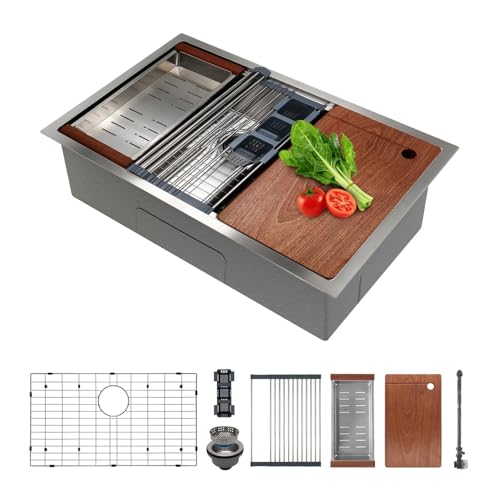
- Oxwiser 30×18 Inch Undermount Kitchen Sink Set, 16 Gauge, 5 Item Bundle
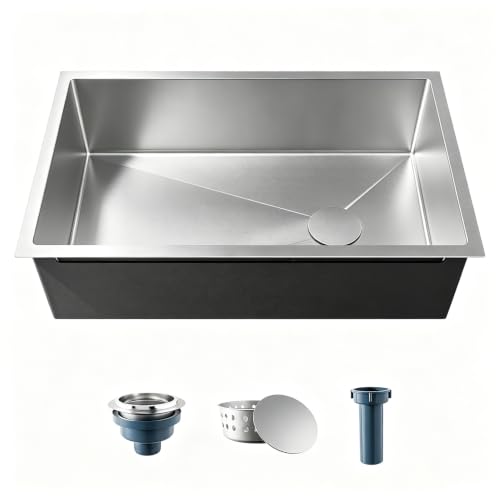
- Delironexu 30 Inch Undermount Kitchen Sink, 18 Gauge, Drain Kit Included
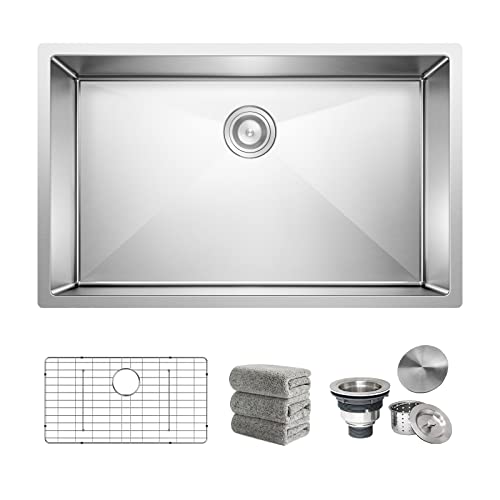
- Oxwiser 32×18 Inch Undermount Kitchen Sink Set, 16 Gauge, 5 Item Bundle
- KRAUS KHU640-33 33 Inch 18 Gauge Undermount Kitchen Sink
- Miuara Farmhouse Sink 30 x 18 Inch White Fireclay Apron Front
- Miuara Farmhouse Sink 33 x 18 Inch White Fireclay Apron Front
Read the full guide ↓ for the stainless-versus-fireclay decision, the cabinet changes an apron front demands, and the daily routine that makes one big bowl work for every kind of washing up.
The search for the best single bowl kitchen sinks usually begins at the moment a cook tries to soak a roasting pan in a double bowl sink and watches it teeter across the divider. A single bowl removes the divider and the frustration with it: the whole footprint becomes usable, the largest pans sit flat, and the sink stops dictating what cookware you are allowed to own. This guide compares six verified single bowl sinks across the two materials that define the category — four stainless steel undermounts from 30 to 33 inches, including two complete accessory bundles, and two white fireclay farmhouse sinks with apron fronts — so you can decide not only the size and gauge you need, but which material’s character belongs in your kitchen.
That material choice is the real fork in this guide. Stainless is light, forgiving, and quiet about its scratches; fireclay is dense, glossy, and makes a visual statement every time you enter the room, at the cost of weight and a cabinet that must be built or modified to carry an apron front. The detailed reviews treat both families honestly, with strengths, trade-offs, and the specifications verified for each model. Around them you will find a comparison table, a buying guide that starts with cookware and cabinet rather than with brands, a how-to layer covering both undermount and apron front installation plus daily care for both materials, and answers to the questions single bowl shoppers ask most. If your heart is already set on steel, our dedicated notes on Best Single Bowl Stainless Kitchen Sinks take the metal-only view of this same decision.
Key Takeaways
- A single bowl’s value is its uninterrupted floor: measure your largest pan and shop by interior floor dimensions.
- Stainless picks here run 30 to 33 inches in 16 and 18 gauge; the Oxwiser sets bundle the grid and drain hardware in the box.
- Fireclay farmhouse picks bring a white apron front statement and a dense, stain-resistant surface, but they are heavy and need a cabinet designed or modified for support.
- The Miuara fireclay bowls are reversible and can install as apron front or undermount, which softens the commitment.
- Depth, gauge, and corner style decide daily satisfaction more than brand does; choose them for your household’s habits.
- Whichever material you choose, a bottom grid and the washing-up tub method make a single bowl behave like two zones.
In this guide
Quick Picks
| Pick | Badge | Size and build | Link |
|---|---|---|---|
| Oxwiser 30×18 Sink Set | Best Overall | 30 x 18 inch, 16 gauge stainless, 5 item bundle with grid and drain assembly | Check on Amazon |
| Delironexu 30 Inch Undermount Sink | Best Value Pick | 30 x 18 x 9 inch, 18 gauge stainless, handmade design, drain kit included | Check on Amazon |
| Oxwiser 32×18 Sink Set | Best for Big Cookware | 32 x 18 inch, 16 gauge stainless, 5 item bundle with grid and drain assembly | Check on Amazon |
| KRAUS KHU640-33 | Best Extra Wide | 33 inch, 18 gauge stainless, rounded corners, NoiseDefend pads | Check on Amazon |
| Miuara Farmhouse Sink 30 Inch | Best Farmhouse | 30 x 18 inch, white fireclay, reversible single bowl, apron front or undermount | Check on Amazon |
| Miuara Farmhouse Sink 33 Inch | Best Large Farmhouse | 33 x 18 inch, white fireclay, reversible single bowl, apron front or undermount | Check on Amazon |
The badges map to decisions, not rankings: two sizes of complete stainless kit, a value stainless bowl, the widest stainless bowl, and two sizes of the same fireclay farmhouse design. Most readers will find their answer by answering two questions — steel or fireclay, and which width the cabinet allows — and the reviews below are organised to make both answers easy. Project planners weighing the sink inside a larger job will find the same picks framed by timeline in our guide to Best Sinks For Kitchen Remodel.
How These Picks Were Chosen
We required every pick to be a true single bowl with a floor that passes the sheet pan test, then verified specifications from the product data: exterior dimensions, gauge and material, included components, mounting style, and finish. The stainless field was screened for the traits that decide satisfaction in a large bowl — drainage design, sound treatment, corner geometry — and the fireclay field for structural honesty: a reversible bowl, published resistance claims limited to what the maker states, and an installation path (apron front or undermount) that a normal remodel can execute.
Owner feedback was read for material-specific patterns. For stainless, that meant pooling, corner buildup, and dent stories. For fireclay, it meant shipping survival, support framing, and how the white surface ages under metal pans and daily scouring. Models with recurring cracks in transit or vague material descriptions were excluded. This is a research-led guide rather than a laboratory test, and the reviews keep that honesty: performance is described from specification and reported experience, and where a number is not published for a pick, we do not invent one.
The 6 Best Single Bowl Kitchen Sinks

Oxwiser 30×18 Inch Undermount Kitchen Sink Set
Badge: Best Overall
Strengths
- Complete 5 item bundle: sink, bottom grid, drain assembly, drain cap, and towel in one box.
- 16 gauge stainless single bowl in the standard 30 x 18 inch footprint.
- Grid protection from day one keeps the bowl floor fresher.
Trade-offs
- Standard size, not the largest; the biggest roasting pans are a closer fit than in the 32 inch set.
- Grid lifts out for deep cleaning.
- Functional styling rather than a design statement.
Mini spec box: Mount: undermount. Size: 30 x 18 inch. Material: 16 gauge stainless steel. Bowl: single bowl. Bundle: sink, bottom grid, drain assembly, drain cap, towel (5 items).
The Oxwiser 30×18 set leads because it is the single bowl purchase with the fewest ways to go wrong. The bowl itself is the category’s proven centre: 30 by 18 inches of 16 gauge steel, big enough for the sheet pan test, thick enough to feel like equipment, and sized for the most common base cabinets. Around it, the bundle removes the three errands that usually follow a sink purchase — the grid that protects the floor, the drain assembly that completes the plumbing, and the cap and towel that finish the job. For a remodel running on a contractor’s schedule, that completeness is not a luxury; it is how the sink avoids becoming the reason a countertop install slips a week.
Daily use is defined by the grid more than new owners expect. Cookware lands on the grid instead of the steel, soaking items sit elevated while water moves beneath them, and the floor’s finish ages slowly and evenly. The bowl’s single uninterrupted volume does the rest: pasta pots, baking trays, and a full day of dishes all fit without strategy. The limits are the standard size’s limits — a truly oversized roasting pan with long handles may want the 32 inch sibling below — and the small chore of lifting the grid for a full scrub. As an overall recommendation for the average kitchen, though, this set is the one we would hand to a friend who asked for a single bowl and no homework.
Best for: most kitchens and most remodels — the complete standard-size answer. / Not suited for: buyers whose largest pans need a 32 inch floor.

Delironexu 30 Inch Undermount Kitchen Sink
Badge: Best Value Pick
Strengths
- Full single bowl dimensions — 30 x 18 x 9 inch — at a value tier position.
- Handmade squared design with a brushed finish that hides daily marks.
- Drain kit included; no bundled extras you did not ask for.
Trade-offs
- 18 gauge steel is lighter in sound and dent resistance than 16 gauge.
- Squared corners need a brush routine.
- No grid included; add one to protect the floor.
Mini spec box: Mount: undermount. Size: 30 x 18 x 9 inch. Material: 18 gauge stainless steel. Bowl: single bowl, handmade design. Finish: brushed. Included: drain kit (no additional accessories).
The Delironexu is the value route into a proper single bowl, and its honesty is refreshing: full dimensions, a stated gauge, a drain kit in the box, and an explicit note that no additional accessories are included, so the price position is achieved by specification rather than by surprise. The 9 inch depth is the detail that lifts it above the anonymous budget tier — tall pots sit low, a high faucet’s stream lands without splashing the counter, and the bowl feels like a basin rather than a tray.
The exchanges are the known ones for its class. Eighteen gauge steel will sound thinner under a disposal and can flex under a dropped pan; the handmade corners will collect residue faster than rounded ones and ask for a brush a few times a week. Add a grid — the one accessory this box omits — and the practical distance to the 16 gauge picks narrows to sound and feel rather than function. For rentals, first homes, and any kitchen where the faucet deserves the bigger share of the budget, this is the single bowl that keeps the essential promise: one big space where everything fits.
Best for: budget-led projects that refuse to shrink the bowl. / Not suited for: buyers who want the heaviest gauge or rounded corners.

Oxwiser 32×18 Inch Undermount Kitchen Sink Set
Badge: Best for Big Cookware
Strengths
- 32 x 18 inch single bowl takes roasting pans and sheet trays flat, with handles.
- Same complete 5 item bundle as the 30 inch set: grid, drain assembly, cap, towel.
- 16 gauge steel keeps the wider floor stiff and substantial.
Trade-offs
- Needs the wider base cabinet class.
- The larger grid is a two-hand lift for deep cleans.
- More bowl than light-use kitchens need.
Mini spec box: Mount: undermount. Size: 32 x 18 inch. Material: 16 gauge stainless steel. Bowl: single bowl. Bundle: sink, bottom grid, drain assembly, drain cap, towel (5 items).
Everything said about the 30 inch Oxwiser applies here with the volume turned up, and for a specific household that volume is the whole decision. If your cooking runs through roasting pans, griddles, and batch baking — if the sheet pan test in your kitchen involves handles and a rack — the 32 inch floor is where single bowl ownership becomes effortless. The bundle logic matters even more at this size, because a grid matched to a 32 inch floor is exactly the kind of accessory that is annoying to source separately and trivially easy to include in the box, as Oxwiser does.
The cabinet check is the gate: this bowl belongs to the wider base class, and the time to discover that is with a tape measure, not with a delivery. Households that pass the gate get a sink that swallows holiday cooking without choreography and still handles Tuesday’s two mugs gracefully with the tub method. Households that fail it should take the 30 inch set without regret — it is the same idea at the size their kitchen was built for. Between this set and the wide Kraus below, the choice is bundle versus brand refinement; between this set and the fireclay pair, the choice is material character, which the next sections take up directly.
Best for: big-cookware households that want the large bowl as a complete kit. / Not suited for: standard-width cabinets.

KRAUS KHU640-33 33 Inch Undermount Kitchen Sink
Badge: Best Extra Wide
Strengths
- 33 inch single bowl — the widest stainless floor in this guide.
- Rounded corners resist buildup; channel grooves manage drainage across the wide floor.
- NoiseDefend pads keep the large bowl quiet under a disposal.
Trade-offs
- 18 gauge steel, a tier below 16 gauge for dent resistance.
- Demands a genuinely wide cabinet.
- Grid and accessories are separate purchases.
Mini spec box: Mount: undermount. Size: 33 inch. Material: 18 gauge stainless steel. Bowl: single bowl, rounded corners. Features: channel grooves for draining, NoiseDefend pads.
The KHU640-33 is the stainless answer for kitchens that think in volume: preserving days, double-cook households, and anyone whose sink regularly holds a whole harvest or a holiday’s worth of cookware at once. Thirty-three inches of uninterrupted floor changes the category of problem a sink can solve — two large items can soak side by side, and the bowl can stage an entire cooking session’s washing in one load. Kraus equips the width properly, with rounded corners that keep the long perimeter easy to wipe and channel grooves that give water a route across the broad floor instead of letting it stand.
The specification trade is explicit: this width arrives in 18 gauge steel where the smaller premium bowls use 16. With NoiseDefend padding the acoustic penalty is well managed, and in a household that places cookware rather than dropping it, the dent-resistance difference rarely becomes a story. Add a grid — at this floor size it is close to mandatory equipment — and the KHU640-33 delivers the single bowl idea at maximum scale for a mainstream tier. If your cabinet cannot take it, nothing else in this paragraph matters; if it can, and your cooking justifies it, this is the wide-water option.
Best for: very large kitchens, canners, and two-cook households. / Not suited for: standard cabinets or buyers who want 16 gauge steel.
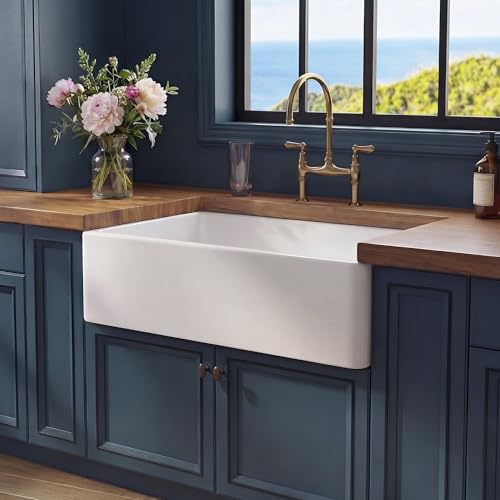
Miuara Farmhouse Sink 30 x 18 Inch White Fireclay
Badge: Best Farmhouse
Strengths
- White fireclay apron front gives the kitchen a genuine focal point.
- Reversible single bowl; installs as apron front or undermount for flexibility.
- Fireclay surface is resistant to stain, crack, heat, and scratch per the maker.
Trade-offs
- Heavy: the cabinet must be built or modified to support an apron front sink.
- White shows every coffee and turmeric incident until wiped.
- Hard surface is less forgiving to dropped glassware than steel.
Mini spec box: Mount: apron front or undermount (drop-in capable per listing). Size: 30 x 18 inch. Material: white fireclay. Bowl: reversible single bowl. Properties (per maker): resistant to stain, crack, heat, and scratch.
The Miuara 30 inch is the pick for buyers whose single bowl decision is really a kitchen identity decision. The white fireclay front becomes the room’s anchor — the element guests notice and the one that makes a kitchen read as farmhouse, cottage, or classic rather than contemporary. Underneath the styling, the bowl is a proper 30 by 18 inch single volume, and the fireclay itself is a serious material: dense, glossy, and specified by the maker as resistant to stain, crack, heat, and scratch. It does not show water spots the way steel does, and its surface wipes to a bright, uniform white that steel’s brushed grain never attempts.
The flexibility in this design deserves attention. The bowl is reversible, and the sink can install as an apron front or as an undermount, which means the same product serves a full farmhouse build and a more cautious renovation that wants the fireclay bowl without the exposed front. The cautions are physical. Fireclay is heavy, and an apron installation needs a support frame inside the cabinet — this is a planned build, not a swap. The glossy hardness that resists scratches also gives dropped glassware no cushion, and white is honest about every splash until you wipe it. Households that accept those terms get a sink that looks like furniture and works like a basin, and for the farmhouse kitchen there is no substitute on this list.
Best for: farmhouse and classic kitchens that want the bowl to be the room’s centrepiece. / Not suited for: quick swaps, unsupported cabinets, or glassware-fumbling households that want a forgiving surface.

Miuara Farmhouse Sink 33 x 18 Inch White Fireclay
Badge: Best Large Farmhouse
Strengths
- 33 x 18 inch fireclay bowl: farmhouse presence at family scale.
- Reversible single bowl; apron front or undermount installation.
- Same stain, crack, heat, and scratch resistance claims as the 30 inch model.
Trade-offs
- The heaviest install on this list; support framing is mandatory.
- Needs a wide cabinet run to look and fit right.
- White upkeep and glassware caution apply at larger scale.
Mini spec box: Mount: apron front or undermount (drop-in capable per listing). Size: 33 x 18 inch. Material: white fireclay. Bowl: reversible single bowl. Properties (per maker): resistant to stain, crack, heat, and scratch.
The 33 inch Miuara is the same farmhouse argument at the scale of a serious family kitchen. The wider bowl takes the largest pans the category produces, stages a full holiday wash-up, and gives the apron front the proportions it wants — a farmhouse front stretched across a wide cabinet run looks intentional in a way a narrow one can struggle to. For households designing a kitchen around this sink, which is the correct order of operations, the 33 is the version that will not feel undersized in five years.
Everything about the install scales too. The weight demands proper framing, the cabinet run must be genuinely wide, and the countertop cutout and support should be planned with the fabricator from the start — the workflow our renovation guide walks through for projects at this level, in Best Sinks For Kitchen Renovation. In daily use, the big white bowl is a pleasure that steel cannot imitate: bright, smooth, quiet about water spots, and vast. Choose it as the foundation of a farmhouse build and it will justify the planning; choose it as an impulse upgrade to an unmodified cabinet and the project will push back.
Best for: farmhouse builds with a wide cabinet run and family-scale cooking. / Not suited for: retrofits without cabinet work or narrow kitchens.
Comparison Table
| Pick | Size | Material / gauge | Standout trait | Link |
|---|---|---|---|---|
| Oxwiser Set 30 | 30 x 18 inch | Stainless, 16 gauge | Complete 5 item bundle | Check on Amazon |
| Delironexu Undermount | 30 x 18 x 9 inch | Stainless, 18 gauge | Value handmade bowl | Check on Amazon |
| Oxwiser Set 32 | 32 x 18 inch | Stainless, 16 gauge | Large bowl, complete bundle | Check on Amazon |
| KRAUS KHU640-33 | 33 inch | Stainless, 18 gauge | Widest steel bowl, rounded corners | Check on Amazon |
| Miuara Farmhouse 30 | 30 x 18 inch | White fireclay | Apron front, reversible bowl | Check on Amazon |
| Miuara Farmhouse 33 | 33 x 18 inch | White fireclay | Farmhouse at family scale | Check on Amazon |
How to Choose a Single Bowl Kitchen Sink
Decide material first, because it decides the project shape. Stainless undermounts install into a standard remodel rhythm: cabinet, countertop cutout, seal, support, plumbing. Fireclay apron fronts ask for a cabinet built or modified with a support frame and a front opening, which is straightforward in a planned renovation and disruptive in a finished kitchen — though the Miuara pair’s undermount option lets you take the fireclay bowl without the apron commitment. Neither material is better in the abstract. Steel is lighter, more forgiving of impacts, and hides its aging in a brushed patina; fireclay is brighter, smoother, and more architectural, and asks for care around heavy drops and support.
Size second, by the pan test and the tape measure together. Your largest pan sets the floor you need; your cabinet interior sets the floor you can have. The overlap of those two numbers is your size: 30 inches for the standard case, 32 for big cookware in a wide cabinet, 33 for maximum volume where the run allows. Then specification: in steel, choose 16 gauge for rough-and-tumble households and 18 gauge knowingly for value; in fireclay, confirm the support plan and the drain hardware compatibility. Finally, decide the accessory system — bundle, separate grid, or workstation thinking — knowing that a grid is the one addition nearly every single bowl owner ends up valuing, because it protects whichever material you chose.
One more decision deserves a paragraph because it hides inside the size decision: drain position. In a single bowl, the drain’s placement shapes how the floor is used. A centred drain is symmetrical and simple, and it is what most of this list’s mainstream designs assume; it also sits exactly where the largest flat items want to rest, which a grid solves by elevating them. When you compare any single bowl, glance at where the drain sits relative to your plumbing rough-in as well — moving a trap arm is a plumber’s hour, not a disaster, but it belongs in the project plan rather than in the install day’s surprises. The wide bowls in particular reward this glance, because their floors are stages for big cookware and the drain is the one fixed piece of scenery on that stage.
How to Install and Care for a Single Bowl Sink
For the stainless undermounts, the sequence is standard: dry-fit to the cutout, seal the flange with silicone, support with rails or a harness, cure, then drain, disposal, and a paper-towel leak test at every joint. For the fireclay Miuaras installed as apron fronts, the sequence starts earlier: build the support frame inside the cabinet so the sink’s weight rests on the frame, not on the countertop; set the sink so the front sits flush and level with the cabinet face; then proceed with countertop templating around the installed sink, which is the order fabricators prefer for apron fronts. Installed as undermounts, the fireclay bowls follow the steel sequence with extra hands — the weight makes the lift a two-person job with the support system ready before the sink leaves the floor.
Care splits by material. Stainless wants a soft sponge, dish soap, wiping along the grain, and a grid between the steel and your cast iron; baking soda paste handles dull film. Fireclay wants a soft cloth or sponge and non-abrasive cleaners to protect the gloss, prompt wiping of strong pigments like turmeric and red wine even though the surface resists staining, and a grid or mat for the same reason as steel — the surface is hard, and what it cannot absorb it can chip if a heavy pan corner lands with force. Both materials reward the same weekly minute: clear the drain area, rinse the corners, dry the rim.
Troubleshooting across both families: Problem: water spots make the sink look dirty an hour after cleaning → on steel, dry after the last use of the evening; on fireclay, the gloss usually hides spots, so persistent marks are likely soap film — rinse more, soap less. Problem: a metallic grey streak appears in the fireclay bowl → that is usually metal transfer from a pan, not damage; a paste of baking soda and gentle rubbing lifts it. Problem: the bowl sounds hollow (steel) → check sound pads and fit the grid. Problem: a slow drain after install → verify the drain assembly seating and trap alignment before assuming the sink’s slope is at fault; wide bowls drain through the same standard plumbing as any sink.
Stainless vs Fireclay: Living With Each Material for a Decade
The decade view clarifies the choice better than the showroom view. Stainless ages by blending: fine scratches accumulate into a soft, even patina, water spots come and go, and the sink at year ten looks like a well-used tool — honest, slightly matte, fully functional. Nothing about it demands ceremony, and almost nothing a household does can hurt it beyond cosmetics. Fireclay ages by holding its line: the white stays white and the gloss stays glossy where it is not chipped, so the sink at year ten can look closer to new than steel does — but the risk concentrates in rare events rather than daily wear. A single hard drop can chip what a thousand normal days could not.
Households should choose by their failure tolerance. If the thought of a chip would bother you every morning, steel’s graceful blending is the safer decade. If the thought of a perpetually slightly-scuffed bowl bothers you more, fireclay’s hold-the-line gloss is worth its care rules. Both Miuara sizes and all four steel picks are legitimate decade purchases; the mistake is choosing by photograph alone, because the photograph shows day one and you will live with day three thousand. Island kitchens raise the same material question with the volume turned up — the sink is visible from every seat — and our island guide at Best Sinks For Kitchen Islands works through that visibility angle in detail.
The Ergonomics of One Big Bowl: Reaching, Lifting, and Long Wash-Ups
A single bowl changes the physical experience of washing up in ways that specification sheets never mention. Without a divider, your hands move in one continuous space, and large items can be rotated rather than lifted clear and re-angled — a roasting pan can be turned inside the bowl under the faucet instead of being hoisted out and dripped across the counter. That difference is small on a Tuesday and significant on a holiday, and it is the reason many converts describe the layout as relaxing rather than merely spacious. The apron front variant adds its own ergonomic note: with no strip of counter between your body and the bowl, you stand closer to the work, which reduces the forward lean during long sessions. Households with back complaints often cite exactly this when they choose the Miuara format despite its installation demands.
Depth cuts both ways ergonomically, and this guide’s picks deserve an honest word about it. A deep bowl — the Delironexu’s 9 inch profile is the reference here — contains splashes and tall pots beautifully, but a long session of hand-washing small items at the bottom of a deep bowl asks more of shorter users and of anyone with shoulder limits. The mitigations are simple and worth planning: a grid raises the working floor by a small but meaningful amount, a washing-up tub raises it further for small loads, and a faucet with a pull-down spray lets you bring the water to the item instead of the item to the water. Judge depth against the people who will actually stand at the sink, not against an abstract ideal, and the single bowl will feel designed rather than merely large.
Lifting deserves a final mention because it decides accessory choices. A bowl full of soaking cookware is emptied item by item in real life, and a grid that can be lifted with one hand while the other holds a pan is worth more than a marginally prettier grid that needs two. Likewise, a tub insert should be light enough to lift when full of water without drama — test its handles mentally before buying. These are humble details, but ergonomics is nothing but humble details accumulated, and a single bowl gives you the room to arrange them well.
Single Bowl Sinks in Rentals, Resales, and Rental-Grade Remodels
Landlords and sellers read sink choices differently from forever-home owners, and the single bowl performs interestingly under that colder eye. For rentals, the stainless picks — particularly the bundled Oxwiser sets and the value Delironexu — offer the combination property managers want: a layout tenants perceive as modern and generous, a surface that tolerates varied care habits, and parts that are universally replaceable. A divided sink in a rental reads as dated in listing photographs in a way a clean single bowl does not, and the bowl’s ability to accept any tenant’s cookware reduces the small frictions that generate maintenance calls about stained or chipped specialty materials.
For resale, the calculation is about breadth of appeal. A mainstream stainless single bowl in the 30 to 32 inch range pleases the widest band of buyers and photographs as neutral, current, and move-in ready. A fireclay farmhouse front is a stronger statement with a narrower band: for the right buyer it is the kitchen’s selling feature, and for the wrong buyer it is the first thing they would change. Neither answer is wrong, but sellers should choose knowingly — the Miuara picks are a commitment to a story about the house, while the steel picks are a commitment to versatility. Investors flipping on a schedule generally take the bundled steel route for the same reason remodelers do: one box, standard installation, no cabinet surgery, and a result that reads as finished in every photograph.
Common Buying Mistakes
The farmhouse mistake is ordering an apron front sink for an unmodified cabinet and discovering the support problem on install day; plan the frame or choose the undermount installation the Miuara design allows. The steel mistake is buying 18 gauge while expecting 16 gauge silence and solidity. The universal mistakes are measuring the cabinet’s door front instead of its interior, shopping by exterior width instead of interior floor, forgetting the disposal stack under a deep bowl, and skipping the grid that protects either material. A subtler one is choosing white fireclay for a household that cooks with turmeric and tomato daily and hates wiping: the surface resists stains, but it displays every splash until cleaned, and honesty about your wiping tolerance is worth more than any resistance claim.
Final Recommendation
For the majority of kitchens, the answer is the Oxwiser 30×18 Sink Set: the proven single bowl, in the right steel, with everything in the box. Scale it to the 32 inch set when your pans and cabinet agree, take the Delironexu when value leads, and the KHU640-33 when only maximum width will do. But if the kitchen you are building in your head has a white apron front at its centre, follow that instinct properly — the Miuara Farmhouse 30, or its 33 inch sibling for a wide run — and plan the cabinet around it. A single bowl is a decade-long companion; choose the material you want to live with, at the size your pans demand.
Frequently Asked Questions
Is a single bowl sink better than a double bowl?
For most modern kitchens, yes: the uninterrupted floor fits the sheet pans, roasting trays, and stockpots that divided bowls cannot, and a washing-up tub recreates a second compartment whenever one is wanted. Double bowls retain a case for households that hand-wash delicate loads daily and rarely use oversized cookware. The market has largely settled this question in the single bowl’s favour, and the six picks here reflect that settlement.
Does a fireclay farmhouse sink need a special cabinet?
For an apron front installation, the cabinet needs a front opening and an internal support frame, because the sink’s weight must rest on framing rather than on the countertop. Many cabinets are sold farmhouse-ready; standard cabinets can be modified by a competent installer. The Miuara picks soften the requirement because they can also install as undermounts, but even then the weight calls for proper support and a two-person lift.
Is stainless steel or fireclay better for a single bowl sink?
Stainless is lighter and more forgiving of impacts, and it hides daily wear in its brushed grain; it can show water spots and fine scratches that blend into a patina. Fireclay is denser and glossier, resists staining, and stays bright white; it is heavier, needs support, and can chip if a heavy object lands hard on an edge. Choose steel for low-drama durability, fireclay for presence and a surface that wipes to a clean gloss.
What size single bowl is best for a family kitchen?
The 32 inch class is the family sweet spot when the cabinet allows it: roasting pans fit flat, a day of dishes fits in one load, and the bowl still behaves for small jobs with a tub insert. Families in standard cabinets do well with the 30 inch class, which passes the sheet pan test and suits the most common base sizes. The 33 inch picks serve very large kitchens and two-cook households.
Can a single bowl sink have a garbage disposal?
Yes — a single bowl means a single drain, which simplifies the disposal decision. Confirm the drain assembly’s compatibility with the disposal flange, and check the vertical stack in the cabinet: bowl depth plus disposal body plus trap must fit together. Bundle sets that include the drain assembly, like the Oxwiser pair, make the compatibility question easier to close before install day.
How do I protect a single bowl sink’s finish?
Fit a bottom grid. It is the single most effective step for both materials: pans land on the grid instead of grinding across the floor, soaking items stay elevated, and the surface underneath ages slowly and evenly. Add the habits of rinsing strong acids and pigments promptly, cleaning with soft tools only, and drying the bowl when the day’s washing is done, and either a steel or fireclay bowl will look cared-for for years.
Can I replace a double bowl sink with a single bowl without changing cabinets?
Often, yes, provided the new single bowl’s exterior dimensions suit the cabinet and the countertop work is planned. The cabinet itself usually survives the conversion, because single and double bowls in the same width class ask for similar support. The countertop is the real question: an undermount conversion almost always means a new or re-cut counter, since the cutout must match the new sink. If your project already includes counters, the conversion is nearly free of extra complexity; if it does not, a drop-in single bowl is the interim option, and the undermount conversion can wait for the counter year. Either way, measure the cabinet interior first, because it — not the old sink — is the authority on what the new bowl can be.
How long do single bowl sinks last in each material?
A stainless single bowl in 16 gauge should serve for decades; the steel does not wear out in home use, and its finish settles into an even patina that most owners stop noticing within the first year. An 18 gauge bowl shares that lifespan in a careful household, with sound and dent feel being the differences rather than longevity. A fireclay bowl is similarly a decades-long fixture — the material is fired ceramic, chemically stable and indifferent to heat and water — provided it is supported correctly and spared the rare hard impact that can chip an edge. In both materials, the parts that actually age out are the accessories: strainers, grids, and seals, all of which are inexpensive and replaceable. The practical conclusion is that you are choosing a companion for the life of the kitchen, which is why this guide spends so much of its length on fit and material character rather than on features.
Are farmhouse sinks going out of style?
The apron front has cycled through trend lists for years, but its persistence comes from function as much as fashion: the exposed front brings the bowl slightly toward the cook and eliminates the counter strip between you and the sink, which many people find more comfortable for long wash-ups. If you choose it for that ergonomic reason and for the material’s qualities, rather than for a photograph, it will not feel dated in your own kitchen.