Disclosure: topratedkitchenware.com is reader-supported. When you buy through links on our site, we may earn an affiliate commission from Amazon and other retailers, at no extra cost to you.
Where to buy
Shoppers searching for the best selling microwaves target are usually standing — physically or digitally — in front of one retailer’s range and asking which of its microwaves the wider market has already validated. This guide answers the model half of that question honestly. The six picks below are verified Amazon listings: every link here goes to Amazon, where you can check the latest price on Amazon and the current listing details. We make no claims about Target’s prices, stock, promotions or which of these models any particular Target store carries, because none of that can be verified from the listings this guide is built on, and all of it varies by store and week. What we can give you is the durable asset: the countertop designs that the broader market keeps choosing, with their identifiers and stated features, so that whatever range you are facing — Target’s included — you can recognise the proven machines in it and judge the rest against them.
- BLACK+DECKER Countertop Microwave Oven, 0.9 Cu.Ft, 900W, Stainless Steel — Best Overall. Check on Amazon for the current listing details.
- TOSHIBA Microwave Oven, 0.9 Cu.Ft, 900W, Black Stainless Steel — Best for Apartments. Check on Amazon for the current listing details.
- TOSHIBA Countertop Microwave Oven, 1.2 Cu.Ft, 1000W, Black — Best Family Pick. Check on Amazon for the current listing details.
- COMFEE’ Countertop Microwave Oven, 0.7 Cu.Ft, 700W, Black — Best Budget-Tier Pick. Check on Amazon for the current listing details.
- Farberware Countertop Microwave Oven 1.1 cu.ft, 1000 Watts, Stainless Steel — Best for Defrosting. Check on Amazon for the current listing details.
- Chefman Countertop Microwave Oven 0.9 Cu. Ft., 900 Watts, Black — Best Mid-Size Pick. Check on Amazon for the current listing details.
Read the full guide ↓ for the detailed reviews, a method for using any single retailer’s range well, and an explanation of how a store’s assortment differs from the market’s — and why knowing both makes you a better shopper in either.
A single retailer, however large, stocks a selection, not the market. Its buyers choose a range that fits its shelf plans, its price architecture and its customers’ habits, and that range is a curated slice of the wider world of microwaves — strong in the mainstream, thinner at the edges, and organised by the store’s logic rather than yours. The shopper’s skill, faced with any such slice, is to know what the whole looks like before judging the part. That is the gap this guide fills for the best selling microwaves target search: it sets out the market’s proven mainstream — the size classes, stated features and designs that households keep choosing across all retailers — so that when you face one store’s shelves or one store’s search results, you can tell at a glance which machines are the validated centre, which are credible alternatives, and which are shelf-fillers that no wider constituency has endorsed.
The six picks are that centre, drawn from verified listings. The family anchor is Toshiba’s 1.2 cu ft sensor machine in black. The mid-compact class — the highest-volume territory in most big-box ranges — is represented three ways: the BLACK+DECKER with its push-button door and stated lock, the Toshiba 0.9 with its apartment manners, and the Chefman 0.9 with its lock, mute and Eco combination. The Farberware covers the defrost-first family at 1.1 cu ft, and the COMFEE’ compact covers the budget tier that dorm and first-flat shoppers actually buy. No sales figures are cited and no retailer’s range is described, for the reasons given above; what is described, in detail, is why these designs keep being chosen — and readers who want the market picture without any retailer frame can start from the Best Simple Microwaves mainstream and work outward.
Key Takeaways
- Every pick here is an Amazon listing. This guide makes no claims about Target’s prices, stock, promotions or assortment — check those live, in store or online, on the day you buy.
- A single retailer’s range is a curated slice of the market; judge it against the market’s proven centre, which is what these six picks represent.
- No sales figures are cited: the picks are the category’s recurring designs, identified by size class and stated features.
- The mid-compact 0.9 cu ft class is represented three ways because it is where single-store ranges and household needs most often meet.
- Match store models by identifiers — brand, capacity, wattage, stated features — never by shelf position or banner.
- The model-first method travels: shortlist here, then let any retailer, Target included, compete for the model you chose.
In this guide
Quick Picks
| Pick | Badge | Capacity | Power | Standout feature |
|---|---|---|---|---|
| BLACK+DECKER 0.9 Cu.Ft Countertop Microwave | Best Overall | 0.9 cu ft | 900W | Push-button door, child safety lock |
| TOSHIBA 0.9 Cu.Ft Microwave Oven | Best for Apartments | 0.9 cu ft | 900W | Child lock, LED lighting, mute function |
| TOSHIBA 1.2 Cu.Ft Countertop Microwave, Black | Best Family Pick | 1.2 cu ft | 1000W | Smart humidity sensor, 12 auto menus |
| COMFEE’ 0.7 Cu.Ft Countertop Microwave | Best Budget-Tier Pick | 0.7 cu ft | 700W | Child safety lock, sound on/off, ECO mode |
| Farberware 1.1 cu.ft Countertop Microwave | Best for Defrosting | 1.1 cu ft | 1000W | Defrost by weight or time, multi-stage cooking |
| Chefman 0.9 Cu. Ft. Countertop Microwave | Best Mid-Size Pick | 0.9 cu ft | 900W | Six presets, express cook, Eco mode, mute |
Use this table as an identification card inside any store’s range. Retailers arrange microwaves by their own merchandising logic — promotion, margin, shelf geometry — so the machine equivalent to a pick here might be at eye level, on an end cap, or online only. The reliable identifiers are the four data columns: brand, capacity, wattage and the stated standout feature. A shelf model that matches a row on all four is a machine this guide has assessed, and you can judge its in-store offer with confidence. A model that matches on two is a different machine in a similar box. Households whose binding constraint is counter depth rather than capacity should also consult the Best Shallow Microwaves, because a store’s range rarely organises itself by that dimension at all.
How These Picks Were Chosen
We selected these six from verified Amazon listings for current countertop microwaves, applying the mainstream test this keyword demands: each pick had to be a design the wider market demonstrably converges on, in a size class that recurs across retailers, with its key features stated in its listing. The family centre is represented by the Toshiba 1.2 sensor machine. The mid-compact class, which dominates the shelf space of big-box retailers and the counters of small households alike, is represented by three distinct answers — door-first, apartment-first and feature-trio — so a shopper facing a store’s version of this class can recognise the genuine articles among the lookalikes. The Farberware adds the defrost-led family alternative at full power, and the COMFEE’ compact anchors the budget tier that every general retailer stocks for students and first flats.
The honesty rules for a retailer keyword are strict, and this guide states them in its opening rather than burying them. All picks are Amazon listings; all links go to Amazon. Nothing in this guide asserts that Target — or any other named retailer — stocks, discounts or promotes any of these models, because listing data cannot establish any of that, and store assortments change constantly in any case. Nothing asserts sales volumes or rankings either. What the guide does assert is checkable: these are proven mainstream designs with stated features, and the method taught here — identify the model precisely, know its strengths and compromises, then check live availability and price at whichever retailer you prefer — is the correct way to shop a single store’s range without being governed by it. Tier language, such as the COMFEE’ compact’s budget-tier positioning, is qualitative, as everywhere in this programme.
One further selection note: we did not attempt to mirror any retailer’s house range or exclusive variants. Store-exclusive models come and go with buying cycles, and a guide built on them would expire with the next range review. The market centre, by contrast, persists — which is why it is the right thing to carry into a store. Shoppers who care about the long tail of ownership can also weigh the warranty picture while they compare, using the Best Mfg Warranty On Microwaves roundup to see how manufacturers’ cover differs across the category.
The 6 Best Selling Microwaves to Look For, Reviewed in Detail
The reviews below follow the Quick Picks order. Each one covers what the machine is, the stated features behind its mainstream standing, where it honestly falls short, and the identifiers that let you recognise it — or its class — inside any retailer’s range.
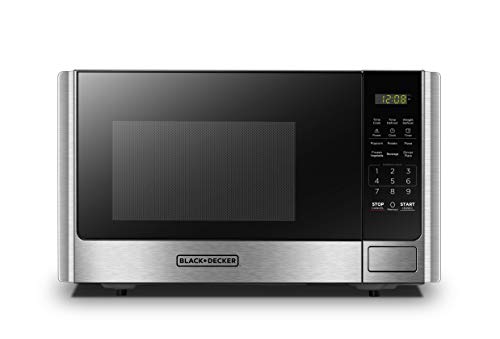
BLACK+DECKER Countertop Microwave Oven, 0.9 Cu.Ft, 900W, Stainless Steel
Badge: Best Overall
Strengths
- Push-button door and stated child safety lock — the most identifiable access design in the mid-compact class.
- 0.9 cu ft and 900W is the small-household specification that big-box ranges are built around.
- Ten power levels and six auto cook presets cover the everyday rotation simply.
Trade-offs
- No sensor is named in the listing; timing remains a manual skill.
- Stainless front shows fingerprints around the door button.
- Families cooking in sequence will outgrow the cavity.
Key specs: Capacity 0.9 cu ft; Power 900W; 10 power levels; Push-button door; Child safety lock; 6 auto cook presets; Finish: stainless steel.
This BLACK+DECKER heads the list because it is the model a single-store shopper is most likely to be glad they recognised. The mid-compact class fills more big-box shelf space than any other, and it fills it with lookalikes; this model’s stated identifiers cut through them. A push-button door — press, and the door opens a controlled amount, with no handle for small hands to haul on — paired with a stated child safety lock gives it an access design that is both a daily convenience for older users and a considered answer for young families. The rest of the specification is the class at its balanced best: a dinner plate fits the 0.9 cu ft cavity, 900W reheats at a fair pace, and the controls keep their promises simple.
Its mainstream standing rests on that combination of identity and balance. A shopper who has read this review can walk any retailer’s microwave aisle and sort it in minutes: find the 0.9, 900W stainless machine with the button door and the lock in its feature list, and you have found this class’s reference point, against which the shelf’s other offerings can be priced and judged. The honest trades are the class’s own — no sensor to supervise cooking, a preset library sized for basics — and for one- and two-person households they are the right trades to accept.
Best for: small households who want the door-and-lock reference point of the class / Not suited for: families or sensor seekers
Check on Amazon for the current listing, the full feature list and delivery options.

TOSHIBA Microwave Oven, 0.9 Cu.Ft, 900W, Black Stainless Steel
Badge: Best for Apartments
Strengths
- Child lock and mute function stated — the considerate pair for shared buildings.
- LED interior lighting turns the door window into a real viewing window.
- Removable 10.6 inch turntable makes the small cavity properly washable.
Trade-offs
- Six auto menus is a modest library for keen cooks.
- 900W feels slow across back-to-back plates for a group.
- Black stainless will not blend with every kitchen scheme.
Key specs: Capacity 0.9 cu ft; Power 900W; 6 auto menus; Mute function; Child lock; LED lighting; Turntable 10.6 inch removable; Finish: black stainless steel.
Toshiba’s own listing pitches this model at apartment life, and in a retailer’s range it plays the same role: the mid-compact for buyers whose context is a small kitchen in a shared building. The stated features assemble that brief with care — a mute function for the neighbours, LED lighting so doneness checks do not require opening the door and losing the heat, a child lock for the households that need one, and a removable turntable so the compact cavity can be kept genuinely clean. Against the BLACK+DECKER above it trades the button door for light, quiet and finish on the same 0.9 and 900W core, which gives the store shopper a clean, preference-based choice between two proven answers rather than a good-better ladder.
That is worth dwelling on, because it is how a healthy class behaves in any good range: the alternatives differ in texture, not in competence. Identify this one by the black stainless finish and the LED lighting in its feature list, check the live price wherever you are shopping, and the decision between it and its classmates can be made on the day, on preference, without anxiety. Its limits — menu depth, group pace — are the class’s limits, honestly shared.
Best for: apartment households that want lock, mute and light / Not suited for: larger households or menu-driven cooks
Check on Amazon for the current listing, the full feature list and delivery options.

TOSHIBA Countertop Microwave Oven, 1.2 Cu.Ft, 1000W, Black
Badge: Best Family Pick
Strengths
- Smart humidity sensor supervises reheating — the feature family buyers most consistently value.
- 12 auto menus, a 12.4 inch removable turntable and an easy clean interior complete the family package.
- Mute function and ECO mode are included at the full family specification.
Trade-offs
- No child lock is named in the verified listing.
- Black finish shows splatter and dust readily.
- Full-size footprint requires a proper stretch of counter.
Key specs: Capacity 1.2 cu ft; Power 1000W; Turntable 12.4 inch removable; Smart humidity sensor; 12 auto menus; Mute function; ECO mode; Easy clean interior; Finish: black.
Every general retailer’s microwave range has a family centre, and in the wider market that centre looks like this: 1.2 cu ft, 1000W, and a sensor to supervise the reheating that dominates family microwave use. Toshiba’s humidity sensor reads the steam coming off food and adjusts the cycle, which turns the daily leftovers run from a sequence of guesses into a supervised process. The dozen auto menus cover the family’s rotating dishes, the turntable is a proper 12.4 inches and lifts out for washing, and the interior is designed to clean easily — the unglamorous feature that decides how the machine feels in year three. In black, it is the finish variant that disappears into darker kitchens, with a stainless sibling carrying the identical specification for brighter ones.
For the single-store shopper, this model is the benchmark to carry: if the range in front of you offers a 1.2, 1000W machine with a humidity sensor and this feature set, you are looking at the market’s family centre whatever the shelf signage calls it; if the store’s family offering lacks the sensor, you now know exactly which compromise its price is asking you to accept. The stated gap is the unnamed child lock — check the current listing if that feature is decisive for your household.
Best for: families who want sensor cooking at the mainstream size / Not suited for: buyers who need a stated child lock
Check on Amazon for the current listing, the full feature list and delivery options.

COMFEE’ Countertop Microwave Oven, 0.7 Cu.Ft, 700W, Black, ECO Mode
Badge: Best Budget-Tier Pick
Strengths
- Budget-tier positioning — one of the lower-cost designs in the compact class, and the natural anchor of any store’s entry shelf.
- Child safety lock and sound on/off stated, which is thoughtful equipment at this tier.
- ECO mode and one-touch buttons suit the dorm, apartment and office habitats its listing names.
Trade-offs
- 700W needs time added to packet instructions, and the cavity caps portions at single servings.
- A deliberately basic feature set — no sensor, no menu library.
- Workmanlike finish, in line with its tier.
Key specs: Capacity 0.7 cu ft; Power 700W; ECO mode; Sound on/off; One-touch buttons; Child safety lock; Intended for dorm, apartment and office use; Finish: black.
General retailers live on their entry shelves, and the compact budget tier is where a store’s microwave range meets its youngest and most price-conscious customers: the student outfitting a dorm room, the tenant furnishing a first flat, the office replacing a break-room veteran. The COMFEE’ is the market’s considered answer to that shelf. Its listing names the habitats plainly and equips them properly — one-touch buttons for users who will never open a manual, a child safety lock for shared spaces, sound on/off for thin walls, and an ECO mode for an appliance plugged in around the clock. In this guide’s qualitative terms it sits in the budget tier, one of the lower-cost designs in its class, which is a positioning a shopper can use in any store: this is what the honest bottom of the compact market looks like, so anything cheaper in a range should be asked what it gave up.
The limits are the format’s physics — small portions, gentler pace — and they are the same limits every compact in every retailer shares. Within them, the COMFEE’ is the entry pick that respects its buyers, and its persistence in the wider market is the proof. Judge any store’s budget compact against its stated feature set and you will price the whole shelf correctly.
Best for: dorms, offices and first flats on a budget tier / Not suited for: family cooking or full-size dishes
Check on Amazon for the current listing, the full feature list and delivery options.

Farberware Countertop Microwave Oven 1.1 cu.ft, 1000 Watts, Stainless Steel
Badge: Best for Defrosting
Strengths
- Defrost by weight or time stated in the listing — the practical system for households that cook from frozen.
- Multi-stage cooking runs defrost-then-cook as one programme.
- Full 1000W at 1.1 cu ft, with express cooking and a clear LED display.
Trade-offs
- No child lock and no sensor are named in the verified listing.
- Six preset options is a smaller library than the Toshiba family model’s twelve.
- Traditional control style; sensor devotees should take the Toshiba instead.
Key specs: Capacity 1.1 cu ft; Power 1000W; 10 power levels with multi-stage cooking; 6 preset options; Defrost by weight or time; LED display; Express cooking; Finish: stainless steel.
The Farberware is the family alternative with a specialism, and specialisms are how a shopper should read any retailer’s range: not as a ladder from worst to best, but as a set of answers to different kitchens. Its listing states defrost by weight or time, and for the many households whose microwave is chiefly a defrosting station feeding weeknight cooking, that system — the machine scaling the cycle to the food’s actual weight — is worth more than a sensor. Multi-stage cooking builds the defrost into a full defrost-then-cook programme, and the whole package runs at a full 1000W in a 1.1 cu ft cavity that can be the difference between fitting a tight counter run and not.
In a store’s range, this is the model that teaches the comparison discipline: against the Toshiba family pick, the question is not which is better but which job your microwave does most — supervised reheating or disciplined defrosting. Choose by your cooking, then check the live offer at whichever retailer you are shopping. The gaps are stated plainly: no lock and no sensor are named in the listing, so households for whom those are decisive have their answers elsewhere in this six.
Best for: households that defrost constantly and cook from frozen / Not suited for: buyers who need a stated child lock or sensor
Check on Amazon for the current listing, the full feature list and delivery options.

Chefman Countertop Microwave Oven 0.9 Cu. Ft., 900 Watts, Black
Badge: Best Mid-Size Pick
Strengths
- Child safety lock, mute button and Eco mode all stated — the considerate trio in one mid-compact.
- Six cooking presets with one-touch express cook keep daily use quick.
- Ten power levels give proper control at the class specification.
Trade-offs
- Black finish only in this listing, against a class where stainless is common.
- No sensor is named in the listing.
- Shares its size class with two strong rivals here, so details and the day’s offer decide.
Key specs: Capacity 0.9 cu ft; Power 900W; 10 power levels; 6 cooking presets with one-touch express cook; Eco mode; Child safety lock; Mute button; Finish: black.
The third mid-compact completes the class’s representation, and its presence is the point: in the highest-volume territory of any big-box range, the shopper deserves more than one proven answer. The Chefman matches the class core — 0.9 cu ft, 900W, ten power levels — and states a trio of considerate features in its listing: a child safety lock for family kitchens, a mute button for light sleepers, and an Eco mode for standby thrift, with express cook handling the hurried end of the day. Against the BLACK+DECKER it trades the button door for that trio; against the Toshiba 0.9 it trades LED lighting for express simplicity and a black finish. No ranking among the three survives contact with a real household’s preferences, which is exactly what a mature class looks like.
For the single-store shopper, the trio is a practical gift: whichever of the three a given range carries, in whichever finish, the class decision has already been validated by the wider market, and the remaining choice is texture and the live price on the day. Identify the Chefman by its black finish and the lock-mute-Eco combination in its feature list, and it will never be confused with a lesser near-twin on a crowded shelf. Readers who prefer the plainest possible version of this class can also weigh it against the Best Simple Microwaves filter, where control simplicity outranks every other virtue.
Best for: small households that want lock, mute and Eco in a black mid-compact / Not suited for: stainless kitchens or sensor seekers
Check on Amazon for the current listing, the full feature list and delivery options.
Comparison Table
| Pick | Capacity | Power | Lock stated? | Standout | Link |
|---|---|---|---|---|---|
| BLACK+DECKER 0.9 | 0.9 cu ft | 900W | Yes | Push-button door | Check on Amazon |
| TOSHIBA 0.9 Black Stainless | 0.9 cu ft | 900W | Yes | LED lighting, mute | Check on Amazon |
| TOSHIBA 1.2 Black | 1.2 cu ft | 1000W | Not named | Humidity sensor, 12 menus | Check on Amazon |
| COMFEE’ 0.7 | 0.7 cu ft | 700W | Yes | Budget tier, sound on/off | Check on Amazon |
| Farberware 1.1 | 1.1 cu ft | 1000W | Not named | Defrost by weight or time | Check on Amazon |
| Chefman 0.9 | 0.9 cu ft | 900W | Yes | Mute, Eco, express cook | Check on Amazon |
Carry this table into any store, Target included, as your identification card. Match a shelf model against a row — brand, capacity, wattage, lock, standout feature — before you look at its ticket. A row match means the offer in front of you is for a machine this guide has assessed on the wider market’s evidence. A near miss with a feature quietly absent is a different machine, and its friendlier ticket deserves a question, not a celebration.
How to Choose a Microwave Inside One Retailer’s Range
Walk in — or log on — with the decisions already made, in the order this guide makes them. Size class first, from your largest dish: 0.7 cu ft for single servings, 0.9 for one or two people, 1.1 to 1.2 for families. Wattage second, remembering that packet food assumes roughly 1000W and that lower bands demand consciously added time. Must-have features third, drawn from the stated vocabulary of these listings: a lock for the toddler years, a mute for thin walls, a sensor for the reheating household, defrost-by-weight for the cook-from-frozen household, a removable turntable or easy-clean cavity for the reluctant cleaner. With those three decisions written down, a retailer’s range stops being a wall of persuasion and becomes a matching exercise: which machines in this store satisfy my list, and what is each one’s live price today?
That method also tells you how to handle the range’s inevitable gaps. If the store’s slice lacks your class or your must-have feature, the correct move is not to compromise downward in the aisle — it is to check the same model through another channel, starting with the Amazon listings linked throughout this guide, and let the retailers compete for a decision you have already made well. Conversely, if the store’s range contains your model, the remaining checks are practical rather than existential: confirm the exact variant carries your feature, since near-twins drop features quietly; confirm what is in the box; and confirm the delivery, pickup and return arrangements that apply at that retailer, because a microwave that arrives the wrong size is only a good purchase if returning it is painless. None of that requires any claim about a specific store’s policies — it is a checklist you can run anywhere, including the store this keyword names.
One last discipline: let the finish decision happen inside the store, not before it. Finishes are where ranges differ most visibly and matter least functionally, and the same proven machine often exists in two of them — the Toshiba sensor design in this guide being the standing example. Decide the cooking in advance; decide the colour in front of the shelf.
How to Set Up and Look After a Countertop Microwave
However the purchase happens, the machine’s home life begins the same way. Place it on a flat, stable counter with clearance around the vents, plug it directly into a wall outlet, set the clock, and run a mug of water to confirm even heating, smooth turntable travel and a door that latches cleanly. Seat any removable turntable properly, remove every protective film — including the one that hides on keypads and impersonates a dead display — and keep the packaging until the household’s standard meals have cooked once without complaint, which is simply good practice for any appliance bought from any channel.
Care is three habits, shared by every pick here. Wipe the cavity while splashes are fresh, or steam them loose with a bowl of water and then wipe. Wash removable turntables in the sink on a regular rhythm. Keep the door seal and latch area crumb-free, never run the oven empty, and keep metal out of it. A countertop microwave maintained this way is a boring appliance for years, and boring — in a kitchen workhorse — is the sound of a purchase that was made well, wherever it was made.
Troubleshooting, in the pattern that matters:
Problem: packet meals emerge cold in the centre → your oven’s wattage sits below the packet’s assumption; add time in small increments, stir midway, and let the food stand a minute before serving.
Problem: the control panel ignores you → the child lock is engaged; release it with the button-hold sequence from the manual before concluding the machine is faulty.
Problem: the turntable rattles or stalls → reseat the plate on its ring, confirm the ring is the right way up, and clear the roller path of debris.
One Store’s Range Versus the Whole Market
A short section on the relationship this keyword is really about. A general retailer’s microwave range is a buyer’s-team artefact: a finite set of models chosen to cover the price points and use cases that store’s customers present, refreshed on a buying calendar, and presented according to the store’s merchandising logic. The whole market is something else — every manufacturer’s full line, every channel’s range, and the slow verdict of households replacing, upgrading and adding machines year after year. The two overlap heavily at the centre, because any competent store stocks the mainstream, and they diverge at the edges, where a given store’s slice thins out: the unusual sizes, the specialist features, the second finishes.
The shopper who understands that relationship shops better in both directions. Inside the store, they can trust the centre — the classes and designs this guide validates are the ones any good range is built from — while recognising shelf-filler for what it is. Outside the store, they know the market can supply whatever the slice lacks, through the listings linked here or any other channel, so no aisle gap becomes a forced compromise. And they are immune to the oldest confusion in retail: mistaking a store’s assortment for the world’s options, or a store’s promotion for the market’s verdict. The best selling microwaves are a market fact, assembled from millions of household decisions; a single range is one retailer’s reading of that fact. Read the fact first — that is what this page is for — and the reading will never steer you wrong. Households whose constraint is a specific small capacity can finish narrowing with the Best Small 10 Countertop Microwaves, where the borderland between compact and mid-size is mapped on its own.
Reading a Store Range: What the Shelf Is and Is Not Telling You
A microwave aisle speaks a language, and it is worth learning which of its sentences are information and which are presentation. Eye-level placement, end caps and promotional signage are presentation: they tell you what the store’s buyers and the manufacturers’ trade programmes agreed to feature this cycle, which correlates with the market’s centre often enough to be interesting and loosely enough to be useless as proof. The information lives in quieter places. A model stocked in depth, in two finishes, with its accessories and replacement turntables nearby, is a model the store expects to keep selling — retailers do not commit that kind of space to experiments. A class represented by several competing brands at several sizes is a class with real household demand behind it; a class represented by a single lonely unit is a niche the store is testing or clearing. And the feature vocabulary on the shelf tickets — sensor, lock, inverter, mute — tells you which attributes the store’s customers have taught it to advertise, which is the market’s curriculum surfacing in a single location.
Online ranges speak the same language in a different accent. Sort orders and “featured” placements are presentation, exactly as shelf position is. The information equivalents are the filters the site offers — the facets customers actually search by — and the persistence of models across range refreshes, which mirrors the in-store signal of stocked-in-depth. In both channels the discipline is identical: let presentation attract your eye if it likes, but let identifiers make your decision. The shopper who can separate those two channels of signal can walk into any retailer in the country, including the one this keyword names, and read its microwave range in ten minutes — what the market has validated, what the store is pushing, and where the two happen to agree, which is where the easiest good purchases in the category are always found.
Common Buying Mistakes
The first mistake is assuming a store’s range is the market — accepting the slice’s limits as the world’s limits, and compromising inside the aisle when the model you need exists one channel over. The second is matching by appearance instead of identifiers, and carrying home a near-twin that quietly lacks the lock or sensor you chose the class for. The third is letting the shelf’s organisation think for you: the promoted position, the end cap and the house favourite are merchandising decisions, not endorsements. The fourth is skipping the practical confirmations — exact variant, box contents, delivery and return arrangements — in the warmth of having found your class on the shelf. The fifth is ignoring wattage because the store’s signage led with capacity. And the sixth is the reverse snobbery: dismissing a store’s mainstream model as ordinary when its ordinariness is precisely the market’s validation, earned across more households than any boutique design will ever meet.
Final Recommendation
Carry the market’s centre into whichever store you shop, and let the store compete for it. Small households should look first for the BLACK+DECKER 0.9 and its door-and-lock package, with the Toshiba 0.9 and the Chefman 0.9 as the class’s other proven answers. Families should look for the TOSHIBA 1.2 with its humidity sensor, or the Farberware if defrosting leads your cooking, while dorms, offices and first flats should find the COMFEE’ compact anchoring the budget tier. If the range in front of you holds your model, check its live price and the practical details and buy with confidence; if it does not, the Amazon listings throughout this guide are one click away. Either way, the decision was made by the market’s evidence and your kitchen’s measurements — the store merely gets to fulfil it.
Frequently Asked Questions
Does this guide say which of these microwaves Target stocks?
No, and deliberately. Every pick here is an Amazon listing, and every link goes to Amazon. Target’s assortment, prices, stock and promotions vary by store and week and cannot be verified from the listings this guide is built on, so we make no claims about them. Use the guide to identify the proven models and their features, then check live availability at Target, Amazon or any other retailer on the day you buy.
How do I recognise one of these models inside a store’s range?
Match on identifiers, not placement: brand, capacity, wattage and the stated standout feature from the comparison table — the push-button door, the humidity sensor, defrost by weight, the lock-and-mute combination. A shelf model matching a row on all of those is a machine this guide has assessed. A near-match missing a feature is a different variant and should be priced and judged as one.
Why are there three 0.9 cu ft models in the picks?
Because the mid-compact class is where small households and big-box ranges most often meet, and a healthy class offers genuinely different answers on the same core: the BLACK+DECKER’s door design, the Toshiba’s apartment features and the Chefman’s lock-mute-Eco trio. Whichever of the three a given range carries, the class decision is already validated — the remaining choice is texture and the day’s price.
What if the store I am shopping does not have the model I chose?
Then let another channel fulfil the decision rather than compromising inside the aisle. The Amazon listings linked throughout this guide are the direct route, and the model-first method means your shortlist, measurements and feature requirements travel intact to any retailer. A store’s gap is information about its range, not a verdict on your choice.
Are store-exclusive microwave variants worth considering?
Judge them by the same stated-features discipline as everything else: capacity, wattage and the named features, compared honestly against the market-centre rows in this guide’s table. An exclusive that matches a proven class and carries its features can be a sound buy; one that trades a sensor or a lock for a friendlier ticket is asking you to fund the difference. The identifiers never lie, even when the signage is enthusiastic.
What should I check besides the model and price in store?
Four practical things: that the exact variant on offer carries the feature you chose it for; what is included in the box; the delivery or pickup arrangements that apply; and how a return would work if the size proves wrong at home. Those checks take minutes, they apply at any retailer, and they are the difference between a good purchase and a good story about one.
Why does this guide avoid naming a best store to buy from?
Because the honest answer is that it depends on the day, the model and the live offer — variables no guide can fix in print. What a guide can do is make you retailer-proof: certain of your model, fluent in its identifiers, and clear about the practical checks that protect the purchase after the model is chosen. A shopper in that position gets a fair outcome at any store, on any week of the year, which is worth considerably more than a store recommendation that quietly expires with the next promotion cycle or range review.


