Disclosure: topratedkitchenware.com is reader-supported. When you buy through links on our site, we may earn an affiliate commission from Amazon and other retailers, at no extra cost to you.
Where to buy
For shoppers asking what the best shape for chopsticks really is, the list below previews each set by its geometry. All six verified sets are linked below, and all six are chopsticks — but they are not the same shape, and shape is this guide’s whole subject. Two listings state a cross-section outright: a square grip section and a full square body. The rest shape your experience through engraved surfaces, hollow cores and tip treatments. The list below previews each set by its geometry; the reviews then grade every shape claim against what the listing actually documents.
- Greatamzor 18/8 Stainless Steel Chopsticks, 5 Pairs — five pairs of 18/8 steel, 9 1/4 inches, laser-engraved grip surface.
- NEWDRIP 18/8 Stainless Steel Chopsticks, 8 Pairs — eight pairs of 18/8 steel, 9.25 inches, laser-engraved grip surface.
- Zliutob Stainless Steel Chopsticks, 5 Pairs — five pairs with a square grip section and textured tips.
- LIXTONGR Dragon & Phoenix Black Chopsticks, 2 Pairs — two pairs of 18/10 steel, 9 inches, black Dragon & Phoenix presentation.
- MUYOS Stainless Steel Chopsticks, 5 Pairs — five hollow-core pairs — shape you feel as weight, or its absence.
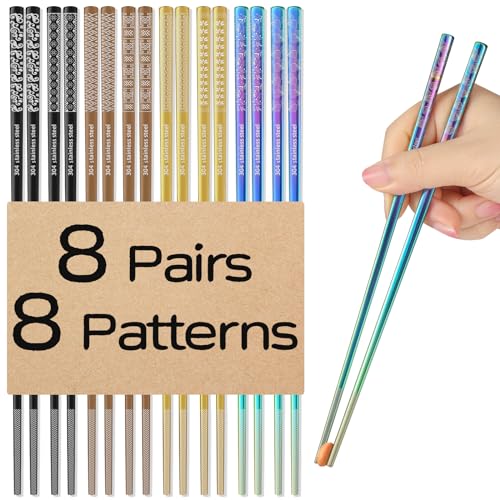
- Greatamzor Multicolor Square Chopsticks, 5 Pairs — five square-bodied multicolor pairs, 9 1/4 inches, copper coin engraving.
Read the full guide ↓ for the geometry itself: what round, square, flat and textured profiles do in the hand and on the food, and which profile solves which problem.
Ask what the best shape for chopsticks is and most guides answer with a material or a brand. Shape is its own question, and it is the one your hand actually asks. A chopstick’s cross-section — round, square, flat, twisted — decides whether the pair rolls off the table, rotates between your fingers, tires your grip, or presents a broad, stable face to a slippery piece of fish. Its taper decides how the tip meets food. Its surface — smooth, engraved, textured — decides how much of the holding is done by friction and how much by your squeeze. Two pairs of identical steel at identical length can eat like different tools because their shapes differ.
This guide works through the six verified sets in our pool as a shape survey. The survey has an honest wrinkle, stated now rather than buried: only two of the six listings name a cross-section — one square grip section, one full square body. The other four shape the eating experience without naming a profile: laser engraving that textures the surface, a hollow core that changes the weight distribution, a non-slip grip whose geometry is left to the photograph. Rather than invent profiles for them, the reviews analyze the shape features each listing does document, and the buying guide explains the full geometry menu so you can judge any listing — including these — with your eyes open.
By the end you will know which profile solves rolling, which solves rotation, which solves fatigue, and which is mostly ceremony. Readers whose real question is the companion dimension should pair this guide with Best Size For Chopsticks — shape and size are the two halves of fit, and neither substitutes for the other.
Key Takeaways
- Shape is three decisions, not one: cross-section, taper and surface. Judge listings on all three.
- Square profiles solve rolling on the table and rotation in the hand — mechanically, not by friction.
- Only two of these six listings state a cross-section; the others shape feel through engraving, hollowing and tips.
- Engraved texture is the most durable surface treatment because it is cut into the metal itself.
- A hollow core is a shape decision you feel as lightness — the right answer for tired hands.
- Round and smooth is the classic profile and the most demanding: it asks the most of your technique.
In this guide
Quick Picks
The badges sort the pool by shape role. Note how few of them are cross-sections — a fair snapshot of a market that sells surfaces more readily than geometry.
| Set | Badge | Why it earns its place |
|---|---|---|
| Greatamzor 18/8 Stainless Steel Chopsticks, 5 Pairs | Best Engraved All-Rounder | Engraved surface on a classic profile: friction doing the work, durably. |
| NEWDRIP 18/8 Stainless Steel Chopsticks, 8 Pairs | Best Engraved Host Set | The same engraved answer in an eight-pair host format. |
| Zliutob Stainless Steel Chopsticks, 5 Pairs | Best Square Grip | Square where the fingers sit, textured where the food sits. |
| LIXTONGR Dragon & Phoenix Black Chopsticks, 2 Pairs | Best Presentation Shape | A presentation pair whose shape story is finish and motif. |
| MUYOS Stainless Steel Chopsticks, 5 Pairs | Best Lightweight Profile | Hollow-core profile: the shape is in the weight you do not feel. |
| Greatamzor Multicolor Square Chopsticks, 5 Pairs | Best True Square Body | Full square body with engraved pattern — both geometry and surface. |
How These Picks Were Chosen
The pool was verified against the Amazon Creators API on 2026-11-20 — ASIN, title and image confirmed for every set — and this keyword then applied a documentation audit specific to shape. For each listing we recorded exactly which geometric facts it states: cross-section if named, grip or tip treatment if named, construction (such as hollow core) if named, and length as the shape-adjacent dimension. The audit’s headline finding is the one the introduction promised: cross-sections are under-documented in this category. Two sets state one; four do not. Those four are not excluded — the keyword asks for the best shapes among real products, and surface and construction are real shape factors — but their reviews confine geometric claims to what is documented and say plainly where the documentation stops.
Ranking within the guide weighs shape effectiveness against the problem each profile solves. A square section earns its ranking by eliminating rotation mechanically — no technique required. Engraving earns its ranking by permanence. The hollow core earns its by removing the fatigue that ends meals badly. Presentation shaping — finish, motif, box — is ranked as what it is: valuable for occasions, neutral for geometry. This is a research-led comparison of documented designs, with no hands-on laboratory claims, and every specification below traces to a listing title or to clearly-labeled general geometry knowledge in the guide sections.
A word on evidence: where this guide describes what round, square or flat profiles do in general, that is established chopstick geometry, true of the forms themselves. Where it describes what a specific set is, that is the listing speaking. The two are never blended, and the Best Square Chopsticks companion guide applies the same discipline to the square specialists alone.
The Best Shape for Chopsticks: 6 Sets Graded Honestly
Each review leads with the set’s documented shape features, then separates what the geometry guarantees from what it merely suggests. Sets whose listings do not state a cross-section are marked as such — treat that line as the most useful sentence in their reviews.
Greatamzor 18/8 Stainless Steel Chopsticks, 5 Pairs
Badge: Best Engraved All-Rounder
Strengths
- The 18/8 steel grade is stated outright in the listing, so you know exactly what alloy you are buying
- Laser engraving cuts the grip texture into the metal itself, so there is no coating to peel, chip or wear smooth
- Five pairs at a mid length suit a small household, a full place-setting run, or a shared sushi night without rationing
Trade-offs
- Smooth steel can feel slick against very oily noodles until your pinch pressure adjusts
- The engraved pattern helps, but it is a modest grip gain rather than a textured rubber-style hold
- Steel conducts heat, so a pair left resting in a hot pan will warm up at the handle end
| Detail | From the listing |
|---|---|
| Material | 18/8 stainless steel |
| Pairs in set | 5 pairs |
| Length | 9 1/4 inches |
| Grip detail | Laser-engraved non-slip pattern |
| Care | Dishwasher safe |
| Stated style | Japanese / Korean |
| Stated use | Cooking and eating |
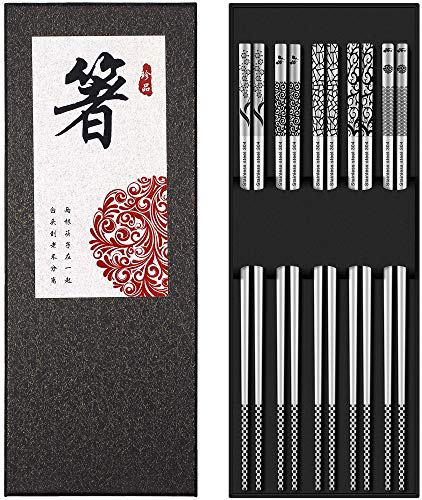
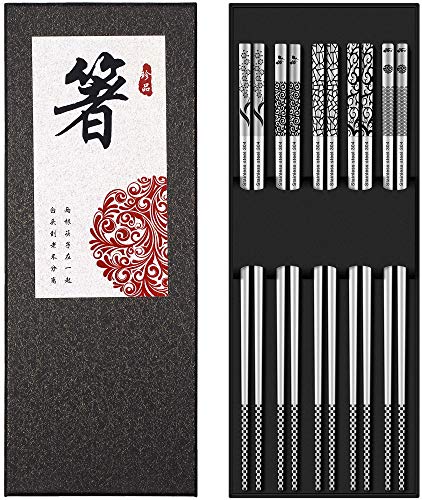
This Greatamzor set is the straightforward reference point for the whole pool: five pairs of 18/8 stainless steel at nine and a quarter inches, with a laser-engraved pattern doing the grip work. The engraving matters more than it might sound. A printed or coated texture eventually wears; a pattern cut into steel is still there after years of dishwasher cycles. The length sits in the middle of the East Asian dining range — long enough for shared dishes in the middle of the table, short enough to stay precise over a rice bowl. Because the listing covers both cooking and eating, the same pair can turn dumplings in a skillet and then come to the table, which is how most home cooks actually use one good set.
Shape verdict: a classic profile carrying a modern surface. The listing does not state a cross-section, so the honest description is an engraved-grip steel pair whose shape contribution is friction, not geometry. That is not a small thing — engraving converts the slipperiest material into a workable one, permanently, because the pattern is the metal. What it cannot do is stop a round pair rolling on a bare table or rotating slowly in a loose grip; if either of those is your complaint, geometry, not surface, is your answer, and it sits further down this list.
Best for: eaters whose problem is slippery food and who want a permanent, engraved fix / Not suited for: eaters whose problem is rolling or rotation — that takes geometry, below

NEWDRIP 18/8 Stainless Steel Chopsticks, 8 Pairs
Badge: Best Engraved Host Set
Strengths
- Eight pairs is the most generous count among the 18/8 sets here — enough for guests without a second purchase
- The stated style range spans Japanese, Korean and Chinese tables, and the 9.25-inch length is a workable compromise between them
- Engraved grip and dishwasher-safe steel make it a low-maintenance everyday set
Trade-offs
- Eight identical pairs means no color coding — guests cannot tell their pair apart at a glance
- A compromise length is exactly that: purists who want a short, pointed Japanese pair or a long Chinese pair will feel the middle ground
- The multipack format is practical rather than giftable in presentation
| Detail | From the listing |
|---|---|
| Material | 18/8 stainless steel |
| Pairs in set | 8 pairs |
| Length | 9.25 inches |
| Grip detail | Laser-engraved non-slip pattern |
| Care | Dishwasher safe |
| Stated style | Japanese / Korean / Chinese |
| Stated use | Cooking and eating |
NEWDRIP takes the same 18/8 formula as the five-pair sets and simply gives you more of it: eight pairs at 9.25 inches, laser engraved, dishwasher safe. That count changes how the set lives in a kitchen. With eight pairs you stop guarding chopsticks — a pair can live by the stove, pairs can sit in the dishwasher while others are in the drawer, and a dinner for six does not trigger a hand-washing session first. The listing names Japanese, Korean and Chinese use, which fits the middle-of-the-road length: this is the generalist set for households that cook across cuisines rather than optimizing for one tradition.
Shape verdict: the same engraved-surface philosophy at host scale. Across eight pairs, consistency of profile matters — guests pick up any pair and meet the same tool — and engraving delivers identical grip pair after pair in a way hand-finished surfaces cannot. The cross-section is again unstated, so rotation and rolling behavior cannot be certified from the listing. Judge it as a friction solution in depth: excellent for households whose problem is slippery food, neutral for households whose problem is a pair that wanders on the table.
Best for: hosts needing identical grippy pairs in depth / Not suited for: buyers who need a certified cross-section before ordering

Zliutob Stainless Steel Chopsticks, 5 Pairs
Badge: Best Square Grip
Strengths
- The square grip section gives your fingers flat faces to hold, which resists rolling and rotation in the hand
- Textured tips attack the exact spot where smooth steel fails — the last inch that actually touches the food
- Five pairs is a sensible household count, and the set is explicitly reusable and dishwasher safe
Trade-offs
- The listing title states no length, so you cannot confirm the size from the title alone before ordering
- The steel grade is not stated either, unlike the 18/8 and 304 sets elsewhere in this pool
- A square grip feels secure but less familiar to eaters raised on round wooden pairs
| Detail | From the listing |
|---|---|
| Material | Stainless steel (grade not stated in the listing title) |
| Pairs in set | 5 pairs |
| Length | Not stated in the listing title |
| Grip detail | Textured tips and a square grip section |
| Care | Dishwasher safe |
| Stated use | Sushi, ramen and daily meals |
Zliutob is the grip engineer of this pool. Instead of decorating the shaft, it changes the geometry: a square grip section where your fingers sit, and textured tips where the food sits. Both changes target the two honest weaknesses of metal chopsticks — rotation in the hand and slippage on glossy food. A square section cannot roll on the table either, a small daily mercy. The listing aims the set at sushi, ramen and daily meals, which matches the design: slippery fish, slick noodles and everyday rice bowls are exactly the foods that punish a smooth round stick. What the listing does not give you is a length or a steel grade, and this guide will not invent either.
Shape verdict: the most deliberate geometry in the pool, targeted with unusual precision. The square section sits where the fingers grip — exactly where rotation starts — while the tips are textured where food contact happens. Two different shape problems, two different shape answers, one pair. The limitation is documentation, not design: with no stated length or grade, the geometry cannot be placed on the size map from the listing alone. If your failures are rotational — the pair slowly twisting until the tips cross — this is the profile the category invented for you.
Best for: eaters whose pairs rotate in the hand or whose tips slip on fish and noodles / Not suited for: buyers who require a stated length and grade

LIXTONGR Dragon & Phoenix Black Chopsticks, 2 Pairs
Badge: Best Presentation Shape
Strengths
- 18/10 is the highest steel grade stated anywhere in this pool
- The Dragon & Phoenix motif and gift box make it the one set here designed to be given, not just used
- At nine inches it is the shortest stated length in the pool — a precise, table-focused pair
Trade-offs
- Two pairs is a gift format, not a household solution — a family will need several boxes
- The black finish is a surface treatment, and surface treatments deserve gentler handling than bare steel over the long term
- The listing is aimed at dining and occasions; it makes no cooking claim
| Detail | From the listing |
|---|---|
| Material | 18/10 stainless steel |
| Pairs in set | 2 pairs |
| Length | 9 inches |
| Finish | Black, Dragon & Phoenix design |
| Grip detail | Non-slip grip |
| Care | Dishwasher safe |
| Presentation | Gift box; listed for dining, travel, housewarming and wedding gifting |
LIXTONGR is playing a different game from the multipacks. Two pairs, the pool’s highest stated steel grade at 18/10, a black finish with a Dragon & Phoenix design, and a gift box — this is the set you hand to someone, at a wedding, a housewarming, or across a dinner table. The nine-inch length is the shortest stated here, which suits its dining focus: shorter pairs are precise pairs, made for picking cleanly from individual bowls and plates rather than reaching across a table. The non-slip grip and dishwasher-safe construction keep it practical under the presentation, so it does not have to live in a drawer as a ceremonial object.
Shape verdict: presentation geometry. The listing documents a non-slip grip and a black Dragon & Phoenix finish, but no cross-section, no tip treatment, no taper — the shape story here is silhouette and surface decoration, aimed at the eye across a table rather than the mechanics in the hand. That is a legitimate design priority for a gift set, and the nine-inch length is at least a dining-true dimension. Buyers whose question is genuinely geometric should treat this set as unexamined rather than examined-and-failed: the listing simply does not enter the shape competition.
Best for: gift-givers and tables where silhouette and motif are the point / Not suited for: shape researchers who need documented geometry
MUYOS Stainless Steel Chopsticks, 5 Pairs
Badge: Best Lightweight Profile
Strengths
- The hollow core cuts the weight that makes solid steel pairs tiring for new chopstick users
- Non-slip tips concentrate grip help at the food end, where it matters most
- A plain silver finish matches any table setting and hides wear gracefully
Trade-offs
- The listing title states neither a length nor a steel grade, so two basic facts are unconfirmed from the title
- A hollow pair feels different — lighter and less planted — which some experienced users dislike
- The listing positions the set for daily meals, with no cooking claim
| Detail | From the listing |
|---|---|
| Material | Stainless steel (grade not stated in the listing title) |
| Pairs in set | 5 pairs |
| Length | Not stated in the listing title |
| Design | Hollow-core lightweight construction |
| Grip detail | Non-slip tips |
| Care | Dishwasher safe |
| Stated use | Reusable, for daily meals |
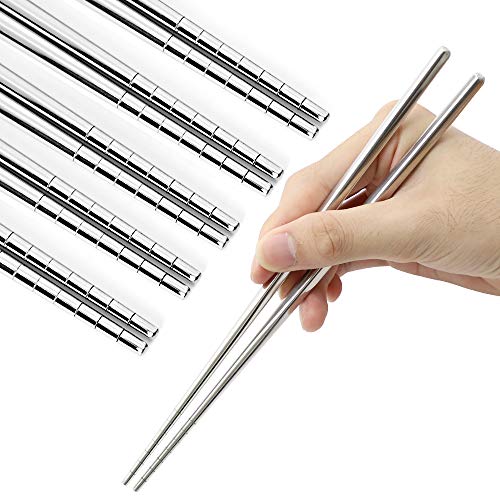
MUYOS answers the most common complaint about metal chopsticks — the weight — with a hollow core. A solid steel pair can feel like holding two pens made of lead by the end of a long meal, especially for anyone still building the grip. Hollowing the shaft keeps the durability and dishwasher safety of steel while bringing the hand feel closer to wood or bamboo. The non-slip tips handle the other metal complaint, slippage, at the business end. In plain silver with five pairs to a set, this is the pool’s quiet everyday option: nothing decorative, everything aimed at making steel feel less like a compromise.
Shape verdict: the invisible profile. A hollow core changes no silhouette and photographs as nothing, yet it is one of the most consequential shape decisions in the pool because it relocates the pair’s mass. A lighter pair balances differently, fatigues differently, and asks less of a developing grip. Combined with non-slip tips, the MUYOS design spends its entire shape budget on the two ends of the experience — weight in the hand, grip on the food — and nothing on the middle. For eaters whose meals end with an aching hand, that is the correct budget.
Best for: eaters whose hands tire — the hollow profile removes weight, not grip / Not suited for: buyers who need a stated length; hosts needing more than five pairs

Greatamzor Multicolor Square Chopsticks, 5 Pairs
Badge: Best True Square Body
Strengths
- Different colors per pair end the whose-pair-is-this problem at shared meals
- The square body cannot roll off the table and gives fingers a positive, non-rotating hold
- The engraved copper coin pattern adds grip texture and a traditional decorative motif at once
Trade-offs
- The steel grade is not stated in the listing title, unlike this brand’s own 18/8 set
- Multicolor finishes are surface color — expect them to prefer gentler washing over the years
- A bold multicolor set will not suit every table aesthetic
| Detail | From the listing |
|---|---|
| Material | Stainless steel (grade not stated in the listing title) |
| Pairs in set | 5 pairs, multicolor |
| Length | 9 1/4 inches |
| Shape | Square, non-slip |
| Grip detail | Laser-engraved copper coin pattern |
| Care | Dishwasher safe |
This Greatamzor set solves a social problem the plain sets ignore: at a shared meal, identical steel pairs are anonymous. Multicolor pairs give every diner a color to claim. Under the color sits a genuinely functional shape — a square, non-slip body at nine and a quarter inches, engraved with a copper coin pattern that doubles as grip texture. Square chopsticks are an old solution, not a gimmick: flat faces sit still on the table, resist rotation between the fingers, and present a broader contact patch to slippery food than a round tip of the same weight.
Shape verdict: the complete geometric statement — a full square body, not merely a square grip zone, engraved with a copper coin pattern that adds a textured surface to the flat faces. A square body cannot roll, resists rotation along its whole length, and meets food with a broader contact face than a round tip of similar weight. The multicolor finish rides on top of the geometry without changing it. If the question is purely “what is the best shape,” this set and the square-grip Zliutob are the two listings that answer in geometry rather than in adjectives — compare them directly in the Best Square Chopsticks guide.
Best for: families and anyone who wants square geometry plus color coding / Not suited for: buyers who want a stated steel grade, or a formal plain finish
Comparison Table
Geometry at a glance. “Not stated” appears often, and that frequency is itself the finding.
| Set | Defining traits from the listing |
|---|---|
| Greatamzor 18/8 Stainless Steel Chopsticks, 5 Pairs | Cross-section not stated · Engraved surface · 18/8 steel · 5 pairs · 9 1/4 in |
| NEWDRIP 18/8 Stainless Steel Chopsticks, 8 Pairs | Cross-section not stated · Engraved surface · 18/8 steel · 8 pairs · 9.25 in |
| Zliutob Stainless Steel Chopsticks, 5 Pairs | Square grip section · Textured tips · Steel, grade unstated · 5 pairs · Length unstated |
| LIXTONGR Dragon & Phoenix Black Chopsticks, 2 Pairs | Cross-section not stated · Non-slip grip · 18/10 steel · 2 pairs · 9 in · Gift presentation |
| MUYOS Stainless Steel Chopsticks, 5 Pairs | Hollow-core construction · Non-slip tips · Steel, grade unstated · 5 pairs · Length unstated |
| Greatamzor Multicolor Square Chopsticks, 5 Pairs | Full square body · Copper coin engraving · Steel, grade unstated · 5 pairs · 9 1/4 in |
How to Choose a Chopstick Shape: The Geometry Menu
Cross-section first, because it is the decision with mechanical consequences. Round is the classic profile: it rolls freely, rotates freely, and rewards a trained, quiet grip — most traditional wooden pairs are round or softly rounded, and generations have eaten beautifully with them. Square trades that freedom for stability: flat faces index against your fingers, the pair stays where the table puts it, and rotation must be forced rather than merely allowed. Flat-sided profiles, traditional in Korean metal chopsticks, push the same logic further for slippery foods like kimchi. Twisted and octagonal variants exist as middle paths. None is “best” in the abstract — square is best at stability, round is best at tradition and fine rolling adjustments of the tip, and your dominant failure mode should choose between them.
Taper second. A pair that narrows to a fine point is a precision instrument: fish flakes, single peas, the last noodle strand. A pair that stays blunt is a hauling tool: sturdier, more forgiving, less exact. Japanese dining tradition prizes the point; communal serving and cooking prize the robust end. Listings rarely quantify taper, so read the stated use — a set aimed at sushi and sashimi is declaring a fine-tip intent, while a set aimed at cooking and shared dishes is declaring the opposite — and treat the declaration as a claim about geometry, because it is one.
Surface third. Smooth steel is the hardest surface in the category; every treatment since has been an apology for it. Engraving cuts texture into the metal and is effectively permanent. Texturing concentrates roughness where it is needed, usually the tips. Coatings and plating change feel and look together and age as surfaces do. When a listing says “non-slip” with no mechanism named, you have learned that the maker cares about the word; when it names the mechanism, you have learned how the pair actually works. Buy mechanisms.
Construction fourth, because it hides. A hollow core, as in the MUYOS set, is a shape decision about mass: the pair’s silhouette is ordinary and its balance is not. Solid pairs feel planted and can feel heavy; hollow pairs feel quick and can feel insubstantial. Neither reaction is wrong, and the only reliable test is a meal-length hold. If your hands have ever ached at a long dinner, weight is a shape specification for you, whatever the listings call it.
And the table test, last and cheapest: does the pair stay where you put it down? Round pairs roll toward plate edges, onto floors, into laps. Square pairs sit. In restaurants this is a nicety; at a family table with children, white upholstery or a dog, it is a daily quality-of-life feature — one reason the square family set in this pool exists, and why our Best Size For Cooking Chopsticks guide gives the same stay-put logic extra weight at the stove, where a rolling pair heads for a hot pan.
One shape variable hides inside every listing photograph and deserves extraction: tip width relative to shaft width. A pair that keeps nearly its full width to the end is a hauling profile — strong, blunt, kind to large items, clumsy on flakes. A pair that narrows decisively is a precision profile. Photographs exaggerate both, so use the stated use as the check: sushi and daily-meal positioning implies the finer end, cooking-and-sharing positioning the stronger end. When the photograph and the stated use disagree, believe the stated use — makers write their intentions more honestly than their stylists stage them.
How to Test a Shape in Your Own Hand
You cannot fully judge a profile from a listing, but you can judge your own hand’s preferences with whatever pairs you already own — including disposables — before spending anything. Eat one meal paying deliberate attention to failures, and classify each one. Food escaping at the tip is a surface or taper problem. The pair slowly twisting until the tips scissor is a rotation problem, solved by square or flat geometry. The pair migrating off the table edge is a rolling problem, also solved by geometry. An aching hand at dessert is a mass problem, solved by hollow or lighter construction. Four failures, four different shape prescriptions — and most buyers who skip this diagnosis buy a beautiful answer to a problem they do not have.
Then, whatever you buy, give the shape a fair trial: a full week of regular meals. Hands adapt to profiles — the first meal with a square pair feels angular to a lifelong round-pair user, and by the fifth meal the fingers have learned the faces. Judge on the fifth meal, not the first, and judge on your hardest food: the slippery noodle, the glossy dumpling, the flake of fish.
- Eat a diagnostic meal with your current pairs and write down every failure, classified: slip, twist, roll or ache.
- Match the dominant failure to its geometry: texture for slip, square or flat for twist and roll, hollow or light for ache.
- Shortlist only listings that name the mechanism — engraved, textured, square, hollow-core — not just the adjective “non-slip.”
- Confirm the companion dimension in the Best Size For Chopsticks guide; the right shape at the wrong length still fits badly.
- Trial the new pair for a week of real meals before judging, and judge on your hardest food.
- Rest the pair on the table edge mid-meal: if it travels, geometry has one more thing to tell you.
Problem: the tips keep crossing like scissors → what to do: that is rotation overwhelming your grip; choke up slightly for a meal to confirm, then move to a square or flat profile that indexes against the fingers. Problem: food shoots off the tips sideways → what to do: the tip face is too round and smooth for that food; a textured tip or the broader face of a square body gives the food somewhere to sit. Problem: the pair feels angular and uncomfortable after a week → what to do: believe your hand; shape preference has a real individual component, and an engraved round-profile set is the legitimate alternative, not a defeat.
One underused shape resource is the chopstick rest. A rest disciplines any profile — even a round pair cannot roll if it is parked on a rest — and it keeps tips off the table surface between bites. Households that love a round profile’s eating feel and hate its parking behavior often solve the whole problem with rests rather than new chopsticks.
If you take one habit from this section, make it the diagnostic meal. Most eaters have never once watched their own failures happen; they have only accumulated a vague sense that chopsticks are “a bit annoying.” One observed meal converts that fog into a named problem, and named problems have products that solve them — several of them reviewed above. The unobserved alternative is buying shapes at random and blaming your hands, which is the most expensive method known to this category, payable in drawers full of almost-right pairs.
A Short History of Profiles: Why Square Exists
Square chopsticks are not a modern invention chasing a trend; they are one of the old answers. Flat faces appear in traditional Japanese and Korean designs for the same reasons they appear in this pool: they sit still, they index in the hand, and they present a kind face to food. The round profile’s dominance in disposable and restaurant pairs is substantially a manufacturing story — round is the cheapest section to produce at volume — rather than a verdict that round eats best. When a modern steel maker chooses square, they are spending production money on geometry, which is why square listings deserve the close reading this guide gives them.
The same history explains the engraved surface: as steel replaced wood in Korean and then global kitchens, makers needed to return the friction that wood had provided for free. Engraving, texturing and flattening are three dialects of one sentence — “we know smooth steel slips” — and a listing that speaks none of them is either aimed at experts or not paying attention.
Shape at the Table: Etiquette and Physics
Profile leaks into etiquette in small ways. A pair that rolls is a pair that falls, and a fallen pair at a formal table is a small social event nobody wants. A pair parked across a bowl — a classic resting pose — heats through if the bowl is soup and the pair is steel, and slides if the profile is round and the rim is glazed. Square and rested pairs are simply calmer objects. None of this decides a purchase alone, but buyers furnishing a table for guests they want to impress underestimate how much of “nice chopsticks” is really “chopsticks that behave.”
Physics has the last word on one more point: contact area. A square tip meeting a round pea sounds worse than a round tip, and for peas it is — but for flat and flaky foods, fish above all, the square face wins, and for noodles the textured round tip wins. Shape advice that ignores your menu is astrology; the buying guide above is organized by failure mode precisely so your menu can overrule it.
Shape and Sound: The Sense Nobody Lists
One consequence of profile never appears in a specification: sound. Steel on ceramic is the loudest combination at any table, and shape modulates it — a flat face lands with a softer, broader contact than a round edge, and a square pair parked rather than rolled eliminates the small clatter of a traveler meeting the plate. In quiet rooms and formal settings, this is not trivial; a noticeable share of “these feel nicer” verdicts about square and flat profiles is, on inspection, “these sound calmer.” No listing will ever tell you this, which is exactly why a shape guide should.
Weight speaks the same hidden language. A profile that concentrates mass — solid, square, steel — announces itself at every set-down, while a hollow profile whispers. Households furnishing a calm table underestimate how much of the experience is acoustic until they have eaten a week with each. If you can, borrow before you buy: one meal with a friend’s square pair teaches your ears and hands more than a month of listings.
Common Buying Mistakes
Shape mistakes are quiet: the pair works, sort of, for years, and the eater blames their own hands. Usually it was the geometry.
- Buying a surface when your problem is geometry. Engraving will not stop rolling or rotation; square will not fix a tip that cannot grip. Diagnose first.
- Trusting the word “non-slip” with no mechanism. Ask what makes it non-slip. If the listing cannot say, the claim is decoration.
- Assuming a cross-section you cannot verify. Four of six listings here state none; buy those sets for their documented virtues, not for an imagined profile.
- Ignoring weight as a shape property. A hollow core changes a meal as surely as a square section does — especially for beginners and long dinners.
- Judging a new profile on the first meal. Hands need days to learn new faces. The fifth meal is the honest verdict.
- Forgetting the table. If your pair will live on a crowded family table, stay-put behavior is a feature, not a footnote.
Final Recommendation
If your dominant failure is rotation or rolling, the shape answer in this pool is Greatamzor Multicolor Square Chopsticks, 5 Pairs — the full square body with an engraved pattern — with the square-grip Zliutob Stainless Steel Chopsticks, 5 Pairs as the precision alternative that concentrates its geometry at the fingers and the tips. If your failure is slippery food on an otherwise happy round-profile life, take the engraved all-rounder Greatamzor 18/8 Stainless Steel Chopsticks, 5 Pairs and let permanent texture do the work.
And if your failure is fatigue, no cross-section will save you — choose the hollow-core MUYOS set and remove the weight instead. Shape is a diagnosis before it is a purchase: name the failure, and this pool contains a documented answer to each of the four that matter.
Frequently Asked Questions
What is the best chopstick shape overall?
There is no profile that wins every test. Square is best for stability — no rolling, no rotation. A fine tapered round profile is best for delicate precision work in trained hands. Textured or engraved surfaces are best for slippery food regardless of section. The right question is which failure you are solving; the buying guide above maps each common failure to its shape.
Do square chopsticks feel strange to eat with?
For the first few meals, to round-pair users, yes — the faces are noticeable. Most eaters adapt within a week and then notice the benefits instead: the pair stays put on the table and does not twist mid-bite. If angularity still bothers you after a week, an engraved round-profile set is a legitimate preference, not a compromise.
Why do so few listings state a cross-section?
Because the category sells surfaces and stories more readily than geometry — and because many steel pairs share similar drawn or rolled profiles that makers do not consider a selling point. This guide treats the silence honestly: four of its six sets are analyzed on their documented shape features (engraving, hollowing, tip treatment) rather than an invented profile.
Are flat Korean-style chopsticks better for slippery food?
Flat sides give fingers a positive index and resist rotation, which helps indirectly with slippery food; the direct fix is tip texture. Korean metal tradition pairs flat profiles with exactly the foods — kimchi, grilled meats, noodles — that punish rotation, which is why the combination persists. Several sets in this pool borrow the same logic through square sections.
Does a hollow-core pair count as a different shape?
Functionally, yes. The silhouette is unchanged, but the mass distribution — the thing your hand actually manages for an hour — is entirely different. This guide treats construction as a shape factor because fatigue is a shape outcome; the MUYOS set is the pool’s example, and its review explains the trade.
What shape is best for beginners?
Forgiving shapes: a square or textured design that holds position for you, a fine-enough tip to succeed on real food, and a light build that does not tax a developing grip. Beginners fail on rotation and fatigue more than on anything else, so the square-grip and hollow-core sets in this pool are the natural starting points.