Disclosure: topratedkitchenware.com is reader-supported. When you buy through links on our site, we may earn an affiliate commission from Amazon and other retailers, at no extra cost to you.
Where to buy
The six machines below are this guide’s shortlist for the best small commercial food dehydrators — compact units with the duty cycle, tray area and controls a small business can actually run on. Each name links to its Amazon listing, where you can check the latest price on Amazon, confirm tray counts and dimensions, and read the newest owner feedback before you decide. One pick is covered in prose only, for a reason its review states plainly.
- Cosori Food Dehydrator, 6 Stainless Steel Trays
- Cosori Food Dehydrator, 5 Stainless Steel Trays
- Magic Mill Pro Food Dehydrator, 7 Stainless Steel Trays
- PSIIDAN Food Dehydrator, 8 Stainless Steel Trays
- Magic Mill Food Dehydrator, 5 Stackable Stainless Steel Trays
- Elite Gourmet 5-Tray Food Dehydrator EFD319 (covered in prose only below — see the review for why)
Read the full guide ↓ for the reasoning behind the order, the honest limitations of every pick, and the checks that matter more than any headline claim.
The best small commercial food dehydrators occupy a useful middle ground: bigger and tougher than the dehydrator in a home kitchen cupboard, far cheaper and simpler than a walk-in commercial dryer. Farm stands drying apple chips, jerky makers selling at markets, pet-treat bakers, cafés garnishing with dried citrus — all of them need the same things: stainless trays that survive daily washing, airflow even enough to skip tray rotation during a production run, a timer that finishes a batch unattended, and a footprint that fits a prep table rather than a warehouse.
This guide ranks six machines against that commercial brief, and it is strict about the word “commercial.” Duty cycle matters: a machine that runs ten hours a day, five days a week, lives a different life from one that dries a garden glut in September. One familiar name is therefore covered in prose only below — a capable home machine that does not belong on a business’s production line, included so readers can see exactly where the line sits. The Best Recommended Food Dehydrators By Cookie Decorators guide shows how one trade — decorated cookies — weights these same machines differently.
Every linked pick was verified against Amazon’s catalogue data on the check date in the sources file. Read the reviews for throughput and tray area, read the buying guide for the arithmetic of drying space per batch, and be honest about your weekly volume before choosing: in a small business, an undersized dehydrator is not a saving, it is a bottleneck with a power cord.
Key Takeaways
- For small commercial work, drying area and airflow design decide throughput — wattage headlines do not.
- Rear-fan and horizontal-airflow machines skip tray rotation, which is unpaid labour in a home and paid labour in a business.
- Stainless trays are non-negotiable commercially: they survive daily washing and do not hold odours between product lines.
- A 48-hour timer with auto shutoff lets batches finish overnight without staff present.
- The Cosori 6-tray is the small-commercial default; the PSIIDAN 8-tray is the throughput pick; the Elite Gourmet is prose-only here because it is a home machine.
- Buy for your busiest week, not your average one — a dehydrator that is too small taxes every batch, forever.
- Keep a batch log from day one — product, settings, hours, yield — because tray-hours are how a producer learns what anything actually costs.
In this guide
Quick Picks
Six machines, one commercial brief. The table gives the badge, the best use and the link status of each pick; the prose-only entry is deliberate and explained in its review. Prices move, so check the latest price on Amazon before costing a purchase into your business.
| Pick | Badge | Best for | Amazon |
|---|---|---|---|
| Cosori Food Dehydrator, 6 Stainless Steel Trays | Best Overall Small Commercial | Small producers who need one dependable production machine | Check on Amazon |
| Cosori Food Dehydrator, 5 Stainless Steel Trays | Best Compact Commercial | Businesses with small, constant daily batches | Check on Amazon |
| Magic Mill Pro Food Dehydrator, 7 Stainless Steel Trays | Best Even Drying for Production | Jerky and fruit producers who sell on consistency | Check on Amazon |
| PSIIDAN Food Dehydrator, 8 Stainless Steel Trays | Best Throughput per Dollar | Growing producers who need batches per week, not batches per day | Check on Amazon |
| Magic Mill Food Dehydrator, 5 Stackable Stainless Steel Trays | Best Backup and Overflow Unit | Businesses needing a flexible second or overflow machine | Check on Amazon |
| Elite Gourmet 5-Tray Food Dehydrator EFD319 | Home Machine — Prose-Only in This Guide | Home users — not commercial production | Prose-only — no link, see review |
How These Picks Were Chosen
Picks were verified against Amazon’s catalogue data, then ranked on commercial criteria in a deliberate order. Tray area came first, measured in square feet of drying space and tray count, because throughput is the product a business is buying. Airflow design came second: horizontal and rear-fan layouts dry evenly without rotation, and rotation is labour. Temperature range and timer came third — a 48-hour timer with auto shutoff is what turns a dehydrator into overnight staff — and construction came fourth, with stainless trays and honest build quality weighted over styling.
One judgement call deserves stating openly. The Elite Gourmet EFD319 appears in the verified pool, and it is a perfectly decent home dehydrator — but its plastic trays, basic airflow and lack of a timer make it a home machine, and this guide will not sell it to a business as commercial equipment. It is reviewed in prose only, without a purchase link, so readers comparing listings elsewhere understand the distinction. This is a research-led guide built from manufacturer specifications and verified listing data; it does not claim in-house load testing, and the buying-guide section gives you the arithmetic to check any machine — including these — against your own production numbers. Home users who wandered into a commercial guide should start instead with the Best Small Food Dehydrators round-up.
Best Small Commercial Food Dehydrators: The 6 Machines, Reviewed for Business Use

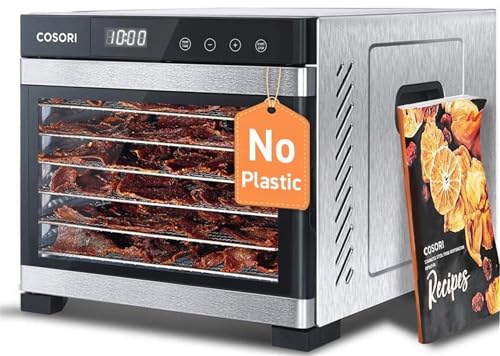
Cosori Food Dehydrator, 6 Stainless Steel Trays
Badge: Best Overall Small Commercial
Strengths
- 6.5 ft² of drying space across six stainless trays — the most area in a compact frame here
- 600W with horizontal airflow for even, rotation-free drying, and quiet operation under 48 dB per the listing
- Precision control from 95 to 165°F with a 48-hour timer — proper overnight production runs
Trade-offs
- 165°F ceiling is fine for most products but shy of the 176°F some jerky protocols prefer
- Six trays is a hard ceiling — a growing business will outgrow it rather than expand it
- Success makes it popular: expect to run it near-constantly at peak season
| Trays | 6 stainless steel trays |
| Drying space | 6.5 ft² |
| Power | 600W |
| Temperature | 95–165°F precision control |
| Timer | 48H |
| Noise | Under 48 dB (per listing) |
The Cosori 6-tray is what “small commercial” looks like when it is done properly. Six and a half square feet of stainless drying space is enough for a market batch of jerky, a café’s weekly garnish production or a pet-treat run, and the horizontal airflow means that batch dries evenly without anyone rotating trays between customers. In a business, that last point is not convenience — it is wages saved on every single run.
The control set supports real production scheduling. Temperatures adjust precisely from 95 to 165 degrees, covering delicate herbs at the bottom and fruit and jerky through the middle of the range; the 48-hour timer with the machine’s quiet operation — listed under 48 decibels — makes overnight runs a normal part of the week rather than a favour someone does the business. Stainless trays go through daily washing without complaint and come back neutral for the next product.
Its limits are the limits of its class. The 165-degree ceiling will bother producers whose jerky process specifies higher finishing temperatures, and six trays is six trays: when the business grows, the answer is a second unit or a larger class of machine, not an accessory. As the first commercial dehydrator a small business buys, though, it is the most complete package in this guide.
Best for: Small producers who need one dependable production machine / Not suited for: Jerky processes that require the highest finishing temperatures
Cosori Food Dehydrator, 5 Stainless Steel Trays
Badge: Best Compact Commercial
Strengths
- The same horizontal-airflow, stainless-tray formula as its bigger sibling in a smaller footprint
- Temperature control up to 176°F — the highest ceiling among the Cosori pair — with four presets
- 48-hour timer and no plastic contact with food suit daily small-batch production
Trade-offs
- 3.1 ft² is roughly half the big Cosori’s area — throughput, not quality, is the compromise
- Presets are consumer-flavoured; production users will run manual settings
- Compact body means full-size sheet products need trimming to fit
| Trays | 5 stainless steel trays |
| Drying space | 3.1 ft² |
| Temperature | Up to 176°F control |
| Airflow | Horizontal |
| Timer | 48H |
| Presets | 4 |
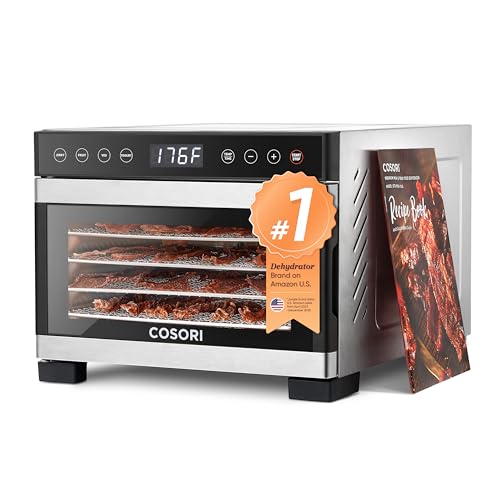
Think of the 5-tray Cosori as the production machine for businesses whose batches are small but constant: the café drying citrus and herbs daily, the chocolatier finishing garnishes, the market baker who needs a reliable tray of product every morning rather than a mountain every week. It keeps the family formula — horizontal airflow, stainless trays, no plastic touching the food — and adds the highest temperature ceiling of the pair, reaching 176 degrees for processes that ask for it.
The 48-hour timer and four presets make it genuinely easy to hand to staff: load, select, walk away, and the batch finishes itself overnight. That ease is a commercial feature in disguise, because the person running your dehydrator at 7 a.m. should not need to be you. Tray cleanup follows the stainless pattern — soak, wipe, neutral — ready for a different product the same day.
The compromise is pure arithmetic: 3.1 square feet dries about half what the 6-tray model does per run. For a business whose volume fits, that is no compromise at all, and the smaller footprint and gentler draw on the budget are real advantages. For a business already planning its second machine, buy the bigger Cosori first and let this one be the second.
Best for: Businesses with small, constant daily batches / Not suited for: Producers who need maximum area per run

Magic Mill Pro Food Dehydrator, 7 Stainless Steel Trays
Badge: Best Even Drying for Production
Strengths
- 600W rear fan even-drying system — seven full-size trays dry uniformly without rotation
- Wide 95°–176°F range covers delicate products and high-finish jerky in one machine
- 48-hour timer with keep-warm and auto shutoff, plus ETL listing for commercial peace of mind
Trade-offs
- Full-size trays and a substantial body need a dedicated prep-table position
- Seven trays of stainless are a real washing load at the end of a production day
- Power draw and size are wasted on businesses with genuinely tiny batches
| Trays | 7 full-size stainless steel trays |
| Power | 600W rear fan |
| Temperature | 95°–176°F |
| Timer | 48H, keep warm, auto shutoff |
| Certification | ETL listed |
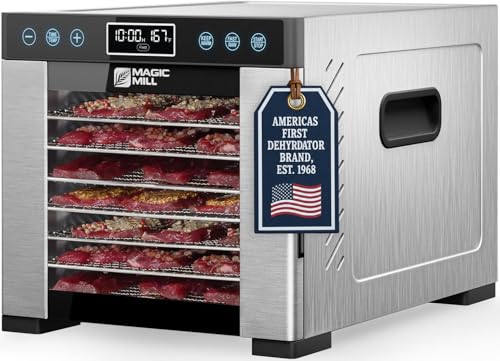
The Magic Mill Pro earns its place in a commercial guide on the strength of two words: rear fan. Mounting the fan and heater behind seven full-size stainless trays produces the most even drying in this line-up, and even drying is what separates a sellable batch from a sorted one — no wet centre trays, no scorched edges, no rotation breaks in the middle of a service day. For jerky and fruit producers whose margins live on consistency, this is the machine whose output needs the least grading.
The specification reads like it was written for small businesses. The 95-to-176-degree range spans herbs to high-finish jerky; the 48-hour timer runs a full production cycle unattended; keep-warm holds a finished batch safely until staff arrive; auto shutoff ends every run cleanly; and the ETL listing is the certification a business wants on equipment that runs overnight in a commercial space. Full-size trays also mean standard sheet products and large cuts fit without trimming.
The costs are space and scale. This is the largest footprint among the linked picks, and it asks for a permanent home on the prep table and a real commitment at the sink when seven stainless trays come out of a jerky run. Businesses at that washing load are, by definition, producing enough to justify it — which is the correct way to read this machine: not as an upgrade, but as equipment sized to a going concern.
Best for: Jerky and fruit producers who sell on consistency / Not suited for: Micro-batches and tight prep spaces

PSIIDAN Food Dehydrator, 8 Stainless Steel Trays
Badge: Best Throughput per Dollar
Strengths
- Eight full-size stainless trays — the largest tray count among the linked picks
- 650W of power, the highest here, for fast turnaround between batches
- 48-hour digital timer and a 95°–167° range cover the commercial product span
Trade-offs
- A younger brand — service network and long-term parts supply are less proven than Cosori or Magic Mill
- 167°F ceiling trails the Magic Mill Pro for high-finish processes
- Throughput is only useful if your prep output can fill eight trays every run
| Trays | 8 full-size stainless steel trays |
| Power | 650W |
| Temperature | 95°–167° |
| Timer | 48-hour digital timer |
The PSIIDAN is the throughput argument in physical form: eight full-size stainless trays and 650W — both figures the highest among this guide’s linked picks — arranged for a business whose constraint is batches per week. More area per run and more power per batch compound: the machine finishes sooner, turns around faster, and starts the next load while a smaller unit is still on its first. For a producer selling out at markets, that compounding is the difference between growth and a waiting list.
The working specification is sound. The range starts at 95 degrees for delicate products, the digital timer runs 48 hours for unattended cycles, and stainless trays handle the daily wash cycle that commercial life imposes. It is listed across the standard commercial product span — jerky, fruit, vegetables, pet treats — without specialisation that would limit a mixed business.
The trade is certainty. PSIIDAN has not accumulated the years of owner history behind Cosori or Magic Mill, so a business is accepting more unknowns about parts and support in exchange for capacity. The prudent pattern is to buy it as the second machine or the expansion machine, prove it across a season, and let it earn the primary role — or to buy it first with eyes open and a backup plan, which for many fast-growing producers is still the right call.
Best for: Growing producers who need batches per week, not batches per day / Not suited for: Businesses that cannot tolerate support unknowns
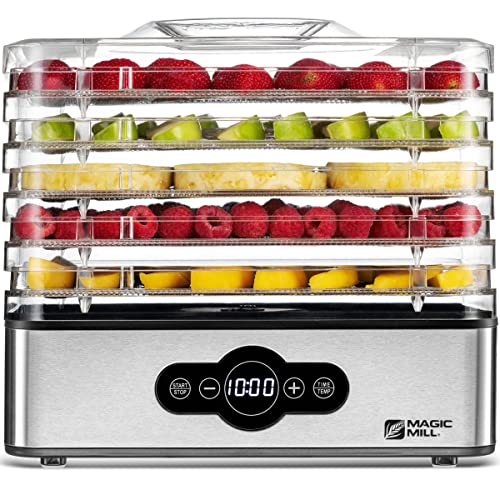
Magic Mill Food Dehydrator, 5 Stackable Stainless Steel Trays
Badge: Best Backup and Overflow Unit
Strengths
- Stackable stainless trays run two to five high — scale the machine to the batch, not the reverse
- 48-hour digital timer and temperature up to 167° cover the standard commercial range
- Compact storage makes it the natural second machine for peak-season overflow
Trade-offs
- Vertical airflow is less even than the rear-fan Pro — rotation may be needed for fussy products
- Five trays maximum, and small ones — a supplement, not a production line
- Manual settings only; staff need a written process to run it consistently
| Trays | 5 stackable stainless steel trays |
| Timer | 48H digital adjustable |
| Temperature | Adjustable, up to 167°F |
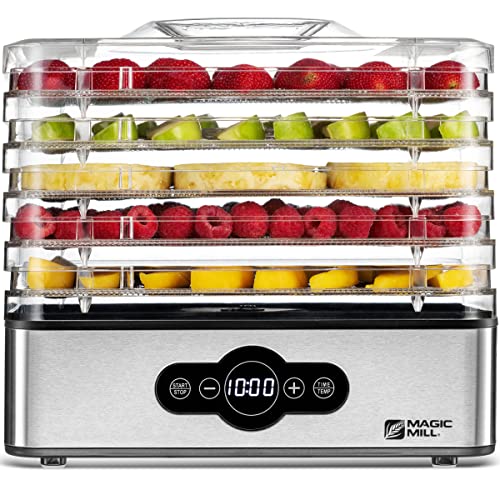
Every small food business knows the week when the main dehydrator is not enough — the holiday rush, the bumper harvest, the wholesale order that lands on top of market prep. The stackable Magic Mill is this guide’s answer to that week: a compact stainless-tray machine that lives in storage eleven months a year and earns its keep in the twelfth, or that runs permanently as the small-batch and test-batch unit beside a larger primary machine.
The stackable design is the point. Run two trays for a recipe trial, five for a real batch; the machine’s footprint and energy use scale with the work in a way fixed towers cannot match. The 48-hour digital timer and a temperature range topping out at 167 degrees cover the standard commercial span, and stainless trays keep the cleanup and odour story consistent with the rest of this guide’s picks.
Its limits define its role. Vertical airflow will never match the Magic Mill Pro’s rear-fan evenness, so delicate or high-value products belong in the primary machine, and this one takes the forgiving loads — herbs, fruit, pet treats, overflow jerky with a rotation halfway. Judged as a business’s only dehydrator it is undersized; judged as the second machine, it is the cheapest capacity insurance in the guide.
Best for: Businesses needing a flexible second or overflow machine / Not suited for: Use as a sole production dehydrator
Elite Gourmet 5-Tray Food Dehydrator EFD319
Badge: Home Machine — Prose-Only in This Guide
Strengths
- Genuinely inexpensive and simple — a sensible first dehydrator for a home kitchen
- Five 11.4-inch trays handle household batches of fruit, herbs and jerky
- Adjustable temperature with a dial control anyone can operate
Trade-offs
- Plastic trays, not stainless — daily commercial washing and odour control work against it
- No timer or auto shutoff, so unattended overnight production runs are not its job
- Basic airflow and home-grade duty cycle are not built for five-day-a-week production
| Trays | 5 BPA-free trays, 11.4-inch |
| Temperature | Adjustable |
| Model | EFD319 |
| Colour | Black |
This entry exists to draw a line honestly. The Elite Gourmet EFD319 is a fine home dehydrator — five trays, adjustable temperature, a price tier that makes it an easy first purchase — and it appears in the verified pool for this keyword. What it is not is commercial equipment, and a guide that sold it to a business as such would be doing its readers a disservice that shows up later as warped trays, uneven batches and a machine retired within the year.
The specifics are the familiar home-grade ones. The trays are BPA-free plastic rather than stainless steel, which matters commercially twice over: plastic absorbs odours between product lines, and it ages under the daily hot washing that food production requires. There is no timer, so the overnight unattended run — the backbone of small-commercial scheduling — is outside its design. Airflow is basic, duty cycle is domestic, and the whole machine is engineered for September garden gluts, not for a market stall’s weekly calendar.
So it is covered here in prose only, without a purchase link, as the reference point that makes the other five picks’ commercial credentials concrete. If your drying is domestic, it is a reasonable buy and the home-focused guides on this site treat it on those terms. If you are equipping a business, let this be the comparison that clarifies your budget: the step from this tier to the Cosori and Magic Mill machines is the step from a kitchen gadget to production equipment.
Best for: Home users — not commercial production / Not suited for: Any business production line
Comparison Table
Badges repeat the Quick Picks verdicts. Note the final row: the Elite Gourmet is listed for contrast, deliberately without a link, because matching the machine class to the job is the first commercial decision.
| Pick | Badge | Standout trait | Watch out for | Amazon |
|---|---|---|---|---|
| Cosori Food Dehydrator, 6 Stainless Steel Trays | Best Overall Small Commercial | 6.5 ft², horizontal airflow, quiet | Fixed six-tray ceiling | Check on Amazon |
| Cosori Food Dehydrator, 5 Stainless Steel Trays | Best Compact Commercial | Compact, 176°F ceiling, presets | Half the area of the 6-tray | Check on Amazon |
| Magic Mill Pro Food Dehydrator, 7 Stainless Steel Trays | Best Even Drying for Production | Rear-fan evenness, ETL listed | Footprint and washing load | Check on Amazon |
| PSIIDAN Food Dehydrator, 8 Stainless Steel Trays | Best Throughput per Dollar | Eight trays, 650W | Brand track record | Check on Amazon |
| Magic Mill Food Dehydrator, 5 Stackable Stainless Steel Trays | Best Backup and Overflow Unit | Stackable, scalable, storable | Vertical airflow evenness | Check on Amazon |
| Elite Gourmet 5-Tray Food Dehydrator EFD319 | Home Machine — Prose-Only in This Guide | Home-grade reference point | Not commercial duty | Prose-only |
How to Choose a Small Commercial Food Dehydrator
Do the tray-area arithmetic before anything else. Multiply trays by area per tray to get drying space per run, then ask how many runs your busiest week requires. A producer moving ten pounds of jerky a week needs a different answer from a café drying garnish daily, and both answers are computable before purchase. As a rule, buy for the busiest week you actually have — capacity shortages tax every batch with extra handling, while a modest surplus simply idles. The Best Small Food Dehydrators With Timer guide covers the timer question in depth for smaller-scale buyers.
Airflow is the second calculation, and it is about labour. Horizontal and rear-fan machines — the Cosori pair and the Magic Mill Pro here — dry evenly enough to skip rotation, which means a batch can be loaded at close of business and collected in the morning. Vertical stackable designs cost less and store smaller, but someone must rotate trays, and in a business that someone is paid. Over a season, the labour difference routinely exceeds the price difference between the two designs.
Check the unglamorous specifications: temperature floor and ceiling against your products’ requirements, timer length against your longest batch, and certifications against your insurer’s and landlord’s expectations. An ETL listing, like the Magic Mill Pro carries, is not marketing — it is the mark that lets equipment run unattended in a commercial space with a clear conscience. Stainless trays belong on the same list: they are the only tray material that survives commercial washing indefinitely while staying neutral between product lines.
Finally, plan the fleet, not the machine. Most small producers end up with a primary unit sized to the average week and a compact second unit — the stackable Magic Mill’s natural role — for peaks, trials and breakdown cover. Two machines also de-risk the calendar: a failure in market week is an inconvenience with a backup and a crisis without one. The Best Uses Of Food Dehydrators guide is worth reading alongside this one if your product line is still expanding into new categories.
Installation is the last unglamorous check, and it is cheaper made now than after delivery. Confirm the counter or prep-table position carries the machine’s weight loaded, that the circuit serving it is not already shared with other heavy equipment that runs at the same hours, and that the machine’s vents have the clearance its manual specifies — dehydrators move a lot of warm air, and a unit boxed into a corner will run hot, slow and unhappy. Staff access matters too: the machine should load from the working side of the kitchen, not across it.
Spares and service belong in the same paragraph of a commercial buyer’s notebook. A business that dries daily should know, before purchase, what a replacement tray costs, whether the fan and element are serviceable or sealed, and how the manufacturer handles a failure inside the first season. None of the machines in this guide is exotic — parts and documentation are obtainable for all of the linked picks — but the time to confirm that is while you are choosing, not during the week the machine stops with a market on Saturday. Keep the purchase records with the batch log; future you, mid-season, will be grateful.
How to Run a Small Commercial Dehydrator Efficiently
Commercial dehydrating is a scheduling discipline as much as a cooking technique. The workflow below is the pattern small producers settle into once the machine stops being a novelty and starts being staff.
- Prep in batches that match tray capacity exactly — slice, season and stage a full load before the machine opens, so loading takes minutes and the previous batch’s heat is not wasted.
- Load for airflow: single layers, space between pieces, nothing touching. Throughput comes from even drying, and even drying comes from air movement, not from cramming.
- Set temperature by product, from your written process sheet — the same settings, every batch, so customers get the product they bought last week.
- Use the timer as your shift schedule: long batches start at close of business and finish before opening; short batches run between services.
- Cool finished product fully before packaging, and package in a dry environment — residual warmth in a sealed bag is condensation, and condensation is spoilage.
- Wash trays the same day, every day. Stainless trays forgive a lot, but sugar and fat films baked on over a week become an hour of scrubbing and a source of off-flavours.
- Log every batch: product, load weight, settings, duration, yield. The log is how a small producer discovers which products actually make money per tray-hour.
That last step deserves emphasis. Tray-hours are the dehydrator’s true currency, and products differ wildly in what they return per hour of machine time. A season of honest logs will tell you which lines deserve the big machine’s prime overnight slots and which should migrate to the overflow unit — or off the menu entirely.
Troubleshooting
Problem: Centre trays finish wetter than edge trays → the load is too dense or the product too unevenly sliced — thin the loading, standardise slice thickness, and reserve the stackable unit for forgiving products if the problem persists.
Problem: Batch times keep stretching week over week → check tray washing and fan intake first — grease and dust films quietly strangle airflow, and a clean machine usually recovers its original pace.
Problem: Jerky texture varies between runs → variation is a process problem, not a machine problem — weigh loads, fix slice thickness, and write the settings down; the batch log exists precisely to catch this drift.
Duty Cycle: The Specification Nobody Prints
Manufacturers print watts, trays and temperatures; the specification that decides commercial life — duty cycle — appears nowhere on a listing. It is the difference between a motor, fan and heating element designed for occasional long runs and a set built to run daily for years. You cannot read it off a spec sheet, but you can infer it: stainless construction, certifications, a brand’s presence in commercial channels, and owner history at production volumes are the available signals, and they are exactly the signals this guide’s ranking used.
The practical translation is honesty about your calendar. A machine run twice a week lives an easy life in almost any tier; a machine run ten hours a day, five days a week, should be bought from the top of this guide’s ranking, with the second-unit plan already sketched. Businesses rarely regret buying duty cycle. They regret, expensively and in public, having bought too little of it during their busiest month.
Two Small Machines or One Big One?
Small producers eventually face the fleet question, and for most the answer is two small machines rather than one large one. Two units dry two products at two temperatures simultaneously — jerky at its setting while herbs take the gentle machine — and they cover each other’s failures in the weeks when failure is unaffordable. A single large machine wins only when every batch is the same product at the same setting, which describes fewer real businesses than the brochures assume.
The natural pairing in this guide is a primary from the top of the ranking — the Cosori 6-tray or the Magic Mill Pro — with the stackable Magic Mill as the flexible second. That combination covers peaks, trials, breakdowns and product separation for less than most single commercial dryers, and it grows one machine at a time as the business does.
Costing a Batch: Tray-Hours, Energy and Labour
A small producer prices honestly only when the dehydrator’s costs are visible. The machine’s true unit is the tray-hour: the batch log described earlier gives you hours per run, trays per run and yield per batch, and from those three numbers every product’s drying cost can be computed and compared. Products that occupy the machine for a full day to return a modest margin are not necessarily bad products — but they should be priced as the premium items they are, or scheduled into hours the machine would otherwise idle.
Labour hides inside the same arithmetic. A rotation-free machine run overnight costs almost no attended minutes per batch; a stackable unit rotated twice by a staff member costs those minutes forever, at wages. Energy, by contrast, is usually the smallest line — a few hundred watts over a long run is real but rarely decisive. Rank your products by margin per tray-hour, schedule the winners into the overnight slots, and the dehydrator stops being an appliance and becomes what it should be in a business: a priced, scheduled production asset.
Food-Safety Habits for Commercial Drying
Commercial drying carries responsibilities home drying does not, and the habits are simple enough that there is no excuse for skipping them. Raw-material preparation happens on sanitised surfaces with the same discipline as any other food production; trays are washed and fully dried before loading, because a wet tray under a long warm run is an invitation nothing should accept. Finished product cools in a clean, dry area — not beside the sink, not under the prep for the next batch — and is packaged only when fully cool and fully dry.
Records close the loop. The batch log that this guide recommends for costing doubles as your traceability record: product, date, batch, settings and yield. If a customer ever questions a product, that log is the difference between a business that can answer and one that can only apologise. None of this requires commercial-scale equipment — it requires commercial-scale habits, applied to the small machines in this guide from the first batch a business sells.
When to Graduate: Signs the Small Commercial Class Is Behind You
Every machine in this guide has a ceiling, and a healthy business eventually meets it. The signs are consistent: the dehydrator runs near-continuously and batches still queue; a second unit has already joined the first and both are spoken for in peak weeks; or a wholesale account asks for volumes that would monopolise your entire drying capacity for days at a time. At that point the question stops being which small machine to add and becomes whether the business is ready for the true commercial class — larger floor or cabinet dryers with the price, power and space requirements to match.
Graduate deliberately, not desperately. The small machines do not become worthless at that moment: they remain the right tools for trials, small product lines, delicate work and breakdown cover beside the big unit, exactly as the stackable Magic Mill serves beside a primary machine today. Businesses that plan the graduation — costing the big machine against the wholesale contract that justifies it — step up cleanly. Businesses that buy it in a panic during peak season pay peak prices for the privilege. Your batch log, once again, is what tells you the moment is coming while there is still time to plan it.
Common Buying Mistakes
Commercial buyers make a distinct set of mistakes — usually by shopping with home-kitchen instincts in a production context.
- Buying a home machine for a production line because the tray count looked similar — duty cycle and tray material decide commercial life, not tray count.
- Sizing for the average week and renting the busiest week in overtime, relays and disappointed customers.
- Ignoring the timer: a machine that cannot finish a batch unattended cannot be scheduled like staff.
- Skipping the batch log, then guessing at pricing without knowing any product’s true cost per tray-hour.
- Packaging warm product to save an hour and losing a batch to condensation.
- Running one machine with no backup through the season the business can least afford a breakdown.
None of these is a knowledge problem — every producer learns them eventually. The only choice is whether the tuition is paid in reading or in ruined batches. Print the list, pin it near the prep table, and let it catch the mistake on the day a tired team is most likely to make it.
Final Recommendation
Start with the Cosori 6-tray if you need one machine that does everything a small business asks: real area, even airflow, quiet overnight runs. Choose the Magic Mill Pro when consistency across seven full-size trays is the product you sell, the PSIIDAN when throughput per dollar drives the decision, and the compact Cosori when batches are small but daily. Add the stackable Magic Mill as your second unit when peaks arrive — and leave the home-grade tier, represented honestly by the prose-only Elite Gourmet, to home kitchens.
Start your shortlist with Cosori Food Dehydrator, 6 Stainless Steel Trays, Cosori Food Dehydrator, 5 Stainless Steel Trays and Magic Mill Pro Food Dehydrator, 7 Stainless Steel Trays — the three picks that cover the widest range of readers in this guide — then use the detailed reviews above to narrow to the one that fits your counter, your habits and your patience for upkeep.
Frequently Asked Questions
What makes a dehydrator “commercial” at this size?
Duty cycle and materials rather than any single feature: stainless trays that survive daily washing, airflow even enough for unattended production runs, a long timer with auto shutoff, and construction — ideally with a recognised certification like ETL — that tolerates running daily for years. A home machine can share a tray count and still fail every one of those tests.
How much drying space does a small business need?
Work backwards from your busiest week: product weight per batch, batches per week, and the hours available to run them. The machines here span roughly three to eight-plus square feet per run; most small producers find the six-to-seven-tray class the working centre, with a compact second unit for peaks rather than a single oversized machine.
Is a 48-hour timer really necessary commercially?
For most producers, yes. Long, slow products — thick jerky, fruit leathers, some pet treats — run past a single working day, and a timer with auto shutoff is what lets those batches occupy overnight and weekend hours without staff attendance. It converts dead hours into production hours, which is the cheapest capacity a small business can buy.
Can one dehydrator handle different products on the same day?
Sequentially, yes, with a wash between strongly flavoured products; simultaneously, only if the products share a temperature and neither perfumes the other. Stainless trays make the sequential pattern practical — they wash fully neutral — which is one reason this guide treats tray material as a commercial specification rather than a preference.
Why is the Elite Gourmet not linked in this guide?
Because it is a home dehydrator — plastic trays, no timer, domestic duty cycle — and this guide’s keyword is commercial equipment. It is reviewed in prose so readers can see the distinction clearly, and it is a reasonable purchase for a home kitchen; it simply does not belong on a production line, and linking it here would imply otherwise.
Should a small business buy two dehydrators?
Usually, once volume justifies it: a primary machine sized to the average week plus a compact second unit covers peaks, product separation and breakdowns. The pair costs less than most single large commercial dryers and removes the single point of failure from the production calendar.
Can a small business start with one dehydrator and add a second later?
Yes — that is the pattern this guide recommends. Start with a primary machine sized to your average week, prove your products and your calendar, then add a compact second unit for peaks and cover. The machines here share the same tray materials and control logic, so a second unit adds capacity without adding a new process for staff to learn.