Disclosure: topratedkitchenware.com is reader-supported. When you buy through links on our site, we may earn an affiliate commission from Amazon and other retailers, at no extra cost to you.
Where to buy
The six machines below are this guide’s shortlist for the best small food dehydrators — compact units that dry seriously without taking over a kitchen. Each name links to its Amazon listing, where you can check the latest price on Amazon, confirm tray counts and dimensions, and read the newest owner feedback before you decide. One very large machine is covered in prose only, because calling it small would be a lie.
- Cosori Food Dehydrator, 5 Stainless Steel Trays
- Magic Mill Pro Food Dehydrator, 7 Stainless Steel Trays
- PSIIDAN Food Dehydrator, 8 Stainless Steel Trays
- Magic Mill Food Dehydrator, 5 Stackable Stainless Steel Trays
- Elite Gourmet 5-Tray Food Dehydrator EFD319
- HOPERAN 16-Tray Food Dehydrator (covered in prose only below — see the review for why)
Read the full guide ↓ for the reasoning behind the order, the honest limitations of every pick, and the checks that matter more than any headline claim.
The best small food dehydrators solve a specific kitchen equation: real drying capacity — enough trays for a garden glut, a jerky batch or a week of lunchbox fruit — inside a footprint that still leaves counter space for cooking, and a body that can live in a cupboard when the season ends. Too small and you dry in frustrating relays; too big and you have bought a piece of furniture. The six machines here map that middle ground honestly, from a five-tray compact that disappears into storage to a sixteen-tray outlier included in prose only, precisely to show where “small” stops.
Small does not have to mean flimsy. The strongest picks in this guide use stainless steel trays, digital timers that run for two days, and temperature ranges that start gently enough for herbs and finish high enough for jerky. The differences that matter are airflow design — rear-fan machines dry evenly without rotation, stackable ones trade a little evenness for storage — and the honest match between tray count and your real harvest. The Best Small Food Dehydrators With Timer guide digs further into the timer question that several of these machines answer well.
Every linked pick was verified against Amazon’s catalogue data on the check date recorded in the sources file. One pick — a sixteen-tray production unit that appeared in the verified pool — is reviewed without a link or photo, because it fails this keyword’s defining test: it is not small. Its review explains what to buy instead if your batches have genuinely outgrown the compact class.
Key Takeaways
- Small means footprint and storage, not weakness — the best compact machines here use stainless trays and 48-hour timers.
- Five to seven trays is the working sweet spot for most households; count your biggest real batch, not your biggest imagined one.
- Rear-fan designs dry evenly without rotation; stackable designs store smaller and let you run fewer trays.
- The Cosori 5-tray is the small-dehydrator default; the Magic Mill Pro is the small-but-serious step up.
- The 16-tray HOPERAN is prose-only here — a fine production machine that is simply not a small dehydrator.
- A 48-hour timer matters even at home scale: it turns drying into a background task instead of a supervised one.
- Measure the cupboard before you measure the harvest — the best small dehydrator is the largest one that still disappears when the season ends, and the one you can store is the one you will still be using in three years.
In this guide
Quick Picks
Six machines ranked for small kitchens and real batches. One is prose-only by design — see its review for why. Prices are not printed because they change; check the latest price on Amazon for the current figure and configuration.
| Pick | Badge | Best for | Amazon |
|---|---|---|---|
| Cosori Food Dehydrator, 5 Stainless Steel Trays | Best Overall Small Dehydrator | Most households — the default small dehydrator | Check on Amazon |
| Magic Mill Pro Food Dehydrator, 7 Stainless Steel Trays | Best Small-but-Serious | Weekly dehydrators who have outgrown a starter machine | Check on Amazon |
| PSIIDAN Food Dehydrator, 8 Stainless Steel Trays | Best for Growing Batches | Households whose batches keep outgrowing five trays | Check on Amazon |
| Magic Mill Food Dehydrator, 5 Stackable Stainless Steel Trays | Best for Tight Storage | Apartments, renters and tight storage | Check on Amazon |
| Elite Gourmet 5-Tray Food Dehydrator EFD319 | Best Budget Small | First-time buyers testing dehydrating on a budget | Check on Amazon |
| HOPERAN 16-Tray Food Dehydrator | Not Small — Prose-Only Boundary Pick | Home businesses that have outgrown the small class | Prose-only — no link, see review |
How These Picks Were Chosen
Picks were verified against Amazon’s catalogue data and then ranked on the criteria that define this keyword. Footprint and storability came first — a small dehydrator that cannot be put away is a contradiction — followed by tray area within that footprint, because capacity per inch of counter is the whole point of the category. Airflow design came next, with rear-fan and horizontal layouts ahead on evenness, then controls: a digital timer and a temperature range starting low enough for herbs were treated as essentials, not luxuries.
The pool contained one machine that fails the category outright: a sixteen-tray, twin-fan production dehydrator. Rather than pretend it is small, this guide reviews it in prose only — no link, no image — as the boundary marker of the category, with guidance on when a buyer should legitimately graduate to that class. This is a research-led guide built from manufacturer specifications and verified listing data, not laboratory testing, and the reviews say plainly where each compact design compromises. Readers whose “small” is actually a business should cross-check the Best Small Commercial Food Dehydrators guide, where duty cycle gets the weight it deserves.
Best Small Food Dehydrators: The 6 Machines, Reviewed for Real Kitchens
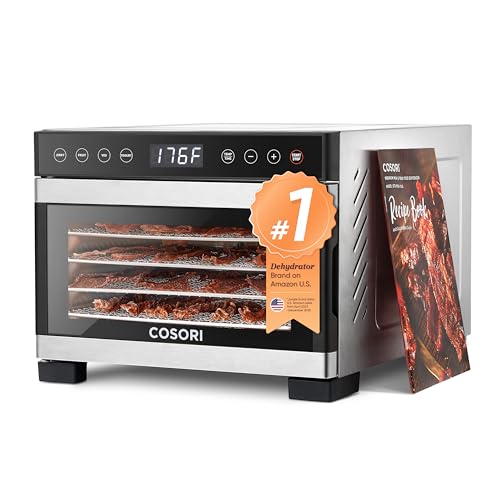
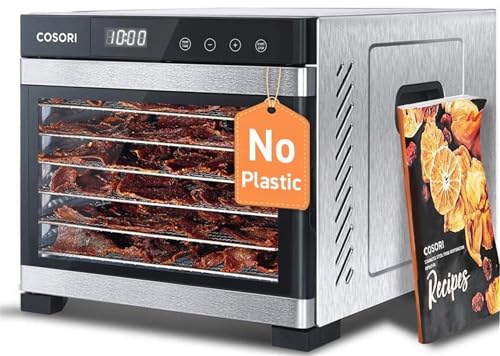
Cosori Food Dehydrator, 5 Stainless Steel Trays
Badge: Best Overall Small Dehydrator
Strengths
- Horizontal airflow dries all five stainless trays evenly — no rotation, even in a compact body
- Temperature control up to 176°F, four presets and a 48-hour timer: full-size features, small footprint
- No plastic contact with food, and a compact design that stores in a standard cupboard
Trade-offs
- 3.1 ft² fills up during a genuine garden glut — big harvests run in relays
- Five fixed trays cannot expand when your batches grow
- Presets are helpful, but manual settings give better results for delicate herbs
| Trays | 5 stainless steel trays |
| Drying space | 3.1 ft² |
| Temperature | Up to 176°F control |
| Airflow | Horizontal |
| Timer | 48H |
| Presets | 4 |
The Cosori 5-tray is the machine this guide recommends first because it refuses the usual compact compromise. Small dehydrators traditionally cut airflow quality to cut size; this one keeps horizontal airflow, so all five trays dry at the same rate and a batch of apple chips or jerky needs no mid-run rotation. The trays are stainless steel, the food touches no plastic, and the whole unit still stores like a small appliance rather than a piece of equipment.
The controls are equally grown-up. Temperature adjusts up to 176 degrees — the full useful range from herbs to jerky — four presets cover the common jobs for households that do not want to consult a chart, and the 48-hour timer lets a long batch start on Friday evening and finish whenever it finishes, without supervision. For the way households actually dehydrate — in bursts, around other cooking, often overnight — that timer is the feature that turns the machine from a project into an appliance.
Capacity is the honest limit: 3.1 square feet is a household batch, not a harvest. Gardeners with a fruit tree’s worth of produce will run relays in peak weeks, and there is no tray expansion. Within its size, though, nothing in this guide is more complete — which is why it, and not a bigger machine, is the default answer to this keyword.
Best for: Most households — the default small dehydrator / Not suited for: Gardeners processing tree-scale harvests

Magic Mill Pro Food Dehydrator, 7 Stainless Steel Trays
Badge: Best Small-but-Serious
Strengths
- 600W rear fan dries seven full-size stainless trays evenly — the best performance in this guide
- 95°–176°F range, 48-hour timer, keep-warm and auto shutoff give it full-size control
- ETL listed, with the build quality to run weekly for years
Trade-offs
- The largest and heaviest of the linked picks — “small” only by comparison with production units
- More machine than an occasional herb-dryer will ever use
- Seven trays is a commitment at the sink after a big batch
| Trays | 7 full-size stainless steel trays |
| Power | 600W rear fan |
| Temperature | 95°–176°F |
| Timer | 48H, keep warm, auto shutoff |
| Certification | ETL listed |
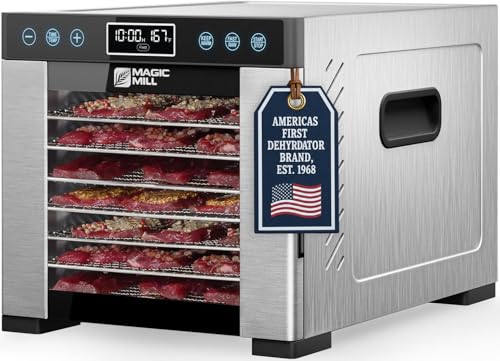
The Magic Mill Pro sits at the top edge of what “small” can honestly mean, and it earns its place by performance rather than by footprint. Its 600W rear fan pushes air evenly across seven full-size stainless trays, producing the most consistent results in this guide — the batch that needs no sorting, no rotation and no excuses. Households that dehydrate weekly rather than seasonally will feel that consistency every single run.
The specification is complete: a 95-to-176-degree range that handles herbs and jerky in the same week, a 48-hour timer with keep-warm for finished batches, auto shutoff, and an ETL listing that reflects its build seriousness. It is the dehydrator for the household that has already outgrown a starter machine and does not intend to buy a third.
The qualification is size. Seven full-size trays make a substantial countertop presence and a real washing load, and in a small kitchen this machine will live on the counter or not at all — it is not a cupboard appliance. Buy it when your batch sizes, not your storage, are the constraint, and it is the best machine in this guide. Buy it for occasional use and the Cosori above will serve you better by being easier to live with.
Best for: Weekly dehydrators who have outgrown a starter machine / Not suited for: Cupboard storage and occasional use

PSIIDAN Food Dehydrator, 8 Stainless Steel Trays
Badge: Best for Growing Batches
Strengths
- Eight full-size stainless trays — the most capacity among the linked picks
- 650W of power turns batches around quickly between runs
- 48-hour digital timer and a 95°–167° range cover the household span
Trade-offs
- Eight trays pushes past “small” for many kitchens — measure your counter first
- A younger brand, with a thinner long-term track record than Cosori or Magic Mill
- 167°F ceiling is slightly lower than the class leaders, though ample for home jerky
| Trays | 8 full-size stainless steel trays |
| Power | 650W |
| Temperature | 95°–167° |
| Timer | 48-hour digital timer |
The PSIIDAN answers the household whose batches keep growing: eight full-size stainless trays and 650W of drying power, the most capacity and the most power among this guide’s linked picks. A deer season’s jerky, a farmers-market haul, a dog-treat production run for a street of neighbours — this is the machine that absorbs the big weekend without relays.
Day to day it behaves like the others in its class: a 95-degree floor for delicate work, a 48-hour digital timer for unattended runs, stainless trays that wash clean and stay neutral between sweet and savoury loads. The 167-degree ceiling sits slightly below the Cosori and Magic Mill leaders, a difference most households will never reach, let alone miss.
Two honest cautions frame the recommendation. First, eight full-size trays is a lot of machine — check the footprint against your counter and storage before ordering, because a dehydrator that lives on the dining table has failed the “small” brief in spirit. Second, the brand’s track record is shorter than the leaders’, so the value calculation trades some certainty for capacity. Households that need the room will find the trade fair; households that do not should take the Cosori and enjoy the cupboard space.
Best for: Households whose batches keep outgrowing five trays / Not suited for: Truly tight kitchens — measure first
Magic Mill Food Dehydrator, 5 Stackable Stainless Steel Trays
Badge: Best for Tight Storage
Strengths
- Stackable trays run two to five high — the only pick that shrinks to fit a small batch
- Stainless trays with a 48-hour digital timer and temperature up to 167°
- Stores smaller than any fixed-tower design here — the apartment-friendly pick
Trade-offs
- Vertical airflow dries less evenly — an occasional tray rotation is part of ownership
- Small trays mean big items and big batches need planning
- No presets; settings are manual
| Trays | 5 stackable stainless steel trays |
| Timer | 48H digital adjustable |
| Temperature | Adjustable, up to 167°F |
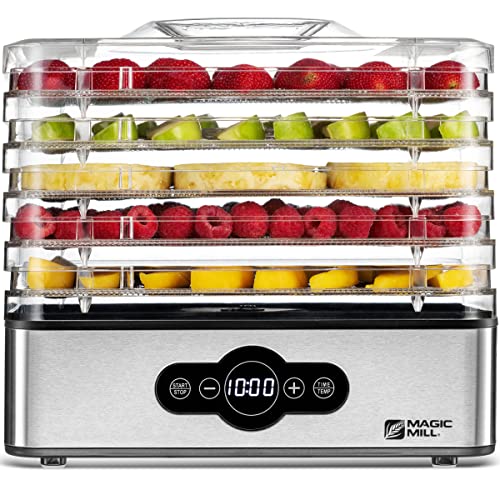
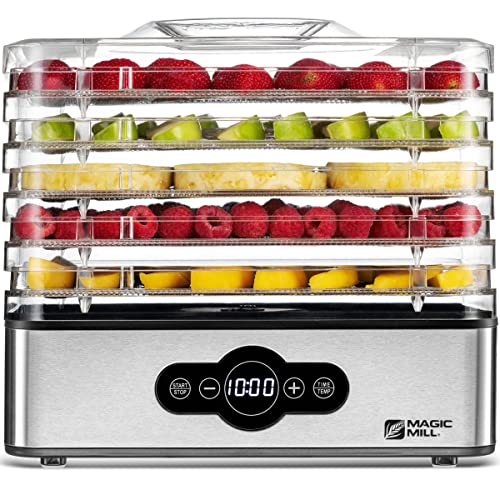
The stackable Magic Mill is the small-kitchen specialist. Its five stainless trays stack two, three, four or five high, so the machine physically matches the batch: a couple of trays for a herb harvest from the windowsill, the full stack for a weekend of fruit. No other pick in this guide scales itself that way, and none stores as small — broken down, it disappears into the cupboard space a fixed tower cannot use.
The essentials survive the shrinking. Trays are stainless steel, so cleanup and odour behaviour match the bigger machines; the timer is a proper 48-hour digital unit, so long batches run unattended; and temperature adjusts up to 167 degrees, covering the household range from herbs through jerky. For renters, apartment dwellers and anyone whose kitchen storage is genuinely scarce, this is the specification that fits real life.
The trade is airflow. Stacked designs move air vertically, and vertical airflow is less even than the rear-fan and horizontal designs ranked above — plan on rotating trays once during long runs if you want perfectly uniform results, and accept that delicate, fussy loads belong in small batches. It is a fair, knowable compromise, and for the kitchens it is designed for, it is the right one.
Best for: Apartments, renters and tight storage / Not suited for: Perfectionists drying large, delicate batches
Elite Gourmet 5-Tray Food Dehydrator EFD319
Badge: Best Budget Small
Strengths
- The most affordable entry into home dehydrating in this guide
- Five 11.4-inch trays suit standard household batches, with adjustable temperature
- Dial-simple controls — nothing to programme, nothing to learn
Trade-offs
- Plastic trays rather than stainless: more scrubbing, and odours linger between projects
- No timer, so long unattended runs need an outlet timer as a workaround
- Basic airflow means rotation is routine for even results
| Trays | 5 BPA-free trays, 11.4-inch |
| Temperature | Adjustable |
| Model | EFD319 |
| Colour | Black |
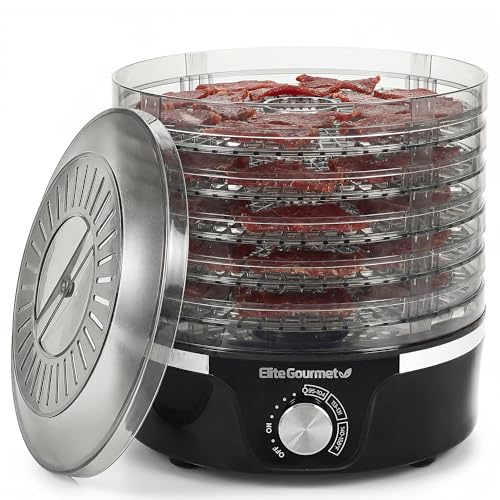
The Elite Gourmet EFD319 is the budget classic of this category: five trays, an adjustable temperature dial, and a price tier that lets a household test the whole dehydrating idea — jerky, fruit leather, dried herbs, dog treats — without committing to stainless-steel money. For a first machine, that low-stakes entry is a legitimate virtue, and its 11.4-inch trays are honestly sized for household batches.
The compromises are the predictable ones, and they are worth naming so buyers choose knowingly. The trays are BPA-free plastic rather than stainless, which means more scrubbing after sticky loads and a memory for strong flavours between projects. There is no built-in timer, so the set-and-forget overnight run that defines the machines above needs a plug-in timer as a substitute. Airflow is basic, so rotating trays is part of the routine.
Judged as a starter, it succeeds: it teaches a household whether dehydrating earns counter space in their life, at the lowest cost of finding out. Judged as a long-term appliance, the Cosori costs more for reasons that show up every week — steel, airflow, timer. Both judgements are in this review so that the right buyers end up with each machine.
Best for: First-time buyers testing dehydrating on a budget / Not suited for: Households who want set-and-forget timers and steel trays
HOPERAN 16-Tray Food Dehydrator
Badge: Not Small — Prose-Only Boundary Pick
Strengths
- Sixteen stainless trays and 800W across two fans — genuine production capacity
- Digital temperature and timer control, listed under 48 dB, with mesh screens and a fruit roll tray included
- For a home business, it replaces relays with single coordinated runs
Trade-offs
- It is not small by any definition this keyword could use — footprint, weight and power are production-class
- Capacity is wasted on household batches; you would heat a tower to dry a tray of herbs
- Buying it for a home kitchen usually means it lives somewhere else permanently
| Trays | 16 stainless steel trays |
| Power | 800W, 2 fans |
| Noise | Under 48 dB (per listing) |
| Controls | Digital temperature and timer |
| Included | 2 mesh screens, 1 fruit roll tray |
Every category needs its boundary marked, and the HOPERAN is this one’s. It appeared in the verified pool for this keyword, and it is a capable machine — sixteen stainless trays, two fans, 800W, digital controls, a fruit roll tray and mesh screens in the box. What it is not, by any honest use of the word, is small. It is covered here in prose only, without a link or a photograph, because recommending it as a small food dehydrator would mislead exactly the readers this guide exists to serve.
The machine itself deserves a fair description. For a home business — a jerky seller, a pet-treat baker, a market producer — sixteen trays convert drying from a relay race into a single coordinated run, and the twin-fan design with digital control keeps that run consistent. The listed noise figure under 48 decibels is considerate for equipment of this output. In the commercial guide on this site, machines of this class are treated on their merits.
For a household, the verdict is simpler: if your batches have genuinely outgrown the seven- and eight-tray machines above — not occasionally, but weekly — then you are no longer shopping for a small dehydrator, and you should shop the larger class deliberately, with this machine among the candidates. If your batches have not outgrown them, the Cosori or the Magic Mill Pro will serve you better in every way that matters, including the cupboard door closing.
Best for: Home businesses that have outgrown the small class / Not suited for: Households — it is not a small dehydrator
Comparison Table
Badges repeat the Quick Picks verdicts. The last row is the category boundary: a production machine listed for contrast, deliberately without a link.
| Pick | Badge | Standout trait | Watch out for | Amazon |
|---|---|---|---|---|
| Cosori Food Dehydrator, 5 Stainless Steel Trays | Best Overall Small Dehydrator | Horizontal airflow in a compact body | Fixed five-tray capacity | Check on Amazon |
| Magic Mill Pro Food Dehydrator, 7 Stainless Steel Trays | Best Small-but-Serious | Rear-fan evenness, seven trays | Size within the “small” label | Check on Amazon |
| PSIIDAN Food Dehydrator, 8 Stainless Steel Trays | Best for Growing Batches | Eight trays, 650W | Footprint and brand history | Check on Amazon |
| Magic Mill Food Dehydrator, 5 Stackable Stainless Steel Trays | Best for Tight Storage | Stackable and scalable | Vertical airflow evenness | Check on Amazon |
| Elite Gourmet 5-Tray Food Dehydrator EFD319 | Best Budget Small | Simple, compact, inexpensive | Plastic trays, no timer | Check on Amazon |
| HOPERAN 16-Tray Food Dehydrator | Not Small — Prose-Only Boundary Pick | Production capacity, 16 trays | Category mismatch: not small | Prose-only |
How to Choose a Small Food Dehydrator That Fits Your Kitchen and Your Batches
Start with the batch you actually make. Tray count is the headline, but drying area is the truth: multiply trays by their size and compare it with your biggest regular load — a jerky batch, a box of orchard fruit, a week of dog treats. Most households land between five and seven trays; buying beyond your batch buys storage problems, and buying below it buys relays. If your honest answer is “it varies,” the stackable Magic Mill’s ability to run two to five trays is designed for exactly that answer.
Airflow decides how much attention a batch needs. Rear-fan and horizontal designs — the Magic Mill Pro and the Cosori here — dry every tray at the same rate, so loading is the last time you touch the food until it is done. Vertical stackable designs cost less and store smaller, and their price is a rotation or two during long runs. Neither is wrong; they are different trades between money, space and attention, and the right one depends on whether your kitchen is shorter on cupboards or on patience. The Best Small Commercial Food Dehydrators guide shows what happens to these same trade-offs when the drying becomes a business.
Controls separate appliances from projects. A digital timer running to 48 hours sounds excessive until the first batch that needs fourteen — at which point it is the difference between drying as a background task and drying as a supervised one. Temperature range matters at both ends: low enough for herbs and delicate fruit without cooking them, high enough for jerky made to your household’s standard. Every linked pick here clears that bar; the budget pick’s missing timer is its defining compromise, priced accordingly.
Finally, think about the wash. Dehydrating is sticky work — fruit sugars and jerky marinades bake onto trays — and stainless steel trays forgive it with a soak, while plastic asks for scrubbing and remembers odours. If the machine will alternate between sweet and savoury loads, steel is close to a requirement. Add the storage question — where does this live in February? — and the right choice usually names itself.
Noise and heat are the two specifications first-time buyers forget, and both matter more in a small kitchen than a large one. A dehydrator runs for many hours, often overnight, in the room where the household also lives; the fan note of a cheap machine becomes a household opinion very quickly. Likewise, every watt of drying power becomes heat in the room — pleasant in January, noticeable in August. Read the listings for noise figures where they are given, place the machine where its warm exhaust is welcome or at least harmless, and factor both into the choice between near-equal machines.
Counter depth is the quiet measurement that decides whether a “small” machine is small for you. Tray counts compare easily; the depth of the unit with its door open, plus the space your hands need to slide trays, is the lived dimension. Measure the counter and the cupboard before ordering — five minutes with a tape now is cheaper than a return, and it is the difference between a machine that fits your kitchen and one that merely fits its box.
Energy use surprises new owners pleasantly, and it is worth understanding why. A dehydrator’s few hundred watts sound substantial until they are compared with an oven heating a whole cavity to do the same job, or with the cost of the produce that spoils when no dryer is available. Run the numbers for your own kitchen if you like — the arithmetic almost always lands in the dehydrator’s favour, especially for long, low-temperature batches that an oven handles badly anyway. Efficiency is not the reason to buy one of these machines, but it removes the commonest objection to running one often.
How to Get Even, Reliable Results from a Small Dehydrator
Small machines reward good habits disproportionately, because their airflow margins are thinner than a production unit’s. The routine below is the one experienced home dehydrators converge on.
- Slice evenly before anything else: uniform thickness is the single biggest determinant of uniform drying, in any machine at any price.
- Load in single layers with air space around pieces — airflow is the active ingredient, and a crowded tray is a slow tray.
- Start at the temperature your product’s standard guidance specifies, and resist opening the door to check; every opening dumps the warm air the batch was using.
- Rotate trays once, halfway, if your machine is a vertical stackable design — and skip the ritual entirely with rear-fan and horizontal models.
- Test doneness on the thickest piece, cooled to room temperature: warm food feels more pliable than it will when cool, and under-dried food is the kind that spoils in storage.
- Cool everything completely before sealing it away, and condition fruit in a jar for several days — shaking daily — so any remaining moisture equalises instead of moulding.
Keep a simple notebook for the first season: product, thickness, temperature, hours, result. Small dehydrators vary enough between models that your own log becomes a better manual than any generic chart, and by the second season you will set the machine from memory and be right.
One storage habit protects everything the notebook teaches: dried food keeps best cool, dark and genuinely airtight, and it keeps worst in the warm, bright spot above the stove where jars look prettiest. Label every container with the product and the date — not because you will forget what apple chips look like, but because three months from now the date is the only honest guide to what should be eaten first. Households that label and rotate their dried stock waste almost none of it, which quietly doubles the value of every batch the machine ever runs.
Troubleshooting
Problem: Pieces at the tray edges dry hours before the centre → the load is too dense or the slices vary — thin the loading, standardise thickness, and rotate once if your design is a vertical stack.
Problem: Fruit darkens and tastes cooked rather than dried → the temperature is too high for delicate produce — drop to the gentle end of the range and accept the longer run; low and slow is the flavour-preserving route.
Problem: Dried food goes mouldy in storage → it was sealed warm or under-dried — cool fully, test the thickest piece cold, and condition fruit in a jar before long storage so hidden moisture reveals itself early.
What “Small” Should Mean When You Shop
Manufacturers use “small,” “compact” and “mini” as marketing weather rather than measurement, so define it yourself before you shop: the footprint your counter can spare, the storage space the machine will occupy for most of the year, and the batch size below which a bigger machine is wasted. Measured against those three numbers, the five-tray Cosori is small in every sense, the seven-tray Magic Mill Pro is small only in footprint-relative-to-output, and the sixteen-tray machine reviewed above is not small at all — which is why it carries no purchase link in a guide with this title.
The honest category boundary protects your kitchen. A dehydrator that is too big does not merely waste money; it colonises a counter, resists being stored, and quietly discourages the small, frequent batches that make dehydrating a habit rather than an event. The best small dehydrator is the largest one that still disappears when you are done with it — and for most households that sentence describes a five-to-seven-tray machine.
The Case for a Timer, Even at Home Scale
New buyers routinely underrate the timer because domestic batches sound short — until the first thick jerky run or fruit leather that wants the far side of twelve hours. A 48-hour digital timer, standard on most picks here, changes the machine’s role: batches start when the food is ready, not when someone can supervise them, and they end themselves at 3 a.m. without an alarm clock’s involvement. Overnight drying is also, not coincidentally, when kitchens are coolest and counters are free.
If you choose the budget route and its missing timer, the standard workaround is a plug-in outlet timer — effective, inexpensive, and one more thing to remember. Households that dehydrate weekly usually upgrade for the timer alone within a season, which is worth knowing before the first purchase rather than after it. The timer-focused comparison in the Best Recommended Food Dehydrators By Cookie Decorators guide shows the same feature deciding a very different kind of drying.
Small Dehydrators for Small Harvests: Herbs, Fruit and the Windowsill Garden
The most common small-dehydrator story is not jerky at all — it is the household that grows a little and hates wasting it. Herbs are the perfect compact load: a windowsill or balcony harvest dries in a few trays at the gentle end of the range, keeps its colour far better than air-drying in a dusty kitchen, and stores in jars that make winter cooking feel like a different season. Every linked machine here starts low enough for herbs; the stackable Magic Mill, which can run just two trays, is the natural specialist for harvests measured in handfuls.
Fruit is the second story: the box of orchard apples, the glut of strawberries, the bananas nobody ate. Small machines turn these into lunchbox stock and baking ingredients at a scale a household can actually consume, and the 48-hour timers mean the transformation happens in the background of a working week. The lesson of both stories is the same — small dehydrators succeed by matching the household’s real surplus, which is measured in trays, not in ambitions.
Renting, Borrowing and the Secondhand Question
Because dehydrators are seasonal for many households, they circulate: borrowed from neighbours, lent within families, bought secondhand in spring and sold in autumn. Borrowing is a genuinely good way to learn your batch sizes before buying — one borrowed weekend teaches more about the tray count you need than a month of reading. If you buy secondhand, the checks are simple: run the machine through a full cycle before paying, confirm the fan runs evenly without new noises, inspect trays for warping or damage, and make sure every tray the listing promises is actually in the box.
What you should not do is let a borrowed or bargain machine set your expectations of the category. An ageing unit with a tired fan dries slowly and unevenly, and households regularly conclude that “dehydrating doesn’t work” when the truth is that one old machine didn’t. Judge the technique by a healthy machine — any of the linked picks here — and judge any individual secondhand unit by the test run, not by its looks.
A First Season Playbook: Five Batches That Teach You Your Machine
New owners learn a dehydrator fastest by running a deliberate curriculum rather than random loads. Batch one is herbs — forgiving, quick, and the gentlest possible introduction to loading and airflow. Batch two is apple or banana chips, which teach slicing discipline and show you your machine’s evenness honestly. Batch three is a fruit leather, which teaches liners, spreading and patience. Batch four is vegetables for soup stock — the load that proves the machine’s usefulness on an ordinary Tuesday. Batch five, when the first four have taught you the controls, is jerky, made carefully to your manual’s guidance and your household’s standard.
Run those five with the notebook open and two things happen. You learn your specific machine — its hot spots if it has them, its real pace against the charts, the settings your kitchen’s humidity demands — and you learn your household: which dried foods actually get eaten, which batches justify their tray time, and whether the dehydrator is a seasonal visitor or a permanent resident. That knowledge, not the specification sheet, is what makes the second season effortless — and it is available to every pick in this guide, from the budget dial machine to the rear-fan Pro.
Common Buying Mistakes
Small-dehydrator regrets are remarkably consistent — and remarkably avoidable.
- Buying tray count instead of tray area, and discovering that eight tiny trays hold less than five full-size ones.
- Ignoring storage: a machine that cannot be put away will be resented by February.
- Crowding trays to finish in one run, then blaming the machine for uneven results that airflow starvation caused.
- Skipping the timer to save money, then supervising long batches like a night watchman.
- Choosing plastic trays for a mixed sweet-and-savoury household and tasting garlic in the apple chips.
- Sealing warm food — the fastest route from a perfect batch to a mouldy jar.
Notice that most of the list is about fit — to your batches, your cupboards, your habits. Small dehydrators fail by mismatch far more often than by defect. That is quietly encouraging news: it means a household that thinks honestly about its batches, its storage and its routines for ten minutes before ordering is very likely to end up with a machine it keeps and uses for years, rather than one that migrates to the garage sale shelf by spring.
Final Recommendation
For most households the Cosori 5-tray is the answer: genuinely compact, stainless, even-drying and fully timered — the machine that fits the kitchen, the batch and the calendar at the same time. The Magic Mill Pro is the upgrade for weekly dehydrators, the PSIIDAN for batches that keep growing, and the stackable Magic Mill for kitchens where storage is the binding constraint. The Elite Gourmet remains the honest budget start. And if your batches have truly outgrown all of them, the prose-only HOPERAN marks where your search should move next — into the larger class, shopped deliberately.
Start your shortlist with Cosori Food Dehydrator, 5 Stainless Steel Trays, Magic Mill Pro Food Dehydrator, 7 Stainless Steel Trays and PSIIDAN Food Dehydrator, 8 Stainless Steel Trays — the three picks that cover the widest range of readers in this guide — then use the detailed reviews above to narrow to the one that fits your counter, your habits and your patience for upkeep.
Frequently Asked Questions
How many trays does a household actually need?
Five to seven covers the great majority of home use — a jerky batch, a box of fruit, a week of treats. Count your biggest regular load rather than your biggest imaginable one; the occasional oversized harvest can run in two relays far more cheaply than an oversized machine can be stored all year.
Are stainless steel trays worth paying more for?
For most households, yes. Stainless releases sticky, sugary loads with a soak instead of a scrub, does not hold odours between sweet and savoury projects, and tolerates years of washing. Plastic trays work and cost less — the budget pick here uses them — but they are the first thing owners cite when they upgrade.
Do small dehydrators dry as well as big ones?
The best small ones do. Airflow design matters more than size: a rear-fan or horizontal-airflow compact machine dries as evenly as a large unit, just less of it per run. Where small machines compromise is capacity and, in stackable designs, a little evenness — not fundamental drying quality.
Why is the 16-tray machine not linked in this guide?
Because the keyword is small food dehydrators, and a sixteen-tray twin-fan production unit is not one. It is reviewed in prose so readers can see where the category ends and what graduating looks like — but linking it here would recommend it as something it is not.
What temperature should I use for jerky and fruit?
Follow the standard guidance for each product and your machine’s manual: jerky is typically dried at the higher end of these machines’ ranges, fruit and herbs progressively lower, with delicate herbs near the gentle floor around 95 degrees. When in doubt, lower and longer preserves flavour and texture better than hot and fast.
Can a small dehydrator make fruit leather and dog treats?
Yes — both are natural small-batch work. Fruit leather needs a suitable tray liner or sheet (some machines include a fruit roll tray), and pet treats are simply small, uniform pieces dried thoroughly. Uniform thickness matters more than the recipe: it is what makes a whole tray finish at the same time.
Where should a small dehydrator live while it runs?
On a stable, heat-safe surface with clearance around its vents, away from the busiest cooking traffic — long runs and busy stovetops compete for the same counter. Many households run theirs on a utility surface, a laundry counter or a sheltered porch; wherever it lives, it needs airflow, a nearby outlet and freedom from splashes.