Disclosure: topratedkitchenware.com is reader-supported. When you buy through links on our site, we may earn an affiliate commission from Amazon and other retailers, at no extra cost to you.
Where to buy
All six models below are verified stainless steel undermount sinks from the research pool for this guide to the best stainless undermount kitchen sinks. Each name links to its Amazon listing, where you can check the latest price on Amazon, confirm the exact configuration and included parts, and read the newest owner feedback before you commit to a sink that will be sealed under your counter for years.
- KRAUS KHU100-30 30 Inch 16 Gauge Undermount Kitchen Sink
- SANYCASA 30 Inch Undermount Workstation Sink, 11 Gauge Stainless Steel
- KRAUS KWU110-32 32 Inch Undermount Workstation Sink
- KRAUS KHU100-32 32 Inch 16 Gauge Undermount Kitchen Sink
- MAYESAR 28 Inch Undermount Kitchen Sink, 16 Gauge, 9 Inch Deep
- cozhao 30 Inch Undermount Kitchen Sink, 18 Gauge 304 Stainless Steel
Read the full guide ↓ for the ranking logic, the honest limitations of every pick, and the buying checks that matter more than any headline claim.
Choosing the best stainless undermount kitchen sinks sounds simple until you stand in front of the specification sheets: gauges that run backwards, bowl depths that change how a stockpot fits, ledges, grooves, pads and corner radii that all claim to matter. An undermount sink is also the least forgiving purchase in a kitchen remodel, because once it is bonded and plumbed beneath a stone or quartz counter, swapping it means cutting into finished work. This guide exists to slow that decision down in the right places, comparing six verified stainless undermount models on the things that actually separate them: steel thickness, bowl size and depth, workstation ledges, sound dampening and the small geometry details that decide whether a sink feels solid or tinny five years from now.
The six picks below are all single-bowl stainless designs in the 28 to 32 inch range, which is where most American kitchens land: big enough for sheet pans and stockpots, small enough to fit standard 33 and 36 inch sink base cabinets. Two of them are workstation sinks with integrated ledges that hold accessories over the bowl; the others are classic undermount bowls that compete on steel quality, corner shape and drainage. If you are also weighing what sits around the sink, our research into Best Kitchen Sinks For Quartz Countertops covers how undermount rims and stone edges work together, and it is worth reading before your fabricator cuts anything.
A note on honesty before the rankings: this is a research-led guide. The picks were verified against manufacturer and listing data, specifications were cross-checked, and the strengths and trade-offs in each review are stated plainly, including the limitations that marketing pages tend to bury. Where a sink asks you to accept a compromise, the review says so in words, and the final recommendation tells you exactly who should walk past the top pick and choose a different bowl instead.
Key Takeaways
- Gauge runs backwards: 16-gauge steel is thicker and more dent-resistant than 18-gauge, and the one 11-gauge pick here is thicker still.
- Workstation ledges (the two Kraus and SANYCASA ledge models) turn the sink into a prep surface, but only help if you will actually use the accessories.
- Rounded corners and channel grooves are the quiet quality signals: they decide how fast the bowl rinses clean and how much scrubbing the corners need.
- Measure your cabinet before your counter: a 32 inch sink generally needs a 36 inch base cabinet, a 30 inch sink a 33 inch base.
- Sound pads matter most in open-plan kitchens; every Kraus pick here carries NoiseDefend padding, the budget picks vary.
- Buy the sink before the counter is templated, never after: the fabricator needs the physical bowl or its exact template.
In this guide
Quick Picks
Six stainless undermount single bowls, ranked for the average remodel first and for special cases after. The badges below are used again in the detailed reviews, so you can jump straight to the model that matches your kitchen.
| Pick | Badge | Standout trait | Where to check it |
|---|---|---|---|
| KRAUS KHU100-30 30 Inch 16 Gauge Undermount Kitchen Sink | Best Overall | 16-gauge TRU16 steel, rounded corners, NoiseDefend pads | Check on Amazon |
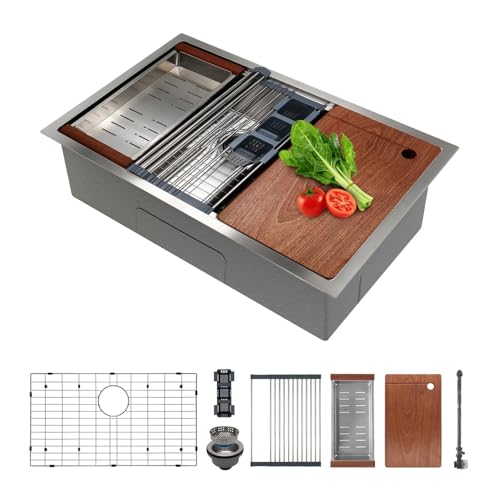
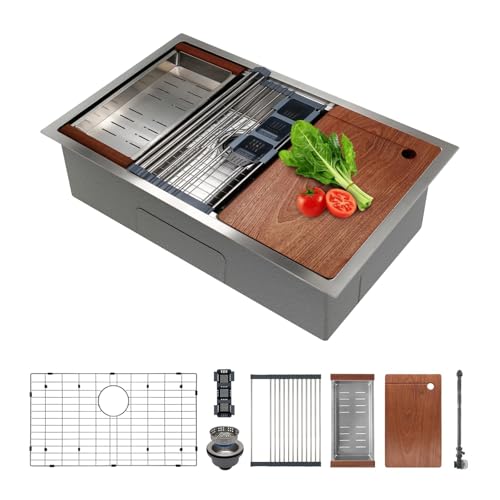
| SANYCASA 30 Inch Undermount Workstation Sink, 11 Gauge Stainless Steel | Best Heavy-Gauge Workstation | 11-gauge (3mm) steel with integrated ledge workstation set | Check on Amazon |
| KRAUS KWU110-32 32 Inch Undermount Workstation Sink | Best Large Workstation | 32 inch 16-gauge bowl, ledge, cutting board and roll-up rack included | Check on Amazon |
| KRAUS KHU100-32 32 Inch 16 Gauge Undermount Kitchen Sink | Best Large Classic Bowl | 32 inch version of the KHU100 pattern: rounded corners, grooves, pads | Check on Amazon |
| MAYESAR 28 Inch Undermount Kitchen Sink, 16 Gauge, 9 Inch Deep | Best for Smaller Cabinets | 28 x 18 inch handmade bowl, 16-gauge, 9 inch depth, brushed finish | Check on Amazon |
| cozhao 30 Inch Undermount Kitchen Sink, 18 Gauge 304 Stainless Steel | Best Value-Tier Pick | 30 inch handmade 304 stainless bowl with drain assembly included | Check on Amazon |
How These Picks Were Chosen
The pool for this guide was restricted to stainless steel, undermount-mount, single-bowl sinks whose listings could be verified in detail: stated gauge, stated dimensions, stated mounting type. Topmount and drop-in models were excluded even when they were cheaper, because the mounting style is the entire point of this keyword. Farmhouse apron-front stainless models were also left out; they are a different installation conversation with different cabinet requirements.
Within that pool, the ranking weighs steel gauge first, because thickness drives dent resistance, sound and the solid feel people describe as quality. Bowl dimensions and depth come second, then drainage design (channel grooves, slope, drain position), then corner geometry, then accessories. Workstation ledges are treated as a genuine feature rather than a gimmick, but a ledge only earns ranking credit when the listing confirms the ledge is integrated into the bowl rather than a separate frame. Readers comparing wider layouts may also want our notes on Best Kitchen Sinks For Islands, where oversized single bowls behave differently than they do against a wall.
What this guide does not do is claim hands-on testing. No sinks were installed, filled or struck for this article. Every judgement is built from verified specifications, manufacturer documentation and patterns in owner reporting, and each review names at least one honest limitation. Prices are deliberately not printed, because sink pricing moves with promotions and finish bundles; each pick links to its listing so you can check the latest price on Amazon at the moment you are actually buying.
The 6 Best Stainless Undermount Kitchen Sinks
Read the reviews in order if you want the ranking, or jump by badge if you already know your constraint: a small cabinet, a workstation habit, or a simple wish for the thickest steel your budget tier allows. Every review follows the same structure so the six are easy to compare line by line.

KRAUS KHU100-30 30 Inch 16 Gauge Undermount Kitchen Sink
Badge: Best Overall
Strengths
- Thick 16-gauge TRU16 stainless construction that resists dents from dropped pans
- Rounded corners rinse clean without the scrubbing tight corners demand
- Channel grooves slope water toward the drain so the bowl floor does not puddle
Trade-offs
- No workstation ledge, so accessories sit in the bowl rather than over it
- 30 inch width still asks for a 33 inch minimum base cabinet
- A classic design that does not include the accessory bundle workstation models ship with
Mini spec box
- Mount: Undermount
- Material: Stainless steel, 16-gauge TRU16
- Size: 30 inch
- Bowl configuration: Single bowl
- Sound treatment: NoiseDefend pads
- Drainage: Channel grooves
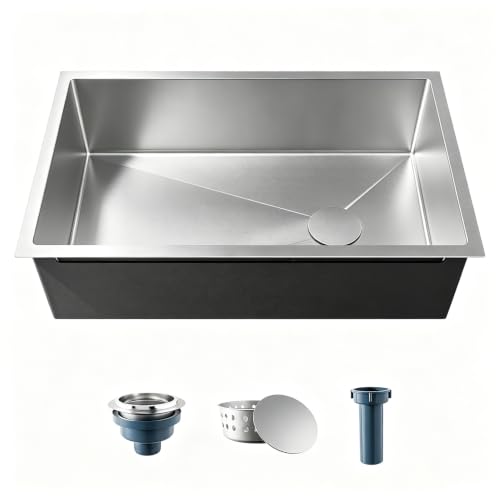
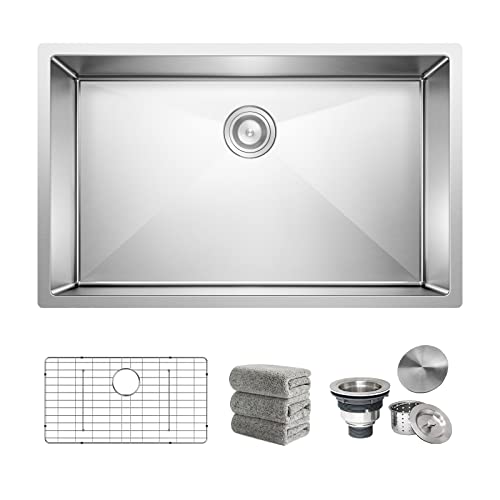
The KHU100-30 is the sink this guide keeps coming back to, because it gets the fundamentals right in the order that matters. The 16-gauge TRU16 steel is the headline: at this thickness the bowl floor feels planted rather than drum-like when a heavy pot lands in it, and the sides shrug off the casual dings that thinner 18-gauge bowls collect in their first year. Kraus pairs that steel with NoiseDefend padding, which takes the hollow ring out of running water and dropped cutlery, a difference that is most noticeable in open-plan kitchens where the sink is never more than a room away.
The rounded corners deserve more credit than they usually get. Tight-radius and zero-radius corners look architectural in photographs, but they trap food film exactly where a sponge is hardest to press. This bowl’s rounded geometry lets a sponge or brush sweep the corners in the same motion as the walls, and the channel grooves in the floor keep rinse water moving toward the drain instead of sheeting into puddles that dry as spots. For a household that cooks daily and cleans quickly, those two details do more for long-term satisfaction than any accessory bundle.
The honest limitation is what the KHU100-30 does not try to be: it is a bowl, not a workstation. There is no ledge, so a cutting board or drying rack either sits inside the bowl (stealing depth) or on the counter beside it. If your cooking style involves constant over-sink prep, the ledge models below will serve you better. If your style is cook, pile, wash, done, this is the most complete classic undermount in the group, and the one least likely to be regretted in year five.
Best for: Most remodels wanting thick steel, quiet operation and easy-clean corners in a standard 30 inch footprint / Not suited for: Cooks who specifically want an integrated workstation ledge
SANYCASA 30 Inch Undermount Workstation Sink, 11 Gauge Stainless Steel
Badge: Best Heavy-Gauge Workstation
Strengths
- 11-gauge steel at 3mm is the thickest material in this guide by a wide margin
- Integrated ledge turns the bowl into a multifunctional workstation for prep and drying
- Ships as a workstation set rather than a bare bowl
Trade-offs
- Very thick steel makes the sink noticeably heavy to handle during installation
- The ledge system only pays off if the included accessories match how you cook
- A newer brand name than the established makers in this guide
Mini spec box
- Mount: Undermount
- Material: Stainless steel, 11 gauge (3mm)
- Size: 30 inch
- Bowl configuration: Single bowl with integrated ledge
- Included format: Workstation set
- Drainage: Superior Drain design
Most sink marketing treats gauge as a quiet line in a spec table. SANYCASA puts it in the product name, and for once the emphasis is justified: 11-gauge steel, stated at 3mm, is dramatically thicker than the 16 and 18 gauge bowls that fill this category. Thick steel changes the sink’s character. It deadens impact sound at the source rather than relying only on pads, it resists the flexing that makes thin bowls feel cheap when a full stockpot is set down hard, and it gives the rim a machined solidity that installers notice immediately.
On top of that steel sits an integrated ledge, which makes this a true workstation: accessories slide along the ledge over the bowl, so washing, chopping and draining can happen in one footprint while the bowl below still holds water or catches scraps. The listing describes the package as a multifunctional workstation set, so the ledge is not an empty promise waiting for separately bought parts. For small kitchens where counter space is the scarcest resource in the room, working over the sink instead of beside it is a real, daily gain rather than a showroom trick.
The limitations are physical. A 3mm steel sink is heavy, and undermount installation is a two-person, support-the-bowl-while-the-adhesive-sets job even with lighter sinks; budget the install accordingly and confirm your cabinet and clips are up to it. The workstation format also asks an honest question: if you will not use ledge accessories weekly, you are carrying extra weight and complexity for a feature that will gather crumbs. Cooks who genuinely prep over the sink will love this sink. Cooks who do not should take the simpler Kraus bowls below and spend the difference elsewhere.
Best for: Prep-heavy cooks who want the thickest steel available in this group and will use a ledge daily / Not suited for: Solo DIY installers, or anyone who knows they will never use workstation accessories

KRAUS KWU110-32 32 Inch Undermount Workstation Sink
Badge: Best Large Workstation
Strengths
- Integrated ledge with cutting board and roll-up rack included in the box
- 16-gauge TRU16 steel with NoiseDefend soundproofing
- 32 inch bowl swallows sheet pans and roasting tins flat
Trade-offs
- Needs a 36 inch base cabinet, which rules out many smaller kitchens
- Included accessories must be stored somewhere when the ledge is not in use
- A bigger, heavier install than the 30 inch models
Mini spec box
- Mount: Undermount
- Material: Stainless steel, 16-gauge TRU16
- Size: 32 inch
- Bowl configuration: Single bowl with integrated ledge
- Included accessories: Cutting board and roll-up rack (per listing)
- Sound treatment: NoiseDefend soundproofing
The KWU110-32 is the workstation concept executed by the most established name in this guide. The bowl is 32 inches of 16-gauge TRU16 steel, and the integrated ledge runs accessories across the top: the listing confirms a cutting board and a roll-up rack are included, which matters more than it sounds. Workstation sinks whose accessories are sold separately often end up as plain sinks with an unused groove; this one arrives ready to work the day it is plumbed in, and the roll-up rack in particular earns its keep as a drying surface that stores in a drawer.
Size is the second story. A 32 inch single bowl takes half-sheet pans flat, holds a roasting tin and a pile of prep bowls at once, and gives a garbage disposal room to work under a full load. NoiseDefend soundproofing keeps that big steel surface from behaving like a drum. In a household that cooks for a family or entertains, the extra two inches over the 30 inch models are felt every single day, and the ledge means the bigger bowl does not have to double as counter space, because the counter work happens over it.
The constraints are equally concrete. This sink needs a 36 inch sink base cabinet, full stop; in a 33 inch cabinet kitchen it is simply not an option, and no amount of wanting it changes the carpentry. The accessories, useful as they are, need a home when they are off the ledge, and the cutting board in particular is a large object to store. Treat this as the pick for kitchens with the cabinet width and the cooking volume to justify it, and measure twice before falling for the format.
Best for: Family kitchens with a 36 inch base cabinet and high daily cooking volume / Not suited for: 33 inch cabinets, or minimalists who dislike storing accessories

KRAUS KHU100-32 32 Inch 16 Gauge Undermount Kitchen Sink
Badge: Best Large Classic Bowl
Strengths
- All the KHU100 fundamentals at a larger 32 inch size
- Rounded corners and channel grooves keep the big bowl easy to rinse
- NoiseDefend pads tame the sound of a large steel surface
Trade-offs
- Requires a 36 inch base cabinet like the other 32 inch pick
- No ledge, so no over-bowl workstation option
- Big single bowl means small loads sit in a lot of empty steel
Mini spec box
- Mount: Undermount
- Material: Stainless steel, 16-gauge TRU16
- Size: 32 inch
- Bowl configuration: Single bowl
- Sound treatment: NoiseDefend pads
- Drainage: Channel grooves
If the KHU100-30 is the right sink at the wrong size, the KHU100-32 is the correction. Everything that makes the 30 inch version the best overall pick carries over: 16-gauge TRU16 steel, rounded corners that a sponge can actually clean, channel grooves that keep the floor draining, and NoiseDefend padding. What changes is volume. The 32 inch bowl takes the items that make smaller sinks feel cramped: roasting pans with handles, grill grates, the big stockpot plus the colander beside it.
There is a subtler benefit to a large classic bowl that workstation models cannot copy: uninterrupted depth and floor space. Soaking a crusted roasting pan overnight, bathing a baby in a pinch, washing a dog that fits nowhere else, filling a mop bucket without angling it under the faucet: a plain, big, deep rectangle of steel does all of it without ledges or accessories getting in the way. Households that use the sink as a utility basin as much as a washing station tend to prefer this honest format, and the KHU100-32 is the strongest version of it in this guide.
Its limitations mirror its size. The 36 inch cabinet requirement excludes smaller kitchens outright. A big single bowl also means a small wash load rattles around in a lot of steel, and without a ledge there is nowhere elevated to drain a single glass except the counter. None of that diminishes the sink; it defines its audience. If your cabinet fits it and your cooking runs large, this is the classic bowl to beat, and readers planning around it may also find Best Kitchen Sinks For Laminate Countertops useful, since undermounting into laminate demands extra sealing care at the rim.
Best for: Large-format cooking and utility use in kitchens with a 36 inch base cabinet / Not suited for: Smaller cabinets, or cooks who want workstation accessories

MAYESAR 28 Inch Undermount Kitchen Sink, 16 Gauge, 9 Inch Deep
Badge: Best for Smaller Cabinets
Strengths
- 28 inch width fits cabinets the 30 and 32 inch picks cannot
- Still 16-gauge steel, so the smaller size does not mean thinner material
- 9 inch depth and round corners suit deep soaking in a compact footprint
Trade-offs
- 28 inches is tight for half-sheet pans, which may need to sit at an angle
- Handmade sinks can show slight dimensional variation; dry-fit before templating
- Fewer included extras than the workstation models
Mini spec box
- Mount: Undermount
- Material: Stainless steel, 16 gauge
- Size: 28 x 18 inch
- Bowl configuration: Single bowl
- Depth: 9 inch
- Finish and corners: Brushed finish, round corner, handmade
Every sink guide needs an honest answer for the kitchen that cannot take a 30 inch bowl, and the MAYESAR is this guide’s answer. At 28 by 18 inches it fits the narrower base cabinets found in condos, galley kitchens and older homes, and it does so without the usual punishment of thinner steel: the listing specifies 16 gauge, the same thickness class as the Kraus picks, in a handmade single bowl with a brushed finish. That combination is rarer than it should be, because small sinks are where manufacturers most often quietly downgrade the material.
The 9 inch depth is the second smart decision. Depth compensates for width: a deep 28 inch bowl soaks a lasagna dish, stands a cutting board upright for washing, and keeps splash inside the bowl when the faucet runs at full pressure over a stack of dishes. The round corners follow the same practical logic as the Kraus bowls, letting a sponge sweep the perimeter without digging into angles. In a small kitchen, where the sink handles every washing job the household has, those details add up to a bowl that works above its size.
The trade-off is the tape measure. A half-sheet pan will not lie flat in a 28 inch bowl the way it does in a 32, and a large family that cooks in bulk will feel the ceiling of this sink quickly. Handmade construction also means you should dry-fit the actual sink and confirm dimensions before the counter is cut, since small variations matter at the rim. For the kitchen it fits, though, this is not a compromise pick; it is the correct pick, and guides like Best Kitchen Sinks For Tiny Homes make the same point from the layout side: the right size beats the biggest size.
Best for: Condos, galleys and older homes with narrower sink base cabinets / Not suited for: Bulk family cooking or anyone who needs a sheet pan to lie flat

cozhao 30 Inch Undermount Kitchen Sink, 18 Gauge 304 Stainless Steel
Badge: Best Value-Tier Pick
Strengths
- Full 30 inch single bowl in 304 stainless steel at the value end of this guide
- Handmade modern styling suits contemporary remodels
- Drain assembly included, so one less part to source separately
Trade-offs
- 18-gauge steel is thinner than the 16-gauge picks and will feel and sound like it
- No stated sound pad system in the verified listing data
- Brand support network is thinner than the established names here
Mini spec box
- Mount: Undermount
- Material: 304 stainless steel, 18 gauge
- Size: 30 inch
- Bowl configuration: Single bowl
- Construction: Handmade
- Included: Drain assembly (per listing)
The cozhao is the value-tier route into a full-size stainless undermount, and its review starts with the number that defines it: 18 gauge. That is thinner steel than the 16-gauge Kraus and MAYESAR bowls and far thinner than the SANYCASA. In daily use the difference shows up as a slightly livelier sound when water hits the floor of the bowl, a touch more flex under a very heavy pot, and a rim that asks for a little more care during installation. None of that makes it a bad sink; it makes it a sink whose price tier, which you can check on its listing, should be weighed against how hard your kitchen works its sink.
What the cozhao gets right is the brief itself. It is a proper 30 inch single bowl in 304 stainless steel, the food-safe grade you want, with handmade construction and a modern profile that suits the flat, minimal look most current remodels aim for. The included drain assembly is a small but real convenience: matching a drain to an aftermarket bowl is one of those errands that wastes an afternoon, and having it in the box removes the risk of a mismatched thread or finish on install day.
Choose this sink with clear eyes. A gentle household, a rental upgrade, a flip, or a second kitchen will get years of service from it, and the money saved against the thicker picks is real. A household that drops cast iron into the sink weekly should step up to 16 gauge and treat the difference as insurance. That is the whole decision, and this guide would rather state it plainly than pretend gauge does not matter.
Best for: Budget-conscious remodels, rentals and lighter-use kitchens wanting full 30 inch size / Not suited for: Heavy daily use where dropped cast iron is a weekly event
Comparison Table
The table lines the six up on the attributes that decide fit and feel. Prices and ratings are deliberately absent: both change constantly, and the fit questions below are the ones that cannot be changed after installation.
| Pick | Mount | Steel | Size and bowl | Notable trait | Check |
|---|---|---|---|---|---|
| KRAUS KHU100-30 30 Inch 16 Gauge Undermount Kitchen Sink | Undermount | 16-gauge stainless | 30 in single bowl | NoiseDefend pads | Check on Amazon |
| SANYCASA 30 Inch Undermount Workstation Sink, 11 Gauge Stainless Steel | Undermount | 11-gauge stainless | 30 in single bowl, ledge | Workstation set | Check on Amazon |
| KRAUS KWU110-32 32 Inch Undermount Workstation Sink | Undermount | 16-gauge stainless | 32 in single bowl, ledge | Board + roll-up rack included | Check on Amazon |
| KRAUS KHU100-32 32 Inch 16 Gauge Undermount Kitchen Sink | Undermount | 16-gauge stainless | 32 in single bowl | NoiseDefend pads | Check on Amazon |
| MAYESAR 28 Inch Undermount Kitchen Sink, 16 Gauge, 9 Inch Deep | Undermount | 16-gauge stainless | 28 x 18 in single bowl | 9 in deep, brushed | Check on Amazon |
| cozhao 30 Inch Undermount Kitchen Sink, 18 Gauge 304 Stainless Steel | Undermount | 18-gauge 304 stainless | 30 in single bowl | Drain assembly included | Check on Amazon |
How to Choose the Best Stainless Undermount Kitchen Sinks
Start with the cabinet, not the sink
The sink base cabinet sets a hard ceiling on sink size. As a working rule, a 32 inch sink wants a 36 inch cabinet, a 30 inch sink a 33 inch cabinet, and the 28 inch MAYESAR in this guide exists precisely for cabinets below that. Measure the inside width of the cabinet box, subtract the wall thickness on both sides, and compare against the sink’s stated dimensions before anything else. No feature, gauge or discount is worth a sink that physically cannot drop into the cabinet you own.
Understand gauge before you compare anything else
Gauge is the most useful single number in stainless sink shopping, and it runs backwards: lower is thicker. The spread in this guide runs from 11 gauge (3mm, the SANYCASA) through 16 gauge (the Kraus bowls and the MAYESAR) to 18 gauge (the cozhao). Thicker steel dents less, sounds deader, and feels more solid under load. It also weighs more and usually sits in a higher tier. For a primary family kitchen, 16 gauge is the sensible floor; 18 gauge is a legitimate economy for lighter use; 11 gauge is a deliberate heavy-duty choice.
Decide whether you are a workstation cook
A ledge is only valuable if your habits use it. If you regularly chop over the sink, drain pasta into a colander suspended over the bowl, or dry glasses on a roll-up rack, a workstation model like the KWU110-32 or the SANYCASA converts dead air into work surface. If your prep happens on the counter and the sink is purely for washing, a classic bowl gives you more uninterrupted depth for the same money and nothing to store. Be honest about your habits rather than your aspirations; the ledge you never use is just a groove that catches crumbs.
Match bowl geometry to your biggest items
List the three largest things you wash: typically a sheet pan, a stockpot and a roasting tin. Check their longest dimension against the bowl’s interior, not its rim-to-rim size. Depth matters as much as width: a 9 inch deep bowl like the MAYESAR’s contains splash and soaks tall items, while shallower bowls are easier on shorter users’ backs. Single bowls, all six picks here, maximise uninterrupted space; households that constantly soak and wash simultaneously are the ones who should consider double bowls instead, accepting the smaller halves that come with them.
Check the quiet details: corners, grooves and pads
Rounded corners clean faster than tight corners, every day, for the life of the sink. Channel grooves in the bowl floor keep water moving to the drain so the steel dries evenly instead of spotting. Sound pads, the NoiseDefend systems on the Kraus picks, decide whether a running faucet and dropped cutlery sound like kitchen noise or like a drum in the next room. None of these appear in headline marketing, and all of them are felt daily. When two sinks tie on size and gauge, these details are the tiebreakers.
Plan the countertop conversation early
Undermount sinks and countertops are one decision, not two. The fabricator needs the sink or its exact template before cutting, the rim reveal (positive, negative or flush) changes how the edge looks and cleans, and the counter material changes the sealing method. Shoppers mid-remodel often ask about Best Kitchen Sinks For Sale when hunting timing and promotions; the better sequence is to choose the sink on fit and gauge first, then watch for the right moment to buy it, because the counter schedule will not wait for a sale.
How to Install and Care for a Stainless Undermount Sink
Most undermount sinks are installed by the countertop fabricator or a plumber, and this guide recommends professional installation for stone counters. The steps below describe the standard sequence so you know what a correct install looks like, what to check before you sign off, and how to care for the steel afterwards.
- Dry-fit first: with the counter still accessible, set the sink in position, confirm the reveal is even on all sides, and check that the faucet holes and the drain line up with the plumbing below.
- Support the bowl mechanically: adhesive and sealant alone are not a mounting system. Clips, rails or a support frame must carry the sink’s weight, especially with heavy-gauge steel and a bowl full of water.
- Seal the rim completely: a continuous bead of quality silicone between rim and counter underside keeps water out of the cabinet; gaps at the back edge are the most common leak source.
- Connect the drain and disposal after the seal cures: rushing this step is how fresh seals get broken. Confirm the drain assembly seats flat and test with a full bowl of water before the disposal goes on.
- Run a full leak check: fill the bowl to the rim, let it stand, then drain it while checking every joint below with a dry hand or paper towel.
- Daily care: rinse and wipe the bowl dry after washing up; stainless looks its best when it is not left under standing water and food film.
- Weekly care: wash with a soft cloth and mild detergent, always wiping in the direction of the brushed grain, and avoid steel wool, which can embed particles that later rust-spot.
On scratches: stainless sinks scratch, and pretending otherwise sets buyers up for disappointment. Fine scratches blend into the brushed finish over time and are part of the material’s honest patina; a sink grid, which several owners add later, keeps pots from grinding directly on the floor. On water spots: they are mineral deposits, not damage, and a wipe-down with a microfibre cloth after the last wash of the day prevents nearly all of them. Households on hard water may add a vinegar-water wipe weekly. Treat the steel this way and a 16-gauge bowl will look respectable a decade in, which is the entire point of buying the thicker material.
Troubleshooting
Problem: The bowl sounds hollow and drummy when water runs → what to do: check whether the sink has sound pads and whether they are fully adhered; adding aftermarket dampening pads to the underside of the bowl, where accessible, noticeably deepens the sound
Problem: Water pools in one corner instead of draining → what to do: confirm the sink is level and the bowl floor’s grooves are clear of debris; persistent pooling on a new install is a levelling issue to raise with the installer promptly
Problem: A musty smell comes from under the counter edge → what to do: inspect the rim seal for gaps, especially along the back; a failed seal lets water into the cabinet and must be cut out and re-sealed, not caulked over
Workstation vs Classic Bowl: Which Format Fits Your Cooking?
The format question divides this guide’s six picks into two camps: the ledge models (SANYCASA and the Kraus KWU110-32) and the classic bowls (both KHU100 models, the MAYESAR and the cozhao). The workstation case is strongest in small and medium kitchens, where counter space is contested and the sink is already where produce gets washed. Sliding a board over the bowl puts chopping directly above the scraps’ destination, and a roll-up rack converts the bowl into a drainer that disappears into a drawer. In those kitchens the ledge is used daily and earns its complexity.
The classic case is strongest where the sink’s job is volume: soaking, washing big items, filling buckets, bathing the dog. A plain bowl has nothing in the way, nothing to store and nothing to align, and its full depth is available for a single huge object. Large households with generous counters often discover the workstation accessories migrating to a cupboard within a year, which is the market quietly voting for the classic format. Neither answer is wrong; the mistake is buying the format that matches a kitchen you do not have. If in doubt, count how many times last week you wished for more counter space versus more sink space, and let that tally decide.
What Gauge Really Changes Day to Day
Gauge discussions tend to stay abstract, so here is the concrete version. Drop a heavy skillet into an 18-gauge bowl and you hear a bright, ringing note and feel the floor give slightly; do the same in a 16-gauge bowl and the sound is shorter and duller; in the 11-gauge SANYCASA it is closer to a thud. Over years, the thinner bowl also collects small dents that catch light and sponge edges, while thicker steel tends to show scratches rather than dents, and scratches blend into a brushed finish far more gracefully.
There is also an installation dimension: thicker steel holds its shape, so rims sit flatter against the counter and seals stay even, while very thin bowls can flex during mounting and need more care to seat perfectly. None of this makes 18 gauge a mistake, the cozhao review above is explicit that lighter households can choose it happily, but it does mean gauge should be a deliberate decision rather than a spec you discover after the fact. If your kitchen is the household’s workshop, buy thickness. If it is a light-use space, buy size and put the savings into a better faucet.
Common Buying Mistakes
- Buying the sink after the counter is cut. The fabricator needs the sink first; ordering in the wrong order turns a simple install into a compromise or a re-cut.
- Choosing by rim-to-rim size alone. Interior bowl dimensions and cabinet interior width are the numbers that decide fit; rim size flatters every sink.
- Ignoring gauge to save a small amount. The sink is a decades-long fixture sealed under stone; steel thickness is the worst place in a remodel to economise without a reason.
- Buying a workstation for aspirational habits. If the accessories will live in a cupboard, you bought a groove, not a workstation.
- Skipping the support hardware. Sealant is a seal, not a structure; a full bowl of water plus a disposal is heavy, and the mounting system must carry it.
- Cleaning with steel wool or bleach soaks. Both attack the finish; a soft cloth, mild detergent and wiping with the grain keep stainless looking right.
Final Recommendation
For most kitchens, the Kraus KHU100-30 is the recommendation: 16-gauge steel, rounded corners, channel grooves and NoiseDefend padding in the standard 30 inch size, with no gimmicks to regret. It is the sink this guide would install in a typical family remodel without a second thought.
Start with the KRAUS KHU100-30 30 Inch 16 Gauge Undermount Kitchen Sink if you want the safest all-round choice in this guide. If its particular trade-offs do not fit your kitchen, the SANYCASA 30 Inch Undermount Workstation Sink, 11 Gauge Stainless Steel is the strongest alternative for the reasons covered in its review, and the KRAUS KWU110-32 32 Inch Undermount Workstation Sink earns its place as the third route worth a serious look before you decide.
Step sideways with intent. Choose the SANYCASA if you want the heaviest steel in the group and will genuinely work over its ledge; choose the KWU110-32 if your cabinet is 36 inches and your cooking volume justifies the big workstation; choose the KHU100-32 for the same volume in a classic bowl. The MAYESAR is the correct answer for narrower cabinets, and the cozhao is a rational value-tier choice for lighter use. Every one of those decisions is defensible; the only indefensible one is buying before measuring the cabinet.
Frequently Asked Questions
Is 16 gauge really better than 18 gauge for a kitchen sink?
Yes, in the ways that accumulate: thicker steel dents less, sounds quieter and feels more solid under heavy pots. An 18-gauge sink like the cozhao in this guide still serves lighter households well, but for a primary family kitchen 16 gauge is the sensible standard, and the difference matters more with every year the sink stays under the counter.
Can I install an undermount sink with laminate countertops?
It is possible but demands care, because the cut edge of laminate must be sealed perfectly against water or the core will swell. Many fabricators prefer topmount for laminate for exactly that reason. If your heart is set on undermount with laminate, use an installer experienced with the combination and inspect the seal closely at handover.
What size cabinet does a 32 inch sink need?
Plan on a 36 inch sink base cabinet for a 32 inch undermount sink. A 30 inch sink generally fits a 33 inch cabinet, and narrower cabinets are why 28 inch models like the MAYESAR exist. Always confirm against the specific sink’s stated minimum cabinet size before ordering.
Do workstation sink accessories fit any ledge sink?
No. Ledge widths and accessory dimensions vary by brand and model, so accessories are effectively proprietary. That is why the KWU110-32’s included cutting board and roll-up rack matter: they are guaranteed to fit the ledge they were designed for, with no measuring gamble.
How do I stop a stainless sink from looking scratched?
You cannot prevent fine scratches entirely, and any seller who promises otherwise is misleading you. You can minimise them with a bowl grid, avoid dragging cast iron across the floor, and clean with the grain. Over time the fine scratches merge into the brushed patina and become far less visible than they are in the first month.
When should the sink arrive during a remodel?
Before the countertop is templated. The fabricator will want the physical sink or its exact template to cut the opening and plan the reveal. Order the sink as soon as the model is chosen, store it safely on site, and do not let the counter schedule get ahead of it.