Disclosure: topratedkitchenware.com is reader-supported. When you buy through links on our site, we may earn an affiliate commission from Amazon and other retailers, at no extra cost to you.
Where to buy
When you shop for the best stand up mixers, the fastest way to buy well is to separate the true stand mixers from the hand mixers that share the shelf. The three Cuisinart SM-50 stand mixers below are linked to Amazon; the three hand mixers are covered in full, in prose only, because they cannot do the one thing this keyword promises — stand on the counter and mix hands-free.
- Hamilton Beach 6-Speed Hand Mixer with QuickBurst (62682G) — covered in prose only in this guide (see the review below for why)
- KitchenAid 5 Ultra Power Speed Hand Mixer (KHM512, Empire Red) — covered in prose only in this guide (see the review below for why)
- Cuisinart Stand Mixer, 12 Speed, 5.5 Quart (SM-50, White Linen) — Check on Amazon
- Hamilton Beach 6-Speed Hand Mixer with Easy Clean Beaters (62636J) — covered in prose only in this guide (see the review below for why)
- Cuisinart Stand Mixer, 12 Speed, 5.5 Quart (SM-50, Ruby Red) — Check on Amazon
- Cuisinart Stand Mixer, 12 Speed, 5.5 Quart (SM-50, Onyx) — Check on Amazon
Read the full guide ↓
Shoppers searching for the best stand up mixers usually want one specific thing: a machine that stands on the counter, holds its own bowl, and does the holding and kneading while they get on with the rest of the recipe. This guide takes that promise literally. The verified pool for this keyword mixes genuine stand mixers with well-regarded hand mixers, so instead of pretending they are the same product, we link the true stand mixers and review the hand mixers in prose — same depth, no link, no image — with the format difference stated plainly in every review.
That honesty turns out to be useful, because the two formats answer different kitchens. If you bake dough weekly and want hands-free work, the stand mixers here are your shortlist. If you bake occasionally and store everything in drawers, the hand mixers may honestly serve you better — and you will know exactly what you are giving up, because each review names it.
If you are comparing neighbouring topics while you shop, our notes on Best Mixers For Making Pizza Dough sit in the same cluster.
Key Takeaways
- Only three picks in this pool are true stand-up mixers — the Cuisinart SM-50 in White Linen, Ruby Red and Onyx — and they are the linked picks.
- The three SM-50s share one spec sheet (12 speeds, 5.5-quart bowl, paddle, dough hook, whisk); choose between them on finish alone.
- The hand mixers are reviewed prose-only: excellent tools, wrong format for a hands-free promise.
- Bowl size around 5.5 quarts is the home-baking sweet spot for double batches without drowning small ones.
- Attachments decide real range: a dough hook in the box matters more than any speed count.
In this guide
Quick Picks
| Pick | Badge | Why it earns its place |
|---|---|---|
| Hamilton Beach 6-Speed Hand Mixer with QuickBurst (62682G) | Best for Occasional Bakers | 250-watt peak motor with a QuickBurst button for short blasts of extra power through thick spots |
| KitchenAid 5 Ultra Power Speed Hand Mixer (KHM512, Empire Red) | Best Beater Design | Turbo Beater accessories are designed to mix heavy, dense ingredients without clogging |
| Cuisinart Stand Mixer, 12 Speed, 5.5 Quart (SM-50, White Linen) | Best Overall | A true stand mixer: 5.5-quart stainless steel bowl, mixing paddle, dough hook and chef’s whisk included |
| Hamilton Beach 6-Speed Hand Mixer with Easy Clean Beaters (62636J) | Most Complete Hand-Mixer Kit | The fullest hand-mixer toolkit here: easy-clean beaters, traditional beaters, dough hooks and a whisk |
| Cuisinart Stand Mixer, 12 Speed, 5.5 Quart (SM-50, Ruby Red) | Best Statement Finish | Same proven SM-50 stand platform: 5.5-quart stainless bowl, paddle, dough hook and chef’s whisk |
| Cuisinart Stand Mixer, 12 Speed, 5.5 Quart (SM-50, Onyx) | Best for Modern Kitchens | Full SM-50 stand-mixer package: 5.5-quart stainless bowl, paddle, dough hook, chef’s whisk |
How These Picks Were Chosen
We built this guide from the verified pick pool for the mixers category, cross-checking every product’s identity and in-box contents against its manufacturer listing data. Then we applied the keyword’s own test — does it stand up and mix hands-free? — as the first filter, because a guide to stand-up mixers that links hand mixers as equals would fail its reader on the first line. Products that passed the format test carry links and images; products that failed it are still reviewed in full, because a hand mixer may be the right purchase for many readers, but they carry no purchase link from an article whose title they do not match.
We also cross-checked each product against the manufacturer’s own listing data before writing, and we were honest about format: where a product in the verified pool did not match the core promise of this keyword, it is reviewed in prose only — no link, no image — with the reason stated in its review. Readers who want the neighbouring angle can also see Best Mixers Under $100.
A note on method and limits: this is research-led guidance, not a lab test. We compared verified specifications, in-box contents, design and the documented strengths of each model, and we weighted them for the specific job in this keyword rather than for an abstract ‘best’. We do not claim hands-on testing we did not do, we publish no prices because prices move, and we publish no star ratings or review counts because those change constantly and would mislead within months. What we can stand behind is the reasoning: every pick below is matched, in plain language, to the buyer it genuinely suits and the buyer it does not.
Best Stand Up Mixers — The Six Picks in Detail
Hamilton Beach 6-Speed Hand Mixer with QuickBurst (62682G)
Badge: Best for Occasional Bakers
Prose-only pick: Hand mixer — it does not stand on the counter or mix hands-free, so it fails the core ‘stand up mixer’ format promise of this keyword.
Strengths
- 250-watt peak motor with a QuickBurst button for short blasts of extra power through thick spots
- Bowl Rest feature lets the mixer sit on the edge of the bowl between additions, keeping beaters out of the batter
- Snap-on storage case keeps the traditional beaters clipped to the mixer instead of loose in a drawer
Trade-offs
- It is a hand mixer, so your arm does the holding and guiding through every batch
- Only traditional beaters are listed in the box — no dough hooks or whisk are named in the title
- Six speeds is plenty for batters, but there is no slow-start feature named, so flour can puff on first contact
| Mini spec box | |
|---|---|
| Type | Electric hand mixer |
| Speeds | 6 speeds plus QuickBurst |
| Motor | 250 watts (peak power, per title) |
| Attachments named | Traditional beaters |
| Storage | Snap-on storage case |
| Color | White |
This is the straightforward, keep-it-in-a-drawer mixer for bakers who make cakes, brownies, whipped cream and mashed potatoes a few times a month and do not want a heavy appliance living on the counter.
The 250-watt motor and QuickBurst button are aimed at the moment a batter thickens — folding in chocolate chips, finishing a stiff frosting, or pulling the last lumps out of a potato pot. The Bowl Rest is a small feature that earns its keep: instead of laying a dripping mixer on the counter, you perch it on the bowl rim while you scrape or add eggs.
The honest limitation is format and toolkit: it is hand-held, so long or heavy mixing sessions are arm work, and with only traditional beaters named you should not plan on kneading bread or cookie dough with hooks this model does not list.
Best for: occasional bakers who want a simple, storable hand mixer with a genuinely useful bowl-rest design / Not suited for: anyone who needs a true stand mixer that works hands-free, or a model that ships with dough hooks
KitchenAid 5 Ultra Power Speed Hand Mixer (KHM512, Empire Red)
Badge: Best Beater Design
Prose-only pick: Hand mixer — hand-held format, not a stand-up/stand mixer; fails the keyword’s core format attribute.
Strengths
- Turbo Beater accessories are designed to mix heavy, dense ingredients without clogging
- Lockable swivel cord can be positioned to the left or right, keeping the cord out of the bowl for either hand
- Easy-release button ejects beaters with one press, and the beaters are dishwasher safe
Trade-offs
- Five speeds is a narrower range than the 6- and 9-speed rivals in this guide
- No storage case is named in the title, so beaters live loose unless you add your own solution
- It is hand-held only — there is no stand, bowl or hands-free mode
| Mini spec box | |
|---|---|
| Type | Electric hand mixer |
| Speeds | 5 speeds |
| Attachments named | Turbo Beaters |
| Cord | Lockable swivel cord |
| Cleaning | Dishwasher-safe beaters |
| Color | Empire Red |
KitchenAid’s hand mixer suits bakers who like the brand’s design language, mix mostly cakes, frostings and soft doughs, and care about small ergonomic touches like a cord that locks to whichever side keeps it clear of the bowl.
The Turbo Beaters are the headline: their open design is meant to pull dense mixtures through without the clogging that stalls basic beaters, which matters in cream-cheese frosting and thick brownie batter. Five well-spaced speeds cover the real jobs — slow folding, medium batter work, fast whipping — without a dial full of near-identical settings.
The limitation is scope: five speeds, beaters only as named, and a hand-held format. It will not knead, it will not run unattended, and bakers who want a case or extra tools in the box should look at the fuller kits in this guide.
Best for: brand-loyal bakers who want clog-resistant beaters and a cord that stays out of the way / Not suited for: anyone shopping for a hands-free stand mixer or an in-box dough hook set

Cuisinart Stand Mixer, 12 Speed, 5.5 Quart (SM-50, White Linen)
Badge: Best Overall
Strengths
- A true stand mixer: 5.5-quart stainless steel bowl, mixing paddle, dough hook and chef’s whisk included
- 12 speeds give fine control from a gentle fold to a fast whip
- Splash guard with pour spout lets you add flour or sugar mid-mix without a dust cloud
Trade-offs
- Counter footprint and weight are in a different class from a hand mixer — plan permanent counter space
- One bowl size has to cover everything; very small batches can sit below the paddle’s best reach
- Three colorways of this same SM-50 appear in this guide, so choose on finish, not on imagined spec differences
| Mini spec box | |
|---|---|
| Type | Stand mixer |
| Speeds | 12 speeds |
| Bowl | 5.5-quart stainless steel |
| Attachments named | Mixing paddle, dough hook, chef’s whisk |
| Extras | Splash guard with pour spout |
| Color | White Linen |
This is the pick for the baker this keyword is actually about: someone who wants the mixer to stand on the counter, hold a real bowl, and work hands-free through cookie dough, cake batter and bread dough while they measure the next ingredient.
The 5.5-quart bowl handles double batches of most home recipes, and the three named tools map cleanly onto the work — paddle for creaming and mixing, dough hook for kneading, whisk for egg whites and cream. Twelve speeds sound like a lot, but the useful part is the low end: a genuinely slow start keeps flour in the bowl, and the splash guard with its pour spout makes mid-mix additions tidy.
The honest limitation is size and commitment: a stand mixer this size wants a permanent home on the counter and a budget to match, and for a single small batch of whipped cream a hand mixer is honestly quicker to wash.
Best for: regular bakers who want one hands-free machine for dough, batter and whipping / Not suited for: tiny kitchens with no spare counter, or bakers who only mix a few times a year
Hamilton Beach 6-Speed Hand Mixer with Easy Clean Beaters (62636J)
Badge: Most Complete Hand-Mixer Kit
Prose-only pick: Hand mixer — hand-held format, not a stand-up/stand mixer; fails the keyword’s core format attribute.
Strengths
- The fullest hand-mixer toolkit here: easy-clean beaters, traditional beaters, dough hooks and a whisk
- 275-watt motor is the strongest named in this hand-mixer group
- Snap-on storage case keeps all four tool types clipped together
Trade-offs
- Hand-held format means heavy dough work is still your arm versus the batch
- Easy-clean beaters trade some traditional beater rigidity for their smooth, food-shedding profile
- White finish and a case full of tools take a little more drawer planning than a bare mixer
| Mini spec box | |
|---|---|
| Type | Electric hand mixer |
| Speeds | 6 speeds |
| Motor | 275 watts (per title) |
| Attachments named | Easy-clean beaters, traditional beaters, dough hooks, whisk |
| Storage | Snap-on storage case |
| Color | White |
If you want one hand mixer that covers the widest range of jobs — batter, dough, whipped cream — without buying tools separately, this Hamilton Beach kit is the most complete box in the group.
The 275-watt motor plus actual dough hooks means it can pull together a small pizza or cookie dough in a way beater-only models should not attempt, and the whisk handles cream and egg whites properly instead of asking beaters to fake it. The easy-clean beaters are the everyday set: their smooth profile sheds batter and rinses fast.
The limitation is physics: dough hooks on a hand mixer still transmit every bit of resistance to your wrist, so big or stiff dough batches belong on a stand mixer. Treat the hooks as a small-batch convenience, not a bread program.
Best for: hand-mixer buyers who want every attachment in one case, including real dough hooks / Not suited for: bread bakers making large or stiff doughs several times a week
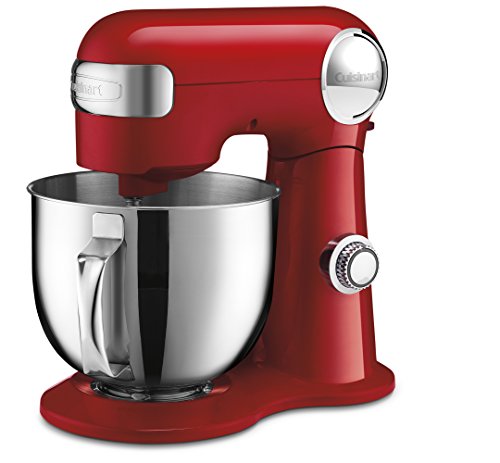
Cuisinart Stand Mixer, 12 Speed, 5.5 Quart (SM-50, Ruby Red)
Badge: Best Statement Finish
Strengths
- Same proven SM-50 stand platform: 5.5-quart stainless bowl, paddle, dough hook and chef’s whisk
- 12 speeds with a splash guard and pour spout for controlled, tidy additions
- Ruby finish makes the always-out appliance part of the kitchen’s look rather than an eyesore
Trade-offs
- Identical core specs to the other SM-50 colors in this guide — the difference is the finish
- Stand-mixer size and weight; not a store-it-away appliance
- A single 5.5-quart bowl must serve both small and large jobs
| Mini spec box | |
|---|---|
| Type | Stand mixer |
| Speeds | 12 speeds |
| Bowl | 5.5-quart stainless steel |
| Attachments named | Mixing paddle, dough hook, chef’s whisk |
| Extras | Splash guard with pour spout |
| Color | Ruby Red |
The Ruby Red SM-50 suits the baker who has already decided a stand mixer will live on the counter permanently and wants that permanent fixture to look intentional — a color accent rather than another white box.
Performance is the SM-50 story: a 5.5-quart bowl for double batches, a paddle that creams properly, a dough hook that kneads while you shape the next loaf, and a whisk for meringues. Twelve speeds and the pour-spout splash guard keep both delicate folds and flour-heavy starts under control.
The honest limitation is that you are paying stand-mixer money and giving up stand-mixer counter space for a machine whose advantage only shows with regular use; occasional bakers will feel the footprint more than the benefit.
Best for: committed home bakers who want the full stand-mixer toolkit in a bold finish / Not suited for: small kitchens, or anyone who would rather store a mixer in a cupboard
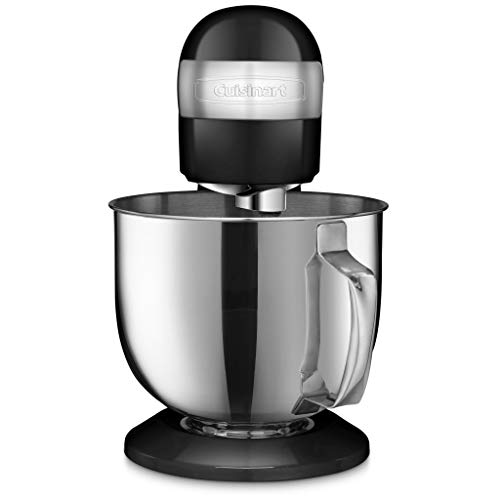
Cuisinart Stand Mixer, 12 Speed, 5.5 Quart (SM-50, Onyx)
Badge: Best for Modern Kitchens
Strengths
- Full SM-50 stand-mixer package: 5.5-quart stainless bowl, paddle, dough hook, chef’s whisk
- 12 speeds span gentle folding through fast whipping in one dial
- Onyx finish hides flour dust and fits darker, modern kitchens
Trade-offs
- Same core specification as the White Linen and Ruby Red versions — finish is the only difference
- Heavy, counter-dwelling format; overkill for a twice-a-year baker
- Small batches can under-fill a 5.5-quart bowl
| Mini spec box | |
|---|---|
| Type | Stand mixer |
| Speeds | 12 speeds |
| Bowl | 5.5-quart stainless steel |
| Attachments named | Mixing paddle, dough hook, chef’s whisk |
| Extras | Splash guard with pour spout |
| Color | Onyx |
The Onyx SM-50 is for the baker who wants the complete stand-mixer toolkit in the most kitchen-neutral finish — the one that disappears into a modern counter line-up and shrugs off visible flour dust between bakes.
Everything the SM-50 does well applies here: hands-free kneading with the dough hook, thorough creaming with the paddle, real whipping volume with the chef’s whisk, and a splash guard that makes adding a cup of flour at speed two a calm event instead of a whiteout. The 5.5-quart bowl is sized for double cookie batches and family cake layers.
The limitation is the same as its color siblings: it is a commitment of counter space and money, and it shares its spec sheet with them, so if the finish does not matter to you there is no performance reason to prefer one SM-50 over another.
Best for: regular bakers who want the full stand package in a low-key, dust-forgiving finish / Not suited for: anyone short on counter space or baking only occasionally
Comparison Table
| Pick | Badge | Key attributes | Best for | Link |
|---|---|---|---|---|
| Hamilton Beach 6-Speed Hand Mixer with QuickBurst (62682G) | Best for Occasional Bakers | Type: Electric hand mixer; Speeds: 6 speeds plus QuickBurst; Motor: 250 watts (peak power, per title) | occasional bakers who want a simple, storable hand mixer with a genuinely useful bowl-rest design | Prose only |
| KitchenAid 5 Ultra Power Speed Hand Mixer (KHM512, Empire Red) | Best Beater Design | Type: Electric hand mixer; Speeds: 5 speeds; Attachments named: Turbo Beaters | brand-loyal bakers who want clog-resistant beaters and a cord that stays out of the way | Prose only |
| Cuisinart Stand Mixer, 12 Speed, 5.5 Quart (SM-50, White Linen) | Best Overall | Type: Stand mixer; Speeds: 12 speeds; Bowl: 5.5-quart stainless steel | regular bakers who want one hands-free machine for dough, batter and whipping | Check on Amazon |
| Hamilton Beach 6-Speed Hand Mixer with Easy Clean Beaters (62636J) | Most Complete Hand-Mixer Kit | Type: Electric hand mixer; Speeds: 6 speeds; Motor: 275 watts (per title) | hand-mixer buyers who want every attachment in one case, including real dough hooks | Prose only |
| Cuisinart Stand Mixer, 12 Speed, 5.5 Quart (SM-50, Ruby Red) | Best Statement Finish | Type: Stand mixer; Speeds: 12 speeds; Bowl: 5.5-quart stainless steel | committed home bakers who want the full stand-mixer toolkit in a bold finish | Check on Amazon |
| Cuisinart Stand Mixer, 12 Speed, 5.5 Quart (SM-50, Onyx) | Best for Modern Kitchens | Type: Stand mixer; Speeds: 12 speeds; Bowl: 5.5-quart stainless steel | regular bakers who want the full stand package in a low-key, dust-forgiving finish | Check on Amazon |
How to Choose the Best Stand Up Mixers for Your Kitchen
Start with format honesty, because it decides everything else in this category. A stand mixer is a motor, a bowl and a set of tools mounted on a frame that does the holding for you: you lock the bowl in, lower the head or raise the bowl, and the machine works through the batch while your hands stay free. A hand mixer is a motor you hold, moving it through the mixture yourself. Neither is ‘better’ in the abstract — they are different tools that happen to share a job title. Stand mixers win on dough, on double batches, on long creaming sessions and on any recipe where you need to add ingredients while the machine keeps working. Hand mixers win on storage, on small quick jobs, on price tier, and on being ready in the ten seconds it takes to open a drawer.
Bowl capacity is the second decision, and it is a math problem, not a vibes problem. A 5.5-quart bowl — the size on the Cuisinart SM-50 models in this guide — comfortably handles a double batch of most cookie recipes, a family-size layer cake, and a standard loaf or two of bread dough. Go much smaller and double batches overflow the tool’s working range; go much larger and small batches sit in a puddle at the bottom that the paddle sweeps over instead of through. Think about your largest regular batch, not your largest imaginable one: the mixer you need for a weekly double batch is different from the one you need for a once-a-year holiday marathon, and buying for the marathon means living with oversize the other fifty weeks.
While you weigh the factors below, it can help to compare how a neighbouring brief frames the same shelf — see Best Pro Channel Mixers for a related take.
Speeds deserve a calmer reading than marketing gives them. What matters is not the top number but the quality of the low end and the spacing between settings. A genuinely slow first speed is what keeps flour in the bowl when you start a batter; a mid range that actually differs from step to step is what lets you cream butter and sugar without flinging it; and a confident top speed is what whips cream and egg whites. Twelve speeds, as on the SM-50, give you fine gradations. Five or six well-chosen speeds, as on the hand mixers here, cover the same jobs with less dial-fiddling. Judge the range by the work, not the count.
Attachments are where a mixer’s real range lives. The classic trio — a flat paddle or beater for creaming and mixing, a dough hook for kneading, and a wire whisk for aerating — covers ninety percent of home baking between them. When a stand mixer lists all three in the box, as the SM-50 does, you are buying a complete system on day one. When a hand mixer lists only beaters, you are buying a batter tool, and dough hooks or a whisk are either a separate purchase or a reason to choose a fuller kit like the Hamilton Beach 62636J. Always read the attachment list before the speed count; it tells you more about what the machine will actually do in your kitchen.
Finally, weigh the ownership costs nobody puts on the box. A stand mixer needs permanent counter space or a strong shelf and the willingness to lift it; it rewards you every single bake. A hand mixer needs a drawer and rewards you with zero footprint. Cleaning runs the other way than people expect: a stand mixer’s bowl and tools are few and large, while a hand mixer’s beaters are small but fiddly, and storage cases — several models here include them — are the difference between a kit that stays together and a drawer of orphans. Choose the machine whose daily friction you mind least, because the best mixer is the one you reach for without thinking.
How to Use a Stand Mixer (and a Hand Mixer) Like You Mean It
Using a mixer well is mostly about sequence and patience. Whether your machine stands on the counter or lives in your hand, the same routine produces better bakes: set up completely before you start, add ingredients in the order the recipe intends, and let the tool do the work at the speed the mixture — not your schedule — dictates.
- Set up before you switch on. Fit the correct tool (paddle for mixing and creaming, hook for dough, whisk for aerating, beaters on a hand mixer), lock the bowl in place, and have every ingredient measured and within reach. Mixing is a continuous process; stopping mid-batch to hunt for vanilla is how overmixed batter happens.
- Start slow, always. Begin at the lowest speed whenever dry ingredients are exposed. Ten seconds of patience at speed one is the difference between flour in the batter and flour on your shirt — this is exactly what features like SmoothStart automate on the hand mixers that have it.
- Add in stages. Add flour in two or three additions, alternating with liquid where the recipe allows, and scrape the bowl down with a spatula between additions. No mixer, at any price, reaches the very bottom and corners perfectly; the scrape-down is part of the technique, not a sign of a bad machine.
- Match speed to stage. Cream butter and sugar at a steady medium until pale and fluffy; mix batter just until the flour disappears; knead dough at the low-medium speed the manufacturer intends for the hook; whip cream fast but stop the moment peaks hold, because thirty extra seconds is butter.
- Rest and clean promptly. Long dough sessions warm a motor; if the housing feels hot or the pitch changes, pause and let it rest. Wash tools right after use — dried batter on a whisk is a chore, fresh batter is a rinse — and store hand-mixer tools in their case so the set survives as a set.
Troubleshooting
Problem: Flour puffs out of the bowl every time you start → what to do: You are starting too fast or adding too much dry ingredient at once. Start at the lowest speed, add flour in stages, drape a towel over the bowl for the first seconds, or use the splash guard if your stand mixer has one.
Problem: The paddle leaves an unmixed layer at the bottom of the bowl → what to do: This is normal geometry, not a defect. Stop, scrape the bottom and sides with a flexible spatula, and mix briefly again. Doing it twice per batch is standard practice even on premium machines.
Problem: The mixer strains, slows or smells warm on dough → what to do: The batch is too big or too stiff for the machine’s format. Split the dough, add a spoonful of liquid if the recipe allows, and let the motor rest. On a hand mixer, treat this as the sign to finish kneading by hand or move the recipe to a stand mixer.
Problem: Whipped cream turned grainy → what to do: It was over-whipped. Cream goes from soft peaks to butter quickly at high speed; next time, finish the last stage at medium speed and stop the moment peaks stand up when you lift the whisk.
For a deeper dive into one adjacent setup question, Best Music Mixers To Use covers ground this guide only touches.
Stand Mixer vs Hand Mixer: The Honest Decision Framework
Strip away the marketing and the decision comes down to three questions. First: what do you bake most? If dough — bread, pizza, stiff cookie dough — appears in your kitchen weekly, a stand mixer’s frame, weight and dough hook are not luxuries; they are the tool doing the job it was shaped for, and every hand mixer in this guide will make you the frame instead. If your baking is cakes, frostings, whipped cream and the occasional soft dough, a hand mixer covers it fully and stores in a drawer.
Second: how much do you bake at once? Double batches are where stand mixers pull away — a 5.5-quart bowl with a paddle working hands-free while you grease pans and preheat the oven is a workflow, not just a mix. Single batches in a home kitchen are hand-mixer territory, and honestly faster: no bowl to lock, no head to lift, two beaters to wash.
Third: where will it live? A stand mixer that must be hauled from a cupboard will be used half as often as its owner hopes; a hand mixer in a case is always thirty seconds from working. Many serious bakers end up owning both — the stand for dough days, the hand mixer for Tuesday’s whipped cream — and this guide’s mix of both formats reflects that real-world pattern rather than a failure to pick a side.
Reading a Mixer Spec Sheet Without Being Fooled
Spec sheets mix the meaningful with the decorative, and telling them apart saves money. Meaningful: the attachment list (what is actually in the box), the bowl size on a stand mixer, the presence of a slow-start or splash guard, and whether tools are dishwasher safe. Decorative: headline wattage on its own — ‘peak power’ figures describe a momentary maximum, not sustained working strength, which is why a well-designed 250-watt hand mixer can outwork a sloppy higher-numbered rival on real batter — and raw speed counts beyond the point where the settings stop feeling different.
The most honest spec is the one that describes your actual session: a storage case predicts a tidy drawer, a bowl-rest feature predicts a cleaner counter, a swivel cord predicts less frustration for left-handed bakers. Read for the features that touch your hands every bake, and let the big numbers compete with each other somewhere else.
Matching the Mixer to the Baker: Four Household Profiles
Profile one is the weekend baker: cakes for birthdays, cookies for the holidays, the occasional ambitious tart. This household is served honestly by a full-kit hand mixer — the kind with hooks and a whisk in a case — because its sessions are real but infrequent, and storage matters as much as power. Profile two is the bread household, where dough is a weekly rhythm and the mixer is infrastructure. Only the stand format belongs here; every other choice is a compromise the baker will feel in their wrists by the third loaf.
Profile three is the small-space cook — a studio flat, a shared house, a galley kitchen — where the counter is contested territory. A compact hand mixer with a bowl rest is not a lesser choice here; it is the only choice that survives contact with the room. Profile four is the teaching kitchen, where children or beginners bake alongside: the stand mixer’s hands-free running and pour-spout additions make it the calmer, more supervisable tool. Find your profile first and the shortlist in this guide mostly selects itself — which is what a buying guide is for.
What Breaks, What Wears, and What That Means for Value
Mixers are among the longest-lived small appliances, and their failure modes are instructive. On hand mixers, the motor rarely dies first — beaters bend, eject mechanisms loosen, and cords fray at the body. On stand mixers, the tools and bowl outlive almost everything, and the wear items are the drive components after years of dough. Two buying lessons follow. First, a complete in-box tool set matters more over a decade than a small spec advantage on day one, because replacement tools for discontinued models are the category’s perennial headache. Second, designs that keep stress low — starting dough at low speed, respecting batch sizes — routinely double a mixer’s working life.
This is also where the storage case, mentioned throughout this guide, stops sounding like a triviality. Tools stored together survive; tools stored loose get bent in drawers, lost in moves, and separated from the machine they fit. When two picks in this guide look close on paper, the one whose kit stays together is, over ten years, very often the better machine in practice — a kind of value no spec sheet prints and every long-term owner recognizes.
Ownership Reality: Living With the Machine You Bought
The first month with any mixer teaches lessons no review can, and they are worth rehearsing before you buy. A stand mixer reorganizes a kitchen around itself: it claims a permanent patch of counter, it becomes the visual anchor of the baking corner, and — this is the part owners consistently report — it gets used more because it is already out. Friction, not capability, is what separates appliances that work weekly from appliances that gather dust, and the stand format’s entire ownership proposition is zero setup friction. You walk up, lock the bowl, and mix. If your counter can grant that patch of land, the machine will repay it constantly.
A hand mixer teaches the opposite lesson: its friction is tiny but nonzero — find the case, fit the beaters, clear a landing spot — and its reward is a kitchen that returns to empty counters the moment the beaters are washed. Neither lesson is a verdict. They are descriptions of two daily lives, and the right purchase is the one whose daily life matches yours. Buyers who misjudge this — the stand mixer exiled to a high cupboard, the hand mixer asked to knead weekly — are the ones who conclude, wrongly, that mixers are disappointing. The machines were fine; the match was not.
If you bake with children or teach beginners, format matters in a specific way: a stand mixer keeps hands away from moving tools once it is running and lets a young helper add ingredients through a pour spout, while a hand mixer demands the operator’s full attention and grip. Neither is unsafe when supervised, but the stand format is calmer to share.
Noise is a real, rarely listed specification. All of these machines are audible; gear-driven stand mixers have a lower, steadier note, while small hand mixers whine at high speed. If you bake early in the morning in a small home, the hand mixer’s short sessions may bother the household less than a ten-minute dough knead, whatever the format’s other virtues.
Secondhand shoppers should know that mixers are among the safer used purchases — motors either run or they do not — but attachments are the catch: a used mixer missing its dough hook is a partial tool. Price any secondhand find as the cost of the machine plus the replacement tools it needs, and compare that honest total with the new, complete kits in this guide.
Recipe writers assume a mixer more often than they say. ‘Cream the butter and sugar’ in a modern recipe means five minutes of machine work that produces a specific, aerated texture; doing it by hand is possible but changes the crumb. Owning even a basic hand mixer aligns your kitchen with how contemporary recipes are actually written.
Consider the second-bowl question before it ambushes you: bakers who make layered recipes — cake plus filling plus whipped cream — discover that a single bowl means washing between components. Some stand-mixer owners eventually buy a second bowl and call it the best accessory they own. You do not need it on day one, but knowing the option exists shapes how you judge a platform: a mixer whose bowls and tools are easy to find spares for is a mixer you can grow with.
Altitude and climate quietly change mixing, wherever you live. High-altitude bakers whip egg whites to stability faster and over-whip sooner; humid kitchens make flour heavier by absorption and doughs stickier. None of this changes which mixer to buy, but it changes how you use the speeds — a touch gentler on whipping at altitude, a spoonful less liquid on a muggy day — and a mixer with fine low-speed control forgives more of it.
One underrated test before you buy: picture the mixer in your kitchen on an ordinary Tuesday, not at a holiday bake-off. The machine that fits your counter, your drawer and your patience on a weekday is the machine that will still be earning its place in three years. Aspirational purchases — the giant bowl, the pro format — tend to become furniture, while right-sized tools become habits.
Common Buying Mistakes
- Buying a hand mixer for a bread habit. Hooks on a hand mixer are a small-batch convenience. If bread is weekly, the stand mixer is the correct first purchase, not the upgrade you buy after burning out two hand mixers.
- Judging by wattage alone. Peak-power numbers are marketing moments. Attachment design, gearing and speed control decide how a mixer feels on real dough and batter.
- Ignoring the attachment list. A mixer without the tool your recipes need is an incomplete purchase. Read what is in the box before you fall for the finish.
- Skipping the scrape-down. Every mixer leaves a layer at the bowl’s bottom and sides. Blaming the machine instead of scraping twice per batch produces streaky batter and uneven bakes.
- Storing a hand mixer without its tools together. Beaters migrate to the back of drawers and vanish. The models with snap-on cases exist precisely because this mistake is universal.
- Buying capacity for the exception. The giant bowl for the once-a-year marathon makes fifty weeks of normal batches worse. Size for your regular bake.
Final Recommendation
If your search for the best stand up mixers meant what it said — hands-free, counter-standing, dough-capable — the answer in this pool is the Cuisinart SM-50, in whichever finish suits your kitchen.
Start with the Cuisinart Stand Mixer, 12 Speed, 5.5 Quart (SM-50, White Linen) — it is the pick that matches this keyword’s core promise most completely, and it is the one most readers should buy first.
If that first choice does not fit your setup, the Cuisinart Stand Mixer, 12 Speed, 5.5 Quart (SM-50, Ruby Red) is the strongest alternative, for the reasons its review above sets out.
Whichever you choose, buy the format that matches your real routine rather than your aspirational one, and keep the neighbouring brief at Best Mixers Whiskey in mind if your needs turn out to sit between two categories.
Frequently Asked Questions
What is the difference between a stand mixer and a stand-up mixer?
Nothing — ‘stand up mixer’ is simply how many shoppers describe a stand mixer: a countertop machine with its own bowl that stands on the counter and mixes hands-free, as opposed to a hand mixer you hold. This guide uses the terms interchangeably and flags clearly which picks are true stand mixers and which are hand mixers.
Can a hand mixer replace a stand mixer?
For cakes, frostings, whipped cream and soft doughs, yes — a good hand mixer covers most home baking and stores in a drawer. For regular bread dough, double batches and long creaming sessions, no: the stand mixer’s frame and hands-free operation are doing real work that your arm otherwise has to do.
How big a bowl do I need on a stand mixer?
Around five to five and a half quarts is the home-baking sweet spot: big enough for double cookie batches and family cakes, small enough that normal batches still engage the paddle properly. The SM-50 models in this guide sit right in that range at 5.5 quarts.
Do more speeds mean a better mixer?
Not by themselves. What matters is a genuinely slow start for dry ingredients, clear steps through the middle, and enough top-end speed for whipping. A well-spaced five or six speeds beat a crowded dial of near-duplicates.
Are mixer attachments interchangeable between brands?
Generally no. Beaters, hooks and whisks are shaped and shafted for their own brand’s fitting, and stand-mixer tools are model-family specific. Buy the tools made for your machine, and check the in-box list before assuming a tool is included.
How do I stop flour flying everywhere when I start mixing?
Start at the lowest speed, add dry ingredients in stages, and use a splash guard if your mixer has one. Models with a slow-start feature automate the gentle ramp; on any other mixer, your thumb on the speed control is the feature.
Is a storage case worth caring about?
Surprisingly, yes. A snap-on case keeps beaters, hooks and whisks together in one grabbable object. Kitchens lose loose beaters constantly; cased kits survive for years as complete sets.


