Disclosure: topratedkitchenware.com is reader-supported. When you buy through links on our site, we may earn an affiliate commission from Amazon and other retailers, at no extra cost to you.
Where to buy
Start with the shortlist itself: the best table top microwaves below are all countertop models verified against Amazon catalog data, spanning 0.7 to 1.2 cubic feet and 700 to 1000 watts, so the table top brief is answered at every size a table top actually holds. Each linked pick names its capacity and wattage in its review, and the buying guide sorts the size decision before the feature decision, which is the order that matters.
- BLACK+DECKER Countertop Microwave Oven, 0.9 Cu.Ft, 900W, Stainless Steel – Best Overall Table Top
- TOSHIBA Microwave Oven, 0.9 Cu.Ft, 900W, Black Stainless Steel – Best Quiet Table Top
- TOSHIBA Countertop Microwave Oven, 1.2 Cu.Ft, 1000W, Black – Best Family Table Top
- COMFEE’ Countertop Microwave Oven, 0.7 Cu.Ft, 700W, Black – Best Small-Space Table Top
- Farberware Countertop Microwave Oven, 1.1 Cu.Ft, 1000 Watts, Stainless Steel – Best for Freezer Cooking
- Chefman Countertop Microwave Oven, 0.9 Cu.Ft, 900 Watts, Black – Best Shared-House Table Top
Read the full guide below for the research method, the detailed reviews, the comparison table, the buying guide and the care instructions.
A table top microwave is the original microwave format and still the most flexible: no installation, no cabinet work, just a flat surface, an outlet and dinner. Shoppers searching for the best table top microwaves are usually balancing three things at once – a footprint the counter can spare, a cavity their dishes fit, and enough wattage that reheating does not become a second cooking session.
The six verified picks in this guide cover the honest range of that balance. At the small end sit a 0.7 cu ft, 700W COMFEE’ built for shelves and studios and a pair of 0.9 cu ft, 900W compacts from BLACK+DECKER, Toshiba and Chefman with mute functions and removable turntables. At the family end, Toshiba’s 1.2 cu ft sensor model and Farberware’s 1.1 cu ft multi-stage model cook at a full 1000 watts. Every pick is linked, because every pick is a genuine table top microwave.
Read by size first and features second. The buying guide below does the capacity maths in plates and casseroles rather than cubic feet alone, and readers whose space is tighter still can cross-check Best Small Microwaves For Countertops, which narrows the same format to the smallest cabinets.
Key Takeaways
- Table top means countertop: all six picks are freestanding models needing only a surface and an outlet.
- Wattage is the speed dial – 700W compacts need roughly a third more time than the 1000W family models.
- The 1.2 cu ft Toshiba is the only pick here with a stated humidity sensor; the rest cook by time and power level.
- Mute functions appear on three picks (both 0.9 Toshibas’ class and the Chefman) – a real feature in open-plan and shared homes.
- Removable turntables, stated on the Toshiba picks, clean under a tap instead of in place.
- Measure your largest plate before choosing a class: 0.7 cu ft takes bowls and mugs, 1.2 cu ft takes family casseroles.
In this guide
Quick Picks
| Pick | Badge | Why it made the list |
|---|---|---|
| BLACK+DECKER Countertop Microwave Oven, 0.9 Cu.Ft, 900W, Stainless Steel | Best Overall Table Top | 900W in 0.9 cu ft with a push-button door and 10 power levels |
| TOSHIBA Microwave Oven, 0.9 Cu.Ft, 900W, Black Stainless Steel | Best Quiet Table Top | 900W compact with a mute function and a removable 10.6in turntable |
| TOSHIBA Countertop Microwave Oven, 1.2 Cu.Ft, 1000W, Black | Best Family Table Top | 1.2 cu ft sensor model with 1000W and a 12.4in turntable |
| COMFEE’ Countertop Microwave Oven, 0.7 Cu.Ft, 700W, Black | Best Small-Space Table Top | The smallest footprint here: 0.7 cu ft, 700W, sound on/off |
| Farberware Countertop Microwave Oven, 1.1 Cu.Ft, 1000 Watts, Stainless Steel | Best for Freezer Cooking | 1.1 cu ft and 1000W with multi-stage cooking and defrost by weight |
| Chefman Countertop Microwave Oven, 0.9 Cu.Ft, 900 Watts, Black | Best Shared-House Table Top | 900W compact with a dedicated mute button and eco mode |
How These Picks Were Chosen
Every candidate came from the verified pick pool for this category and was checked against the keyword’s single core: is it a table top – that is, countertop – microwave? All six listings state countertop format outright, so all six are linked, and the comparison could spend its effort on the differences that decide ownership: capacity, wattage, sensor versus timer cooking, mute and eco functions, and turntable design.
Figures are quoted only where a listing states them. The Toshiba 1.2’s humidity sensor and 12.4 inch turntable, the Farberware’s defrost by weight and multi-stage cooking, the COMFEE”s sound on/off – each claim in the reviews traces to a verified listing line, and where a listing is silent, the reviews say so rather than assuming a feature into existence.
This is research-led guidance, not a hands-on test programme: no unit here was cooked in for this guide, and the judgements rest on verified specifications and established microwave practice. Readers furnishing a first small kitchen may also find Best Small Microwaves First a useful companion, since first-buyer priorities overlap heavily with the table top brief.
The 6 Best table top microwaves Candidates, Reviewed in Detail
The reviews follow the pool order, from the balanced 0.9 cu ft opener through the family-size models to the shared-house compact. Each states its size and wattage plainly, names one honest limitation, and closes with a best-for verdict.
Spec boxes quote only verified listing data, badges match the Quick Picks table, and prose is never used to smuggle in an unstated feature – if a model lacks a sensor, its review sells you technique instead.
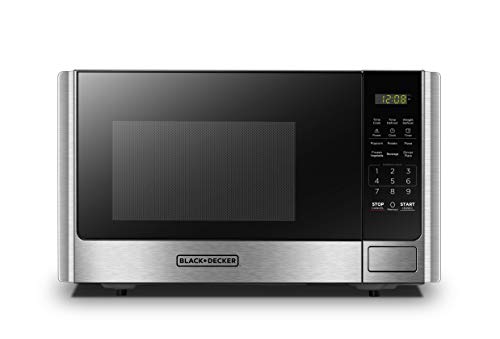
BLACK+DECKER Countertop Microwave Oven, 0.9 Cu.Ft, 900W, Stainless Steel
Badge: Best Overall Table Top
Strengths
- 900 watts in a 0.9 cu ft cabinet is the sweet spot for singles and couples – real power without a family-size footprint
- A push-button door opens with an elbow or a knuckle when your hands are full
- Ten power levels give genuine low-power control for melting and softening, not just full-blast reheating
Trade-offs
- The 0.9 cu ft cavity will not take a large casserole or a full-size dinner plate with a cover
- The listing title states no sensor cooking, so times are manual rather than humidity-guided
- Stainless finishes show fingerprints and need a wipe to stay looking sharp
Mini spec box: 0.9 cu ft countertop microwave; 900W (per API title); Stainless steel finish; 10 power levels (per API title); Push-button door (per API title); Child safety lock (per API title); 6 auto cook presets (per API title).
This BLACK+DECKER is the straightforward mid-compact of the pool: 0.9 cubic feet, 900 watts, a stainless steel finish, ten power levels, six auto cook presets, a push-button door and a child safety lock, all stated in its listing. Nothing in that list is exotic, and that is the point – it is the specification a first small microwave is usually judged against.
The power-to-size balance is what earns it attention. Compact microwaves at 700 watts reheat slowly and unevenly; 900 watts in this cavity class brings cooking times close to the instructions printed on most packaged foods, which are usually written for this wattage band. The ten power levels matter more than the presets for experienced users, because level three or four is how butter melts without exploding and how delicate sauces warm without splitting.
Day to day it is a reheat-and-defrost worker: leftovers at lunch, frozen vegetables at dinner, a mug of milk in between. The honest limitation is cavity height and width – measure your largest everyday plate before ordering, because a 0.9 cu ft interior forgives mugs and bowls but not party platters.
Ownership note: keep the waveguide cover (the small flat panel inside the cavity wall) clean and intact. Splatter baked onto that cover is the most common cause of sparking scares in compact microwaves, and a wipe after messy reheats prevents it entirely.
For the table top brief this is the balanced starting point: enough power for honest timing, enough cavity for a couple’s plates, and a push-button door that suits a working counter.
Best for: singles, couples and small kitchens wanting a genuine 900W compact with simple controls / Not suited for: households reheating large casseroles or oversized plates
Check on Amazon for the current listing, configuration and latest price.

TOSHIBA Microwave Oven, 0.9 Cu.Ft, 900W, Black Stainless Steel
Badge: Best Quiet Table Top
Strengths
- A mute function silences beeps – a genuine quality-of-life feature in apartments and open-plan homes
- The 10.6 inch removable turntable lifts out for washing instead of being wiped in place
- Black stainless steel hides fingerprints better than bright stainless
Trade-offs
- The listing title states no sensor cooking, so reheating is time-and-power based
- At 0.9 cu ft it shares the compact class’s limits with large dishes
- Black stainless is a darker finish that should be matched against your other appliances deliberately
Mini spec box: 0.9 cu ft microwave; 900W (per API title); Black stainless steel finish; 6 auto menus (per API title); Mute function (per API title); Child lock (per API title); LED lighting (per API title); 10.6 inch removable turntable (per API title).
Toshiba’s 0.9 cu ft, 900W entry in black stainless steel leads its listing with the features apartment dwellers actually ask about: six auto menus, a mute function, a child lock, LED lighting and a 10.6 inch removable turntable. The mute function deserves its headline place. A microwave that can be silenced is a different appliance at midnight in a studio flat or during a baby’s nap, and most compact rivals still beep at full volume.
The removable turntable is the second practical point: a plate that lifts out goes under the tap or into the dishwasher, while fixed or fiddly plates get wiped resentfully and cleaned properly twice a year. Combined with LED cavity lighting – brighter and longer-lived than the bulbs older compacts used – the ownership details here are better thought through than the headline size and wattage suggest.
In daily use it covers the compact brief completely: reheats, defrosts and preset cooking for one or two people, quietly. The honest limitation is the absence of stated sensor cooking, so a covered plate and a minute of standing time do more for even results than any preset button.
Ownership note: use the mute function deliberately rather than permanently – the end-of-cycle beep is also your reminder that food is standing and cooling, and silenced food forgotten in the cavity is a smell no mute button can fix.
This Toshiba is the table top pick for homes where the microwave shares airspace with sleep and study – the mute function is a format feature here, not a garnish.
Best for: apartments and quiet households wanting a 900W compact with a mute function and a removable turntable / Not suited for: buyers who want sensor-guided reheating, or who regularly cook for a family in one batch
Check on Amazon for the current listing, configuration and latest price.

TOSHIBA Countertop Microwave Oven, 1.2 Cu.Ft, 1000W, Black
Badge: Best Family Table Top
Strengths
- The smart humidity sensor adjusts reheat and cook times by steam, the single biggest upgrade over timer-only compacts
- 1.2 cu ft and a 12.4 inch turntable take a full dinner plate and most family casseroles
- 1000 watts matches the cooking times printed on most packaged foods
Trade-offs
- A 1.2 cu ft cabinet needs more counter depth and clearance than the 0.7-0.9 compacts
- Black shows dust and pale splatter more visibly than stainless finishes
- Sensor menus reward covered food; uncovered loads give the sensor less steam to read
Mini spec box: 1.2 cu ft countertop microwave; 1000W (per API title); Black finish; 12.4 inch removable turntable (per API title); Smart humidity sensor (per API title); 12 auto menus (per API title); Mute function (per API title); ECO mode (per API title); Easy clean interior (per API title).
This Toshiba is the pool’s benchmark family countertop model: 1.2 cubic feet, 1000 watts, a smart humidity sensor, twelve auto menus, a mute function, ECO mode, an easy-clean interior and a 12.4 inch removable turntable, in black. The humidity sensor is the specification that separates it from the timer-only compacts – it reads the steam coming off the food and ends the cycle when the food is done rather than when a guessed minute count expires.
Sensor reheating changes the most common microwave task, the leftover plate, from a two-attempt negotiation into a one-button job. The size is the other half of the case: 1.2 cu ft with a 12.4 inch plate is the smallest class that honestly fits family cookware, which is why this footprint, rather than the sub-1.0 compacts, is where most households eventually land.
Day to day it is the family default: sensor reheat for plates, sensor cook for vegetables and rice, manual power levels for melting and defrosting. The honest limitation is counter footprint – measure depth including the door swing and the rear clearance the manual asks for before it replaces a smaller unit.
Ownership note: ECO mode trims standby draw, which matters on a counter appliance that sits plugged in all year. Enable it once at setup; the clock display is the only visible sacrifice and the saving runs twenty-four hours a day.
The family table top argument in one model: sensor cooking and a 12.4 inch plate mean the unit on the counter behaves like the kitchen’s second cook, not its drinks warmer.
Best for: families and keen reheating households wanting sensor cooking in a true family size / Not suited for: the tightest counters, or buyers who only ever warm a mug
Check on Amazon for the current listing, configuration and latest price.

COMFEE’ Countertop Microwave Oven, 0.7 Cu.Ft, 700W, Black
Badge: Best Small-Space Table Top
Strengths
- The smallest footprint in the pool – the size that genuinely fits dorm shelves and tight counters
- Sound on/off answers the noise complaint that follows compact microwaves into shared spaces
- One-touch buttons keep the control panel honest: press, heat, eat
Trade-offs
- 700 watts heats noticeably slower than 900-1000W models, and packaged-food times need extending
- The 0.7 cu ft cavity fits mugs, bowls and small plates – not dinner plates with covers
- The listing title states no sensor cooking or inverter drive
Mini spec box: 0.7 cu ft countertop microwave; 700W (per API title); Black finish; ECO mode (per API title); Sound on/off (per API title); One-touch buttons (per API title); Child safety lock (per API title); Positioned for dorm, apartment and office use (per API title).
The COMFEE’ 0.7 cu ft, 700W compact is the pool’s specialist in smallness: ECO mode, sound on/off, one-touch buttons and a child safety lock, positioned by its own listing for dorm, apartment and office use. That positioning is accurate rather than limiting – this is the microwave for a shelf, a studio corner or an office kitchenette where a 1.2 cu ft cabinet simply cannot go.
The trade every buyer must price in is wattage. At 700 watts, reheating takes roughly a third longer than the times printed for 1000W ovens, and dense foods need stirring and standing time to even out. For the jobs this size class exists for – drinks, instant meals, soup bowls, popcorn, leftovers for one – that trade is usually worth the counter space returned, which is why this format remains a permanent fixture of the market.
In daily use it is a personal appliance: breakfast oatmeal, a lunchtime bowl, a late drink. The honest limitation is batch thinking – it serves one person at a time happily and a family meal only in shifts.
Ownership note: at 700 watts, standing time is a cooking stage, not a delay. Leave covered food for a minute after the beep and the centre finishes on stored heat; most ‘this compact is weak’ complaints are really skipped standing time.
The COMFEE’ defends the smallest table tops – shelves, studio corners, office counters – where the correct capacity is the one that fits and the correct wattage is the one you accept knowingly.
Best for: dorm rooms, studios, offices and single-person reheating where footprint is the deciding factor / Not suited for: families, large plates, or anyone impatient with extended cooking times
Check on Amazon for the current listing, configuration and latest price.

Farberware Countertop Microwave Oven, 1.1 Cu.Ft, 1000 Watts, Stainless Steel
Badge: Best for Freezer Cooking
Strengths
- Multi-stage cooking is a feature compacts rarely offer: defrost then cook in one programmed sequence
- Defrost by weight beats defrost by guesswork for meat taken straight from the freezer
- 1000 watts in a 1.1 cu ft cabinet keeps it compact-adjacent while cooking at full standard speed
Trade-offs
- The listing title states no sensor cooking, so reheating stays manual
- Stainless steel shows fingerprints readily around the keypad and handle
- Multi-stage programming takes a minute to learn, which casual users may never bother with
Mini spec box: 1.1 cu ft countertop microwave; 1000 watts (per API title); Stainless steel finish; 10 power levels with multi-stage cooking (per API title); 6 preset options (per API title); Defrost by weight or time (per API title); LED display (per API title); Express cooking (per API title).
The Farberware 1.1 cu ft, 1000-watt model in stainless steel carries the pool’s most cook-oriented control set: ten power levels with multi-stage cooking, six preset options, defrost by weight or time, an LED display and express cooking. Multi-stage cooking is the headline – program a defrost stage followed by a cooking stage and a frozen chicken portion thaws then cooks in one unattended run, a workflow most compacts force you to supervise in two visits.
Defrost by weight is the supporting act that deserves equal billing. Time-based defrosting asks you to guess how a frozen block behaves; weight-based defrosting at least starts from a measured input, and in practice it thaws more evenly with fewer cooked edges. For households whose weeknight cooking genuinely starts from the freezer, this control set is more useful than another half dozen preset buttons.
Day to day the express cooking handles the quick jobs and the staged programs handle the planned ones. The honest limitation is reheating finesse: without a stated sensor, leftover plates are a manual time-and-power judgement, so covered dishes and a stir halfway remain the technique.
Ownership note: multi-stage programs reward a written note on the fridge for the two or three frozen staples you actually cook. Once your defrost-plus-cook sequence for chicken portions is dialled in, weeknight consistency stops depending on memory.
Farberware’s table top case is control depth: multi-stage programs and weight defrost turn a countertop box into a freezer-to-plate pipeline for organised cooks.
Best for: freezer-first cooks who will use defrost-by-weight and multi-stage programming / Not suited for: sensor-reheat seekers, or users who want the simplest possible panel
Check on Amazon for the current listing, configuration and latest price.

Chefman Countertop Microwave Oven, 0.9 Cu.Ft, 900 Watts, Black
Badge: Best Shared-House Table Top
Strengths
- A dedicated mute button plus eco mode – the two small-space courtesy features in one compact
- 900 watts keeps packaged-food timing honest in a 0.9 cu ft cabinet
- One-touch express cook covers the press-and-go jobs that make up most microwave use
Trade-offs
- The listing title states no sensor cooking
- The black finish shows dust and light-coloured splatter readily
- 0.9 cu ft shares the compact ceiling on dish size
Mini spec box: 0.9 cu ft countertop microwave; 900 watts (per API title); Black finish; 10 power levels (per API title); 6 cooking presets with one-touch express cook (per API title); Eco mode (per API title); Child safety lock (per API title); Mute button (per API title).
Chefman’s 0.9 cu ft, 900-watt compact in black matches the class standard on power and size, then adds the two features small-space owners ask for by name: a mute button and an eco mode, alongside ten power levels, six cooking presets with one-touch express cook and a child safety lock. It is the same formula as the Toshiba 0.9 in this pool, in a black finish and with the mute promoted to its own button.
That button placement is a small thing done right. Mute buried in a settings menu gets set once and forgotten; a labelled button gets used tactically – silenced for the early-morning reheat, audible for the family dinner rush. Eco mode trimming standby draw completes a specification clearly aimed at apartments, shared houses and anywhere the microwave lives within earshot of a bed.
In daily use it is a courteous compact: quick express jobs, quiet late-night jobs, and honest 900W timing for everything between. The honest limitation matches its class – no stated sensor, and a cavity sized for plates and bowls rather than roasting dishes.
Ownership note: black finishes hide scorch marks but advertise dust, so the wipe-down habit matters more, not less. A damp microfibre cloth weekly keeps the keypad legible and the door seal seating cleanly.
The Chefman closes the list as the shared-house table top: express cooking for the rush, a mute button for the quiet hours, and eco mode for the bills in between.
Best for: shared houses and apartments wanting a 900W compact with a proper mute button / Not suited for: sensor-cooking seekers or large-dish households
Check on Amazon for the current listing, configuration and latest price.
Comparison Table
| Pick | Badge | Headline spec (from listing) | Standout trait |
|---|---|---|---|
| BLACK+DECKER Countertop Microwave Oven, 0.9 Cu.Ft, 900W, Stainless Steel | Best Overall Table Top | 0.9 cu ft countertop microwave | 900W in 0.9 cu ft with a push-button door and 10 power levels |
| TOSHIBA Microwave Oven, 0.9 Cu.Ft, 900W, Black Stainless Steel | Best Quiet Table Top | 0.9 cu ft microwave | 900W compact with a mute function and a removable 10.6in turntable |
| TOSHIBA Countertop Microwave Oven, 1.2 Cu.Ft, 1000W, Black | Best Family Table Top | 1.2 cu ft countertop microwave | 1.2 cu ft sensor model with 1000W and a 12.4in turntable |
| COMFEE’ Countertop Microwave Oven, 0.7 Cu.Ft, 700W, Black | Best Small-Space Table Top | 0.7 cu ft countertop microwave | The smallest footprint here: 0.7 cu ft, 700W, sound on/off |
| Farberware Countertop Microwave Oven, 1.1 Cu.Ft, 1000 Watts, Stainless Steel | Best for Freezer Cooking | 1.1 cu ft countertop microwave | 1.1 cu ft and 1000W with multi-stage cooking and defrost by weight |
| Chefman Countertop Microwave Oven, 0.9 Cu.Ft, 900 Watts, Black | Best Shared-House Table Top | 0.9 cu ft countertop microwave | 900W compact with a dedicated mute button and eco mode |
Read the table size-first: capacity and wattage decide whether a table top microwave fits your kitchen and your patience, and every feature after that is refinement. The sensor Toshiba and the multi-stage Farberware are the two control upgrades; the mute-equipped compacts are the two courtesy upgrades.
How to Choose Best table top microwaves
Start with the plate test, because capacity numbers are abstract and plates are not. A 0.7 cu ft cavity handles mugs, soup bowls and single-serve trays. A 0.9 cu ft cavity adds standard dinner plates without covers. A 1.1 to 1.2 cu ft cavity takes dinner plates with covers and the medium casseroles family cooking actually uses. Buy the smallest class that passes your plate test and you keep counter space; buy one class up and you keep options. Both errors – too small daily, too big forever – are visible in the returns data of this category every year.
Next, wattage, because it sets the tempo of every job. Packaged-food instructions are generally written around 1000 to 1100 watts. A 1000W model follows them as printed. A 900W model needs a small addition most owners stop noticing within a week. A 700W model needs roughly a third more time plus disciplined standing time, which is a fair trade only when footprint truly demands it – the dorm and studio case explored in Best Small Microwaves For Dorm.
Then decide how the oven should think. Timer-and-power cooking, offered by most of this pool, is predictable and rewards a minute of technique: covers, stirring, standing. A humidity sensor, stated only on the Toshiba 1.2 here, automates the commonest job – reheating – by reading steam. Multi-stage programming, on the Farberware, automates a different job: the defrost-then-cook sequence. Choose the automation that matches the task you repeat, not the longest feature list.
Weigh the courtesy features if your kitchen shares airspace. A mute function or sound on/off appears on the Toshiba 0.9, the Chefman and the COMFEE’ in different forms, and in a studio or a house with a night-shift worker it is worth more than two extra presets. ECO modes trim standby draw across a year of plugged-in idleness. These are small specifications with daily consequences, which is why this guide names them in every review rather than burying them.
Finally, plan the physical placement like you mean it. Table top units need rear and top clearance for heat and steam, a grounded outlet of their own, and a door swing that does not fight a wall or a kettle. Measure depth with the door open, not just the cabinet. Apartment readers will find the placement conversation continued in Best Small Microwaves For Apartments, where clearance and landlord rules get their own treatment.
How to Set Up and Use a Table Top Microwave Well
A table top microwave asks for no installation, but the first ten minutes of placement and setup decide years of behaviour. The steps below are the routine this guide recommends for every countertop model in the pool.
After setup, the how-to is technique: covers on, power levels used deliberately, and standing time treated as a cooking stage rather than a delay.
- Measure and clear the space first. Confirm the counter spot takes the cabinet’s width and depth with the door fully open, and leave the rear and top clearance the manual specifies – microwaves vent heat and steam and suffocate against walls and cabinet lips.
- Level, stable, and away from water. Set the unit on a flat, dry surface where the door swing is unobstructed and splashes from the sink do not reach the vents or the control panel.
- Use a grounded outlet on its own. Plug directly into a grounded wall outlet. Microwaves draw heavily while running; power strips and extension leads are not rated for the habit and manuals forbid them.
- Set the clock and explore the panel. Run through power levels, the presets you will actually use, and any mute or eco setting while the manual is open – features configured on day one are the features that get used.
- First run: a mug of water. Heat a mug of water for a minute. It proves the unit, warms the cavity, and gives you a baseline for how loud and fast your new microwave is.
- Learn your wattage adjustment. If your unit is 700 or 900 watts and your recipes assume 1000 or more, add time in small increments and use standing time – the buying guide’s wattage section explains the maths.
- Wipe the cavity while it is new and easy. Start the habit immediately: a quick wipe after messy reheats keeps the interior, the door seal and the waveguide cover in the condition that prevents odours and sparking scares.
Troubleshooting
Problem: food is hot at the edges and cold in the centre -> the load was too dense or too deep for one pass – stir or rearrange halfway, use a lower power level for longer, and let standing time finish the job.
Problem: sparking or arcing inside the cavity -> stop the unit and check for metal trim on dishes, a damaged waveguide cover or heavy baked-on splatter on the cavity wall – clean or replace the cover, and never run the oven empty.
Problem: the turntable stutters or stops -> food debris is under the roller ring or the plate is seated off its guide – remove, wash and reseat the plate and ring, and check the load is centred.
Wattage, Translated: What 700, 900 and 1000 Watts Feel Like
Wattage is cooking speed, and the differences in this pool are large enough to plan around. A mug of water that boils in about two minutes at 1000 watts takes closer to three at 700. A frozen ready meal printed with a five-minute instruction for a high-wattage oven needs roughly seven in a 700W compact, with a stir in the middle if the meal allows it. None of this makes a 700W oven bad – it makes it a considered purchase, right for one person’s drinks and bowls, wrong for a family’s nightly production line.
Power levels interact with wattage in a way new owners often miss. A conventional microwave’s lower levels are full power pulsed on and off, so level five on a 1000W unit delivers more average energy than level five on a 700W unit. Delicate work – melting chocolate, softening butter, proofing a sauce – is therefore gentler in a small oven and more abrupt in a big one, which is why experienced owners of powerful models drop a level lower than recipes suggest.
The practical rule: match the oven to the instructions you actually follow. If your freezer is full of packaged meals printed for standard wattage, a 900 or 1000W pick keeps life simple. If your use is drinks, porridge and single bowls, a 700W compact’s slower tempo is a footnote, not a flaw – a point the first-buy discussion in Best Small Microwaves First makes from the beginner’s side.
Turntables, Plates and the Even-Heating Question
Most table top microwaves rotate food on a glass turntable because microwave energy patterns are uneven, and rotation walks every part of the dish through the hot and cool zones. The practical differences between models are plate diameter and removability. Diameter decides dish fit – the 12.4 inch plate on the Toshiba 1.2 turns family dishes that the compacts’ smaller plates refuse – and removability decides cleaning, because a plate that lifts out gets washed properly while a fixed arrangement gets wiped hopefully.
Technique closes whatever gap hardware leaves. Covers trap steam and even out tops, stirring redistributes the middle, arranging food in a ring leaves the centre – the coolest zone – empty, and standing time lets conduction finish what radiation started. Owners who build those four habits into muscle memory get even results from any model in this pool, sensor or not.
One caution belongs here: a turntable plate is glass, heavy for its size, and usually removed one-handed over a sink. Two hands and dry grips are the entire safety programme, and they are worth stating because a replacement plate costs more than anyone expects.
Where a Table Top Microwave Should Live in the Kitchen
Placement is an ergonomics decision disguised as a furniture decision. The comfortable zone is between hip and shoulder height, close to the fridge and the serving area, away from the sink’s splash radius and the hob’s steam. Counter corners waste the door swing; the stretch of counter between fridge and sink – the landing zone for food coming out of cold storage – is where a table top microwave earns its keep a dozen times a day.
Heat and steam need somewhere to go. Every model here vents from the sides, back or top, and the manual’s clearance figures are the minimum for safe, cool running rather than decoration. A unit pushed flush into a corner alcove runs hotter, ages faster and steams the cabinet above it. Leaving the stated gaps is the cheapest reliability upgrade in this entire guide, and it costs nothing but a tape measure’s worth of honesty at setup.
Presets, Express Cook and Power Levels: Which Controls Matter
Control panels advertise abundance, but three controls do nearly all the real work: a quick-start express function for drinks and reheats, a power-level control for everything delicate, and a defrost that takes weight as an input where available. The six-preset and twelve-menu panels in this pool are conveniences layered on those three, useful when they match your habits – popcorn people genuinely use the popcorn button – and inert decoration when they do not.
Judge a panel by your own repetition, not by its count. The household that reheats two plates a night needs a sensor or a well-learned time; the household that defrosts meat four nights a week needs the Farberware’s weight defrost and staging; the household of one needs the COMFEE”s one-touch simplicity and a mute. Controls are only features when they map to a routine, which is why the reviews in this guide describe each panel by the routine it serves.
One habit separates experienced microwave owners from frustrated ones: they own a microwave-safe cover and use it every time. It keeps the cavity clean, keeps the food moist, evens the heating and costs less than a single replacement turntable plate.
Microwave care is mostly moisture and splatter management. Cover food with a microwave-safe lid or plate and most cavity cleaning disappears. Wipe spills while they are fresh – a sugary or fatty splatter reheated through a week of cycles becomes a baked glaze that needs soaking, not wiping. Keep the door seal and its mating surface clean, because that seal is part of the safety system, and never run the oven empty, which stresses components with nowhere for the energy to go. A bowl of water heated for a few minutes loosens dried splatter with steam before a deep clean, and a soft cloth does the rest; abrasive pads have no place inside a microwave cavity.
Common Buying Mistakes
- Buying by headline capacity without the plate test, then discovering the family casserole does not fit.
- Choosing 700 watts for a packaged-food household and resenting the extra minutes every single day.
- Pushing the unit flush against walls and cabinets, ignoring the clearance its vents need.
- Running the microwave on a power strip or extension lead against every manual’s instruction.
- Never using power levels – full blast for butter, chocolate and eggs, with predictable results.
- Skipping standing time, then judging the oven harshly for a cold centre it was about to fix.
Final Recommendation
If one pick has to be named first for a family table top, it is the Toshiba 1.2 cu ft sensor model: 1000 watts, a humidity sensor for the daily reheat, a 12.4 inch removable turntable and a mute function cover the brief more completely than any rival here.
Choose the BLACK+DECKER 0.9 or the Chefman if a couple’s compact with honest 900W timing is the real brief, the Toshiba 0.9 if quiet matters most, the Farberware if your cooking starts from the freezer, and the COMFEE’ if the shelf or studio corner sets the size and nothing else can.
Every pick in this guide is a genuine table top microwave with its size and wattage stated in the open, so the decision is honestly just this: the smallest cavity that passes your plate test, at the highest wattage your counter and patience allow.
Start your shortlist with BLACK+DECKER Countertop Microwave Oven, 0.9 Cu.Ft, 900W, Stainless Steel, TOSHIBA Microwave Oven, 0.9 Cu.Ft, 900W, Black Stainless Steel and TOSHIBA Countertop Microwave Oven, 1.2 Cu.Ft, 1000W, Black – compare their current listings, configurations and latest prices, then commit to the one that matches your space and your cooking.
Frequently Asked Questions
What size table top microwave does a family need?
For most families, 1.1 to 1.2 cu ft is the honest minimum: dinner plates with covers and medium casseroles fit, and the turntable diameter – 12.4 inches on the Toshiba 1.2 here – turns them without catching. Smaller classes suit singles and couples whose largest load is a plate or a bowl.
Is 700 watts enough for everyday use?
For drinks, porridge, soup and single-serve meals, yes, with time added to packaged instructions and standing time respected. For a household reheating family portions or following packaged directions nightly, 900 to 1000 watts is the comfortable band.
Do I need sensor cooking on a countertop microwave?
It is the most useful single upgrade for reheating, because a humidity sensor ends the cycle when the food is steaming rather than when a guessed time expires. It is not essential – covers, stirring and standing time replicate most of the benefit with timer-only models.
Can a table top microwave go inside a cabinet or shelf?
Only with the clearances the manual specifies on every side that vents, and never in a sealed cabinet. Heat and steam must escape; a shelf with open air around the unit and the stated gaps is fine, an enclosed cupboard is not.
What is the difference between a mute function and sound on/off?
They solve the same problem – beeping in quiet homes – with different controls. A mute button silences the unit until pressed again; sound on/off is usually a setting toggled the same way. Both appear in this pool, and either serves a studio, a dorm or a house with sleeping children.
How long should a countertop microwave last?
Years of daily service is the normal expectation for this category, with the door latch, the turntable plate and the interior finish as the usual wear points. The care routine in this guide – clean seal, clean waveguide cover, no empty running – is what separates a long-lived unit from a short one.


