Disclosure: topratedkitchenware.com is reader-supported. When you buy through links on our site, we may earn an affiliate commission from Amazon and other retailers, at no extra cost to you.
Where to buy
Five of the six pots in this guide to the best teapots for stove no lime problems are linked below to their Amazon product pages, so you can confirm the current capacity, infuser style, and availability before ordering. One pot — the DRNKNSTX — is covered prose-only, because its listing states no stovetop claim and this guide’s first rule is that only stated stovetop pots belong on a burner. Start with the short list, then read the full guide for the honest truth about limescale and the descaling routine that actually solves it.
- CNGLASS Glass Teapot Stovetop Safe, 20.3 oz — Check on Amazon
- DRNKNSTX Enchanted Tea Pot with Tea Infuser, 20 oz (covered prose-only below — no stovetop claim in its listing)
- HIWARE 1000ml Glass Teapot with Removable Infuser
- PARACITY Glass Teapot Stovetop, 18.6 oz
- Ehugos 1500ml Glass Teapot with Removable Infuser
- Teabloom Glass Teapot, 40 oz, with Glass Infuser
Read the full guide ↓
Let us begin with the honesty this keyword deserves: no teapot prevents limescale. Limescale is your water’s mineral content precipitating under heat, and any vessel that boils hard water — glass, steel, or enamel — will collect it. What the best teapots for stove no lime management offer is not immunity but advantage: glass shows scale the moment it starts, while it is still a five-minute wipe rather than a chisel job; a smooth glass interior releases scale readily to a simple vinegar or citric-acid soak; and a stovetop-safe glass pot lets you see exactly when descaling is due instead of discovering it in flakes in the cup. Every linked pot in this guide states a stovetop claim in its listing and is made of clear glass — the two facts that, combined with the descaling routine in this guide, keep a stove pot effectively lime-free in daily life.
The distinction matters because the alternative — an opaque pot whose scale builds unseen — fails silently and then all at once: heating slows, flakes appear, flavours dull, and the eventual descale is an excavation. Glass inverts that story. You watch the first faint haze form at the waterline, you soak it away in minutes, and the pot returns to clarity. Add the habits in this guide — emptying the pot after use rather than letting water stand, a weekly wipe in hard-water homes, a monthly soak — and “no lime” stops being a product claim and becomes what it honestly is: a maintenance result. The wider stovetop picture, including safe heating practice, is covered in Best Teapots For Stove; this page adds the hard-water chapter.
Key Takeaways
- The CNGLASS 20.3 oz glass teapot is our first choice for hard-water stove use: stovetop safe per its listing, compact enough to descale in minutes, with a removable infuser.
- No pot prevents limescale — glass wins because scale is visible early and releases easily from a smooth interior.
- Only stated stovetop pots belong in this guide: five picks state the claim; the DRNKNSTX does not and is prose-only.
- The routine is the remedy: empty after use, wipe weekly, soak monthly with vinegar or citric acid.
- Filtered water slows scale dramatically for households in very hard-water areas.
In this guide
Quick Picks
| Pick | Badge | Capacity from listing | Heating noted in listing | Link |
|---|---|---|---|---|
| CNGLASS Glass Teapot | Best Overall for Hard Water | 20.3 oz | Stovetop safe | Check on Amazon |
| DRNKNSTX Enchanted Tea Pot | Prose-Only: No Stovetop Claim | 20 oz | Not stated — kettle use | Covered prose-only below |
| HIWARE Glass Teapot | Best Household Pick | 1000ml | Stovetop safe | Check on Amazon |
| PARACITY Glass Teapot | Best Solo Pick | 18.6 oz / 550ml | Stovetop format | Check on Amazon |
| Ehugos Glass Teapot | Best Large Pick | 1500ml / 50 oz | Stovetop safe | Check on Amazon |
| Teabloom Glass Teapot | Best for Watching Scale and Brew | 40 oz | Stovetop and microwave safe | Check on Amazon |
Badges reflect hard-water practicality — visibility of scale, ease of descaling, and size — on top of the stovetop-claim requirement every linked pick meets.
How These Picks Were Chosen
This is a research-led guide with two strict filters. First, the stovetop filter from our companion guide: a listing must state a stovetop claim to be linked for stove use. Five of the six pool listings do — the CNGLASS, HIWARE, and Ehugos state “stovetop safe,” the PARACITY carries “Stovetop” in its name and description, and the Teabloom states “stovetop and microwave safe.” The DRNKNSTX states no heating claim and is therefore reviewed prose-only, without a link or image, however pleasant it is as a kettle pot. Second, the hard-water filter: every linked pick is clear glass, because visibility is the working mechanism of lime management, and every one has a removable infuser, because baskets and strainers are where scale hides and must be reachable for cleaning.
We make no claim that any pick resists scale by design — no listing here states such a property, and we will not invent one. The ranking instead reflects how each pot supports the routine that genuinely controls lime: small pots descale fastest, smooth interiors release deposits most readily, and clear walls report the pot’s condition at a glance. Where a listing leaves a detail unstated, such as an infuser’s material, the review says so. Readers in soft-water areas will find the descaling sections reassuringly unnecessary and the stove guidance in Best Teapots For Stove No Rust a useful companion on the other great enemy of stove vessels.
The 6 Best Teapots for Stove No Lime Headaches — 5 Stated for the Stove, 1 Prose-Only

CNGLASS Glass Teapot Stovetop Safe, 20.3 oz
Badge: Best Overall for Hard Water
Strengths
- Stovetop safe is stated in the product’s name in the listing — a clear direct-heat claim.
- Compact 20.3 oz body is the fastest pot here to descale: a small soak, a quick rinse, done.
- Removable infuser, and the clear glass reports the first haze of scale immediately.
Trade-offs
- The listing does not state the infuser material.
- Compact size means more frequent heating cycles for groups — and each cycle is a fresh chance for scale if water stands in the pot.
- Small pots show waterline marks proportionally more; the weekly wipe matters.
Mini spec box: Capacity 20.3 oz · Stovetop safe per listing · Removable infuser · For loose leaf and blooming tea.
The CNGLASS leads a hard-water guide for a practical reason: maintenance scales with size, and this is the pot whose descaling is a five-minute non-event. A compact glass body takes a small volume of descaling solution, soaks evenly, rinses in seconds, and — because it is clear — tells you at a glance whether the job is finished. Its stovetop claim is as explicit as listings get, and its one-to-two-mug size matches the sessions that dominate hard-water households’ actual tea drinking.
Who it suits: solo and pair drinkers in hard-water areas who want the stove routine with the least possible lime upkeep. The honest limitation is throughput — a household serving four will heat it repeatedly — and the unstated basket material. For its intended scale, it is the easiest pot in this guide to keep genuinely lime-free.
Best for: hard-water solo and pair brewing with minimal descaling / Not suited for: group serving.
DRNKNSTX Enchanted Tea Pot with Tea Infuser, 20 oz
Badge: Prose-Only — No Stovetop Claim in Listing
Strengths (as a kettle-filled pot)
- 20 oz glass steeper format for one or two drinkers.
- Listing describes a loose leaf steeper with infuser.
- Gift-oriented presentation.
Trade-offs
- No stovetop claim appears in its listing, so it fails this guide’s first filter for direct heat.
- The listing states no infuser material.
- As a kettle pot it would still collect scale from hard water — visibility helps, but it cannot join a stove guide.
Mini spec box: Capacity 20 oz · Tea infuser / loose leaf steeper · Glass tea maker per listing · Heating claim: none stated.
The DRNKNSTX appears here so the guide’s boundary stays visible. Nothing about limescale changes the first question — can this pot go on the stove? — and its listing does not claim that it can. As a kettle-filled glass steeper it shares glass’s visibility advantage for scale-watching, and our other guides review it in that role. In this guide it is an honest non-recommendation for stove use, carried without a link or image, and buyers in hard-water homes who like its size should choose the CNGLASS or PARACITY, which match its scale with the stovetop claim actually stated.
Who it suits: gift buyers and kettle households. Who it does not suit is anyone shopping from this page’s title — the stove comes first, and the claim is not there.
Best for: kettle-filled steeping and gifts / Not suited for: stovetop use — no claim stated.
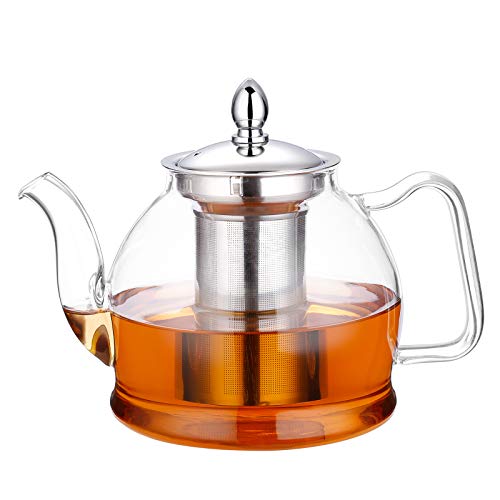
HIWARE 1000ml Glass Teapot with Removable Infuser
Badge: Best Household Pick
Strengths
- Listing states stovetop safe at a household 1000ml capacity.
- Large clear walls make scale surveillance effortless — a litre pot shows its waterline honestly.
- Removable infuser, reachable for the descaling routine’s basket chapter.
Trade-offs
- The listing does not state the infuser material.
- A litre of hard water per session deposits proportionally more mineral than a small pot’s fill — the empty-after-use habit matters most here.
- Descaling a litre pot takes more solution and more soak space than the compact picks.
Mini spec box: Capacity 1000ml · Removable infuser · Stovetop safe per listing · Made for blooming and loose leaf tea.
Households in hard-water areas face a scale arithmetic problem: more water heated means more mineral delivered, and the family pot is where deposits grow fastest. The HIWARE’s defence is transparency at scale — nothing about its condition can hide — paired with a size that justifies the monthly soak as a scheduled ritual rather than a chore discovered too late. Brewed, emptied, and rinsed daily, and soaked monthly, a litre glass pot stays clear for years; left standing full between sessions, it will fur faster than any small pot, and the glass will show you that too.
Who it suits: hard-water households disciplined about the empty-and-rinse habit. The honest limitation is that discipline itself — a household that leaves water standing in the pot should choose a smaller vessel whose neglect is cheaper to reverse. For the household that runs the routine, it is the complete family answer.
Best for: family rounds with a real descaling routine / Not suited for: leave-it-full households.
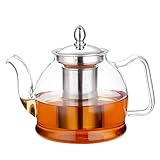

PARACITY Glass Teapot Stovetop, 18.6 oz
Badge: Best Solo Pick
Strengths
- “Stovetop” is in the product’s name in the listing, framing it as a stovetop tea kettle.
- Removable 18/8 stainless steel infuser stated in the listing — the basket most likely to meet hard water daily is also the most specified here.
- 18.6 oz / 550ml borosilicate body: the smallest soak, the fastest descale in this guide.
Trade-offs
- One mug per cycle; no group capacity.
- Steel mesh in hard water wants its own rinse-and-dry habit to stay bright.
- Small basket crowds bulky leaves.
Mini spec box: Capacity 18.6 oz / 550ml · Borosilicate glass · Removable 18/8 stainless steel infuser · Stovetop format per listing · For blooming and loose leaf tea · Camping and travel positioning.
The PARACITY is the hard-water solo drinker’s complete answer: a stovetop-named borosilicate pot small enough that descaling is trivial, with a stated steel infuser that can be lifted out, soaked separately, and dried properly — the three actions that keep mesh bright in mineral country. Because a solo pot is typically emptied to the last mug, it also escapes the standing-water problem that furs the big pots: there is simply nothing left in it to deposit. Its travel positioning extends the same virtues to hard-water destinations unknown.
Who it suits: solo drinkers in hard-water areas, at home or on the move. The honest limitation is hospitality, as ever. For the one-mug routine in a limescale postcode, it is the lowest-maintenance pot in this guide.
Best for: low-maintenance solo brewing in hard water / Not suited for: serving guests.

Ehugos 1500ml Glass Teapot with Removable Infuser
Badge: Best Large Pick
Strengths
- Listing states stovetop safe at the largest capacity here, 1500ml / 50 oz.
- Removable stainless infuser stated in the listing — a specified basket at event scale.
- Hand-crafted clear glass keeps even a big batch’s condition visible.
Trade-offs
- The largest mineral throughput in this guide: batch brewing in hard water demands the strictest empty-and-soak discipline.
- Descaling 50 oz takes the most solution and the longest soak.
- Large glass is delicate and heavy when full.
Mini spec box: Capacity 1500ml / 50 oz · Removable stainless infuser · Stovetop safe per listing · Hand crafted · For blooming and loose leaf tea.
The Ehugos is the event pot, and hard water does not cancel events — it just adds a line to the host’s checklist. Brewed full for a gathering or an iced-tea batch, emptied completely afterwards, and given its soak on schedule, the big glass pot stays as clear as the small ones; the physics of its disadvantage is simply volume, and volume is managed by routine rather than by hope. Its stated stainless infuser matters at this scale, because a large basket is the component most likely to be left soaking in mineral water by a tired host — specify it, lift it out, dry it, and the problem never starts.
Who it suits: hosts and batch brewers in hard-water areas who run a real routine. The honest limitation is that it punishes casual ownership more than any other pick here. Bought as the second, large pot beside a daily driver, it is exactly right.
Best for: gatherings and batches with disciplined upkeep / Not suited for: casual, leave-it-standing use.

Teabloom Glass Teapot, 40 oz, with Glass Infuser
Badge: Best for Watching Scale and Brew
Strengths
- Listing states stovetop and microwave safe — the broadest heating claim here, giving a non-stove reheating route that adds no fresh scale from a burner cycle.
- Removable glass infuser inside glass walls: no hidden surfaces anywhere in the vessel — every deposit is visible.
- 40 oz serves a small group, and the listing includes 2 blooming teas.
Trade-offs
- Glass infuser slots are typically less fine than steel mesh for small leaf particles.
- Glass components need careful handling during descaling soaks and rinses.
- Mid-large size: more upkeep than the compact picks, less capacity than the Ehugos.
Mini spec box: Capacity 40 oz · Removable glass infuser · Stovetop and microwave safe per listing · Includes 2 blooming teas · 2-in-1 kettle and tea maker.
The Teabloom’s hard-water virtue is total visibility: with a glass infuser inside a glass body, there is no opaque corner, no hidden basket weave, nowhere for scale to establish itself unobserved. For the drinker who wants to manage lime by evidence, it is the most honest instrument in this guide — the pot as its own inspection report. Its microwave claim adds a practical grace note in hard-water homes, since reheating a cup’s worth in the pot avoids another full burner cycle. At 40 oz it also sits at the largest size whose descaling still feels like a small job.
Who it suits: evidence-minded drinkers and small-group hosts in hard-water areas. The honest limitation is the care glass-on-glass components ask during cleaning. For buyers who will actually look at their pot — the entire premise of lime management — it is a compelling final pick. More on keeping stove vessels sound in Best Teapots For Tea Lovers companion coverage.
Best for: visible, manageable scale control for small groups / Not suited for: rough handling or the finest-cut teas.

Comparison Table
| Pick | Capacity | Heating claim in listing | Hard-water note | Link |
|---|---|---|---|---|
| CNGLASS | 20.3 oz | Stovetop safe | Fastest descale in this guide | Check on Amazon |
| DRNKNSTX | 20 oz | None stated | Prose-only — not for stove use | — |
| HIWARE | 1000ml | Stovetop safe | Household volume; empty-after-use habit essential | Check on Amazon |
| PARACITY | 18.6 oz / 550ml | Stovetop format | Stated steel infuser; empties fully each session | Check on Amazon |
| Ehugos | 1500ml / 50 oz | Stovetop safe | Largest upkeep; strictest routine | Check on Amazon |
| Teabloom 40 oz | 40 oz | Stovetop and microwave safe | Fully visible interior and infuser | Check on Amazon |
How to Choose a Stove Teapot for a Hard-Water Home
Apply the stove filter first. As in our stove guide, only a stated claim earns a burner. That filter removes the DRNKNSTX from linked contention here, and it should remove any pot from your own shortlist whose listing will not say the words.
Then choose glass, and choose visibility. In hard-water country, the pot’s most valuable property is that it cannot lie to you. Clear glass reports scale at the haze stage, when removal is trivial. Opaque vessels report it at the flake stage, when removal is a project. Every linked pick here is clear glass for exactly that reason.
Size for your descaling patience. Maintenance effort rises with capacity. A solo drinker’s 18–20 oz pot descaled monthly is a five-minute habit; a 50 oz pot on the same schedule is a bigger production. Match the pot to the routine you will actually keep, because a skipped routine defeats any pot.
Mind the components. Scale colonises baskets and strainers first, where water lingers in mesh. A removable infuser you can soak separately and dry fully — stated steel on the PARACITY and Ehugos, glass on the Teabloom — is the component-level answer. Whatever the material, removability is the feature that makes descaling complete rather than cosmetic.
Think in tiers qualitatively. Compact stated-stovetop pots sit at the accessible end, mid-size all-rounders in the middle, and large formats at the upper end. In hard-water homes the value gradient runs opposite to instinct: the cheaper, smaller pot is often the cheaper pot to own, because its lime upkeep is the lightest.
How to Descale a Glass Stovetop Teapot — and Keep It That Way
- Empty the pot completely and remove the infuser. Descaling solution must reach every surface the water touches, including the basket, which soaks separately in the same solution.
- Fill with a warm solution of water and white vinegar in roughly equal parts, or water with a spoonful of citric acid dissolved in it. Both are food-safe acids that dissolve mineral deposits without abrasives.
- Let it soak. Light haze needs twenty minutes; established scale may need a few hours. The glass lets you watch the deposits loosen and judge completion by eye.
- For stubborn patches at the waterline, a soft cloth or bottle brush during the soak lifts what the acid has softened. Never use scouring pads or metal tools on glass.
- Empty, rinse thoroughly several times with fresh water, and boil a pot of plain water if you want absolute assurance that no vinegar note survives — then discard it.
- Dry the pot and infuser fully before storing or reusing. Standing moisture is tomorrow’s first deposit.
The keeping routine. Daily: empty the pot after the last session and rinse — scale grows in standing water, not in a dry pot. Weekly in hard-water homes: a hot-water wipe of the interior while the pot is warm from use. Monthly (or at the first visible haze, whichever comes sooner): the soak above. Troubleshooting. Problem: white flakes in the tea → the pot is overdue; descale today and shorten the interval. Problem: scale returns within days → your water is very hard; add filtered water for the pot, or descale more often with the quick version of the soak. Problem: a vinegar smell lingers → rinse more, and run the plain-water boil; it clears completely.
Understanding Your Water: Hardness, Taste, and the Pot
Hard water is not a defect — it is water carrying calcium and magnesium picked up from rock, and in many regions it is simply what comes from the tap. Its effects divide into the cosmetic and the culinary. Cosmetically, it hazes glass, spots steel, and furs heating surfaces; that is the subject of this guide, and it is fully manageable. Culinarily, very hard water can flatten delicate teas and leave a chalky edge in the cup, which is a matter of taste rather than maintenance: if your teas taste dull despite good leaf and good steeping, a filtered-water week is the cheapest experiment available to you. What hard water does not do is excuse any pot from the stove-claim rule or make scale a product’s fault. The mineral arrives with the water; the pot’s job is to make its management easy, and the drinker’s job is the routine. Households that understand that division of labour stop shopping for a mythical scale-proof pot and start keeping a clear one — which is the entire destination of this page.
Filtered Water and Other Reinforcements
For households where scale returns faster than the routine can politely handle, reducing the mineral load at the source is the decisive step. A simple jug filter used only for the teapot’s water slows deposit formation dramatically, because the pot is a small, defined consumer — you are not filtering the house’s water, just the litre or two a day that becomes tea. The side benefit is flavour: many drinkers find their teas brighter on filtered water. Beyond filtration, habits compound: heating only the water you need (less mineral delivered per session), emptying promptly, and keeping the pot dry between uses each shave the deposit rate further. None of these measures is mandatory — the soak routine alone keeps any glass pot in this guide serviceable — but together they convert a hard-water home into an effectively soft-water routine for the one vessel that matters to a tea drinker.
Care and Cleaning Beyond Descaling
Lime is the headline, but a stovetop glass pot’s full care card is short enough to memorise. Inspect before heating — chips and cracks retire a pot from burner duty. Heat moderately, never dry, never unattended. Empty the basket while the leaves are warm, rinse the pot once it has cooled, and dry with the lid off. Set hot glass down only on dry, room-temperature surfaces, and wash it only when cool. Store it clear of heavier cookware. The descaling soak slots into this card as the monthly entry. Owners who run the whole card find that a glass stove pot’s lifespan is measured in years of unremarkable service — and that the clarity which makes scale visible also makes every other aspect of the pot’s condition visible, which is why glass owners are rarely surprised by their equipment.
Hard-Water Regions and Habits: Reading Your Own Situation
Water hardness is local — sometimes street-by-street — and the fastest way to know yours is evidence you already own. A kettle that furs visibly within weeks, white spotting on glassware, and a shower head that slows over the year all report very hard water and argue for the full routine in this guide: filtered water for the pot, weekly wipes, monthly soaks. A kettle that stays clean for a season reports softer water, and the same pot will need only occasional attention. Renters and new movers should run the observation for a month before buying anything beyond the pot itself; the pot, being glass, becomes the measuring instrument, its first haze a dated data point. Households that split the year between homes — or campers carrying the PARACITY pattern between sites — will meet both regimes and can let the pot’s clarity set the local schedule. The principle is to manage the water you have, at the intensity it actually demands, rather than running a worst-case routine everywhere or a hopeful one anywhere.
Scale in the Infuser: The Small Print of Lime Management
Ask experienced hard-water owners where scale causes real trouble and they rarely say the pot’s walls — they say the basket. Mesh and fine slots trap mineralised water as it cools, and deposits there narrow the openings, slow the drain, and eventually flavour the steep with a chalky note that drinkers misdiagnose as a tea problem. The countermeasures are all in the routine but deserve emphasis: lift the infuser out promptly after the steep rather than letting it sit in cooling liquor; rinse it under running water while it is still warm; dry it fully rather than storing it damp in the closed pot; and give it its own soak alongside the pot’s monthly descaling, in the same solution, for the same duration. Glass infusers, like the Teabloom’s, show their deposits as clearly as the pot does — one more argument for the all-glass path in hard-water homes. A basket maintained this way stays free-draining for years; a neglected one becomes the reason a good pot gets blamed.
What Descaling Cannot Fix — and When to Replace Instead
Honesty about limits belongs in a maintenance guide. Descaling removes mineral deposits; it does not remove etching, scratches from past abrasive cleaning, cracks, or chips — and a pot with damage in the glass has no business on a stove regardless of how clear it is. If a pot’s interior has gone permanently cloudy in a way a proper soak does not touch, the cause is usually historic scouring damage rather than scale, and no routine will reverse it. At that point the household’s choice is cosmetic tolerance for kettle use, or replacement for stove use. The encouraging arithmetic is that a pot protected from abrasives and thermal shock rarely reaches that state: the owners who descale by soaking, wipe with cloth, and heat moderately are the same owners whose five-year-old pots photograph like new ones. Prevention is not a slogan in this category; it is the entire difference between the two outcomes, and it costs a cloth and a spoonful of citric acid.
Teaching the Household: Making the Routine Survive Other Hands
A descaling routine kept by one person fails the first week they travel, so hard-water households do well to make the system legible to everyone who uses the pot. The daily rule fits on the pot’s shelf card: empty it, rinse it, leave it dry. The weekly wipe belongs to whoever makes the weekend pot. The monthly soak benefits from a calendar anchor — the first Sunday, the rent day, any date that recurs without thought — and from keeping the citric acid beside the tea rather than in a distant cupboard, because routines live where their materials live. Guests and older children need only the daily rule; the chemistry can remain one person’s quiet speciality. Households that share the system this way report the pot simply stays clear, with no single heroics involved — which is the mature form of “no lime”: not a product, not a project, just a house habit as unremarkable as rinsing a mug. Readers setting up a stove-first kitchen from scratch will find the vessel-selection side in Best Teapots For Tea And Coffee companion coverage.
The First Month in a Hard-Water Home: A Starter Schedule
New owners in hard-water areas benefit from a deliberate first month, because it converts guesswork into a personal schedule. Week one: simply use the pot normally, emptying and rinsing daily, and note the day the first haze becomes visible at the waterline — that interval is your water’s signature. Week two: run the first descale at that haze point, timing how long the soak takes to restore full clarity; light, early deposits should clear quickly, and if they do not, shorten the interval rather than lengthening the soak. Week three: decide the filtration question with evidence — if the haze returned inside a fortnight, filtered water for the pot earns its place; if the pot stayed clear for three weeks, your water is kinder than feared and the simple routine suffices. Week four: set the standing rhythm — daily emptying, the weekly wipe, the soak on your discovered interval — and write it where the pot lives. After that month, lime management stops being a topic and becomes a background habit, which is precisely the state this guide exists to produce. The pot you chose for its visibility has, in effect, measured your water for you.
Stove Heat and Scale: Why Moderate Burners Deposit Less Trouble
One interaction between the stove guide’s advice and this guide’s deserves spelling out: the fiercer and more localised the heat, the faster mineral precipitates at the hot spot, which is why scale in stove pots often rings the base first. Moderate, even heating — the same habit that protects glass from thermal stress — also spreads precipitation more evenly and thinly, keeping deposits in the easy-soak category for longer. A pot habitually blasted on maximum will fur its base between monthly soaks in a way a gently heated pot will not, even on identical water. The two disciplines of this series — stove safety and lime management — thus turn out to be one discipline viewed from two sides: treat the pot gently and it stays both sound and clear. Owners who adopt the moderate-heat habit for safety reasons frequently report the descaling benefit as an unexpected dividend, and it is one more reason the four linked pots’ routines in this guide are written the way they are.
Lime, Taste, and the Teas That Notice Most
Scale’s flavour effects arrive gradually, which is why drinkers adapt to them without noticing. A furred pot heats less evenly, so steeps run a touch cooler and thinner than intended; mineral residue in a basket adds a chalky backdrop that robust breakfast blends shrug off but delicate greens and whites cannot hide behind. The practical test is comparative: after a proper descale, brew your most delicate tea and taste it against your memory of last week’s cup — households routinely report the difference as the moment the routine earns their loyalty. This is also why the descaling interval should be set by the most delicate tea you drink regularly rather than the most forgiving one. A household of breakfast-blend drinkers can run a relaxed schedule honestly; a household that treasures a fine sencha should descale at the first haze and consider filtered water a flavour purchase, not merely a maintenance one. The pot, once again, is only doing what glass does — making the invisible visible, this time on the palate as well as the eye.
A Closing Perspective: Clear Glass as a Household Standard
There is a reason this guide, and the stove coverage it belongs to, keeps returning to transparency. A clear pot converts maintenance from a schedule you must remember into a condition you can see, and it converts brewing from a recipe you must trust into a process you can watch. In hard-water homes that double visibility is the whole strategy: the same walls that show you the tea’s colour show you the water’s mineral story, and a household that can see both will manage both. Choose the size your sessions need, keep the nine-word routine — empty, rinse, dry, wipe, soak — and let the glass do the reporting. That is as close to “no lime” as honest equipment and honest habits can take you, and in practice it is close enough that the problem disappears from the household’s list of problems.
Common Buying Mistakes
- Believing a “no lime” product claim. Scale comes from water, not from pots. Buy visibility and easy descaling instead of promises.
- Choosing an opaque pot in a hard-water home. Hidden scale is unmanaged scale; glass reports trouble while it is still trivial.
- Letting water stand in the pot between sessions. The single most scale-friendly habit a household can have. Empty, rinse, dry.
- Attacking scale with abrasives. Acid soaks dissolve it; scouring pads scratch glass and give future deposits a grip.
- Ignoring the infuser during descaling. Baskets fur first. Soak the components separately, every time.
- Putting an unclaimed pot on the stove. The stove-claim rule outranks every lime consideration, as the prose-only entry in this guide demonstrates.
Final Recommendation
For most hard-water households, start with the CNGLASS 20.3 oz glass teapot: a stated stovetop claim, a compact body that descaled in minutes, and clarity that reports its own condition. Run the first-month schedule in this guide before forming any verdict — let the pot measure your water, set your interval from evidence, and fold the soak into a calendar anchor. Households that complete that month rarely think about limescale again, which is the honest destination behind this keyword: not a pot that defies chemistry, but a routine so light that chemistry never gets a vote. Choose the PARACITY for the solo routine with a stated steel infuser, the HIWARE for the family round, the Ehugos for gatherings with disciplined upkeep, and the Teabloom when total visibility appeals. Keep the routine — empty daily, wipe weekly, soak monthly — and the lime problem this keyword names becomes a five-minute monthly habit rather than a property your pot must magically possess.
Frequently Asked Questions
Can a teapot really prevent limescale?
No. Limescale is precipitated from hard water by heat, and every vessel that boils hard water collects it. What a good pot offers is management: clear glass shows deposits at the haze stage, and a smooth interior releases them easily to a vinegar or citric-acid soak. “No lime” is a routine, not a product feature.
How often should I descale a stovetop teapot?
At the first visible haze — monthly is a good default rhythm in hard-water homes, less often where water is softer. Small pots make the job so quick that erring on the frequent side costs almost nothing.
What is the best descaler for a glass teapot?
Warm water with white vinegar, or with citric acid dissolved in it. Both dissolve mineral deposits safely without abrasives. Soak the pot and the infuser separately, rinse thoroughly, and dry fully. Avoid scouring pads, which scratch glass and give future scale a foothold.
Why is one pot in this guide not linked?
The DRNKNSTX listing states no stovetop claim, and this guide links only pots whose listings claim stove use. It is covered honestly as a kettle-filled pot, without a purchase link or image — the same rule applied across our stove coverage.
Does filtered water stop limescale?
It slows it dramatically, because it reduces the mineral content reaching the pot. Combined with emptying the pot after use and a monthly soak, filtered water makes scale a negligible issue even in very hard-water areas — and many drinkers prefer the taste of their tea on it as well.
Is limescale in my teapot harmful?
It is the same mineral content that was in your drinking water, redeposited. The practical problems are performance and pleasure — slower heating, flakes in the cup, dulled flavour — rather than safety. Keeping the pot descaled is about good tea and a long-lived pot.
What size stove teapot is easiest to keep lime-free?
The compact class — 18 to 20 oz — because descaling is fastest and a solo pot is naturally emptied completely each session. The CNGLASS and PARACITY in this guide are the lowest-upkeep picks; larger pots stay clear too, but they ask for a stricter routine.
Vinegar or citric acid — which should I use?
Either works; the choice is practical. Vinegar is in most kitchens already and costs little, but needs a thorough rinse to clear its smell. Citric acid, sold as a powder, rinses neutrally and stores neatly beside the tea, which is why routine-keepers tend to migrate to it. Use whichever you will actually use monthly — consistency beats chemistry in descaling, as in most of tea.