Disclosure: topratedkitchenware.com is reader-supported. When you buy through links on our site, we may earn an affiliate commission from Amazon and other retailers, at no extra cost to you.
Where to buy
Four of the six pots in this guide to the best teapots for stove use are sold with a stovetop claim in their listings, and those four are linked below to their Amazon product pages so you can confirm the current capacity, infuser style, and availability before ordering. Two further pots from the same pool — the Enchanti and the DRNKNSTX — are reviewed honestly as prose-only entries, because their listings do not state stovetop safety and we will not imply a heating claim a maker has not made. Start with the short list, then read the full guide for safe stovetop practice.
- Enchanti Tea Pot, One Touch Glass Teapot with Infuser, 27 oz (covered prose-only below — no stovetop claim in its listing)
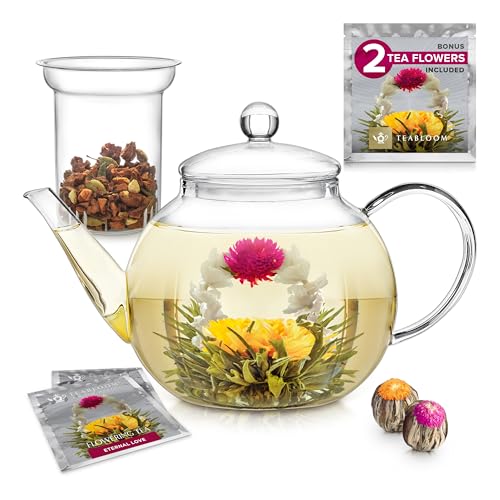
- Teabloom Celebration Glass Teapot & Kettle, 27 oz — Check on Amazon
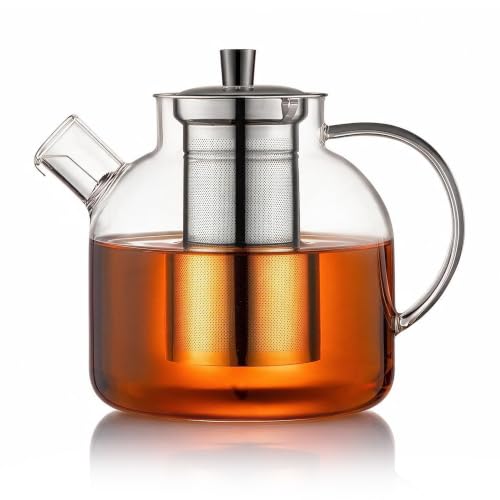
- CNGLASS Glass Teapot Stovetop Safe, 20.3 oz
- DRNKNSTX Enchanted Tea Pot with Tea Infuser, 20 oz (covered prose-only below — no stovetop claim in its listing)
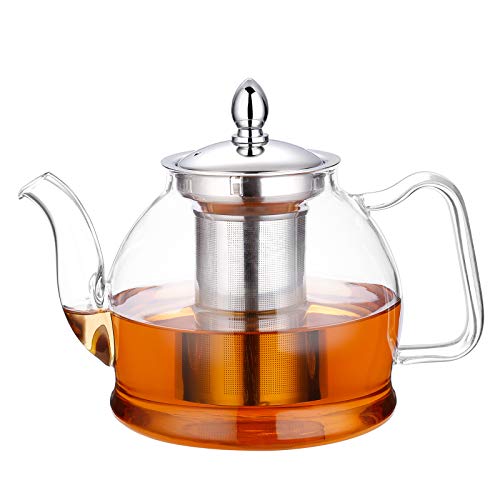
- HIWARE 1000ml Glass Teapot with Removable Infuser
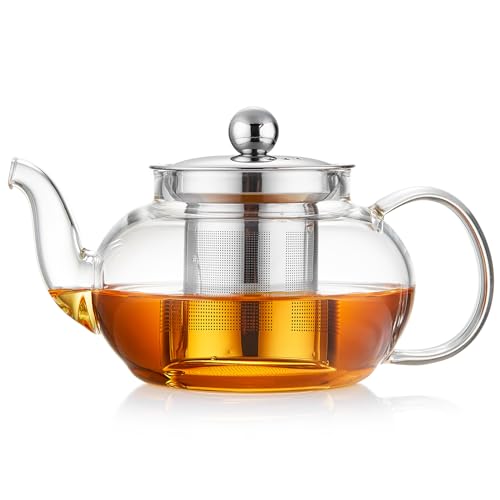
- PARACITY Glass Teapot Stovetop, 18.6 oz
Read the full guide ↓
A teapot that can sit on the stove collapses tea-making into a single vessel: fill it, heat it, steep in it, pour from it. The best teapots for stove use are the ones whose makers actually claim that duty — and that word, claim, is the spine of this guide. Glass teapots are not automatically stovetop safe; the listings that state stovetop safe (or stovetop and microwave safe) have been designed and described for direct heat, while listings that stay silent must be treated as kettle-filled pots, however sturdy they look. We have applied that rule strictly: four pots in this guide carry a stated stovetop claim and are linked; two well-regarded pots from the same pool do not state it and are covered prose-only, with the gap explained, so you can see exactly what the distinction costs and buys.
Why want a stovetop pot at all? For the robust teas that dominate daily drinking — black teas, breakfast blends, roasted styles, most herbals — the one-vessel routine removes a transfer, a second washing-up item, and a surprising amount of morning friction. It also suits households without a kettle, small kitchens, and anyone whose tea-making happens at the stove anyway. The trade is discipline: direct heat demands the habits set out in this guide’s how-to section, from never boiling a pot dry to lifting it with a protected hand. Readers comparing the wider category will find the general picks in Best Teapots For Loose Leaf Tea; this page is for the stove specifically, and it is strict about it.
Key Takeaways
- The Teabloom Celebration 27 oz glass teapot is our first choice for stove use: its listing states stovetop and microwave safe with heat-resistant glass and a removable glass infuser.
- Only buy for the stove what is sold for the stove — a stated stovetop claim in the listing is the entry requirement, and four picks here meet it.
- Two pool pots (Enchanti, DRNKNSTX) are covered prose-only because their listings make no stovetop claim; they remain fine kettle-filled pots.
- Stovetop glass rewards gentle heat, a pot that is never left dry or unattended, and a protected hand for pouring.
- Sizes run from the 18.6 oz PARACITY for one mug to the 1000ml HIWARE for a household round — all with water heated in the pot itself.
In this guide
Quick Picks
| Pick | Badge | Capacity from listing | Heating noted in listing | Link |
|---|---|---|---|---|
| Enchanti Tea Pot, One Touch | Prose-Only: No Stovetop Claim | 27 oz / 800ml | Not stated — kettle use | Covered prose-only below |
| Teabloom Celebration | Best Overall for Stove | 27 oz | Stovetop and microwave safe | Check on Amazon |
| CNGLASS Glass Teapot | Best Compact Stovetop Pot | 20.3 oz | Stovetop safe | Check on Amazon |
| DRNKNSTX Enchanted Tea Pot | Prose-Only: No Stovetop Claim | 20 oz | Not stated — kettle use | Covered prose-only below |
| HIWARE Glass Teapot | Best Household Stovetop Pot | 1000ml | Stovetop safe | Check on Amazon |
| PARACITY Glass Teapot | Best Solo Stovetop Pot | 18.6 oz / 550ml | Stovetop format | Check on Amazon |
Badges in this guide are governed by one fact first — whether the listing claims stovetop use — and by size and routine after that.
How These Picks Were Chosen
This is a research-led guide, and its method is stricter than most in this series. We took the verified pool for this group, read every listing title for an explicit stovetop claim, and divided the pool by that line without exceptions. Four listings state it — the Teabloom Celebration (“Stovetop & Microwave Safe”), the CNGLASS (“Stovetop Safe”), the HIWARE (“Stovetop Safe”), and the PARACITY (“Stovetop” in its name and description) — and those four are the linked recommendations. Two listings do not — the Enchanti and the DRNKNSTX, whose titles describe infusers and formats but never claim direct-heat use — and those two are reviewed prose-only, without purchase links or images, because recommending them for stove use would require inventing a claim their makers did not make.
We consider this strictness a service rather than a limitation. Glass and direct heat are a serious pairing, and the difference between a pot designed for a burner and one merely tolerant of hot water is precisely the difference a listing’s wording exists to communicate. Where a maker has made the claim, we trust it and say so; where they have not, the safe and honest assumption is kettle use. Readers who prefer a kettle routine regardless will find the prose-only pots assessed fairly on their other merits — both are capable loose leaf brewers away from the stove. The hard-water companion to this guide, Best Teapots For Stove No Lime, takes up the descaling side of stovetop ownership.
The 6 Best Teapots for Stove Use — 4 Stated for the Stove, 2 Prose-Only
Enchanti Tea Pot, One Touch Glass Teapot with Infuser, 27 oz
Badge: Prose-Only — No Stovetop Claim in Listing
Strengths (as a kettle-filled pot)
- 27 oz / 800ml versatile size for one to three drinkers.
- Listing is purpose-built for loose leaf tea, with a one-touch serving format.
- Glass body keeps the brew visible.
Trade-offs
- Its listing states no stovetop or microwave claim — for this guide’s purpose, that is disqualifying for direct heat.
- The listing also does not state the infuser material.
- Sold as a gifts set; presentation is part of the proposition.
Mini spec box: Capacity 27 oz / 800ml · One touch glass teapot with infuser · For loose leaf tea · Heating claim: none stated.
The Enchanti is included so the boundary of this guide is visible rather than hidden. As a loose leaf pot filled from a kettle, it is a perfectly reasonable 27 oz all-rounder with an easy-serving format — the same qualities that earned it a full linked review in our loose leaf coverage. But this guide’s question is narrower: what can sit on the stove? Its listing does not say it can, and so here it cannot be recommended for that use, carries no purchase link, and should be bought, if at all, as a kettle pot.
Who it suits: kettle households who like its size and serving style. The honest limitation is the whole point of its inclusion — a buyer whose purpose is stovetop brewing should choose one of the four stated pots below, at whatever size matches their routine.
Best for: kettle-filled loose leaf brewing / Not suited for: stovetop use — no claim stated.
Teabloom Celebration Glass Teapot & Kettle, 27 oz
Badge: Best Overall for Stove
Strengths
- Listing states stovetop and microwave safe, with heat-resistant glass — the most complete heating claim in this guide.
- Removable glass infuser keeps the whole heat-and-steep process visible in one vessel.
- 27 oz serves one to three drinkers, and the listing covers loose leaf, bagged, and blooming tea, with 2 blooming teas included.
Trade-offs
- Glass infuser slots are typically less fine than steel mesh for the smallest leaf particles.
- Glass components need careful handling, especially in a stove-centred routine.
- Mid-size only — households wanting a litre-class round should look at the HIWARE.
Mini spec box: Capacity 27 oz · Removable glass infuser · Stovetop and microwave safe per listing · Heat-resistant glass · Includes 2 blooming teas · For loose leaf, bagged, and blooming tea.
The Celebration leads because its listing makes the stove claim in the fullest terms available in this pool — stovetop and microwave safe, heat-resistant glass — and pairs it with the format a one-vessel routine wants: a removable infuser for the steep, clear walls for judging it, and a 27 oz size that matches the commonest sessions. Heat the water in the pot, drop the basket in, lift it out at time, and pour: the entire practice of tea in four actions and one object. The microwave claim adds a second heating route for small top-ups, which no other pick here states.
Who it suits: stove-first households of one to three drinkers who want the claim stated as completely as possible. The honest limitation is fine filtration, as with any glass infuser, and the care glass always asks. For the buyer whose first question is “can it go on my stove?”, this listing answers most completely.
Best for: one-vessel stove brewing with the fullest stated claim / Not suited for: the finest-cut teas or litre-size rounds.

CNGLASS Glass Teapot Stovetop Safe, 20.3 oz
Badge: Best Compact Stovetop Pot
Strengths
- Stovetop safe is in the product’s very name in the listing — the claim could not be clearer.
- 20.3 oz compact size heats quickly and suits one or two drinkers.
- Removable infuser, with the listing covering loose leaf and blooming tea.
Trade-offs
- The listing does not state the infuser material.
- Compact capacity means a second heating cycle for groups.
- Small pots on big burners need the heat-management habits in this guide’s how-to section.
Mini spec box: Capacity 20.3 oz · Stovetop safe per listing · Removable infuser · For loose leaf and blooming tea.
The CNGLASS is the minimalist’s stovetop pot: a compact vessel whose listing leads with its stovetop safety, sized for the one-to-two-mug sessions that dominate real tea drinking. Small volume is a genuine stove virtue — the water heats fast, the pot is light to lift and pour, and the whole routine from cold fill to first cup is the shortest in this guide. For a single drinker or a couple in a small kitchen, it is the pot that makes the kettle redundant with the least possible apparatus.
Who it suits: solo and pair drinkers, small kitchens, and anyone whose stove is already the kitchen’s centre. The honest limitation is scale — it will not serve a table — and the unstated basket material. Within its size class, it is the clearest stovetop proposition here.
Best for: fast, compact, one-vessel brewing / Not suited for: group serving.
DRNKNSTX Enchanted Tea Pot with Tea Infuser, 20 oz
Badge: Prose-Only — No Stovetop Claim in Listing
Strengths (as a kettle-filled pot)
- 20 oz glass steeper format sized for one or two drinkers.
- Listing describes a loose leaf steeper with infuser, made for diffusing loose leaf tea.
- Gift-oriented presentation.
Trade-offs
- No stovetop or microwave claim appears in its listing — it cannot be recommended for direct heat in this guide.
- The listing also states no infuser material.
- Presentation-led design is aimed at giving rather than daily utility.
Mini spec box: Capacity 20 oz · Tea infuser / loose leaf steeper · Glass tea maker per listing · Heating claim: none stated.
The DRNKNSTX is the second boundary case, included for the same reason as the Enchanti: so readers can see that this guide’s line is drawn by evidence, not preference. As a giftable 20 oz glass steeper filled from a kettle, it has a clear role, and our other guides review it in that light. For stove use, its listing is silent, silence is not a claim, and so it appears here without a link or image, as an honest non-recommendation for this specific purpose.
Who it suits: gift buyers and kettle households. Who it does not suit is the entire audience of this guide — anyone shopping for the stove should pass to the four stated pots, two of which (the CNGLASS and PARACITY) match its solo scale with the claim actually made.
Best for: kettle-filled steeping and gifts / Not suited for: stovetop use — no claim stated.
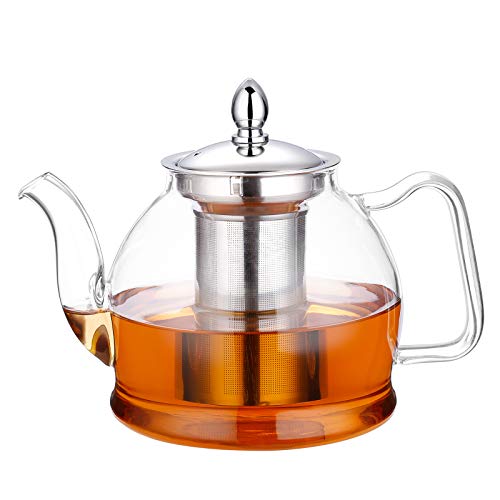
HIWARE 1000ml Glass Teapot with Removable Infuser
Badge: Best Household Stovetop Pot
Strengths
- Listing states stovetop safe, at a household 1000ml capacity — the family round heated and brewed in one vessel.
- Removable infuser keeps the steep controlled even at litre scale.
- Listing covers blooming and loose leaf tea, a broad household brief.
Trade-offs
- The listing does not state the infuser material.
- A full litre on the stove is the heaviest lift and pour in this guide — the protected-hand habit matters.
- Oversized for solo sessions.
Mini spec box: Capacity 1000ml · Removable infuser · Stovetop safe per listing · Made for blooming and loose leaf tea.
Households feel the one-vessel advantage most, because their alternative is the most cumbersome: a kettle boiled, a litre pot filled, two vessels washed, every morning. The HIWARE removes the kettle from that sentence entirely. A litre of water heats where the tea will steep, the basket goes in at the boil, comes out at time, and the round pours at one strength. Its stovetop claim is stated in the same plain terms as the CNGLASS’s, at more than double the capacity — the combination that makes it this guide’s household recommendation.
Who it suits: families and shared kitchens brewing robust everyday teas at volume. The honest limitation is solo use, which it serves clumsily, and the physical reality of a full glass litre — lift it like it matters, because it does. Paired with a compact pot for solo sessions, it completes a stove-first kitchen.
Best for: household rounds heated and brewed in one pot / Not suited for: solo mugs.

PARACITY Glass Teapot Stovetop, 18.6 oz
Badge: Best Solo Stovetop Pot
Strengths
- “Stovetop” is in the product’s name in the listing, and its description frames it as a stovetop tea kettle.
- Removable 18/8 stainless steel infuser stated in the listing — the finest stated filtration here, in the smallest pot.
- 18.6 oz / 550ml borosilicate body heats fast and brews exactly one generous mug.
Trade-offs
- One mug per heating cycle; no group capacity.
- Small basket crowds bulky leaves.
- Listing also pitches camping and travel — a hint that its home is anywhere a heat source is.
Mini spec box: Capacity 18.6 oz / 550ml · Borosilicate glass · Removable 18/8 stainless steel infuser · Stovetop format per listing · For blooming and loose leaf tea.
The PARACITY closes the ladder at the solo end, and it is arguably the purest expression of this guide’s idea: a small borosilicate pot, named for the stovetop, with a stated steel infuser, brewing one mug from cold water to cup without another vessel entering the story. Its camping and travel positioning underlines the point — wherever there is a burner, there can be proper loose leaf tea. For the desk-adjacent hotplate, the studio stove, or the small home kitchen, it is the complete solo system.
Who it suits: solo drinkers who want the kettle gone. The honest limitation is hospitality, which a second, larger pot must supply. As the daily driver of a one-person stove-first routine, nothing else in this guide is as exactly fitted. Campers comparing dual-use kit may also enjoy Best Teapots For Tea And Coffee coverage of multi-role vessels.
Best for: solo one-vessel brewing anywhere there’s a burner / Not suited for: serving guests.
Comparison Table
| Pick | Capacity | Heating claim in listing | Status in this guide | Link |
|---|---|---|---|---|
| Enchanti | 27 oz / 800ml | None stated | Prose-only | — |
| Teabloom Celebration | 27 oz | Stovetop and microwave safe | Linked | Check on Amazon |
| CNGLASS | 20.3 oz | Stovetop safe | Linked | Check on Amazon |
| DRNKNSTX | 20 oz | None stated | Prose-only | — |
| HIWARE | 1000ml | Stovetop safe | Linked | Check on Amazon |
| PARACITY | 18.6 oz / 550ml | Stovetop format | Linked | Check on Amazon |
How to Choose a Teapot for the Stove
Start with the claim, not the appearance. Glass thickness, a sturdy look, or a kettle-like shape prove nothing about direct heat. The listing’s words are the evidence: stovetop safe, stovetop and microwave safe, or stovetop in the product’s name and description. If the words are absent, the pot is a kettle pot, full stop. This single rule, applied without exceptions, is the difference between a safe stovetop purchase and a hopeful one.
Then size the vessel to the session. Stove pots are heated per session, so size honesty matters twice: an oversized pot wastes heating time and steeps small sessions shallowly, while an undersized one forces repeated cycles for a group. The ladder here runs 18.6 oz for one mug, 20.3 oz for one-to-two, 27 oz for one-to-three, and 1000ml for a household — pick the rung your mornings actually stand on.
Consider the burner you own. Small pots sit best on small burners, with the flame or element matched to the base rather than licking up the sides; very large glass vessels want the household’s most even heat source. Induction households should verify compatibility on the product page, since glass alone does not couple with induction. None of this is stated in the listings quoted here, so treat the product page as the authority for your specific hob.
Weigh the infuser as usual. Stove duty does not change steeping: a removable infuser, fine enough for your teas, emptied promptly. The PARACITY’s stated steel mesh is the fine end; the Celebration’s glass infuser is the visible end. Choose by your leaf, as in any other guide in this series.
Think in tiers qualitatively. Compact stated-stovetop pots sit at the accessible end, the versatile 27 oz class in the middle, and the litre household class at the upper end of this particular range. The premium worth paying for here is never a heating claim — that is binary — but capacity and fit.
How to Use a Glass Teapot on the Stove Safely
- Inspect the pot before heating: no chips, no cracks, no exceptions. Retire damaged glass from heat duty entirely.
- Fill with the water you need — and never heat the pot empty or let it boil dry. A dry glass pot on a hot burner is the one unforgivable error in this method.
- Use moderate heat. Glass prefers a steady climb to a violent one; a medium burner setting reaches the boil with far less thermal stress.
- Match the burner to the base: flames or elements should heat the bottom, not wrap around the sides.
- When the water reaches the heat your tea wants — a full boil for robust teas, off the boil and rested for delicate ones — remove the pot from the heat before adding the basket if your routine calls for it, or add the leaf and steep off the burner. Tea steeps; it does not cook.
- Pour with a protected hand on the handle, and set the pot down on a dry, room-temperature surface — never a wet counter or a cold stone slab.
- Let the pot cool before washing, and never run cold water into hot glass.
Troubleshooting. Problem: the pot makes ticking or pinging sounds on the burner → the heat is likely too fierce or uneven; reduce the setting and let the pot warm more gradually. Problem: tea tastes scorched or stewed → it sat on residual heat after steeping; move the pot off the burner the moment the water is ready, and lift the basket at time. Problem: white mineral film builds up inside → that is limescale from your water, not damage; the descaling routine in the care section and in Best Teapots For Stove No Rust companion advice will clear it.
Gas, Electric, and Induction: Matching the Pot to the Hob
The stove in your kitchen shapes the routine as much as the pot does. On gas, the discipline is flame size: keep the flame under the base, use a moderate setting, and remember that an oversized flame heats the handle’s neighbourhood and the glass walls unevenly. On electric coil or ceramic hobs, the discipline is patience: these surfaces cycle heat in pulses, which glass tolerates well at moderate settings, and they stay hot after switch-off, so moving the pot aside at the boil matters. On induction, plain glass does not heat at all without a compatible base or disc, so induction households must verify the specific product’s arrangement on its page before buying for stove use — or simply keep a kettle routine, which induction performs superbly. Portable burners and camping stoves, relevant to the PARACITY’s travel positioning, follow the gas rules with extra attention to stability: a small pot on a small stove wants a level, settled flame. In every case the principles repeat — moderate, even heat; water always present; no sudden temperature shocks — because they are glass’s principles, not any one hob’s.
Which Teas Belong in a Stovetop Pot
Stovetop brewing flatters the robust majority of the tea shelf. Black teas and breakfast blends want freshly boiled water and forgive the one-vessel routine completely. Roasted oolongs, hojicha, and most herbal infusions — rooibos included — are equally at home. The delicate end needs one adaptation: green and white teas want water cooled below boiling, which in a stovetop pot means heating the water, taking the pot off the heat, and letting it stand briefly before the leaves go in. That pause costs nothing and preserves the method’s convenience, but it must be a conscious step, because water poured straight off a rolling boil will bully a delicate leaf in any vessel. Masala-style spiced teas that are simmered with milk are the one preparation that goes further than steeping — a cooking method in its own right, better served by a saucepan than by any glass pot in this guide. Buy the stovetop pot for the teas you steep, and let the saucepan keep the teas you cook.
The Kettle Question: What a Stovetop Pot Replaces and What It Does Not
A stovetop teapot replaces the kettle for one job — heating steeping water — and households should be clear-eyed about the boundary. It does not replace the kettle’s speed for large volumes of boiling water for cooking, its precision for temperature-set delicate work, or its convenience when three different hot drinks are wanted at once. What it replaces, it replaces completely: the daily transfer of water from kettle to pot, with its cooling, its dripping, and its second vessel to wash. Many stove-first households end up keeping both — the pot for tea’s daily round, the kettle for everything else — and find the duplication cheap at the price, because each tool does the job it is shaped for. The buyer this guide most wants to protect is the one who discards the kettle on day one and discovers the boundary on day three; keep the kettle until the pot’s routine has proven itself across a full week of your real drinking.
Care and Cleaning for Stovetop Glass
Stovetop pots live a harder life than kettle pots, and their care has two extra chapters. The first is the base: heating can bake mineral deposits onto the hottest surface, so a regular hot bicarbonate soak — and, in hard-water homes, the fuller descaling routine covered in our no-lime guidance — keeps the glass clear and the heating even. The second is inspection: before each heating, a glance at the base and walls for chips or hairline cracks becomes a habit worth automating, because heat finds flaws that cold water forgives. The daily liturgy is otherwise unchanged — empty the basket warm, rinse in hot water once the pot has cooled, dry with the lid off, and store away from heavier cookware that could clip it. Never wash a hot pot, never set a hot pot on a cold or wet surface, and never leave a pot heating unattended: three nevers that, observed, give glass a long and uneventful stove life.
Stovetop Teapots in Small Kitchens, Studios, and Workplaces
The one-vessel argument strengthens as kitchens shrink. In a studio flat, a bedsit, or a small office kitchenette, the kettle-plus-pot arrangement consumes counter and cupboard space that barely exists, and a stated stovetop pot that heats, steeps, and pours from the burner earns its footprint every day. The compact end of this guide — the CNGLASS and PARACITY — was practically designed for these rooms, and the PARACITY’s camping pitch makes the same point from the other direction: where there is a heat source and no room for a kettle, the stovetop pot is not a compromise but the complete tea station. Workplace buyers should add one consideration: a pot that lives by a shared stove gets handled by many hands, so the inspection habit and the moderate-heat rule should be written on a note by the burner until they become the room’s culture. Hot water discipline in shared spaces is a courtesy as much as a safety practice.
A Week With a Stovetop Pot: Where the Convenience Actually Shows
Convenience claims are cheap in a listing and expensive to fake across a week, so it is worth tracing where the one-vessel routine actually saves effort. Monday morning: one fill, one heating, one wash — the kettle never leaves its corner, and the counter holds one object instead of two. Midweek, the second-steep habit improves, because refreshing hot water is a burner knob rather than a kettle cycle, and leaves that would have been thrown away give their second infusion. The weekend gathering is where the HIWARE pattern justifies itself: a litre heated and brewed in place, refilled in place, without the brewer shuttling between stove and table with a kettle. And the honest debit side appears too: delicate green tea days still want the cooling pause, and the pot must be watched while it heats in a way a switch-off kettle never demands. Net across the week, households that drink robust teas daily come out clearly ahead; households centred on delicate teas should weigh the kettle routine more kindly. The guide’s picks serve the first household best, and say so.
Stovetop Glass Versus Stovetop Metal: An Honest Word
Buyers cross-shopping this category will meet metal stovetop kettles and pots, and the comparison deserves a straight answer rather than a sales pitch. Metal wins on indestructibility: it can be knocked, boiled hard, and handled roughly for decades, and a whistling kettle adds an audible cue glass cannot offer. Glass wins on everything to do with the tea itself: the steep is visible, the flavour is neutral, the interior rinses provably clean, and one vessel both heats and brews with the leaves watched throughout. The households that choose glass knowingly are those whose priority is the cup and the ritual; the households that choose metal knowingly are those whose priority is surviving a chaotic kitchen. Neither is wrong — but they are different purchases, and a buyer should not expect a glass pot, however well claimed for the stove, to forgive metal’s handling. This guide’s discipline — moderate heat, constant water, gentle hands — is simply the price of glass’s advantages, stated upfront.
When the Stove Is Not the Answer
A balanced guide names its own limits. If your household drinks mostly delicate green and white teas, the kettle’s temperature control will serve you better than any stovetop pot, and the prose-only pots in this guide — or any kettle-filled brewer — become the sensible buy. If your kitchen runs on induction with no compatible arrangement, the stovetop route closes unless the product page says otherwise. If the pot will live in a house of small children and crowded burners, the risk calculus of glass on a stove deserves a sober second thought. And if your tea-making happens far from any stove — a desk, a workshop bench — an electric kettle at the point of use beats a stovetop pot in the kitchen every time. The four linked pots here are excellent answers to a specific question; this guide’s respect for its readers includes saying plainly when the question is not theirs.
Reading Stovetop Claims Like a Careful Buyer
Because this guide’s whole structure rests on listing language, buyers deserve a short course in reading it. The strongest form is an explicit safety statement — “stovetop safe” or “stovetop and microwave safe” — attached to the product itself, as the Celebration, CNGLASS, and HIWARE listings provide. Nearly as strong is the claim carried in the product’s name and repeated in its description, as with the PARACITY’s “Stovetop” kettle framing. What does not count: a photograph of a pot near a stove, the word “kettle” alone, heat-resistant language without a stovetop statement, or a buyer’s review claiming they used it on a burner and it survived. Survival stories are anecdotes, not design claims, and glass keeps its own counsel until the day it does not. When in doubt, the product page’s full description and the maker’s answers to buyer questions are the places to look — and if the claim cannot be found there, the disciplined conclusion is the one this guide drew for two of its six pots: a good kettle pot, not a stove pot.
Second Steeps and Top-Ups: The Stovetop Pot’s Quiet Advantage
One underappreciated consequence of heating in the serving pot is how gracefully it handles the tail of a tea session. In a kettle routine, the second steep waits on a fresh boil and the top-up cup arrives lukewarm; in a stovetop routine, the water supply is the pot’s own element, and a gentle return to the burner — with the basket out and brewed tea in the pot — restores drinking temperature without stewing the leaves, because the leaves are no longer in the liquor. Handled this way, with brief, gentle reheating rather than a hard re-boil, a household round can stay at temperature across a long breakfast without the flavour penalties of a pot left steeping. The discipline is the same as everywhere in this guide: moderate heat, constant attention, and never a dry pot. Drinkers who host long, talkative teas will find this the stovetop format’s most persuasive daily argument — the session no longer cools faster than the conversation.
A Final Safety Summary Worth Reading Twice
Everything this guide asks of a stovetop glass owner fits in one breath: buy only a stated claim, fill before heating, heat moderately, watch the pot, steep off the burner, pour with a protected hand, land on a dry surface, cool before washing, and inspect before the next heating. None of it is difficult, and all of it together is the difference between a pot that serves for years and a story about the day the glass gave up. The four linked pots were chosen because their makers stood behind the method in writing; the owner’s half of the bargain is the nine habits above.
What Owners Say After a Month: The Pattern of Reports
Read across buyer reports for stated stovetop pots and a consistent pattern emerges, which this guide’s advice is built to reproduce. The satisfied owners describe the routine, not the object: the morning fill, the quiet boil, the basket lifted at the right moment, the single wash. The dissatisfied reports cluster around the predictable failures — a pot heated empty by a distracted hand, a fierce burner, a cold sink — or around size regrets that a session-honest purchase would have prevented. Almost nobody reports the glass itself misbehaving when the nine habits are kept. That is the most reassuring evidence available for the format: its failures are procedural, and procedures can be learned in a week.
Common Buying Mistakes
- Assuming any glass teapot can go on the stove. Only a stated claim earns direct heat. Two pots in this very guide are excluded for lacking it.
- Boiling the pot dry or leaving it unattended. The cardinal sins of stovetop glass — water always in the pot, eyes always in the kitchen.
- Using maximum heat for speed. Moderate heat boils water with far less thermal stress and barely less speed.
- Steeping on residual heat. Take the pot off the burner when the water is ready; tea steeps, it does not simmer.
- Washing hot glass in cold water. Thermal shock ends more stovetop pots than the stove ever does. Let it cool first.
Final Recommendation
For most stove-first households, start with the Teabloom Celebration 27 oz glass teapot: the fullest heating claim in this pool, a removable infuser, and the size that fits the commonest sessions. Give the new routine a full week before judging it — long enough for the moderate-heat habit, the inspection glance, and the off-the-burner steep to become automatic, and for the one-vessel mornings to show their cumulative ease. Stovetop brewing is a small discipline with a daily dividend, and the pot chosen on a stated claim, in the right size, will pay it for years. Choose the CNGLASS for compact speed, the PARACITY for the solo mug with a stated steel infuser, and the HIWARE when the household round must heat and brew in one vessel. And respect the guide’s boundary: the Enchanti and DRNKNSTX are decent kettle pots that make no stovetop claim, and no discount or design charm should talk you into putting them on a burner.
Frequently Asked Questions
Can any glass teapot go on the stove?
No. Only a teapot whose listing states stovetop safety should be heated directly. Glass that merely tolerates boiling water poured into it is a different thing from glass designed for a burner, and the listing’s wording is the evidence you have. This guide links only the four pots whose listings make the claim.
Why are two pots in this guide not linked?
Because their listings — the Enchanti and the DRNKNSTX — do not state a stovetop claim. They are covered honestly as kettle-filled pots, without purchase links or images, so that the guide never implies a heating capability their makers have not claimed.
Is a stovetop teapot better than using a kettle?
It is simpler for daily steeping — one vessel to fill, heat, steep in, and wash — and it suits robust teas perfectly. A kettle still wins for temperature precision with delicate teas and for general kitchen duty. Many households happily keep both.
What heat setting should I use for a glass teapot?
Moderate. A medium burner brings water to the boil with much less thermal stress than a fierce one, and the time saved by maximum heat is small. Keep flames or elements matched to the pot’s base, and never heat the pot empty.
Can I steep delicate green tea in a stovetop pot?
Yes, with one adaptation: heat the water, take the pot off the heat, and let it stand briefly so the water cools below boiling before the leaves go in. The pot provides the water; the pause provides the temperature.
What size stovetop teapot should I buy?
The size of your session: 18.6–20.3 oz for one or two mugs, 27 oz for one to three drinkers, 1000ml for a household round. Stove pots are heated per session, so an honest size saves both time and steeping quality.
How do I keep a stovetop glass teapot from cracking?
Never heat it empty, use moderate heat, inspect it for chips before heating, set it down only on dry room-temperature surfaces, and let it cool before washing. Those five habits address essentially every cause of failure in stovetop glass.
Can I use a stovetop teapot on an induction hob?
Plain glass does not heat on induction by itself, so check the specific product’s page for any compatible base or disc arrangement before assuming it will work. If the listing is silent, treat the pot as unsuitable for induction and use a kettle routine instead — induction heats kettle water superbly, so the household loses nothing but the one-vessel format.