Disclosure: topratedkitchenware.com is reader-supported. When you buy through links on our site, we may earn an affiliate commission from Amazon and other retailers, at no extra cost to you.
Where to buy
The six models below are the verified picks checked for this guide. Two of them are genuine RV toilets built for a floor flange and a black tank, and those two carry Amazon links. The other four are marine heads — boat toilets with boat plumbing assumptions — and they are covered in prose only, with no link and no image, with the reason stated plainly in each review.
- SEAFLO RV Toilet — Check on Amazon for the current configuration and availability
- Dometic Model 410 Complete RV Toilet
- Jabsco Twist n’ Lock Manual Marine Toilet — covered in prose only (marine system)
- SEAFLO Deluxe Flush Freshwater Electric Marine Toilet — covered in prose only (marine system)
- SFA Saniflo Sanimarin 4 Electric Marine Macerating Toilet — covered in prose only (marine system)
- SEAFLO 12V Electric Marine Toilet, Compact — covered in prose only (marine system)
Read the full guide ↓ for the ranking logic, the honest limitations of every pick, and the measurements to take before any toilet is ordered.
Searching for the best toilets for campervan builds — the word written as one word, the way converters and forum members usually write it — lands you in a results page that mixes three different vehicles. There are motorhome toilets, boat toilets and camping toilets all competing for the same click, and the differences between them are not styling differences. A campervan, whether it is a factory conversion or a self-build on a panel van, has a small fresh tank, a small waste tank or cassette, a 12-volt system sized for lights and a fridge, and a bathroom that shares its square footage with the shower, the wardrobe and sometimes the kitchen. The right toilet is the one designed for exactly those constraints.
This guide reviews the two verified RV toilets in the pool that meet a campervan on its own terms — a gravity-flush SEAFLO and a porcelain Dometic — and then deals honestly with the four marine heads that share the pool, explaining what each does well on the water and why its plumbing keeps it out of a van. Shoppers whose vans run a cassette or a portable instead will find the neighbouring research behind Best Toilets For Rv useful context, because the campervan answer changes completely with the waste system underneath it.
Every pick was checked against the verified pool for this category on 2026-11-20. Linked picks carry an Amazon link so you can check the latest price on Amazon; prose-only picks are identified as such wherever they appear. Spec boxes use only details stated in the verified listing titles — where a title gives no weight or dimension, this guide does not invent one.
Key Takeaways
- The SEAFLO RV Toilet is the practical first choice for most campervans: gravity flush by foot pedal, an 18.4-inch residential height and a 9.5-inch rough-in that fits the flange position most van wet baths are built around.
- The Dometic Model 410 is the comfort upgrade: a round porcelain bowl at an 18-inch chair height for owners who want the fixture to feel residential and accept porcelain’s weight and care demands.
- All four remaining picks are marine heads. Their intake and discharge belong to boat plumbing, so they are reviewed in prose only and recommended to nobody building a normal campervan.
- Gravity flushing is the campervan’s friend: no macerator load on the house battery, no pump to prime, and wear parts limited to seals and a valve.
- If your campervan has no black tank, none of these six is your toilet — the cassette and portable categories behind Best Small Portable Camp Toilets are where that search belongs.
In this guide
Quick Picks
| Pick | Badge | Type | Link |
|---|---|---|---|
| SEAFLO RV Toilet | Best Overall | RV gravity flush, foot pedal | Check on Amazon |
| Dometic Model 410 Complete RV Toilet | Best Porcelain Comfort | RV gravity flush, round porcelain bowl | Check on Amazon |
| Jabsco Twist n’ Lock Manual Marine Toilet | Best Manual Marine Alternative | Marine manual pump — prose only | Prose only |
| SEAFLO Deluxe Flush Freshwater Electric Marine Toilet | Best Freshwater Marine Alternative | Marine electric macerator — prose only | Prose only |
| SFA Saniflo Sanimarin 4 | Best Quiet Macerating Alternative | Marine macerating, 12V — prose only | Prose only |
| SEAFLO 12V Electric Marine Toilet, Compact | Best Compact Marine Alternative | Marine electric macerator — prose only | Prose only |
Two badges here describe campervan toilets and four describe boat toilets included for completeness. That ratio is not a failure of the pool; it is an accurate map of what this search returns in the real market, and the detailed reviews treat it that way.
How These Picks Were Chosen
This guide is research-led. No hands-on testing is claimed. Each candidate was assessed from its verified listing title — brand, stated application, flush mechanism, bowl material and shape, seat height, rough-in and mounting — and screened against the campervan’s non-negotiables. The screen asked: does it discharge by gravity through a standard RV floor flange into a black tank? Does it flush from the vehicle’s fresh water without a raw-water intake? Can its wear parts be carried as spares and changed at the roadside? The two RV toilets passed and are linked. The four marine heads failed on system type — the manufacturer’s own titles call them marine — and are covered in prose only, because a guide that silently dropped them would leave shoppers to meet them unbriefed on a results page. No prices, ratings or review counts appear anywhere in this guide; those numbers move constantly and help nobody choose a plumbing system.
The 6 Best Toilets for Campervan Builds, Reviewed Honestly
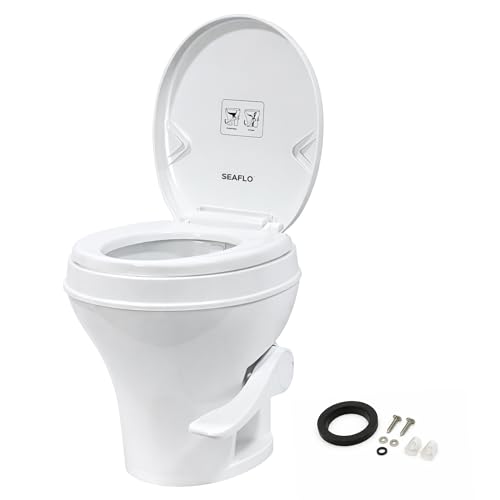
SEAFLO RV Toilet
Badge: Best Overall
Strengths
- Built for the job as titled: an RV toilet for camper, travel trailer and motorhome use, with gravity flush and a foot pedal — hands stay clean, no electrics involved.
- 18.4-inch residential height with a soft-close seat, so it sits like a home toilet rather than a camping stool.
- Stated 9.5-inch rough-in and 2-bolt mount, matching the flange geometry most van wet baths are laid out around.
Trade-offs
- It is a fixed plumbed fixture: a campervan without a black tank and flange cannot use it in any configuration.
- The listing title states a long warranty period, but the title gives no bowl material claim beyond the model description, so shoppers wanting porcelain should look at the Dometic below.
- Foot-pedal flushing spends fresh water on every rinse; water discipline still decides how long the tank lasts.
Mini spec box
- Brand: SEAFLO
- Model reference in title: SFRTPH-01-01
- Seat height: 18.4-inch residential height
- Flush: gravity flush, foot pedal
- Rough-in: 9.5-inch, fits most RVs as titled
- Mount: 2-bolt mount
- Seat: soft close
- Stated application: camper, travel trailer, motorhome
The SEAFLO earns Best Overall by being unremarkable in exactly the right ways. Gravity flush means the waste route is a short drop through the flange into the tank — no pump curve, no macerator, no control board between the user and a working toilet at midnight. The foot pedal keeps the flush mechanical and keeps hands away from the mechanism, a small hygiene point that matters more in a shared van bathroom than in a house. The 18.4-inch height is the tallest claim in this pool and the one adult users will feel most: knees unbend naturally, and older travellers in particular will notice the difference every single day of a tour.
The stated 9.5-inch rough-in deserves a paragraph of its own, because rough-in is where campervan toilet purchases quietly die. The rough-in is the distance from the wall behind the toilet to the centre of the floor flange. Van wet baths are moulded or built tight, and a toilet whose rough-in exceeds the available distance simply cannot be bolted down — no adjustment exists. SEAFLO titles this model as fitting most RVs at that 9.5-inch figure, which suits the compact flange positions typical of van conversions. Measure yours before ordering anyway: wall to flange centre, with the finished wall surface, not the framing. Owners comparing the wider RV market will recognise the same measurement discipline running through Best Toilets For Rvs, where trailer flange positions vary just as much.
Who should skip it? Cassette owners, no-tank minimalists, and anyone whose heart is set on porcelain. For the mainstream campervan with a wet bath and a black tank, this is the toilet the rest of the guide is measured against.
Best for: campervans with a plumbed wet bath and black tank, especially where the flange sits close to the wall / Not suited for: cassette builds, no-tank builds, or buyers who specifically want a porcelain bowl

Dometic Model 410 Complete RV Toilet
Badge: Best Porcelain Comfort
Strengths
- Round porcelain bowl — porcelain rinses clean, resists staining and feels like a home fixture, and the round shape fits tighter wet baths than an elongated bowl.
- 18-inch chair height with a soft-close seat and a universal 2-bolt mount, matching standard RV flange practice.
- Gravity flush: the same pump-free, macerator-free simplicity as the SEAFLO, from the most established name in RV sanitation in this pool.
Trade-offs
- Porcelain is heavier than polymer and less tolerant of freezing with water trapped in the valve — winterisation must be done properly.
- A round bowl gives up some seated room compared with an elongated bowl; larger users may prefer the elongated format where space allows.
- Like every fixed toilet here, it is useless to a van without a black tank and flange.
Mini spec box
- Brand: Dometic
- Bowl: round porcelain bowl
- Seat height: 18-inch chair height, residential-style
- Flush: gravity flush
- Mount: universal fit, 2-bolt mount
- Seat: soft-close
- Colour: white
The Model 410 is the comfort-first alternative, and its argument is material. A porcelain bowl is the surface home bathrooms settled on for good reasons: it is hard, smooth, easy to clean and slow to stain, and in a small van bathroom that is used many times a day those qualities compound. The round bowl is the campervan-friendly half of the design — where the elongated Dometic 420 reviewed in the sister guide needs front-to-back room, the 410’s round profile tucks into the short wet baths that dominate van conversions, trading a little seated length for a fit that actually happens.
Underneath, everything is reassuringly plain: gravity flush, two bolts, a soft-close seat. There is nothing to wire, nothing to prime and nothing electronic to fail at altitude or in the cold. The honest limitations are porcelain’s own: weight over the rear axle budget of a small van is rarely decisive but never zero, and a porcelain fixture with water standing in its valve is a freeze risk that a polymer toilet shrugs off. Owners who winterise carefully will never meet the problem; owners who park up in November and hope for the best meet it in March. Choose the 410 when the van is a small apartment that tours; choose the SEAFLO when the van is a tool that works hard and winters rough.
Best for: campervan owners who want a porcelain, residential-feeling toilet in a compact round-bowl footprint / Not suited for: elongated-bowl preferrers, rough winter storage without winterising, or any no-tank build
Jabsco Twist n’ Lock Manual Marine Toilet
Badge: Best Manual Marine Alternative
Strengths
- Manual operation with no electrical draw — the quality that draws campervan shoppers to it in the first place.
- Compact bowl and a Twist n’ Lock handle pattern that generations of boat owners know how to use and service.
- A simple pump mechanism that can be rebuilt with a service kit rather than replaced whole.
Trade-offs
- It is a marine toilet: it expects a raw-water intake and a marine discharge run, and a campervan has neither.
- Every flush is a pumping session, in the smallest room in the van, with the handle needing swing room the wet bath rarely has.
- Its compactness is bowl-deep only; the plumbing system it belongs to is full-size boat hardware.
Mini spec box
- Brand: Jabsco
- Model reference in title: 29090-5000 Twist n’ Lock
- Operation: manual marine toilet
- Bowl: compact bowl
- Stated application: marine
Prose only, because its core system type is marine. The Jabsco’s appeal to van owners is understandable: no electricity, a compact bowl, a famous name. But a manual marine toilet is not a self-contained appliance; it is the visible end of a boat’s sanitation system, drawing in water from outside the hull and pumping waste toward a marine holding tank or discharge fitting. Installed in a campervan, both ends of that system have to be invented — a freshwater feed valved in a way the pump was not designed around, and a discharge route into a tank that sits waiting for a gravity drop this toilet never makes. The build threads of those who have done it are monuments to ingenuity and warnings in equal measure. If zero electrical draw is the quality you want, cassette and portable toilets deliver it in systems designed for land vehicles, which is why they have their own categories and their own guides.
Best for: boat owners, and project builders who treat plumbing as the hobby itself / Not suited for: campervan owners who want a toilet that matches their van’s existing flange and tank
SEAFLO Deluxe Flush Freshwater Electric Marine Toilet
Badge: Best Freshwater Marine Alternative
Strengths
- Fresh water rinse instead of raw-water intake, removing one of the usual marine mismatches.
- Ceramic bowl, soft-close seat, a four-way flush panel and a stated quiet flush with a macerator pump.
- 12-volt operation, matching vehicle electrics on paper.
Trade-offs
- Its discharge is a macerator pump-out for marine holding plumbing — the opposite of the gravity drop a campervan black tank is positioned for.
- Smart flush electronics plus a macerator means two extra failure domains in a vibrating vehicle.
- Freshwater flushing spends the van’s most rationed supply on every flush.
Mini spec box
- Brand: SEAFLO
- Power: 12V
- Rinse: fresh water rinse
- Controls: 4-way flush panel, smart flushing system
- Bowl: ceramic bowl, soft-close seat
- Pump: macerator pump
- Stated application: marine
Prose only. Of the four marine picks, this is the one that comes closest to speaking a campervan’s language — fresh water in, ceramic comfort, quiet operation. The disqualifier is on the way out: a macerator exists to push waste through a hose to a tank gravity cannot reach, a problem boats have and campervans, with the tank directly beneath the flange, do not. Fitting this head means abandoning the van’s gravity geometry, wiring a panel and a pump, and accepting that every flush is now an electrical and mechanical event. The two linked RV toilets above deliver the same ceramic-or-porcelain comfort class with none of that transplant. On a boat, buy it with confidence. In a campervan, admire it and move on.
Best for: boat owners wanting freshwater rinse and a ceramic bowl / Not suited for: campervans, where its macerator answers a question the vehicle never asks
SFA Saniflo Sanimarin 4 Electric Marine Macerating Toilet
Badge: Best Quiet Macerating Alternative
Strengths
- The only pick whose title publishes a noise figure — 52 dB(A) — and quiet matters in thin-walled vehicles and boats alike.
- Stainless steel macerating blade, control panel included, standard height, from a specialist maceration maker.
- Made in France, with the fit and finish the title’s positioning implies.
Trade-offs
- A marine macerating toilet: pumped, macerated discharge into marine plumbing, not a gravity drop into a van tank.
- Macerator internals are specialist service territory — not a layby repair with carried spares.
- Every flush draws 12-volt power for maceration from the house battery.
Mini spec box
- Brand: SFA Saniflo
- Model: Sanimarin 4
- Type: electric marine macerating toilet
- Blade: stainless steel
- Noise: 52 dB(A) as stated in title
- Controls: control panel included
- Power: 12V
- Origin: made in France
Prose only. The Sanimarin 4 is what the top of the marine market looks like, and its presence in this guide is useful mainly as a measuring stick: this is the complexity budget a boat spends to move waste horizontally through a hull. A campervan spends none of it, because its tank is underneath. The single transferable scenario is the rare custom build whose waste tank genuinely cannot sit below the bathroom — a layout decided at the drawing board, with the pump specified as part of the design. Nobody reaches that build by picking a toilet from a list, and retrofitting maceration into a standard wet bath buys noise-controlled complexity to solve a problem that does not exist. Its quiet figure is real; so is the gravity toilet’s quieter claim — silence by simplicity.
Best for: boat owners prioritising quiet maceration; the rare remote-tank custom build designed around a pump / Not suited for: conventional campervan plumbing of any layout
SEAFLO 12V Electric Marine Toilet, Compact
Badge: Best Compact Marine Alternative
Strengths
- Compact size with a ceramic bowl — the combination that makes small-van shoppers stop scrolling.
- Self-priming macerator with switch panel control, as simple as marine maceration gets.
- Titled for boat and yacht use, where its footprint is a genuine advantage.
Trade-offs
- Compact describes the bowl, not the system: fixed marine plumbing, pumped discharge and a control panel are all still required.
- Self-priming serves a boat’s intake; the campervan’s difficulty is the discharge side, which stays macerated and pumped.
- It assumes a marine holding system at the other end of the hose run.
Mini spec box
- Brand: SEAFLO
- Power: 12V electric
- Size: compact size
- Pump: self-priming macerator
- Controls: switch panel control
- Bowl: ceramic bowl
- Stated application: boat, yacht
Prose only. If you arrived here hoping the compact marine toilet was the small-campervan answer, the kind answer is that its compactness is real and beside the point. The space a campervan toilet consumes is mostly system space — tank position, vent, dump access — and this toilet’s system is a boat’s from intake to discharge. A van that could host it can host either linked RV toilet more simply; a van that cannot host those needs a cassette or a portable. That is the same conclusion the wider research behind Best Small Portable Camping Toilets reaches from the portable side: match the system to the vehicle first, and let bowl size argue only among finalists of the right type.
Best for: small boat heads with marine plumbing already in place / Not suited for: campervans of any size, where its system assumptions do not transfer
Comparison Table
| Pick | System type | Flush | Bowl | Campervan verdict | Link |
|---|---|---|---|---|---|
| SEAFLO RV Toilet | Plumbed RV | Gravity, foot pedal | 18.4-inch height | First choice for a black-tank van | Check on Amazon |
| Dometic Model 410 | Plumbed RV | Gravity | Round porcelain | Comfort pick for tight wet baths | Check on Amazon |
| Jabsco Twist n’ Lock | Marine | Manual pump | Compact bowl | Raw-water intake required — prose only | Prose only |
| SEAFLO Deluxe Freshwater Marine | Marine | Electric, macerator | Ceramic | Pumped discharge — prose only | Prose only |
| SFA Saniflo Sanimarin 4 | Marine macerating | Electric, macerator | Standard height | Boat system — prose only | Prose only |
| SEAFLO Electric Marine Compact | Marine | Electric, macerator | Ceramic, compact | Boat system in a small bowl — prose only | Prose only |
The system-type column is the whole story of this guide in miniature. Two plumbed RV toilets, four marine heads, and a campervan that can only ever use the first kind without a plumbing transplant. If you read nothing else before ordering, read that column, then measure your flange, then decide between the two linked finalists on bowl material and shape — porcelain round or the taller moulded design — because those are the only two decisions this purchase actually contains.
How to Choose the Right Toilet for a Campervan
Decide the waste system before the fixture
Black tank, cassette or portable: the campervan toilet question is answered at the system level before any product is compared. A black tank under a floor flange takes a gravity RV toilet — the two linked picks. A cassette hatch takes a cassette toilet, which is not in this pool. No system at all takes a portable, which lives in a different category. Shoppers who choose the fixture first and the system second end up adapting, and adapted sanitation is a hobby, not an appliance. Write down which system your van has, or will have, and let that single fact cut the market to a shortlist.
Rough-in and flange position
Measure from the finished wall behind the toilet to the centre of the floor flange. That number is the rough-in your new toilet must match or beat. The SEAFLO titles a 9.5-inch rough-in fitted to most RVs; the Dometic uses a universal 2-bolt mount. Neither fact rescues a toilet ordered against a guessed measurement. While the tape is out, measure door swing and knee room too — a toilet that fits its flange but traps the user against a shower screen has still failed.
Bowl shape: round fits, elongated comforts
Round bowls exist for tight rooms and elongated bowls for relaxed ones. In campervans the room usually wins the argument, which is why the round porcelain Dometic 410 is such a natural campervan pick. Where a build genuinely has the length — larger coachbuilt vans — an elongated bowl is the more comfortable daily fixture. Let the tape measure arbitrate; do not let a showroom sit-test in a warehouse overrule the dimensions of your own wet bath.
Water and battery budgets
Gravity flushing spends water and no electricity. Electric flushing spends both, and maceration spends them enthusiastically. A campervan’s fresh tank and house battery are shared with drinking, cooking, washing, refrigeration and light, so every toilet specification should be read as a claim on those shared budgets. The linked picks keep the claim small and predictable. The prose-only marine picks would make the claim larger and add plumbing novelty on top — the opposite direction from everything else in a well-planned conversion.
Seat height against tray height
Both linked picks sit at residential heights — 18.4 inches for the SEAFLO, 18 inches for the Dometic — but a wet-bath tray adds its own height beneath them. Add the two numbers and test the sum against the shortest regular user. A toilet that leaves feet dangling will be cursed nightly; a toilet that sits too low will be cursed by anyone with a bad knee. Height is a five-minute calculation that decides years of comfort.
How to Install, Use and Maintain a Campervan RV Toilet
Installation follows the RV pattern and rewards patience. Confirm the flange is sound, clean and level with the finished floor. Set a fresh flange seal, lower the toilet onto its two bolts, and tighten evenly in small alternations — porcelain and moulded bodies both distort or crack under one-sided force. Connect the fresh water feed and pressurise the system, checking every joint dry-eyed before first use. Put a starter charge of water into the black tank so the first waste never lands on a dry floor, then test-flush repeatedly, watching the bowl seal hold its water barrier between flushes.
In daily use, the rules are water discipline and seal care. Use enough water to rinse the bowl fully — a timid flush saves water today and buys odour tomorrow. Keep the bowl seal clean and moist; it is the odour barrier for the whole van. At the dump point, empty the tank completely, rinse until the discharge runs clear, and leave a small water charge behind. Carry the seal and water-valve spares for your model; they are small, and the day you need one is never a day with a parts shop in walking distance. Consumables belong to the same discipline — owners often ask about paper, and the practical guidance collected under Best Toilet Paper For Portable Toilets about fast-dissolving paper applies to small black tanks just as much as to portable ones.
Troubleshooting, in the pattern that matters on the road:
- Problem: the bowl will not hold its water seal → debris on the seal or a worn seal blade; clean the groove thoroughly first, replace the seal if the water still drains away.
- Problem: odour in the van despite a clean bowl → check the tank vent for blockage and confirm the tank was re-charged with water after the last dump; a dry, unvented tank announces itself quickly.
- Problem: pedal feels stiff or the flush weakens → inspect the water valve and the supply pressure from the van’s pump before suspecting the toilet itself; most weak flushes are supply problems wearing a toilet costume.
Campervan Versus Motorhome Toilets: Is There a Difference?
Mechanically, very little: the same gravity toilets serve both, which is why the SEAFLO’s title lists camper, trailer and motorhome in one breath. The difference is in the margins. A motorhome usually offers a bigger wet bath, a bigger black tank and a bigger battery, so elongated bowls and taller fixtures fit without argument. A campervan compresses every one of those margins, which is why round bowls, close rough-ins and zero electrical draw rank higher here than they would in a motorhome guide. Read motorhome advice through a compression filter and it serves a campervan well; read it unfiltered and you will order a toilet your bathroom cannot hold.
What About Cassette and Portable Alternatives?
They deserve a fair paragraph rather than a dismissive one. A cassette toilet gives a campervan a real flushing fixture with no black tank, serviced by carrying a sealed cassette to a dump point — a genuinely elegant answer for vans that tour campsites. A portable toilet gives up the fixture entirely in exchange for total flexibility and the lowest system cost. Both are legitimate campervan answers; neither is in this pool, and this guide will not pretend the marine heads are substitutes for them. If your build points that way, shop those categories directly — the tent and portable research behind Best Tent Camping Portable Toilets covers the portable end of the market on its own terms.
Touring Patterns: Matching the Toilet to How You Actually Travel
The same campervan can be three different vehicles across a year, and the toilet feels different in each. On a campsite-based holiday, where the van parks for a week and the site facilities carry most of the load, the onboard toilet is a night-time and early-morning convenience. Almost any sound system serves, and the plumbed picks here serve best because they ask nothing of the user at 6 a.m. On a touring holiday — a new pitch every night or two, mixed site and wild stops — the onboard toilet becomes the primary facility, the black tank’s capacity sets the rhythm of the trip, and the gravity picks’ simplicity pays compound interest: no electrical budget to nurse, no pump to baby, and a dump routine that takes minutes at any site or aire.
On long off-grid stretches the calculation sharpens again. Fresh water in equals waste capacity out, and the toilet sits on both sides of that ledger. This is where shoppers sometimes envy the portable and cassette categories, whose waste can be emptied into any suitable facility without moving the van, and where the marine heads’ freshwater appetite looks worst of all. The honest advice is to choose for your dominant pattern, not your most romantic one. A van that tours campsites ninety percent of the year should not be plumbed for the other ten percent at the cost of daily convenience — and a van genuinely built for month-long off-grid work should be honest early, at the system decision, rather than disappointed later at the fixture.
Space Planning Around a Fixed Campervan Toilet
A fixed toilet is never just a toilet; it is the anchor tenant of the wet bath, and the room organises itself around it. Plan the shower’s spray pattern so the toilet is not the splash zone’s centre, or accept a seat that needs wiping before every use. Plan the storage for the unglamorous kit — spare seals, gloves, a small brush, the dump-point hose if your build carries one — within reach of the person doing the work, not in a locker under the bed. Plan the ventilation with the toilet in mind: a small roof vent or fan over the wet bath does more for the van’s atmosphere than any scented product, because it removes moist, odorous air at source instead of perfuming it.
Lighting deserves the same practical thought. A dim warm bulb flatters a campervan interior and defeats a midnight toilet visit in equal measure; a modest, well-placed light over the wet bath is a safety feature for older travellers and children. Flooring matters too: the area in front of the toilet takes more wet-foot traffic than anywhere else in the van, so the tray or floor finish there should be the most slip-resistant and the easiest to wipe in the whole build. None of this appears in a toilet listing, and all of it decides whether the toilet you chose feels like a facility or an apology. The linked picks, being standard RV fixtures with standard footprints, at least make this planning predictable — one more quiet advantage of buying inside the category your vehicle belongs to, rather than adapting a boat’s head and discovering its service clearances with the walls already up.
The Second Season: Living With the Choice You Made
Buying guides are written at the moment of purchase, but toilets are judged in the second season, when the novelty is gone and the routine remains. This is where the gravity picks quietly win their category. A gravity RV toilet in its second year needs its seal checked, its valve exercised, its bowl cleaned like any home bowl — and that is close to the whole list. There is no pump curve degrading, no macerator blade dulling on the things guests should never have flushed, no control panel fogging with wet-bath condensation. The maintenance conversation stays boring, and boring is the highest praise sanitation equipment can earn.
The second season is also when fit decisions come home. The rough-in you measured gives a toilet that has never rocked, never leaked at the base, never needed re-seating. The height you calculated gives travellers who still use the room without thinking about it. The bowl shape you let the tape measure choose gives a door that has swung freely ten thousand times. None of these successes feel like successes; they feel like nothing, which is the point. The failures, by contrast, are vivid and recurring — the adapted marine head that needs priming after every lay-up, the elongated bowl that cost the shower its elbow room, the macerator whose spares live in a marine catalogue. Choose the toilet whose second season you can describe in one boring sentence, and you have understood everything this guide is trying to say.
Common Buying Mistakes
- Buying a marine head because the voltage matches. Twelve volts is where the similarity ends. Intake, discharge and service all belong to a boat.
- Guessing the rough-in. The flange does not move for your convenience. Measure wall to flange centre before ordering anything.
- Forgetting the tray. Fixture height plus tray height is the height your knees experience. Add them.
- Choosing elongated by default. In a short wet bath an elongated bowl can steal the room the door swing and the shower need. Round exists for a reason.
- Skipping the spares. A seal and a valve cost little and weigh nothing. Discovering that at a remote dump point costs a day.
Final Recommendation
For most campervans with a plumbed wet bath, the SEAFLO RV Toilet is the recommendation: residential height, a close rough-in, a soft-close seat and a gravity flush that asks nothing of the battery. Owners who want the fixture to feel like home and can winterise with care should step across to the Dometic Model 410, whose round porcelain bowl is the comfort pick in a compact footprint. The four marine heads are reviewed above so that nobody buys one by accident: on boats they range from good to excellent, and in a campervan every one of them is a plumbing project wearing a toilet’s clothes. Choose by system, verify by tape measure, and the best toilets for campervan life reduce to a short, honest list — exactly as a buying guide should leave them. Two linked picks, four explained exclusions, and a decision you can defend at any dump point in the country: that is the correct shape of this purchase, and it is a better outcome than a long list of links to toilets your van could never use.
Frequently Asked Questions
Is “campervan” toilet shopping different from RV toilet shopping?
The products overlap almost completely — gravity RV toilets serve both — but the constraints differ. Campervans compress the wet bath, the tank and the battery, so compact bowls, close rough-ins and zero electrical draw matter more. This guide ranks with those compressions applied, which is why the round-bowl Dometic and the close-rough-in SEAFLO lead it.
Can I fit one of the marine toilets if I really want the ceramic bowl?
The ceramic comfort is available without the marine system: the Dometic 410’s porcelain bowl delivers the same class of surface in a gravity RV toilet. Fitting the marine unit instead means inventing its intake and discharge plumbing, wiring its pump or macerator, and sourcing marine spares on the road. The bowl is not worth the system.
What rough-in do most campervans have?
It varies by converter and by build, which is exactly why this guide refuses to treat any figure as universal. The SEAFLO in this pool is titled at a 9.5-inch rough-in fitted to most RVs. Measure your own flange position — finished wall to flange centre — and compare it with the figure in the listing before ordering.
How do I stop black tank odours in a small van?
Odour control is mostly discipline: keep the bowl seal holding water, use enough flush water, never let the tank sit dry and dirty after a dump, and confirm the vent is clear. A small van concentrates smells, so the routine matters more than any additive. If odour persists with a sound seal and a clear vent, suspect a flange seal leak at the base and re-seat the toilet on a fresh seal.
Does a foot pedal flush use more water than a hand flush?
The pedal itself decides nothing; the user’s habits decide everything. A pedal makes a full, confident rinse easy, which tends to keep bowls cleaner and tanks healthier. Timid half-flushes save a little water per event and spend it back later in rinsing and odour control. In a campervan’s small tank, steady adequate flushes plus prompt dumping beat rationing at the pedal.
When is a portable toilet honestly better than either linked pick?
When the van has no black tank and no plan to fit one: weekend builds, multi-use vans that carry cargo in the week, and minimal conversions where a bathroom would consume the living space. A portable asks nothing of the build and can be removed entirely. The linked picks are better toilets; the portable is sometimes the better system. Choose the system first.
How long will a gravity RV toilet last in a campervan?
The fixture itself is one of the longest-lived components in the van, because so little inside it moves: a pedal, a valve, a seal. Those wear items are replaceable with hand tools, and replacing them on schedule is the entire longevity strategy. What shortens a toilet’s life is not use but neglect — a dry, fouled seal left for a season, water left standing through a freeze, or a rocking mount ignored until the flange suffers. Treat it like the simple machine it is, winterise it like the water system it belongs to, and there is no reason the linked picks should not outlast several sets of tyres, several batteries and possibly the van’s second owner as well.


