Disclosure: topratedkitchenware.com is reader-supported. When you buy through links on our site, we may earn an affiliate commission from Amazon and other retailers, at no extra cost to you.
Where to buy
Cleaning a toilet seat well is a design question before it is a chore: hinges that hide grime, bowls that grow mould at the waterline, and bases that trap dust decide how long the job takes. This shortlist for the best toilets seats for cleaning is drawn from a pool of complete toilets — one smart one-piece with self-cleaning wash modes, and four macerating systems whose sealed, pumped design changes the cleaning equation — plus one portable toilet shown prose-only, because a camping potty is not a bathroom seat in any sense that survives a cleaning rota.
- TDH Luxury Smart Toilet with Bidet — Best for Cleaning Overall. A one-piece smart toilet with multiple cleaning modes, bidet washing and a seamless shell — the pool’s cleaning flagship. Check the latest price on Amazon.
- Simple Project 750W PRO Macerating Toilet System — Best Pump Capacity. The 750W PRO macerating system; the most pump capacity in the pool for basement installations. Check the latest price on Amazon.
- SUPERFLO 750W Macerating Toilet System — Best for a Full Basement Bath. A 750W macerating system with four inlets for a fuller basement bathroom, in a wipe-clean enclosed format. Check the latest price on Amazon.
- Simple Project Upgrade Macerating Toilet System (600W) — Best Macerating Pick. A 600W macerating system with three inlets; a compact below-grade unit whose smooth housing wipes down quickly. Check the latest price on Amazon.
- Simple Project 600W Macerating Toilet System — Best Rear-Outlet Design. A 600W rear-outlet one-piece macerating design; the rear outlet removes the floor-level trapway bulge from the cleaning route. Check the latest price on Amazon.
- Ann Katy Upgrade XL Portable Toilet — Portable Only (Prose-Only) (prose-only, no link and no photo). A portable camping toilet — its cleaning is emptying and rinsing a portable unit, a different task entirely.
Read the full guide ↓ for badges, honest trade-offs, a comparison table and the checks that decide whether a toilet actually fits your bathroom.
The best toilets seats for cleaning are not found by scrubbing harder; they are chosen, at purchase, by design. The minutes in a weekly bathroom clean are spent in predictable places: around seat hinges where spray and dust combine, under the rim where jets hide scale, along the trapway bulge and bolt caps at the base, and at the tank-to-bowl seam on two-piece toilets. A toilet designed against those places — one-piece or skirted, with a considered seat mount and a bowl that washes itself clean — halves the job for the whole of its life. That design lens is what this guide applies to its pool.
The pool itself is unusual and this guide is upfront about it: one smart toilet and four macerating systems, plus a portable. The TDH smart toilet is the natural leader — its multiple cleaning modes wash the user, its bidet nozzle is self-rinsing by design, and its one-piece shell removes the seams where grime gathers. The macerating systems change the equation differently: their bowls are compact, their housings smooth and enclosed, and in the below-grade bathrooms they serve, a toilet that wipes down fast and resists the damp-room mould pressure is worth real money. The wider seat view sits in Best Toilets Seats, and the soft-close angle in Best Toilets With Soft Closing Seats.
What this guide will not do is invent features. Where a title does not state a quick-release seat or a skirted bowl, the review says so and grades the cleaning case on what is stated: construction type, outlet position, and the cleaning modes that are actually claimed. Cleaning honesty matters because the chore is weekly — an exaggerated claim is discovered fifty-two times a year.
Key Takeaways
- The TDH smart toilet leads on cleaning: one-piece shell, bidet washing and multiple stated cleaning modes.
- Seat-area cleaning is decided by the mount: favour seats that release or lift clear of the hinge zone, and check what a title actually states.
- One-piece and enclosed designs remove the tank seam and trapway crevices where grime accumulates.
- The four macerating picks suit below-grade bathrooms, where damp makes easy-wipe surfaces worth more.
- The portable toilet is prose-only: emptying a camping potty is not the cleaning task this keyword means.
In this guide
Quick Picks
| Pick | Badge | Headline spec (from verified title) | Listing |
|---|---|---|---|
| TDH Luxury Smart Toilet with Bidet | Best for Cleaning Overall | One-piece smart toilet with built-in bidet | Check on Amazon |
| Simple Project 750W PRO Macerating Toilet System | Best Pump Capacity | Macerating upflush system, 750W pump | Check on Amazon |
| SUPERFLO 750W Macerating Toilet System | Best for a Full Basement Bath | Macerating upflush system, 750W pump | Check on Amazon |
| Simple Project Upgrade Macerating Toilet System (600W) | Best Macerating Pick | Macerating upflush system, 600W pump | Check on Amazon |
| Simple Project 600W Macerating Toilet System | Best Rear-Outlet Design | Macerating upflush system, 600W pump | Check on Amazon |
| Ann Katy Upgrade XL Portable Toilet | Portable Only (Prose-Only) | Portable format with lid | Prose-only |
Badges here grade the cleaning route, not general merit: how many crevices the design presents, whether the wash system helps, and how the seat area is reached. A pick can be an excellent toilet and still ask more of the cleaning cloth than its neighbour.
How These Picks Were Chosen
This guide is research-led. Every product named here comes from a verified product pool checked against Amazon listing data on 2026-11-20, and only products whose verified titles state the facts we rely on — bowl shape, flush volume, seat height, rough-in, seat type — are described with those facts. Where a title does not state a specification, this guide says so instead of filling the gap, because a toilet is a decade-long purchase and a guessed dimension is an expensive mistake.
The shortlist for best toilets seats for cleaning was built by applying the keyword’s own test first. Products that pass it are linked, with photographs, so you can check the current listing yourself. Products that are genuine toilets but fail the specific test — a wrong bowl shape, an unstated seat, a height outside the class — are still reviewed, but prose-only: no link, no photograph, and a plain statement of why they are shown that way. That separation is the honesty mechanism of this guide. A link here means the verified title supports the claim in the heading.
We did not hands-on test these toilets, and no sentence in this guide pretends otherwise. Flush figures quoted, such as the MAP 1000g benchmark where a title states it, are the manufacturers’ standardised test results as published in the verified titles, not measurements we took. Prices are never printed because they move; every linked pick carries a check-price link instead, and ratings are never quoted as fixed numbers because they change daily. What this guide gives you is a verified shortlist, the measurements to take before ordering, and the trade-offs stated plainly.
Within the pool, picks were ordered by how directly they serve the search behind best toilets seats for cleaning: the closest matches lead, the useful alternatives follow, and the prose-only entries sit where their limitation is easiest to understand. Badges summarise that judgement in the Quick Picks and are repeated in each detailed review so the two never disagree.
The 6 Best toilets seats for cleaning, Reviewed in Detail

TDH Luxury Smart Toilet with Bidet
Badge: Best for Cleaning Overall
The TDH is a one-piece luxury smart toilet that folds a bidet, instant warm water, a warm-air dryer and a heated seat into a single fixture, with a larger LED display, a night light, foot-sensor flushing and leave-seat auto flush. As a cleaning machine it is the most feature-complete pick in these pools: multiple cleaning modes wash the user, and the one-piece shell wipes down faster than a two-piece with a tank seam. The cautions are practical. It needs power at the toilet location, its bowl shape is not stated in the verified title, and every electronic feature is a future service item a plain toilet never has.
For cleaning, the TDH stacks advantages no passive toilet can match: the bidet’s multiple cleaning modes are the product’s stated purpose, the one-piece body deletes the tank seam, and the seat area belongs to a designed system rather than to two exposed hinge posts. Its review in the seat context of Best Toilets Seats makes the same point from the comfort side; here the point is minutes saved weekly, for years.
Strengths
- Bidet, dryer and heated seat integrated in one fixture
- Foot-sensor and auto flushing reduce touch points
- One-piece body has fewer seams to clean
Trade-offs
- Bowl shape is not stated in the verified title
- Needs an electrical outlet near the toilet
- Smart features mean more components to service
Key specs (from the verified listing title): One-piece smart toilet with built-in bidet; Instant warm water and warm-air dryer; Heated seat (leave-seat auto flush, foot sensor); Larger LED display and night light; Multiple cleaning modes.
Best for: Buyers who want an integrated bidet and heated seat in a one-piece design / Not suited for: Bathrooms with no outlet near the toilet, or buyers avoiding electronics
Simple Project 750W PRO Macerating Toilet System
Badge: Best Pump Capacity
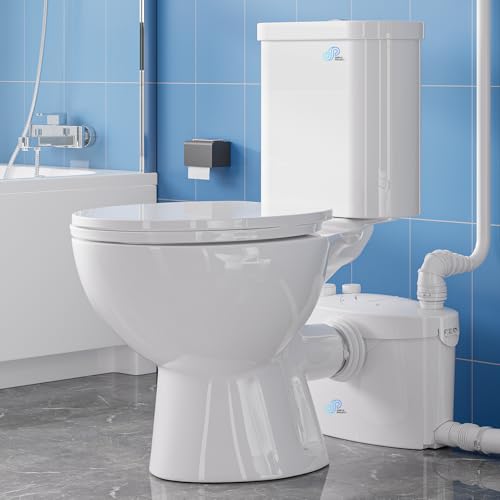
The Simple Project 750W PRO is a macerating upflush system: instead of relying on gravity, a 750W macerator pump reduces waste and pushes it to the existing drain, which is how a basement, attic conversion or garage bathroom becomes possible without breaking the floor. Four water inlets let it serve additional fixtures, and the dual flush keeps water use sensible. It is a problem-solver, not a conventional toilet: it needs electricity, the pump is a service item over a long life, and its bowl shape is not stated in the verified title.
The 750W PRO is the capacity pick of the macerating group, and its cleaning argument mirrors the SUPERFLO’s: enclosed pump housing, compact bowl, decisive pumped emptying that leaves less residue standing in the bowl between uses. For an attic or basement bathroom cleaned on a weekly round rather than daily, that decisiveness is the difference between a wipe and a scrub.
Strengths
- Adds a bathroom where no drain line exists
- Powerful macerator handles waste a gravity toilet cannot move uphill
- Four inlets can serve a sink and shower too
Trade-offs
- Bowl shape is not stated in the verified title
- Pump needs power and eventual servicing
- Not a standard gravity installation
Key specs (from the verified listing title): Macerating upflush system, 750W pump; 4 water inlets; Dual flush; Designed for basement installation; Quiet operation claimed.
Best for: Basement or below-grade bathrooms with no gravity drain / Not suited for: Standard bathrooms with a normal floor flange

SUPERFLO 750W Macerating Toilet System
Badge: Best for a Full Basement Bath
The SUPERFLO 750W system takes the same upflush approach: a macerating pump that lets a toilet work in a basement or garage where waste must travel up or across to reach the main drain. With four water inlets it can anchor a small bathroom group rather than a lone toilet. The trade-offs mirror every macerating system — dependence on power, a pump that will eventually need attention, and installation that follows the manufacturer’s venting and discharge instructions rather than a simple wax-ring set.
The SUPERFLO brings the same enclosed, wipe-down logic at 750W with four inlets — the fuller basement bathroom version. In a below-grade room that may also hold a shower, humidity is the cleaning enemy and smooth surfaces are the defence; this system’s housing-first design is the right instinct. As with its siblings, the title is silent on seat release, and the honest buyer checks.
Strengths
- Strong pump for below-grade installations
- Four inlets support a small full bathroom group
- Avoids cutting concrete for a new drain
Trade-offs
- Bowl shape is not stated in the verified title
- Requires power at the unit
- Pump servicing is part of long-term ownership
Key specs (from the verified listing title): Macerating upflush system, 750W pump; 4 water inlets; Designed for basements and garages; Powerful and quiet operation claimed.
Best for: Below-grade bathrooms, garage conversions and workshop washrooms / Not suited for: Conventional bathrooms with an existing floor drain

Simple Project Upgrade Macerating Toilet System (600W)
Badge: Best Macerating Pick
This upgraded Simple Project system uses a 600W macerator pump with three water inlets and an AC vent, designed to build a basement bathroom where gravity drainage does not reach. It is the middle option in the macerating family: enough pump for a toilet plus basin and shower connections, without the larger 750W units’ capacity. As with every upflush system, ownership means power dependence and eventual pump service, and local water-use rules should be checked before installation.
This 600W system’s cleaning case is its format: a compact macerating unit with a smooth enclosed housing, installed in the basement bathrooms where damp air makes every crevice a mould nursery. Fewer external contours mean a faster wipe-down, and the pump’s sealed path means the bowl empties decisively rather than leaving a standing waterline to scale. Its seat mount is not described in the title, so allow a closer look at the listing photos before assuming quick-release convenience.
Strengths
- 600W pump sized for a small bathroom group
- Three inlets can serve sink and shower
- Avoids breaking floors for drainage
Trade-offs
- Bowl shape is not stated in the verified title
- 1.6-class flush volume should be checked against local rules
- Pump needs power and servicing
Key specs (from the verified listing title): Macerating upflush system, 600W pump; 3 water inlets; AC vent included in description; Designed for basement installation; Powerful and quiet operation claimed.
Best for: Basement bathrooms and below-grade additions / Not suited for: Standard bathrooms with a working floor flange

Simple Project 600W Macerating Toilet System
Badge: Best Rear-Outlet Design
This Simple Project 600W system pairs a one-piece rear-outlet bowl with a macerator pump, three water inlets and an AC vent, and it can serve a sink and shower alongside the toilet. The rear outlet is the detail that matters in retrofits: waste leaves through the wall side to the pump rather than down through the floor. One caution is stated in its own title — the flush is listed at a 1.6 figure, which exceeds the 1.28 GPF ceiling enforced in strict jurisdictions, so local code must be checked before it is specified.
The rear-outlet design earns its cleaning badge honestly: with waste leaving through the rear, the bowl’s exterior loses the floor-level trapway bulge that collects dust and mop-water grime on conventional toilets, so the base wipes clean in one pass. Its stated 1.6 flush figure, however, exceeds strict 1.28 GPF jurisdictions’ ceilings — a compliance check, flagged here as in its San Francisco context, that comes before any cleaning virtue.
Strengths
- Rear-outlet one-piece bowl suits wall-side discharge
- Three inlets support a small bathroom group
- Upflush design avoids floor demolition
Trade-offs
- Stated 1.6 flush volume exceeds strict 1.28 GPF rules in some cities
- Bowl shape is not stated in the verified title
- Pump requires power and maintenance
Key specs (from the verified listing title): Macerating upflush system, 600W pump; One-piece rear-outlet bowl; 1.6 GPF-class flush as stated (1.6gbf); 3 water inlets; AC vent; Can serve sink and shower.
Best for: Below-grade or rear-discharge retrofits where a floor drain is impossible / Not suited for: Jurisdictions enforcing a strict 1.28 GPF maximum
Ann Katy Upgrade XL Portable Toilet
Badge: Portable Only (Prose-Only)
The Ann Katy Upgrade XL is a portable toilet in the camping sense: a lightweight, lidded unit sized generously for adults and intended for hiking, beach, boat and emergency use. It solves a real problem — sanitation where there is no plumbing — but it is not a bathroom toilet, it does not flush to a sewer, and it should never be compared with plumbed fixtures on flush power or comfort. In any guide about installed toilets it can only be an honest footnote for off-grid and emergency situations.
The Ann Katy’s cleaning is a different verb: emptying, rinsing and sanitising a portable unit after a trip. That is a real chore with its own products and routines, but it is not the weekly bathroom clean this keyword describes, and no amount of XL sizing makes a camping potty a bathroom seat. Prose-only, as the category difference demands.
Strengths
- Genuinely portable for camping, boats and emergencies
- XL size suits adults better than small camp potties
- No installation of any kind
Trade-offs
- Not a plumbed toilet: no flush plumbing or sewer connection
- Waste handling is manual
- Not a substitute for a bathroom fixture
Key specs (from the verified listing title): Portable format with lid; Extra-large (XL) sizing for adults; Lightweight and compact when stored; No plumbing connection.
Best for: Campers, boaters and emergency preparedness kits / Not suited for: Any plumbed bathroom, rental unit or code-inspected installation
Comparison Table
| Pick | Badge | Format | Key detail | Listing |
|---|---|---|---|---|
| TDH Luxury Smart Toilet with Bidet | Best for Cleaning Overall | One-piece smart toilet with built-in bidet | Instant warm water and warm-air dryer | Check on Amazon |
| Simple Project 750W PRO Macerating Toilet System | Best Pump Capacity | Macerating upflush system, 750W pump | 4 water inlets | Check on Amazon |
| SUPERFLO 750W Macerating Toilet System | Best for a Full Basement Bath | Macerating upflush system, 750W pump | 4 water inlets | Check on Amazon |
| Simple Project Upgrade Macerating Toilet System (600W) | Best Macerating Pick | Macerating upflush system, 600W pump | 3 water inlets | Check on Amazon |
| Simple Project 600W Macerating Toilet System | Best Rear-Outlet Design | Macerating upflush system, 600W pump | One-piece rear-outlet bowl | Check on Amazon |
| Ann Katy Upgrade XL Portable Toilet | Portable Only (Prose-Only) | Portable format with lid | Extra-large (XL) sizing for adults | Prose-only |
Judge this table by the cleaning route: construction and outlet columns tell you how many crevices each design presents, and the one row with stated cleaning modes is the row that leads the guide.
How to Choose the Right Toilet for Your Bathroom
To choose a toilet for easy cleaning, walk the weekly route in your imagination. Start at the seat hinges: can the seat release or lift so the hinge zone can actually be wiped, or is it a fixed crevice that will be dirty for a decade? Move to the bowl: a glaze that sheds waste and a rim design that washes evenly decide how much scrubbing the bowl demands, and a stated self-cleaning or bidet wash system, like the TDH’s, does part of the work at every use. Finish at the base: skirted or rear-outlet designs present a smooth wall to the cloth, while exposed trapways and bolt caps present a landscape.
Water quality writes the second half of the cleaning story. Hard water scales rims and waterlines wherever a toilet stands; a decisive flush that empties the bowl fully — the pumped emptying of the macerating picks is the extreme case — leaves less standing mineral water to deposit. In damp rooms, especially the below-grade bathrooms these macerating systems serve, ventilation is a cleaning feature too: a fan that clears humidity does more against mould than any coating, a point the basement-focused guidance in Best Toilets Round echoes for small rooms generally.
Start with the rough-in, because it is the one measurement that cannot be negotiated. Measure from the finished wall — not the baseboard — to the centre of the floor flange bolts. Twelve inches is standard, ten inches appears in older and smaller rooms, and fourteen inches exists in some older homes. A toilet built for the wrong rough-in either will not fit or will sit with an ugly, dust-collecting gap behind the tank. Every pick in this guide states its rough-in in its spec box where the verified title gives one; where it does not, confirm on the listing before ordering.
Next, sit-height. Measure your current toilet from the floor to the top of the seat and compare honestly. Standard height sits around fifteen inches, comfort and chair heights run sixteen and a half to nineteen, and ADA guidance centres on seventeen to nineteen inches to the top of the seat. Taller is easier for standing up and harder for shorter users and children, whose feet should rest flat for comfort and for children’s independence. There is no universally right answer — there is only the right answer for the people who will use the room every day.
Then water. Flush volume is printed as GPF, gallons per flush. The federal ceiling is 1.6 GPF, strict states such as California enforce 1.28 GPF, and dual-flush models split the difference with a light flush near or below one gallon for liquids. A household flushing five times per person per day saves a meaningful amount of water each year by choosing 1.28 over 1.6, and in a strict jurisdiction the choice is made for you: a 1.6 GPF toilet may not be legal to install at all. Check the stated GPF in each spec box against your local rule before anything else about a pick tempts you.
Finally, construction. One-piece toilets cost more effort to lift but clean in half the time and never leak at a tank joint. Two-piece toilets are easier to carry up stairs, cheaper to repair, and hide a seam that collects grime. Skirted designs hide the trapway for a smooth wipe-down; exposed trapways give easier access to bolts and supply lines. Neither is better in the abstract — the right choice follows your cleaning patience, your stairs, and your installer’s back.
How to Fit These Toilets and Keep Seat and Bowl Genuinely Clean
A toilet rewards an unhurried installation and a calm maintenance routine. The steps below are the standard sequence for a conventional floor-mounted toilet; macerating, marine and RV systems follow their manufacturers’ instructions instead, and any pick in this guide of those types should be installed from its own manual, not from this summary.
- Turn off the water supply and flush to empty the tank, then sponge out what remains in tank and bowl.
- Disconnect the supply line, unbolt the old toilet, lift it clear and scrape the old wax ring fully off the flange.
- Inspect the flange: it should sit level with or slightly above the finished floor, with no cracks. Repair a damaged flange before going further.
- Dry-fit the new toilet to confirm the rough-in and that the bowl sits without rocking on the finished floor.
- Fit a new wax ring (or the ring supplied with the toilet), lower the bowl straight onto the bolts without sliding it, and press down evenly.
- Fit washers and nuts finger-tight, then alternate sides with a wrench in small steps — porcelain cracks when one side is forced.
- Connect the tank on two-piece models, attach the supply line, and fit the seat using its supplied hardware.
- Turn the water on slowly, let the tank fill, check every joint for moisture, and flush several times while watching the base.
- Only when the base is proven dry, run a neat bead of sanitary sealant around the front and sides of the base, leaving the back unsealed so a future leak can show itself.
For keeping the toilet at its best: clean the bowl weekly with a non-abrasive cleaner, keep bleach tablets out of the tank because they degrade flappers and seals, check the supply connection and the base for moisture every few months, and replace the flapper at the first sign of phantom flushing — a toilet that refills briefly on its own is almost always asking for that inexpensive part. Tighten a rocking toilet promptly; movement breaks the wax seal long before the porcelain suffers.
Troubleshooting
Problem: the toilet rocks slightly after installation → stop and re-set it. Rocking is usually an uneven floor or a flange sitting too low; shims made for toilets, placed at the base edge, level the bowl before the seal is asked to hold.
Problem: the tank refills for a few seconds every hour → replace the flapper. It is the cheapest part in the system and the cause in the great majority of phantom-flush cases; check the chain length while you are there.
Problem: the flush feels weak on a dual-flush model → confirm you are holding the full-flush button long enough for solids, and check the tank water level against the mark inside the tank — a low fill quietly weakens every flush.
Problem: water appears at the base after flushing → do not just caulk over it. That is the wax seal asking to be replaced: lift, inspect the flange, fit a new ring and re-set the toilet.
The Seat Hinge Zone: the Dirtiest Square Inch in the Bathroom
Ask any professional cleaner where a bathroom’s effort concentrates and the answer is the seat hinge zone: the posts, caps and the shadow beneath them collect spray, dust and hair in a mixture that a surface wipe never reaches. The design cures are release mechanisms — seats that unclip or lift so the zone can be cleaned as a flat surface — and the chore cure is a monthly deep clean with the seat removed, using an old toothbrush where the cloth cannot go. When comparing listings, hinge access is worth more than a second flush button.
The smart-toilet answer is integration: on the TDH the seat belongs to a designed system, its underside shaped for wiping and its wash modes reducing what reaches the porcelain in the first place. Neither approach excuses the monthly deep clean — but both decide whether that clean takes four minutes or fourteen, fifty-two weeks a year.
Cleaning Chemistry That Helps, and Habits That Harm
Mild and regular beats strong and rare. A weekly non-abrasive clean keeps scale and biofilm from establishing; bleach tablets dropped in the tank are the classic false economy, degrading flappers and seals until the toilet leaks and the cleaning problem becomes a plumbing bill. In-tank cleaners also void some makers’ warranties — a detail worth more than the blue water is.
For the seat itself, warm water and a mild detergent on a soft cloth preserve both plastic and damper hinges; abrasive powders scratch the surface into a texture that then holds dirt, the opposite of the goal. Vinegar soaks shift light scale on porcelain; pumice made for toilets addresses established waterline rings on vitreous china only, never on plastic seats or smart-toilet components. The routine matters more than the arsenal — a truth the maintenance-minded readers of Best Toilets Ranked will recognise from flush care as well.
Hard Water, Scale and the Cleaning Calendar
In hard-water homes, the cleaning war is lost at the waterline and the rim jets. Mineral scale narrows the rim channels month by month until the bowl wash weakens and streaks survive the flush — at which point owners scrub harder at a problem that is actually inside the porcelain. The calendar cure is boring and effective: a monthly vinegar treatment for light scale, attention to rim jets with a small brush or mirror check each season, and a descaling routine for macerating systems exactly as their makers specify, since pump components meet the same water the bowl does. The smart toilet’s wash modes reduce what reaches the bowl; they do not repeal mineral chemistry.
Scale also explains a pattern cleaners misread: the toilet that cleans easily for two years and then suddenly does not. Nothing about the household changed; the rim jets narrowed past the point where the flush could rinse the bowl’s full circumference, and every clean became a negotiation with the dry streaks the water no longer reached. Restoring the jets — carefully, with the maker’s guidance — restores the toilet, which is why this guide keeps returning to the same sermon: design decides the weekly minutes, and water decides how long the design keeps its promise.
Build the calendar into the purchase. A toilet whose seat releases in seconds will get its monthly hinge clean; a toilet whose jets are reachable will get its seasonal check. The picks in this guide were graded on exactly that realism — not on how clean they look in a photograph, but on how clean a busy household can keep them in year three.
Living With a Macerating Toilet: the Maker’s Cleaning Routine
The four macerating picks in this guide ask for one cleaning habit their gravity cousins do not: respect for the pump’s chemistry. A macerator is a sealed unit with blades, seals and a motor, and the cleaning products that porcelain shrugs off can be unkind to the elastomers inside it. Makers of these systems typically bless specific descaling routines — often a proprietary or vinegar-based treatment on a stated cycle, especially in hard-water homes — and discourage the bleach-heavy improvisation that a conventional toilet tolerates. The routine is not onerous; it is simply specific, and the time to learn it is the day of installation, not the day the pump slows.
The bowl and seat of a macerating toilet clean like any other’s, with the bonus that the pumped emptying is decisive: less standing water in the bowl between uses means a slower waterline and less scale at the rim, the two fronts where the weekly clean spends its minutes. Externally, the enclosed housings wipe down in the smooth passes this guide has praised. The system’s one true cleaning cost is access discipline: keep the unit’s service clearances as the maker specifies, because the day the pump needs attention is the day a tiled-in installation becomes a renovation.
Households weighing a macerating pick for a basement bathroom should therefore budget cleaning as a system: the weekly wipe and bowl clean they know, plus the maker’s descaling cycle on the calendar, plus a fan that keeps the below-grade room dry enough for all of it to matter. Bought with that calendar understood, these are among the easiest toilets in the pool to keep genuinely clean — which is why they hold four of this guide’s six places without apology.
Which Pick for Which Household?
- The household that hates the weekly clean: the TDH smart toilet. Its stated cleaning modes, bidet washing and seamless one-piece shell attack the chore at its sources, and no other pick in the pool can make that claim in writing.
- The basement bathroom, toilet-led: either 600W Simple Project system, chosen by outlet layout — the rear-outlet model where wall-side discharge suits the room. Their enclosed housings wipe down fast in the damp rooms they serve.
- The fuller below-grade bathroom: the SUPERFLO or Simple Project 750W PRO, sized by inlet count and pump capacity. In a basement suite with a shower adding humidity, smooth enclosed surfaces are the cleaning strategy, and these are built that way.
- The trip-and-camp household: the Ann Katy — for the vehicle and the emergency kit, where its portable cleaning routine belongs. It earns its prose-only place honestly and should never be asked to be a bathroom.
Common Buying Mistakes
- Dropping bleach tablets in the tank and dissolving the flapper you then blame for leaking.
- Scrubbing plastic seats with abrasive powder, scratching them into a dirt-holding texture.
- Never removing the seat for the monthly hinge-zone clean — the dirtiest area is the one the cloth cannot reach in place.
- Buying on flush claims while ignoring construction: the tank seam and exposed trapway are where your weekly minutes go.
- Ignoring ventilation in a basement bathroom and fighting the mould that damp air guarantees.
- Assuming a stated feature the title does not contain — check seat release and bowl design on the listing, not in your hopes.
A closing thought on the weekly ten minutes: cleaning is the only interaction with a toilet that is guaranteed to repeat, fifty-two weeks a year, for the life of the fixture. Flush performance is felt in moments; design quality is felt in the cleaning rota, in hinge zones and seams and waterlines, long after the purchase price is forgotten. That is why this guide graded an unusual pool — a smart toilet and four macerating systems — without embarrassment: on the cleaning criterion, their designs genuinely lead. Buy the toilet whose cleaning route you have walked in your imagination and found short, and the chore shrinks to fit the design, as it should.
One more cleaning truth, learned by everyone who has kept a house: the toilet that stays clean is the one whose cleaning fits the household’s actual rhythm, not its aspirational one. A design that needs four minutes weekly from a household that gives it four minutes will look better in year five than a demanding design owned by optimists. Grade your own rhythm as honestly as this guide graded its pool, and choose the pick whose route — hinges, seams, waterline and all — fits inside it.
Final Recommendation
If cleaning effort is the brief, the TDH is the answer this pool supports best: a one-piece smart toilet whose stated cleaning modes and seamless shell are designed against the weekly chore itself. Among the macerating picks, choose by installation — the 600W Simple Project systems for a toilet-led basement room, the 750W pair where capacity and inlets matter — knowing their enclosed formats wipe down faster than the conventional toilets they replace below grade.
Whatever you install, buy the cleaning route, not the photograph: hinge access, construction seams and outlet position are the specification of a toilet that stays clean, and they are all visible before purchase to a buyer who knows to look.
Start your shortlist here: TDH Luxury Smart Toilet with Bidet — Check on Amazon · Simple Project 750W PRO Macerating Toilet System — Check on Amazon · SUPERFLO 750W Macerating Toilet System — Check on Amazon.
Frequently Asked Questions
What toilet design is easiest to keep clean?
One-piece or skirted designs with smooth bases, because they remove the tank seam and the exposed trapway where grime collects. In this pool the TDH’s one-piece shell is the exemplar, and the rear-outlet macerating design removes the floor-level trapway bulge entirely.
How do I clean around toilet seat hinges properly?
Monthly, remove or release the seat — most modern seats unclip or unbolt by hand — and clean the hinge zone as a flat surface with a cloth and an old toothbrush for the posts. Weekly surface wipes cannot reach the shadow under the hinges, which is why that zone is every bathroom’s dirtiest square inch.
Do bidet toilets really stay cleaner?
They help in two ways: washing with water leaves less residue in the bowl than paper alone, and smart toilets like the TDH state multiple cleaning modes with self-rinsing nozzles. They do not abolish the weekly clean, but they lower what it has to remove.
Are macerating toilets harder to clean?
Externally they are easier — compact bowls and smooth enclosed housings wipe down quickly, which suits the damp below-grade rooms they serve. Internally, the pump and macerator are sealed service items; follow the maker’s descaling guidance for hard water rather than improvising.
What cleaning products should I avoid?
Bleach tablets in the tank, which degrade flappers and seals, and abrasive powders on plastic seats and smart components, which scratch surfaces into dirt-holding textures. Mild detergent, non-abrasive bowl cleaner and a vinegar soak for light scale cover the honest needs.
Why is a portable toilet in this guide at all?
Because it was in the verified pool, and its presence teaches the category line: its cleaning is emptying and rinsing a portable unit, not maintaining a bathroom seat. It is reviewed prose-only so nobody mistakes it for a plumbed option — the same distinction drawn in Best Toilets Seats For Cleaning contexts wherever portables appear.
How often should a toilet seat be deep-cleaned?
Surface-wipe the seat weekly with the rest of the bathroom, and deep-clean the hinge zone monthly: release or remove the seat, clean the posts and the shadow beneath them as flat surfaces, and check the mount’s tightness while it is off. In hard-water homes, add a seasonal rim-jet check — that calendar keeps any pick in this guide genuinely easy to live with.


