Disclosure: topratedkitchenware.com is reader-supported. When you buy through links on our site, we may earn an affiliate commission from Amazon and other retailers, at no extra cost to you.
Where to buy
Every model in this guide is sold through Amazon, where you can check the live listing, flush specification, and owner feedback before buying. All six picks carry links — every one of them is a genuine flush-power contender, from a top-rated measured flush to a machine that grinds.
- HOROW 17 Inch Comfort Height Toilet — Check on Amazon
- Simple Project 750W PRO Macerating Toilet System
- TOTO Drake Two-Piece Elongated Toilet
- Gerber Maxwell Crest Elongated Two-Piece Toilet
- Simple Project 600W Macerating Toilet System
- MAXSA Elongated Two-Piece Toilet
Read the full guide ↓ for the flush-power breakdown of each model — measured scores, pump wattage, trapway design — and the honest boundary of what “anything” can mean for a toilet.
Let us define the search honestly before ranking anything: when people look for the best toilets that flush anything, they do not mean toys, wipes, or a dropped phone — no toilet flushes those, and the ones that try become plumbing emergencies. They mean the load that defeats ordinary toilets: the heavy, high-volume, worst-day flush that makes a standard fixture fill, swirl, hesitate, and leave its cargo behind. They mean a toilet that takes the worst their household produces, at a family gathering, with a queue outside the door, and clears it in one confident flush without a plunger, a prayer, or a second handle press. That is the standard this guide ranks against.
Six toilets meet it by three different technologies. The HOROW leads on measurement, with a published MaP 1000g flush rating — the top band of the industry test that flushes increasing loads of media until a toilet fails — and a full 1.6 GPF setting to deliver it. The Simple Project 750W PRO answers with machinery: a macerator that grinds waste before pumping it away, so the question stops being whether the load can pass and becomes whether it can be shredded, which it can. The TOTO Drake brings the proven gravity platform, a full-volume TORNADO FLUSH with a decade-deep reputation. Behind them, the Gerber Maxwell Crest contributes a glazed trapway built for bulk passage, the Simple Project 600W one-piece brings a full-volume flush to its own macerating system, and the MAXSA shows how far a well-designed 1.28 GPF siphonic flush can go.
The ranking principle is evidence in descending order: a published test score, then mechanical certainty, then a platform’s service record, then design claims. Every pick below clears the bar of an ordinary toilet by a wide margin; the order is about how completely each one removes doubt. Readers comparing the wider power-flush field will find the same hierarchy argued, in different words, across Best Toilets With Powerful Flush round-ups — measurement first, machinery second, marketing last.
Key Takeaways
- “Flush anything” honestly means any legitimate household load — no toilet flushes wipes, toys, or hygiene products, and trying is how emergencies happen.
- The HOROW leads on published proof: a MaP 1000g rating, the top band of the bulk-clearance test, with a full 1.6 GPF flush for solids.
- The Simple Project 750W PRO removes doubt mechanically — its macerator grinds waste to slurry, so passage is never the question.
- The TOTO Drake is the proven gravity answer: full-volume TORNADO FLUSH, a self-scouring bowl, and parts everywhere.
- The Gerber’s glazed trapway and the Simple Project 600W’s full-volume macerating flush are the strong supporting picks.
- The MAXSA clears impressively on 1.28 GPF — proof that design matters — but physics gives the full-volume picks the final margin.
In this guide
Quick Picks
Ranked by certainty: the measured champion, the mechanical certainty, the proven platform, then the strong designs in descending order of published evidence.
| Pick | Badge | Why it stands out | Link |
|---|---|---|---|
| HOROW 17 Inch Comfort Height Toilet | Best Overall — Measured Champion | Published MaP 1000g flush rating with a dual flush reaching a full 1.6 GPF — the heaviest tested clearance in this guide. | Check on Amazon |
| Simple Project 750W PRO Macerating Toilet System | Best Mechanical Certainty | 750W macerator with four inlets and dual flush: waste is ground to slurry and pumped out, so intact passage is never required. | Check on Amazon |
| TOTO Drake Two-Piece Elongated Toilet | Best Proven Gravity Flush | 1.6 GPF TORNADO FLUSH with CEFIONTECT glaze — the full-volume platform with the longest record of clearing heavy loads. | Check on Amazon |
| Gerber Maxwell Crest Elongated Two-Piece Toilet | Best Trapway for Bulk | Glazed trapway its listing says prevents clogs, a bowl-clearing flush, and a tool-free install kit with wax ring included. | Check on Amazon |
| Simple Project 600W Macerating Toilet System | Best One-Piece Macerating | One-piece 600W macerating system with a stated full 1.6 gallons per flush — grinding certainty in the tidiest format here. | Check on Amazon |
| MAXSA Elongated Two-Piece Toilet | Best Efficient Power | Comfort-height elongated toilet whose 1.28 GPF siphonic flush evacuates decisively — the design-over-volume proof piece. | Check on Amazon |
How These Picks Were Chosen
Scoring for this keyword weighed the three mechanisms that decide whether a heavy load clears. First, measured bulk performance: a MaP score is the industry’s standardised answer, produced by flushing standardised media loads until failure, and a published score outranked every other claim. Second, mechanical processing: a macerating system does not ask a load to pass intact through a trapway, so its pump wattage and flush volume were scored as certainty rather than probability. Third, gravity design: flush volume, flush platform, and trapway treatment, in that order, for the conventional toilets.
Only verified listing data was used. The MaP figure, the pump wattages, the flush volumes, and the trapway claim in these reviews are the manufacturers’ published specifications as supplied in the pool; where a listing is silent — the MAXSA publishes no score, the Gerber no volume — the review says so and ranks on design instead of pretending otherwise. Sentiment sources like Best Toilets That Flush Well discussions informed the framing of what households actually mean by “anything”, but no ranking rests on them.
This is a research-led guide, not a load-testing lab: we did not flush the MaP protocol ourselves. The scores quoted are the makers’ published results. No prices appear anywhere in the guide, because prices move — follow the links to the current figure on Amazon, and read the trade-offs with the strengths, because every technology here buys its certainty at a different price in money, water, or machinery.
The 6 best toilets that flush anything a household produces
The reviews run from measured certainty to strong design. By the end of the list the flushes are still far beyond ordinary — the ranking is about the last few percent of doubt, which is exactly what this keyword pays to eliminate.

HOROW 17 Inch Comfort Height Toilet
Badge: Best Overall — Measured Champion
Strengths
- MaP 1000g is the maximum band of the standard bulk test — the load this toilet cleared is a published fact
- Full 1.6 GPF setting delivers the rated power for solids, with a light 1.1 GPF for liquids
- 17-inch chair height, elongated bowl and soft-close seat fit the households producing the heaviest loads
Trade-offs
- The rating belongs to the full flush — a household living on the light setting owns a different toilet
- Newer brand, thinner long-term parts story than the legacy makers
- Chair height needs a step stool for shorter users and small children
Key specs from the listing
- Format: Two-piece, elongated
- Flush score: MaP 1000g (per listing)
- Flush: Dual flush 1.1/1.6 GPF
- Seat height: 17 inch, ADA chair height
- Seat: Soft-close
- Rough-in: 12 inch
Every other claim in this guide is an argument; the HOROW’s is a measurement. MaP testing exists precisely to answer this keyword: technicians flush a toilet with measured loads of soybean paste and paper, increasing the load until the toilet fails, and publish the grams it cleared. The scale tops out at 1000g, and that is the figure in this listing. Translated from the lab: the heaviest standardised load the industry throws at a toilet went through this one. For a buyer whose defining bathroom memory is a standard toilet failing on a heavy day, that is the sentence the whole search was looking for.
The engineering behind the number is a full-volume flush spent properly. The 1.6 GPF setting is the rated configuration, and it is the setting this guide instructs households to treat as the default for anything solid — the 1.1 GPF light flush is a water feature for liquids, not a personality trait. Around the flush, the format serves the same households: a 17-inch chair height for the tall and the stiff-kneed, an elongated bowl, and a soft-close seat that survives the family years.
The reservations are the familiar ones for a newer name: parts depth and decades-long support are promises rather than history, and the dual flush demands the one discipline described above. Neither dents the central fact. On the only published measurement this keyword recognises, the HOROW stands alone at the top of the scale — which is why the discussions in Best Toilets To Flush Heavy Turds keep arriving at measured flush performance as the answer, however the question is phrased.
Best for: Households whose ordinary loads defeat ordinary toilets, and who want the proof published / Not suited for: Buyers who will not enforce full-flush discipline, or who want a legacy brand first
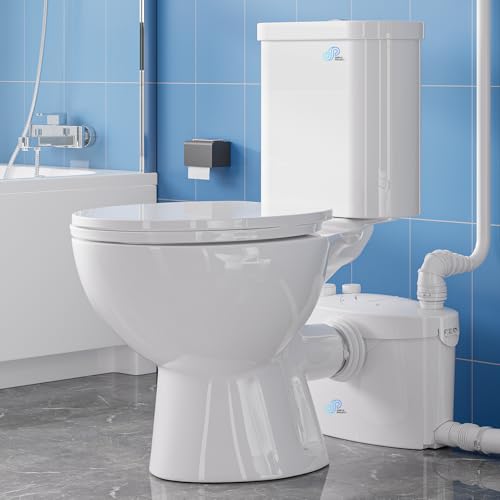
Simple Project 750W PRO Macerating Toilet System
Badge: Best Mechanical Certainty
Strengths
- Maceration changes the physics — a ground slurry cannot bridge a trapway the way a solid load can
- 750W is the strongest pump class here, with headroom for lifts and long runs
- Four inlets let the same certainty serve a full basement or attic bathroom
Trade-offs
- Machinery has a service life a gravity drain does not — the pump will need attention across the years
- Depends on electricity; an outage disables it entirely
- The paper-only rule is absolute, because the pump, not a trapway, meets every mistake
Key specs from the listing
- Format: Macerating upflush system
- Pump: 750W macerator
- Inlets: 4 water inlets
- Flush: Dual flush
- Use: Basements, attics, additions
- Design: Space saving
The HOROW wins the test; the 750W PRO declines to take it. A macerating toilet does not flush a load through a passage and hope — it receives the load, grinds it with a 750W macerator into a slurry, and pumps that slurry through a modest pipe to the drain. Ask whether it can “flush anything” and the honest answer is that the category of failure has changed: a solid load cannot obstruct a system that never transports solids. For the heaviest household use, that is a kind of certainty no gravity toilet, however rated, can structurally offer.
The PRO specification supports the promise at scale. The 750W motor is the joint-strongest here, sized for real lifts — a basement below the sewer line, an attic conversion at the top of the house — and four inlets extend the same grinding certainty to a basin, a shower, and a fourth fixture, so the whole added bathroom inherits the toilet’s reliability. The listing positions it for exactly those spaces, in a space-saving format that suits the conversions it serves.
The price of mechanical certainty is mechanical ownership, and this guide states it in every macerating review because buyers deserve it unstated nowhere: the pump is a wear item, power is a dependency, service access must be built in, and the input rule — waste and paper only — is enforced by a machine that jams on wipes instead of swallowing them. Households that accept those terms get the closest thing to a guaranteed flush that plumbing sells. Households that cannot accept them should take the measured gravity champion above, and the comparison between the two philosophies runs through Best Toilets With Power Flush debates everywhere: test scores versus machinery, probability versus process.
Best for: Basements, attics and heavy-use added bathrooms that want clearance guaranteed by process / Not suited for: Gravity-drained bathrooms that do not need a machine, or homes with unreliable power

TOTO Drake Two-Piece Elongated Toilet
Badge: Best Proven Gravity Flush
Strengths
- Full 1.6 GPF flush gives heavy loads maximum water transport through the bowl and down the line
- TORNADO FLUSH rim jets scour the bowl during the flush, so performance does not fade with residue
- Universal height, elongated bowl, and the deepest parts network in the guide
Trade-offs
- No MaP score is published in this listing — the evidence is a service record, not a figure
- Still a gravity toilet: a trapway can be defeated by non-flushables, as any trapway can
- Two-piece tank seam needs routine cleaning
Key specs from the listing
- Format: Two-piece, elongated
- Flush: 1.6 GPF, TORNADO FLUSH
- Seat class: Universal Height
- Glaze: CEFIONTECT
- Colour: Cotton White
- Model: CST776CSFG#01
The Drake is what proven looks like in this category. Its TORNADO FLUSH drives a full 1.6 gallons through rim jets in a circulating wash — the bowl is scrubbed at the same moment the siphon takes the load — and that volume continues down the drain run behind the waste, which is where heavy loads are actually won or lost in older houses. Plumbers recommend it for problem bathrooms not because of any single specification but because the whole system — volume, jets, glaze, trapway — was designed by a maker who understood that a flush is a transport event, not a rinse.
The CEFIONTECT glaze is the long-game advantage. Heavy-load performance fades in ordinary toilets as residue roughens the bowl and trapway entrance; a microscopically smooth glaze denies waste its grip, so the Drake’s thousandth flush resembles its first far more closely than an unglazed rival’s does. Add universal-height seating and parts available in every hardware store in the country, and the Drake is the toilet for the buyer who wants the problem solved for the longest possible time with the least possible ceremony.
It ranks third here on a technicality this guide refuses to hide: its listing publishes no MaP score, so on an evidence-ranked page it stands behind the toilet that publishes the maximum one and the machine that makes the test irrelevant. Plenty of households will rationally invert that order — a record across thousands of bathrooms is its own kind of measurement. What no one should do is mistake the ranking for a gap: the Drake clears heavy loads as a matter of long routine, and the comparisons in Best Toilets With Flush Pressure show its platform at the centre of the gravity school.
Best for: Conventional bathrooms, especially older homes, wanting proven heavy-load clearance / Not suited for: Buyers who want the published test figure, or a bathroom that needs a pump for drainage

Gerber Maxwell Crest Elongated Two-Piece Toilet
Badge: Best Trapway for Bulk
Strengths
- Glazed trapway keeps the bulk passage slick — the direct engineering answer to heavy loads
- Listing describes a flush that clears the bowl with ease
- Tool-free install kit with wax ring makes the upgrade a single-session job
Trade-offs
- No score and no flush volume published in the verified listing
- Professional-channel brand with thinner consumer information
- Fewer stated specifications overall — confirm the configuration on the listing
Key specs from the listing
- Format: Two-piece, elongated
- Trapway: Glazed, stated to prevent clogs
- Seat: Soft-close
- Install: Tool-free kit, wax ring included
- Colour: White
Strip a heavy-load flush down to physics and one component decides it: the trapway, the S-passage the load must travel, whose diameter sets the maximum passable bulk and whose surface decides how much of each load leaves a deposit behind. Gerber’s Maxwell Crest is the only gravity toilet in this pool whose listing leads with that component — a glazed trapway, stated to prevent clogs. Glazing keeps the passage as smooth as the bowl’s visible surface, so loads slide rather than grip, and the passage stays at its designed diameter year after year instead of narrowing with scale and residue.
The rest of the proposition is a tradesman’s idea of a complete answer: a flush described as clearing the bowl with ease, a soft-close seat, and an install kit that is tool-free with the wax ring in the box — the two errands that stall a replacement removed in advance. Gerber sells through plumbers more than through advertising, and the Maxwell Crest reads like it: no screen, no scent, just the component that matters, treated properly.
Its ranking is bounded by its paperwork. With neither a published score nor a stated flush volume in the verified data, it cannot be placed above the measured champion, the machine, or the famous platform — the evidence hierarchy this guide announced at the start. But for a buyer whose problem is specifically bulk passage in a conventional bathroom, the Gerber is aimed at the right inch of porcelain, and aimed by a maker the trade trusts. In the taxonomy of Best Toilets With Strong Flush discussions, it is the design-first entry, and design-first is a respectable school.
Best for: Bulk-passage problems in conventional bathrooms, and DIY replacers who want the full kit / Not suited for: Buyers who want a published score or a stated flush volume

Simple Project 600W Macerating Toilet System
Badge: Best One-Piece Macerating
Strengths
- Macerating action gives the same ground-slurry certainty as the PRO, in a one-piece presentation
- A stated 1.6 gallons per flush feeds the pump with maximum transport water
- Three inlets serve a complete small bathroom through the one system
Trade-offs
- 600W has less lift and run headroom than the 750W PRO for ambitious installs
- One-piece format is heavier to position during installation
- The macerator terms apply: power, service access, paper-only discipline
Key specs from the listing
- Format: One-piece macerating system
- Pump: 600W macerator
- Flush volume: 1.6 gallons per flush
- Inlets: 3 water inlets
- Vent: AC vent
- Outlet: Rear outlet
The second macerating entry trades a slice of the PRO’s pump headroom for the tidiest format in the guide: a one-piece system whose 600W macerator grinds the load and whose stated 1.6 gallons per flush — the full modern volume — gives the pump abundant water to move it with. The anti-anything logic is identical to its stronger sibling: nothing travels intact, so nothing bridges, and the heaviest household load becomes a pumping task the machine was sized for rather than a passage event with odds attached.
Where the 600W class draws its line is the discharge run. For the typical basement bathroom — a modest lift to the main, a short horizontal run — 600W is properly sized with room to spare, and the one-piece bowl presents like a designed fixture in a finished suite rather than an appliance behind a toilet. Stretch the run across the house or up a full extra storey and the PRO’s 750W stops being a luxury and becomes the correct specification; pump sizing, like flush volume, is insurance bought against the worst day.
Choose this system when the project is a finished added bathroom of ordinary ambition and the household wants grinding certainty without the utility-room aesthetic. It shares the class commitments — electricity, an access panel in the plan, and a paper-only rule the whole household can recite — and in exchange it retires the plunger from that bathroom permanently, which is the entire promise of this keyword delivered by the second technology that can honestly make it.
Best for: Finished basement suites and additions with typical lifts and runs / Not suited for: Long or high discharge routes, where the 750W PRO is the right size

MAXSA Elongated Two-Piece Toilet
Badge: Best Efficient Power
Strengths
- Siphonic action, once established, empties the bowl with a completeness rinsing flushes cannot match
- Clears on 1.28 GPF — the water bill and the septic tank both notice the mercy
- Comfort height, soft-close seat, easy-clean ceramic, standard 12-inch rough-in
Trade-offs
- Physics sets the ceiling: less water means less transport margin than the full-volume picks on the heaviest loads
- No published score or trapway claim in the listing
- The name pairs a 15-inch figure with comfort-height wording — verify the dimensions before ordering
Key specs from the listing
- Format: Two-piece, elongated
- Flush: 1.28 GPF, siphonic, water-saving
- Seat class: Comfort height (per listing description)
- Seat: Soft-close
- Rough-in: 12 inch
- Finish: Easy-clean white ceramic
The MAXSA closes the list as the control experiment: how far can design alone go against this keyword? Its weapon is the siphon. A siphonic toilet does not push the load through with water pressure; it establishes a siphon that pulls the bowl’s entire contents through the trapway in one evacuation, and a well-formed siphon at 1.28 GPF clears loads that embarrass lesser toilets using half again the water. In a modern home with sound drains, the MAXSA will handle family life — including most of its heavy days — without drama, while spending the least water in this guide.
The honest boundary is margin. “Flush anything” is a request for certainty at the extreme, and at the extreme the full-volume picks hold cards the MAXSA cannot: the HOROW’s tested maximum load, the macerators’ grinding, the Drake’s transport volume down a long run. On a short, modern, well-sloped drain, those margins may never be called. On an old, flat, or long one, they are the whole game — and this keyword’s buyers, by self-selection, are the people whose margins get called.
Buy the MAXSA, then, if your house is modern, your drains are proven, and your current toilet’s failures are about its own tired design rather than about heroic loads. It is a good toilet out of its weight class here only because the class is defined by extremes. The round-ups at Best Top Flush Toilets place such efficient siphonic designs respectably for ordinary homes — this guide simply insists that “anything” is not an ordinary brief, and ranks the certainty accordingly.
Best for: Modern homes with proven drains that want strong clearance with low water use / Not suited for: The heaviest loads on old, long, or flat drain runs
Comparison Table
Three technologies, one promise. The score, the wattages, and the volumes in this table are the whole argument — read them before the adjectives in any guide, including this one.
| Pick | Format | Flush and water | Seat and fit | Best for | Link |
|---|---|---|---|---|---|
| HOROW 17 Inch Comfort Height Toilet | Two-piece gravity | Dual 1.1/1.6 GPF, MaP 1000g | 17 inch chair height, elongated | Heaviest measured loads | Check on Amazon |
| Simple Project 750W PRO Macerating Toilet System | Macerating upflush | Dual flush, 750W pump | Enclosed system fit | Ground-waste certainty, any load | Check on Amazon |
| TOTO Drake Two-Piece Elongated Toilet | Two-piece gravity | 1.6 GPF TORNADO FLUSH | Universal Height, elongated | Proven heavy-load workhorse | Check on Amazon |
| Gerber Maxwell Crest Elongated Two-Piece Toilet | Two-piece gravity | Efficient flush (volume not stated) | Height not stated, elongated | Trapway-first bulk design | Check on Amazon |
| Simple Project 600W Macerating Toilet System | One-piece macerating | 1.6 gallons per flush, 600W pump | Enclosed system fit | Grinding certainty, tidy format | Check on Amazon |
| MAXSA Elongated Two-Piece Toilet | Two-piece gravity | Siphonic 1.28 GPF | Comfort height (verify), elongated | Efficient design, honest ceiling | Check on Amazon |
How to Choose a Toilet That Genuinely Flushes Anything
Flush-power shopping is a market of adjectives built on a foundation of three measurable things. This section names the three, shows how to weigh them for your house, and draws the honest line around the word “anything”.
Know the three mechanisms — and their evidence
Measured gravity performance is the first mechanism: a toilet whose flush has been load-tested under the MaP protocol and scored. The score is the only claim in the category that a stranger verified with a scale, which is why it leads this guide’s ranking. When you shop beyond this page, treat any “powerful flush” claim without a score, a volume, or a named platform as unpriced advertising — the maker knows the number and chose not to print it.
Mechanical processing is the second: a macerator replaces passage with grinding, converting the question from probability to process. Its evidence is wattage and flush volume, and its cost is machinery. Gravity design is the third: volume for transport, a platform that fires bowl and line together, and a trapway wide and glazed enough to pass bulk without accreting it. Every toilet in this guide is strong in at least one mechanism; the ranking is the order in which the mechanisms remove doubt.
Match the margin to your drain, not your optimism
Flush margin is spent in the drain run. A short, modern, well-sloped run forgives almost anything and lets an efficient siphonic design shine. A long run, a flat run, a run with a history — those spend margin on every flush, and they are where full volume and grinding earn their keep. Be honest about which run you own: the age of the house, the distance to the main, and the story of past blockages are the three witnesses, and they rarely lie in the optimistic direction.
Household load is the other half of the match. Count the users, the children, the gatherings, and the medical realities that make some homes’ ordinary loads other homes’ extremes. The right purchase is the one whose certainty covers your worst ordinary week — not the average Tuesday, and not the theoretical maximum a salesman imagines.
Draw the “anything” line where physics draws it
Finally, the boundary every honest guide must print: toilets are designed for human waste and toilet paper. Wipes — including every product labelled flushable — hygiene items, paper towels, cotton products, and children’s experiments with toys are not loads; they are obstructions, and they defeat champions. The macerators grind waste, not wipes; the rated flushes were tested on media, not on a dropped action figure. A household that wants “flush anything” performance must first agree on what anything excludes, or it will meet its plunger again holding the one object no toilet was built to pass. The fuller discussion of load discipline lives in Best Toilets With Forceable Flush reading, where the force in question is always water and machinery, never optimism.
How to Get Maximum Flush Performance From Day One
A champion flush can be installed carelessly into an ordinary one. These steps protect the performance you paid for, from the flange up, and keep it at full strength across the years.
- Start at the flange. A high-performance flush fires into whatever the flange gives it. Check the flange is intact, level, and at the right height before the toilet goes down — a restricted or misaligned outlet taxes every flush the toilet will ever make.
- Set the tank to its marked line. On gravity models, set the fill valve so the water level reaches the line marked inside the tank. A low tank silently converts a full-volume toilet into a three-quarter-volume one, and the heavy loads find out first.
- Use the full flush for solids — as law, not advice. On dual-flush models like the HOROW, the light setting is for liquids. Post the rule, teach the rule, and let no guest-economising undo the rating you bought.
- Keep the jets at full strength. Twice a year, check the rim jets and the bowl jet for mineral narrowing and clear them gently. Scale is a slow tax on flush power, and hard-water homes pay it fastest.
- Protect the trapway’s surface. Skip abrasive scouring inside the bowl and trapway entrance; a scratched glaze grips waste the way the unglazed surface the Gerber’s design avoids would. Ordinary cleaners and a soft brush preserve the slickness the performance depends on.
- For macerators, guard the pump like the engine it is. Paper and waste only, service access preserved, and a household that knows the sound of a healthy cycle — a change in that sound is the earliest warning, months before any failure.
After any performance change — a slower siphon, a bowl that needs a second flush for ordinary loads — work the cheap checklist before doubting the toilet: tank level, flapper lift and seal, jet clarity, and whether someone has quietly switched the household to the light flush for everything. In practice, one of those four explains nearly every “the toilet got worse” report, and each is a ten-minute fix that restores a champion to its rating.
Troubleshooting
Problem: the rated toilet hesitates on heavy loads it once cleared → what to do: check the tank water level and the flapper first — a short flush is the most common cause, ahead of any trapway problem
Problem: the macerator strains or stops mid-cycle → what to do: power it down and check for a forbidden object; a jammed pump run repeatedly becomes a burned motor, and the object is almost never something that should have been flushed
Problem: the bowl clears but the line gurgles afterwards → what to do: the load is travelling but the run is marginal — favour full flushes, and if gurgling brings slow drainage elsewhere, the line needs inspection rather than a stronger toilet
What MaP Testing Actually Does, and Why It Leads This Guide
Maximum Performance testing was created because toilet marketing had become unmoored from measurement. The protocol is admirably blunt: a toilet is flushed with soybean paste and paper in standardised loads, the loads increase, and the score records the largest load — in grams — that the toilet cleared completely, across repeated trials. It measures the single event this keyword cares about, in public, with a number. A score at the top of the scale, like the HOROW’s published 1000g, does not mean the toilet is perfect; it means that on the heaviest standardised load the industry applies, it did not fail.
Use the score with its limits in view. It is a bowl-clearance measurement under laboratory conditions: it cannot see your drain run’s slope, your household’s paper, or a decade of scale. That is why this guide pairs it with mechanisms and margins rather than treating it as a coronation. But in a category where every box claims power, the maker who publishes a maximum-band score has done something the others have not — submitted to the test. Shoppers comparing across the category will find the same respect for the number wherever measured models are separated from merely described ones.
Grinding Versus Flushing: Two Philosophies of Certainty
The deepest split in this guide is not between brands but between two ideas of reliability. The gravity philosophy says: design the passage and the water so well that failure becomes improbable, and accept the small residue of chance as the price of a machine with almost no moving parts. Its champions — the HOROW’s rating, the Drake’s record — are genuinely superb, and their failures, when they come, arrive as a plunger job. The macerating philosophy says: remove the passage problem from physics entirely, grind everything, and accept machinery — with its service life and its rules — as the price of certainty. Its failures, rarer per flush, arrive as service calls.
Neither philosophy is the correct one in the abstract; they are correct for different houses and different tolerances. A household that cannot abide any moving part in a toilet should buy the best measured gravity flush and keep a plunger it will rarely touch. A household that cannot abide the rare touch — the basement suite, the rental, the bathroom a queue depends on — should buy the grinder and keep its access panel honest. What this guide hopes to have made impossible is the third option: buying on adjectives, in ignorance of which philosophy you have actually purchased.
Common Buying Mistakes
The mistakes that defeat even champion flushes:
- Believing “flush anything” includes wipes. It does not, for any toilet, at any price. Wipes are the leading cause of champion toilets meeting plumbers.
- Living on the light flush. A dual-flush toilet’s rating belongs to its full flush. Light-for-everything ownership quietly converts a champion into an ordinary toilet.
- Letting the tank run low. A fill valve set under the marked line under-delivers every flush. Heavy loads are the first to know.
- Scouring the glaze away. Abrasive cleaning roughens the surfaces the performance depends on. The slickness is a specification; protect it like one.
- Buying power for a drain problem. Gurgling and multi-fixture slowness mean the line, not the load. A stronger toilet delivering waste to a closing line faster is not a cure.
- Undersizing a macerator to save money. Wattage is headroom for the worst run on the worst day. A pump at its limit ages loudly and early.
Final Recommendation
Buy the HOROW if you want the promise in writing: a published maximum-band MaP rating, a full-volume flush to deliver it, and a family-ready format around it. On the evidence standard this keyword deserves, nothing else in the guide — or most guides — stands ahead of a number like that. Check on Amazon
Buy the Simple Project 750W PRO if you would rather replace probability with process: a grinder does not care how heavy the load is, and for basement, attic, and rental bathrooms that certainty is worth its machinery. Check on Amazon The Drake remains the gravity traditionalist’s champion, the Gerber the trapway purist’s, and the MAXSA the proof that design still counts. Choose the certainty your house needs, enforce the paper rule, and the plunger becomes what it should have been all along — a tool you own but cannot remember using.
Frequently Asked Questions
Is there really a toilet that flushes anything?
There is a toilet that flushes anything it was designed for — human waste and toilet paper, in any realistic household quantity. The HOROW in this guide carries a published MaP 1000g rating, the maximum band of the industry load test, and the macerating systems grind waste so passage is never in doubt. There is no toilet that flushes wipes, hygiene products, paper towels, or toys; those obstruct champions and macerators alike, and the macerator they obstruct is the more expensive day. “Anything” in this category means any load, not any object.
What is a MaP score and why does it matter?
MaP — Maximum Performance — is an independent testing protocol that flushes a toilet with increasing standardised loads of test media and paper until it fails, publishing the gram weight it cleared. It matters because it is the only widely used measurement of exactly the event heavy-load shoppers fear. Scores at the top of the scale, like the 1000g published for the HOROW here, mean the toilet cleared the heaviest load the test applies. It measures bowl clearance in lab conditions, so drain condition and household habits still matter — but as evidence, it outranks every adjective in the industry.
Is a macerating toilet stronger than a regular toilet?
For the loads both can take, the macerator is more certain: it grinds waste to a slurry and pumps it, so a heavy load cannot bridge a trapway — there is effectively no trapway event. The trade is that it is a machine, with a motor that has a service life, a need for power, and an absolute intolerance of wipes. A top-rated gravity toilet like the HOROW or the Drake asks nothing but water and gives decades of nearly-as-certain service. Strength, in other words, depends on whether you count certainty per flush or certainty per decade.
How much water does a powerful flush need?
The strongest gravity performance in this guide comes at the full modern flush volume — the 1.6 GPF settings of the HOROW and the Drake — because water is the transport medium that carries a heavy load through the bowl and down the run. Design can economise impressively, as the MAXSA’s 1.28 GPF siphonic flush shows, but at the extreme loads this keyword targets, volume remains margin. On short modern drains the efficient designs rarely miss it; on long or flat runs, it is the difference the whole purchase turns on.
Why does my powerful toilet still clog sometimes?
Work the short list first: the tank water level below its marked line, a flapper dropping early, rim jets narrowed by scale, or the household using a light flush for solids. Then the harder list: a load that was never flushable, or a drain run that is narrowing and turning the toilet into the messenger. A champion toilet with a fading flush is almost always one of the first four — each a ten-minute fix — and recognising that saves both the plunger work and the doubt.
Should I choose a power-flush toilet for a rental property?
A heavy-clearance toilet is one of the best investments a landlord can make, because stop-ups are the most common plumbing call in rentals and each one costs a visit. Choose measured or proven clearance — the HOROW’s rating or the Drake’s record — with standard parts a handyman can source same-day, and pair it with a provided bin and a written flushables rule for tenants. The macerating option suits rentals only where drainage forces it, since a pump in a tenant’s hands needs the paper rule enforced by someone who may never read it.


