Disclosure: topratedkitchenware.com is reader-supported. When you buy through links on our site, we may earn an affiliate commission from Amazon and other retailers, at no extra cost to you.
Where to buy
Short on time? This is the shortlist behind our guide to the best toilets tiny houses, in ranked order. Linked names open the product’s online listing, where you can check the latest price on Amazon and confirm the full specification before you buy.
- SUPERFLO 750W Macerating Toilet System — Best Plumbed Pick for Slab Builds
- Simple Project Upgrade 600W Macerating Toilet System — Best Vented Macerator for Tiny Baths
- Simple Project 600W Macerating Toilet System — Best One-Piece Upflush
- Ann Katy Upgrade XL Portable Toilet — Best Zero-Install Stopgap
- Nature’s Head Structure Kit with Composting Toilet (Foot Spider Handle) — Best Complete Tiny-Home Kit (Foot Spider)
- Nature’s Head Structure Kit with Composting Toilet (Spider Handle) — Best Complete Tiny-Home Kit (Spider Handle)
Read the full guide ↓
Introduction: Toilets tiny houses — what actually matters
Choosing among the best toilets tiny houses can actually use is an infrastructure decision disguised as a shopping decision. A conventional home assumes a water supply, a sloped drain, a sewer or septic connection and a bathroom big enough to swing a door. A tiny house may have some of those, none of those, and a bathroom measured in single-digit square feet. The toilet has to fit the dwelling’s systems before it fits the room.
This pool, usefully, covers the three real tiny-house strategies. Two Nature’s Head composting kits delete water and drainage entirely — and their listings name tiny homes outright. Three macerating systems keep the familiar flush while deleting the gravity drain, pumping waste up or across to wherever the tiny house keeps its outlet. One portable unit deletes everything, for the build-in-progress or the simplest possible setup. Readers comparing the neighbouring question of Best Types Of Toilets For Tiny Houses will find the same evidence standards applied there.
All six are linked, because all six genuinely serve tiny dwellings — but they serve different tiny lives. A plumbed tiny on a foundation, a THOW (tiny house on wheels) that moves monthly, and an off-grid cabin build want different toilets, and the reviews keep those lives separate.
Key Takeaways
- Tiny-house toilets divide by infrastructure: composting (no water, no drain), macerating (flush, pumped drain), portable (nothing at all).
- Both Nature’s Head kits name tiny homes in their verified listings and arrive as complete, self-contained systems.
- Macerating picks suit tiny houses on slabs or foundations where a flush is wanted but a gravity drain cannot run.
- The portable pick is a stopgap and travel solution, not a whole-dwelling answer.
- Venting, power draw and waste routine — not bowl comfort — are the decisions that decide tiny-house toilet happiness.
In this guide
Quick Picks: best toilets tiny houses
| Pick | Badge | Stated highlights | Link |
|---|---|---|---|
| SUPERFLO 750W Macerating Toilet System | Best Plumbed Pick for Slab Builds | Type: macerating upflush system; Motor: 750W macerator; Inlets: 4 water inlets | Check on Amazon |
| Simple Project Upgrade 600W Macerating Toilet System | Best Vented Macerator for Tiny Baths | Type: macerating upflush system with pump; Motor: 600W macerator; Inlets: 3 water inlets plus AC vent | Check on Amazon |
| Simple Project 600W Macerating Toilet System | Best One-Piece Upflush | Type: macerating upflush system with pump; Motor: 600W macerator; Inlets: 3 water inlets plus AC vent | Check on Amazon |
| Ann Katy Upgrade XL Portable Toilet | Best Zero-Install Stopgap | Type: portable camping toilet, no plumbing; Size: XL, extra large stated; Features: lid stated, lightweight and compact stated | Check on Amazon |
| Nature’s Head Structure Kit with Composting Toilet (Foot Spider Handle) | Best Complete Tiny-Home Kit (Foot Spider) | Type: self-contained composting toilet kit, waterless; Kit: complete all-inclusive structure kit stated; Handle: Foot Spider handle stated | Check on Amazon |
| Nature’s Head Structure Kit with Composting Toilet (Spider Handle) | Best Complete Tiny-Home Kit (Spider Handle) | Type: self-contained composting toilet kit, waterless; Kit: complete all-inclusive structure kit stated; Handle: Spider handle stated | Check on Amazon |
How These Picks Were Chosen
We judged every pick against tiny-house constraints rather than bathroom norms: Does it need a water supply? A drain, and at what slope? Power, and how much infrastructure around it? What is the weekly waste routine, and what footprint does the unit claim in a room where every inch is budgeted? Listings that named tiny homes or off-grid living earned credit for speaking to the brief; general basement products were assessed on whether their mechanism genuinely transfers to a small dwelling. If your shortlist widens, Best Toilets Ranked is the companion comparison built for that angle.
The verified product pool for this guide was checked through the Amazon Creators API on 2026-11-20: every linked ASIN, product title and image in this article comes from that verified pool, and nothing has been added from memory, from another site, or from a retailer listing we could not verify. Specifications are quoted only where the verified title states them; where a title is silent — on a flush volume, a rough-in, a dimension — the review flags the silence instead of filling it with a plausible number.
Comfort features were scored last and honestly — a tiny-house toilet is sat on daily like any other, but a delightful seat on a system your dwelling cannot support is worthless. This is research-led comparison from stated specifications; no units were installed in a tiny house for this guide, and dimensions not stated in listings are flagged for a listing check rather than invented.
The 6 Best Toilets tiny houses

SUPERFLO 750W Macerating Toilet System
Badge: Best Plumbed Pick for Slab Builds
Strengths
- Full-power 750W grinding for demanding upflush runs
- Four inlets support a toilet plus additional fixtures on one pump
- Positioned for garages as well as basements, where drainage is often worst
Trade-offs
- Flush volume is not stated in the verified title
- Pump dependence means outages and macerator rules apply
- The strongest pump is more hardware than a simple powder room needs
Key specifications (as stated in the verified listing):
- Type: macerating upflush system
- Motor: 750W macerator
- Inlets: 4 water inlets
- Stated positioning: basements and garages
- Installation: described as easy installation in the listing
SUPERFLO’s 750W system matches the top power figure in this group and aims it at basements and garages — the two spaces most likely to lack a usable floor drain. Four inlets mean the pump can be the drainage hub for a small bathroom group rather than serving the toilet alone, and the listing describes installation as easy relative to conventional below-floor plumbing. In practice the appeal is route freedom: pressurised narrow pipe can rise to meet the main drain instead of demanding a continuous downhill slope through concrete.
In a tiny house on a slab or skid foundation, the SUPERFLO’s upflush design solves the one problem that stops a plumbed bathroom: the drain is never where the toilet wants to be. Pressurised narrow pipe lets the bathroom sit anywhere along the tiny floor plan, and four inlets mean the shower and basin share the route out.
In a tiny floor plan its four inlets let one pump serve the whole wet room, saving the space and money of separate drainage solutions. The ownership rhythm is ordinary flushing plus an ear for the pump’s cycle — a small tuition for a real bathroom in a slab-built tiny.
Best for: plumbed tiny houses on slabs needing drainage freedom / Not suited for: off-grid tinies without reliable power for a pump

Simple Project Upgrade 600W Macerating Toilet System
Badge: Best Vented Macerator for Tiny Baths
Strengths
- Updated version of the 600W platform with the same three-inlet flexibility
- Lets a basement gain a flushing toilet where gravity drainage cannot reach
- Quiet operation is stated in the listing, relevant for bathrooms near living space
Trade-offs
- Flush volume is not stated in the verified listing title, so water use cannot be compared from the title alone
- Electric pump dependence and macerator-only waste rules apply, as with the whole class
- Vent and power routing still need planning before purchase
Key specifications (as stated in the verified listing):
- Type: macerating upflush system with pump
- Motor: 600W macerator
- Inlets: 3 water inlets plus AC vent
- Stated positioning: basement upflush installation
The Upgrade 600W system is Simple Project’s refreshed take on its mid-power macerator: three inlets, a vent connection, and a pump sized for one added bathroom. It suits the classic problem — a basement, garage conversion or under-stairs space where the sewer line is above the floor or too far away for a gravity fall. Because the discharge travels through narrow pipe under pressure, the pipe run can climb and turn in ways a soil pipe cannot. What the verified title does not state is a flush volume, so any water-use comparison has to come from the full listing rather than assumption.
The vent connection is this pick’s tiny-house credential: in a dwelling where the bathroom is steps from the bed and the kitchen, odour management is not a detail. A vented macerator with three inlets covers a compact wet bath while keeping the air of a very small home honest.
The vent connection earns its keep most in the smallest dwellings, where bathroom air is living air. Owners who route the vent properly report the system disappearing into the household routine, which is the highest praise available to infrastructure.
Best for: compact vented wet baths in lived-in tiny homes / Not suited for: buyers needing stated flush volumes up front

Simple Project 600W Macerating Toilet System
Badge: Best One-Piece Upflush
Strengths
- Proven mid-power macerator format for adding a basement bathroom without floor demolition
- Three inlets plus a vent connection cover a toilet, sink and shower combination
- Rear-outlet bowl keeps the discharge path short and hidden behind the unit
Trade-offs
- The stated flush volume is the older full-volume figure, so it is not a water-saving design
- Needs a power outlet near the unit and a vent path, which not every basement corner offers
- As with all macerators, wipes and non-paper items are strictly off limits
Key specifications (as stated in the verified listing):
- Type: macerating upflush system with pump
- Motor: 600W macerator
- Inlets: 3 water inlets plus AC vent
- Outlet: rear outlet bowl
- Flush volume stated: 1.6 gallons per flush
This 600W Simple Project system is the middleweight upflush option: the same basic idea as its stronger sibling — grind, then pump — sized for a single added bathroom rather than a whole suite. The listing states three water inlets and an AC vent connection, a rear-outlet bowl, and connections intended to also serve a sink and shower. For a basement conversion that is the practical package: one pump, one small discharge line run up to the house drain, and no jackhammer work on the slab. The trade is dependence on power and on the macerator rules — only waste and toilet paper go in, ever.
The one-piece rear-outlet format suits a tiny wet room visually and spatially — no separate pump box eating floor beside the bowl. Its stated full-volume flush is the counterweight: a tiny house on a small water tank or well will feel 1.6 gallons per flush, so this pick fits plumbed tinies with a real supply, not minimal tank builds.
Its one-piece rear-outlet form keeps a tiny wet bath visually calm — no visible pump box competing for the room’s few inches of attention. The water budget is its honest cost, and plumbed tinies with real supplies will pay it without noticing.
Best for: finished tiny bathrooms with a real water supply / Not suited for: minimal-tank or water-hauling builds

Ann Katy Upgrade XL Portable Toilet
Badge: Best Zero-Install Stopgap
Strengths
- Needs no water supply, drain or installation of any kind
- XL sizing makes it more usable for adults than miniature camping potties
- Lightweight and compact for transport and storage
Trade-offs
- It is a camping and emergency product, not a bathroom toilet — no flush system or sewer connection
- Waste must be emptied and the unit cleaned manually after use
- No seat height, capacity or flush mechanism is stated in the verified title
Key specifications (as stated in the verified listing):
- Type: portable camping toilet, no plumbing
- Size: XL, extra large stated
- Features: lid stated, lightweight and compact stated
- Users stated: adults and kids
- Settings stated: hiking, beach, boat, emergency and RV use
The Ann Katy Upgrade XL is a portable camping toilet: a lidded, lightweight unit with no plumbing, no flush system and no connection to any drain. The listing positions it for hiking, beach trips, boats, RV use and emergencies, in an extra-large size intended to be more practical for adults than the smallest camping potties, and suitable for kids as well. Everything about it is manual — set it down, use it, empty it, clean it. That simplicity is exactly its value in the settings it was built for, and exactly its limit everywhere else.
For a build still in progress, a van conversion shakedown, or the simplest off-grid shelter, the Ann Katy is the zero-infrastructure answer: no install, no water, no power. In a finished tiny house it is a stopgap rather than a system — manual emptying at this scale is a daily chore, not a routine — but as the toilet you can use tonight, nothing else here competes.
Kept in a tiny house after the build, it becomes the festival toilet, the guest-overflow toilet, the power-cut toilet. Its long-term role is supporting, and households that assign it that role honestly are the ones still glad they bought it in year three.
Best for: builds in progress and emergency or travel use / Not suited for: a finished tiny house’s permanent system
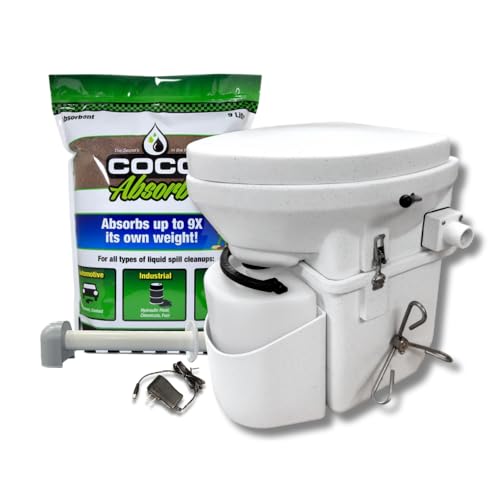
Nature’s Head Structure Kit with Composting Toilet (Foot Spider Handle)
Badge: Best Complete Tiny-Home Kit (Foot Spider)
Strengths
- Uses no water and needs no drain, sewer or septic connection at all
- The listing explicitly names tiny homes among its intended settings
- Complete kit format suits a from-scratch tiny build or cabin fit-out
Trade-offs
- Composting requires medium management and venting — a routine, not a flush-and-forget appliance
- Solids handling is manual by design, which not every household will accept
- Two near-identical Nature’s Head kits appear in this pool; compare handle types before choosing
Key specifications (as stated in the verified listing):
- Type: self-contained composting toilet kit, waterless
- Kit: complete all-inclusive structure kit stated
- Handle: Foot Spider handle stated
- Settings stated: cabins, tiny homes and off-grid living
- Water use: none — 100% self-contained waterless system stated
Nature’s Head is the name most associated with composting toilets in small dwellings, and this Structure Kit bundles the toilet into a complete, all-inclusive package the listing aims squarely at cabins, tiny homes and off-grid living. The system is waterless and fully self-contained: waste is composted in the unit rather than flushed away, so there is no drain to connect, no septic to size and no flush water to supply — three infrastructure problems deleted at once for a tiny build. The Foot Spider handle variant turns the agitator by foot. Ownership means managing composting medium and a vent, a simple recurring routine that replaces plumbing entirely.
This is the pick the keyword describes most literally: a complete composting kit whose listing names tiny homes, deleting water supply, drain and septic from the build sheet in one decision. For a THOW it also deletes the black-water tank and dump-station routine. The Foot Spider handle suits owners who prefer foot operation in a tight bathroom.
Ownership becomes a gentle cadence: turn the handle, mind the medium level, empty finished material on a schedule measured in weeks to months depending on use. Full-time couples and solo dwellers alike describe the routine shrinking to background within the first season.
Best for: off-grid and mobile tiny houses wanting a complete kit / Not suited for: households unwilling to manage compost medium

Nature’s Head Structure Kit with Composting Toilet (Spider Handle)
Badge: Best Complete Tiny-Home Kit (Spider Handle)
Strengths
- Waterless, drain-free composting in a complete kit aimed at tiny homes by name
- Hand-operated Spider handle keeps the mechanism simple and power-free
- Self-contained format works where no plumbing exists at all
Trade-offs
- Same compost-management routine as any composting toilet — medium, venting, manual emptying
- Very close in specification to the Foot Spider kit in this same shortlist
- Not a flushing toilet, so guest familiarity cannot be assumed
Key specifications (as stated in the verified listing):
- Type: self-contained composting toilet kit, waterless
- Kit: complete all-inclusive structure kit stated
- Handle: Spider handle stated
- Settings stated: cabins, tiny homes and off-grid living
- Water use: none — 100% self-contained waterless system stated
This second Nature’s Head Structure Kit shares the platform of the first — a complete, self-contained, waterless composting system the listing directs at cabins, tiny homes and off-grid living — and differs in the agitator handle: a hand-turned Spider handle rather than the foot-operated version. For a tiny home the underlying proposition is identical: no water supply, no black-water tank, no sewer or septic connection, and a footprint that fits a wet-room corner or a dedicated closet. The choice between the two kits is ergonomic — how you prefer to turn the compost — rather than functional.
The hand-cranked Spider twin of the kit above: identical tiny-house proposition — waterless, self-contained, plumbed to nothing — with the agitator turned by hand. In a stationary tiny on a foundation, where the toilet closet is laid out once and kept, the hand handle is the simpler mechanism with nothing at floor level to work around.
The hand-cranked kit suits the stationary tiny whose bathroom layout is fixed and considered; the handle’s swing becomes part of the room’s choreography. Its care rhythm is identical to its twin’s — the choice really is ergonomics, all the way down.
Best for: stationary tiny homes wanting simple hand operation / Not suited for: users who prefer foot-operated agitation
Comparison Table
One view of the whole shortlist for the best toilets tiny houses: stated format and headline specification per pick, with the honest gaps left visible. A dash in the link column marks a prose-only profile.
| Pick | Badge | Format | Headline stated specification | Link |
|---|---|---|---|---|
| SUPERFLO 750W Macerating Toilet System | Best Plumbed Pick for Slab Builds | macerating upflush system | Motor: 750W macerator | Check on Amazon |
| Simple Project Upgrade 600W Macerating Toilet System | Best Vented Macerator for Tiny Baths | macerating upflush system with pump | Motor: 600W macerator | Check on Amazon |
| Simple Project 600W Macerating Toilet System | Best One-Piece Upflush | macerating upflush system with pump | Motor: 600W macerator | Check on Amazon |
| Ann Katy Upgrade XL Portable Toilet | Best Zero-Install Stopgap | portable camping toilet, no plumbing | Size: XL, extra large stated | Check on Amazon |
| Nature’s Head Structure Kit with Composting Toilet (Foot Spider Handle) | Best Complete Tiny-Home Kit (Foot Spider) | self-contained composting toilet kit, waterless | Kit: complete all-inclusive structure kit stated | Check on Amazon |
| Nature’s Head Structure Kit with Composting Toilet (Spider Handle) | Best Complete Tiny-Home Kit (Spider Handle) | self-contained composting toilet kit, waterless | Kit: complete all-inclusive structure kit stated | Check on Amazon |
How to Choose Toilets tiny houses
Begin with the dwelling’s systems, not the toilet catalogue. Water: does the tiny house carry a plumbed supply with pressure, a tank you haul and refill, or no water to spare? Every flush toilet spends supply; a composting toilet spends none, which on a hauled-water build is the difference between a weekly and a daily refill rhythm. Drainage: a foundation tiny on a slab may reach a septic line only uphill; a THOW must carry waste to a dump point or compost it on board. Power: macerators and their pumps want reliable electricity; composting wants a small vent fan at most; a portable wants nothing.
Then plan the waste routine you will actually keep. Composting means medium on hand, a vent path to outside, and periodic emptying of finished material — a calm, infrequent routine most owners settle into, and a genuine commitment for anyone who will not. Macerating means ordinary flushing daily and pump awareness occasionally. Portable means frequent manual emptying — sustainable for a weekend, wearing for a winter. Tiny-house forums are full of toilet regret, and it is almost never about the seat; it is about a routine mismatched to the household. The related shortlist at Best Toilets Ratings applies the same stated-specification method to its own brief.
Finally, measure like a tiny builder. Footprint, door swing, knee room in front of the bowl, and service access all matter more at tiny scale. Where a listing does not state dimensions — several here do not — treat the full listing’s specification table as a required stop before ordering, and mock the footprint in tape on the floor. In a tiny bathroom, two inches is a design decision.
Consider the dwelling’s future when you choose, because tiny houses change state. A THOW may settle onto land with a septic connection; a cabin may gain a well; a build may add a grey-water system. Systems differ in how gracefully they hand over to a successor: a composting unit relocates or resells as a complete object, a macerator leaves pipework behind, a portable simply moves to the next project. Buying the toilet for the dwelling’s next chapter as well as this one is the mark of the second-time tiny builder.
How to Set Up a Tiny-House Toilet System That Works Daily
For a composting install, the sequence is: position for knee room and handle swing, route the vent hose to outside air with as few bends as the shell allows, connect the small fan power if your setup uses one, charge the chamber with medium per the manual, and do a smell-and-airflow check after the first week. Venting is the whole game — a well-vented composting toilet is famously neutral; a badly vented one is famously not. For the adjacent case, see the thinking collected under Best Toilets Reddit.
For a macerating install in a tiny, plan the discharge route before the bathroom walls close: shortest practical run to the outlet, gentle bends, and access to the pump preserved — tiny houses punish sealed-in appliances. Provide the power outlet on a circuit that will not be shared with a kettle and a heater at once. For a portable, designate its level spot and its emptying routine from day one; improvisation is what makes portables unpleasant.
Whichever system you choose, write the routine down for guests. Tiny houses host curious visitors, and every system here — compost crank, macerator rules, portable etiquette — has one non-obvious behaviour a guest will get wrong. A small card in the bathroom is the cheapest reliability upgrade in this entire guide.
Document your system for the dwelling’s future humans: a page in the tiny house’s folder with the toilet’s model, its routine, its vent or discharge route drawn by hand, and its quirks in plain words. Tiny houses change hands, host guests and get borrowed by family. The page costs an evening and converts your hard-won calibration into the dwelling’s permanent knowledge.
Troubleshooting
- Problem: a composting toilet smells indoors → check the vent path and fan first; odour in the room almost always means air is not being drawn through the unit and out, long before it means the compost itself.
- Problem: a macerator trips power in a tiny house → audit what shares its circuit; pumps draw hardest at start-up, and tiny electrical systems feel simultaneous loads that houses shrug off.
- Problem: the bathroom feels cramped beyond the tape mock-up → revisit handle swing and door arc; in tiny bathrooms the moving clearances, not the fixture footprint, usually steal the space.
Composting, Macerating or Portable: The Tiny-House Decision in One Pass
Composting wins when infrastructure is scarcest and the household accepts a managed routine: no water, no drain, no tank, and a listing-level pedigree in tiny homes from both kits here. It is the default recommendation of the tiny-house movement for good reason — it removes the two hardest services to provide in a small dwelling.
Macerating wins when the tiny is essentially a small conventional house — foundation, supply, septic or sewer nearby but awkwardly placed — and the household wants an ordinary flush with ordinary habits. Portable wins on day one of a build and on the road. The mistake is choosing by ideology; the right answer is the system your dwelling’s water, drain and power already support, maintained by a routine your household will genuinely keep. Households often cross-shop this with Best Toilets Resist Main Line Clogs, where the same products are judged on a different priority.
Designing the Tiny Bathroom Around the Toilet
In a tiny bathroom the toilet is the anchor tenant: it is the fixture that cannot move once systems are set, and everything else — shower drain, basin, door, storage — negotiates around it. Composting frees the layout most, needing only vent access; macerating frees the drain route but fixes a pump position; a conventional gravity toilet, notably absent from this pool, fixes the room to the drain entirely.
Wet-bath layouts, where the shower shares the toilet’s waterproof room, pair naturally with one-piece and compact formats and with composting units that shrug at humidity per their manuals. Dry-bath layouts reward the smallest footprint and the quietest system. Decide the room type first; the shortlist above then narrows itself. Households often cross-shop this with Best Toilets Resist Main Line Clogs, where the same products are judged on a different priority.
Power, Water and Waste: The Tiny-House Utility Triangle
Every tiny-house toilet decision is secretly a utilities budget. A flushing toilet spends water on every visit — trivial in a city flat, decisive in a dwelling whose entire supply is a tank measured in tens of gallons. A macerating toilet additionally spends electricity in short, strong bursts, which an off-grid system must schedule around the same battery bank that runs lights and refrigeration. A composting toilet spends neither, and instead spends a small continuous trickle of attention: medium, venting, and the owner’s routine.
Waste is the third side of the triangle. A plumbed tiny must store or export black water — a holding tank with dump-station visits, or a septic connection that ties the dwelling to one piece of land. A composting tiny exports finished material occasionally and locally. A portable exports small amounts frequently. None of these is free; they are priced in different currencies, and households differ in which currency they hold.
That is why this guide refuses a single winner. The listings support three coherent ways to pay the triangle’s price, and the right choice is the one whose currency — water, watts, attention, or dump trips — your dwelling already budgets for. Decide the budget first and the toilet selects itself.
Three Tiny Lives, Three Toilets
The THOW that moves with the seasons and parks where hookups are luck: the Nature’s Head kit is its natural citizen. No black-water tank to freeze or dump, no water spent on flushing, and a vent run planned into the shell. Between the two kits, this household picks by bathroom layout — foot operation where hands are busy, hand crank where floor space is sacred.
The foundation tiny on a rural lot with a well, a septic tank uphill, and an owner who wants an ordinary bathroom: the macerating systems were invented for this geometry. The SUPERFLO pumps the suite’s waste up to the septic line; the owner flushes like any homeowner and the triangle’s price is a modest electric draw.
The build in progress, lived in from the first framed wall: the Ann Katy carries the household through construction honestly, and many owners keep it afterwards as the outdoor or emergency backup. Its scenario is a reminder that the best toilet for a phase of tiny life is not always the best for the finished dwelling.
Field Notes: The First Season With a Tiny-House Toilet
Every tiny-house system has a learning season, and the households that expect one fare better than those promised none. Composting owners describe the first weeks as calibration — medium quantities, vent behaviour in their particular climate, the handle’s rhythm — followed by a long, dull competence. The ones who struggle almost always trace it to the vent: a bend too many, a fan unpowered, an intake competing with a wood stove’s draw.
Macerator owners in tinies describe a different calibration: electrical. The pump’s start-up draw meets the kettle, the heater, the inverter’s opinion. By the second month the household has an unconscious choreography of loads, and the bathroom behaves like any small house’s. The lesson generalises: in a tiny dwelling, every appliance is in a relationship with every other, and the toilet is no exception.
Portable owners in the build phase describe gratitude and a deadline in the same breath — gratitude that the simplest possible answer exists tonight, and a clear sense of the week it should stop being the answer. The builds that go well treat the portable as scaffolding: essential, temporary, and removed when the real system arrives.
Across all three, the first season’s other lesson is guests. Tiny houses attract the curious, and every system here has exactly one behaviour a visitor will get wrong. The card in the bathroom — unglamorous, handwritten, specific — is mentioned by experienced tiny owners with the seriousness usually reserved for structural advice.
Before You Buy: A Final Checklist
Run this list against your own bathroom before any pick in this guide — linked or prose-only — takes your money. It is the whole method of the article compressed into five checks.
- Your dwelling’s water reality: plumbed supply, hauled tank, or none to spare.
- Your drainage reality: septic or sewer and its direction, a holding tank, or none.
- Your power reality: grid, generous solar, or a battery bank that must be budgeted.
- The waste routine your household will keep for years, not weeks — chosen honestly.
- Footprint, handle swing, door arc and service access taped out in the actual room.
Which Pick, For Which Dwelling: A Final Routing
If your tiny house moves, or sits off-grid, or hauls its water, route to the Nature’s Head kits and decide only the handle. Foot Spider where the bathroom choreography favours it, hand Spider where the layout is fixed and simple. Everything else about the two is the same complete, waterless answer, and the listings’ own words — tiny homes — endorse the routing.
If your tiny house is a small plumbed house in disguise — foundation, supply, a septic that geography made awkward — route to the macerators: SUPERFLO for the fullest wet room and the longest route out, the vented Simple Project Upgrade for the compact bath, the one-piece 600W where the room’s finish matters and the water supply can feed its full-volume flush.
If your tiny life is currently a build site, a shakedown season or a van in transition, route to the Ann Katy now and to a permanent system when the dwelling settles. There is no shame in the sequence; there is only waste in pretending a phase is a destination, in either direction.
And whichever route you take, let the routing question stay the one this guide opened with: not which toilet is best, but which infrastructure your dwelling actually has — water, drainage, power — and which waste routine your household will still be keeping, cheerfully, in the third winter. The toilet is the answer to those questions, never a substitute for asking them.
Common Buying Mistakes
- Choosing a flush toilet for a hauled-water build and discovering the refill rhythm it imposes.
- Sealing a macerator pump behind finished walls with no service access.
- Skipping or shortcutting the composting vent because the run looked awkward.
- Assuming portable convenience scales from a weekend to full-time living.
- Ordering before taping the footprint — and the handle swing and door arc — on the actual floor.
Final Recommendation
For most tiny houses, start with the Nature’s Head kits: they are the only picks whose listings name this exact life, and they delete the most infrastructure. Choose the Foot Spider or the hand Spider by the ergonomics of your bathroom layout, not by any functional gap — there is none that the listings state.
Choose a macerating system when your tiny is a plumbed small house in disguise: SUPERFLO for drainage freedom across a fuller bathroom, the vented Simple Project Upgrade for a compact wet bath, the one-piece 600W where looks and a real supply meet. Keep the Ann Katy for the build phase, the road, and emergencies — roles it fills honestly and cheaply in effort.
Start your shortlist here: SUPERFLO 750W Macerating Toilet System, Simple Project Upgrade 600W Macerating Toilet System, Simple Project 600W Macerating Toilet System. Check on Amazon for the current listing details of each before you decide.
Frequently Asked Questions
What type of toilet is best for a tiny house?
The composting toilet is the movement’s default for a reason: it needs no water supply, no drain and no septic, which are the three hardest services in a small dwelling. Both Nature’s Head kits here name tiny homes in their listings. Plumbed tinies with awkward drainage are the macerating case; portables serve builds and travel.
Do tiny houses have flushing toilets?
Many do — where the dwelling has a water supply and a route to a sewer, septic or holding tank. The macerating picks in this guide exist for tinies whose drain route defeats gravity: the pump sends waste up or across through narrow pipe. A conventional gravity toilet needs its drain below and downhill, which many tiny layouts cannot offer.
How does a composting toilet work in daily life?
Liquids and solids are separated in the unit; solids are mixed with a composting medium by the handle after use and break down in the chamber, while a small vent keeps air moving outward. The routine is adding medium, turning the handle, and emptying finished material periodically — minutes of calm maintenance replacing all plumbing.
Can I use a portable camping toilet full-time in a tiny house?
You can, and some builders do during construction, but the manual emptying frequency makes it a wearing permanent system. It shines as the day-one solution, the travel toilet and the emergency backup. Most full-time tiny households graduate to composting or macerating, as this shortlist’s structure suggests.
Does a macerating toilet use much water or power in a tiny home?
Power draw is a pump’s brief run per flush — modest, but it requires reliable electricity, which off-grid tinies must budget. Water use follows the flush volume: one pick here states a full 1.6 gallons per flush, which a tank-fed build will notice; where a listing does not state volume, check the full listing before committing a small water system to it.
What should I measure before ordering a tiny-house toilet?
The taped footprint, knee room, door swing, and the swing of any handle — plus the service routes: vent path for composting, discharge run and outlet position for macerating, power point for pumps. Several listings here do not state dimensions in their titles, so the specification table on the full listing is a mandatory stop.
Can a tiny house use a normal flush toilet?
Yes, when the dwelling sits on a foundation with a water supply and a drain that runs downhill to a sewer or septic — some do exactly that. This pool contains no conventional gravity toilet because tiny layouts so often break one of those conditions; the macerating picks are the flush-preserving answer when the drain is the broken condition.
How much space does a composting toilet need?
Less than a conventional toilet and tank in most layouts, and no clearance behind for a cistern — but it needs working room: knee space, handle swing, and vent access. Several listings here do not state dimensions, so confirm the footprint and clearances on the full listing and tape them out in the actual room before ordering.


