Disclosure: topratedkitchenware.com is reader-supported. When you buy through links on our site, we may earn an affiliate commission from Amazon and other retailers, at no extra cost to you.
Where to buy
Short on time? This is the shortlist behind our guide to the best types of toilets for tiny houses, in ranked order. Linked names open the product listing, where you can check the latest price on Amazon and confirm the full specification before you buy. Picks marked prose-only are reviewed in full below without a sales link, for reasons stated openly in their reviews and in the sources note that accompanies this guide.
- Nature’s Head Composting Toilet Structure Kit (Listing A) — Best Overall for Tiny Houses — Check on Amazon
- SUPERFLO 750W Macerating Toilet System — Best Macerating Type
- Simple Project Upgrade Macerating Toilet System (600W) — Best Quiet Macerating Type
- Simple Project 600W Macerating Toilet System — Best Compact Macerating System
- Nature’s Head Composting Toilet Structure Kit (Listing B) — Best Composting Alternative Listing
- Ann Katy Upgrade XL Portable Toilet — Best Portable Type
Read the full guide ↓
Introduction: In a tiny house, the toilet is a systems decision
The best types of toilets for tiny houses are not smaller versions of suburban toilets — they are different answers to a harder problem. A tiny house may sit on a foundation with full hookups, on a trailer that moves, or off-grid with a water tank and a battery bank, and each of those lives permits different toilets. The six verified picks in this guide cover the three types that genuinely work at tiny scale: macerating systems that pump waste to wherever a line can reach, a portable type that asks for nothing at all, and composting systems that need no water and no sewer. Choosing among them is choosing how your tiny house handles water, power, and waste for years.
Space is the obvious constraint, but it is rarely the deciding one. The deciding constraints are infrastructure. A plumbed tiny house on a pad can run a compact gravity toilet — yet even there, a macerating type buys layout freedom, letting the bathroom sit wherever the floor plan wants it instead of wherever a drain can fall. A trailer tiny house adds motion and freeze risk, which punish stored water. An off-grid build adds arithmetic: every flush is water hauled, pumped, and stored again as waste. The types below map onto those lives, and the reviews grade each pick inside its type’s logic. Readers mapping the wider category can start from Best Types Of Toilets and the tiny-house-specific discussion at Best Toilets Tiny Houses.
Two honest notes before the ranking. First, two picks are separate verified listings of the same Nature’s Head composting kit; they are reviewed as their own slots, with the duplication declared, because kit listings diverge in contents and the comparison itself is useful. Second, no pick here is a standard gravity toilet, because the supplied pool — sensibly, for this keyword — is built from the types that free a tiny house from conventional plumbing. If your tiny house is permanently hooked up and you want the conventional answer, the types guide above is your reading; this guide is for everyone whose bathroom has to earn its footprint.
Key Takeaways
- Tiny-house toilet choice is an infrastructure decision: hookups, mobility, and off-grid arithmetic matter more than bowl size.
- Three types dominate at tiny scale — macerating, composting, and portable — and all six picks sit inside those types.
- Macerating types buy layout freedom: the bathroom can go where the floor plan wants, not where a drain can fall.
- Composting types eliminate water and sewer entirely, at the cost of an ongoing owner routine.
- The portable type is the zero-infrastructure answer — right for part-time and mobile tiny living, wrong as a full-time fixture.
In this guide
Quick Picks
Three macerating systems for plumbed-but-flexible tiny builds, two composting kit listings for waterless living, and one portable for the road. Badges name each pick’s tiny-house role.
| Pick | Badge | Why it is here |
|---|---|---|
| Nature’s Head Composting Toilet Structure Kit (Listing A) | Best Overall for Tiny Houses | Nature’s Head composting kit: 100% self-contained, waterless, built for tiny homes. |
| SUPERFLO 750W Macerating Toilet System | Best Macerating Type | 750W macerator, four inlets — serves a tiny bathroom suite from one pump. |
| Simple Project Upgrade Macerating Toilet System (600W) | Best Quiet Macerating Type | 600W macerator with three inlets; listing emphasises quiet operation. |
| Simple Project 600W Macerating Toilet System | Best Compact Macerating System | 600W one-piece macerating system, three inlets, AC vent, rear outlet. |
| Nature’s Head Composting Toilet Structure Kit (Listing B) | Best Composting Alternative Listing | Second verified Nature’s Head kit listing — compare kit contents before choosing. |
| Ann Katy Upgrade XL Portable Toilet | Best Portable Type | XL portable, lightweight with lid — the zero-infrastructure option for mobile tiny living. |
How These Picks Were Chosen
The pool was verified against Amazon’s Creators API on 2026-11-20, and every linked pick’s listing, brand, and image were confirmed there. Type coverage governed selection: for this keyword, a pick earns its place by representing a way a tiny house can actually handle waste — pumped, composted, or carried — and specification boxes quote only what the verified listings state, including pump wattage and inlet counts for the macerating systems.
Grading was type-appropriate. Macerating systems were judged on pump strength, inlet count, and stated quietness, because those decide how large a tiny bathroom suite they can serve and how livable the pump’s presence is. Composting listings were judged on self-containment and kit completeness. The portable was judged on portability and stated capacity for mixed users. The two Nature’s Head listings are declared duplicates in type — same verified description, separate listings — and the reviews treat the second as a comparison slot rather than pretending it is a different machine. That transparency standard runs across this programme’s small-space coverage, including Best Toilets Ranked for the conventional categories.
This is research-led guidance, not a season lived in a tiny house with each system. Where ownership involves a routine — compost management, pump service, portable emptying — the reviews describe the routine plainly so the commitment is chosen, not discovered. Prices are left to the live listings through check-price links, because printed figures go stale.
The Best Types of Toilets for Tiny Houses, Reviewed
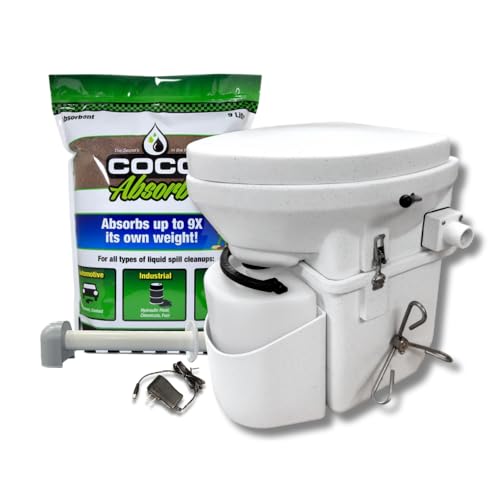
Nature’s Head Composting Toilet Structure Kit (Listing A)
Badge: Best Overall for Tiny Houses
Strengths
- Fully waterless and self-contained — no plumbing at all
- Purpose-built for tiny homes, cabins and off-grid settings
- Complete kit positioning simplifies the first setup
Trade-offs
- Composting routine is ongoing owner involvement, not flush-and-forget
- Vent routing still needs planning in a tiny build
- Guests unfamiliar with composting toilets need a short briefing
Key specifications (from the verified listing)
- Format: Composting toilet, complete structure kit
- System: 100% self-contained, waterless
- Stated settings: Cabins, tiny homes, off-grid use
Nature’s Head is the name most associated with composting toilets in small-space living, and this listing is its complete structure kit: a 100% self-contained, waterless composting system positioned for cabins, tiny homes, and off-grid settings. The principle is separation and composting rather than flushing — liquids and solids are managed separately, solids are broken down in a composting medium, and no water, sewer, or septic connection is involved at all. For a tiny house that is the entire appeal: the toilet stops being a plumbing problem and becomes a self-contained appliance with a vent. Ownership is a routine rather than an event — managing the medium, emptying on a cycle, keeping the vent clear — and households that accept that routine gain a bathroom that works identically on a foundation, on a trailer, or off the grid entirely.
For the archetypal tiny house — small footprint, precious water, no sewer connection to lean on — the composting type is the answer the movement itself converged on, and Nature’s Head is its reference maker. This complete structure kit removes the toilet from the plumbing plan entirely: no flush water drawn from a small tank, no black-water storage to pump out, no drain field to permit. In a tiny house those absences compound — the water system shrinks, the floor plan frees, and winterisation stops being a plumbing anxiety. The type’s price is a routine: managing the composting medium, keeping the vent clear, and emptying on a cycle. Tiny-house owners, who already run their homes by conscious routine, are exactly the people who tend to find that price fair — and this kit, sold as complete, is the gentlest entry into paying it.
Best for: Off-grid and water-conscious tiny houses wanting a permanent, plumbed-free toilet / Not suited for: Owners who want flush-and-forget with zero routine

SUPERFLO 750W Macerating Toilet System
Badge: Best Macerating Type
Strengths
- 750W pump is the strongest macerator rating in this pool
- Four inlets can serve a small basement bathroom suite
- Avoids breaking concrete for a gravity drain line
Trade-offs
- Pump noise and power dependence come with the format
- Mechanical system needs eventual pump service
- Overkill where a normal gravity rough-in already exists
Key specifications (from the verified listing)
- Format: Macerating upflush toilet system
- Pump power: 750W macerator
- Connections: 4 water inlets
- Intended locations stated: Basements and garages
The SUPERFLO system is the heavy-duty end of the macerating idea: a 750W macerator pump and four water inlets, positioned by its listing for basements and garages. Four inlets matter because they let the same pump serve a small suite — toilet, basin, shower, and one more fixture — which is how a basement bathroom gets built without excavating the slab for a gravity drain. The stronger pump rating is about head height and distance: pumping waste up and across to the main stack is work, and undersized pumps are the ones that struggle. Like every macerating system it trades the silence and simplicity of gravity for freedom of placement, and it should be judged on that trade, in rooms where the trade is the only way to get a bathroom at all.
Where a tiny house has water and power but no convenient drain — a pad build whose bathroom landed far from the septic line, a conversion under a loft — the macerating type is the layout liberator, and the SUPERFLO is its strongest representative here. The 750W pump is the pool’s most powerful, and four inlets let one system serve the whole tiny bathroom: toilet, basin, shower, and a fourth fixture. That suite capacity matters disproportionately in tiny design, where a second pump or a moved wall is a budget event. The type’s honest costs ride along: pump noise in a small volume, power draw in the house’s electrical budget, and a machine with a service life where porcelain would have none. For a hooked-up tiny house that needs plumbing freedom, those costs buy the floor plan — usually the right trade.
Best for: Hooked-up tiny houses whose bathrooms sit away from the drain line / Not suited for: Off-grid builds counting watts and water

Simple Project Upgrade Macerating Toilet System (600W)
Badge: Best Quiet Macerating Type
Strengths
- 600W macerator with three inlets covers a small suite
- Listing emphasises quiet operation for living-space basements
- Up-flush format avoids slab excavation
Trade-offs
- Still a powered, mechanical system with service needs
- Three inlets is one fewer than the four-inlet alternative here
- Not suited to replacing a healthy gravity installation
Key specifications (from the verified listing)
- Format: Macerating upflush toilet system
- Pump power: 600W macerator
- Connections: 3 water inlets, AC vent
- Operation described: Powerful and quiet operation
This Simple Project listing is the upgraded 600W macerating pattern: three water inlets and an AC vent behind a one-piece-style bowl, described by its listing as powerful and quiet in operation. The use case is identical in spirit to its siblings — a bathroom below or away from the main drain, typically a basement — but the positioning leans on refinement: quieter running matters more when the new bathroom sits under a bedroom or beside a family room. Three inlets cover the standard small-suite combination of toilet plus basin plus shower. As with all macerators, the honest comparison is not against a gravity toilet in a plumbed bathroom, but against the cost and disruption of the alternative, which is usually cutting concrete or not having the bathroom.
In a tiny house, every appliance is in the same room as your life, which is why this Simple Project listing’s emphasis on quiet operation earns it a distinct slot rather than also-ran status. Its 600W macerator and three inlets cover the standard tiny suite — toilet, basin, shower — and its up-flush format places the bathroom without slab or gravity constraints. The comparison with the SUPERFLO above is a genuine tiny-house decision: one more inlet and more pump, versus a listing that leads with refinement for living-space proximity. A tiny bathroom under a sleeping loft argues for quiet; a tiny bathroom serving a family argues for capacity. Either way, the type’s shared terms apply — power dependence and eventual pump service — and both listings should be read as buying layout freedom at those terms.
Best for: Tiny houses where the bathroom sits close to sleeping space / Not suited for: Builds needing a fourth inlet or fully off-grid operation

Simple Project 600W Macerating Toilet System
Badge: Best Compact Macerating System
Strengths
- Creates a working bathroom where no floor drain exists
- Three inlets let a sink and shower share the system
- Up-flush design avoids breaking up a concrete floor
Trade-offs
- Depends on power and a pump — moving parts a gravity toilet lacks
- Not a gravity toilet: different maintenance and noise profile
- Installation is a small plumbing project, not a simple swap
Key specifications (from the verified listing)
- Format: One-piece toilet with macerator pump system
- Pump power: 600W macerator
- Flush volume stated: 1.6 GPF class up-flush
- Connections: 3 water inlets, AC vent
- Outlet: Rear outlet bowl
The Simple Project macerating system exists for rooms where gravity cannot do the work: a basement, garage conversion, or attic space with no soil pipe below the floor. Its 600W macerator grinds waste and pumps it upward to the main line, and the listing states three water inlets plus an AC vent, so a sink and shower can share the system to build a small bathroom where none was plumbed. That is a genuinely different product from a gravity toilet — it trades mechanical simplicity for locational freedom, and it depends on electrical power and a pump that will one day need service. In guides about gravity formats it belongs in the conversation as the honest alternative for impossible rooms, clearly labelled, rather than as a like-for-like substitute for a tank-and-bowl toilet.
This Simple Project system is the macerating type in its most integrated form: a one-piece toilet with the 600W pump system behind it, three water inlets, an AC vent, and a rear outlet. For a tiny house, the integration is the point — one appliance to place, plumb, and vent, rather than a toilet plus a separate macerator box competing for the same scarce cubic feet. The rear-outlet design suits the type’s purpose: waste leaves horizontally to the pump’s chosen route, not down through a floor that may be a trailer deck. Read against its siblings, it is the middle path — same pump class as the quiet-positioned listing, a more unified body than either. Its type-level limitations are the family’s: electricity, noise, and a pump’s lifespan, accepted in exchange for putting a flush bathroom where no drain exists.
Best for: Tiny builds wanting one integrated up-flush unit / Not suited for: Off-grid houses or owners avoiding mechanical systems

Nature’s Head Composting Toilet Structure Kit (Listing B)
Badge: Best Composting Alternative Listing
Strengths
- Same waterless, self-contained composting proposition
- A second verified listing gives buyers a comparison point on kit contents
- Purpose-built for tiny homes, cabins and off-grid settings
Trade-offs
- Near-identical listings demand careful comparison before ordering
- Composting routine is ongoing owner involvement
- Vent routing still needs planning in a tiny build
Key specifications (from the verified listing)
- Format: Composting toilet, complete structure kit
- System: 100% self-contained, waterless
- Stated settings: Cabins, tiny homes, off-grid use
This second Nature’s Head structure-kit listing carries the same verified description as its sibling — a complete, 100% self-contained waterless composting kit for cabins, tiny homes, and off-grid use — under a separate listing. We review it as its own slot because the pool verifies it separately, and because duplicate listings are a real feature of shopping for this category: the sensible reader move is to compare the two listings’ current configurations and included components carefully before choosing, since kit contents are where near-identical listings diverge. The underlying proposition is unchanged: separation-based composting, no water or sewer connection, a vented self-contained unit that suits a tiny house exactly because it asks nothing of the building’s plumbing. Whichever listing a buyer picks, the ownership routine — medium management and scheduled emptying — is the same.
This slot is deliberately a mirror: a second verified listing of the Nature’s Head composting structure kit, carrying the same verified description as the first. Its value to a tiny-house buyer is procedural, not mechanical. Composting kits are bought as bundles — the toilet, the structure components, the medium, the venting pieces — and near-identical listings are exactly where bundle contents quietly differ. The tiny-house lesson generalises beyond this brand: when two listings describe the same system, the decision lives in the included-components list, and ten minutes comparing those lists is worth more than any badge. The underlying type judgement is unchanged from the first listing — waterless, self-contained, routine-based — so a buyer convinced by the composting argument should treat these two slots as one decision with two doors, and walk through the one whose kit is more complete.
Best for: Composting-committed buyers comparing kit completeness across listings / Not suited for: Buyers wanting a mechanically different alternative to the first listing

Ann Katy Upgrade XL Portable Toilet
Badge: Best Portable Type
Strengths
- Lightweight and compact with a lid for transport and storage
- XL sizing stated for adults, while still listed for kids
- No plumbing or power needed — works anywhere
Trade-offs
- No flush system: waste handling is manual by design
- Stability cannot match a floor-fixed fixture
- A trip tool, not a substitute for a home bathroom
Key specifications (from the verified listing)
- Format: Portable toilet, extra large
- Design: Lightweight and compact, with lid
- Stated users: Adults and kids
- Stated uses: Camping, hiking, beach, boat, emergency, RV
The Ann Katy is the pool’s true portable: an extra-large, lightweight camping toilet with a lid, listed for adults and kids across camping, hiking, beach, boat, emergency, and RV use. Portability changes every criterion. There is no flush power to compare because there is no plumbing; what matters is stability under an adult, a lid that seals between uses, a size that packs into a vehicle, and a shape a child can manage at a campsite. The XL sizing is the differentiator in its listing — many portable potties are sized for children or slight adults, and a design that states extra-large capacity suits family camping where one unit serves everyone. It will never be a bathroom fixture, and judged as one it fails; judged as the thing that makes a tent, a boat, or a road-trip stop workable, it is exactly the right shape of product.
The portable type is the tiny-house answer for the lives that are only partly tiny: the trailer that travels, the build still under construction, the guest overflow, the season before the permanent system goes in. The Ann Katy’s XL, lightweight, lidded design is the type done properly for mixed users — sized for adults, stated for kids as well, and sealed between uses. Judged as a type, its virtues are total: no water, no power, no installation, and it leaves with you. Its limitation is equally total: waste handling is manual and frequent, and as a full-time, years-long fixture for a household it asks more than most owners will happily give. The honest tiny-house verdict is that the portable is a brilliant bridge and a poor destination — buy it for the journey, the build phase, or the road, and let one of the types above be the home.
Best for: Mobile tiny living, build phases, and guest overflow / Not suited for: A full-time household’s permanent only toilet
Comparison Table
The first decision is the type column — pumped, composted, or carried — because it follows from your tiny house’s infrastructure. Pump wattage and inlets separate the macerating siblings; the composting rows differ by listing, not by machine.
| Pick | Badge | Defining trait | Listing |
|---|---|---|---|
| Nature’s Head Composting Toilet Structure Kit (Listing A) | Best Overall for Tiny Houses | Composting type, waterless, self-contained kit | Check on Amazon |
| SUPERFLO 750W Macerating Toilet System | Best Macerating Type | Macerating type, 750W pump, 4 inlets | Check on Amazon |
| Simple Project Upgrade Macerating Toilet System (600W) | Best Quiet Macerating Type | Macerating type, 600W, quiet-operation positioning | Check on Amazon |
| Simple Project 600W Macerating Toilet System | Best Compact Macerating System | Macerating type, one-piece, 3 inlets, AC vent | Check on Amazon |
| Nature’s Head Composting Toilet Structure Kit (Listing B) | Best Composting Alternative Listing | Composting type, waterless kit (alternate listing) | Check on Amazon |
| Ann Katy Upgrade XL Portable Toilet | Best Portable Type | Portable type, XL, no plumbing or power | Check on Amazon |
How to Choose the Right Toilet Type for a Tiny House
Start with your tiny house’s infrastructure, stated bluntly. If the house is permanently sited with water, power, and a sewer or septic connection within a sane distance, you have every option in this guide and one more — a conventional compact toilet, covered in the general types guide. If the house has water and power but the drain cannot reach the bathroom, the macerating types exist for you. If water is hauled or tanked and every litre is counted, composting is the arithmetic winner. If the house moves, or is not yet finished, the portable type covers the gap. Most tiny-house toilet regret comes from choosing a type for a house you wish you had instead of the one on your land.
Water arithmetic deserves real numbers. A flush toilet in a tiny house drinks from the same tank that showers and dishes draw on, and its waste must then be stored or treated — so each flush is spent twice, once as supply and once as capacity. A composting toilet spends water zero times, which is why off-grid tiny houses converge on it despite the routine. A macerating toilet spends like a flush toilet plus a pump’s electricity, and in an off-grid power budget that draw belongs in the spreadsheet beside the fridge and the water pump. Run your own house’s numbers — tank size, flush count, battery capacity — before falling for any type’s brochure.
Space planning is subtler than footprint. A composting unit needs vent routing and clearance to remove its container; a macerating system needs access to its pump for the service day that will eventually come, plus an electrical point; a portable needs a dignified storage spot and an emptying route you will actually walk weekly. Measure the bathroom with those service envelopes included, not just the fixture’s outline. In two hundred square feet, a toilet that cannot be serviced without dismantling joinery is a design error, however small its footprint. The tiny-house guides in this programme, including Best Toilets Resist Main Line Clogs for the plumbed cases, return to this service-access point often because experience keeps teaching it.
Finally, be honest about routine tolerance — yours, specifically. Composting asks for regular, unglamorous attention forever. Macerating asks for nothing until it asks for a pump service, possibly urgently. Portable asks for frequent small efforts. Conventional plumbing, where available, asks the least of all, which is why it remains the default wherever infrastructure allows. Tiny living rewards owners who choose systems matching their actual tolerance rather than their aspirational one; the toilet is the system where that honesty matters most, because it cannot be quietly neglected.
One last tiny-house filter: weight and its distribution. A composting unit is light and stays light. A macerating system adds a pump, pipework, and the water standing in them. A portable is trivial until its tank is full, at which point it is a heavy object to carry through a small door. In a house on wheels, those kilograms sit on an axle with a rating; in a house on a foundation, they sit in your arms on service day. Weigh the system as it will exist in its worst moment — full, due for service, mid-winter — and not as it leaves the box.
How to Set Up and Run a Tiny-House Toilet System
Installation in a tiny house is less about the fixture than about the routes around it: vent, water, power, and your own access. The steps below follow the sequence experienced tiny builders use — decide the routes first, place the fixture second.
- Fix the type to the infrastructure before buying: hookups and drain distance for macerating, vent route for composting, storage and emptying route for portable.
- Plan the vent path for composting and macerating systems while walls are open; a straight, short vent run is easier to keep clear and quiet than a clever one.
- Leave a service envelope: pump access for macerating systems, container-removal clearance for composting units, and never box either in permanently.
- For macerating systems, put the pump circuit on its own protected outlet and note the breaker; in a tiny electrical panel, knowing which switch revives the bathroom is not trivia.
- For composting systems, establish the medium routine from day one — correct starting medium, regular turning or agitation per the maker’s rhythm, and a calendar note for emptying before it is overdue.
- For portable use, set the emptying routine and supplies before the first trip, not at the first full tank; gloves, bags, and a designated rinse point turn a chore into a procedure.
- Winterise by type: drain and protect macerating water lines in a freezing, unheated house; composting and portable types, holding no supply water, shrug off the cold that cracks plumbed systems.
Living with the system is then a matter of rhythm. Composting owners fold the routine into weekly house checks. Macerating owners listen — a change in the pump’s note is the early-warning system — and keep the maker’s service contacts with the house documents. Portable owners simply keep the schedule. None of these rhythms is heavy; all of them are cheaper than the emergency version of the same task in a house with no spare room to work in.
Troubleshooting
Problem: A composting toilet develops an odour → what to do: check the vent first — a blocked or poorly routed vent is the usual cause — then the medium’s moisture balance; odour in a composting system is a ventilation or balance problem, not an inevitability.
Problem: A macerating pump cycles oddly or runs long → what to do: check for a slowly leaking inlet fixture topping the system up, and confirm nothing non-flushable has entered the pump; if the note of the pump has changed, arrange service before it stops rather than after.
Problem: A portable toilet’s seal smells between uses → what to do: rinse and dry the seal, confirm the lid closes fully, and store the unit ventilated; the design seals well when its gasket is clean and seated.
Macerating vs Composting: The Tiny-House Fork in the Road
Most plumbed-versus-waterless debates in tiny housing reduce to two questions: do you trust a machine, or a routine? The macerating path keeps the familiar flush experience — a normal-looking toilet, water doing the work — and concentrates its cost into a pump that will someday need service, in a house where service access is tight and a dead bathroom is a whole-house problem. The composting path removes the machine and the water entirely, and spreads its cost into small, regular owner attention that never arrives as an emergency.
Neither answer dominates; they suit different temperaments and different houses. A sited tiny house with mains power and a septic line can treat the pump as a minor appliance among many. An off-grid house counting watts and litres will find the composting routine cheaper than the pump’s appetite. The mistake is choosing by ideology — flush pride or compost virtue — instead of by the house’s actual infrastructure and the owner’s actual habits. The types are tools; the house is the specification.
Designing the Tiny Bathroom Around the Toilet
In a tiny bathroom, the toilet decision radiates. A composting unit’s vent can share planning with the shower’s moisture venting. A macerating system’s pump route can free the shower to sit where gravity alone would never drain it — the layout dividend that makes the type worth its machinery. A portable’s storage niche can double as the laundry hamper’s home on travel days. Good tiny design treats the toilet type as a floor-plan input chosen early, not a fixture squeezed in late.
The same thinking governs clearances. Doors, knees, and elbows need their inches regardless of house size, and a toilet type that saves two inches of footprint but costs six inches of service access has not saved space — it has borrowed it from your future self. Measure the room three ways: fixture in place, fixture being serviced, and a person using it at 3 a.m. The type that survives all three measurements is the one to buy.
Resale, Rental, and Guests: The Social Life of a Tiny Toilet
A tiny house’s toilet type follows the house into its social life. Sell the house, and a composting system is either a headline feature to an off-grid buyer or a question mark to a conventional one; a macerating system reads as normal plumbing to almost everyone, which is a genuine resale argument for the pumped types in sited tiny houses. Rent the house, and the calculation sharpens: guests and tenants reliably misunderstand composting routines and macerator prohibitions alike, and both misunderstandings arrive as maintenance events.
The practical mitigations are cheap and worth planning at purchase. A framed thirty-second guide beside a composting toilet prevents most guest errors. A small, polite do-not-flush list protects a macerator from its one true enemy. And a portable kept in reserve covers the weekend a pump chooses to retire. None of this should decide the type on its own — infrastructure still rules — but a buyer who plans the social layer at the same time as the plumbing layer will have a calmer ownership of whichever type they choose.
Common Buying Mistakes
The first tiny-house mistake is choosing a toilet type before the house’s infrastructure is final — buying a macerator for a build that ends up beside the septic line, or a composter for a house that gains full hookups. Sequence the decisions: site, services, then fixture. The second is ignoring the service envelope, boxing a pump behind permanent joinery or a composting container behind a fixed bench, converting routine maintenance into demolition.
Third, underestimating the portable’s emptying rhythm and promoting it to a permanent fixture it was never designed to be. Fourth, forgetting guests: a tiny house with a composting toilet needs a thirty-second briefing card, not an apology, and a macerating system needs its do-not-flush list posted where a guest will actually read it. Fifth, skipping the winter question — a plumbed system in an intermittently heated tiny house is a freeze claim waiting for a cold snap, while the waterless types sail through. In tiny houses, the toilet is infrastructure; treat its purchase with infrastructure seriousness.
Sixth, do not size the system for your best week of tiny living — size it for your worst. The composting container that is manageable on a schedule becomes a burden when travel or illness doubles the interval; the macerator that serves a couple politely can be overwhelmed by a holiday weekend of guests; the portable that suits a solo traveller strains under a family. Tiny systems have no slack by design, which means the buyer’s job is to imagine the fullest, busiest, coldest week of the year and confirm the chosen type survives it on paper. The type that passes that test will never surprise you in the small hours.
Final Recommendation
For the classic tiny-house brief — small water system, no sewer to lean on, a permanent home — the first choice is the Nature’s Head composting kit (Check on Amazon), with its twin listing (Check on Amazon) compared carefully on kit contents before ordering. It is the type the tiny-house movement itself settled on, for arithmetic reasons that have not changed.
Choose the macerating type instead when your house has power and water but its bathroom cannot reach a drain: the SUPERFLO for suite capacity and pump strength, the quiet-positioned Simple Project where the bathroom sleeps next door, the integrated Simple Project system where one appliance must do everything. And keep the portable in its honoured place — the bridge, the road, the build phase. In a tiny house, the best toilet type is the one your infrastructure would have chosen for you; this guide’s job was to make that choice conscious.
Frequently Asked Questions
What is the best type of toilet for a tiny house on wheels?
Composting, for most moving tiny houses: it carries no flush water to slosh or freeze, needs no sewer connection at each stop, and its venting is simple. Macerating systems can work in a frequently hooked-up trailer, and portables serve short trips — but for full-time mobile living, waterless is the type that matches the life.
Can a tiny house use a normal flush toilet?
Yes, when it is permanently sited with water, power, and a sewer or septic connection — many tiny houses on foundations do exactly that. The types in this guide earn their place where one of those services is missing, distant, or deliberately declined. Infrastructure decides; the fixture follows.
Do composting toilets smell?
A correctly vented composting toilet with balanced medium should not smell in normal use — the vent carries air outward continuously, and odour complaints almost always trace to a blocked vent or a medium that has become too wet. The routine is real, but so is the result when it is kept.
How much power does a macerating toilet use in a tiny house?
The pump draws its rated wattage — 600 to 750 watts in this guide’s systems — but only in short bursts while it clears, so the daily energy total is modest. The planning point is not the total but the peak: the circuit and, off-grid, the inverter must handle the pump alongside other loads. Sited houses on mains power will never notice it.
Why are there two listings for the same composting kit?
Because the verified pool contains two separate listings with the same description, and we review the pool as verified rather than silently merging it. The practical advice is to compare the two listings’ included components closely — kit contents are where near-identical listings differ — and order the more complete bundle.
Is a portable toilet a real option for tiny-house living?
As a bridge, yes — during a build, for travel, or for guest overflow, a good XL portable is genuinely serviceable. As a full-time household’s only toilet for years, its manual emptying rhythm makes it the weakest of the three types here. Buy it for the role it is good at.
Can a tiny house have a bathroom with both a shower and a toilet on one macerator?
Yes — that is precisely what the inlet counts on the macerating systems describe. A three-inlet system can serve the toilet, a basin, and a shower; the four-inlet SUPERFLO in this guide adds a fourth connection. The planning points are pump capacity for the combined load and honest pipe runs, both of which are installation-day decisions rather than daily concerns.


