Disclosure: topratedkitchenware.com is reader-supported. When you buy through links on our site, we may earn an affiliate commission from Amazon and other retailers, at no extra cost to you.
Where to buy
The learn in this keyword is the whole brief: not chopsticks as objects, but chopsticks as a curriculum. The search for the best training chopsticks adult learn success stories have in common usually ends at the same place — an ordinary adult pair with forgiving details, used daily. The six verified sets below are all standard stainless steel pairs, not hinged trainers, and we say so plainly. What earns each one its place is a learning feature: engraved non-slip tips that stop early failures, a square profile that steadies new fingers, a hollow-core build that extends practice sessions, and multipack formats that turn solitary drills into shared meals. All six are linked, and every review is written from the learner’s chair.
- NEWDRIP 18/8 Stainless Steel Chopsticks, 8 Pairs — eight pairs of engraved 18/8 steel: the set a whole table can learn on
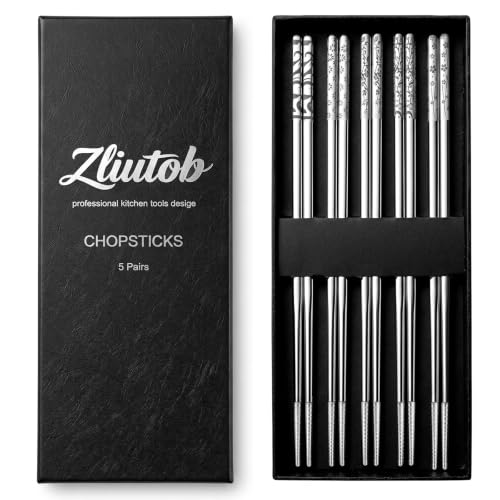
- Zliutob Stainless Steel Chopsticks, 5 Pairs — square grip and textured tips that coach finger placement by feel
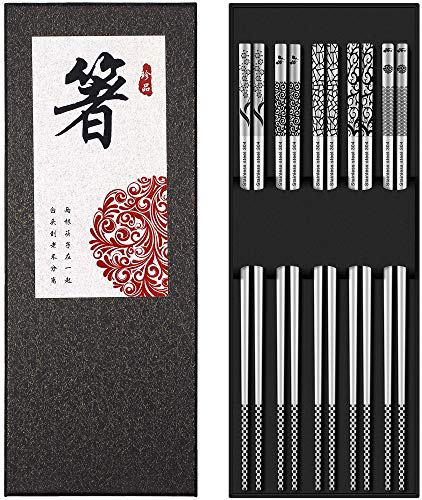
- LIXTONGR Dragon & Phoenix Black Stainless Steel Chopsticks, 2 Pairs — gift-boxed 18/10 pair to graduate to when the basics hold
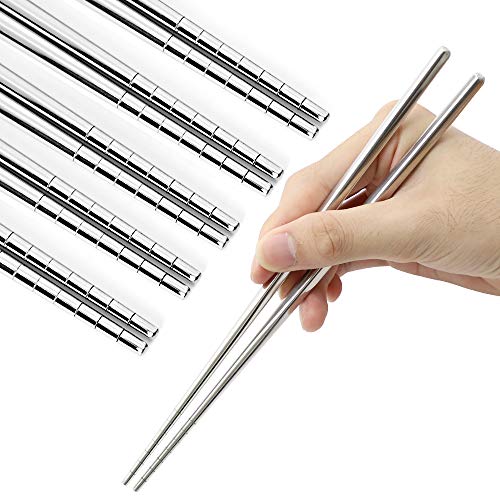
- MUYOS Stainless Steel Chopsticks, 5 Pairs, Silver — hollow-core lightness that keeps long practice sessions comfortable
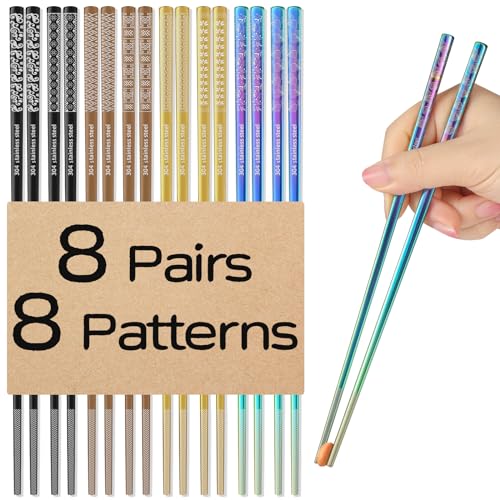
- Greatamzor Multicolor Stainless Steel Chopsticks, 5 Pairs — square, engraved and colour-coded: a practice pair you can always find
- Greatamzor Titanium-Plated Stainless Steel Chopsticks, 2 Pairs — titanium-plated two-pair set for the learner furnishing a serious table
Read the full guide ↓ for the detailed reviews, the comparison table, and the technique and care guidance that decides which of these sets actually fits your hands and your table.
Every adult who learns chopsticks tells the same story with different foods: a clumsy first week, a sudden click, and then a lifetime of wondering why it ever seemed hard. The best training chopsticks adult learn journeys share are rarely exotic, because the tool’s job in that story is modest — stay out of the way while the hand rewires itself. That rewiring needs successful repetitions, and successful repetitions need a pair that does not sabotage them: tips that hold food, a profile that holds still, a weight that holds up for a whole meal.
This guide is transparent about its pool. The verified sets behind it are standard stainless steel chopsticks, not hinged training devices with bridges or loops, and no review below will pretend a hinge exists where it does not. Instead, each pick is assessed as learning equipment: what does its engraving do for a first-week grip, what does its shape teach the fingers, how does its weight ration practice time, how does its set size change the social shape of learning? Those are the questions that decide whether an adult is still practising in week three, which is the only metric that matters.
You will also find the learning method itself in this guide — a sequenced practice plan, the grip reset that fixes most failures, and troubleshooting for the three problems every adult learner meets. Treat the products and the plan as one purchase: the pair removes the equipment failures, the plan removes the technique failures, and what is left is just time, which for this skill is measured in dinners, not months.
Key Takeaways
- All six picks are standard adult pairs, not hinged trainers; their learning value lives in engraved tips, square profiles and lighter builds.
- Learning succeeds on sequenced practice: textured chunky foods first, slippery foods last, ten focused minutes a day.
- The NEWDRIP eight-pair set turns learning social — the strongest known predictor of an adult sticking with practice.
- Square profiles (Zliutob, Greatamzor multicolor) resist the rotation that makes beginners’ tips cross.
- Keep one consistent pair for practice; recognisable colour or pattern removes daily friction.
In this guide
Quick Picks
| Pick | Badge | Why it stands out |
|---|---|---|
| NEWDRIP 18/8 Stainless Steel Chopsticks, 8 Pairs | Best Overall for Learning at Home | Eight engraved pairs: learn together, host sooner, never run short mid-lesson |
| Zliutob Stainless Steel Chopsticks, 5 Pairs | Best for Group Learning | Square grip and textured tips coach new fingers by geometry |
| LIXTONGR Dragon & Phoenix Black Stainless Steel Chopsticks, 2 Pairs | Best Grip for New Fingers | The kept pair: 18/10 steel, gift box, a reward for sticking with it |
| MUYOS Stainless Steel Chopsticks, 5 Pairs, Silver | Best Graduation Pair | Hollow-core weight for learners whose practice ends in hand cramps |
| Greatamzor Multicolor Stainless Steel Chopsticks, 5 Pairs | Easiest for Long Practice | Colour-coded square pairs make your practice set instantly findable |
| Greatamzor Titanium-Plated Stainless Steel Chopsticks, 2 Pairs | Most Recognisable Practice Pair | A formal plated pair for learners setting a table worth learning at |
How These Picks Were Chosen
Our shortlist method for a learning-focused keyword differed from a normal buying guide. Raw specifications — steel grade, set size, stated length — were only the entry ticket. Each verified listing was then scored against the failure modes of adult learning: Does the tip carry texture that grips food for an unsteady hand? Does the profile resist rotation? Is the build light enough for a full practice meal? Does the format support the way adults actually learn, which is socially, at real meals, with other people’s dinners depending on it? The six sets that answered those questions best make up this guide.
The honesty rules were the same as always. This is research-led guidance built from verified listing data and the documented behaviour of these designs, not a claim of hands-on testing, and where a listing leaves a fact unstated — a length, a steel grade — the review flags the gap rather than papering over it. We also refused to relabel any of these standard pairs as hinged trainers. If your learning needs a physical alignment aid, that is a different product, and the comparison section below explains when it is the right first step and how these sets serve as the second.
The 6 Best Training Chopsticks Adult Learn

NEWDRIP 18/8 Stainless Steel Chopsticks, 8 Pairs
Badge: Best Overall for Learning at Home Readers comparing nearby options often also look at Best Training Chopsticks Adult.
Eight pairs is the headline here. The NEWDRIP set stretches one purchase across a full table — a dinner party, a hot-pot night, a family that eats with chopsticks daily — in 18/8 stainless steel at 9.25 inches, with laser-engraved non-slip detailing. For households that host, the maths of multipacks matters more than any single-pair refinement: matching pairs look intentional on a set table, and a deep bench of spares means the dishwasher cycle never dictates the menu. The engraved patterning keeps the look playful rather than institutional, which is not always true of bulk steel sets.
As learning equipment, this set’s gift is scale. Eight engraved pairs mean the learning never waits for the dishwasher, guests can join the experiment without a equipment shortage, and a household can adopt chopsticks as its default in one decision rather than a gradual drift. The engraved tips do the same favour for your guests’ first attempts as for yours. The learning risk is diffusion — eight identical pairs invite grabbing any set rather than building feel with one — so claim a pair, keep it in the same drawer spot, and let the other seven be the supporting cast.
Strengths
- Eight pairs: the deepest bench in this line-up for hosting
- Engraved non-slip sections help both grip and food control
- One consistent length and style across the whole table
Trade-offs
- Eight pairs is more than a solo cook will ever rotate through
- Storage for eight pairs needs a drawer organiser or crock
- Engraving style is decorative; minimalists may prefer plain steel
At a glance:
- Material: 18/8 stainless steel
- Length: 9.25 inches
- Set size: 8 pairs
- Tips: laser-engraved, non-slip
- Care: dishwasher safe
- Style: Japanese / Korean / Chinese
Best for: households learning together / Not suited for: a learner who needs a physical hinge aid

Zliutob Stainless Steel Chopsticks, 5 Pairs
Badge: Best for Group Learning
The Zliutob set makes its case through shape. A square grip profile does not roll on the table, sits steadier between the fingers, and gives a learner’s hand four flat reference faces instead of a slippery cylinder; textured tips then do the food-side work on ramen noodles and sushi pieces, the two jobs the listing itself names. Five pairs keep it a household set rather than a hosting arsenal. The listing does not state a length or a steel grade, so this is a pick you choose for geometry and texture, not for published dimensions — measure your current favourite pair first if length matters to you. Readers comparing nearby options often also look at Best Training Chopsticks.
Geometry is a patient teacher. This square-profile set gives new fingers four flat faces to register, which quietly prevents the slow rotation that twists round sticks apart mid-bite, and its textured tips handle the food end of the lesson. Learners who describe themselves as uncoordinated often turn out to be fighting round, polished equipment; change the geometry and the same hands look competent within a week. The compromise is sensory: square edges stay noticeable in the hand longer than round ones, and some graduates will later prefer a rounder pair. By then, the skill is theirs to spend as they like.
Strengths
- Square profile resists rolling and steadies finger placement
- Textured tips are aimed squarely at noodles and sushi
- Five pairs is a sensible household quantity
Trade-offs
- Length and steel grade are not stated in the verified listing
- Square edges feel angular to diners raised on round bamboo
- Texture holds onto oily sauces until washed
At a glance:
- Set size: 5 pairs
- Grip: square profile
- Tips: textured, non-slip
- Care: dishwasher safe
- Listing uses: sushi, ramen, daily meals
Best for: learners fighting stick rotation / Not suited for: diners who dislike angular profiles

LIXTONGR Dragon & Phoenix Black Stainless Steel Chopsticks, 2 Pairs
Badge: Best Grip for New Fingers
Two pairs, a gift box, and the richest steel grade in this cluster: the LIXTONGR Dragon & Phoenix set is the presentation pick. 18/10 stainless steel is the grade restaurants associate with their best flatware, the black finish and dragon-and-phoenix motif make it a deliberate object rather than a utensil-drawer afterthought, and at 9 inches it runs slightly shorter than the 9.25 inch sets around it — a small difference that some hands prefer for control. The listing itself names dining, travel, housewarming and wedding use, which is exactly the life this set is built for: given, kept, and used on occasions.
Every curriculum needs a graduation, and this gift-boxed 18/10 set is shaped like one: two pairs, a presentation box, a slightly shorter 9 inch length that many learners find tidier in the hand. Buy it too early and it is just a handsome pair; buy it when the basics hold and it becomes the marker that the project succeeded — the set brought out for guests, dates and the meals you used to dread. The non-slip grip keeps it honest as a working tool, not a trophy. Learning research is unglamorous on this point: visible milestones sustain habits, and this set is a milestone you can hold. Readers comparing nearby options often also look at Best Training Chopsticks For Adults.
Strengths
- 18/10 steel: the premium grade in this line-up
- Gift box presentation suits weddings and housewarmings
- Slightly shorter 9 inch length can feel more controllable
Trade-offs
- Only two pairs: not a family-drawer solution
- Black decorative finish asks for gentler handling to stay pristine
- Motif styling is a matter of taste and will not suit minimal tables
At a glance:
- Material: 18/10 stainless steel
- Length: 9 inches
- Set size: 2 pairs
- Grip: non-slip
- Care: dishwasher safe
- Presentation: gift box
- Listing uses: dining, travel, housewarming, wedding
Best for: learners who respond to milestones / Not suited for: daily family rotation (only two pairs)
MUYOS Stainless Steel Chopsticks, 5 Pairs, Silver
Badge: Best Graduation Pair
Weight is the MUYOS argument. A hollow-core build trims the heft that makes solid steel chopsticks tiring over a long meal, which matters more than most first-time metal buyers expect: chopstick fatigue is real, and it shows up as a cramping grip and sloppy pickups halfway through a bowl of noodles. Five silver pairs with non-slip tips keep the format familiar — daily meals, per the listing — while the lighter hand feel narrows the gap between metal durability and bamboo lightness. If you have bounced off steel chopsticks before because they felt like knitting needles, this is the design that answers that complaint.
Practice time is the currency of learning, and weight is its tax. This hollow-core set cuts the tax: five lightweight pairs with non-slip tips let a new grip survive a full noodle bowl without the forearm ache that ends sessions early and teaches squeezing as a compensation. For learners who have quit steel before, or who are rebuilding dexterity, that extension of comfortable practice is worth more than any engraving pattern. The honest caveat is feel — some learners like a heavier pair’s feedback — so treat this as the specialist tool for the fatigue problem specifically.
Strengths Readers comparing nearby options often also look at Best Training Chopsticks For Toddlers.
- Hollow-core build is noticeably lighter over long meals
- Non-slip tips compensate for the lighter touch
- Plain silver finish matches any existing flatware
Trade-offs
- Featherweight feel can read as insubstantial to some diners
- Length is not stated in the verified listing
- Hollow construction rewards avoiding use as a kitchen pry tool
At a glance:
- Set size: 5 pairs
- Build: hollow-core, lightweight
- Tips: non-slip
- Care: dishwasher safe
- Finish: silver
- Listing use: daily meals
Best for: learners limited by hand fatigue / Not suited for: learners who prefer heavier feedback

Greatamzor Multicolor Stainless Steel Chopsticks, 5 Pairs
Badge: Easiest for Long Practice
The second Greatamzor entry pairs a square profile with a laser-engraved copper coin pattern and a multicolor finish across five pairs at 9 1/4 inches. Square sides keep the pair from rolling off a plate rim, the engraving gives fingers and food something to hold onto, and the colour spread lets a household assign pairs by colour — a small system that quietly ends the shared-drawer mix-ups. It reads as the personality pick of the steel sets: all the practical engineering of its plainer sibling, with a finish that makes the table setting part of the point.
Findability is an underrated learning feature. This multicolor square set lets a learner own a colour, and owning a colour means the practice pair is located in two seconds, washed because it is missed, and reached for by default — the tiny logistics that decide whether a habit survives a busy month. The engraved copper coin pattern and square faces supply the grip story at both ends. It will not match a formal table, and it is not trying to; it is trying to be used three hundred times, which is the only syllabus that has ever taught this skill.
Strengths
- Square profile plus engraving: grip help at both ends
- Colour variety supports a pair-per-person household system
- Five pairs at full 9 1/4 inch adult length
Trade-offs Readers comparing nearby options often also look at Best Tips For Using Chopsticks.
- Copper coin motif will not match every table style
- Engraved grooves need deliberate washing after oily meals
- Multicolor sets can clash with formal flatware
At a glance:
- Length: 9 1/4 inches
- Set size: 5 pairs
- Profile: square, non-slip
- Pattern: laser-engraved copper coin
- Care: dishwasher safe
- Finish: multicolor
Best for: learners in shared, busy kitchens / Not suited for: formal dining rooms

Greatamzor Titanium-Plated Stainless Steel Chopsticks, 2 Pairs
Badge: Most Recognisable Practice Pair
Two pairs with a titanium-plated black-silver finish: this Greatamzor set is built to be looked at as much as used. The plating gives the steel a darker, more formal presence than bright silver pairs, the laser engraving keeps the non-slip story intact, and the gift-set presentation points it at couples, hosts and anyone furnishing a first serious table. Plated finishes do ask for a little respect — they are not the pair to toss loose into a cutlery drawer or scrub with abrasives — but as a kept-for-best set that also works daily, it occupies a niche none of the multipacks try to fill.
Some adults learn best when the goal is beautiful. This titanium-plated two-pair gift set gives the project a destination: a table set properly, a pair with presence, meals that feel like occasions while the skill is still new. The engraved tips keep the function real, and the plated finish asks for the gentle care that, frankly, also suits a learner’s mindset — deliberate, unhurried, attentive. It is the least forgiving pick here in one sense: two pairs means no bench when one is in the wash. Buy it as the kept set alongside a workhorse multipack, and the combination covers both the learning and the living.
Strengths
- Titanium-plated finish: the most formal look in this line-up
- Engraved non-slip tips keep function under the styling
- Two-pair gift format suits couples and occasions
Trade-offs
- Plated finishes reward gentle washing over abrasive scrubbing
- Two pairs only: a kept set, not a household workhorse
- Length is not stated in the verified listing
At a glance: Readers comparing nearby options often also look at Best Titanium Chopsticks.
- Set size: 2 pairs
- Finish: titanium-plated, black silver
- Tips: laser-engraved, non-slip
- Care: dishwasher safe
- Style: Japanese / Korean
- Presentation: gift set
Best for: aesthetically motivated learners / Not suited for: high-rotation family use
Comparison Table
| Pick | Set size | Length (as listed) | Standout trait | Link |
|---|---|---|---|---|
| NEWDRIP 18/8 Stainless Steel Chopsticks, 8 Pairs | 8 pairs | 9.25 inches | Eight engraved pairs: learn together, host sooner, never run short mid-lesson | Check on Amazon |
| Zliutob Stainless Steel Chopsticks, 5 Pairs | 5 pairs | Not stated in listing | Square grip and textured tips coach new fingers by geometry | Check on Amazon |
| LIXTONGR Dragon & Phoenix Black Stainless Steel Chopsticks, 2 Pairs | 2 pairs | 9 inches | The kept pair: 18/10 steel, gift box, a reward for sticking with it | Check on Amazon |
| MUYOS Stainless Steel Chopsticks, 5 Pairs, Silver | 5 pairs | Not stated in listing | Hollow-core weight for learners whose practice ends in hand cramps | Check on Amazon |
| Greatamzor Multicolor Stainless Steel Chopsticks, 5 Pairs | 5 pairs | 9 1/4 inches | Colour-coded square pairs make your practice set instantly findable | Check on Amazon |
| Greatamzor Titanium-Plated Stainless Steel Chopsticks, 2 Pairs | 2 pairs | Not stated in listing | A formal plated pair for learners setting a table worth learning at | Check on Amazon |
Compare these sets as learning tools, not just tableware: set size is really about how practice fits your household, and the trait column names the specific learning problem each design answers. Lengths are shown only where the verified listing states them — an unstated length is a reason to measure your current pair before ordering, not a defect we will hide.
How to Choose Training Chopsticks for an Adult Who Is Actually Going to Learn
Choose for the failure you actually have. If food slides off, the fix is tip texture — engraving, scoring, square faces. If the sticks themselves wander and cross, the fix is profile — flat faces that resist rotation. If sessions end early, the fix is weight — a hollow-core build. If practice keeps not happening, the fix is logistics — a recognisable pair, enough pairs, a household that has joined in. Naming your failure mode before shopping is the whole secret of this category, because the products genuinely differ by which failure they remove.
Decide separately whether you need a hinge phase. A bridged trainer guarantees alignment and can carry a learner through the first meals, especially where dexterity is limited; it teaches nothing about finger control, and adults usually outgrow it in days. The sets in this guide assume you are ready to learn the real grip, possibly after a short hinge phase, and they are built to remain your everyday pairs afterwards. That dual life — training tool now, tableware for years — is the economic argument for buying a good standard pair instead of a disposable trainer.
Finally, budget your consistency. Motor learning consolidates around a stable tool: same length, same weight, same feel, meal after meal. That argues for picking one primary pair early — by colour, pattern or simple drawer position — and resisting rotation through a collection while you learn. It also argues for dishwasher-safe steel over fussier materials during the learning months, because a pair that is annoying to clean is a pair that gets skipped, and skipped days are the true enemy of the two-week click.
How Adults Learn Chopsticks: The Grip, the Order, the Two-Week Plan
The grip has one rule: the bottom stick does not move. Brace it against the base of your thumb and the side of your ring finger, then lay the top stick across your middle fingertip, held by thumb and index, and move only that one. Every common failure — crossing, dropping, cramping — traces back to both sticks moving or to a fist grip compensating for it. Rebuild this rest position before blaming any product, including the ones in this guide.
With the grip set, learning becomes a sequencing problem. Foods differ enormously in difficulty, and adults who start with the hardest ones conclude they lack talent when they actually lack a syllabus. Work through this order at real meals, roughly ten minutes of deliberate attention a day:
- Stage one: large textured pieces — roast vegetables, meat chunks, thick noodles. Aim for a success rate that feels almost too easy.
- Stage two: full normal meals, chopsticks only, with the fork kept in the kitchen as an emergency exit you decline to use.
- Stage three: slippery foods enter gradually — dumplings, glazed mushrooms, sauced noodles — one dish at a time.
- Stage four: precision work — single beans, separating strands, filleting fish cleanly. This is fluency training.
- Stage five: an unchosen meal — a hot pot with friends or a sushi counter — taken without anxiety. You have learned.
Protect the process with two small disciplines. Wash engraved and textured tips thoroughly after oily meals, because residue makes the next session artificially harder and can convince you that you have regressed. And end practice when your hand tires: fatigued repetitions rehearse the squeeze grip you are trying to eliminate. Progress in this skill looks like nothing for days and then like everything at once — plan to still be practising when the click arrives, because it arrives for the people who are.
Troubleshooting:
- Problem: the sticks cross when you close them → the top stick is held too far back. Move your grip slightly toward the tips and drill slow, empty open-close movements before meals.
- Problem: noodles slide off no matter what → check the equipment before the technique: polished tips are the likely culprit, and an engraved or square-tip pair changes the physics immediately.
- Problem: your hand aches after ten minutes → both sticks are moving and your thumb is doing overtime. Reset the rest position, and consider the lightweight hollow-core set while your grip rebuilds.
Why Adults Learn Differently From Children — and Why That Helps
Children learn chopsticks the way they learn language: slowly, immersed, without embarrassment and without a deadline. Adults learn under opposite conditions — self-conscious, impatient, and usually motivated by a specific table they want to sit at without anxiety. The adult disadvantage is real but so is the adult advantage: adults can learn deliberately. A child needs a thousand unstructured meals; an adult can compress the curve with a correct grip model, a sequenced food order and ten honest minutes a day, which is precisely the programme this guide is built around.
The implication for equipment is that adults do not primarily need simplified tools; they need honest ones. A hinged trainer can start the process, but the adult learner’s binding constraints are friction and morale, not alignment. That is why this guide spends its attention on tip texture, profile stability, weight and the social formats that keep practice happening. It is also why the guide refuses to oversell: an adult who discovers their ‘training’ pair has no training features feels cheated, and cheated learners quit. You deserve the map as it actually is.
Making Practice Social: The Multipack Effect
The most reliable finding in adult skill hobbies is embarrassingly untechnical: people persist at what other people do with them. Chopsticks are no exception. A learner eating alone with a fork in reach negotiates with themselves nightly, and negotiation is tiring; a household that adopts chopsticks together, or a standing dumpling night with friends, removes the negotiation entirely. This is the real argument for the multipack sets in this line-up — not unit economics, but the conversion of practice from a private project into a shared default.
If you buy for that effect, set it up deliberately. Put pairs at every setting rather than offering them as a test, choose forgiving menus for the first gatherings, and keep the tone playful — dropped food is comedy material at a learning table, not failure evidence. Several of the sets here, the colour-coded ones especially, support the system by giving each regular their own identifiable pair. Two months of such evenings will do what a solitary season of drills often cannot: make the skill feel like something you have, rather than something you are attempting.
Length deserves more respect than it gets in most product listings. The standard adult eating length across these sets sits around nine to nine and a quarter inches, and that is not arbitrary: it keeps fingertips clear of hot broth, spans a dinner plate comfortably, and balances in the hand without the tail end catching on sleeves. Shorter pairs feel nimble for sushi and small plates; longer pairs earn their keep at a hot pot or a shared serving bowl. If you already own a pair you like, measure it before ordering anything new — matching a known-good length removes the single biggest source of first-week disappointment with an otherwise good set.
Care is where stainless steel quietly wins the long game. There are no lacquers to chip, no fibres to swell, no finishes that object to the dishwasher, and no seasoning ritual. What steel does ask for is basic thoroughness: engraved and textured sections hold onto oils and sauces, so a proper wash — not a rinse — keeps them tasting like nothing, which is exactly what a utensil should taste like. Dry storage matters too. A pair put away wet in a closed case or a sealed drawer compartment will eventually show it, whatever the grade stamped on the listing.
The honest way to think about set size is to count eaters, then add friction. A household of two that hosts monthly needs a different bench than a family of five eating with chopsticks nightly, and the dishwasher cycle is a real constraint: pairs in the wash are pairs you cannot use. Multipacks look excessive on a product page and feel inadequate on a Friday night with six guests and a hot pot. Buy for the table you actually set most months of the year, not the table you set once at a holiday, and let the big-occasion problem be solved by a second, cheaper backup set if it ever becomes real.
Etiquette travels with the tool. Resting a pair across the bowl is fine on a rest and contentious without one; sticking chopsticks upright in rice is widely read as a funerary image and worth avoiding at any table where it might land badly; passing food directly from one pair to another carries similar associations in Japanese settings. None of this affects which set you should buy, but a buyer learning chopsticks as an adult is usually also learning the table culture around them, and the two educations are cheaper together. A simple rest, incidentally, also keeps engraved tips off tablecloths and stops round pairs rolling onto the floor.
Finally, judge any pair by its third month, not its first meal. New steel can feel slick until your grip adjusts; new textures can feel aggressive until your fingers learn how little pressure they need. The sets that last are the ones whose compromises you stop noticing: the weight that becomes normal, the length that becomes instinct, the finish that survives your actual dishwasher rather than an idealised one. That is why this guide weights durability signals — steel grade where stated, construction, dishwasher care — as heavily as first-impression features. A chopstick is a ten-year object bought in a ten-minute decision; the least a guide can do is slow the decision down.
Grip is a trainable skill, and the timeline is kinder than most new users expect. The first week with any new pair is mostly about the rest position: the lower stick stays still, braced against the ring finger and the base of the thumb, while the upper stick does all the travelling, pivoted by the index and middle fingers. Once that division of labour clicks, the hand stops squeezing, and squeezing was the real source of most early failures — dropped noodles, aching fingers, food launched across the table. Practice with forgiving foods first: thick noodles, chunky stir-fry pieces, anything with texture. Save peas, beans and glossy dumplings for when the motion is boring, because boring is what mastery feels like from the inside.
A note on rests, the smallest accessory in this world: a rest keeps tips off the table, keeps round pairs from emigrating to the floor, and gives a meal a small, civilised pause button. Households that adopt rests find their pairs last longer in finish and in dignity, and guests read the table as considered. Rests are not bundled with the sets in this guide — the listings do not claim them — so treat them as a separate, inexpensive completion of any set you buy, chosen in a material that shares your pairs’ care routine.
Children at the table change the arithmetic of any set, even in an adult-focused guide. Small hands need shorter tools, and a household’s adult pairs will be borrowed, brandished and occasionally lost to the sofa regardless of policy. The pragmatic defence is depth — a bench that absorbs the chaos — plus one deliberate decision: keep the pair you care about out of the general pool, by colour, pattern or a separate rest by your own setting. Households that plan for the borrowing lose less to it.
There is a sensory detail experienced eaters mention and listings never do: temperature. Steel arrives at the mouth at room temperature and warms instantly; it neither insulates like bamboo nor chills like a spoon from a cold drawer. Most diners stop registering this within a week. Those who never do are not wrong — they are simply telling you their material preference is real, and the correct response is to honour it with a second type in the drawer rather than to argue a palate out of its own evidence.
Sustainability claims in this category deserve the same audit as product claims. A durable pair used daily for a decade displaces a small mountain of disposables; a durable pair used twice displaces almost nothing, and a cheap pair replaced yearly sits honestly in between, provided the replacements are genuinely recycled or composted where the material allows. The variable is never the object alone — it is object multiplied by meals. Which is one more reason this guide keeps returning to depth, comfort and care routines: they are what turn a purchase into the multiplied term.
If you take one analytical habit from this guide into the rest of your kitchen, let it be the contents-list habit: read what is verifiably in the box before admiring what is in the photograph. It applies to chopsticks, to the combined travel sets this programme has audited, and to nearly everything sold with styling. Sellers who state grades, lengths, counts and contents are competing on facts; sellers who state only adjectives are competing on fog. Your money is a vote for which kind of listing gets written next year.
Common Buying Mistakes
Learners rarely fail for lack of effort; they fail at the purchasing and planning stage, in ways that are entirely avoidable. These are the recurring ones.
- Buying a hinged trainer as the whole plan. It solves week one and strands you in week three. Pair it with — or skip it for — a forgiving standard set you can grow into.
- Practising only on hard mode. Slippery foods first is a syllabus error, not a character test. Sequence the foods and the skill follows.
- Rotating through many pairs while learning. Consistency consolidates motor learning. Claim one pair, by colour or pattern, and practise with it daily.
- Judging steel by a five-minute hold. Weight reveals itself across a meal. The lightweight option exists for learners who discover this the aching way.
- Treating dropped food as data about talent. It is data about tips, grip and food choice — all fixable, none of them you.
Final Recommendation
If your household is learning together, the NEWDRIP eight-pair set is the strongest start in this guide: engraved tips for everyone, no shortages, and the social momentum that actually finishes the job. Learning solo, the Zliutob square profile is the most instructive single design, while the MUYOS hollow-core set is the answer if fatigue has ended your sessions before. The LIXTONGR and titanium-plated Greatamzor sets are the graduations — buy one when the skill holds and you want the table to show it.
Whichever set you choose, pair it with the plan: rest position first, foods in order, ten minutes a day, no death grip. Adults who follow that programme with any of these six pairs reliably reach the click — and on the far side of the click, the training question disappears, replaced by the much better question of what to eat next.
Start here: NEWDRIP 18/8 Stainless Steel Chopsticks, 8 Pairs (Best Overall for Learning at Home); Zliutob Stainless Steel Chopsticks, 5 Pairs (Best for Group Learning); LIXTONGR Dragon & Phoenix Black Stainless Steel Chopsticks, 2 Pairs (Best Grip for New Fingers).
Frequently Asked Questions
What makes a standard pair of chopsticks good for learning?
Three features do the teaching. Textured or engraved tips grip food that polished steel drops, producing the early successes practice runs on. A square or otherwise stable profile resists the rotation that makes beginners’ sticks cross. And a manageable weight — including hollow-core designs — lets a new grip survive a full meal without cramping. The six sets in this guide were chosen for exactly those features; none is a hinged trainer, and the guide is explicit about that distinction and when a hinge is the better first step.
Should an adult beginner buy a hinged training pair first?
If alignment itself is the barrier — the sticks will not stay parallel at all — a hinged or bridged trainer is a reasonable first purchase for the opening meals. Most adults, though, can start directly on a forgiving standard pair and learn the real grip from day one, which avoids buying a tool designed to be outgrown. A common path is a few meals with a helper, then a set like the ones reviewed here for the long consolidation phase. Judge by your first week: persistent crossing despite a correct rest position argues for the hinge; ordinary clumsiness does not.
How many pairs should a learner buy?
Enough that practice never waits on washing: two pairs for a solo learner is a sane minimum, while a learning household should think in multipacks — the eight-pair set in this guide exists for exactly that situation. Beyond quantity, consistency matters: claim one identifiable pair as your daily practice set, since motor learning consolidates faster around a stable length, weight and feel. Extra pairs then serve guests, spares and the social meals that keep the habit alive.
Why does my hand cramp when I practise?
Cramping is the signature of a moving lower stick and a compensating squeeze. Rebuild the rest position — lower stick braced and still, upper stick moving alone — and shorten sessions until the new pattern holds. Equipment can help at the margins: a lighter hollow-core pair, like the MUYOS set reviewed here, reduces the load while your grip relearns. If cramping persists across weeks despite correct form, that is worth a conversation with a clinician rather than another product.
Are metal chopsticks a good idea for a learner?
Textured metal, yes; polished metal, no. Laser-engraved tips give steel a food grip comparable to bamboo for everyday meals, and steel adds durability, dishwasher care and a consistent feel that stays identical for years — a genuine aid to motor learning. The traditional objection is weight, which hollow-core designs answer directly. Many learners keep a bamboo pair as well, and that is fine; what matters is that your primary practice pair is forgiving on tips, stable in profile and light enough for a full meal.
How long until chopsticks feel natural?
With daily practice in a sensible food order, most adults eat comfortably within two to three weeks and stop thinking about their hands within a couple of months. The transition usually feels sudden — one meal the motion is a project, the next it is just how you eat. Learners who practise socially, with forgiving equipment and sequenced foods, reach that point fastest; learners who only attempt chopsticks at high-stakes public meals progress slowest, because anxiety tightens the grip that practice is trying to loosen.