Disclosure: As an Amazon Associate, topratedkitchenware.com earns from qualifying purchases. Links to Amazon on this page are affiliate links; they cost you nothing extra. Listing details such as price and availability change often, so check the current Amazon listing before you buy.
Walk into any appliance aisle or scroll through any shopping page and the word water cooler covers a surprising range of things. There are tall cabinets that take a jug on top, tall cabinets that hide the jug underneath, slim units wired to the kitchen plumbing, little countertop boxes and plain insulated jugs with a tap. Choosing between them is easier when you stop asking which model is the best and ask which style fits your home, your back and your habits. That is the way to find the best types of water coolers for you.
This guide walks through each style, one at a time, then compares them on lifting, running costs, space, noise and upkeep. For every style we point to one real example so you can see what a typical listing looks like, but we do not rank the products. The goal is that you finish reading knowing which style to shop for, and what to watch for on the product page.
Quick Comparison
| Style | Best for | Main point | Example link |
|---|---|---|---|
| Top load cabinet | Simple, low-fuss use | Jug is inverted on top, easy to understand | Brio 500 Series Tri-Temp Top Load Water Cooler CLTL520 |
| Bottom load cabinet | Anyone who dislikes lifting | Jug sits in a hidden compartment | Check on Amazon |
| Bottleless point of use | Homes with a water line nearby | No jugs, filters instead | Check on Amazon |
| Countertop | Small kitchens and desks | Compact, often thermoelectric | Vitapur VWD2036W-1 Countertop Room and Cold Water Dispenser White |
| Portable jug | Outdoors and job sites | No power, carry and pour | Check on Amazon |
| Commercial bottom load | Busy shared spaces | Office-oriented hot and cold | Oasis MaxxFill Flex Bottom Load Hot Cold Water Cooler BXM1SHS |
In this guide
How These Types Were Compared
We have not used these coolers, so the comparison rests on maker descriptions, listings and the general design of each style. We chose one familiar example for each category and mention only features that appear on the listing. Where the listing leaves something out, such as noise or capacity, we say so and suggest you check.
The style criteria are the ones that decide most purchases: how the water gets in, how much lifting is needed, what temperatures are offered, how much space the unit takes and what ongoing parts you must buy.
The Best Types of Water Coolers, Style by Style
Top Load Cabinets, with the Brio CLTL520
A top loading cooler is the classic design. You lift a five gallon jug, flip it and drop its neck into the cabinet. Gravity does the rest, so there is no pump to wear out, and the mechanics are easy to understand. The Brio 500 Series CLTL520 is listed as a tri-temp top loader, so it offers cold, room temperature and hot water.
The trade-off is lifting. A full jug weighs around forty pounds and must be raised above waist height. It suits households with strong lifters, garages and break rooms where someone is happy to take the job. Skip it if a bad back or a low ceiling is a concern.
Brio 500 Series Tri-Temp Top Load Water Cooler CLTL520
Bottom Load Cabinets, with the Primo 601088
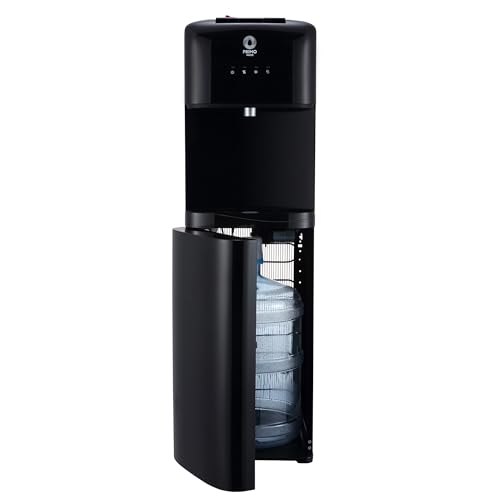
Bottom loading coolers hide the jug in a compartment below the taps. You slide the bottle in at knee height, and an internal pump moves the water upward. Retail listings describe the Primo 601088 as a black, bottom loading dispenser with hot and cold settings.
The appeal is obvious: less lifting and a cleaner look. The cost is the pump, which adds a little noise and one more part that can fail. Some designs also give less cold storage, so check the listing and manual. Choose this style if you want the comfort of bottled water without the heavy lift.
Bottleless Point of Use Units, with the Avalon A5BLK
A bottleless cooler connects to the home water line and filters the supply internally. There are no jugs, no deliveries and no returns. The Avalon A5BLK is described as a self cleaning bottleless unit with cold, cool and hot settings.
What you swap for the convenience is filter care and installation. Cartridges need replacing on the maker’s schedule, and the unit needs a nearby supply line. Hire a licensed plumber if you are not confident. Choose this style when you live in a place you own or when a landlord allows the connection.
Countertop Dispensers, with the Vitapur VWD2036W-1
Countertop coolers sit on a table or a shelf and take a smaller bottle. The Vitapur VWD2036W-1 is listed as a white countertop dispenser for room and cold water, with a semiconductor cooling module that avoids a compressor.
These are the choice for tight kitchens, dorm rooms and desks. Their limits are capacity and cold strength: thermoelectric cooling only lowers the temperature by a modest amount. There is no hot tap on this one. Pick a countertop style when space is the top concern and demand is light.
Vitapur VWD2036W-1 Countertop Room and Cold Water Dispenser White
Portable Jugs, with the Igloo 42316
A portable jug is the simplest type of all. The Igloo 42316 is described as a five gallon seat top water jug with a recessed spigot and a cup bracket. No power or plumbing is involved, so it goes wherever your vehicle goes.
It will not chill or heat on its own, and it is heavy when full. It fits sports days, camping and work sites. It is a poor match for a kitchen where you want cold water on demand.
Commercial Style Bottom Loaders, with the Oasis BXM1SHS
Office brands such as Oasis build coolers for shared spaces, and the MaxxFill Flex BXM1SHS is listed as a five gallon bottom load cooler with hot and cold taps. It shows what the step from a home cabinet to a workplace cabinet looks like.
These models tend to be taller and better supported by distributors, and some sellers show limited stock, so check availability. For a family kitchen they may be more cooler than you need.
Oasis MaxxFill Flex Bottom Load Hot Cold Water Cooler BXM1SHS
Top Loading Versus Bottom Loading
This is the choice most bottled water households face. Top loaders are simpler and usually lower in cost to repair, but they demand a lift. Bottom loaders are kinder to your back and hide the jug, but add a pump. If nobody in the home has trouble lifting, a top loader is perfectly sensible. If you share the chore with a teenager or an older relative, spend time on a bottom loader.
Look at what each style does to your counter and your floor. Top loaders are often taller by the height of the jug. Bottom loaders keep the overall height lower. Measure cupboards above the spot where you plan to place the cooler.
Bottled Versus Bottleless
A bottled cooler needs a supplier or a refill plan, space for spare jugs and a regular swap. A bottleless unit needs a water line and filter changes. Running costs differ: jugs recur weekly, filters recur monthly or yearly depending on the model. If you move often, bottled wins on flexibility. If you stay put and hate carrying, bottleless wins on convenience.
Do not forget small items such as drain lines for some filter systems and the space under a sink for a supply connection. Read the installation notes before you decide.
Hot, Cold and Tri-Temp Options
Cold only coolers are simpler and have a lower chance of causing burns. Hot and cold models give you tea and soup water, but the hot tank is a risk near children and a drain on power. Tri-temp coolers add a room temperature tap, which is useful for people who find cold water too sharp for drinking or who use it for plants and pets. Whichever you pick, follow the maker’s instructions for hot water use, keep the tap away from the edge of a counter and treat a safety lock as an extra layer only.
Compressor Versus Thermoelectric Cooling
Compressor cooling works like a small refrigerator and chills water well. It also hums and clicks as it cycles. Thermoelectric cooling uses a semiconductor module and is generally described as calmer, but it cools less strongly. In a warm room, a thermoelectric cooler may only deliver water that is cool, not cold. Cabinets for crowds nearly always use compressors, while countertop units often use thermoelectric modules.
How to Choose Between the Styles
Work through four questions. How many people will drink from it? Who will do the lifting or the filter changes? Can you connect to plumbing? How much space and noise can the room accept? Answers to those four lead you to a style well before you look at a brand.
Single people and couples with little space are usually best served by a countertop cooler. Families with a back-friendly attitude to jugs suit bottom loaders. Owners who want to forget about deliveries fit bottleless. Garages and workshops fit top loaders and portable jugs. Offices often prefer commercial bottom loaders or plumbed units.
A useful trick is to picture an ordinary Tuesday. Imagine who fills a glass at seven in the morning, who changes the jug or the filter, and where the empty jugs go. If the picture includes someone struggling, you have probably picked the wrong style, however good the specifications look on paper. Write the answers down before you open a shopping page, and they will keep you from drifting toward a tall, impressive cabinet that does not suit the room.
Once you know the style, compare the cabinets in it on the features that matter to you: temperature settings, spigot design, drip tray, safety lock, filter type and warranty. Finally, make sure you can get replacement parts and manuals for the model.
Installation, Safety and Legal Notes
Whatever the style, read the manual before the first use. Plumbed coolers should be installed by a licensed plumber, and electrical changes belong with a licensed electrician. Keep the cooler on a level surface with the clearance the maker specifies, and use a grounded outlet. Hot water units need careful placement away from children. Local rules can apply to plumbing and to equipment in public buildings, and you should confirm them with your local authority.
Care and Troubleshooting
| Style | Main upkeep task |
|---|---|
| Top and bottom load | Clean reservoir and spout on the maker’s schedule |
| Bottleless | Change filters, check connections |
| Countertop | Wipe the tray, clean the reservoir |
| Portable jug | Rinse, dry and check the spigot |
If a cooler leaks, stops pouring or changes sound, unplug it and check the manual before calling for service.
A Room-by-Room Checklist Before You Pick a Cooler Style
Water coolers look similar in photos, yet the style you choose changes how you live with the unit every day. Use the checklist below to match a style to your space, your routine and the people who will use it.
- Measure the spot where the cooler will stand, including height, width, depth and clearance for ventilation behind and beside it.
- Check the floor surface and whether you need a mat or tray to protect it from drips.
- Decide who will lift bottles, and whether a top-loading design or a bottom-loading cabinet would suit that person better.
- Think about whether you would rather receive delivered bottles, fill your own, or connect to a water line.
- Look at the electrical outlet nearby, and follow the maker guidance about extension cords and surge protectors.
- Consider whether you need hot water, and if so how you will keep children away from it.
- Choose a spot out of direct sunlight and away from heat sources.
- Confirm how you will store spare bottles, and where used ones will go.
If any item on this list worries you, treat it as a signal. For example, a cramped nook may favor a slim countertop dispenser such as the Vitapur VWD2036W-1, while a spacious kitchen can host a floor-standing cabinet like the Primo 601088 or the Brio CLTL520.
Mistakes That Make a Cooler Annoying to Own
Most complaints about water coolers come from avoidable choices. Watch for these before you buy.
Ignoring who does the lifting
A full bottle is heavy. A top-loading cooler needs a lift up and over, while a bottom-loading cabinet needs a lift to the lower compartment. Think honestly about the person who will handle it most often.
Forgetting ventilation
Many coolers need space around the back or sides to release heat. Pushing the unit tight against a wall can affect performance, so follow the clearance guidance in the manual.
Skipping the cleaning plan
Reservoirs, taps and drip trays need regular attention. Check the maker instructions on cleaning agents and schedules before purchase, and be ready to follow them.
Overlooking the hot tap safety
If children or vulnerable adults share the space, choose a model with the safety features the maker describes and keep the unit out of easy reach.
Choosing by looks alone
A beautiful finish means little if the unit is too tall for your cabinet or uses a bottle size you cannot easily get.
Comparing Five Common Styles
The table below sorts the styles discussed in the guide by how you supply water and where they tend to fit best. It is a quick reference, not a replacement for the maker specifications.
| Style | Water supply | Typical fit |
|---|---|---|
| Top-loading cabinet | Bottle placed on top | Offices and homes where lifting is easy |
| Bottom-loading cabinet | Bottle hidden in a lower compartment | Kitchens where appearance matters |
| Bottleless point of use unit | Connected to a water line | Spaces with plumbing access and no bottle storage |
| Countertop dispenser | Small bottle placed on top | Tight kitchens and small offices |
| Portable jug | Filled by hand | Camping, workshops and job sites |
| Commercial bottom loader | Heavy-duty bottle compartment | Busy offices and shared spaces |
Whichever style you choose, check the specifications for bottle size, power use and voltage compatibility with your outlet.
A Glossary of Water Cooler Terms
- Tri-temp: a dispenser that offers hot, cold and room temperature water.
- Point of use: a unit connected directly to a water supply instead of using bottles.
- Reservoir: the internal tank that holds water before it is dispensed.
- Child safety lock: a feature that requires a deliberate action before hot water flows.
- Thermoelectric cooling: a cooling method that uses an electrical effect rather than a compressor.
- Compressor cooling: a cooling method similar to a refrigerator system.
- Drip tray: a tray at the base that catches spills.
- Self-cleaning cycle: a maker feature that helps sanitize internal parts, to be used as the manual describes.
Familiarity with these words helps when you compare product pages and read manuals.
Decision Guide by Situation
- Small apartment: a countertop dispenser such as the Vitapur VWD2036W-1 can save floor space.
- Busy family kitchen: a bottom-loading cabinet such as the Primo 601088 or the Oasis BXM1SHS keeps bottles out of sight and easier to change.
- Office with plumbing access: a bottleless unit like the Avalon A5BLK removes bottle handling, subject to installation requirements.
- Outdoor work: a portable jug such as the Igloo 42316 supports mobile use.
- Traditional setup: a top-loading model like the Brio CLTL520 offers a familiar layout.
Installation, Safety and Care Notes
Read the manual before you plug anything in. Place the cooler on a level, stable surface, and leave the clearance the maker specifies. Use a grounded outlet and avoid overloaded circuits. For bottleless models, plumbing connections and water line work should follow the maker instructions and local plumbing codes, and a licensed plumber should handle any work you are not confident about. Clean the unit on the schedule the maker gives, using only approved cleaning products. Unplug the cooler before cleaning, and let it settle before use. If you notice leaks, odd smells or electrical problems, stop using it and contact the maker or a qualified technician.
How to Read a Cooler Product Listing
Listings pack important facts into small text. Look first at the dimensions and the bottle size the unit accepts, since not every cabinet works with every bottle. Then find the hot and cold output description, noting whether the maker lists temperature ranges or simply says hot and cold. Read the electrical details such as voltage and power use, and compare them with your outlet. Check whether a filter, a drip tray and a child safety feature are included. Look at the cleaning instructions, and see whether the maker offers replacement parts. Finally, read the warranty summary to learn what is covered. If any detail is missing, ask the seller or contact the maker before ordering.
Bottled Versus Bottleless: Questions to Ask Yourself
Bottle delivery brings convenience for some households and clutter for others. Ask whether you have room to store spare bottles, whether you can lift them safely, and whether a delivery service operates in your area. For bottleless units, ask whether you can connect to a water line without altering your plumbing, and who will carry out the work. Consider maintenance, such as filter changes, and how often the maker recommends them. Think about noise, since a unit in a quiet room may be more noticeable. Either choice can work well, provided it fits your routine and you follow the maker setup guidance carefully.
Frequently Asked Questions
Which type of water cooler is easiest to live with?
Bottom loaders and bottleless units cut down lifting, so many households find them easiest.
Is a bottleless cooler always better than a bottled one?
No. It avoids jugs but requires a water line and filters, which not every home can offer.
Are countertop coolers powerful enough for a family?
They suit light use. A busy family usually needs a full size cabinet.
Do all coolers have hot water?
No. Some models offer only cold or room and cold water. Check the listing.
Can I switch from bottled to bottleless later?
Yes, but it means buying a different unit and arranging a supply connection.
What size jug do most bottled coolers use?
Five gallon jugs are the usual size, but confirm the neck and cap type in the manual.
Does the style change how often I clean the cooler?
Not by much. Every style needs regular wiping, but bottleless units add filter changes and portable jugs need rinsing after each trip.
A Walk Through a House, Style by Style
Abstract comparisons become clearer when you walk the styles through a real home. Start in the kitchen of a family house. Floor space exists in a corner, the household drinks constantly, and people pass through all day. This is natural territory for a cabinet style, and the choice between the top loading Brio and the bottom loading Primo is decided by the household’s arms: if someone can lift a full bottle happily, the top loader’s simplicity and clear view of the water level are genuine pleasures; if not, the bottom loader’s hidden bottle and pump do the same job with the heavy part removed. Either way, the kitchen gets a water station that the whole family uses without thinking.
Move to a small flat, where the kitchen is a wall of units and the living space doubles as a bedroom. The cabinet styles now look like furniture competing with the sofa, and the countertop Vitapur comes into its own: water service at worktop height, a small bottle that one person can handle, and a footprint measured in inches of counter rather than feet of floor. Its capacity limits, which would frustrate the family, match a single person’s or a couple’s day almost exactly. Style, in other words, is often just capacity wearing the right clothes for the room.
End the walk in three special cases. A home office or studio that must stay quiet borrows the countertop logic and adds a preference for gentle operation. A garage, workshop or garden room with no water line and intermittent use is portable jug country, the Igloo’s home ground, because a jug asks for nothing and waits patiently between uses. And a busy premises, a salon, a clinic waiting room, a small office with real footfall, is where the commercial style bottom loader represented by the Oasis earns its keep, built for a pace of use that would wear a domestic machine’s welcome thin. One house, five territories, and the right style changes at every door: that is the whole argument of this guide in a single walk.
The Effort Budget of Each Style
Every cooler charges its owner in effort; the styles simply present the bill at different moments. The top loader charges in short, physical instalments: a lift at every bottle change, in exchange for which everything else about it is effortless, visible and simple. The bottom loader removes that instalment and charges instead in small complexities: a pump to do the lifting, a bottle hidden from view so its level must be checked by opening the door or watching for the signs of an empty, and a compartment to keep clean at floor level.
The bottleless style charges upfront and then in dates. Upfront, there is installation, connecting the unit to a supply and setting up its filtration, a job measured in an hour or an appointment rather than in minutes. Afterwards, the charge is calendrical: filter changes that must be remembered, ordered and fitted on schedule for the water to stay at its best. Households that are good with dates find this the cheapest style of all in effort. Households that are not find the bottled styles kinder, because a bottle announces its own emptiness in a way a filter never does.
The countertop charges in counter space, a daily tax on a small kitchen’s most contested surface, and in more frequent bottle changes of a lighter kind. The portable jug charges in preparation: filling, chilling, carrying and cleaning around each use, with nothing at all charged between uses. Lay the five bills side by side and the decision often makes itself, because most people know instantly which currency they would rather pay in: strength, dates, space or preparation. Choose the style whose bill you will pay gladly, and you will still be paying it happily in three years, which is more than can be said for a style chosen on features alone.
Mixed Households: When One Style Is Not Enough
Guides like this one tend to crown a single style, but real homes often run two, and it is worth saying plainly that this can be the right answer. The commonest pairing is a cabinet cooler in the kitchen doing the heavy work, and a portable jug that lives a separate life in the car, the shed or the sports bag. They never compete, because their jobs never overlap, and each is better at its job than any compromise product stretched across both.
A second pairing suits larger or split-level homes: a main bottled or bottleless unit where the family gathers, and a small countertop unit where distance would otherwise discourage drinking, an upstairs landing, a home office at the garden’s end, a guest suite. The second machine is not an indulgence in that setting; it is the difference between water that is used and water that is merely available in theory. What matters is that each machine has its own routine clearly owned, bottles or filters and cleaning alike, because two neglected coolers are worse than one, and shared responsibility for the second machine is the classic way it gets forgotten.
What mixed ownership should not become is an excuse to avoid the main decision. The primary style, the one that serves the household’s daily thirst, still deserves the full comparison this guide lays out. Add a secondary style for a secondary job once the primary choice is sound, and the combination will feel deliberate rather than accumulated, which is the difference between a well run house and a cupboard full of good intentions.
How Each Style Ages
A cooler’s first month tells you about its features; its second year tells you about its style. Top loaders age the most gracefully of the cabinet types, because their working idea is the simplest: gravity, a reservoir and taps. What ages on them is cosmetic and peripheral, seals, taps and the collar area, all within the owner’s cleaning domain, and a well kept top loader at five years is much the same machine it was at one. Bottom loaders add a pump to that picture, and the pump is the part whose character may change with age, which is why listening to your machine occasionally, and noticing when a familiar sound changes, is part of bottom loading ownership from the start.
Bottleless units age in their filters first and their cabinet second. A bottleless machine with its cartridges changed on schedule delivers remarkably consistent water year after year, because its consumable heart is renewed each time. The same machine on neglected filters declines in the glass long before anything mechanical complains, which is why this guide treats the filter calendar as the style’s defining discipline. Countertop units age like other small kitchen appliances: their tanks and taps stay sound with cleaning, while their exterior, living at eye level among the cooking, collects the knocks and splashes of the worktop and rewards the wipe-as-you-go habit.
Portable jugs age in their seals and spigots, the two parts this guide has already identified as their whole character. A jug whose seal is rinsed of grit and whose spigot is kept clean can serve for many seasons; a jug stored damp and sealed ages in a single winter. The pattern across all five styles is the same lesson wearing different clothes: each style has one place where age shows first, and the owner’s routine should be built around exactly that place.
Why People Change Styles, and What They Learn
Owners rarely change styles because a machine failed. They change because the household changed, and the stories repeat often enough to be useful warnings. The commonest is the move from top loading to bottom loading when a back, a shoulder or a change in who does the lifting makes the old routine untenable. The lesson is not that top loading was a mistake; it served well until the household’s strength changed. But shoppers who already suspect lifting will become an issue are wise to start at the bottom loading style and skip the intermediate chapter.
The second story is the move from bottled to bottleless when a household’s consumption outgrows the bottle routine: the empties multiply, the storage corner overflows, and the appeal of water that simply arrives through a pipe becomes overwhelming. The lesson there is to watch your own consumption honestly in the first year. A household emptying bottles at a stately pace will never need plumbing; a household churning through them should admit early that its style is a phase, not a destination. The third story runs the other way, from bottleless back to bottled, almost always after a move to a rented home or a property where connecting to the supply is impractical. It carries the mirror lesson: bottleless convenience is partly a property of the house, and it does not always travel with you.
Countertop owners change styles when households grow, trading up to a cabinet when children and guests multiply the demand, and cabinet owners in shrinking households trade down just as happily in the other direction. None of these moves is a failure of the original purchase. They are the normal life of a long lived appliance category, and they suggest a relaxed way to buy: choose the style for the household you have now and can clearly foresee, keep the machine well, and let a future change of style be a future decision, made with the valuable experience of the style you know.
Decision Shortcuts by Constraint
If you have read this far and remain torn, decide by your hardest constraint rather than by your favourite feature, because constraints are what styles actually answer. No lifting, now or foreseeably: bottom loading or bottleless, and the choice between them turns on whether you can connect to a supply. No plumbing possible, in a rental or a listed building or simply by preference: bottled styles only, and the bottleless chapter closes without regret. No floor space: countertop, accepting its capacity, or a jug where the need is occasional. No power at the point of use, outdoors or in outbuildings: the portable jug, which is not a compromise in that setting but the only style designed for it.
Very high daily volume, in a large family or a small workplace: cabinet capacity, and within it the commercial style build if the traffic is truly constant, because domestic machines used at commercial pace age before their time. A strong preference for a particular bottled water: bottled styles, since a bottleless machine by definition serves filtered local supply. A strong aversion to remembering dates: bottled again, because bottles announce themselves and filters do not. A strong aversion to storing bottles: bottleless, with the filter dates accepted as the price. Work through the constraints in that blunt order and most readers will find the field has narrowed to one style and perhaps two models, which is exactly where a buying decision wants to be.
More Questions About Choosing a Style
Which style is best for a first ever cooler?
For most first time buyers, a bottled cabinet style is the gentlest introduction, because it asks for no installation, teaches you your household’s true consumption, and can be moved or resold easily if your needs change. Choose top or bottom loading by the lifting question. A year of that experience makes every later decision, including a possible move to bottleless, an informed one rather than a guess.
Does the style affect how the water tastes?
Indirectly, yes. Bottled styles serve the water you buy, so their taste is chosen at the shop or the exchange point. Bottleless styles serve your local supply through their filters, so their taste is made at home and depends on filter condition. Countertop and cabinet machines holding the same water at the same temperature taste the same; style shapes temperature, convenience and routine far more than flavour, provided every machine is kept clean.
Which style is easiest to move house with?
The portable jug, trivially, and after it the countertop and bottled cabinet styles, which need only to be emptied, dried for the journey as the manual directs, and plugged in at the other end. The bottleless style is the one that stays partly behind, since its connection belongs to the old kitchen and must be made again in the new one. Frequent movers should weight that honestly when they choose.
Can one style serve a home business as well as a family?
It can, provided the volume is honest. A home business with a handful of clients a day is still domestic traffic, and any cabinet style will serve it. A business with a waiting room in constant use has crossed into the territory where the commercial style build in this guide is the prudent choice, both for the machine’s longevity and for the impression steady, ready water makes on the people waiting.
What is the most common style mistake of all?
Choosing by the showroom virtues, looks and feature lists, instead of by the effort budget described above. The styles differ less in what they can do than in what they ask, and the asks are paid weekly for years. The readers who finish this guide knowing which bill they would rather pay are the readers who will still be pleased with their cooler when its novelty is a distant memory.
A Note on Temperature Options Across the Styles
One dimension cuts across all the styles and deserves a moment of its own: how many temperatures the machine offers, and whether your household will use them. Cold only is the simplest arrangement and suits jugs, some countertop units and households that drink water as water. Hot and cold is the classic cabinet pairing, replacing a share of the kettle’s work and serving drinks, soups and cooking shortcuts. Tri-temp designs add a room temperature path, which sounds like a small thing until a household discovers how many of its glasses were always meant to be neither chilled nor hot: the morning glass, the medicine glass, the bottle filled for a run.
The discipline is to count your household’s actual draws for a day before deciding. Most people who do this are surprised in one direction or the other: either the hot side turns out to be the main event, in homes that run on tea and coffee alternatives, or it turns out to be a rarity that a kettle covers without effort. There is no prestige in the longer list. A temperature option you never use still occupies a tank, still draws its share of attention in cleaning and running, and still appears in the price of the machine in the broad sense. The styles in this guide each come with their characteristic temperature arrangements, set out in the style by style reviews above, and the happiest match is the one where the household’s counted day and the machine’s offered taps line up almost exactly.
Where children are part of the household, the hot option carries its familiar condition, which every style shares: check the lock, teach the rule, and place the machine with small hands in mind. That condition does not favour one style over another, since cabinets and countertops alike offer hot water, but it does favour the household that settles the question at installation rather than after the first fright. Temperature, in short, is a household decision wearing a machine’s clothes, and it rewards the same honesty as every other section of this guide.
What to Do in the First Week With Your Chosen Style
Whatever style you chose, the first week has the same shape, adjusted for the type. Set the machine up where it will live, with its clearances respected and its footing level, and let it settle and cycle before judging its water. Learn its sounds while they are new, so that later changes have something to be compared against. Run the first bottle, the first filters or the first fills exactly as the manual directs, including any flushing or discarding of first water, because shortcuts taken in week one have a way of lingering in the taste for weeks.
Then set the style’s own system running. Bottled households: decide the spare bottle arrangement and where empties wait. Bottleless households: write the filter dates down and set the reminder before the packaging goes out. Countertop households: agree the counter rules, what may be stored against the unit, which is nothing, and who wipes the splash zone. Jug households: wash, dry and store the jug properly once, so the good habit is the first habit. Every style fails in its own characteristic way when its system is neglected, and every system is five minutes of thought in the first week. Spend those five minutes, and the style you chose will spend years repaying them.
The Styles in One Sentence Each
For the reader who wants the whole guide distilled before going back to the detailed sections: the top loader is the simple classic that asks for a lift; the bottom loader is the same idea with the lift removed and a pump added; the bottleless unit is water as a utility, earned with an installation and kept with a calendar; the countertop is the small home’s cabinet, trading capacity for a worktop footprint; the portable jug is water that travels, asking preparation instead of power; and the commercial style cabinet is the domestic idea built for a crowd. Six sentences, six different households. Somewhere in them is the machine that fits your kitchen, your strength, your diary and your day, and the detailed comparisons above exist to help you be sure which one it is before it arrives, rather than after.
One more encouragement, whichever style you land on: the differences between good examples of neighbouring styles are smaller than the difference a good routine makes. A well kept top loader will out-serve a neglected bottleless unit every week of the year, and a jug that is washed and dried properly will pour better water than a cabinet nobody cleans. Style decides the shape of the job; the household decides whether the job gets done. Choose a shape you can keep up, keep it up, and the type question that fills this guide will quietly answer itself in the drinking.
And when visitors ask which type they should buy, as they will once they have used yours, lend them this guide’s method rather than your answer: walk their home room by room, ask who lifts, who remembers dates, where the machine would stand and what the quietest hour demands. Their right style is in their answers, just as yours was in yours.
That borrowed method travels better than any single recommendation, because homes differ more than machines do.
Keep the same spirit at home: review the fit once a year, as households change, and let the machine’s role evolve with the family it serves rather than against it.
Small reviews like that keep a good purchase good.
Bottom Line
Choose the style first. Pick a bottom loader such as the Primo 601088 for comfort with jugs, a bottleless Avalon A5BLK to remove jugs, a countertop Vitapur VWD2036W-1 for tight spaces, and a plain Igloo jug for the outdoors. Then compare features inside your chosen style and keep the manual handy.