Disclosure: topratedkitchenware.com is reader-supported. When you buy through links on our site, we may earn an affiliate commission from Amazon and other retailers, at no extra cost to you.
Where to buy
Performance in a vacuum sealer is not a slogan — it is vacuum strength, draw speed, seal integrity and the ability to repeat all three twenty bags in a row without fading. The six machines below are the verified picks whose stated specifications and feature sets support genuine best vacuum sealers performance, from a 95kPa countertop flagship to a handheld that earns its place on convenience rather than raw power. Every pick is linked so you can check the latest price on Amazon.
- ROUUO Vacuum Sealer 95kPa — Best Overall Performance. The strongest stated vacuum in the pool, with pulse mode and a removable drip tray for wet work.
- UPRUBE Vacuum Sealer 95kPa — Best for Speed and Batch Work. Matches the top stated vacuum and adds the fastest stated draw speed plus a digital timer.
- FoodSaver PowerVac Compact VS0150 — Best Compact Performance. A compact FoodSaver designed to store vertically, handling both dry and wet food.
- FoodSaver Compact Vacuum Sealer — Best for Sous Vide Readiness. Ships with airtight bags and a roll, and is positioned by its maker for sous vide and storage.
- Bonsenkitchen Vacuum Sealer Machine — Best Simple Performer. A straightforward multi-mode external system in silver, with five bags included.
- Chef Preserve Compact Vacuum Sealer — Best Handheld Performance. A portable handheld that ships with thirty reusable bags for small, frequent jobs.
Read the full guide ↓ for badges, strengths and trade-offs, a side-by-side comparison table, a full buying guide and step-by-step technique sections.
Shopping for the best vacuum sealers performance figures actually describe is harder than it should be, because the numbers on the box measure different things. One brand quotes vacuum pressure, another quotes pump wattage, a third quotes how fast air leaves the bag, and none of them quote the figure that matters most in a real kitchen: whether the twentieth seal of a long portioning session is as tight as the first. This guide cuts through the spec-sheet fog by judging performance the way food experiences it — how completely the air leaves, how reliably the seal closes, and how the machine behaves with the wet, awkward, bulky foods that defeat weaker designs.
That framing produces a deliberately mixed list. At the top sit two countertop machines with the strongest stated vacuum figures in the pool, pulse control for delicate work and the kind of motors that suit bulk buying days. In the middle are two FoodSaver compacts whose performance case rests on consistency and storage-friendly design rather than headline numbers. A straightforward multi-mode compact follows, and the list closes with a handheld — included honestly, because performance for a single portion resealed on a weeknight is a different job from performance across a whole side of salmon, and the right tool for the small job outperforms the wrong tool dragged out of a cupboard. Readers comparing formats side by side will also find useful context in our roundup of Best Views Top 10 Vacuum Sealers, which ranks the most-watched models shoppers research before buying.
One warning before the picks: performance claims age badly when they are detached from technique. A strong pump cannot rescue a bag loaded past its fill line, a wet seal channel, or a roll cut too short to grip. The how-to section later in this guide covers the technique that lets any of these machines deliver what its specifications promise, and the buying-guide section explains which specifications predict real results and which are decoration.
A final framing note: this guide treats performance as a profile, not a podium. The machine with the deepest vacuum is not automatically the best performer for a household whose sealing is mostly small and daily, any more than the most convenient handheld is a performer for a hunter breaking down a season’s catch. Each pick below is therefore badged for the job at which it genuinely excels, reviewed against that job’s demands, and flagged with the jobs it should not be asked to do. Read the badges as seriously as the specifications — they are where the research and the spec sheets meet.
Key Takeaways
- Vacuum pressure (kPa), pump speed and seal-bar quality predict performance better than wattage alone.
- Pulse mode is the single most useful performance feature for wet or delicate foods, because it lets you stop the draw before liquid reaches the seal.
- Consecutive-seal stamina matters for bulk shoppers: machines with roll storage, cutters and cooling-aware design keep pace through long sessions.
- The two strongest stated performers here are the 95kPa ROUUO and UPRUBE countertop machines; the FoodSaver compacts trade peak numbers for consistency and small footprints.
- Handheld sealers perform a different job — small, frequent reseals — and should be judged on convenience, not compared directly with countertop pumps.
- Technique decides outcomes: dry seal channels, correct bag sizing and a double seal on wet foods matter as much as the machine.
In this guide
Quick Picks
| Pick | Badge | Format | Standout trait | Link |
|---|---|---|---|---|
| ROUUO Vacuum Sealer 95kPa | Best Overall Performance | Countertop external | 95kPa stated vacuum, 230W motor, pulse mode, drip tray | Check on Amazon |
| UPRUBE Vacuum Sealer 95kPa | Best for Speed and Batch Work | Countertop external | 95kPa, 12L/min stated draw, digital timer, 10 ft roll included | Check on Amazon |
| FoodSaver PowerVac Compact VS0150 | Best Compact Performance | Compact external, vertical storage | Vertical-storage design; dry and wet food capability | Check on Amazon |
| FoodSaver Compact Vacuum Sealer | Best for Sous Vide Readiness | Compact external | Bags and roll included; maker positions it for sous vide | Check on Amazon |
| Bonsenkitchen Vacuum Sealer Machine | Best Simple Performer | Compact external | Multiple modes for meal prep; external system; 5 bags included | Check on Amazon |
| Chef Preserve Compact Vacuum Sealer | Best Handheld Performance | Handheld, reusable bags | Handheld format; 30 reusable bags included | Check on Amazon |
How These Picks Were Chosen
This list was built by research, not by inventing hands-on claims. We compared the verified product pool specification by specification — stated vacuum pressure where published, motor power, stated draw speed, the presence of pulse and moist modes, drip-tray and roll-storage design, and what is included in the box — and then weighted those facts against the jobs performance shoppers actually describe: bulk freezer portioning, wet-food sealing, sous vide preparation and daily resealing. Machines were ranked by how completely their feature set serves those jobs, not by brand familiarity.
Two honesty notes belong here. First, stated vacuum figures come from the manufacturers’ own listings; where a listing publishes no pressure figure, we say so rather than guessing, and the pick is justified on other documented traits. Second, no pick in this guide carries a price or a rating, because both change constantly — the links let you check the latest price on Amazon at the moment you shop. Community discussion was also part of the background reading: the threads gathered under Best Vacuum Sealers Reddit repeatedly reward the same traits this guide weights — pulse control, seal reliability and painless bag handling — which is reassuring convergence rather than coincidence.
Finally, format honesty: a handheld sealer cannot match a countertop pump’s draw, and pretending otherwise would corrupt the ranking. The handheld pick is therefore badged and reviewed for the job it genuinely performs well, and the comparison table keeps formats visible so no reader mistakes categories.
The 6 Best Vacuum Sealers Performance Shoppers Can Trust

ROUUO Vacuum Sealer 95kPa
Badge: Best Overall Performance
Strengths
- Strongest stated vacuum in the pool at 95kPa, paired with a 230W motor
- Pulse mode gives manual control over the draw for wet and delicate foods
- Removable drip tray catches liquid before it reaches the pump or seal channel
Trade-offs
- Countertop footprint is the largest commitment on this list
- Power is wasted on tiny daily reseals a handheld would finish faster
- Generous bundle of rolls and bags still runs out; ongoing bag costs apply
| Spec | Detail |
|---|---|
| Stated vacuum | 95kPa |
| Motor power | 230W |
| Modes | Dry / moist, pulse |
| Storage | Built-in bag storage and cutter |
| Included | 3 bag rolls and 10 bags |
| Tray | Removable drip tray |
The ROUUO earns the top badge because its specification sheet reads like a checklist of what performance actually requires. The stated 95kPa vacuum is the strongest figure in this pool, and the 230W motor behind it suggests a pump that reaches that draw without straining — the difference shows up not on the first bag but on the fifteenth, when weaker machines begin leaving visible air pockets around irregular shapes. Built-in roll storage and a cutter keep the session moving, because performance in a real kitchen is also throughput: every pause to hunt for scissors or a fresh roll is a pause in which a queue of portioned meat warms on the counter.
The feature that converts raw power into usable performance is pulse mode. With marinated cuts, sauced portions or anything juicy, a fully automatic cycle keeps pulling until liquid reaches the seal line — and a wet seal is a failed seal waiting to announce itself in the freezer. Pulsing lets you walk the draw up to the moment the liquid starts to move, stop, and seal with a dry channel. The removable drip tray is the second line of defence, catching what escapes and lifting out for washing instead of leaving residue to bake onto a fixed channel. For shoppers whose hardest job is wet food, our dedicated guide to Best Wet Food Vacuum Sealers explores that specialism further, but as an all-round performer this machine covers the wet case credibly too.
The honest limitation is size and intent: this is a machine for people who seal in sessions. If your sealing life is one bag of coffee beans a week, its power and footprint are surplus, and the compact or handheld picks below will serve you with less cupboard drama. There is also the usual external-sealer caveat — it works with textured bags and rolls, not smooth film — so factor bag supply into running costs. Judged on the complete performance picture, though, nothing else in the pool combines this draw strength, this control and this session-friendly design.
Best for: bulk buyers and freezer stockers who seal in long sessions and need wet-food control / Not suited for: occasional sealers with minimal counter space

UPRUBE Vacuum Sealer 95kPa
Badge: Best for Speed and Batch Work
Strengths
- 95kPa stated vacuum matches the strongest figure in the pool
- Stated 12L/min draw speed is the fastest published here — bags collapse quickly
- Digital timer and dry/moist/pulse modes give repeatable, controllable cycles
Trade-offs
- 135W motor rating is lower than the ROUUO’s, despite equal stated vacuum
- Nine-in-one feature lists always include minor modes most owners rarely use
- Speed advantage shrinks on small bags where any machine is quick
| Spec | Detail |
|---|---|
| Stated vacuum | 95kPa |
| Stated draw speed | 12L/min |
| Motor power | 135W |
| Modes | Dry / moist / pulse, 9-in-1 functions |
| Display | Digital timer |
| Included | 10 ft bag roll, cutter and bag storage |
If the ROUUO is the power pick, the UPRUBE is the pace pick. Its stated 12 litres per minute draw is the fastest published figure in this pool, and pace is a real performance dimension: a bag that evacuates in seconds rather than half a minute keeps a portioning line moving, reduces the window in which liquid can creep toward the seal, and makes sealing twenty portions feel like a task rather than a sentence. The 95kPa stated vacuum matches the top figure here, so the speed does not appear to be bought by sacrificing draw strength on paper.
The digital timer is a subtler performance feature than it looks. Repeatability is the soul of batch work — the same seal time on bag thirty as on bag one — and a visible timer turns sealing from guesswork into a process you can standardise. Combined with dry, moist and pulse modes, the machine covers the main technique variations: full automatic draw for dry goods, a gentler or adjusted cycle for moist foods, and manual pulsing for the delicate or very wet bags where judgement beats automation. The easy-tear cutter and built-in storage for the included 10 ft roll keep the workstation self-contained.
Balance requires noting the 135W motor rating, lower than the ROUUO’s 230W. Wattage is not destiny — pump design matters more than the raw number — but shoppers planning marathon sessions with dense, bulky loads may prefer the heavier-rated machine, while shoppers who value cycle speed and control will not feel short-changed here. The nine-in-one label should also be read calmly: the core modes are what you will use weekly, and the rest are occasional conveniences rather than reasons to buy. As a performance package built around speed and repeatability, it is genuinely distinct from the top pick rather than a runner-up copy of it.
Best for: batch portioners who value fast cycles and repeatable, timed seals / Not suited for: shoppers who equate performance purely with motor wattage
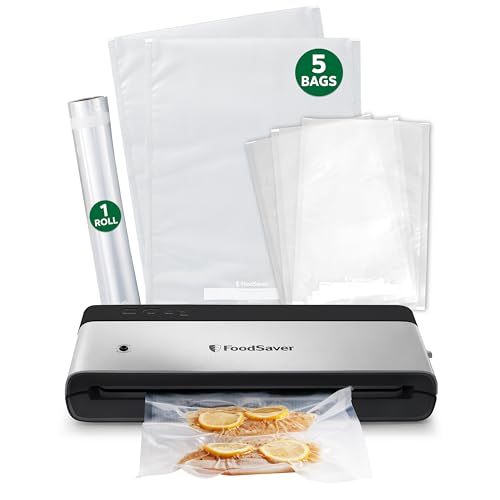
FoodSaver PowerVac Compact VS0150
Badge: Best Compact Performance
Strengths
- Vertical storage design keeps a real countertop machine within reach in small kitchens
- Documented for both dry and wet food, covering the two main home jobs
- FoodSaver ecosystem means bags and rolls are easy to source almost anywhere
Trade-offs
- Listing publishes no vacuum-pressure figure, so peak draw cannot be compared on paper
- Compact machines generally suit moderate sessions better than marathon bulk days
- No pulse mode is stated in the listing information
| Spec | Detail |
|---|---|
| Design | Compact, vertical storage |
| Finish | Stainless steel and black |
| Food types | Dry and wet food |
| Model | VS0150 PowerVac Compact |
The PowerVac Compact makes its performance argument differently: a machine that lives within arm’s reach gets used, and a sealer that gets used for every leftover, every half onion and every small portion delivers more real-world freshness than a stronger machine exiled to a high cupboard. Its vertical storage design is the enabling feature — the machine stands upright in the footprint of a cookbook, so it can live on the counter or in a slim gap rather than demanding a drawer of its own. Performance, in a small kitchen, begins with presence.
On the sealing itself, the listing documents the machine for both dry and wet food, which covers the realistic spread of home work: coffee, grains and cheese at one end, marinated meats and sauced leftovers at the other. The FoodSaver name carries a practical advantage that never appears in specification tables — bags, rolls and accessories for the brand are stocked everywhere, in multiple widths, so the machine never sits idle waiting for a proprietary consumable to arrive. Stainless steel and black finishing also matters more than it should: appliances that look at home on the counter stay on the counter.
The honest gaps are about evidence rather than suspicion. The listing publishes no vacuum-pressure figure, so this guide will not pretend to rank its peak draw against the 95kPa machines above; shoppers whose definition of performance is maximum stated vacuum should choose between the ROUUO and UPRUBE. Nor is a pulse mode stated, which makes very wet sealing a technique exercise — freeze liquids first, leave headroom — rather than a button press. Within its compact brief, though, the PowerVac is the credible performer: present, versatile across food types, and backed by the deepest consumables ecosystem in the category.
Best for: small kitchens that need a genuine countertop sealer without the footprint / Not suited for: spec-sheet shoppers who want a published maximum vacuum figure
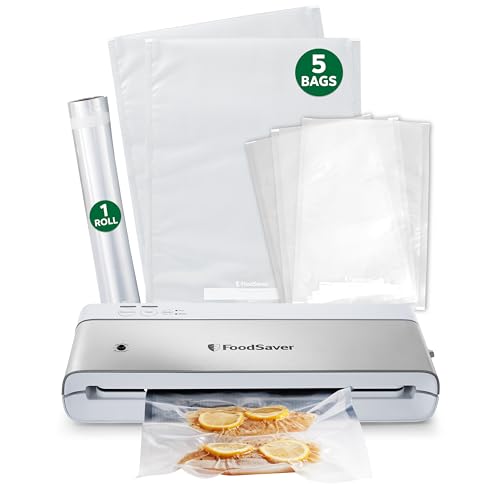
FoodSaver Compact Vacuum Sealer
Badge: Best for Sous Vide Readiness
Strengths
- Includes airtight bags and a roll, so it works out of the box
- Maker explicitly positions it for sous vide as well as storage
- Compact white design suits smaller counters and lighter-duty routines
Trade-offs
- No vacuum-pressure or speed figure is published in the listing
- Compact class means moderate sessions, not whole-animal breakdown days
- Sous vide performance still depends on bag quality and technique
| Spec | Detail |
|---|---|
| Design | Compact |
| Colour | White |
| Included | Airtight bags and roll |
| Positioning | Sous vide and airtight food storage |
Sous vide is the most demanding mainstream job a home sealer faces: the bag must hold its vacuum submerged for hours, the seal must not soften or creep in warm water, and excess air left in the bag makes food float and cook unevenly. This FoodSaver Compact is the pick badged for that work because its maker positions it explicitly for sous vide alongside airtight storage, and because it arrives with airtight bags and a roll in the box — the consumables the job requires, present from day one rather than discovered as an extra purchase at checkout.
Its performance story is about adequacy delivered reliably in a compact format. Water-bath cooking does not need the deepest vacuum in the category; it needs a complete draw that removes the buoyant air, a seal with no channels or wrinkles, and bags rated for the bath. A compact machine that does those three things every time will produce better sous vide results than a powerhouse used carelessly. Readers going deeper on the cooking side should pair this pick with our specialist guide to Best Vacuum Sealers Sous Vide, which covers bath-specific technique in full.
The limitations mirror its sibling above: no published vacuum figure in the listing, and a compact chassis aimed at household-scale sessions. Long baths also reward a double seal — running the seal cycle twice — which is technique, not machinery, and is covered in the how-to section below. What this pick offers the performance-minded sous vide cook is a purpose-positioned, ready-to-run machine without the bulk of the session sealers; for households whose sealing revolves around the water bath and weekly storage rather than bulk freezer days, that is the right performance profile.
Best for: sous vide cooks who want a compact, ready-to-run machine / Not suited for: bulk freezer stockers running very long sessions
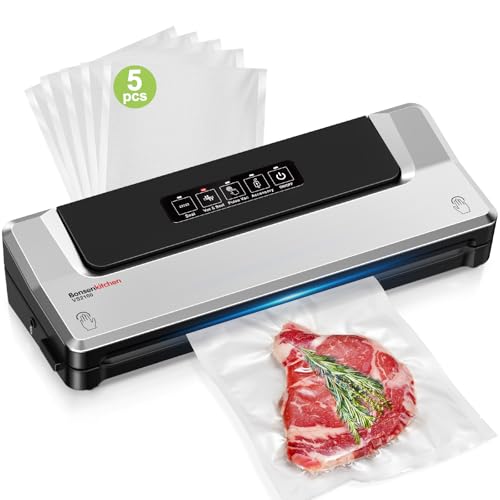
Bonsenkitchen Vacuum Sealer Machine
Badge: Best Simple Performer
Strengths
- Multiple modes cover the standard meal-prep sealing jobs without complexity
- External vacuum system format works with standard textured bags and rolls
- Compact silver design stores and cleans easily
Trade-offs
- Only five bags included — the smallest starter supply on this list
- No vacuum-pressure figure is published in the listing
- Fewer specialist features: no stated pulse mode, timer or drip tray
| Spec | Detail |
|---|---|
| Design | Compact, silver |
| System | External vacuum system |
| Modes | Multiple modes for meal prep |
| Included | 5 vacuum bags |
| Positioning | Kitchen food storage and sous-vide |
There is a performance argument for simplicity: a machine with a short, obvious control scheme gets its settings right every time, and operator error — wrong mode, bag misaligned, seal interrupted — ruins more bags in real kitchens than modest pump specifications ever will. The Bonsenkitchen is built on that argument. It is a compact external vacuum system with multiple modes aimed squarely at meal prep, the weekly rhythm of portioning proteins, vegetables and grains that dominates actual home sealing. Its listing positions it for kitchen food storage and sous-vide, and claims freshness extended several times over compared with ordinary storage — a claim about the category’s basic physics, which any competent vacuum delivers.
Performance expectations should be set honestly. The listing publishes no vacuum-pressure figure and states no pulse mode, timer or drip tray, so on paper this is the most modest countertop specification here. What it offers instead is adequacy with low friction: standard external-system compatibility with textured bags and rolls, a footprint that suits smaller kitchens, and a silver finish that wipes clean. For the meal-prep user sealing a dozen bags on a Sunday, the difference between this and the flagship picks is smaller than the specification gap suggests, because meal-prep foods are mostly cooperative — portioned, pat-dried, bag-friendly.
The clearest practical caveat is the starter supply: five included bags is a taster, not a stock, so budget for a roll from the first week. Shoppers working to a firm ceiling will find the value framing in Best Vacuum Sealers Under $200 useful background, since this machine competes in that accessible tier of the market. Choose the Bonsenkitchen when your sealing is regular but not extreme, and when a machine you fully understand beats a machine with modes you will never open.
Best for: meal preppers who want simple, reliable weekly sealing / Not suited for: power users who want published maximum specs and pulse control

Chef Preserve Compact Vacuum Sealer
Badge: Best Handheld Performance
Strengths
- Thirty reusable bags included — the most generous consumable bundle on this list
- Handheld format lives in a drawer and deploys in seconds
- Reusable bags suit the open, reseal, reopen rhythm of everyday ingredients
Trade-offs
- Handheld draw cannot match countertop vacuum depth or speed
- Works with its valve-style reusable bags, not standard rolls
- Not the tool for bulk sessions or large cuts
| Spec | Detail |
|---|---|
| Format | Handheld, portable |
| Included | 30 reusable vacuum bags |
| System | Reusable valve bags |
| Positioning | Meal saving and everyday storage |
Judging a handheld by countertop standards misses what performance means at this format. The Chef Preserve performs when the job is small and frequent: the opened block of cheese, the half avocado, the deli meat and berries that spoil in ordinary containers because dragging out a countertop machine for one small bag feels disproportionate — so nobody does it, and the food loses. A handheld that lives in a drawer, pairs with its valve bags in seconds and reseals without ceremony wins those encounters outright, and those encounters are where most household food waste actually happens.
The thirty reusable bags in the box are the substance of the offer. Reusability changes the economics and the habits of sealing: there is no per-bag cost discouraging you from resealing after taking two slices, and no roll to measure and cut for a handful of grapes. The maker describes the unit as a powerful handheld, and within the format that is the right expectation — a firm draw on small bags, sized for portions and ingredients rather than roasts. Meal savers, small households, dorm and caravan kitchens, and anyone whose sealing is measured in handfuls rather than freezer-loads are its natural constituency.
The boundaries are firm and should be respected. This is not a bulk tool: long sessions, large cuts and deep-vacuum freezer archiving belong to the countertop picks above, and its reusable valve bags are a closed system — you cannot cut a custom length from a roll for an awkward shape. Nor will it satisfy the spec-driven shopper comparing published vacuum figures, a game handhelds do not enter. Read as what it is — the performance leader for small, frequent, everyday sealing — it earns its place on this list honestly, and many households will use it more in a month than a flagship gets used in a year. Grill-focused readers may also recognise the format from discussions around Best Vacuum Sealers Steven Raichlen, where quick marinade and leftover work comes up often.
Best for: small households resealing ingredients daily; drawer storage / Not suited for: bulk freezer sessions or shoppers needing roll-based custom bags
Comparison Table
| Pick | Badge | Format | Key trait | Link |
|---|---|---|---|---|
| ROUUO 95kPa | Best Overall Performance | Countertop external | Highest stated vacuum figure in this list; drip tray fitted | Check on Amazon |
| UPRUBE 95kPa | Best for Speed and Batch Work | Countertop external | Fastest stated air draw in the list; timer fitted | Check on Amazon |
| FoodSaver PowerVac | Best Compact Performance | Compact external, vertical storage | Smallest countertop footprint; stores upright | Check on Amazon |
| FoodSaver Compact | Best for Sous Vide Readiness | Compact external | Ready out of the box for water-bath cooking bags | Check on Amazon |
| Bonsenkitchen | Best Simple Performer | Compact external | Simplest control scheme among the countertop picks | Check on Amazon |
| Chef Preserve | Best Handheld Performance | Handheld, reusable bags | Only handheld here; reusable-bag system cuts consumable cost | Check on Amazon |
Read the table by format first and specifications second. The two 95kPa countertop machines are the peak-performance tier, separated by emphasis — the ROUUO on power and wet control, the UPRUBE on draw speed and repeatability. The FoodSaver pair form the consistency tier, trading published peak figures for compact presence and ecosystem depth, while the Bonsenkitchen simplifies the same idea further. The Chef Preserve stands apart by format: comparing its draw with a countertop pump is a category error, and its row exists so handheld shoppers can see exactly what they gain in convenience and give up in depth.
How to Choose a Vacuum Sealer for Real Performance
Read the specifications like an engineer
Vacuum pressure, quoted in kilopascals, describes how deep a vacuum the pump can pull; higher figures generally mean tighter bags around irregular shapes and less residual air. Draw speed, quoted in litres per minute, describes how fast the bag collapses — a throughput figure that matters in batches. Wattage describes the motor’s electrical appetite and correlates only loosely with either; a well-designed 135W pump can out-seal a crude higher-watt machine. Seal-bar quality is the unquoted specification: a wide, even seal tolerates minor moisture and wrinkles that split a narrow one. Judge a machine on the combination, and distrust any listing that shouts one number while hiding the rest.
Duty cycle is the specification nobody publishes and everybody needs. Sealing is stop-start work for the pump but continuous work for the heat-seal bar, which needs cooling intervals on long runs. Machines with roll storage, cutters and timers are designed around sessions; minimalist machines are designed around occasional bags. Match the design intent to your real pattern — the household that portions a warehouse-club run monthly needs session stamina more than it needs a slightly deeper vacuum on a single bag.
Match modes to your foods
Dry mode is the default full cycle. Moist mode adjusts the cycle for foods with surface liquid. Pulse mode hands the draw to your judgement, button-press by button-press, and is the performance feature that most expands what a machine can handle: breads and soft fruit that a full draw would crush, and wet foods whose liquid must be stopped short of the seal. An accessory hose, where offered, extends the machine to canisters and jars. List the five foods you seal most, and buy the mode set that serves them; modes you never use are not performance, they are clutter.
Size the format to your kitchen and habits
Countertop externals are the performance mainstream: deepest draws, roll-based custom bags, session stamina. Compacts trade a little stamina for presence in small kitchens. Handhelds trade depth for immediacy and pair with reusable valve bags. Chamber machines sit above this list’s class entirely and suit liquids-heavy commercial work. The correct question is not which format is best but which format’s performance profile matches your dominant job — and honest guides, including this one, badge picks by job for exactly that reason.
How to Get Maximum Performance From Any Vacuum Sealer
Set up for the session. Work with the machine on a flat, dry surface, bags or a roll within reach, food portioned before the first seal. Cut roll bags generously — extra length at the open end gives the machine grip and keeps food away from the seal zone. Portion first, seal second: a laid-out line of filled bags turns sealing into a rhythm instead of a series of interruptions.
Load and seal correctly. Keep the bag’s open end flat, clean and dry inside the channel; curl or fold back the opening while filling so drips never touch the sealing area. Leave clear headroom between food and seal — crowded bags are the leading cause of weak seals. Smooth wrinkles from the seal zone with your fingers before closing the lid, because the bar seals the bag exactly as presented to it, wrinkles included.
Handle wet foods deliberately. Pat surfaces dry. For very wet items, pre-freeze for a short spell until the surface firms and liquid stops moving, or use pulse mode and stop the draw the moment liquid begins travelling toward the seal. Consider a double seal — a second seal line just beyond the first — on anything destined for a long freezer stay or a water bath.
Maintain the machine. Wipe the seal channel and gaskets after wet work; remove and wash drip trays where fitted. Store the machine unlatched if the maker advises it, so gaskets are not compressed flat between sessions — a flattened gasket is a slow leak in waiting. Check the seal bar for residue build-up, which causes uneven seals that look fine and fail later.
Problem: the bag loses vacuum in the freezer → what to do. Inspect the seal for channels, wrinkles or trapped moisture; reseal with a double line after drying the seal zone, and check the bag for pinholes from bones or sharp edges — pad sharp points with a folded paper towel next time.
Problem: liquid reaches the seal area → what to do. Stop the cycle, dry the channel, and switch strategy: pulse mode, more headroom, or a brief pre-freeze. Never simply re-run the same automatic cycle and hope; the same physics will deliver the same puddle.
Problem: the machine will not start or draw → what to do. Confirm the bag’s open end sits fully inside the vacuum channel, the lid is latched as designed, and the gasket is clean and seated. Most no-draw faults are presentation faults, not pump faults.
Performance Over Time: What Degrades and What Does Not
A sealer’s tenth year differs from its first mainly in consumable parts: gaskets compress, seal wires accumulate residue, and drip trays and cutters dull or clog. Pumps themselves are comparatively durable when kept dry — which is why wet-food technique is also a longevity strategy, since liquid drawn into a pump is the classic premature failure. Owners who wipe channels, store machines unlatched and keep liquids out of the pump routinely get long service from mid-tier machines, while flagship machines die young in kitchens that seal marinades carelessly. Performance, in other words, is partly a maintenance outcome, and the cheapest performance upgrade available to any owner is a clean gasket.
Bag quality is the other hidden variable. Thin or poorly textured bags limit any machine: the texture channels are what let air escape from the bag’s far corners, and seals are only as strong as the film being melted. When results disappoint, changing bag stock is a cheaper experiment than changing machines — and a useful diagnostic, because a machine that seals one brand of bag beautifully and another badly is telling you about film, not pumps.
What Performance Means for Food Safety and Quality
Vacuum sealing is a quality technology, not a safety shortcut. Removing air slows oxidation and freezer burn and delays some spoilage organisms, but it does not sterilise food, does not stop all bacteria — some thrive without oxygen — and does not extend fridge life indefinitely. Perishables still need refrigeration or freezing, still need sensible use-by judgement, and should still be labelled with contents and date. The performance that matters here is seal integrity over time: a bag that quietly admits air in week three delivers neither the quality nor the storage life its owner assumes, which is why this guide weights seal reliability as heavily as draw strength.
For sous vide cooking, performance has a specific safety-adjacent meaning: a bag that floats because of trapped air cooks unevenly, and uneven cooking is a genuine quality and safety concern at low temperatures. A complete draw and a sound seal are therefore part of the cooking method, not a packaging preference — one more reason the sous vide pick above is badged on reliability and readiness rather than on the deepest headline vacuum.
Common Buying Mistakes
Buying the biggest number. A single shouted specification — wattage, usually — tells you little. Shoppers who buy the combination of vacuum figure, modes and session design that matches their food do better than shoppers who buy the largest digit on the box.
Overfilling bags. Food crowded into the seal zone contaminates it and guarantees weak seals. Headroom feels wasteful and is actually the cheapest performance available.
Sealing liquids on a dry automatic cycle. The draw will pull liquid to the seal every time. Pulse, pre-freeze or leave the liquid job to a design that anticipates it.
Ignoring the gasket. Storing the machine latched, never wiping the channel, and then blaming the pump for weak draws is the category’s most common self-inflicted wound.
Expecting vacuum to replace the freezer or the calendar. Sealed food still ages. Label, date and rotate stock; performance is wasted on food nobody can identify.
Final Recommendation
For most performance-minded shoppers, the ROUUO is the first choice: the strongest stated vacuum in the pool, pulse control for the hard bags, a drip tray for the wet ones and session-friendly storage and cutting — the complete performance profile in one machine. Check on Amazon
Choose the UPRUBE instead if your sessions are long and pace is your pain point; its stated draw speed and timer discipline suit batch workers beautifully. Check on Amazon The FoodSaver PowerVac is the right answer when the kitchen, not the food, sets the limits — genuine countertop capability that stores vertically and stays in daily reach. Check on Amazon
Sous vide households should start with the FoodSaver Compact, meal preppers with the Bonsenkitchen, and small-space daily resealers with the Chef Preserve handheld. Performance is not one summit; it is the match between a machine’s strengths and your food’s demands, and every pick here is the strongest match for its stated job.
Frequently Asked Questions
What vacuum pressure figure should I look for?
Treat published kilopascal figures as a guide to the top tier rather than an absolute ranking: the strongest stated figures in this pool are 95kPa, and machines publishing such figures are signalling a powerful pump. But seal quality, modes and technique move real results as much as the headline number, which is why this guide weighs the whole specification set.
Does higher wattage mean better sealing?
Not reliably. Wattage describes electrical consumption, not vacuum depth or seal quality. A lower-watt machine with a well-designed pump and a good seal bar can outperform a crude higher-watt design, so compare vacuum and speed figures and feature sets before wattage.
Why does pulse mode matter so much?
Pulse mode lets you stop the draw manually at the exact moment a delicate food begins to compress or a liquid begins moving toward the seal. That single control converts failures — crushed soft foods, wet seals — into successes, and it is the feature experienced owners most often refuse to give up.
How many bags can I seal in a row?
It depends on the machine’s design intent. Session-oriented machines with roll storage and cutters are built for long runs with brief pauses; minimalist compacts and handhelds suit shorter runs. Give any machine short rests between seals on very long sessions, and keep the seal bar clean so heat and residue do not compound.
Can a handheld replace a countertop sealer?
For small, frequent resealing of ingredients in its reusable bags, yes — that is its home ground. For bulk sessions, large items, custom bag sizes or the deepest vacuum, no: the formats are complements, and many serious kitchens own one of each.
Why do my sealed bags sometimes puff up later?
Either air is entering through a flawed seal or pinhole, or the food itself is producing gas as it ages — some vegetables and cheeses do this naturally. Inspect the seal, reseal if the food is sound and recently sealed, and discard anything whose age or smell raises doubt; vacuum is not a safety guarantee.
Do I need special bags?
Countertop external machines need textured (embossed) bags or rolls so air can escape along the channels; handhelds use their own valve bags. Smooth film will not evacuate properly in an external machine no matter how strong the pump is.