Disclosure: topratedkitchenware.com is reader-supported. When you buy through links on our site, we may earn an affiliate commission from Amazon and other retailers, at no extra cost to you.
Where to buy
Five of the six pool products are genuinely waterless, and all five are linked below: two Nature’s Head composting kits, two dry flush designs (Laveo and the rechargeable MODIWELL R1808), and the Ann Katy XL portable. The sixth pool product — a plumbed macerating system that flushes with water — was excluded entirely and is documented in the sources file, because a water-flushing pump toilet cannot appear in a waterless guide honestly.
- Nature’s Head Structure Kit with Composting Toilet — Foot Spider Handle — check the latest price on Amazon
- Nature’s Head Structure Kit with Composting Toilet — Spider Handle — check the latest price on Amazon
- MODIWELL R1808 Fixed RV Dry Flush Toilet — check the latest price on Amazon
- Laveo Dry Flush Toilet — check the latest price on Amazon
- Ann Katy Upgrade XL Portable Toilet — check the latest price on Amazon
Read the full guide ↓
The best waterless toilets solve a problem plumbing cannot: sanitation where there is no water supply, no drain, no septic field — or where all three exist but the building moves, freezes, or sits empty for months. Cabins, tiny homes, boats, vans, RVs, workshops, and emergency backup at home all land on the same short technology list, and this guide’s five verified picks cover its three real branches: composting toilets that transform waste in a vented chamber, dry flush toilets that seal each use into a cartridge, and the simple containment portable that asks for nothing at all.
The five are not interchangeable, and this guide ranks them by the honesty of their fit rather than by novelty. The Nature’s Head composting kits — in foot-spider and classic spider-handle variants — are the permanent-installation answer, built for daily full-time use with no consumables beyond a dry medium. The Laveo Dry Flush and the MODIWELL R1808 are the appliance answer: MODIWELL’s listing adds a rechargeable, swivel-top design aimed at fixed RV installation, while the Laveo is a portable unit that moves between vehicles and sites. The Ann Katy XL is the minimalist answer — an extra-large lidded portable with no mechanism at all, and therefore nothing to power, clog, or maintain.
Readers whose interest is specifically the biological branch will find it treated in depth in Best Waterless Composting Toilets; this guide is the wider map, and it spends its length on the decision that actually divides buyers — transformation versus containment, permanent versus portable, routine versus consumables. It also enforces the category boundary in the other direction: the pool’s one water-flushing product was excluded, with the reason recorded, because ‘waterless’ is a physical claim, not a marketing neighbourhood.
Every specification below comes from the manufacturer’s verified listing. Where a listing is silent — a portable’s unstated capacity, a dry flush unit’s exact cartridge count — the review works with the design and says the figure is unstated. In a category sold heavily on lifestyle imagery, that discipline is the difference between a buying guide and a brochure.
Key Takeaways
- Five genuine waterless picks in three technologies: composting (Nature’s Head ×2), dry flush (Laveo, MODIWELL), and containment portable (Ann Katy).
- The pool’s sixth product, a water-flushing macerating system, was excluded and documented — it is not waterless in any sense.
- Composting suits permanent, daily use: no water, no cartridges, a vent and a routine instead. Dry flush suits intermittent and mobile use, at a per-use consumable cost.
- MODIWELL’s R1808 is the fixed-installation dry flush: rechargeable, swivel-top, built for RVs and boats rather than carried between sites.
- The Ann Katy XL is the zero-mechanism option — no power, no consumable system, nothing to fail — at the cost of the most manual emptying routine.
- Match the technology to the use pattern first; every disappointment in this category is a pattern mismatch, not a defective toilet.
In this guide
Quick Picks
| Pick | Badge | Standout trait | Check |
|---|---|---|---|
| Nature’s Head Structure Kit with Composting Toilet — Foot Spider Handle | Best Overall Waterless Toilet | Complete self-contained composting kit; foot-operated agitator; zero water, zero cartridges | Check on Amazon |
| Nature’s Head Structure Kit with Composting Toilet — Spider Handle | Best Classic Composting Pick | Same complete composting kit with the hand-crank spider agitator | Check on Amazon |
| MODIWELL R1808 Fixed RV Dry Flush Toilet | Best Fixed Dry Flush for RVs | Waterless rechargeable dry flush, swivel top, fixed RV/boat installation, Loo Seal sealing | Check on Amazon |
| Laveo Dry Flush Toilet | Best Portable Dry Flush | Waterless, portable, self-contained LDPE unit for vans, boats, camping, tiny homes | Check on Amazon |
| Ann Katy Upgrade XL Portable Toilet | Best Zero-Mechanism Portable | Extra-large lidded portable, lightweight and compact — no water, no power, no consumable system | Check on Amazon |
Read the table by rows of commitment. The composters ask for a vent route and weekly tending, and repay it with near-zero running costs. The dry flush pair ask for cartridges and (for the MODIWELL) a charge, and repay it with push-button simplicity. The Ann Katy asks for carrying and discipline, and repays it with total independence from power, parts, and plumbing. Your site and your temperament pick the row; the reviews then pick within it.
If your shortlist started with the flush-toilet world, the contrast behind Best Toilets Ranked is instructive: ranked flush toilets compete on fractions of a gallon, while everything in this guide competes on using none — a different sport, judged by different rules.
How These Picks Were Chosen
Six pool products were verified through the Creators API and then tested against a single physical criterion: does the product operate with no water? Five passed on their own listing evidence — two Nature’s Head composting kits (‘100% self-contained waterless toilet system’ is the maker’s own stated description), the Laveo (‘waterless, portable, self contained’, stated), the MODIWELL R1808 (‘waterless rechargeable’, ‘no-plumbing’, stated), and the Ann Katy portable, a containment design that uses no flush water by construction. One failed outright: the Simple Project 600W macerating system is a plumbed toilet that flushes with water and pumps the result to a drain. It was excluded from the picks entirely, with its ASIN and the reason recorded in the sources file — not demoted to a prose mention, because there is no honest sentence in which it belongs in this guide.
The five survivors were compared on installation demand (vent route, fixed mounting, or none), daily routine, consumables and their supply risk, emptying reality, power needs, and the use pattern each design serves best. Ranking rewards fit and documentation: listings that state their mechanism and intended uses plainly scored above listings long on adjectives. This is research-led guidance; it claims no field testing and prints no ratings, review counts, or prices.
A note on the two Nature’s Head listings, carried over from this guide’s composting companion: they are one platform in two handle configurations. They are reviewed as the two purchasable variants they are, with the shared engineering treated once and the genuine difference — foot pedal versus hand crank — compared directly, rather than padded into a fake rivalry.
The 5 Best Waterless Toilets
Ordered by depth of installation: the two permanent composting kits first, then the fixed dry flush, the portable dry flush, and finally the zero-mechanism portable. Each review covers the mechanism, the routine it creates, and one honest limitation.
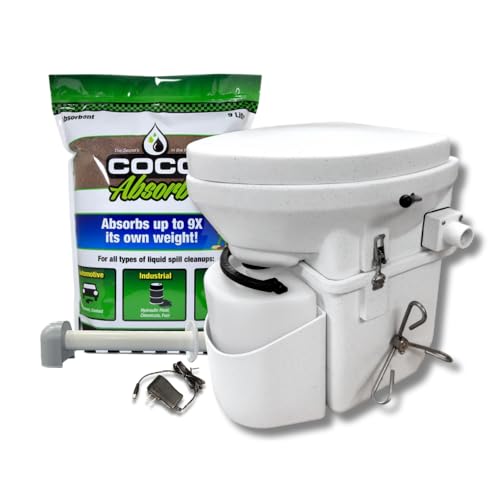
Nature’s Head Structure Kit with Composting Toilet — Foot Spider Handle
Badge: Best Overall Waterless Toilet
Strengths
- True composting: urine separation and a vented, agitated solids chamber transform waste with no water and no consumable cartridges.
- Foot spider handle works the agitator without bending or gripping a crank — the easiest daily routine in the composting branch.
- Sold as a complete all-inclusive structure kit, the format a remote installation actually needs.
Trade-offs
- Requires a vent route to the outside and a small continuous power supply for the vent fan.
- Composting is a tended process: medium, cranking, and two emptying rhythms (liquids in days, solids in weeks) are permanent routines.
- Guests need a thirty-second briefing — sitting always, paper modestly, nothing else in.
At a glance: Type: self-contained composting toilet, structure kit; Water use: none (stated 100% self-contained waterless system); Agitator: foot spider handle; Kit: complete all-inclusive (stated); Stated uses: cabins, tiny homes, off-grid living.
The Nature’s Head foot-spider kit is the most complete answer this category offers to a permanent site. Its composting design separates urine at the bowl into its own bottle, drops solids into a vented chamber of dry medium, and relies on a small vent fan to keep that chamber dry, aerated, and at negative pressure — the physical arrangement that makes a composting toilet odourless in normal use and lets biology, not water, do the disposal. After each solid use, the agitator buries the deposit in the medium; in this variant that agitator is worked by a foot spider handle, which removes the bending and hand-cranking the classic design asks for, every single time, for years.
That ergonomic detail is why this variant takes the overall badge in a guide read by full-time users. A composting toilet’s success is a compound of small daily compliances, and the foot operation is the compliance most likely to survive tired evenings, older knees, and visiting grandchildren. The structure-kit format compounds the advantage at installation: everything the system needs arrives together, which matters at a cabin or off-grid site where a missing fitting is a day’s round trip, not a hardware-store errand.
The limitations are the technology’s own. It needs a vent path out of the building and power for the fan — trivial for most cabins and tiny homes, a genuine planning item for a power-free site. It needs medium in stock and an owner who treats emptying rhythms as household routine rather than emergency. And it transforms waste rather than removing it, so the finished material must be handled under local rules. Buyers who accept those terms get the category’s reference design in its most usable form; buyers who do not should keep reading — the dry flush picks below exist for them.
Best for: permanent cabins, tiny homes, and off-grid houses wanting full-time waterless sanitation with no cartridges / Not suited for: power-free sites with no vent route, or owners who will not tend a biological system

Nature’s Head Structure Kit with Composting Toilet — Spider Handle
Badge: Best Classic Composting Pick
Strengths
- The classic hand crank: the configuration most composting advice, troubleshooting, and owner experience is written about.
- Cranking by hand returns tactile information about medium level and moisture that experienced owners actively use.
- Identical composting platform and complete kit to the foot variant — same separation, venting, and waterless operation.
Trade-offs
- Bending and gripping a crank after every solid use is the daily effort the foot variant was designed to remove.
- Shares all platform requirements: vent, fan power, medium, and the two emptying rhythms.
- Its case over the foot variant is preference, not performance — compare both listings before deciding.
At a glance: Type: self-contained composting toilet, structure kit; Water use: none (stated 100% self-contained waterless system); Agitator: spider handle (hand crank); Kit: complete all-inclusive (stated); Stated uses: cabins, tiny homes, off-grid living.
This is the same composting toilet as the pick above — same separator bowl, same vented chamber, same complete structure kit for cabins, tiny homes, and off-grid living — in its original configuration, where the agitator is turned by a hand crank called the spider handle. The review can therefore be short about engineering and specific about the one difference, because the difference is the decision. The crank is worked by hand after each solid use: a bend, a grip, several turns that bury the deposit and aerate the medium.
Two honest advantages keep the crank competitive. The first is information: resistance through the handle tells a practised owner about the chamber’s moisture and fill level the way a gardener reads soil by hand, and composting rewards exactly that kind of feel. The second is ecosystem: the classic configuration is the one the category’s collective knowledge describes, so any question you will ever type into a search box at midnight has been answered against this handle. For a mechanically minded owner, that familiarity is worth real money and real calm.
The cost is ergonomic and cumulative. The crank asks the same small effort hundreds of times a year, and in households with older users, bad backs, or weak grips, small repeated efforts are exactly the ones that start being skipped — and a composting system punishes skipped agitation. This guide therefore badges the foot variant above it for most full-time households, while recommending this classic without hesitation to able, hands-on owners who prefer the simplest mechanism and the deepest pool of shared experience behind it.
Best for: hands-on owners who value tactile feedback, mechanical simplicity, and the most documented configuration / Not suited for: households where bending or gripping is difficult for any regular user

MODIWELL R1808 Fixed RV Dry Flush Toilet
Badge: Best Fixed Dry Flush for RVs
Strengths
- Dry flush sealing (the maker’s Loo Seal system) wraps each use away — no odour, no sight, no water, no vent.
- Rechargeable and plumbing-free, yet designed as a FIXED installation with a swivel top — a real RV toilet, not a carried portable.
- Stated for care use as well as RVs and boats: the push-button routine suits users who cannot manage cranks, cassettes, or carrying.
Trade-offs
- Consumable-dependent: the sealing system runs on refill material, a standing cost and supply chain the composters avoid.
- Rechargeable means a battery to keep charged — a small but real addition to an RV’s power routine.
- A newer, single-model brand presence: confirm refill availability for your region before fixing it into an RV build.
At a glance: Type: dry flush toilet, fixed installation; Water use: none — waterless, no plumbing (stated); Power: rechargeable (stated); Top: swivel (stated); Sealing: Loo Seal waterless sealing (stated); Stated uses: RVs, boats, off-grid, emergency, care use.
The MODIWELL R1808 occupies the most interesting niche in this guide: a dry flush toilet designed not to be carried, but installed. It is fixed-format for RVs and boats, with a swivel top — a practical touch in the tight geometry of a vehicle bathroom, where the approach angle is rarely straight — and it seals each use with the maker’s Loo Seal waterless system, wrapping waste away at the touch of the mechanism. No plumbing, no water, no vent, no black tank: the RV gains a permanent, civilised toilet whose entire infrastructure is a rechargeable battery and a supply of sealing refills.
The care-use note in its listing deserves attention, because it identifies the design’s deepest strength. A sealed, push-button routine asks nothing physical of the user — no crank, no cassette to haul, no bag to tie — which makes this format genuinely suitable for users with limited strength or mobility, in an RV, in a boat cabin, or in a home care setting where a waterless toilet near the bed or the living space changes what independent living means. Emergency use follows from the same properties: a rechargeable, plumbing-free toilet is the one that still works in a power cut, a freeze, or a plumbing failure at home.
The trade-offs are the dry flush family’s. The sealing consumable is proprietary in nature — this toilet’s running cost and its supply risk live in the refill, so verify ongoing availability before the unit is built into cabinetry, and keep a reserve on board. The rechargeable battery joins the RV’s charging routine; run flat, the toilet waits. And per-use cost makes it a poor economist for a large full-time household on land, where a composter’s near-zero consumables win. For the vehicle and care briefs it was designed for, though, the R1808 is the most purpose-built pick in this guide.
Best for: RVs, boats, and care settings wanting a fixed, sealed, push-button waterless toilet / Not suited for: high-volume full-time land households, or anyone unwilling to stock proprietary refills

Laveo Dry Flush Toilet
Badge: Best Portable Dry Flush
Strengths
- The simplest waterless routine made: each use sealed into a cartridge, no vent, no medium, no biology to manage.
- Portable and self-contained in a tough LDPE body — one toilet serves the van this month and the cabin next.
- Indifferent to intermittent use, the pattern that makes composters sulk: ideal for weekends and seasonal sites.
Trade-offs
- Runs on proprietary refill cartridges — an ongoing cost and a supply dependency, worst under heavy daily use.
- Waste is sealed and disposed of, not transformed; some buyers and some jurisdictions dislike the bagged-waste stream.
- Portable format means portable seating: fine for its brief, not a full-time household’s first choice.
At a glance: Type: dry flush toilet, portable; Water use: none — waterless, self-contained (stated); Body: LDPE, white; Stated uses: tiny homes, vans, boats, camping, RVs, off-grid.
The Laveo is the waterless toilet for people who have looked at composting, understood it, and declined the hobby. Its dry flush mechanism seals each use into an internal cartridge bag: press, sealed, forgotten, until the cartridge is spent and swaps out as a single contained unit. There is no vent to install, no medium to stock, no crank to turn, and nothing alive inside the box. The body is LDPE — the light, tough polymer of fuel cans and kayaks — and the unit is portable in the true sense: it can serve a van conversion this season, a boat next season, and a cabin’s overflow guests in between, because its entire installation is a flat place to stand.
Intermittence is its superpower. A composting chamber is a garden: it prefers regular attention and sulks through long neglect followed by a crowd. The Laveo is an appliance: used twice in a month or twenty times in a weekend, its behaviour is identical, which is precisely the pattern of vans, boats, camps, and second homes. The maker’s own positioning — easier than an incinerating or composting toilet — is the rare marketing line this guide can endorse from the design alone: for a large class of owners, sealed-and-simple is not a compromise but the requirement.
The costs are structural. Cartridges are a proprietary consumable: budget them, stock them, and accept that a supply interruption idles the toilet. The sealed waste stream goes out as solid waste under local rules, which some buyers reject on principle and some facilities restrict in practice. And under heavy full-time use, the per-use cost steadily loses to a composter’s bag of medium. Read the badges as the guide intends: the Laveo is the best portable dry flush here, and the right first waterless toilet for anyone whose use is mobile or occasional.
Best for: vans, boats, camping, and seasonal cabins — waterless sanitation with zero management / Not suited for: full-time households counting per-use costs, or buyers committed to composting on principle

Ann Katy Upgrade XL Portable Toilet
Badge: Best Zero-Mechanism Portable
Strengths
- Nothing to break: no mechanism, no battery, no cartridge system — the most failure-proof waterless design possible.
- Extra-large format in a lightweight, compact body, usable by adults and kids across camping, boat, and emergency RV duty.
- A lid keeps the unit discreet and contained between uses and during the carry to a dump point.
Trade-offs
- The most manual routine here: waste is contained and must be bagged or emptied and the unit cleaned by hand.
- No sealing or flushing action — odour control rests on the lid, prompt emptying, and user discipline.
- The listing states no capacity figure, so plan emptying conservatively rather than trusting any number.
At a glance: Type: portable containment toilet, extra-large; Water use: none (no flush mechanism); Body: lightweight and compact (stated); Lid: included; Stated uses: hiking, beach, boat, emergency RV, camping.
The Ann Katy XL is what remains when every mechanism is stripped away — and for a real class of buyers, what remains is exactly right. It is an extra-large portable toilet with a lid: a seat, a containment body, and nothing else. It uses no water because it has no flush; it needs no power because it has no motor or fan; it consumes no cartridges because it has no sealing system. In an emergency kit, a small boat, a tent camp, or an RV whose plumbing has failed two days from anywhere, that absence of dependencies is not a limitation but the entire value proposition: this toilet cannot break down, because there is nothing in it to break.
The XL sizing is the detail that makes it adult-viable. Minimal portables fail by being perches — too small and too low for grown users, who then avoid them. Ann Katy’s listing leads with extra-large capacity for adults and kids in a body still described as lightweight and compact, which is the combination that gets a portable carried, stored under a dinette or in a locker, and actually used at night instead of avoided. The lid does quiet double duty: containing odour in a small cabin and making the walk to the dump point a private errand rather than a public one.
The routine is the price, and this guide states it without varnish: waste is contained, then bagged or emptied and the unit washed by hand, on a rhythm set by use and heat rather than by any stated capacity — the listing gives none, so empty early and often. Odour control is discipline, not technology. For buyers who accept that bargain — ultralight travellers, emergency planners, minimalists, and anyone backing up a primary system — the Ann Katy is the most honest product in this guide: it promises a seat and a container, and it delivers exactly that, anywhere on earth.
Best for: emergency kits, small boats, tent camping, and as a zero-dependency backup toilet / Not suited for: anyone wanting sealing, flushing action, or a hands-off emptying routine
Comparison Table
| Pick | Type | Water use | Mechanism | Standout | Check |
|---|---|---|---|---|---|
| Nature’s Head Structure Kit with Composting Toilet — Foot Spider Handle | Composting | None | Foot spider handle | Complete kit | Check on Amazon |
| Nature’s Head Structure Kit with Composting Toilet — Spider Handle | Composting | None | Spider hand crank | Complete kit | Check on Amazon |
| MODIWELL R1808 Fixed RV Dry Flush Toilet | Dry flush, fixed | None | Rechargeable, swivel top | Loo Seal sealing | Check on Amazon |
| Laveo Dry Flush Toilet | Dry flush, portable | None | Sealed cartridge | LDPE body | Check on Amazon |
| Ann Katy Upgrade XL Portable Toilet | Containment portable | None | No mechanism at all | XL seat, lidded | Check on Amazon |
How to Choose a Waterless Toilet
Choose the technology before the product, using your use pattern as the judge. Daily, permanent, single-site use — the cabin, the tiny home, the liveaboard — rewards composting: the Nature’s Head pattern asks for a vent and a routine and then runs for years on medium and minutes. Fixed vehicle or care use rewards installed dry flush: the MODIWELL’s sealed, rechargeable, push-button format behaves like an appliance in an RV or beside a bed. Mobile and intermittent use rewards portable dry flush: the Laveo does not care whether it works twice a month or twenty times in a weekend. And the zero-dependency brief — emergencies, minimal kits, backup duty — belongs to the Ann Katy, whose lack of mechanism is its specification.
Then audit the site’s hard constraints, in this order: venting, power, and disposal. A composter without a vent route to outside air is a bad installation waiting to happen, so walk the vent path physically before ordering. Power sorts the rest: the composter’s fan wants a small continuous supply, the MODIWELL wants charging, the Laveo and Ann Katy want nothing. Disposal is the constraint buyers check last and regret first: compost material and dry-flush cartridges are both handled under local rules that vary by place, and the time to learn your area’s answer is before the toilet arrives — the recurring lesson in the owner experiences gathered under Best Toilets Reddit is that nobody’s toilet failed them as often as their assumptions did.
Cost the whole ownership, in both currencies this category charges. Composting charges attention — cheap medium, trivial fan power, and an owner’s minutes every week. Dry flush charges money — a predictable per-use consumable cost, plus refill supply risk that should be retired by keeping a reserve stock. The containment portable charges effort at emptying time. There is no free option, only a choice of which currency your household is rich in; the rankings instinct imported from flush-toilet shopping, visible in Best Toilets Ratings habits, actively misleads here, because the ‘best’ waterless toilet for a full-time cabin and the best for a weekend van are different products for structural reasons.
Finally, interrogate the listing the way this guide did. A waterless claim should name its mechanism — composting with separation and venting, dry flush with sealing, or plain containment. Listings that blur the categories, or pool neighbours that flush with water while wearing a waterless keyword, are telling you something about the seller. Apply the same scepticism to capacity and consumable claims: stated figures you can plan around, unstated figures you must treat as unknown, and any figure a seller will not print is a figure you should not repeat to yourself as fact.
How to Install and Live With a Waterless Toilet
Installation divides cleanly by technology. For a composting kit (either Nature’s Head):
- Site the unit where the vent can run outside by the straightest route and the liquids bottle can be lifted out without contortion.
- Fit the vent hose and fan, seal the exterior exit against weather and insects, power the fan, and verify with a tissue that air draws inward at the bowl.
- Charge the solids chamber with the specified dry medium before first use — never start a chamber empty.
- Brief every user: sit for every use (separation is positional), paper modestly, agitator after solids, nothing else in — no wipes, ever.
- Set the rhythms: liquids bottle on its short cycle, solids chamber on its long one, medium topped up by the crank’s feel or the schedule.
For the dry flush pair, installation is placement plus supply: the MODIWELL fixes into its RV or boat position with its swivel top checked for clearance through its full arc, its battery charged, and refills stored aboard; the Laveo simply stands level wherever it serves, with a cartridge loaded and spares within reach. For the Ann Katy, preparation is a liner or bagging routine per the campground’s rules and a stored kit — bags, absorbent if you use it, gloves, and cleaning supplies — kept with the unit, not across the site. Across all five picks, the living-with-it rules rhyme: keep consumables in stock, empty on schedule rather than at crisis, wash and dry any unit before storage, and never let a liquid-holding part freeze full.
Troubleshooting
Problem: odour from a composting unit → check the fan is running and drawing inward, then the chamber’s moisture: odour means wet, and wet means liquids are reaching the solids (separation discipline) or the medium is exhausted. Correct the cause; air fresheners are not a setting on the toilet.
Problem: a dry flush unit jams or fails to seal → stop cycling it, check for an over-full cartridge or a mis-seated refill, and consult the maker’s clearing procedure; forcing a sealing mechanism converts a jam into a repair. For the rechargeable MODIWELL, rule out a flat battery first — it is the most common cause of a ‘dead’ unit.
Problem: a portable smells between uses → the sealing faces or lid are dirty, or emptying has slipped behind use. Clean the contact surfaces, empty now, and shorten the interval; with containment designs, rhythm is the entire odour-control system.
Transformation vs Containment: The One Decision Behind All Five Picks
Every waterless toilet in this guide answers the same question differently: what happens to waste in the minute after use? Composting answers ‘it begins to transform’ — separated, dried, aerated, and processed in place by a tended biological system. Dry flush answers ‘it is sealed’ — wrapped out of sight and smell by a mechanism, removed later as a unit. Containment answers ‘it waits’ — held plainly until a person carries it away. None of these is a more advanced version of another; they are three different allocations of effort, money, and infrastructure, and the whole art of buying in this category is matching the allocation to a life.
The matching rules are stable enough to state plainly. Where a site is permanent and its people are present daily, transformation wins, because tending is cheap when it is daily and consumables are a tax paid forever. Where use is intermittent or the users change — rentals, guests, crews, patients — containment by sealing wins, because a mechanism does not need to be taught, trusted, or tended. Where the overriding need is that the toilet exist and work under any circumstances at all, plain containment wins, because it has no dependencies to fail. Buyers who state their pattern honestly before shopping almost never regret this category; buyers who shop by product photography almost always do, a pattern the second-hand market documented under Best Toilets Sale quietly confirms every season.
The Waterless Bonus Nobody Puts on the Box: Nothing to Freeze, Burst, or Leak
Owners of cabins and boats learn to value a property no listing in this guide headlines: a waterless toilet removes water from a building that may sit empty and unheated. A plumbed toilet in a winterised cabin is a liability managed with antifreeze and anxiety — traps, tanks, and supply lines all hold water that freezes expansively. A waterless toilet holds none. It can be left in a frozen cabin, a hauled-out boat, or an unheated workshop indefinitely, and returned to service the moment its owner walks in, which is a large part of why the category owns the seasonal-property market.
The same logic runs in miniature inside a vehicle. An RV’s plumbed system is its most freeze-vulnerable and leak-consequential plumbing; a waterless toilet — fixed dry flush or portable — steps outside that system entirely, extending the travel season at both ends and removing one whole class of 2 a.m. water emergencies. When you read the five reviews above, weigh this property alongside the mechanisms: in the settings these toilets serve, ‘contains no water’ is not merely an environmental virtue but a structural one, and for many owners it is, in the end, the deciding feature.
Common Buying Mistakes
Mistake one: buying the category by keyword instead of mechanism. ‘Waterless’ includes composters, dry flush units, and plain portables with utterly different routines — and excludes, whatever a careless listing implies, anything that flushes with water, including the macerating system excluded from this guide’s pool. Read the mechanism line before the marketing line.
Mistake two: installing a composter without walking the vent route first. Venting is half the technology; a unit vented badly or not at all will smell, and the design will be blamed for the installation.
Mistake three: starving a dry flush of its consumables. A cartridge-dependent toilet with no cartridges in stock is furniture. Keep a reserve wherever the toilet lives — aboard the boat, in the van, at the cabin — and reorder at the reserve, not at the empty.
Mistake four: skipping the guest briefing on a composter. Sitting, paper discipline, and the agitator are a thirty-second lesson; an unbriefed weekend crowd can set a chamber back a month. Put the rules on the wall and remove the social friction of asking.
Mistake five: storing any of these units dirty, sealed, or wet. Wash, dry, and store open as the design allows; the category’s second-season odour stories are almost all storage stories. The same care applies at purchase time to checking what a listing does not state — an unprinted capacity is an unknown, and planning a trip around an unknown is how a good toilet gets an unfair review.
Final Recommendation
For a permanent waterless installation, buy the Nature’s Head — and choose the handle by household: the foot spider for daily full-time use and any user who would struggle to crank, the classic spider for hands-on owners who want the tactile, most documented mechanism. It is the only branch of this category that runs for years on minutes and medium, and the kit format makes it installable anywhere a vent can reach outside air.
For vehicles and care settings, the MODIWELL R1808 is the fixed answer — sealed, rechargeable, push-button, and built into the RV rather than carried through it. For mobile and intermittent use, the Laveo’s portable dry flush is the simplest ownership in the guide. And for emergencies, minimal kits, and backup duty, the Ann Katy XL asks for nothing and therefore never fails to be available. State your pattern honestly, buy the branch that matches it, keep its consumables in stock — and let any product that needs a water supply argue its way into some other guide.
Start here: Nature’s Head composting toilet, foot spider handle, Nature’s Head composting toilet, spider handle, MODIWELL R1808 dry flush toilet.
Frequently Asked Questions
What types of waterless toilets are there?
Three, all represented in this guide. Composting toilets separate urine and process solids in a vented chamber with a dry medium — the Nature’s Head pattern. Dry flush toilets seal each use into a cartridge bag with no water and no biology — the Laveo and the rechargeable MODIWELL R1808. Containment portables simply hold waste in a lidded unit for manual emptying — the Ann Katy XL. They share zero water use and nothing else; the buying guide above matches each type to the use pattern it serves.
Do waterless toilets smell?
The composting and dry flush designs are engineered specifically not to: a composter’s vent fan holds its chamber at negative pressure and dries its contents, while a dry flush seals each use away immediately. Odour from either is diagnostic — a failed fan or wet chamber in the composter, a mis-seated cartridge in a dry flush. A plain containment portable controls odour only by its lid and its owner’s emptying rhythm, which is the honest trade for its simplicity and price of entry.
Which waterless toilet is best for a tiny home?
For a full-time tiny home, a composting toilet — here, the Nature’s Head in whichever handle configuration suits the household — because daily permanent use is exactly what composting rewards: no cartridges to buy, no waste bags to dispose of, and a routine that folds into household life. The dry flush designs suit tiny homes used intermittently, or households that cannot route a vent; the MODIWELL’s fixed format is the tidiest of those options.
Which waterless toilet is best for an RV?
It depends on the RV’s pattern. A fixed installation points to the MODIWELL R1808 — rechargeable, swivel-topped, and designed for RV and boat installation with sealed dry flushing. A portable answer points to the Laveo for sealed simplicity or the Ann Katy XL for zero-dependency backup and emergency use. A plumbed RV toilet replacement is a different, specialist category that none of these replaces directly; these picks serve RVs without plumbed toilets, or supplement one to save its black-tank capacity.
What does a waterless toilet cost to run?
In money: a composter runs on dry medium and a fan’s trivial electricity — the cheapest per use here. Dry flush units run on proprietary refill cartridges, a predictable per-use cost that should be budgeted and stocked like fuel. The Ann Katy runs on bags or absorbent if you use them, and water for washing. In effort, the order reverses: the composter asks the most tending, the dry flush the least. This guide prints no product prices — check the latest price on Amazon for the units themselves — but the running-cost structure above is the figure that decides satisfaction.
Can a waterless toilet be the only toilet in a home?
Yes — composting toilets serve as the sole toilet in full-time cabins, tiny homes, and off-grid houses, provided the vent is installed correctly, medium is kept in stock, and local rules on handling finished material are followed. Dry flush can also serve full-time, with cartridge cost and supply as the governing constraints. What a waterless toilet cannot be is an afterthought: whichever branch you choose, it becomes a small system you operate, and the households that thrive with one are the households that chose their branch — transformation, sealing, or containment — with their eyes open.


