Disclosure: topratedkitchenware.com is reader-supported. When you buy through links on our site, we may earn an affiliate commission from Amazon and other retailers, at no extra cost to you.
Where to buy
This is the complete how to clean comforter guide. Every linked pick below was verified against its manufacturer listing. Prose-only picks — where a product does not genuinely match what you searched for — are named honestly, with no purchase link, so you are never sent to the wrong product. Check the current price on Amazon from any linked pick.
- CozyLux Queen Comforter Set, 7 Piece Bed in a Bag — Best Complete Set. Check on Amazon for the current price.
- Bedsure Queen Comforter Set, Prewashed Beige, 3 Piece — Best Low-Fuss Set. Check on Amazon for the current price.
- Bedsure Comforter Duvet Insert, King 90 x 102 — Best King Insert. Check on Amazon for the current price.
- Bedsure Comforter Duvet Insert, Queen 88 x 88 — Best Overall for Cleaning. Check on Amazon for the current price.
- EASELAND Queen Down Alternative Comforter, 88 x 88 — Best Stand-Alone Comforter. Check on Amazon for the current price.
- Lavish Comforts Down Alternative Comforter, King 104 x 86 — Best Oversized King. Check on Amazon for the current price.
Read the full guide ↓
Knowing how to clean comforter fill without ruining it comes down to three disciplines: wash it less often than you think, in a machine big enough for it to move, and dry it more completely than feels necessary. Most comforter damage is not caused by dirt — it is caused by crushed fills, half-dried clusters and detergent left behind by a crowded drum. This guide gives the full routine, then reviews six comforters and sets specifically by how forgiving they are to clean.
The six span the cleaning spectrum: a CozyLux seven-piece set whose sheets and shams share the wash load, a prewashed Bedsure set, two Bedsure duvet inserts in king and queen that are explicitly machine washable, an EASELAND queen comforter built as a washable duvet insert, and a Lavish Comforts king that arrives in compressed packaging. Judged through a cleaning lens, their differences — size, fill, tabs, set versus insert — decide your laundry day more than their colours ever will. By the end you will know how to clean comforter bedding of every type in this pool, and how to keep it lofty between washes.
Key Takeaways
- Wash the comforter rarely — the duvet cover or top sheet takes the weekly wash so the comforter doesn’t have to.
- Machine size is the first rule: the comforter must tumble loosely, or use a laundromat’s large front-loader.
- Gentle cycle, mild detergent, an extra rinse — detergent residue is a leading cause of flat, scratchy fill.
- Dry low and long with dryer balls, and check for cool, damp clumps by hand before calling it done.
- Stains get treated before the wash, never with heat after — heat sets what water would have lifted.
- Store clean, fully dry and loosely packed; vacuum compression is for shipping, not for your closet.
In this guide
Quick Picks
| Pick | Badge | Why it stands out | Check |
|---|---|---|---|
| CozyLux Queen Comforter Set, 7 Piece Bed in a Bag | Best Complete Set | Dark grey colour is the most forgiving of wash-day realities | Check on Amazon |
| Bedsure Queen Comforter Set, Prewashed Beige, 3 Piece | Best Low-Fuss Set | Prewashed fabric means less first-wash shrinkage surprise | Check on Amazon |
| Bedsure Comforter Duvet Insert, King 90 x 102 | Best King Insert | Explicitly machine washable as listed — rare clarity for a king | Check on Amazon |
| Bedsure Comforter Duvet Insert, Queen 88 x 88 | Best Overall for Cleaning | Machine washable as listed, at the most manageable full size | Check on Amazon |
| EASELAND Queen Down Alternative Comforter, 88 x 88 | Best Stand-Alone Comforter | Machine washable as listed and designed to be seen, not just inserted | Check on Amazon |
| Lavish Comforts Down Alternative Comforter, King 104 x 86 | Best Oversized King | Generous oversized drape for deep king mattresses | Check on Amazon |
How These Picks Were Chosen
The six products were verified against their manufacturers’ listings and then assessed specifically as cleaning subjects: stated washability where the listing publishes it, fill type, size (a king comforter is a different laundry problem from a queen), and whether the product is a stand-alone comforter, a set, or an insert designed to live inside a washable cover. All six are genuine comforters or comforter sets, so all six are linked; the reviews rank them by cleaning forgiveness, which is this keyword’s honest angle on the pool.
Care guidance here follows the consensus practice for each fill type and the washability statements in the listings; where a listing does not publish a care detail, the guide says so and defers to the care label on the physical product, which always outranks a web page — including this one. No prices or ratings are printed anywhere; linked picks carry check-price links for the current figure.
The 6 Comforters, Judged by How They Clean

CozyLux Queen Comforter Set, 7 Piece Bed in a Bag
Badge: Best Complete Set
Strengths
- Dark grey colour is the most forgiving of wash-day realities
- Whole set launders together for a full-bed refresh
- 240GSM fill is substantial without being unmanageable in a large machine
Trade-offs
- Seven pieces make a full laundry session, not a quick load
- Dark dyes want a first wash alone to protect other bedding
- The comforter itself still needs a large-capacity machine
Key specs (from the listing)
- Size: Queen, 88 x 88 inches (comforter)
- Set: 7 pieces — sheets and shams included
- Fill: 240GSM all-season
- Certification: OEKO-TEX certified as listed
- Fit: mattresses up to 14 inches as listed
- Colour: Dark Grey
The CozyLux set is the full-bed cleaning proposition: a 240GSM all-season comforter plus sheets and shams, in a dark grey that shrugs off the faint marks that show mercilessly on white hotel-style bedding. For households that refresh the entire bed in one laundry day, a matched set that washes as a system is genuinely convenient — one programme, one detergent, one drying session, and the bed is remade complete.
The cleaning cautions are about load management. Seven pieces is a lot of fabric: split the set across two loads rather than crowding one, because crowding is what leaves detergent in the fill and creases in the sheets. Wash the dark grey separately the first time, as with any deep dye. The comforter itself, at queen size and 240GSM, wants the largest drum you have — the set’s convenience does not repeal the capacity rule.
Choose this set if your question about how to clean comforter bedding is really ‘how do I refresh the whole bed at once’ — and budget the laundry session it honestly requires.
Best for: Full-bed refresh households and anyone who prefers forgiving dark bedding / Not suited for: Small machines or anyone wanting a single quick load
Check on Amazon — see the current price and full listing details.

Bedsure Queen Comforter Set, Prewashed Beige, 3 Piece
Badge: Best Low-Fuss Set
Strengths
- Prewashed fabric means less first-wash shrinkage surprise
- Three pieces is a manageable laundry load
- Slightly oversized 90 x 90 comforter drapes and washes as one piece
Trade-offs
- Beige shows marks more than the dark grey set
- Fewer pieces than the 7-piece set for a full-bed change
- All-season fill still needs full drying patience
Key specs (from the listing)
- Size: Queen, 90 x 90 inches
- Set: 3 pieces, prewashed bedding
- Fill: all season, warm yet light as listed
- Certification: OEKO-TEX listed
- Colour: Beige
The Bedsure three-piece set is the lighter laundry lift: a prewashed 90 x 90 queen comforter with shams, in beige, at an all-season weight described as warm yet light. Prewashing is a cleaning virtue in itself — the fabric has already done its shrinking and softening before it reaches you, so your first wash is uneventful, which is exactly what a first wash should be.
Three pieces fit a home machine’s rhythm far better than seven, and the comforter’s slightly generous footprint means it works as the bed’s visible layer, where its washability gets used honestly. The trade-offs are cosmetic and seasonal: beige will show the odd mark between washes where dark grey hides it, and an all-season fill still demands the full low-and-long drying routine. As a default set for a main bed, its cleaning profile is the pool’s most relaxed.
Pick this set when your priority in learning how to clean comforter bedding is a routine you will actually keep: fewer pieces, predictable fabric, no drama.
Best for: Main bedrooms wanting a washable set with a light laundry footprint / Not suited for: Households wanting a full 7-piece matched change in one box
Check on Amazon — see the current price and full listing details.

Bedsure Comforter Duvet Insert, King 90 x 102
Badge: Best King Insert
Strengths
- Explicitly machine washable as listed — rare clarity for a king
- Down alternative fill tolerates washing better than feather fills
- Eight tabs keep it married to its washable cover
Trade-offs
- A king insert is a laundromat-sized load in many homes
- Large wet weight strains small machines and slow drying
- White insert relies on its cover for stain protection
Key specs (from the listing)
- Size: King, 90 x 102 inches
- Fill: down alternative
- Anchoring: 8 corner tabs
- Care: machine washable as listed
- Certification: OEKO-TEX listed
A king insert is the heavyweight cleaning problem of this guide — 90 by 102 inches of filled bedding — and the Bedsure king answers it with the two properties that matter: down alternative fill that tolerates machine washing, and an explicit machine-washable listing. Used as designed, inside a duvet cover that takes the weekly soil, the insert itself washes a few times a year; when that day comes, it wants the biggest front-loader available and a long, patient dry.
The eight corner tabs are a cleaning feature in disguise: an insert that stays tied into its cover distributes wear evenly and never balls into one corner, which is where uneven washing and drying begin. The honest limitation is logistics — a wet king insert is heavy, and a home machine that technically fits it may clean it poorly. The laundromat trip, twice a year, is the professional answer and this guide recommends it without embarrassment.
For king beds, the lesson of how to clean comforter inserts is mostly venue: own the cover routine at home, and outsource the insert’s big wash to a machine built for it.
Best for: King beds using a duvet cover system who wash the insert seasonally / Not suited for: Homes determined to wash everything in a small domestic machine
Check on Amazon — see the current price and full listing details.
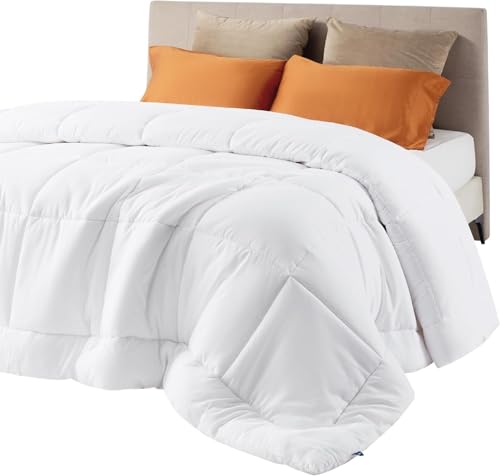
Bedsure Comforter Duvet Insert, Queen 88 x 88
Badge: Best Overall for Cleaning
Strengths
- Machine washable as listed, at the most manageable full size
- Down alternative fill is the most wash-tolerant fill family
- Eight tabs keep fill behaviour even through wash and wear
Trade-offs
- White — the cover must do the stain shielding
- All-season weight is a full load on its own
- Synthetic loft declines slowly over many washes
Key specs (from the listing)
- Size: Queen, 88 x 88 inches
- Fill: down alternative
- Anchoring: 8 corner tabs
- Care: machine washable as listed
- Certification: OEKO-TEX listed
The queen Bedsure insert is this guide’s cleaning champion: the same machine-washable, down alternative, eight-tab design as its king sibling, at the size a large home machine can genuinely handle. If the insert system is your bedding philosophy — cover washes weekly, insert washes rarely — this is the pool’s most executable version of it, with OEKO-TEX listed materials as a further reassurance.
Its cleaning routine is the template this guide teaches: gentle cycle, mild detergent, extra rinse, tumble low with dryer balls, hand-check for damp clumps, air before remaking. The honest limitations are the white colour’s dependence on its cover and the slow arithmetic of synthetic fill — every wash costs a little loft, which is why the cover system exists. Treated that way, this insert should stay lofty and neutral for years.
Start your shortlist here if you want the insert-and-cover system with the least laundry friction — it is the reference routine for how to clean comforter inserts at home.
Best for: Queen beds committed to the duvet-cover system and home washing / Not suited for: Anyone who dislikes white bedding even under a cover
Check on Amazon — see the current price and full listing details.

EASELAND Queen Down Alternative Comforter, 88 x 88
Badge: Best Stand-Alone Comforter
Strengths
- Machine washable as listed and designed to be seen, not just inserted
- Corner tabs give the cover option without requiring it
- Down alternative fill forgives home washing
Trade-offs
- Used without a cover, it will need washing more often — plan for it
- White hotel styling shows every mark between washes
- Hotel-quality is positioning; judge it by the wash routine it survives
Key specs (from the listing)
- Size: Queen, 88 x 88 inches
- Fill: down alternative
- Use: quilted duvet insert or stand-alone comforter
- Features: corner tabs
- Care: breathable, machine washable as listed
- Style: hotel quality positioning
The EASELAND is the dual-role entry: a quilted down alternative comforter, machine washable as listed, with corner tabs for insert duty but a finish intended to be seen on the bed. That duality defines its cleaning profile — it is the pool’s best answer for sleepers who dislike duvet covers and want the comforter itself to be the washable layer, accepting more frequent washes as the price of the simpler bed.
If you run it coverless, adopt a top sheet religiously; it halves the soil the comforter takes and stretches the wash interval back toward sanity. The white hotel styling is the honest trade — beautiful on day one, accountable for every coffee splash thereafter. Its down alternative fill is the right fill for this role precisely because it forgives the extra washes the role demands.
Choose the EASELAND when your version of how to clean comforter bedding is ‘the comforter is the cover’ — and choose its fill type, not just its looks, for that job.
Best for: Coverless-bed sleepers wanting a good-looking, washable comforter / Not suited for: Anyone unwilling to wash a comforter more than seasonally
Check on Amazon — see the current price and full listing details.

Lavish Comforts Down Alternative Comforter, King 104 x 86
Badge: Best Oversized King
Strengths
- Generous oversized drape for deep king mattresses
- Down alternative fill suits seasonal machine washing
- Plush all-season build for cold sleepers
Trade-offs
- The largest wash load in this guide — laundromat territory
- Compressed arrival needs full airing before first use or wash judgement
- Plush depth dries the slowest of the six
Key specs (from the listing)
- Size: King, 104 x 86 inches
- Fill: down alternative
- Positioning: premium plush, all season, hotel cooling comforter
- Packaging: arrives compressed
The Lavish Comforts king is the maximalist closer: an oversized 104 x 86 down alternative comforter with a plush, all-season, hotel-cooling brief. The drape is the point — on a deep king mattress it covers the sides the way display beds do. Through the cleaning lens, that generosity is a logistics commitment: this is the biggest, slowest-drying wash in the guide, and it should be bought by households at peace with the laundromat routine.
It arrives compressed, so give it a full day of airing and shaking before judging its loft or washing it — compressed fill reads flat and can look disappointing until it recovers. Its down alternative fill at least makes the seasonal big wash straightforward in kind, if not in scale. The honest limitation is drying: plush king fills hold water, and the hand-check for cool damp patches matters more here than anywhere else in the pool.
Buy this comforter when drape is worth a laundry expedition — the final lesson in how to clean comforter bedding at king scale is that size, not fill, sets the difficulty.
Best for: Deep king mattresses and cold sleepers wanting maximum drape / Not suited for: Small-machine households or anyone who dreads laundry day
Check on Amazon — see the current price and full listing details.
Comparison Table
| Pick | Badge | Key specs | Best for | Check |
|---|---|---|---|---|
| CozyLux Queen Comforter Set, 7 Piece Bed in a Bag | Best Complete Set | Size: Queen, 88 x 88 inches (comforter); Set: 7 pieces — sheets and shams included | Full-bed refresh households and anyone who prefers forgiving dark bedding | Check on Amazon |
| Bedsure Queen Comforter Set, Prewashed Beige, 3 Piece | Best Low-Fuss Set | Size: Queen, 90 x 90 inches; Set: 3 pieces, prewashed bedding | Main bedrooms wanting a washable set with a light laundry footprint | Check on Amazon |
| Bedsure Comforter Duvet Insert, King 90 x 102 | Best King Insert | Size: King, 90 x 102 inches; Fill: down alternative | King beds using a duvet cover system who wash the insert seasonally | Check on Amazon |
| Bedsure Comforter Duvet Insert, Queen 88 x 88 | Best Overall for Cleaning | Size: Queen, 88 x 88 inches; Fill: down alternative | Queen beds committed to the duvet-cover system and home washing | Check on Amazon |
| EASELAND Queen Down Alternative Comforter, 88 x 88 | Best Stand-Alone Comforter | Size: Queen, 88 x 88 inches; Fill: down alternative | Coverless-bed sleepers wanting a good-looking, washable comforter | Check on Amazon |
| Lavish Comforts Down Alternative Comforter, King 104 x 86 | Best Oversized King | Size: King, 104 x 86 inches; Fill: down alternative | Deep king mattresses and cold sleepers wanting maximum drape | Check on Amazon |
How to Clean a Comforter Without Ruining the Fill
The pre-wash routine: inspect, treat, prepare
Shake the comforter outdoors first — loose dust and hair should not become wash water soup. Inspect for stains and treat each one before the wash with a small amount of mild detergent worked in gently; treating after a hot dry is fighting a set stain. Check seams and quilting for openings, because a wash can turn a small tear into a fill escape. Readers setting up a full bedding routine can pair this with Best Comforter Under $700 when a replacement joins the rotation.
The wash itself: capacity, cycle, detergent
Front-loaders only, ideally large ones: top-loader agitators twist filled bedding into ropes. Gentle or bulky cycle, warm or cool water per the care label, and less detergent than instinct suggests — excess detergent lodges in fill and is the hidden cause of scratchy, flat comforters. Add an extra rinse cycle as routine. Halfway through, if your machine allows a pause, redistribute the comforter so no section stays folded and unwashed.
Drying is where comforters are saved or ruined
Tumble dry on low with dryer balls or clean tennis balls, which break up clumps as they form. Stop every half hour, pull the comforter out, and shake it hard — this redistributes fill while it is still mobile. The dry is finished not when the surface feels dry but when the thickest quilted squares feel uniformly warm and light, with no cool, heavy patches. A final hour of airing over chairs before remaking the bed is cheap insurance.
Fill-specific rules: synthetic vs feather
Down alternative forgives: it tolerates gentle machine washing and tumble drying, and its enemies are heat excess and detergent residue. Feather and down demand the same wash gentleness but far more drying — damp down clumps, smells, and can mildew; dry it longer than seems sane and store it only when bone dry. Never dry-clean unless the label instructs it, and never use fabric softener on fills you want to keep lofty — it coats fibres and kills loft.
Between washes: the cover system and airing
The cheapest cleaning is prevention. A duvet cover or a flat top sheet takes the weekly soil; airing the comforter over a line or chairs on a dry morning refreshes it without a wash; and rotating two comforters, if you own them, halves each one’s wash count. Most comforters in this guide should see a machine a few times a year at most — if yours needs monthly washing, the system around it, not the comforter, is what needs changing.
Detergent, bleach and softener: the chemistry shelf, audited
Three bottles decide most comforter outcomes. Detergent: mild, modestly dosed — the fill needs rinsing more than it needs soap, and residue is flatness in liquid form. Bleach: only ever on a care label’s explicit invitation, and never on fills whose loft you value; oxygen-based stain treatments, used before the wash, do the honest work bleach promises. Fabric softener: leave it on the shelf entirely for filled bedding — it coats fibres to feel slick, and coated fibres do not loft, breathe or insulate as they should. The comforter that smells of nothing and springs back in the hand is the clean one; fragrance is not a metric.
How to Clean Comforter Fill, Covers and Stains: The Full Routine
Here is the complete wash-day routine in order, from bare bed to remade bed. It assumes a machine-washable down alternative comforter like most of this guide; feather fills follow the same steps with the drying stage doubled in patience.
- Strip the bed, shake the comforter outdoors, and spot-treat any stains with mild detergent, worked in gently and left to sit while you prepare the machine.
- Check seams and corners for damage; a small tear gets a few stitches now rather than a fill leak mid-wash.
- Load the comforter alone into the largest front-loader available, arranged loosely — if it must be forced, go to a bigger machine instead.
- Select the gentle or bulky cycle, use a modest measure of mild detergent, and add an extra rinse.
- Mid-cycle, pause if possible and redistribute the comforter so folded sections open to the water.
- When the wash ends, lift the comforter supporting its full wet weight — dragging a wet comforter by one corner stresses every seam.
- Tumble dry on low with dryer balls, removing and shaking the comforter every 30 minutes to redistribute fill.
- Hand-check the thickest squares for cool, damp patches; continue drying until none remain, then air the comforter over chairs for an hour before remaking the bed.
Troubleshooting
Problem: The fill has clumped after washing → It dried unevenly. Return it to the dryer on low with dryer balls for another full cycle, shaking every 15 minutes; most clumps separate once fully dry. Persistent clumps in an old comforter signal fill breakdown.
Problem: The comforter smells musty → It was stored or remade damp. Re-dry it completely, then air it outdoors; if the smell survives a full dry, a gentle re-wash with thorough rinsing is the cure — and never store it until it is bone dry.
Problem: The comforter came out flat → Usually detergent residue or over-washing. Run a rinse-only cycle to clear residue, dry fully with balls, and shake hard; then reduce future wash frequency and let the cover do the weekly work.
Machine Wash or Dry Clean? Reading the Comforter You Own
The first cleaning decision is not detergent or temperature — it is whether your comforter belongs in a machine at all. Most down alternative comforters, including the Bedsure, EASELAND and CozyLux designs in this guide, are built and labelled for machine washing, because synthetic clusters tolerate water and agitation. Feather and down fills tolerate washing too, but demand gentler cycles, far more drying patience, and a machine large enough that the comforter is not crushed — crushing is what breaks clusters and feathers, not water.
Capacity is the silent rule: a comforter should be able to tumble loosely. If your home machine swallows it only when forced, the correct venue is a laundromat’s large front-loader, not a determined stuffing session that cleans nothing and stresses every seam. Dry cleaning is the fallback for comforters whose labels demand it — solvents are unkind to some fills, so the label, not habit, decides.
Why Comforters Get Lumpy, Flat or Musty — and Which Failures Are Reversible
Nearly every comforter complaint traces to moisture or compression. Lumpiness after washing is fill that dried unevenly or migrated before it dried — usually reversible with a full re-dry and a vigorous shake. Mustiness is fill that was stored or remade damp — reversible with a complete dry and airing, if caught before mildew sets in. Flatness is the slow one: clusters and feathers break down over years of washing and compression, and that loss of loft is the comforter’s genuine end of life.
The practical conclusion shapes this whole guide: wash rarely, wash correctly, dry completely, store loosely. A comforter washed four times a year with a cover doing the weekly work will outlive one washed monthly — in loft, in softness and in the seams that hold it together.
Comforter Rotation and the Two-Comforter System
Households that keep bedding longest tend to own two comforters per main bed: a light one and a substantial one, rotated by season. The system pays for itself in laundry terms — each comforter is washed half as often, rests between uses, and is always seasonally correct, which removes the temptation to overwash the all-season compromise in a heatwave. The six products here map naturally onto the system: the DOWNCOOL-weight and light builds for summer (in this comforter pool, the lighter Bedsure set), the 240GSM CozyLux and plush Lavish Comforts for winter.
Storage is the system’s other half: the off-season comforter goes away clean, bone dry and loosely bagged, and comes back needing an airing, not a wash. Rotation plus correct storage is how a comforter reaches the long end of its lifespan with its loft intact.
Three Laundry Realities, Three Comforters
The apartment dweller with a small machine and no laundromat patience: the Bedsure three-piece set, because its pieces fit her actual laundry, and a routine that fits is a routine that happens. The family whose bed hosts children, a dog and weekend breakfasts: the CozyLux dark grey set, because forgiveness is a colour, and the whole bed refreshes as one system. The coverless minimalist who makes the bed in ninety seconds: the EASELAND, washed as the visible layer it is, on a fill chosen to forgive exactly that frequency.
Each choice began with a laundry reality, not a colour swatch — which is the cleaning lens this guide has applied throughout.
In Daily Use: How the Picks Differ
A year of living and laundering separates these six along one axis: how much laundry infrastructure each demands. The sets demand sessions; the inserts demand a system (cover discipline) but repay it with rare washes; the kings demand venue. None of that is visible in a product photograph, and all of it decides whether the comforter is still lofty in year three. Buy the comforter your laundry can sustain — the most beautiful fill in this pool will lose to a modest one whose routine actually happens.
Comforters in Guest Rooms, Rentals and Busy Households
The comforters that age fastest in this category are rarely in main bedrooms — they are in guest rooms washed after every visitor, in rentals turned over on a schedule, and in family homes hosting a rotation of children and animals. For those duties the cleaning specification outranks every other: a comforter must be machine washable without ceremony, sized for the machines actually available, and coloured or covered to survive contact with real life. In this pool that points to the Bedsure inserts inside covers for guest rooms — the cover washes in minutes, the insert almost never — and to the dark, washable CozyLux set where a full-bed turnover is the routine.
The doctrine that emerges is worth stating plainly: in high-turnover rooms, buy the system, not the showpiece. A modest insert inside a fresh cover reads to a guest as impeccable bedding, because to the person sleeping under it, the cover is the bedding. Hosts who internalise that sentence stop ruining good comforters in hot washes and start running the calmest laundry in this guide.
A Worked Example: One Comforter, One Year of Correct Care
Follow a single comforter — say the Bedsure queen insert inside its cover, on a main bed — through a year of the routine this guide teaches, and notice how little happens. Weekly, the cover comes off with the sheets and is washed hot with them; the insert is shaken over the bed and aired while the mattress breathes. Monthly, on a dry morning, the insert spends an hour over a line or a pair of chairs while the bed is remade — no water, no wear, just air doing quiet work. That rhythm, repeated, is the entire secret: the insert meets a washing machine only when the calendar or an accident says so.
Twice in the year, it does. In spring, a full wash: stains checked (none, because the cover took them), gentle cycle in the home front-loader it genuinely fits, modest detergent, extra rinse, then a low tumble with dryer balls and two shake-outs, finished with an hour’s airing before the cover — washed separately — is re-tied at all eight tabs. In autumn, after a bout of illness in the house, the same routine runs again, unhurried, because the household owns enough spare bedding that the insert can take the full day its drying deserves. Two washes in a year: that is the frequency at which a down alternative insert keeps its loft for years instead of months.
Set against it the counter-example every laundromat worker knows: the same insert washed monthly on a hot cycle by a household without a cover, softened into flatness, dried on high until its shell tired, and replaced in its second year with the complaint that comforters do not last. They do last — under a system. The year described above costs less effort than the counter-example’s monthly battles, which is the final argument for the routine: correct comforter care is not the diligent option. It is the lazy one, correctly understood.
The Wash-Day Checklist, in Order
Tape this sequence to the laundry wall. Before: shake outdoors, treat stains, check seams, confirm the machine is big enough — genuinely, not hopefully. During: gentle or bulky cycle, modest mild detergent, extra rinse, redistribute at the halfway point if the machine allows. After: support the full wet weight out of the drum, tumble low with dryer balls, out and shaken every half hour, hand-check the thickest squares, and a final hour of airing before the bed is remade. Storage, when it comes: clean, bone dry, loosely bagged, never compressed.
Twelve actions, and the comforter’s whole lifespan is decided by how routinely they happen. Households that run the checklist without thinking about it — because it is on the wall — keep comforters lofty for years; households that improvise each wash eventually improvise a failure. Print the list. It is the cheapest bedding insurance in this entire guide.
Keep the whole philosophy in one sentence and the details will follow: a comforter should be protected weekly, aired often, washed rarely, dried completely and stored loosely. Every technique in this guide is an elaboration of those five verbs, and every comforter failure you will ever meet is one of them neglected. Tape the sentence above the checklist, run both without thinking, and your comforter will repay you in the only currency bedding has — years of loft, neutrality and warmth, quietly delivered.
Common Buying Mistakes
- Washing a comforter monthly out of habit, spending its loft years early — the cover exists to be washed instead.
- Forcing a king comforter into a small machine, achieving neither cleanliness nor mercy for the seams.
- Using fabric softener or heavy detergent doses, which coat fill and flatten it.
- Calling the dry finished when the surface feels dry, while the quilted squares still hold damp cores.
- Storing a comforter vacuum-compressed or slightly damp, then blaming the product for the musty flatness that follows.
- Dry-cleaning a washable comforter (or machine-washing a dry-clean one) because the label went unread.
Keep researching: If your shortlist narrows to a specific budget tier, Best Comforter For Guest Rooms Under $700 compares that tier in detail. Readers furnishing a particular room type may also want Best Comforter For Apartments Under $700 before they finalise a choice. For a narrower comparison built around one room and budget, see Best Comforter For Small Bedrooms Under $700. And if the budget is the deciding factor from the start, Best Comforter Under $1000 is the companion shortlist to work through. If your shortlist narrows to a specific budget tier, Best Comforter For Small Bedrooms Under $400 compares that tier in detail.
Final Recommendation
If you take one product from this guide, take the Bedsure queen insert: machine washable as listed, wash-tolerant down alternative fill, eight-tab cover discipline and the most manageable size — the complete cleaning system in one purchase. The CozyLux set suits full-bed refresh days, the Bedsure set low-fuss routines, the EASELAND coverless beds, and the two kings — Bedsure for the cover system, Lavish Comforts for maximum drape — ask only that you respect their laundry scale. Master the routine and any of them will stay lofty for years; the routine, more than the product, is how to clean comforter bedding well. Guest-room keepers can compare spares against Best Comforter For Guest Rooms Under $700.
Start your comparison with the top picks from this guide: CozyLux Queen Comforter Set, 7 Piece Bed in a Bag, Bedsure Queen Comforter Set, Prewashed Beige, 3 Piece, Bedsure Comforter Duvet Insert, King 90 x 102 — check the current price on Amazon for each before you decide.
Related guides
Frequently Asked Questions
How often should you wash a comforter?
A few times a year is right for most households when a duvet cover or top sheet takes the weekly soil. Wash sooner after illness or spills. If your comforter seems to need monthly washing, add or change the cover system rather than washing the fill to death.
Can you machine wash a king comforter at home?
Only if your machine is genuinely large and the comforter tumbles loosely inside it. For most homes, a laundromat’s large front-loader is the correct venue for a king — it cleans better, spins drier and spares both the comforter and your machine.
Why did my comforter go lumpy in the wash?
Almost always incomplete or uneven drying: damp fill clumps and migrates. Re-dry on low with dryer balls, shaking every 15–30 minutes, and most lumpiness reverses. Box-stitched and well-quilted comforters resist it best.
What detergent is best for comforters?
A modest amount of mild detergent, with an extra rinse. The common error is excess: residue lodges in the fill and leaves it flat and scratchy. Skip fabric softener entirely — it coats fibres and destroys loft.
How do you dry a comforter without a dryer?
Slowly and honestly: over lines or chairs in moving air, turning and shaking it through the day, and never remaking the bed until the thickest squares feel uniformly dry. In humid weather this can take more than a day — a dryer or laundromat is the safer tool for thick fills.
How should a comforter be stored?
Clean, bone dry, and loosely packed in a breathable bag in a dry closet. Not vacuum-compressed — that was shipping packaging, and months of crushing costs loft — and never stored damp, which is how mustiness is manufactured.
Can I wash a comforter in a top-load machine?
Only a small, light comforter in a large top-loader without a central agitator — agitators twist filled bedding into stressed ropes. Front-loaders are the correct tool; for anything king-size or plush, a laundromat’s large front-loader is both kinder and more effective.
How do I remove a specific stain from a comforter?
Treat it before washing, never after drying: work a little mild detergent into the stain, let it sit, then wash the whole comforter so no cleaning ring remains. Heat from a dryer sets stains, so inspect the spot while the comforter is still wet and re-treat if it persists.