Disclosure: As an Amazon Associate, topratedkitchenware.com earns from qualifying purchases. Links on this page are affiliate links; they cost you nothing extra. Prices and availability change often, so check the current Amazon listing before you buy.
Asking is a copper cookware set worth it deserves a better answer than enthusiasm, so this page treats the question as an audit. Is a copper cookware set worth it for your kitchen — not for kitchens in general — depends on what you cook at the stove, what hob you cook it on, how you feel about ten seconds of drying and the occasional polish, and whether the set in your sights is real copper at all. That last point matters more than any other: traditional copper lined with tin or steel, copper-core sealed in stainless, and copper-coloured nonstick with no working copper in it are three different purchases sharing one name, and each has its own worth-it answer. Below: the short answer, what you actually get, the real costs beyond money, who it pays off for, who should skip it, the alternatives, and a checklist to close the decision.
Is a Copper Cookware Set Worth It? The Short Answer
Worth it if you cook at the stove with attention most weeks — sauces, fish, eggs, sugar work — on gas or a compatible hob, and you read hand-washing, drying, and occasional polishing as ritual rather than tax: then real copper buys you control nothing else matches, in a set that can serve for decades, and the premium spreads itself thin across all those years. Not worth it if your stove mostly boils and reheats, if your hob is induction and no verified magnetic set fits, or if the care contract would be resented by October — in those kitchens the premium buys weight, chores, and a colour. And a special verdict for copper-coloured sets: worth it as entry nonstick, never worth it as copper, because the copper is not in the pan.
Key Takeaways
- Copper’s value is control — even, responsive heat — and it is tasted only by cooking that uses control: sauces, delicate fish and eggs, searing, sugar.
- The premium is best judged per year of service: traditional copper is a decades asset, copper-coloured nonstick a service-life consumable.
- The hidden costs are real but specific: care minutes, polishing choice, tin renewal, weight in the hand, and induction research.
- Copper-core is the worth-it answer for most serious cooks who want the benefit without the rituals.
- If the honest summary of your stove life is boil, steam, reheat — the answer is no, and a single responsive pan is the smarter purchase.
In this guide
What You Actually Get
Copper conducts heat faster and more evenly than any other metal commonly used in a pan, and that single physical fact explains almost everything else in this category. Heat applied at one point under a copper base spreads sideways quickly, so the whole cooking surface arrives at a similar temperature instead of developing a fierce hotspot over the burner ring and cooler corners elsewhere. Just as usefully, copper gives heat back quickly: lift the pan or turn the flame down and the surface temperature follows within moments, which is why sauce makers and candy makers have prized the metal for generations. A pan that answers the controls immediately forgives small mistakes and rewards attention, because the gap between what you intend and what the food experiences stays narrow.
Sauce work is copper’s ancestral home ground, and the reason is control at the gentle end rather than power at the fierce end. A reduction that needs to hold just below a simmer, a custard that must thicken without scrambling, a caramel that has to stop at amber the moment it arrives — these are tasks where a pan that overshoots punishes instantly. Copper’s quick cooling when heat is cut turns near-misses into saves: the custard comes off the burner and actually stops cooking, the caramel halts where the cold cream hits it. Cooks who make sauces weekly feel this as calm; cooks who make them twice a year feel it as insurance on the occasions that tend to be celebrations, when failure is most expensive.
Searing is where responsive metal proves itself in food you can taste. A chop or a piece of salmon laid into a pan pulls heat out of the surface; a slow pan dips in temperature and the food steams in its own juices before it browns, while a copper-rich pan fed by a steady burner recovers quickly and keeps the surface in browning territory. The crust that results is not a cosmetic detail — it is where much of the flavour of cooked meat and fish is built. Copper does not sear by itself, of course: the pan must be properly preheated, the food dry, and the cook patient enough to leave it undisturbed. What copper changes is how forgiving the window is once those basics are right.
You also get, with traditional copper, an object with unusual staying power in a disposable category. The set does not date the way coatings date; it can be repaired, re-lined, resold, and inherited. And you get the display value, which this page counts honestly rather than snobbishly excluding: pans that make a kitchen look like cooking happens there, and that make some cooks cook more. A purchase that increases how often you cook at home pays a dividend no specification sheet captures — provided, always, that the pans are cooked with and not merely hung.
The Real Costs Beyond Money
Copper tarnishes, and any guide that treats that as a footnote is setting buyers up for disappointment. Exposed copper reacts with air, moisture, heat, and the acids in food splashes, moving through bright salmon-pink to brown and amber, and eventually to a soft patina. The change is purely cosmetic — a tarnished pan cooks exactly like a polished one — but it is unavoidable on any set where real copper meets the air, and it begins quickly. Kitchens that cook with copper daily usually settle into one of two camps: those who polish back to a shine on a rhythm, and those who let the pans wear a working patina and consider it the honest uniform of tools that earn their keep.
Daily care for real copper is a short routine with a long memory. Wash in warm soapy water, avoid the dishwasher — its detergents are harsh on copper and tin alike and can discolour finishes — dry immediately and completely, and store dry. Keep empty pans off high heat, which protects tin linings and prevents the dark scorching that polishing struggles to lift. Salt deserves a specific mention: add it to liquids once they are moving rather than leaving crystals sitting on a damp lining, a habit that protects steel interiors from pitting and tin from staining. None of this is difficult; all of it is habitual, and the cooks who thrive with copper are the ones who find the habits soothing rather than the ones who perform them resentfully.
Add the subtler costs. Weight: traditional copper is a two-handed material at family sizes, and that is a daily tax on some wrists. Learning curve: your memorised burner settings are wrong for the first weeks, and a few dishes will pay tuition. Hob risk: a kitchen renovation to induction can strand a traditional set that lacks a magnetic base, so the purchase quietly bets on your future kitchen. And opportunity cost in its plainest form — the same tier buys an excellent stainless set plus superb knives, and for some kitchens that bundle is worth more than control at the stove. An honest audit lists these beside the premium rather than underneath it.
Who It Pays Off For
The sauce-led home cook
Your week includes pan sauces, reductions, custards, or a proper omelette habit, and you already cook attentively — copper’s responsiveness slots into skills you own and multiplies them. For this profile the set pays off weekly and visibly, and the care routine reads as part of the craft you already enjoy. This is the profile the category was built by, over centuries, and the worth-it answer here is the easiest yes on the page.
The serious cook buying once
You are furnishing a kitchen you expect to keep, you dislike replacement cycles, and you would rather buy one excellent set than three adequate ones. Traditional copper or copper-core fits that philosophy exactly: repairable, renewable, effectively permanent. The premium is front-loaded and the service is back-loaded, which is the shape of every good tool purchase. Our copper cookware set buying guide helps this profile choose between the two constructions without overspending on pieces that will not be used.
The cook who hosts
Dinner parties raise the stakes of exactly the dishes copper makes safer: the sauce held without breaking, the caramel stopped on time, the fish cooked evenly for six. If your cooking reputation is periodically wagered on stove-top control in front of guests, the insurance value is real, and the pans’ table presence — copper goes from stove to table beautifully — pays a second dividend. Hosting cooks also tend to accept the polishing rhythm more easily, since the brightening often coincides with the occasions themselves.
Who Should Skip It
The boil-and-reheat kitchen
It is worth being honest about how much of copper’s benefit a given household will actually taste. A kitchen that mostly boils, steams, reheats, and oven-finishes will notice the looks and the weight more than the responsiveness, because those methods forgive everything. A kitchen that makes pan sauces, cooks fish and eggs on the stove, works with sugar, or simply enjoys the feedback loop of a pan that answers instantly will taste the difference weekly. The premium for real copper is large enough that buying it for the first kitchen is mostly buying jewellery for the stove — beautiful jewellery, but the honest guide should say so, and point that buyer toward one excellent responsive pan instead of a full set.
The induction household without a verified set
There is a workaround worth knowing about and worth treating with suspicion: induction converter discs, metal plates placed between hob and pan that heat up and conduct into the copper. They do make a non-compatible pan usable, but they insert a slow, lossy layer exactly where copper’s responsiveness was supposed to live, and many cooktop makers discourage them. As an emergency bridge for one beloved pan, a disc is defensible; as the plan for a whole new set, it defeats the purchase. Buyers on induction who love what copper does should look at copper-core designs with magnetic bases, which keep much of the responsiveness and answer the hob without mediation.
The dishwasher-loyal, chore-minimal household
There is no shame in this profile; there is only mismatch. If cookware that needs hand-washing and immediate drying will be quietly resented and eventually quietly avoided, the finest copper set becomes the most expensive cupboard decoration you own. Copper-core softens this verdict — it washes like stainless — but if even its tier gives pause, stainless bought well is the honest answer, and the comparison is laid out fairly in our copper versus stainless steel head-to-head.
Strengths and Trade-Offs of Owning One
Strengths of ownership
- Control that improves specific dishes every single week, not on special occasions only.
- A set that can be maintained, renewed, and kept for decades — ownership deepens rather than expires.
- Cooking pleasure as a real return: responsive tools make attentive cooks cook more.
Trade-offs of ownership
- A care contract with no holidays: drying, gentle handling of linings, polishing by choice or patina by acceptance.
- Weight and hob constraints that follow the set into every future kitchen.
- A premium that only cooking — frequent, stove-centred cooking — can repay.
Alternatives to Consider
The strongest alternative is the split purchase: keep or buy a sound stainless set for bulk work and add one or two copper pieces — a saucepan or saucier, a wide sauté pan — for the responsive jobs. This captures most of copper’s tasted benefit at a fraction of the set premium, and it is what many experienced cooks quietly do. The second alternative is copper-core as a full set, already discussed: most of the control, none of the rituals, a premium between stainless and traditional copper. The third is simply excellent clad stainless, which has never been a consolation prize; our survey of the best stainless steel cookware sets shows how good the default can be, and the best tri-ply cookware sets covers its best constructions.
All-Clad Copper Core set
Position in this guide: premium tier. In plain terms, this is the copper-core archetype: a band of real copper sealed inside a multi-ply stainless construction, so the copper works invisibly and the surfaces you touch are stainless steel. For the worth-it question, this is the alternative most likely to change the answer: if traditional copper’s care made the verdict no, this construction reopens it.
Best for: cooks who want genuine copper responsiveness with stainless durability, no polishing, no re-lining, and a set that behaves like the stainless they already know. Not suited for: buyers who want to see and display copper, traditionalists who prefer a tin lining’s cooking feel, and anyone whose budget points to the entry tier. Because this pick is presented prose-only while its listing verification is pending, treat it as a researched recommendation to check against the current listing — construction, lining, and hob compatibility especially — rather than as a linked product, and check the price on Amazon when you are ready to compare it against the rest of the shortlist.
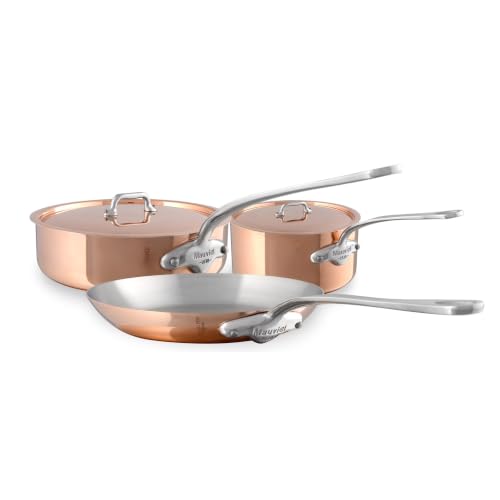
Mauviel copper set
Position in this guide: premium tier. In plain terms, this is heritage French copper in the traditional form: a real copper body with a stainless steel lining, made by a maker whose name is close to synonymous with the category. This is the full-commitment version of yes: the maximum benefit and the maximum contract, worth it precisely for the households described above and not otherwise.
Best for: serious cooks who sauce, sear, and simmer daily, who accept polishing and hand-washing as part of ownership, and who are buying for decades. Not suited for: induction kitchens without a verified magnetic base, dishwasher households, and anyone who wants nonstick forgiveness for eggs and fish. Because this pick is presented prose-only while its listing verification is pending, treat it as a researched recommendation to check against the current listing — construction, lining, and hob compatibility especially — rather than as a linked product, and check the price on Amazon when you are ready to compare it against the rest of the shortlist.

Gotham Steel copper set
Position in this guide: entry tier. In plain terms, this is the best-known name in the copper-coloured family: an aluminium set with a ceramic-style nonstick surface in a copper tone. This is the alternative answer when the audit reveals the brief was convenience all along — worth its entry tier as nonstick, and a category error only if bought under copper expectations.
Best for: households that want easy-release everyday cooking and the copper look on an entry budget, and who understand they are buying nonstick convenience rather than copper performance. Not suited for: anyone shopping for real copper responsiveness, induction certainty, or a set expected to serve for decades. Because this pick is presented prose-only while its listing verification is pending, treat it as a researched recommendation to check against the current listing — construction, lining, and hob compatibility especially — rather than as a linked product, and check the price on Amazon when you are ready to compare it against the rest of the shortlist.
How to Get the Most Value If You Buy
Long-term ownership adds one line to the routine for tin-lined pieces: inspection. Hold the pan to the light occasionally and look for the lining wearing thin, showing a change of colour or sheen where copper begins to show through, especially at the centre and around the rivets. Bare copper against acidic food is the one genuine don’t in this category, so a worn lining means the pan rests from tomato sauces until it is re-tinned. Re-tinning is a specialist service in most countries, neither instant nor free, and it returns the pan like new. Steel-lined and copper-core owners skip this entire chapter, which is precisely what their premium buys.
There is also a middle path built into technique rather than schedule. Wiping a copper exterior with a dry cloth straight after washing removes the water that causes most spotting; storing pieces dry and unstacked, or stacked with soft protectors, prevents the scuffs that make tarnish look worse than it is. Cooks who dry immediately often find their pans hold an acceptable glow for weeks between polishes, because most visible dullness is water spotting layered over very light tarnish. The lesson generalises across this whole category: copper rewards small, prompt habits and punishes postponement, which is either a satisfying ritual or an annoying tax depending entirely on the cook.
Value also comes from use patterns: put the copper where responsiveness pays — sauces, fish, eggs, searing, sugar — and let plainer pots boil the pasta without guilt. Cook the learning curve deliberately in the first fortnight with forgiving dishes at lower settings than habit suggests. Keep the set visible and reachable if you can; tools that are seen are used, and use is the entire return on this investment. A copper set cooked with five times a week is one of the cheapest luxuries in the kitchen per use; the same set cooked with monthly is among the most expensive. The purchase does not decide which — the routine does.
The Decision Checklist
- Do I make sauces, custards, caramel, or delicate fish at least a few times a month? (No → probably not worth it.)
- Is my hob gas or radiant electric — or is the exact set verified for induction? (Unverified induction → not yet.)
- Will I hand-wash, dry immediately, and either polish occasionally or accept patina, cheerfully, in year three? (No → copper-core or stainless.)
- Can I lift a full, heavy pan with confidence? (No → copper-core or smaller pieces.)
- Am I buying this set for this kitchen for years, not months? (Months → the premium cannot spread itself.)
- Have I confirmed the set is real copper — layers and lining named — rather than copper-coloured? (Unconfirmed → stop and check.)
- Would one or two copper pieces plus my current pans capture the benefit? (Yes → the split purchase beats the set.)
Score it plainly: mostly yes answers mean the set is worth it for you, and the remaining work is choosing the construction — our step-by-step guide to choosing a copper cookware set walks that path. Mostly no answers mean the worth-it answer is no, and that is a successful audit rather than a failed one: the money stays available for the upgrade your cooking will actually taste. Mixed answers point, as they so often do in this category, to copper-core — the construction invented for mixed answers.
The Trial Version: How to Test the Answer Before Paying It
You do not have to take this page’s word, or anyone’s, because copper offers an unusually honest trial: one pan. Buy a single copper or copper-core saucepan or saucier — the shape where responsiveness is tasted most — and cook your three most-made stove dishes in it for a month, keeping the care routine faithfully. At the end of the month you will know things no review can tell you: whether the control changes your food, whether the drying habit is ritual or tax in your actual hands, and whether you reach for the pan or around it. If the pan has become the favourite, the set question has answered itself and the trial pan joins the set. If it has become a beautiful obligation, you have bought the answer at the price of one pan instead of ten — the cheapest research in the category.
What the Money Buys Elsewhere: An Honest Comparison of Upgrades
A premium has rivals, and an audit should name them. The same commitment buys a top-tier stainless set with money left for knives; a serious induction hob upgrade in some kitchens; a year of excellent ingredients, which improve dinners more reliably than any pan; or cooking classes, which improve them more reliably still. Copper wins against those rivals only when control at the stove is genuinely your binding constraint — when your technique is ready, your dishes demand it, and your current pans are the thing standing between you and the food you are trying to make. If the binding constraint is time, ingredients, or confidence, spend there first and let copper wait. Worth-it is a ranking, not a property of the object, and this page’s checklist is designed to produce your ranking rather than the market’s.
The Sentimental Ledger, Audited
Finally, count the sentimental returns with the same honesty as the costs, because they are real and they are routinely either inflated or denied. A copper set can be the object a kitchen is built around, the thing cooked with daily and handed on eventually, carrying family meals in its patina in a way no coated pan can. That is worth something — to some households, a great deal. It is worth nothing extra, however, if the pans are not cooked with, and it curdles into its opposite if the set becomes a reproach hanging over a kitchen that never wanted the rituals. Buy the sentiment only as a dividend on the cooking case, never as the case itself, and it will still be paying out in thirty years. That, in the end, is the whole audit: cooking first, costs counted, sentiment as the bonus — and on those terms, for the right kitchen, a copper cookware set is worth it completely.
The Numbers You Can Honestly Run
This page has avoided printing prices, because they change and because the category’s tiers are wide — but a worth-it audit can still do honest arithmetic with the figures you supply yourself. Take the set’s current price, divide it by the years you realistically expect to keep it, and divide again by the number of times a week you will cook the dishes copper improves. The resulting cost per improved dinner is the only number that matters, and it behaves dramatically: for the daily sauce cook on a decades horizon it shrinks to a triviality; for the monthly cook on a two-year horizon it stays stubbornly large. Run the same arithmetic for copper-core and for the split purchase of one or two pieces, and notice how often the split purchase wins the arithmetic while losing the romance. Neither result should be overridden by the other — but the arithmetic deserves to be seen before the romance is allowed to speak, because romance, unexamined, is how premium cookware ends up as expensive storage.
Regret, Studied From Both Directions
Buyer’s remorse in this category comes in two opposite flavours, and an audit should taste both. The first is the traditional set bought by a household that never adopted the rituals: the regret is daily, small, and corrosive, and it attaches not to the pans’ cooking — which remains superb — but to every sink-side encounter. The second is subtler: the keen cook who bought sensible stainless, or a coloured set, to be practical, and who feels a small pang at every sauce made since — the regret of the road not taken, charged monthly at the stove. Neither regret is irrational, and they map precisely onto the profiles this page has drawn. The worth-it question, reduced to its honest core, is simply this: which regret would you rather risk? Answer that, and the checklist above is merely the paperwork confirming a decision your temperament has already made. The cooks who thrive with copper are the ones who feared the second regret more; the cooks who thrive without it feared the first. Both were right, and both audits were worth doing.
There is a third, rarer regret worth recording for completeness: the buyer who purchased copper colour believing it was copper metal, and discovered the substitution months later from a page like this one. That regret is not about temperament at all — it is about information — and it is the only one of the three that is wholly preventable by reading the construction before paying. If this audit accomplishes nothing else, let it accomplish that: nobody who finishes it will ever pay for a colour while believing they bought a metal, and that single protection is worth the price of the whole inquiry.
The View From the Other Side of the Purchase
Imagine the two households this audit keeps describing, five years after deciding. In the first, the traditional set hangs over a gas range, patinaed at the edges, polished at the centres where hands and cloths pass, and the cook reaches for the saucepan without thinking because it has made a thousand sauces well. Ask that cook whether it was worth it and the question barely parses — the set is not an expense any more, it is furniture of the cooking life, and its cost has dissolved into years of dinners. In the second household, the sensible stainless set is in the dishwasher, the evening is easy, and the cook has never once thought about linings, and would find the first household’s rituals faintly comic. Ask that cook whether skipping copper was worth it and the question parses no better. Both households audited correctly — because both audits were really about self-knowledge, and self-knowledge, unlike cookware, cannot be bought at any tier. This page’s checklist is a machine for producing it; the pans are almost incidental.
A Word About Timing: When the Answer Changes
Worth-it is also a question with a date on it. The answer that is no in a rented flat with an induction hob and a newborn can become yes in a settled kitchen with a gas range and Sunday sauces, without either answer being wrong. Kitchens change, cooking deepens, households gain and lose members, and the audit should be re-run when the life changes rather than treated as a lifetime verdict. That is the final reason this page refuses a universal answer: it is not evasion but accuracy. Copper will still be there, being copper, whenever your kitchen becomes the kind that can use it — the metal has waited five thousand years for its cooks, and it is in no hurry. Buy it when the audit says yes, and not a season before.
The Inheritance Test and the Landfill Test
Two final tests, both a little theatrical and both surprisingly decisive for the households they touch. The inheritance test: can you picture handing this set to a child, a sibling, or a friend who cooks, decades from now, with the pans still earning their place? Traditional copper passes it almost by definition — it may be the only cookware category where the picture is ordinary rather than fanciful — and for buyers who cook partly to build a household’s continuity, that picture has genuine worth that no per-dinner arithmetic captures. The landfill test is its mirror: picture the set’s exit. A consumable set exits whole, repeatedly, across a lifetime of replacements; a copper set, steel-lined or re-tinned, essentially never exits at all. Households that feel the weight of either picture should let it vote. Households that feel neither should strike both tests and decide on the cooking alone, which has been this audit’s home ground from the start.
What Owners Say a Year Later, Translated
Long-term owner sentiment in this category follows a pattern so regular it can be translated in advance. Traditional copper owners, a year in, talk about dishes: the sauce that behaves now, the fish that stopped sticking once technique caught up, the caramel that no longer frightens them. Their complaints, when they have them, are about other people’s habits — a partner and a dishwasher, a guest and a metal spoon — which is the sound of a care contract being kept by its signatory and tested by everyone else. Copper-core owners talk about not thinking about their pans, which from that construction is the highest available praise. Coloured-set owners talk about replacing a piece, cheerfully or otherwise, on the schedule this audit predicted. None of these voices is the wrong one; each is the sound of a household living inside the decision it made. The audit’s purpose is to make sure the voice you hear in a year is the one you chose — and if you have read this far, you already know which of the three it is going to be.
So the books close where they opened. Worth it is not a property of copper; it is a relation between a metal and a kitchen, and relations are audited honestly or not at all. This page has laid out the benefit, the costs in money and minutes and temperament, the profiles on each side, the alternatives with their own merits, and a checklist to sign. What remains is the smallest and largest step: answering for your own stove. Do that plainly, and whichever way the answer falls, you will have bought — or declined — like someone who understood the category, which is the only kind of customer this remarkable, demanding, rewarding metal has ever deserved.
The Answer, Addressed to Three Readers
To the sauce cook on gas, hovering at the order button: yes. Your cooking is the kind this metal was refined by centuries to serve, your hob asks no questions, and the rituals will read as craft within a month. Buy the construction your temperament prefers, keep the drying towel closer than the polishing cream, and expect this purchase to be one of the few in your kitchen that never needs re-deciding. To the busy household on induction, hovering likewise: not this set, not this year — and hear that as the audit succeeding, not failing. Buy the stainless or verified copper-core that fits your life, and let copper wait for a kitchen that can use it; it has waited longer for worthier cooks than either of us. To the reader who came for permission to buy the colour: buy it gladly, as nonstick, with the coating’s lifespan accepted and the savings spent on something your cooking will taste. Three readers, three answers, one audit — and every answer an honest yes to the question that was actually being asked underneath the one on the door.
That is the note to end on. Worth-it was never hiding in the metal; it was hiding in the match between the metal and a life. Make the match and copper is worth it completely. Miss it and no discount redeems the purchase. The checklist has done its work if you now know which side of that line your kitchen stands on — and knowing, in this category, is most of the value there is.
One Sentence for the Fridge Door
Audits should end with something portable, so here is the whole page in the space of a breath. A copper cookware set is worth it when the cooking is attentive, the hob is willing, and the hands that wash up do not mind the metal’s small ceremonies — and it is not worth it, at any discount, when any one of those three is missing. Test your kitchen against that sentence before you test your budget against any listing, because the sentence is the audit and the budget is merely its paperwork. Readers who can say all three clauses without flinching already know their answer, and readers who flinch at one know theirs. The metal, indifferent and magnificent, awaits both decisions with equal patience — as it has awaited every cook, in every century, who ever stood in a kitchen doorway doing this same arithmetic.
And to the reader still undecided after the checklist, the profiles, and the arithmetic, one gentle suggestion remains: borrow the experience before buying it. Cook a sauce in a friend’s copper pan, or in a single trial piece of your own, and pay attention not to the sauce but to yourself — whether the responsiveness delights you in your hands, not in the abstract, and whether the washing-up afterward felt like a ritual or an interruption. Audits can narrow a decision to its final question, but that question is answered by hands, not by pages. Yours have the casting vote; this page merely made sure they cast it informed.
There is a reason this audit kept returning to the same three witnesses — the dishes, the hob, and the towel. Money can be re-earned and tiers can be re-argued, but those three testify daily and cannot be cross-examined into changing their story. If they testify for copper in your kitchen, believe them and buy with a whole heart. If they testify against it, believe them just as completely and spend the money where your own witnesses point. An audit that ends in self-belief has done its work, whichever verdict it carried.
The pans, meanwhile, sit in their boxes and their shop windows, indifferent to the outcome — salmon-bright, heavy, patient. That indifference is the last thing worth learning from them: good tools do not plead. They wait for the cook whose life fits them, and they reward that cook for decades. Be that cook, or be the cook who wisely walks past, and either way this category will have treated you honestly — because, for once, you insisted on treating it honestly first.
The Usage Tally: Let a Month of Evidence Decide
Borrow, rent, or simulate before you commit if you possibly can, and run the copper cookware set through your real week rather than an imagined improved version of it. Keep a plain tally of uses for a month, on paper on the fridge if necessary, because the honest count of actual uses is the number every value judgement secretly depends on. Note what each use replaced: a purchase, a chore done by hand, another appliance’s time, or nothing at all because the job would simply not have happened. Record the minutes the copper cookware set saves or costs across a whole session, including setup and cleaning, since value lives in the full cycle and not in the headline moment.
Write down the uses that felt like genuine pleasure rather than mere efficiency, because enjoyment is a legitimate return and pretending otherwise distorts the arithmetic. Ask who else in the household benefits and who merely tolerates the storage, the noise, or the counter space, and count those votes without weighting your own twice. Where a shortlist names specific examples, such as All-Clad Copper Core set, run these same checks against that listing line by line rather than assuming the general verdict transfers unchanged. Apply the identical test to Mauviel copper set as well, on the same day and under the same conditions, because a fair comparison needs one ruler rather than two moods.
- Tally real uses for one full month
- Log what each use actually replaced
- Count full-cycle minutes including cleaning
- Give the space a vote in the decision
- Imagine a breakdown in year two
- Set a decision deadline with a default
If Gotham Steel copper set is also in contention, give it the same worksheet and let the three sets of answers sit side by side before anyone reaches for a checkout button. Consider the space as a cost with a rent of its own: a copper cookware set that earns its footprint weekly is a different proposition from one that squats on it monthly. Think about the season ticket question: whether your interest is a durable habit or a project-shaped enthusiasm that will fade when the project ends. Compare against the honest alternative, which is usually doing the job with what you already own, slowly and imperfectly, rather than against doing it not at all.
Imagine the copper cookware set breaking in year two and ask whether you would replace it immediately, eventually, or never, since that imagined answer is the cleanest verdict available before buying. Factor in the learning period without resenting it, but do not let a promise of future ease excuse a present that your tally says is not working. Notice whether you keep finding new jobs for it or keep finding excuses to use it, because the difference between those two patterns is the difference between value and clutter. Give the decision a deadline and a default: if the tally has not persuaded you by that date, the answer is no for now, and no is a complete decision rather than a failure.
Revisit the question if your household, space, or routine changes materially, because worth is a property of a match between product and life, not of the product alone. Write the sentence that would make it worth it, in advance and in numbers you can check, so the verdict comes from evidence you gathered rather than from mood at the checkout. Count the accessories you would genuinely buy alongside it as part of the commitment, since a product that only works with extras is really the bundle, sized as such. Ask whether the same money and space spent on your current setup, on better ingredients, storage, or a repair, would beat the improvement the copper cookware set promises.
Talk to your future self at the spring clean: will this be in the used-weekly group, the stored hopefully group, or the why-do-we-own-this group, and what in the tally supports that guess? Accept that a narrow, wholehearted yes for one weekly job is worth more than a broad, lukewarm yes across ten occasional ones. Close the question by deciding what happens to the tool or appliance it replaces, because keeping both forever is often the hidden cost that tips a fair yes into a no. Whatever the category, photograph your intended spot with the neighbouring items in place, because a picture exposes crowding that measurements alone politely ignore.
Frequently Asked Questions
Is copper cookware worth it for a beginner?
Usually not as a first set. Beginners benefit most from forgiving pans while technique forms, and traditional copper is the opposite of forgiving about care even though it is kind about heat. A beginner who loves the idea does better with one copper or copper-core saucepan for sauces while learning on sturdier everyday pans. The exception is the beginner who already knows they love the rituals — polishing, maintaining, keeping beautiful tools — because then the care contract is a pleasure from day one rather than a surprise.
How long does a copper set take to pay for itself?
It pays in performance from the first sauce, but the financial logic needs years: spread across decades of service, a traditional set’s cost per year undercuts repeatedly replaced mid-tier sets, while across a two-year horizon it cannot compete. That is why the checklist asks about your time in this kitchen. Copper is worth it on the decades ledger and questionable on the seasons ledger, and both ledgers are honest — the mistake is auditing a decades purchase with a seasons calculator, or the reverse.
Is copper-core worth it compared with traditional copper?
For most households, yes — it keeps the majority of copper’s evenness and responsiveness, removes polishing, re-lining, and utensil rules, and usually suits induction-era kitchens better. Traditional copper remains worth its extra for cooks who want the last increment of control, the tin lining option, and the visible metal. Think of copper-core as worth it for the cooking and traditional copper as worth it for the cooking plus the craft; neither verdict shames the other.
Are copper-coloured sets ever worth it?
As nonstick, yes: light, forgiving, easy to clean, handsome, and gently tiered — a sensible purchase for first kitchens and convenience-first households, with a service life set by the coating. As copper, never: there is no working copper in the pan, so none of copper’s responsiveness, longevity, or high-heat freedom is included at any price. The worth-it question collapses if the product is misidentified, which is why this page insists on naming the families before pricing them.
What is the cheapest way to get copper’s benefits?
Buy fewer pieces. One excellent copper or copper-core saucepan or saucier, plus a wide sauté pan if the budget stretches, delivers most of the tasted benefit — sauces and delicate work — while your existing pots keep boiling and braising. The split purchase is how many experienced cooks actually own copper. It also lowers every hidden cost: less polishing, less weight, less storage, and a smaller bet against a future induction hob. Sets are satisfying, but benefit lives in specific pans doing specific jobs.
Does copper cookware hold its value?
Traditional copper holds value unusually well for cookware: it is repairable, re-lining restores it, and a second-hand market for quality makers exists because the pans remain fully useful for decades. Copper-core sets hold value moderately, like other premium clad cookware. Copper-coloured nonstick holds essentially no resale value, consistent with being a consumable. Resale should never be the reason to buy a pan — but as a tiebreaker between constructions, the durability of value mirrors the durability of the object itself.
Related Guides and Next Steps
Keep reading with these companion pieces from the same kitchen: copper cookware set review copper cookware set pros and cons how to clean a copper cookware set the best Mauviel copper cookware stainless cookware with a copper core the best induction cookware sets. Each one takes a single question from this page and gives it the full treatment, so you can go deeper exactly where your own decision is still open.


