Disclosure: As an Amazon Associate, topratedkitchenware.com earns from qualifying purchases. Links on this page are affiliate links; they cost you nothing extra. Prices and availability change often, so check the current Amazon listing before you buy.
The copper cookware set vs stainless steel cookware set question is the real decision hiding inside most copper purchases, because stainless is the default serious cookware of the modern kitchen and copper is its oldest challenger. This comparison puts a copper cookware set vs stainless steel cookware set head to head on the criteria that decide daily satisfaction — heat behaviour, delicate food, durability, care, hob compatibility, weight, and long-term value — with a verdict on each, and with one complication handled honestly throughout: copper itself comes in traditional, copper-core, and copper-coloured forms, and only the first two belong in this fight. The coloured family is nonstick, and comparing it to stainless would be comparing a coating to a metal.
Copper Cookware Set vs Stainless Steel Cookware Set: Quick Verdict
Choose copper if your cooking is built on control — sauces, fish, eggs, sugar — and you accept hand-washing, drying, and the occasional polish as the rent on that control. Choose stainless steel if you want one set that tolerates every habit, every utensil, the dishwasher, and every hob, and cooks very well while asking nothing. Choose copper-core — stainless outside, copper inside — if you read both sentences and wanted both; it exists precisely for you, at a premium tier. The detailed verdicts below explain where each of those summaries comes from, criterion by criterion.
Key Takeaways
- Heat: copper is more even and far more responsive; stainless is good and slower to answer.
- Delicate food: tin-lined copper is kindest, steel-lined copper and stainless are equals in technique demands, and all three trail nonstick for pure forgiveness.
- Care: stainless wins outright against traditional copper; copper-core draws the match.
- Hobs: stainless with a magnetic base suits induction by default; copper needs a specifically engineered base.
- Longevity: both are decades-long materials; copper adds a renewable lining, stainless adds indifference to neglect.
- Value: stainless is the rational default; copper is the enthusiast’s justified premium; copper-core is the compromise with a tier to match.
In this guide
Side-by-Side at a Glance
| Criterion | Copper cookware set | Stainless steel cookware set |
|---|---|---|
| Heat spread | Most even of any common material | Good in clad builds, hotspot-prone in thin builds |
| Responsiveness | Answers the burner almost immediately | Noticeable lag on the way up and down |
| Cooking surface | Tin or stainless lining over copper | Stainless throughout |
| Care | Hand-wash, dry, polish exposed metal; tin renews | Dishwasher-tolerant, utensil-proof, forgettable |
| Induction | Only with an engineered magnetic base | Standard on most modern sets |
| Weight | Heavy in traditional form | Moderate; varies by clad build |
| Tier | Premium for real copper | Every tier from entry to premium |
| Lifespan | Decades; lining renewable | Decades; nothing to renew |
Read the table as a map, not a result: the rows are weighted differently by every kitchen. A sauce cook reads the first two rows and stops; a parent of three reads the care row twice. The sections below argue each row properly, because a table can tell you what differs but not how much it matters at your stove.
Heat Behaviour: Evenness and Responsiveness
Evenness and responsiveness are different virtues, and copper is unusual in offering both at once. A thick aluminium base can be even but slow to react; a thin steel pan reacts fast but cooks in hotspots. Copper’s conductivity moves heat sideways so effectively that a well-made copper pan feels calm at high heat and precise at low heat, holding a bare simmer under a custard as obediently as it sears a chop. That breadth is the real product being sold in this category, and it is also the yardstick for judging imitations: a pan that merely looks like copper delivers neither virtue, because the colour contributes nothing. What matters is how much copper is in the pan, where it sits in the construction, and what lines the cooking surface.
Stainless steel’s defence is that modern clad construction narrows the gap: a stainless set with a full aluminium or copper core across the base and walls cooks evenly enough that most dishes never reveal the difference. That defence is honest — and it concedes the comparison’s terms, because the core doing the work in the best stainless sets is there to imitate what copper does natively. Where the gap survives every construction trick is responsiveness: thermal mass and conductivity together mean stainless changes temperature on a delay of its own, and in sauce work that delay is the difference between catching a custard and rescuing one. Verdict on heat: copper, clearly — the clearest win in this comparison.
Delicate Food and Everyday Cooking
Delicate foods draw a fair map of the lining question. Fish fillets and eggs in a steel-lined copper pan demand a properly heated surface, a film of fat, and confidence; in tin, they forgive a degree or two of error; on copper-coloured nonstick, they forgive almost everything but give back less browning and a different texture. None of these is the correct answer in isolation. The cook who fries eggs daily for children and the cook who plates delicate fish for guests are shopping in the same category for opposite reasons, and the honest guide’s job is to route each of them to the construction that matches the food they actually cook, not the food in the photograph.
For the everyday bulk of cooking — boiling, simmering, braising, reheating — the two materials are effectively tied, and anyone who tells you otherwise is selling something. Water and time forgive the differences. The delicate-food gap is therefore narrower than copper’s reputation suggests: it is a gap about linings and technique, not about the headline metals. A cook with sound preheating habits will fry eggs happily in stainless or steel-lined copper for years; a cook without them will struggle in both and should buy tin, nonstick, or patience. Verdict on delicate food: a draw between steel surfaces, with tin-lined copper ahead on kindness and stainless ahead on nothing in particular.
Searing, Fond and High Heat
Searing is where responsive metal proves itself in food you can taste. A chop or a piece of salmon laid into a pan pulls heat out of the surface; a slow pan dips in temperature and the food steams in its own juices before it browns, while a copper-rich pan fed by a steady burner recovers quickly and keeps the surface in browning territory. The crust that results is not a cosmetic detail — it is where much of the flavour of cooked meat and fish is built. Copper does not sear by itself, of course: the pan must be properly preheated, the food dry, and the cook patient enough to leave it undisturbed. What copper changes is how forgiving the window is once those basics are right.
Stainless counters with two genuine advantages: it tolerates being left empty on high heat without a thought, and its surface builds fond — the browned layer that becomes pan sauce — aggressively and releases it cleanly on deglazing. Steel-lined copper shares both traits, since its cooking surface is stainless; the comparison here is really between copper’s heat delivery and stainless’s heat delivery to the same surface. Tin-lined copper sits this round out at the fierce end, since tin prefers moderation. Verdict on searing: copper by a nose for recovery and evenness, stainless fully respectable, tin excused by design.
Durability and Lifespan
Resale and inheritance sound like strange criteria for cookware until you remember that good copper is one of the few kitchen categories where both are real. Traditional copper pans are repaired, re-tinned, resold, and handed down; they appear in estate sales and get fought over. Nonstick sets, however good, are consumables with a service life. That does not make the consumable a bad buy — most kitchens run happily on replaceable pans — but it reframes the comparison. The question is never simply which set costs less; it is whether you are buying a tool for the next few years or an asset for the next few decades, and both answers are respectable.
The failure modes differ instructively. Stainless fails by neglect-proof endurance: it can be scorched, soaked, dropped, and dishwasher-blasted for decades and merely look tired. Copper fails, when it fails, by its lining and its softness: tin wears and renews, bodies dent where steel would shrug, and a neglected pan can need professional attention. But note the asymmetry — copper’s failures are repairable almost by definition, while a warped or delaminated clad stainless pan is simply finished. Both materials outlast their owners’ kitchens; they simply age in different dialects. Verdict on durability: stainless for abuse tolerance, copper for repairability — call it a draw with different signatures.
Care, Tarnish and the Dishwasher Question
Copper tarnishes, and any guide that treats that as a footnote is setting buyers up for disappointment. Exposed copper reacts with air, moisture, heat, and the acids in food splashes, moving through bright salmon-pink to brown and amber, and eventually to a soft patina. The change is purely cosmetic — a tarnished pan cooks exactly like a polished one — but it is unavoidable on any set where real copper meets the air, and it begins quickly. Kitchens that cook with copper daily usually settle into one of two camps: those who polish back to a shine on a rhythm, and those who let the pans wear a working patina and consider it the honest uniform of tools that earn their keep.
Daily care for real copper is a short routine with a long memory. Wash in warm soapy water, avoid the dishwasher — its detergents are harsh on copper and tin alike and can discolour finishes — dry immediately and completely, and store dry. Keep empty pans off high heat, which protects tin linings and prevents the dark scorching that polishing struggles to lift. Salt deserves a specific mention: add it to liquids once they are moving rather than leaving crystals sitting on a damp lining, a habit that protects steel interiors from pitting and tin from staining. None of this is difficult; all of it is habitual, and the cooks who thrive with copper are the ones who find the habits soothing rather than the ones who perform them resentfully.
This is stainless steel’s home round and it wins it without needing exaggeration. A stainless set can be cooked in, soaked, machine-washed, stacked wet, and ignored, and it will greet you tomorrow unchanged. Traditional copper converts each of those habits into a small debt. Copper-core, pointedly, concedes nothing here: its exterior and interior are stainless, so the entire round is a draw for that construction — which is the strongest argument that copper-core is best understood as stainless that cooks like copper, rather than copper that behaves like stainless. Verdict on care: stainless, decisively, against traditional copper; level against copper-core.
Hob Compatibility, Especially Induction
Induction compatibility is the question that quietly decides this category for a growing share of kitchens, because copper on its own does not work on an induction hob. Induction needs a magnetic layer to couple with the cooktop’s field, and pure copper — like pure aluminium — is not magnetic. Traditional copper pans and copper-core pans alike will sit unrecognised on an induction surface unless the design adds a magnetic stainless base or the maker has engineered the bottom layer for induction, which some modern lines do and many do not. The only reliable test is the maker’s own statement for that specific set, checked piece by piece, because within one set the large stockpot and the small saucepan occasionally differ.
Stainless’s advantage is structural: most modern stainless sets are built on magnetic bases as a matter of course, because the market’s centre of gravity moved to induction and the makers followed. Copper’s market — traditional, gas-centred, heritage — moved slower, so compatibility remains a per-set research project rather than an assumption. On gas and radiant electric, the round reverses completely: copper’s responsiveness shines on open flame, and stainless has nothing to say back. Verdict on hobs: stainless for induction households by default, copper for gas households by delight — check your own hob before weighing this round at all.
Weight, Handling and Storage
A traditional copper set is the heaviest luggage in the kitchen: dense metal, full pans, two-handed pours. Stainless clad sets are meaningfully lighter at the same sizes, and the difference is felt most by cooks who toss food in the pan, cook one-handed while holding a child or a phone, or have wrists and joints that ration effort. Storage follows weight: copper traditionally hangs, which needs a rack and wall or ceiling space; stainless stacks in a cupboard and forgives the stacking. None of this is decisive alone, but it compounds the care round — copper asks more of your arms as well as your minutes. Verdict on handling: stainless, for most bodies, most days.
Strengths and Trade-Offs of Each Side
Copper: strengths
- Unmatched evenness and responsiveness, tasted weekly by sauce-and-fish cooks.
- Tin lining’s kindness to delicate food; steel lining’s familiarity.
- Repairable, renewable, effectively permanent; beauty that functions.
Copper: trade-offs
- Care contract: hand-wash, dry, polish; tin renewal on a long cycle.
- Induction only with an engineered base; heavy in the hand.
- Premium tier, and a market polluted by coloured imitations.
Stainless steel: strengths
- Indifference to habits: dishwasher, metal utensils, soaking, stacking.
- Induction-ready by default in most modern sets; every tier available.
- Excellent all-round cooking, especially in clad builds with a conducting core.
Stainless steel: trade-offs
- Slower, less even heat than copper; sauces demand more vigilance.
- Sticking learning curve for eggs and fish, identical to steel-lined copper’s.
- No path to copper’s control at any tier — the ceiling is lower.
Who Each Option Suits and Who Should Skip Each
It is worth being honest about how much of copper’s benefit a given household will actually taste. A kitchen that mostly boils, steams, reheats, and oven-finishes will notice the looks and the weight more than the responsiveness, because those methods forgive everything. A kitchen that makes pan sauces, cooks fish and eggs on the stove, works with sugar, or simply enjoys the feedback loop of a pan that answers instantly will taste the difference weekly. The premium for real copper is large enough that buying it for the first kitchen is mostly buying jewellery for the stove — beautiful jewellery, but the honest guide should say so, and point that buyer toward one excellent responsive pan instead of a full set.
Copper suits the attentive stove cook with gas or a verified base, a tolerance for rituals, and a decades-long horizon. Stainless suits the busy, the induction-equipped, the dishwasher-loyal, and anyone furnishing a kitchen that must simply work. Skipping copper is right when the care contract would be resented; skipping stainless is right only when you have cooked on copper and cannot go back — a real condition, attested by generations of cooks, and the reason this comparison never ends in a rout. For a wider frame before deciding, the copper cookware set buying guide covers the whole category, and our survey of the best stainless steel cookware sets represents the other corner fairly.
How to Decide: Questions That Branch
Answer in order and stop when a question decides it. One: is your hob induction, with no plans to change? If yes, stainless — or a verified magnetic copper-core set — and the comparison ends. Two: do you make pan sauces, custards, caramel, or delicate fish at least weekly? If no, stainless, and spend the difference elsewhere. Three: will hand-washing, drying, and occasional polishing feel like ritual or like tax? Tax means copper-core or stainless; ritual means traditional copper has been waiting for you. Four: is this a decades purchase or a this-kitchen purchase? Decades strengthen copper’s case; a temporary kitchen strengthens stainless’s. Five: do you want to see the metal? Only traditional copper answers yes, and there is no wrong answer — only an unexamined one.
Where to Buy: The Representative Sets
Both sides are represented below prose-only while listing verification is pending; check construction and hob compatibility on the current listing, and check the price on Amazon when comparing.
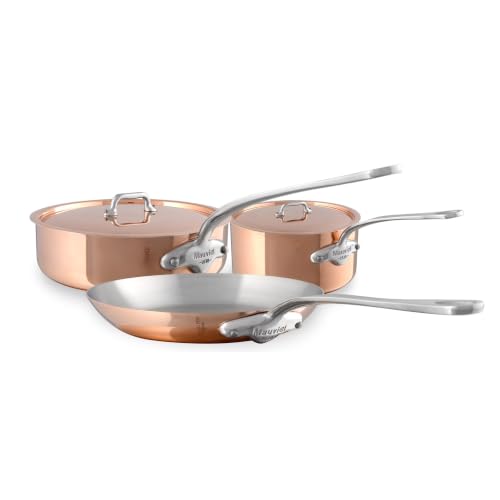
Mauviel copper set
Position in this guide: premium tier. In plain terms, this is heritage French copper in the traditional form: a real copper body with a stainless steel lining, made by a maker whose name is close to synonymous with the category. The traditional copper corner in this comparison: maximum control, full care contract, heritage build.
Best for: serious cooks who sauce, sear, and simmer daily, who accept polishing and hand-washing as part of ownership, and who are buying for decades. Not suited for: induction kitchens without a verified magnetic base, dishwasher households, and anyone who wants nonstick forgiveness for eggs and fish. Because this pick is presented prose-only while its listing verification is pending, treat it as a researched recommendation to check against the current listing — construction, lining, and hob compatibility especially — rather than as a linked product, and check the price on Amazon when you are ready to compare it against the rest of the shortlist.
All-Clad Copper Core set
Position in this guide: premium tier. In plain terms, this is the copper-core archetype: a band of real copper sealed inside a multi-ply stainless construction, so the copper works invisibly and the surfaces you touch are stainless steel. The bridge candidate: stainless manners with a copper heart, for households whose answers above split down the middle.
Best for: cooks who want genuine copper responsiveness with stainless durability, no polishing, no re-lining, and a set that behaves like the stainless they already know. Not suited for: buyers who want to see and display copper, traditionalists who prefer a tin lining’s cooking feel, and anyone whose budget points to the entry tier. Because this pick is presented prose-only while its listing verification is pending, treat it as a researched recommendation to check against the current listing — construction, lining, and hob compatibility especially — rather than as a linked product, and check the price on Amazon when you are ready to compare it against the rest of the shortlist.

Lagostina copper set
Position in this guide: mid tier. In plain terms, this is a clad set from a long-established Italian maker that builds copper into a layered construction, sitting between the coloured nonstick family and the premium heritage makers. The mid-tier clad route, for buyers who want metal cooking and copper in the construction without the heritage tier.
Best for: buyers who want a step up from basic nonstick into clad-metal cooking without going straight to the top tier, and who will confirm the exact construction and hob compatibility of the specific set before ordering. Not suited for: purists seeking thick traditional copper with a hand-finished lining, and induction households that have not verified the base of the exact model. Because this pick is presented prose-only while its listing verification is pending, treat it as a researched recommendation to check against the current listing — construction, lining, and hob compatibility especially — rather than as a linked product, and check the price on Amazon when you are ready to compare it against the rest of the shortlist.
Final Recommendation by Use Case
For sauce-led, gas-stove, ritual-friendly cooking: traditional copper, and enjoy the finest stovetop control available at home. For mixed family cooking on any hob with no appetite for upkeep: stainless steel, bought in a good clad build, and never think about this comparison again. For serious cooks torn between the two: copper-core, the rare compromise that keeps the substance of both promises. And for anyone tempted by copper colour as a shortcut in this debate: that is a third product, nonstick, with its own honest uses — assessed in our copper cookware set reviews — but it does not get a vote in this particular head-to-head.
The Cost-Per-Year Round Nobody Scores Honestly
Comparisons love a price round, but the honest version is not a number — it is a shape. Stainless spreads its cost evenly: one purchase, no renewals, no services, nothing further, at tiers from modest to premium. Copper front-loads: a premium purchase, then near-zero running costs for steel-lined and core sets, and one recurring service line — re-tinning — for tin, arriving after years and restoring the pan completely. Over a short horizon stainless wins the economics almost regardless of tier. Over a decades horizon the shapes converge, and copper’s repairability can pull ahead of a clad stainless set that eventually delaminates and must be replaced whole. The round therefore has no winner until the buyer names a horizon, which is why this comparison refuses to score it in the table above. Verdict on value over time: stainless for horizons under a decade, a genuine contest beyond one.
The Sound, Feel and Kitchen-Presence Round
Subjective rounds are usually banished from serious comparisons, which is a pity, because cookware is handled daily and its feel is data. Copper is dense and warm-toned; it hangs beautifully, pours with authority, and makes a stove look like a place where cooking is a practice rather than a chore. Stainless is cooler in every sense: lighter in the hand at the same duties, quieter visually, at home in any kitchen style, and completely unbothered by being stacked in a drawer. Cooks who cook more when their tools please them — a real and common effect — should count presence as a legitimate round and score it for whichever material makes them reach for a pan. Cooks indifferent to it should strike the round entirely. Either way, it should be decided consciously, because it is the round most likely to be smuggled into the decision disguised as something else. Verdict on presence: personal, and legitimately so.
What About Mixing Them?
The comparison format forces a duel, but kitchens are not duels. The most common resolution among experienced cooks is a mixed battery: stainless for the stockpot, the big boiling jobs, and the dishwasher rotation; copper or copper-core for the saucepans, the saucier, and the wide sauté pan where control is tasted. Each material is then doing only the work it wins at, and the household’s total care burden is a fraction of a full copper set’s. Purists of either camp call this indecision; cooks who serve the results call it Tuesday. If this comparison has felt like a choice between two half-right answers, the mixed battery is the whole-right one, and both sides’ representative sets above can be bought piece by piece toward it over time rather than in one decisive box.
Mixing also de-risks the two scariest failure modes in this head-to-head: the induction renovation that strands traditional copper, and the discovery that your household resents hand-washing. A mixed battery stranded by a new hob still has its stainless majority working; a mixed battery in a resentful household has only a few pans to forgive. Start mixed, learn which side your cooking actually lives on, and let a future purchase complete the set in the direction of the evidence. That is not a compromise of the comparison — it is the comparison, applied with patience.
The Saucepan Test: One Pot, Both Metals, Three Sauces
If this entire comparison had to be settled by one vessel, it would be the humble saucepan, because sauces are where the metals’ characters diverge most measurably in ordinary cooking. A béchamel in stainless demands stirring discipline at the corners, where the base’s cooler rim lets milk sit and thicken unevenly, and it keeps cooking for a noticeable moment after the pan leaves the heat. The same sauce in copper thickens evenly across the base, answers the whisk’s pace, and stops when you say stop. A caramel widens the gap further: stainless hotspots print themselves as uneven colour, while copper colours as one field, which is why sugar workers treat the material as equipment rather than preference. A tomato sauce, simmered long and acidic, narrows the gap again to almost nothing — time forgives all — while adding the lining footnote that tin wants the sauce served and the pan washed rather than left to sit overnight. Three sauces, three different margins, one consistent direction: the more a sauce depends on the cook’s timing, the more copper’s side of this comparison earns.
The Decade Test: Both Sets at Year Ten
Project both purchases a decade forward and the comparison changes texture. The stainless set at year ten is functionally identical to itself at year one, cosmetically tired in the way of all hard-used steel, and has cost its owner nothing in services, rituals, or research since the day it arrived. The traditional copper set at year ten has been polished or patinaed according to its owner’s religion, may have renewed a tin lining once, and cooks — this is the point — exactly as responsively as the day it was unboxed, because copper’s gift does not degrade. The copper-core set splits the projection: stainless surfaces ageing like stainless, copper heart still answering inside. Year ten flatters copper’s permanence and stainless’s effortlessness simultaneously, which is why this comparison keeps ending in profiles rather than a podium. The decade test does not crown a winner; it asks whether you would rather own a tool that never changes and never helps, or one that never changes and always helps — at the price of being asked, occasionally, for help in return.
One more decade-scale difference deserves the record: repairability culture. Stainless cookware, when it fails, fails into the recycling stream; there is no craft of re-stainlesing. Copper sustains a small, real repair economy — re-tinning specialists, handle and rivet work, straightening — because the material rewards repair. A buyer who values keeping objects in service will feel that difference at year ten even if they never use the service, the way one values a repairable boot over a disposable one. A buyer who values never thinking about objects will feel the opposite with equal legitimacy. This comparison’s final service is to insist that both feelings are data.
The Utensil Drawer Test
Small rounds reveal big truths, so consider the utensil drawer. Stainless steel cookware is serenely indifferent to what stirs it: metal whisks, metal spoons, the spatula you have owned since university. Steel-lined copper shares that indifference completely, since the surface being stirred is the same metal. Tin-lined copper asks the drawer to change — wood, silicone, nylon — and asks the cook’s habits to change with it, because one absent-minded metal spoon, dragged hard across a hot tin surface a hundred times a year, is how linings age before their time. Copper-coloured nonstick, for completeness, makes the same demand as tin for entirely different reasons. The round sounds trivial until it is multiplied by every meal of a decade, at which point utensil freedom reveals itself as one of stainless’s deepest conveniences — and one of the strongest practical arguments for choosing steel lining when you choose copper. Verdict on utensils: stainless and steel-lined copper together, ahead of tin, with the drawer as witness.
The Guest Test: Cooking for an Audience
Both metals perform; only one of them performs. Copper brought to the table or hung within sight of guests changes the social weather of a dinner — it announces that the meal was made with serious tools, and it flatters the cook before a bite is tasted. Stainless, however excellent, is socially invisible, which many cooks prefer: the food should speak, not the equipment. Neither instinct is superior, but they are different, and a buyer who hosts often should score this round consciously rather than discover, mid-dinner-party, that they bought the invisible set while wanting the announcement, or the announcement while wanting to disappear into the cooking. Ownership is long and guests are recurring; buy the social behaviour you actually want from your pans. Verdict on presence at the table: copper, for cooks who want it — and a legitimate want it is.
Draw the whole comparison to its close, then, with the observation it has been approaching for several thousand words: this head-to-head has no loser. Stainless steel is the finest default cookware material ever standardised — forgiving of habits, ready for every hob, honest at every tier. Copper is the finest specialist material ever standardised — unmatched where control is tasted, demanding where chores are counted. A comparison that ends with two winners and a map between them has not failed to decide; it has decided the thing that was actually being asked, which is not which metal is better, but which metal is yours.
The Repair Bench Test
Send both sets, hypothetically, to be fixed. The copper set’s ailments are a craftsman’s list: a tin lining renewed, a handle re-riveted, a dent raised, a warped base trued by a specialist who works on exactly this material because a living tradition of copper cookware sustains the trade. The stainless set’s ailments are shorter and sadder: a delaminated clad base is terminal, a warped pan is a recycling candidate, and a failed handle weld is a factory matter rather than a bench one. This asymmetry rarely decides a purchase on its own — most pans of either metal never need the bench — but it completes the comparison’s portrait of the two materials’ philosophies. Copper is an object in an ongoing relationship with its maker and its menders; stainless is an object designed to need nobody. Households differ in which philosophy feels like quality, and the difference is temperament, not engineering. Score the round for your own temperament and move on, but score it knowingly: it is the round that predicts how you will feel about the set in year fifteen, when everything new has worn off and only the relationship remains.
A Note on the Third Contestant Nobody Invited
Every copper-versus-stainless discussion is eventually crashed by cast iron, so let this comparison seat it briefly and fairly. Iron beats both metals for retained heat and for the fierce, steady sear; it loses to both on responsiveness, weight per task, and sauce manners, and it brings its own care religion of seasoning. Its presence clarifies the duel rather than confusing it: the kitchen metals form a triangle of specialisms — iron for mass, stainless for indifference, copper for control — and mature kitchens pick a point inside the triangle rather than a corner. This page has argued the copper-stainless edge of that triangle in full because that is the comparison shoppers actually face at the set-buying moment. But the reader who finishes it and buys one copper saucepan, keeps the stainless set, and adds an iron skillet for the steaks has not failed the comparison. They have understood it better than the format allows most comparisons to be understood, and their stove, which is the only judge with jurisdiction, will approve.
The Tiebreaker Round: Your Next Kitchen
One round remains that no specification can settle, because it concerns a kitchen that does not exist yet. Sets of this class outlive kitchens, so the buyer is implicitly choosing for their next hob, their next storage, possibly their next household. Stainless hedges that future best: it works on whatever comes, asks nothing of whoever washes, and fits hands of every strength. Copper bets on continuity: that the cooking will stay stove-centred, the hob will stay compatible, and the rituals will stay welcome. Neither bet is foolish, but they are different bets, and the tiebreaker in this entire comparison is simply which future you find easier to imagine. Choose the metal that belongs in the kitchen you are becoming, not only the one you have, and the head-to-head resolves itself — as, by now, it probably already has.
And if it has not resolved, reread the quick verdict at the top of this page and notice which summary produced a flicker of disappointment. That flicker is data. The comparison can inform a decision, argue it, and stress-test it, but the final gram on the scale is the cook’s own response to the two futures on offer — and it has never once been wrong about which pan gets used.
One more small, practical observation belongs in the record before the verdicts close: mixed households split by this comparison often discover that the argument was never really about two sets, but about two pans. The saucepan and the wide sauté pan are where copper’s case concentrates; the stockpot and the big boiling vessel are where stainless’s indifference is worth most. A comparison of sets can therefore end, usefully and honestly, in a division of labour rather than a coronation — two pans of copper, the rest of steel, and a stove on which every material present is doing the work it wins at. If the preceding rounds have left you torn, that division is not an evasion of the verdict. It is the verdict, expressed in cookware.
Print the table at the top of this page, if your household decides things on paper, and let each cook mark the two rows they care about most. In practice the marks cluster: someone always circles care, someone always circles heat, and the set that emerges from the circled rows is the set the household actually wants, stated in its own handwriting. Comparisons supply the rows; families supply the circles. That division of labour is the healthiest ending a head-to-head can have.
The Home Tie-Break: Checks That Settle the Argument
Run these tie-breaker checks in your own space before the decision hardens, because the differences between the two sides of this comparison behave differently in every household. Start with the tape measure: write the working footprint and the storage footprint for each option, including the clearance each one needs to open, cool, drain, or be carried safely. List your five most frequent jobs and mark, for each one, which option you would reach for without thinking, since that instinctive tally usually predicts long-term satisfaction. Consider the second user in your household and which option they would operate correctly without a briefing, because shared tools are judged by their least confident user.
Compare the cleanup after the same messy job done both ways, counting minutes and pieces to wash rather than impressions, and let that arithmetic speak plainly. Compare the failure modes: what a worn seal, a lost part, or a tired motor does to each option, and which failure you could live with for a month while arranging a fix. Where a shortlist names specific examples, such as Mauviel copper set, run these same checks against that listing line by line rather than assuming the general verdict transfers unchanged. Apply the identical test to All-Clad Copper Core set as well, on the same day and under the same conditions, because a fair comparison needs one ruler rather than two moods.
- Measure working and storage footprints for both
- Tally five frequent jobs by instinct
- Time the same messy cleanup both ways
- Run the ordinary Tuesday test in your head
- Run the busiest-day test in your head
- Write the deciding sentence before ordering
If Lagostina copper set is also in contention, give it the same worksheet and let the three sets of answers sit side by side before anyone reaches for a checkout button. Compare the consumables and accessories each side quietly requires over a year, and whether those extras are ordinary items or single-source purchases. Compare how each option treats your smallest everyday task and your largest occasional one, and be suspicious of any option that only wins at the extreme you rarely visit. Compare the learning curve honestly by imagining a tired beginner, which might be you on a weekday evening, meeting each option for the first time.
Compare the exit costs: which option is easier to resell, gift, store as a spare, or demote to a second room if your needs change next year. Compare how each side fits the rest of your equipment, since compatibility with what you already own can outweigh a small difference in headline performance. Compare the noise, heat, and presence each option brings to the room at the hour you will use it most, and ask the other people who share that room for their vote. Run the holiday test in your head: the biggest, busiest session of your year, with helpers underfoot, and decide which option you would rather be operating then.
Run the ordinary Tuesday test as well, because most ownership is Tuesdays, and the option that wins the quiet weekday usually wins the year. If the tally stays level, choose by cleanup and storage rather than by peak performance, since daily friction compounds faster than occasional brilliance. Write the deciding sentence down before you order, naming the job and the household fact that settled it, so buyer’s remorse has something factual to argue with later. Revisit that sentence if your household changes, because a verdict built on real jobs expires when the jobs do, and the other option may deserve a second hearing then.
Notice which option you keep defending in conversation, and treat that defensiveness as information: people rarely argue for the choice they secretly expect to regret. Check whether either option forces a supporting purchase to work as described, and fold that requirement into the comparison before treating the headline difference as real. End by asking which option you would choose if both were already in the house and one had to leave, since that framing strips away novelty and sunk cost in one move. Whatever the category, photograph your intended spot with the neighbouring items in place, because a picture exposes crowding that measurements alone politely ignore.
Keep every measurement, tally, and note from these checks in one place, ideally with the receipt, so the next decision in this category starts from your evidence rather than from scratch. Involve the household early where the product is shared, since a decision everyone helped measure is a decision nobody relitigates at the first inconvenience. Prefer the option that fits your existing routine with the fewest new habits, because each new habit is a small tax collected every single day. Be wary of solving a storage problem by creating a carrying problem, since distance between storage and use is where good equipment goes to be forgotten.
Frequently Asked Questions
Is copper really better than stainless steel, or just prettier?
On heat behaviour it is measurably better: copper spreads heat more evenly and changes temperature faster than stainless steel, and cooks taste that in sauces that stop on command, custards that do not overshoot, and searing surfaces that recover instead of steaming. On care, compatibility, and effort, stainless is better by an equally real margin. Prettiness is a bonus attached to the traditional form, not the substance of the claim — copper-core, which hides the metal entirely, keeps most of the cooking advantage.
What is copper-core, and which side of this comparison is it on?
Copper-core is a construction, not a compromise of honesty: a layer of real copper sealed inside a multi-ply build, with stainless steel forming the cooking surface and the exterior. It cooks much more like copper than plain stainless does — more even, more responsive — while washing, shining, and ageing exactly like stainless. In this comparison it belongs to both sides, which is why it is so often the answer for households whose needs split between control and convenience.
Which is better for induction, copper or stainless steel?
Stainless steel, by default and by a wide margin. Most modern stainless sets are built with magnetic bases for induction, while copper is not magnetic and traditional copper sets will not heat on an induction hob at all unless the line is specifically engineered with a magnetic base. Some copper-core sets are so engineered. If your kitchen is induction, treat stainless as the safe answer and any copper claim as a research task to verify for the exact set, piece by piece.
Does food stick more in copper or stainless steel pans?
It depends on the lining, not the headline metal. Steel-lined copper and stainless steel pans behave identically here — both need proper preheating and fat for eggs and fish, and both reward the technique with clean release and excellent fond. Tin-lined copper sticks least of the metal surfaces, which is one reason enthusiasts prize it. The surfaces that truly do not stick are nonstick coatings, including the copper-coloured family — a different product with its own trade-offs in heat tolerance and lifespan.
Which lasts longer, a copper set or a stainless steel set?
Both are decades-class materials, aging differently. Stainless endures neglect indefinitely and asks for nothing; its typical end is warping or delamination in clad builds, which is terminal. Copper’s body is effectively permanent, its steel lining likewise, and its tin lining wears over years but can be professionally renewed, returning the pan to full service. In practice, either set outlasts the kitchen it was bought for; the choice is between a set that ignores you and a set that occasionally needs you.
Is a copper set worth it if I already own stainless steel?
Only if the gap this comparison identifies — responsiveness — is one your cooking actually feels. If your stainless set leaves you rescuing sauces, nursing custards, and fighting hotspots, copper adds something real and you will use it weekly. If your cooking is boiling, braising, and reheating, copper adds weight and chores to results you already achieve. Many cooks split the difference: keep the stainless set, add one or two copper pieces for the responsive jobs, and let the two materials divide the labour.
Related Guides and Next Steps
Keep reading with these companion pieces from the same kitchen: copper cookware set pros and cons how to clean a copper cookware set is a copper cookware set worth it stainless cookware with a copper core the best stainless steel cookware set the best tri-ply cookware sets. Each one takes a single question from this page and gives it the full treatment, so you can go deeper exactly where your own decision is still open.


