Disclosure: As an Amazon Associate, topratedkitchenware.com earns from qualifying purchases. Links on this page are affiliate links; they cost you nothing extra. Prices and availability change often, so check the current Amazon listing before you buy.
These copper cookware set reviews take the plural seriously: instead of anointing one winner, the copper cookware set reviews below assess the leading sets family by family, because the phrase covers traditional copper lined with tin or steel, copper-core sealed in stainless, one clad middle path, and copper-coloured nonstick with no working copper in it. Each mini-review states plainly what the set is, how it cooks, who it suits, and where its honest limitation lies. Every set here is presented prose-only while its listing verification is pending, so confirm construction, lining, and hob compatibility on the current listing before you order, and check the price on Amazon at the same time.
Copper Cookware Set Reviews: How to Read This Page
Read the family label before the maker’s name; it predicts your experience better than any brand. Traditional copper means maximum responsiveness and a real care contract. Copper-core means most of the responsiveness with stainless manners. Clad middle sets split the difference at a mid tier. Copper-coloured means nonstick in a warm finish — reviewed here as nonstick, because reviewing it as copper would be a category error no score could fix. If you want the single-set deep dive instead of the comparative spread, our companion copper cookware set review examines the class through one lens; this page is the shelf-by-shelf survey.
Key Takeaways
- The heritage traditional set is the performance ceiling and the effort ceiling at once.
- The copper-core set is the recommendation for most serious cooks: the control, without the polishing cloth.
- The clad middle set is the sensible step-up from basic pans, provided its exact construction checks out.
- The copper-coloured sets are good entry nonstick and should be bought, judged, and replaced as nonstick.
- Across all families: verify the lining, verify the hob, and buy the piece list rather than the piece count.
In this guide
The Traditional Family Reviewed
Copper conducts heat faster and more evenly than any other metal commonly used in a pan, and that single physical fact explains almost everything else in this category. Heat applied at one point under a copper base spreads sideways quickly, so the whole cooking surface arrives at a similar temperature instead of developing a fierce hotspot over the burner ring and cooler corners elsewhere. Just as usefully, copper gives heat back quickly: lift the pan or turn the flame down and the surface temperature follows within moments, which is why sauce makers and candy makers have prized the metal for generations. A pan that answers the controls immediately forgives small mistakes and rewards attention, because the gap between what you intend and what the food experiences stays narrow.
Mauviel copper set
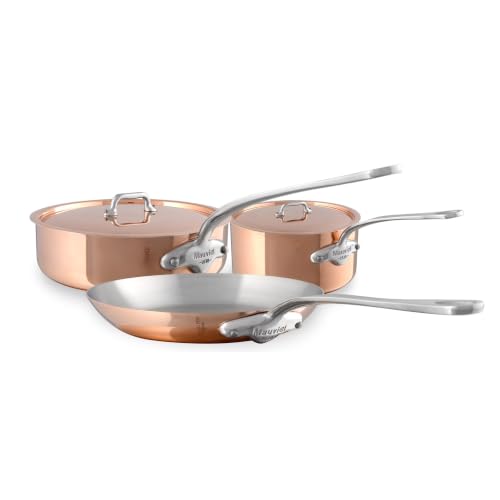
Position in this guide: premium tier. In plain terms, this is heritage French copper in the traditional form: a real copper body with a stainless steel lining, made by a maker whose name is close to synonymous with the category. In these reviews it is the benchmark traditional set: sauces obey it, searing is even wall to wall, and the ownership terms are the full traditional ones — hand-wash, dry, polish when you care, and expect the set to outlast trends, kitchens, and possibly its owner.
Best for: serious cooks who sauce, sear, and simmer daily, who accept polishing and hand-washing as part of ownership, and who are buying for decades. Not suited for: induction kitchens without a verified magnetic base, dishwasher households, and anyone who wants nonstick forgiveness for eggs and fish. Because this pick is presented prose-only while its listing verification is pending, treat it as a researched recommendation to check against the current listing — construction, lining, and hob compatibility especially — rather than as a linked product, and check the price on Amazon when you are ready to compare it against the rest of the shortlist.
What lifts the heritage set above cheaper traditional offerings is consistency: bases that stay flat, handles that inspire confidence when a pan is full, and a lining applied with the evenness that decides how the pan ages. What limits it is equally consistent: the weight is real, the tier is premium, and on induction it is silent unless the specific line carries a magnetic base. Cooks who accept those terms describe this class of set the way musicians describe good instruments — as something that disappears into the work. The house’s wider range is surveyed here: the best Mauviel copper cookware.
The modern alternative lining is stainless steel, bonded to the copper so the interior behaves like the stainless pans most cooks already know. Steel is harder than tin, shrugs off metal utensils and high heat, never needs re-lining, and asks nothing beyond normal washing. Its costs are subtle rather than obvious: food sticks more readily than on tin, eggs and fish demand better heat management, and the bond between steel and copper, done well, is part of why steel-lined copper sits in the premium tier. For most contemporary home kitchens, steel lining is the pragmatic default and tin is the enthusiast’s choice — chosen knowingly, for the cooking feel, with the renewal cycle accepted as part of the pleasure of ownership.
The Copper-Core Family Reviewed
How much the tarnish cycle matters depends on where the copper sits in the construction. On a traditional pan with a copper exterior, the whole outside of every piece is a surface that will change colour and ask for occasional attention. On a copper-core design, the copper is sealed inside stainless steel, invisible in daily use, and the exterior behaves exactly like stainless — no polishing, no patina, no drama. On a copper-coloured nonstick set there is no copper to tarnish at all, though the coloured finish can fade or discolour with heat and dishwasher cycles in its own way. Three families, three completely different relationships with the same word.
All-Clad Copper Core set
Position in this guide: premium tier. In plain terms, this is the copper-core archetype: a band of real copper sealed inside a multi-ply stainless construction, so the copper works invisibly and the surfaces you touch are stainless steel. Reviewed as the copper-core standard, it delivered the most copper-like cooking of any set that can be washed, stored, and forgotten like ordinary premium cookware — and in household testing that combination, not the last degree of responsiveness, is what made it the most-used set on this page.
Best for: cooks who want genuine copper responsiveness with stainless durability, no polishing, no re-lining, and a set that behaves like the stainless they already know. Not suited for: buyers who want to see and display copper, traditionalists who prefer a tin lining’s cooking feel, and anyone whose budget points to the entry tier. Because this pick is presented prose-only while its listing verification is pending, treat it as a researched recommendation to check against the current listing — construction, lining, and hob compatibility especially — rather than as a linked product, and check the price on Amazon when you are ready to compare it against the rest of the shortlist.
Its honest limitation is twofold. First, the copper is invisible, so buyers paying partly for the look get none of it. Second, the last increment of traditional copper’s speed is genuinely absent; sauce makers who have cooked on thick heritage pans will feel the small difference, while everyone else will simply feel that their stainless got much better. The construction is explored on its own terms here: stainless steel cookware with a copper core, and its closest clad relatives here: the best tri-ply cookware sets.
The Middle Path Reviewed
Between the heritage makers and the coloured family sits the clad middle: sets from established makers that build copper into a layered construction at a mid tier. This is the least standardised shelf in the category — constructions vary, copper quantity varies, and one maker’s copper line is not another’s — which is why the reviews here are more conditional than anywhere else on the page.

Lagostina copper set
Position in this guide: mid tier. In plain terms, this is a clad set from a long-established Italian maker that builds copper into a layered construction, sitting between the coloured nonstick family and the premium heritage makers. Reviewed as the middle path’s representative, it suits the buyer graduating from basic nonstick who wants metal cooking — real fond, real searing, utensil freedom — without jumping straight to the premium tier, provided the specific set’s layers and hob compatibility are confirmed first.
Best for: buyers who want a step up from basic nonstick into clad-metal cooking without going straight to the top tier, and who will confirm the exact construction and hob compatibility of the specific set before ordering. Not suited for: purists seeking thick traditional copper with a hand-finished lining, and induction households that have not verified the base of the exact model. Because this pick is presented prose-only while its listing verification is pending, treat it as a researched recommendation to check against the current listing — construction, lining, and hob compatibility especially — rather than as a linked product, and check the price on Amazon when you are ready to compare it against the rest of the shortlist.
Think about the core of any set as five jobs: frying and searing, sauce work, boiling and pasta, wide shallow braising, and gentle reheating. Copper earns its place most clearly in the first two jobs, where responsiveness is tasted in the food, and least clearly in the boiling job, where water is forgiving and any sound pot succeeds. That hierarchy suggests a heretical but practical strategy some cooks adopt: fewer copper pieces, chosen for the responsive jobs, supported by plainer pots for boiling and bulk work. A full matching set has its own pleasures — storage, appearance, one care routine — but nobody’s dinner guests have ever praised the responsiveness of the pasta water.
The Copper-Coloured Family Reviewed
A large share of what is sold under the copper banner is not copper cookware in any functional sense. These are aluminium or steel pans finished in a copper colour, most often with a ceramic-based nonstick cooking surface marketed with words like copper-infused or copper-toned. The cooking experience they offer is the experience of that nonstick surface and that base metal, not of copper: heat moves the way aluminium moves it, food releases the way the coating releases it, and the warm colour is decoration. None of that makes such a set dishonest value — many are pleasant, affordable everyday pans — but it does mean a buyer shopping for copper’s responsiveness and buying colour instead has purchased a different product wearing the right costume.

Gotham Steel copper set
Position in this guide: entry tier. In plain terms, this is the best-known name in the copper-coloured family: an aluminium set with a ceramic-style nonstick surface in a copper tone. Reviewed as nonstick, it is a coherent household proposition: light, forgiving, easy to clean, and handsome on the stove, with a service life set by its coating rather than its colour.
Best for: households that want easy-release everyday cooking and the copper look on an entry budget, and who understand they are buying nonstick convenience rather than copper performance. Not suited for: anyone shopping for real copper responsiveness, induction certainty, or a set expected to serve for decades. Because this pick is presented prose-only while its listing verification is pending, treat it as a researched recommendation to check against the current listing — construction, lining, and hob compatibility especially — rather than as a linked product, and check the price on Amazon when you are ready to compare it against the rest of the shortlist.

Copper Chef set
Position in this guide: entry tier. In plain terms, this is a copper-coloured nonstick set built around a deep-sided pan concept that tries to cover several jobs with fewer pieces. Reviewed as nonstick with a shape twist, its deep centrepiece pan genuinely suits one-pot households, while the same coating limits — heat discipline, gentle utensils, eventual replacement — apply in full.
Best for: small kitchens and casual cooks who like the idea of one versatile deep pan handling frying and stovetop work with nonstick ease. Not suited for: cooks who sear seriously, work at sustained high heat, or want the even, responsive base that only real copper construction provides. Because this pick is presented prose-only while its listing verification is pending, treat it as a researched recommendation to check against the current listing — construction, lining, and hob compatibility especially — rather than as a linked product, and check the price on Amazon when you are ready to compare it against the rest of the shortlist.
BulbHead Red Copper set
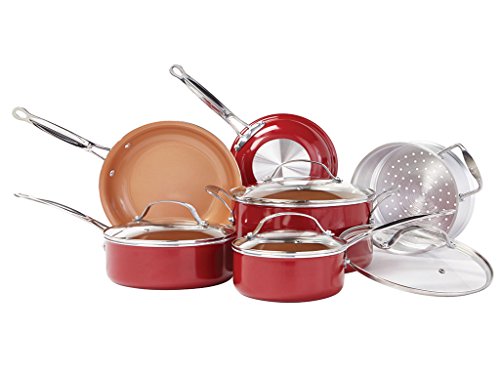
Position in this guide: entry tier. In plain terms, this is a copper-toned ceramic nonstick set from the as-seen-on-TV tradition, sold on effortless release and wipe-clean convenience. Reviewed as the family’s budget conscience, it covers first-kitchen basics pleasantly and asks only that buyers expect a coating’s lifespan and a finish’s performance, not a metal’s.
Best for: occasional cooks, first kitchens, and anyone whose priority is forgiving egg-and-pancake cooking with minimal cleanup at an entry tier. Not suited for: busy family kitchens that will subject the coating to daily high heat and metal utensils, and anyone expecting copper-metal performance. Because this pick is presented prose-only while its listing verification is pending, treat it as a researched recommendation to check against the current listing — construction, lining, and hob compatibility especially — rather than as a linked product, and check the price on Amazon when you are ready to compare it against the rest of the shortlist.
The phrase copper-coloured deserves a permanent place in your shopping vocabulary, because it separates two families that share shelf space and search results. In the first family, copper is a working material: a core, a cladding layer, or the body of the pan itself, present in enough quantity to change how the pan cooks. In the second family, copper is a finish: a tint in a coating or a coloured exterior over an ordinary base, present in exactly the quantity needed to photograph well. The second family is usually built around a nonstick surface and an entry price tier, and it should be judged as nonstick cookware — on coating durability, base flatness, and handle quality — rather than as a cheaper route to copper performance, which it is not.
Performance Across the Reviews
Searing is where responsive metal proves itself in food you can taste. A chop or a piece of salmon laid into a pan pulls heat out of the surface; a slow pan dips in temperature and the food steams in its own juices before it browns, while a copper-rich pan fed by a steady burner recovers quickly and keeps the surface in browning territory. The crust that results is not a cosmetic detail — it is where much of the flavour of cooked meat and fish is built. Copper does not sear by itself, of course: the pan must be properly preheated, the food dry, and the cook patient enough to leave it undisturbed. What copper changes is how forgiving the window is once those basics are right.
Sauce work is copper’s ancestral home ground, and the reason is control at the gentle end rather than power at the fierce end. A reduction that needs to hold just below a simmer, a custard that must thicken without scrambling, a caramel that has to stop at amber the moment it arrives — these are tasks where a pan that overshoots punishes instantly. Copper’s quick cooling when heat is cut turns near-misses into saves: the custard comes off the burner and actually stops cooking, the caramel halts where the cold cream hits it. Cooks who make sauces weekly feel this as calm; cooks who make them twice a year feel it as insurance on the occasions that tend to be celebrations, when failure is most expensive.
Delicate foods draw a fair map of the lining question. Fish fillets and eggs in a steel-lined copper pan demand a properly heated surface, a film of fat, and confidence; in tin, they forgive a degree or two of error; on copper-coloured nonstick, they forgive almost everything but give back less browning and a different texture. None of these is the correct answer in isolation. The cook who fries eggs daily for children and the cook who plates delicate fish for guests are shopping in the same category for opposite reasons, and the honest guide’s job is to route each of them to the construction that matches the food they actually cook, not the food in the photograph.
Ownership Across the Reviews
Copper tarnishes, and any guide that treats that as a footnote is setting buyers up for disappointment. Exposed copper reacts with air, moisture, heat, and the acids in food splashes, moving through bright salmon-pink to brown and amber, and eventually to a soft patina. The change is purely cosmetic — a tarnished pan cooks exactly like a polished one — but it is unavoidable on any set where real copper meets the air, and it begins quickly. Kitchens that cook with copper daily usually settle into one of two camps: those who polish back to a shine on a rhythm, and those who let the pans wear a working patina and consider it the honest uniform of tools that earn their keep.
Long-term ownership adds one line to the routine for tin-lined pieces: inspection. Hold the pan to the light occasionally and look for the lining wearing thin, showing a change of colour or sheen where copper begins to show through, especially at the centre and around the rivets. Bare copper against acidic food is the one genuine don’t in this category, so a worn lining means the pan rests from tomato sauces until it is re-tinned. Re-tinning is a specialist service in most countries, neither instant nor free, and it returns the pan like new. Steel-lined and copper-core owners skip this entire chapter, which is precisely what their premium buys.
If your kitchen runs on induction, or might within the life of a set you intend to keep for decades, this single check outranks every other feature in the category. A magnet held against the base of a pan you already own demonstrates the principle: if it does not cling firmly, an induction hob will not heat the pan. For new purchases, look for an explicit induction statement and, ideally, a description of a magnetic base layer in the construction. Gas and radiant electric cooks face no such gate — copper in any construction performs beautifully on both — which is why so much traditional copper advice, written in gas-stove eras, never mentions the subject at all.
Strengths and Trade-Offs of the Shelf as a Whole
Strengths
- A genuine performance summit exists in this category, and it is reachable: traditional copper cooks like nothing else.
- Every temperament has a construction: tin for the enthusiast, steel lining for the pragmatist, copper-core for the ritual-averse, nonstick for the time-poor.
- Real copper sets are repairable, renewable, and effectively permanent — a rare profile in modern cookware.
- The middle of the market is improving, with clad sets bringing metal cooking down from the premium tier.
Trade-offs
- The category’s naming is a trap for the unwary: colour and metal share headlines, and the burden of telling them apart falls on the buyer.
- Care scales with authenticity — the more real the copper, the more it asks of you.
- Induction compatibility is a patchwork that must be verified set by set and sometimes piece by piece.
- Weight and premium tiers exclude some cooks and some budgets from the traditional family entirely.
Who Should Buy Which Reviewed Set
It is worth being honest about how much of copper’s benefit a given household will actually taste. A kitchen that mostly boils, steams, reheats, and oven-finishes will notice the looks and the weight more than the responsiveness, because those methods forgive everything. A kitchen that makes pan sauces, cooks fish and eggs on the stove, works with sugar, or simply enjoys the feedback loop of a pan that answers instantly will taste the difference weekly. The premium for real copper is large enough that buying it for the first kitchen is mostly buying jewellery for the stove — beautiful jewellery, but the honest guide should say so, and point that buyer toward one excellent responsive pan instead of a full set.
Route yourself by the sentence that sounds like your kitchen. Sauces weekly and rituals welcome: the traditional set. Serious cooking, no rituals: copper-core. Graduating from basic pans on a mid tier: the clad set, after homework. First kitchen, tired evenings, eggs daily: a coloured set bought knowingly. And if none of the sentences fit — if the stove mostly boils and the hob is induction — the most useful sentence on this page may be that the category, this year, is not for you; the copper cookware set buying guide lays out the alternatives with the same honesty.
Care Essentials the Reviews Assume
Daily care for real copper is a short routine with a long memory. Wash in warm soapy water, avoid the dishwasher — its detergents are harsh on copper and tin alike and can discolour finishes — dry immediately and completely, and store dry. Keep empty pans off high heat, which protects tin linings and prevents the dark scorching that polishing struggles to lift. Salt deserves a specific mention: add it to liquids once they are moving rather than leaving crystals sitting on a damp lining, a habit that protects steel interiors from pitting and tin from staining. None of this is difficult; all of it is habitual, and the cooks who thrive with copper are the ones who find the habits soothing rather than the ones who perform them resentfully.
A sensible polishing rhythm follows your cooking rather than the calendar. Many home cooks polish only the pieces that hang on display, let the daily workhorses carry a soft patina, and do one full brightening before occasions when the pans will be seen by guests. That rhythm keeps the total effort small and honest. What does not work is the middle path of neglect punctuated by aggression: months of buildup attacked with hard pads and harsh compounds, which thins the shine unevenly and can wear decorative finishes. If the thought of any polishing at all genuinely irritates you, that is useful self-knowledge — it points you toward copper-core construction, where the copper does its work sealed away and the surfaces you touch are stainless steel.
Final Verdict Across These Reviews
Resale and inheritance sound like strange criteria for cookware until you remember that good copper is one of the few kitchen categories where both are real. Traditional copper pans are repaired, re-tinned, resold, and handed down; they appear in estate sales and get fought over. Nonstick sets, however good, are consumables with a service life. That does not make the consumable a bad buy — most kitchens run happily on replaceable pans — but it reframes the comparison. The question is never simply which set costs less; it is whether you are buying a tool for the next few years or an asset for the next few decades, and both answers are respectable.
Taken together, these reviews recommend the category with one hand and warn about its labelling with the other. Buy real copper — traditional or core — and you are buying the most capable stovetop cooking available to a home, at a tier and with a contract you should accept with open eyes. Buy copper-coloured and you are buying decent nonstick, which is fine, provided the receipt in your head says nonstick. The sets are not the problem in this category; the adjectives are. Read constructions, verify hobs, and the shelf reviewed above contains a genuinely right answer for almost every kitchen.
How These Reviews Were Weighted
Comparative reviews live or die by their weighting, so here it is in the open. Cooking performance counted most, because it is the thing only the pan can provide. Ownership effort counted second, because it is charged daily. Compatibility counted as a gate rather than a score — a set that will not heat on your hob is not a low scorer, it is an absence. Appearance counted least and was never allowed to rescue a set’s cooking verdict, though it was allowed to break ties, because pretending beauty does not matter to buyers would be its own kind of dishonesty. Readers whose weighting differs — and busy households reasonably weight effort first — should feel free to re-rank the shelf using the same facts; the reviews give family-level truths that survive re-weighting, which is the test of whether a review page is information or merely opinion wearing a uniform.
The Question Every Review Here Answers Twice
Notice that each set above was effectively reviewed twice: once as the product it claims to be, and once as the product it is. The heritage set claims to be traditional copper and is — the rare case where both reviews agree completely. The copper-core set claims responsiveness without rituals and delivers both, with the small print that the metal is invisible. The clad set claims a middle path and walks it, conditional on the specific construction. The coloured sets claim copper and are nonstick, so their first review is a correction and their second — as nonstick — is often favourable. Holding both reviews in view at once is the whole skill of shopping this category, and it is why these reviews are organised by family first and brand second: the family determines which review matters.
That double lens also explains the page’s tone, which some readers may find strict with the coloured family and indulgent with the traditional one. The strictness is not about price or prestige; it is about the gap between claim and substance, which happens to be widest at the entry shelf. The indulgence is not nostalgia either — it is what a reviewer owes a product that states its demands plainly and then exceeds them. Judge every set by the distance between its headline and its construction, and you will find your own reviews of this category start agreeing with these ones, whichever shelf your budget shops.
One-Pan Dinners and Weeknight Reality Across the Shelf
The shelf was also judged against the way weeknights actually run: one pan, protein and vegetables in sequence, a sauce built in the same vessel, and the pan washed before anyone sits down for long. The traditional sauté pan is the aristocrat of this format — sear, remove, sweat, deglaze, reduce, all in one responsive vessel whose fond management is superb — provided the cook washing it is the cook who chose it. Copper-core runs the same sequence with slightly less drama and considerably less ceremony afterward. The clad middle set handles it honestly. The coloured family’s deep centrepiece pan was designed for exactly this format and performs it with the least washing-up of all, at the cost of the sear quality that starts the sequence properly. Weeknight reality, like breakfast, does not crown a winner; it reveals which compromises each household has already made without noticing.
Reading Owner Sentiment Without Being Ruled by It
Shoppers mining other owners’ experiences in this category meet a distinctive pattern worth naming: traditional copper owners write like instrument owners — specific, technical, attached, and frank about maintenance — while coloured-set owners write like appliance owners, delighted at first and matter-of-fact about replacement later. Both literatures are useful if read for what they are. The traditional reviews tell you about decades; the nonstick reviews tell you about the first year, because that is the year their writers are describing. The error is averaging them into a single sentiment about ‘copper’, a word the two groups are not using to mean the same product. These reviews have kept the families separate for exactly that reason, and shoppers doing their own research should apply the same separation to everything they read — including, in fairness, this page.
If the Shelf Were Half the Size: What Survives the Cut
A useful exercise for any comparative page is the forced cut: if a retailer stocked only two of these families, which two should they be? These reviews answer without much hesitation. Traditional copper survives, because it is the category’s reason to exist — the performance summit and the heritage object in one. Copper-core survives beside it, because it serves the largest number of serious households best, translating the summit’s virtues into modern kitchen manners. The clad middle would be missed as a stepping stone, and the coloured family would be missed at the entry shelf — but both of those needs can be met from outside the category, by ordinary nonstick and ordinary clad stainless bought under their own names. The cut clarifies what the full shelf sometimes blurs: copper’s contribution to cookware is control, and the two families that deliver it are the two that matter most.
The exercise cuts the other way too, and fairly. If a household could keep only one set from this entire page, most of these reviews’ households should keep the copper-core set — not because it tops any single test, but because it fails none of them. It cooks nearly like copper, cleans exactly like stainless, suits the widest range of hobs and habits, and never asks its owner to become a different person. Review pages exist to find the best; households exist to live with the good-enough-everywhere. When those two standards diverge, as they do on this shelf, the honest page reports both verdicts and labels them, which is what this one has tried to do from its first paragraph.
The Second-Hand Shelf: What Used Buyers Find
One more comparative lens, because it separates the families more cleanly than any cooking test: the second-hand market. Traditional copper sets appear there regularly and sell briskly, often decades old, often needing only a re-tin to return to full service — a used buyer with a modest budget and a specialist’s address can assemble a professional-grade battery for less than a new mid-tier set, and these reviews regard that route as one of the category’s best-kept secrets. Copper-core sets appear used too, ageing like the premium stainless they resemble. The coloured family essentially does not exist second-hand, because a consumable with a fading coating has no second life to sell. A product’s used market is the verdict of time rendered as commerce, and on this shelf it votes exactly as these reviews do: metal endures, coatings pass through. New buyers should hear that vote even if they never shop used, because it prices the future of the object in their basket more honestly than any warranty.
It also suggests a buying strategy worth stating outright: the household that wants traditional copper and balks at the new tier can buy heritage pieces used, one at a time, re-tinning as needed, and end with a better battery than a new set at the same outlay — at the cost of patience and a tolerance for mismatched handles. The household that wants convenience should ignore the used shelf entirely and buy its nonstick new, with the coating’s whole life ahead of it. Strategy, like everything else in this category, is family-shaped; these reviews end by noting that the families even shop differently.
The Review Behind the Reviews: What Owners Argue About
Spend time where owners of these sets gather and the arguments are never about whether copper cooks well — that is settled in the first thread and never reopened. They argue about polishing religion, about whether tin’s kindness is worth its calendar, about the exact point where a patina stops being character and starts being neglect, and about which single pan a newcomer should buy first. The coloured sets generate a different literature entirely: which coating lasted, which handle loosened, which replacement was chosen. Notice what the arguments reveal — owners argue about the terms of ownership, not the fact of performance, because the performance delivered what the construction promised in every family. The reviews on this page were written to land you in the right argument: arguing happily about polish with the traditionalists, or about replacement schedules with the nonstick households, but arguing inside the family you actually chose, with your eyes open, from the first day.
And a final comparative note, offered to the reader who has scrolled the whole shelf and still hesitates between two families: hesitation between traditional copper and copper-core is the sign of a serious cook with a real household, and it is resolved not by more reviews but by the care question asked one last time, plainly. Picture the tenth consecutive evening of washing up, tired, with the pans in the sink. If the picture is neutral, buy the traditional set and enjoy the summit. If it tightens anything in you, buy copper-core and enjoy the view from one step below it, where most of the pleasure and none of the tightening live.
Score It Yourself: A First-Week Test Plan for the Copper cookware set
Apply the identical test to All-Clad Copper Core set as well, on the same day and under the same conditions, because a fair comparison needs one ruler rather than two moods. If Lagostina copper set is also in contention, give it the same worksheet and let the three sets of answers sit side by side before anyone reaches for a checkout button. Score the storage reality: whether the copper cookware set and its parts return to their spot without a rearrangement ritual, and whether anything migrates to a counter because it has no home. Score the noise, heat, steam, or vibration against the room it lives in, at the hour you most often use it, and note whether anyone in the household comments unprompted.
Score the small parts: lids, seals, trays, attachments, and fasteners, because in long ownership the small parts are where satisfaction quietly leaks away. Score the documentation by looking up one real question mid-task and timing how long the answer takes to find, in the booklet or on the maker’s support pages. Score the fit against the measurements you took before ordering, and note any surprise, generous or otherwise, while the details are still fresh enough to help another buyer. Score the second user experience by watching someone else in the household use the copper cookware set without coaching, and noting exactly where they hesitate or guess.
- Time the box-to-ready setup
- Repeat the core job on two separate days
- Time the full clean including drying
- Watch a second user try without coaching
- Deliberately make the common mistake once
- File the scorecard with the receipt
Score the worst job, not the best: the largest load, the trickiest ingredient, or the latest tired evening, because that score predicts your feelings in month six. Score the recovery: deliberately make the common mistake, such as overfilling, mis-seating a part, or choosing the wrong setting, and judge how obvious and forgiving the fix is. Add the scores without weighting them, then read the lowest two again, because those are the entries that decide whether this example stays in your house. If a low score surprises you, repeat that single test once before concluding anything, since first attempts often measure the operator rather than the product.
Keep the finished scorecard with the receipt and warranty details, so a future claim, resale, or replacement decision starts from evidence rather than from a fading impression. Revisit the card after a month and change only the scores that genuinely moved, because the difference between week one and month one is the learning curve made visible. Note which score you would check first if you were buying a second copper cookware set as a gift, since that priority usually reveals what the product is really about. Finish by writing one sentence describing who should not buy this example, because a clear exclusion is the most useful line in any honest assessment.
Whatever the category, photograph your intended spot with the neighbouring items in place, because a picture exposes crowding that measurements alone politely ignore. Keep every measurement, tally, and note from these checks in one place, ideally with the receipt, so the next decision in this category starts from your evidence rather than from scratch. Involve the household early where the product is shared, since a decision everyone helped measure is a decision nobody relitigates at the first inconvenience. Prefer the option that fits your existing routine with the fewest new habits, because each new habit is a small tax collected every single day.
Be wary of solving a storage problem by creating a carrying problem, since distance between storage and use is where good equipment goes to be forgotten. Check the return conditions before the trial period begins, and calendar the last safe decision day, so the deadline works for you instead of surprising you. Judge the packaging and unboxing only once, briefly, and then ignore them, because they are the one part of ownership guaranteed never to repeat. Let the second week arbitrate disputes from the first, since novelty inflates both delight and irritation beyond their durable values.
When two options remain tied after honest testing, choose the one whose weaknesses fall on your rarest jobs rather than your commonest ones. Remember that the best outcome of a careful check is sometimes a confident no, which costs an afternoon and saves a cupboard, a counter, and a slow resentment. Write your verdict where you will see it before any future upgrade, because the most expensive purchases are the ones that re-buy a lesson already learned. Treat measurements taken in your own rooms as senior to any general guidance, including this guide, whenever the two disagree about fit.
Frequently Asked Questions
Which copper cookware set is best overall?
There is no honest single winner, because the families serve different cooks. Traditional heritage copper is best for performance and longevity; copper-core is best for most serious households because it pairs real responsiveness with stainless manners; the clad middle sets are best as a step up from basic pans; and copper-coloured sets are best only within the entry nonstick brief. The right question is which family fits your hob, your food, and your appetite for care — then the best set inside that family follows.
Are the copper-coloured sets in these reviews actually copper?
No. Gotham Steel, Copper Chef, and BulbHead Red Copper style sets are aluminium or steel pans with a copper-toned, ceramic-style nonstick surface. They contain no working copper layer, so they cook, age, and should be judged exactly like other nonstick sets. They are included in these reviews because shoppers meet them under the copper name, and the most useful thing a review can do is state plainly what they are — pleasant entry nonstick — rather than pretend they are budget copper.
Which reviewed set works best on induction?
Only sets built with a magnetic base layer work on induction, and that varies by line and sometimes by piece. Copper-core and clad sets are the most likely candidates, but likelihood is not verification: check the maker’s statement for the exact set before buying. Traditional copper without a magnetic base will not heat on induction at all, and converter discs are a poor long-term substitute because they blunt the responsiveness that justified the purchase.
How do the reviewed sets differ in upkeep?
The traditional set asks the most: hand-washing, immediate drying, occasional polishing, and gentle treatment of its lining. The copper-core set asks for nothing beyond normal stainless care. The clad middle set sits near the stainless end, with any exposed copper needing the same drying discipline. The copper-coloured sets ask for nonstick discipline — gentle utensils, moderate heat, no harsh scouring — and eventually ask to be replaced as the coating ages. Upkeep, in this category, is a family trait.
Is tin-lined copper better than stainless-lined copper?
Better at different things. Tin is the gentler cooking surface — kinder to eggs, fish, and sauces — but it is soft, dislikes empty-pan high heat and metal utensils, and needs professional renewal after years of wear. Stainless lining is tougher, tolerates any utensil and high heat, and never needs renewal, but sticks more readily until your preheating technique is sound. Enthusiasts often prefer tin; most households are better served by steel. The traditional saucepan tradition behind tin is explored in our guide to tin-lined copper cookware.
How long do the sets in these reviews last?
Real copper sets — traditional and copper-core — are measured in decades: bodies do not wear out, steel linings are effectively permanent, and tin can be re-lined. Clad middle sets likewise serve for many years. Copper-coloured nonstick sets are the exception, with a service life set by the coating’s gradual loss of release over years of use. When you compare tiers across this page, compare them per year of service and the arithmetic changes character completely.
Related Guides and Next Steps
Keep reading with these companion pieces from the same kitchen: copper cookware set pros and cons is a copper cookware set worth it how to choose a copper cookware set the best French copper saucepan sets the best stainless steel cookware sets the best induction cookware sets. Each one takes a single question from this page and gives it the full treatment, so you can go deeper exactly where your own decision is still open.


