Disclosure: As an Amazon Associate, topratedkitchenware.com earns from qualifying purchases. Links on this page are affiliate links; they cost you nothing extra. Prices and availability change often, so check the current Amazon listing before you buy.
Asking is a crepe pan worth it is really asking whether a specialised flat pan earns permanent space in your kitchen — and the honest answer depends almost entirely on how you cook, not on the pan. So: is a crepe pan worth it? Worth it if thin-batter cooking — crepes, galettes, pancakes, dosas, eggs, tortillas — happens in your kitchen monthly or more, because the dedicated shape makes all of it easier and better. Not worth it if crepes are a rare novelty and your cupboard is already at war. This article works through what you actually get, the real costs beyond money, the households it pays off for, and a checklist that settles the question for your kitchen specifically.
Key Takeaways
- Short answer: worth it for monthly-or-more flat-batter cooks; not worth it for twice-a-year crepe makers with tight storage.
- What you get is repeatability — thin, even crepes on demand — plus a flat pan that works across the week, not just on crepe mornings.
- The real costs are storage, a short learning curve, and a small material-specific care routine — not the purchase tier, which amortises quickly.
- Steel and iron versions are effectively permanent; nonstick and electric versions repay their tiers in easy, consistent service.
What You Actually Get When You Buy a Crepe Pan
You get a shape that solves the thin-batter problem properly. The flat base cooks a film of batter evenly from centre to rim, the low sloped sides let a spreader and spatula work without obstruction, and the balance suits the tilt that spreads batter thin. In practice that means crepes stop being a project and become a routine: batter rested the night before, pan hot in minutes, a stack produced at the pace of a conversation. You also get the cafe effect — food that reads as a treat and an occasion, made from the cheapest ingredients in the kitchen.
You also get more than crepes, which is where the value quietly doubles. The same surface handles pancakes with better browning than a skillet’s crowded floor, dosas and other flatbreads, quesadillas and grilled sandwiches, eggs that a spatula can actually reach, and tortillas crisped for tacos. Owners consistently report the pan becoming a weekday regular. Judge the purchase against that whole workload, not against crepe mornings alone, and the arithmetic changes completely — a point the hands-on testing in crepe pan review keeps returning to.
Spreading the batter thin is the skill that defines a crepe, and it is mostly about timing and quantity. Use less batter than instinct suggests: a small ladle for a standard pan is plenty. Pour into the centre of a hot, lightly greased surface, then immediately tilt and rotate the pan in one smooth circular motion so the batter runs to the edges before it sets. If you are using a wooden spreader, rest it lightly on the surface and sweep in a circle without pressing down, because pressure tears a half-set crepe. Holes are information, not failure: they mean the pan was a touch too hot, the batter a touch too thick, or the pour a touch too slow. Thin the batter with a spoonful of milk or water, lower the heat slightly, and pour with more confidence on the next one.
A good crepe batter should pour like light cream and coat a spoon in a thin film. Mix it just until combined — overworking develops chew — then rest it so the flour swells and the foam subsides. If you are making galettes, buckwheat flour brings the nutty, savoury character the style is known for, and it benefits from an even longer rest. Keep two small bowls ready as you cook: one with melted butter and a brush or folded paper towel for greasing in whisper-thin amounts, and one for the finished stack, layered between sheets of baking paper if the crepes will wait. Warm fillings go further than cold ones, and a filled crepe returned briefly to the pan crisps at the edges in a way a microwave never matches.
In this guide
The Real Costs Beyond Money
Storage is the first real cost. A stovetop crepe pan is mercifully flat — it hangs or slides into a shallow slot — but an electric maker is a genuine cupboard commitment, and households short on space should measure before romanticising brunch stations. The second cost is the learning curve: one session of sacrificial crepes while batter, heat, and spread come together. It is short, but it is not zero, and cooks who expect appliance-style instant success sometimes abandon the pan one session too early. The third cost is care, charged by material: seasoning attention for steel and iron, gentle handling for nonstick, wiping and cool storage for electrics. None exceeds a couple of minutes per session, but the pan whose care you resent will not stay in rotation.
The subtler cost is system fit. A wide pan on a small burner, a non-induction base on an induction hob, a heavy iron pan in a tired wrist — these mismatches tax every session and are the leading cause of ‘not worth it’ verdicts that were really ‘wrong pan’ verdicts. The defence is five minutes of honesty before buying: measure the burner, check the hob type, lift something of similar weight, and count your real flat-batter cooking per month. The checklist at the end of this article formalises exactly that.
Who It Pays Off For
The family breakfast household. If weekends already involve pancakes or eggs for a table, a crepe pan upgrades the ritual immediately and pays for itself in cafe trips not taken. Children treat crepe mornings as events, and the pan’s weekday versatility means it never waits long between uses. The entertainer. Brunch hosts get a live cooking station — especially with an electric maker — where guests watch, choose fillings, and eat in waves; few kitchen purchases generate that much social return per use. The skill-builder. Cooks who enjoy mastering a craft get a short, satisfying apprenticeship with edible homework, and a tool — in steel or iron — that visibly improves alongside them for decades.
Who Should Skip It
The rare crepe maker. If crepes happen once or twice a year, a restaurant or a friend’s pan serves you better than ownership; the learning curve restarts each time and the storage cost is paid year-round. The space-squeezed minimalist. If every cupboard slot is contested and a good griddle or large skillet already covers your flat cooking adequately, the dedicated pan’s improvement may not clear your personal bar — adequacy is a legitimate standard. The set-and-forget cook. If your cooking joy comes from appliances that hide their process, a stovetop crepe pan will frustrate you; either choose the electric format, which hides the most, or skip the category with a clear conscience. The balanced ledger behind these profiles is laid out in crepe pan pros and cons.
Strengths and Trade-Offs of Owning One
Strengths of owning: repeatability — thin, even crepes on demand rather than by luck; economy — treat-level food from staple ingredients, with the tool amortising over years; and versatility — a flat pan that works all week. Trade-offs of owning: a storage slot permanently spoken for; a small, material-specific care routine; and a short learning curve paid up front. Notice the asymmetry: the strengths are experienced every session, while the trade-offs are experienced once (learning), briefly (care), or silently (storage). That asymmetry is why owners so rarely reverse their verdict — and why the exceptions are almost always storage cases.
Alternatives to Consider Before You Decide
If you do buy, these are the options the value argument runs through — durable steel and iron at one end, easy nonstick and steady electrics at the other. Each is presented prose-only while verification is pending; check price on Amazon to compare current listings. If you do not buy, the honest alternatives are a good flat griddle, which covers pancakes and passable crepes, and your largest low-sided skillet, which covers the occasional crepe with thicker results.

de Buyer Crepe Pan
De Buyer is the name most closely associated with the traditional French crepe pan, and its carbon steel pans are built around a simple idea: a flat, heavy base, very low sloped sides, and a surface that improves the more you cook on it. Carbon steel starts out plain and develops seasoning through use, so the release gets better over months rather than worse. The pan feels substantial in the hand, sits flat and steady on the burner, and responds to heat changes the way experienced cooks expect from steel. It asks for a little care in return: dry it after washing, keep the seasoning fed with thin coats of oil, and store it dry.
Choose this pan if you want the classic stovetop experience and you are willing to season and maintain carbon steel. It suits cooks who make crepes regularly, who enjoy dosettes and galettes as much as sweet crepes, and who prefer buying one pan for the long term. Skip it if you want a pan that is forgiving from the very first use with no learning curve, or if you dislike hand washing and drying cookware straight away. This is a premium-tier option; check price on amazon to confirm the current listing, size, and included accessories before you buy.
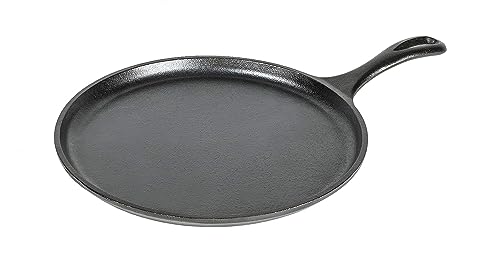
Lodge Cast Iron Crepe Pan
Lodge brings cast iron to the crepe pan format with a wide, flat griddle-style surface and the heat retention the material is famous for. Once the iron is properly hot it holds a steady temperature through batch after batch, which is exactly what crepe making rewards: the tenth crepe cooks at the same pace as the second. The surface arrives pre-seasoned, and like all cast iron it improves with regular use and sensible care. The trade-off is weight. A cast iron crepe pan is not a pan you swirl with a flick of the wrist for an hour; most cooks spread the batter with a spreader or tilt the pan on the burner instead.
Choose this pan if even, patient heat matters more to you than lightness, and if you already like cooking on cast iron. It is a strong fit for weekend batches, for galettes that want a crisp edge, and for cooks who value a pan that can be restored almost indefinitely. Skip it if wrist comfort is a concern, if you want to swirl batter one-handed, or if you prefer cookware you can leave soaking in the sink. This is a mid-tier option; check price on amazon to confirm the current listing, size, and included accessories before you buy.
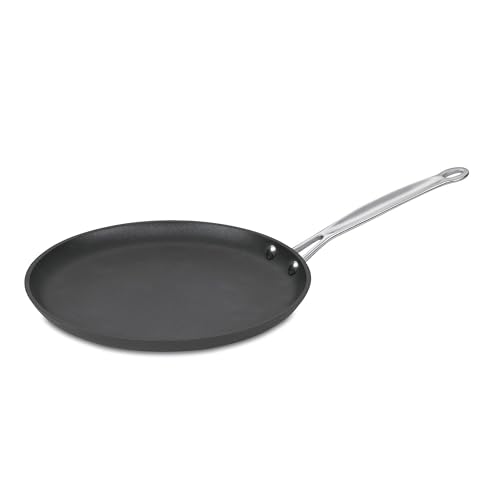
Cuisinart Chef’s Classic Crepe Pan
The Cuisinart Chef’s Classic crepe pan represents the mainstream nonstick route: a hard-anodized style body with a slick interior, low sides shaped for sliding a spatula under a finished crepe, and a handle that stays comparatively comfortable during a session. Nonstick changes the technique slightly. You need very little fat, the batter glides as you tilt, and cleanup is a quick wipe rather than a seasoning routine. For occasional crepe makers and busy family breakfasts, that ease is the whole point.
Choose this pan if you want predictable release from the first morning, easy cleanup, and a pan that doubles happily for pancakes, eggs, and quesadillas. It suits beginners who are still learning batter consistency and heat control, because the surface forgives small mistakes. Skip it if you want a pan to keep for decades, since every nonstick surface has a working life, or if you regularly cook over very high heat, which nonstick coatings dislike. This is a mid-tier option; check price on amazon to confirm the current listing, size, and included accessories before you buy.
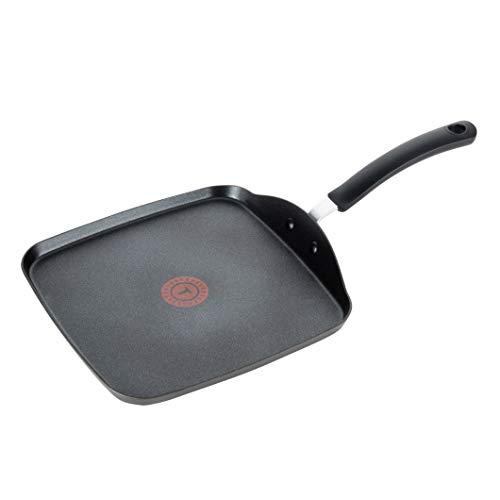
T-fal Crepe Pan
T-fal’s crepe pan sits at the accessible end of the market: light, simple nonstick cookware aimed at people who want to try crepes without committing to carbon steel or cast iron. The light build makes the swirl-and-tilt motion easy to learn, especially for smaller hands and for kids cooking with supervision. The surface releases sweet and savoury batters cleanly while it is in good condition, and the pan stores easily in a shallow drawer or cupboard slot.
Choose this pan if you are crepe-curious, cook them a handful of times a year, or want a low-commitment pan for a holiday home, a student kitchen, or a first apartment. It is also a sensible second pan when one cook is making sweet crepes and another is working on savoury galettes. Skip it if you make crepes weekly and want a surface that deepens with use, or if you need induction compatibility without checking the base carefully first. This is a entry-tier option; check price on amazon to confirm the current listing, size, and included accessories before you buy.

Moss & Stone Electric Crepe Maker
The Moss & Stone electric crepe maker moves the cooking surface off the stove entirely. It is a countertop plate with its own heating element and temperature control, designed so you pour, spread, and lift crepes at a comfortable counter height. The appeal is consistency and independence: the plate holds its setting while the stove stays free, and beginners can repeat the same heat level session after session instead of re-learning a burner’s moods. Many electric makers in this class also invite a dipping technique, where the plate is briefly inverted into a shallow dish of batter for an especially thin coating.
Choose this option if you make crepes for a crowd, if your stove runs hot and uneven, or if you want a dedicated station for brunch service where guests can watch or help. It also suits cooks who struggle to judge burner heat. Skip it if counter and storage space are tight, if you dislike single-purpose appliances, or if you want the flavour and control that come from a heavy pan on a live flame. This is a mid-tier option; check price on amazon to confirm the current listing, size, and included accessories before you buy.
Proctor Silex Electric Crepe Maker
Proctor Silex offers the electric crepe maker idea in a straightforward, family-kitchen form: a flat nonstick plate, simple controls, and accessories in many kits such as a spreader and spatula to get the thin-batter technique started. The learning curve is gentle. You set the control, wait for the plate to settle, spread a small ladle of batter, and lift the crepe when the edges set and the surface looks matte. Because the plate is fixed, there is no pan to balance, which helps new cooks focus entirely on batter and timing.
Choose this maker if you want the easiest possible route to a stack of breakfast crepes, if children will be helping, or if you regularly cook for a table of people with mixed sweet and savoury orders. Skip it if you want one tool that also fries eggs and sears galettes on the stove, or if you prefer the ritual and responsiveness of a traditional pan. This is a entry-tier option; check price on amazon to confirm the current listing, size, and included accessories before you buy.
How to Get the Most Value If You Buy
Work over medium heat and treat consistency as the goal. Burners cycle, pans store heat differently, and batter straight from the fridge cooks slower than batter at room temperature, so judge by the crepe rather than the dial. A well-judged crepe sets in well under a minute, with lacy, lightly golden edges and a supple centre. Smoke, instant dark patches, or batter that seizes before it spreads all point to a pan that is too hot; a pale, rubbery crepe that refuses to colour points to one that is too cool. Electric makers simplify this by holding a setting, while heavy steel and iron reward patience because they change temperature slowly and then hold it beautifully through a long batch.
Seasoning a steel or iron crepe pan is a habit rather than a project. The surface improves every time you cook with a little fat, provided you dry the pan thoroughly and never leave it wet. When a pan feels dull or food starts to catch, warm it, rub in a whisper of oil until the surface looks almost dry, and heat it past the smoke point briefly before cooling. Avoid soaking, avoid harsh scouring except when you intend to reseason, and do not panic about colour: a good working pan turns mottled brown, then deep bronze, then nearly black in the centre. That darkening is the seasoning itself, and crepes sliding cleanly off it are the proof that the routine is working.
Respect the handle. On steel and cast iron pans the handle is part of the same hot metal as the cooking surface, and it heats up quietly during a long session — the danger moment is the cheerful grab halfway through a batch when the first crepes felt fine. Build the habit of a dry towel or a silicone handle sleeve from the first crepe, every time, and keep the towel dry because a damp cloth conducts heat and steam straight to your palm. Position handles turned away from other burners and away from the walkway side of the stove, keep children on the far side of the counter during flipping practice, and remember that electric makers keep hot plates exposed at counter height, so treat the plate edge like a burner even after the indicator light changes.
Cleaning a crepe pan should take about a minute, and most damage comes from impatience rather than dirt. Let a screaming-hot pan cool slightly before water touches it, especially thin nonstick and electric plates, because thermal shock warps bases and stresses coatings. Batter residue usually lifts with hot water and a soft cloth once the pan has rested; stubborn edges on steel and iron yield to a paste of coarse salt and a little oil, wiped out and followed by a quick reseasoning heat. Dry everything completely, because a crepe pan put away damp is a pan seasoning itself with rust spots instead of oil. Store flat or hanging, with the cooking surface protected from the rims and bases of other pans.
Beyond care, value compounds through use, so build the habits that create use: keep a rested-batter routine on weekends, park the pan where it is visible rather than buried, learn one savoury galette as well as your sweet repertoire so the pan works lunches too, and teach someone else in the household — a pan with two cooks gets used twice as often. The buying framework that matches models to households is in crepe pan buying guide, and multi-model verdicts are in crepe pan reviews.
Is a Crepe Pan Worth It? The Decision Checklist
Answer honestly, yes or no. One: Do I cook flat-batter foods — crepes, pancakes, dosas, eggs, tortillas — at least monthly? Two: Do I have a flat storage slot or a cupboard shelf the pan or maker genuinely fits? Three: Does my largest burner match the pan size I want, and does the base suit my hob? Four: Am I willing to give one session to learning batter, heat, and spread? Five: Will I perform the small care routine my chosen material asks for? Six: Would a cafe crepe habit cost my household more in a season than this pan’s tier? Five or more yeses: buy, and buy the durable version. Three or four: buy at the entry tier and let your habits vote again in a year. Two or fewer: skip it, and enjoy crepes made by other people’s pans without a flicker of guilt.
Crepe Pan Practice Notes From Real Sessions
The second side of a crepe needs far less time than the first, and overcooking it is the most common route to a tough, dry result. Once flipped, count in seconds, not minutes: the underside should take a light colour in spots and stay supple enough to fold without cracking. If you are filling the crepe in the pan, the second side is where fillings warm and cheese melts, so arrange the filling as soon as the crepe lands back down. Crepes that crack when folded were usually cooked too long, spread too thin over too fierce a heat, or made from batter that needed more rest and a touch more liquid.
A word about the first crepe, because every tradition in crepe making honours it: it will probably be imperfect, and that is its job. The first crepe absorbs the extra fat, proves the heat, tests the batter’s flow, and calibrates your pouring hand. Cooks in Brittany traditionally give it to the dog or eat it standing at the stove. Plan for it. Make the batter a little more generous than the headcount demands, treat crepe one as a diagnostic, adjust heat and thickness from what it tells you, and start judging from crepe two onward. Sessions that begin with that mindset stay relaxed, and relaxed cooks make better crepes.
Fillings change what the pan must do. A crepe filled after cooking asks only for a clean release and a supple texture. A crepe filled in the pan — cheese to melt, an egg to set, Nutella-style spreads to warm, fruit to soften — asks for even heat and a little more patience at a slightly lower temperature, so the base does not scorch while the filling catches up. Delicate pans earn their keep here: a surface that heats evenly and releases predictably lets you fold in the pan with a spatula, slide the parcel out in one motion, and keep the line moving when a table of people is waiting.
More From the Crepe Pan Notebook
Size is a quiet decision with loud consequences. A smaller crepe pan makes crepes that fold neatly for one person and stores anywhere, but each crepe is a modest portion. A wide pan produces the generous, foldable crepes of a crepe stand and handles dosette spreading beautifully, yet it needs a burner that heats its full base and cupboard space to match. Electric plates tend to the wider format, which is part of their brunch appeal. Whatever you choose, match the pan to the burner: a wide base on a small burner cooks a pale ring of batter around a raw-looking centre, no matter how good the pan is.
The second side of a crepe needs far less time than the first, and overcooking it is the most common route to a tough, dry result. Once flipped, count in seconds, not minutes: the underside should take a light colour in spots and stay supple enough to fold without cracking. If you are filling the crepe in the pan, the second side is where fillings warm and cheese melts, so arrange the filling as soon as the crepe lands back down. Crepes that crack when folded were usually cooked too long, spread too thin over too fierce a heat, or made from batter that needed more rest and a touch more liquid.
A word about the first crepe, because every tradition in crepe making honours it: it will probably be imperfect, and that is its job. The first crepe absorbs the extra fat, proves the heat, tests the batter’s flow, and calibrates your pouring hand. Cooks in Brittany traditionally give it to the dog or eat it standing at the stove. Plan for it. Make the batter a little more generous than the headcount demands, treat crepe one as a diagnostic, adjust heat and thickness from what it tells you, and start judging from crepe two onward. Sessions that begin with that mindset stay relaxed, and relaxed cooks make better crepes.
Fillings change what the pan must do. A crepe filled after cooking asks only for a clean release and a supple texture. A crepe filled in the pan — cheese to melt, an egg to set, Nutella-style spreads to warm, fruit to soften — asks for even heat and a little more patience at a slightly lower temperature, so the base does not scorch while the filling catches up. Delicate pans earn their keep here: a surface that heats evenly and releases predictably lets you fold in the pan with a spatula, slide the parcel out in one motion, and keep the line moving when a table of people is waiting.
Storage shapes buying decisions more than most guides admit. A traditional crepe pan is nearly flat and hangs happily from a hook or slides into the shallow drawer where sheet pans live. Cast iron is heavier and prefers a permanent home on a rack or the stove itself. Electric makers are the bulkiest option and earn their cupboard space only when they are used often; measure the shelf before you buy, and store the unit fully cool and dry with its cord loosely coiled rather than wrapped tight around a warm plate. A pan that is annoying to store becomes a pan that is annoying to use, whatever its cooking merits.
Crepes travel well beyond breakfast. The same pan and batter logic covers dosettes for a savoury lunch, blintz-style parcels, thin pancakes for layering into a crepe cake, and the wrappers for a dozen regional dishes that all rely on a thin, supple, evenly cooked sheet. That versatility is the quiet argument for owning a dedicated pan: a tool bought for Sunday crepes ends up working weekday lunches and celebration desserts. When you assess value, count those uses honestly — a pan used across the week justifies itself very differently from one that appears twice a year.
Finally, trust the evidence of your own sessions over any guide, including this one. Keep tiny notes for the first few batches: how much batter per crepe, where the heat sat, which adjustments fixed tearing or sticking. Crepe making is a physical skill with a short learning curve, and two or three sessions of honest notes will teach your hands more than a shelf of cookbooks. The right pan is the one that makes those sessions feel easy enough to repeat — because repetition, far more than equipment, is what turns adequate crepes into excellent ones.
A dosette, the small wooden T-shaped spreader used in Brittany, looks like a toy until you use one properly. Soak a new wooden spreader in water before its first session so batter clings less, hold it at a low angle, and let the crossbar ride on the batter rather than the pan. The motion is a calm spiral from the centre outward, finished in seconds. Metal spreaders exist and last forever, but wood is gentler on seasoning and nonstick alike, and its slight flex forgives an uneven hand. If your crepes keep coming out thick in the middle and bare at the edges, the spreader angle is usually the culprit, not the batter.
Stacking finished crepes is a small craft of its own. Slide each crepe onto a warm plate, and if the session will run long, cover the stack with a clean cloth or an upturned second plate so the edges stay supple instead of drying into crackers. Crepes destined for filling later in the day keep beautifully layered between sheets of baking paper, and they freeze the same way, stacked with paper between them and sealed in a bag. Thaw the stack in the fridge overnight or at room temperature for an hour, then warm each crepe for a few seconds in a dry pan before filling, which restores the fresh texture far better than reheating a filled crepe.
Savoury galettes deserve their own note because they punish the habits sweet crepes forgive. Buckwheat batter is more fragile, wants a thoroughly hot and well-seasoned or well-greased surface, and benefits from a slightly thicker pour than a dessert crepe. The classic complete galette — ham, grated cheese, and an egg cracked into the centre — needs the pan at a steady medium heat so the white sets as the cheese melts without the base scorching. Fold the edges in toward the yolk once the white turns opaque, give it another half minute, and serve it on a warm plate. A pan that releases a buckwheat galette cleanly will release anything.
Judge a crepe session by its rhythm rather than its first crepe. Cooks who enjoy the process settle into a loop: grease lightly, pour, spread, wait for the matte finish and lacy edge, loosen with a thin spatula, flip or slide, give the second side a brief kiss of heat, and stack. The flip itself can be done with a spatula, with confident fingers at the edge once it has cooled a second, or — on light pans only — with a small toss. Heavy steel and iron pans are turned with a spatula, not tossed, and there is no shame in that: most professional crepe stations use a spatula and a spreader, not acrobatics.
Butter is both ingredient and tool in crepe making, and how you apply it matters. A whole knob melted in the pan floods the batter and fries the edges; a brush, a folded paper towel, or the cut side of a potato on a fork — the old Breton trick — lays down the thin film you actually want. Between crepes, re-grease only when the surface starts to look dry or the previous crepe hesitated to release. On seasoned steel and iron, the need for added fat fades as the session goes on. On nonstick, a bare trace is enough, and excess butter pooling at the edges is a sign to wipe, not to add.
Finally, plan the serving as carefully as the cooking. Crepes wait gracefully for a few minutes in a low oven on a covered plate, but they punish long delays by drying at the edges. The smoothest hosts cook to order in short runs, keep fillings warm and within reach, and let guests fold their own — which turns the pan’s steady rhythm into part of the entertainment. If you must cook ahead, stack with baking paper, wrap the stack, and refresh each crepe for seconds in the hot dry pan before filling. That small ritual restores the just-made texture that makes a crepe worth eating in the first place.
Consider the humble question of batter temperature, which separates smooth sessions from frustrating ones. Batter straight from an overnight rest in the fridge is thicker and colder than batter rested on the counter, and cold batter on a hot pan sets at the edges before it finishes spreading. The fix is simple: take refrigerated batter out while the pan preheats, give it a gentle whisk, and thin it with a spoonful of milk if it pours slowly. Room-temperature batter flows faster, so pour a little less of it. Experienced cooks adjust batter the way they adjust heat — continuously, in small amounts, guided by the crepe in front of them rather than by the recipe behind them.
There is a reason professional crepe stands work on large, heavy plates rather than light pans, and it is worth understanding before you buy. Mass is stability: a heavy surface barely notices the cold shock of fresh batter, so the fifteenth crepe cooks exactly like the third. Home cooks can borrow that principle at any budget by choosing the heaviest base they can comfortably handle, preheating it fully, and resisting the urge to chase temperature with constant burner adjustments. Light pans have their place — they swirl beautifully — but they ask the cook to supply the steadiness that a heavy pan supplies on its own.
Think about the crepe itself as a structure for a moment. A good crepe is a flexible sheet with three zones: lacy, crisp edges; a tender middle; and enough strength to fold around a filling without tearing. Each zone is a heat-and-thickness report. Lace comes from batter thin enough to form holes that set instantly at the rim. Tenderness comes from moderate heat and a short second side. Strength comes from rested batter whose flour has fully hydrated. When a batch disappoints, diagnose by zone: brittle edges mean too hot or too thin, a gummy middle means too thick or too cool, and tearing means the batter needed rest or the pan needed patience before the flip.
The economics of a crepe pan are unusually kind, because the food itself is inexpensive and the tool has almost nothing to break. A stovetop pan has no electronics, no seals, and no moving parts; its lifespan is measured in decades for steel and iron, and in good years for nonstick. An electric maker adds a heating element and a control, which is its main long-term risk, balanced by its consistency while it works. However you spend, the cost per use collapses quickly for anyone cooking monthly or more — one of the reasons the worth-it question, explored in is a crepe pan worth it, resolves positively for so many households.
Regional traditions offer free lessons if you pay attention to them. Breton cooks grease with a potato dipped in butter and spread with a wooden dosette on iron. Dosa cooks in India work a ferociously hot, seasoned flat pan with batter spread in spirals and oil dripped at the edges — proof that the thin-batter technique thrives on well-kept iron and steel across cultures. Japanese dorayaki and Russian blini traditions show the same batter logic at smaller scales. Your crepe pan sits in a long, global lineage of flat pans and thin batters, and borrowing techniques across those traditions will improve your crepes faster than buying accessories will.
Advanced Crepe Pan Notes
There is a quieter benefit to owning this pan that rarely appears in reviews: it slows a household down in a good way. Crepes cannot be rushed beyond their rhythm, they are cooked one at a time and eaten in company, and the cook stands in one place doing one calm thing well. In a kitchen culture of timers and multitasking, a tool that enforces a gentle pace has a value that does not show up in specifications. Many owners, asked why they kept the pan for years, end up describing the mornings as much as the food.
Finally, a note on buying second-hand, because steel and iron crepe pans circulate for generations. A used carbon steel or cast iron pan with surface rust, old seasoning, or a cooked-on patina is usually a bargain in disguise: scrub it back, reseason it in thin layers, and it will cook like new, because the material forgives almost everything except a warped base. Check that base on a flat surface before paying — a pan that rocks or spins has been heat-abused and will cook unevenly forever. Nonstick and electric pans, by contrast, should be bought new, since their working surfaces and elements carry the wear that matters.
Once the basic crepe is reliable, batter variations open a second hobby inside the first. A spoonful of cocoa whisked into sweet batter makes chocolate crepes that want nothing more than berries and cream. A pinch of cinnamon or a grating of citrus zest perfumes a plain batter without changing its behaviour. Herb-flecked savoury batters — chives, parsley, a little black pepper — turn a galette base into something that looks deliberate on the plate. The rule with variations is to change one thing at a time and keep the consistency constant, because a flavoured batter that is also too thick teaches you nothing except that two changes at once are a mistake.
The Usage Tally: Let a Month of Evidence Decide
Borrow, rent, or simulate before you commit if you possibly can, and run the crepe pan through your real week rather than an imagined improved version of it. Keep a plain tally of uses for a month, on paper on the fridge if necessary, because the honest count of actual uses is the number every value judgement secretly depends on. Note what each use replaced: a purchase, a chore done by hand, another appliance’s time, or nothing at all because the job would simply not have happened. Record the minutes the crepe pan saves or costs across a whole session, including setup and cleaning, since value lives in the full cycle and not in the headline moment.
Write down the uses that felt like genuine pleasure rather than mere efficiency, because enjoyment is a legitimate return and pretending otherwise distorts the arithmetic. Ask who else in the household benefits and who merely tolerates the storage, the noise, or the counter space, and count those votes without weighting your own twice. Where a shortlist names specific examples, such as de Buyer crepe pan, run these same checks against that listing line by line rather than assuming the general verdict transfers unchanged. Apply the identical test to Lodge cast iron crepe pan as well, on the same day and under the same conditions, because a fair comparison needs one ruler rather than two moods.
- Tally real uses for one full month
- Log what each use actually replaced
- Count full-cycle minutes including cleaning
- Give the space a vote in the decision
- Imagine a breakdown in year two
- Set a decision deadline with a default
If Cuisinart Chef’s Classic crepe pan is also in contention, give it the same worksheet and let the three sets of answers sit side by side before anyone reaches for a checkout button. Consider the space as a cost with a rent of its own: a crepe pan that earns its footprint weekly is a different proposition from one that squats on it monthly. Think about the season ticket question: whether your interest is a durable habit or a project-shaped enthusiasm that will fade when the project ends. Compare against the honest alternative, which is usually doing the job with what you already own, slowly and imperfectly, rather than against doing it not at all.
Imagine the crepe pan breaking in year two and ask whether you would replace it immediately, eventually, or never, since that imagined answer is the cleanest verdict available before buying. Factor in the learning period without resenting it, but do not let a promise of future ease excuse a present that your tally says is not working. Notice whether you keep finding new jobs for it or keep finding excuses to use it, because the difference between those two patterns is the difference between value and clutter. Give the decision a deadline and a default: if the tally has not persuaded you by that date, the answer is no for now, and no is a complete decision rather than a failure.
Frequently Asked Questions
Is a crepe pan worth it if I only make crepes occasionally?
It depends on what ‘occasionally’ means in your kitchen. Monthly, yes — especially because the pan also works for pancakes, eggs, dosas, and tortillas between crepe sessions. Twice a year, honestly no: the learning curve restarts each time, and the storage cost runs all year. Occasional makers are better served by an entry-tier nonstick pan if they want to own something, since the commitment — in care as much as cost — is the smallest in the category.
Is an expensive crepe pan worth it over a cheap one?
The premium tier buys material and lifespan. A carbon steel pan at the premium tier is effectively permanent and improves with seasoning; an entry nonstick pan is easy and kind but has a finite coating life. For weekly cooks, the durable pan’s cost per use falls below the cheap pan’s within a surprisingly short time. For rare cooks, the cheap pan is the rational buy — you are purchasing a few easy years, not a decade of service.
Can I just use a regular frying pan instead?
You can, and for a first experiment you should — it costs nothing to discover whether your household loves crepes. What the frying pan cannot give you is the dedicated pan’s thin spreading, even cooking to the rim, and clean spatula access. If the experiment succeeds and crepes become a habit, the upgrade is one of the more noticeable in the kitchen for its tier. If the experiment fails, you have your answer and an unspent budget.
Is an electric crepe maker worth it compared with a pan?
For beginners, brunch hosts, and cooks with uneven stoves, yes: the held temperature removes the hardest variable, and the counter station format suits cooking for a crowd. For cooks who enjoy the stove ritual, want a pan that also fries eggs and crisps tortillas, or lack cupboard space, the stovetop pan is worth more. The two formats solve different problems; worth follows the problem you actually have.
How long does a crepe pan take to pay for itself?
Quickly, for most households that use it. The ingredients for a family crepe session cost a fraction of a cafe brunch for the same table, and the pan itself is a modest, long-lived tool — permanent in steel or iron. Households cooking monthly typically feel the purchase justified within the first season, and the pan’s weekday versatility accelerates that: every pancake, dosa, and quesadillas night is also a dividend.
What if I buy one and do not use it?
Then sell it or give it away with the lesson learned — but protect against that outcome before buying. Count your real flat-batter cooking for a month, borrow a pan or make frying-pan crepes twice, and buy at the entry tier if your habits are unproven. The cooks who regret this purchase are almost never wrong about the pan; they were optimistic about their routines. Honest counting is the whole secret.
Related Guides
Keep exploring with these companion guides: crepe pan buying guide crepe pan pros and cons crepe pan review crepe pan reviews For everyday flat-pan comparisons, see best frying pans for eggs.


