Disclosure: As an Amazon Associate, topratedkitchenware.com earns from qualifying purchases. Links on this page are affiliate links; they cost you nothing extra. Prices and availability change often, so check the current Amazon listing before you buy.
This knife set buying guide is built for one job: to help you choose a knife set you will still be pleased with after a year of weeknight dinners, not just on the day it arrives. A good set is a small system — blades, handles, storage and care — and the pages below take that system apart in the order that matters: what a set does and its main types, the picks worth shortlisting at a glance, the questions that decide steel, size, weight and storage, how to prioritise by the way you cook, and the care essentials that protect the purchase. Throughout, one safety thread runs underneath every recommendation: store knives in a block, sheath or magnetic strip, never loose in a drawer; hand-wash individually and dry immediately; and keep every blade out of children’s reach.
Key Takeaways
- Buy the composition before the count: a chef’s knife, paring knife, serrated knife and utility knife do nearly all home prep.
- Forged sets feel substantial and durable; stamped sets are lighter and kinder to budgets. Both cut well when maintained — hone often, sharpen occasionally.
- Storage is part of the product. A block, sheaths or a magnetic strip protect edges and hands; loose drawer storage ruins both.
- Handle fit in your own hand beats any specification. Weight, balance and grip security with wet hands decide daily comfort.
- Judge the set by its chef’s knife and its weakest everyday piece, not by its most impressive slot.
In this guide
What a Knife Set Does and the Main Types
Forged Block Sets
Forged sets are built from blades shaped from a single piece of steel, typically with a bolster, full tang and riveted handle scales. They feel substantial, balance toward the handle, and suit cooks who like a knife with authority for dense vegetables and long sessions. The type anchors the premium end of the market and asks the most of your care routine in return — hand-washing, immediate drying, proper storage — though in truth every type asks the same. Choose forged when weight feels like control to you rather than effort.
Stamped Block Sets
Stamped blades are cut from sheet steel and finished to shape, which makes them lighter, thinner and usually easier on the budget. Modern stamped sets from reputable makers are far better than their reputation from decades past: they take a keen edge, feel agile, and suit smaller hands and high-volume vegetable prep. They typically skip the heavy bolster, which some cooks prefer for sharpening access along the whole edge. Choose stamped when lightness and value matter more than heft and tradition.
Sets with Alternative Storage
Not every set lives in a counter block. Some ship with individual sheaths for organised drawer trays, some are designed around magnetic strips or in-drawer docks, and compact sets target small kitchens directly. The storage format should be chosen with the same care as the blades, because it decides where the set lives, whether it stays out of children’s reach, and how well edges are protected day to day. Our look at best knife storage for small kitchens compares the formats honestly.
Specialist and Extended Sets
Extended sets add santoku, carving pairs, boning or fillet knives, shears and larger steak-knife complements. They make sense when your cooking genuinely calls for them — regular roasts, whole fish, a household that entertains at the table — and are filler when it does not. The discipline of this guide is to start from the core four, then let your real menu argue for each addition.
Knife Set Buying Guide: Top Picks at a Glance
Six lines anchor this guide’s shortlist, spanning premium forged tradition through working-kitchen stamped practicality to entry household value. All are presented prose-only, positioned by qualitative tier, while verification is pending. Badges reflect role, not ranking.
Wüsthof Classic Knife Set
The Wüsthof Classic line is the traditional forged German benchmark in this group: full-tang blades, triple-riveted handles and a reassuring heft that suits cooks who like a knife with presence. As a set it covers the core shapes most home kitchens actually use, and its character is control and durability rather than featherweight agility. Treat it as the premium tier of this cluster, hand-wash and dry it immediately, and store every piece in its block slot rather than loose in a drawer.
Best for: cooks whose priorities match this set’s character. Not suited for: buyers expecting a different tier of steel, weight or finish than a premium set honestly offers. Badge: Best Overall for traditional forged feel.

Henckels International Classic Knife Set
The Henckels International Classic line is a long-running stamped-and-forged-look staple from the Zwilling group’s value brand: triple-rivet styling, a familiar European profile and set compositions built around everyday cooking. It sits in the mid-range tier, aimed at households that want a matched, traditional-looking set without stepping into premium forged money. Edges benefit from regular honing between sharpenings, and the pieces store best in the supplied block or on a magnetic strip.
Best for: cooks whose priorities match this set’s character. Not suited for: buyers expecting a different tier of steel, weight or finish than a mid-range set honestly offers. Badge: Best classic mid-range all-rounder.

Victorinox Fibrox Pro Knife Set
Victorinox, maker of the Swiss Army knife, builds the Fibrox Pro line around textured, slip-resistant handles and light, agile blades that many working cooks reach for daily. As a set it is an entry-to-mid tier workhorse: easy to handle for long prep sessions, forgiving for newer cooks, and composed around genuinely useful shapes. It will not feel like a heavy forged German set, and that lightness is precisely its appeal for smaller hands and high-volume chopping.
Best for: cooks whose priorities match this set’s character. Not suited for: buyers expecting a different tier of steel, weight or finish than a entry-to-mid set honestly offers. Badge: Best grip security for busy, wet-handed prep.

Mercer Culinary Genesis Knife Set
Mercer Culinary built its name supplying professional kitchens and culinary schools, and the Genesis line carries that working-kitchen DNA: grippy, practical handles, sensible blade shapes and set compositions that skip decorative filler. It sits in the entry-to-mid tier and suits cooks who care more about grip security with wet hands than about counter display. The handles tolerate busy kitchens well, but the blades still deserve individual hand-washing, immediate drying and proper block, sheath or strip storage.
Best for: cooks whose priorities match this set’s character. Not suited for: buyers expecting a different tier of steel, weight or finish than a entry-to-mid set honestly offers. Badge: Best working-kitchen value with professional roots.

Cuisinart Triple Rivet Knife Set
Cuisinart’s Triple Rivet line applies the brand’s appliance-era polish to cutlery: contoured handles, a block presentation designed for counters and set lists that lean generous. It is a mid-range option for cooks who value how a set looks as a unit and want one purchase to cover prep, carving and table steak knives. Keep expectations aligned with the tier, hone little and often, and never leave a piece hidden in a sink of soapy water while washing up.
Best for: cooks whose priorities match this set’s character. Not suited for: buyers expecting a different tier of steel, weight or finish than a mid-range set honestly offers. Badge: Best presentation for gift and registry buying.
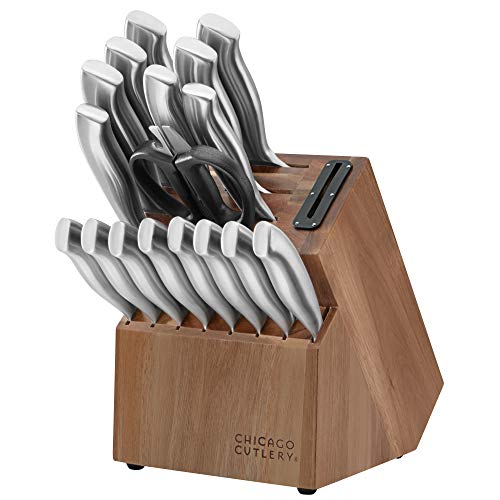
Chicago Cutlery Fusion Knife Set
Chicago Cutlery’s Fusion line is the entry-tier household name in this group: modern handle styling, broad set compositions that often include steak knives and shears, and a low-commitment route into matched cutlery for first kitchens. It suits occasional cooks and starter homes best. Edges at this tier benefit most from frequent honing and gentle treatment — hand-wash individually, dry straight away, and keep blades out of the dishwasher and out of loose drawer storage.
Best for: cooks whose priorities match this set’s character. Not suited for: buyers expecting a different tier of steel, weight or finish than a entry set honestly offers. Badge: Best entry point for first kitchens.
Which Pieces Do You Actually Need?
Start with an audit of your last two weeks of cooking. Most households find the same pattern: one main knife does the bulk of chopping, a small knife handles detail work, a serrated blade deals with bread and tomatoes, and everything else is occasional. A set earns its place when its composition mirrors that pattern with quality concentrated in the core four. Count steak knives separately — they serve the table, not the board — and be sceptical of any set whose count depends on them or on duplicate small knives. The round-up of best knife sets for home kitchens is a good visual reference for sane compositions.
Forged or Stamped — and What Steel Really Means for You?
At principle level, the steel question reduces to three practical traits: how keen an edge the blade takes, how long it holds that edge in your cooking, and how it behaves when maintained at home. Finer, harder edges feel sharper and hold longer but ask for gentler treatment and a stable board; tougher, softer edges forgive more abuse and refresh quickly on a steel. Do not chase specification numbers for specific models — judge by type and tier, and by the maintenance rhythm you will honestly keep: honing realigns an edge for routine upkeep, while sharpening removes metal to rebuild a dull one, and every set in this guide expects the first often and the second occasionally. Carbon-rich steels, where offered, reward immediate drying with superb edges; stainless compositions forgive a slower routine. Either way, hand-wash and dry immediately per maker guidance.
How Much Knife Can Your Hands Handle?
Size and weight are personal, and the buying-guide answer is to match the chef’s knife — the set’s hardest-working piece — to your hands and your board. Larger blades cover more board and suit bigger hands and high-volume prep; shorter blades feel nimbler in small kitchens and smaller hands. Weight divides cooks honestly: some read heft as stability, others as fatigue over a kilo of onions. Handles matter as much as blades — grip the shape mentally across a wet, greasy session, because that is real cooking. A handle that stays secure with wet hands is a safety feature, and every cut should travel away from your body on a stable board that does not rock or slide.
Where Will the Set Live?
Decide storage before you fall for a set, because the block’s footprint, the strip’s wall or the tray’s drawer decides whether the set integrates into your kitchen or fights it. Blocks want dry counter away from the hob’s steam, positioned out of children’s reach. Magnetic strips want sound wall and careful mounting height — see our guide to best magnetic knife strips for placement thinking. Sheaths and in-drawer trays want an organised drawer with individual slots, never a loose jumble. Whichever you choose, the rule is absolute: store knives in a block, sheath or magnetic strip, never loose in a drawer.
How to Prioritise by Use Case
The weeknight family cook should prioritise a strong core four, secure handles and easy care, in the mid tiers where durability per money peaks. The enthusiastic hobby cook who breaks down chickens and tackles winter squash should weight forged heft and an extended composition with carving and boning capacity. The small-kitchen cook should let storage lead: compact sets, strip-ready blades and sheaths beat any block bargain. The entertainer should count the table side — a proper complement of steak knives, explored further in our best steak knife sets guide — and a carving pair, because that is where their set will actually be judged by guests.
First Setup and Care Essentials
When the set arrives, wash every piece individually by hand before first use — never leave them hidden in a sink of soapy water — dry immediately, and place each in its storage home. Learn the storage motion: blades into block slots without forcing, onto strips spine-first. Set your board up properly — a large, stable board, ideally end-grain wood or quality plastic; our look at best end grain cutting boards explains why board choice protects edges. From the first week, hone the straight edges lightly before big sessions, wash and dry after every use, and keep the whole system out of children’s reach. The complete routine lives in our guide to how to clean knife set pieces.
Mistakes to Avoid
The expensive mistakes are predictable. Buying by headline count instead of composition. Choosing the chef’s knife size you think you should want rather than the one your hands want. Ignoring storage until the block meets your actual counter. Planning to dishwasher the set, which dulls edges and stresses handles until the bargain is not one. Skipping the honing steel because the set did not include one. And storing the overflow pieces loose in a drawer ‘temporarily’, which is where edges and fingers get hurt. Finally, if the value question itself is still open for you, read is a knife set worth it before spending anything, and weigh the two-sided ledger in knife set pros and cons. Hands-on impressions of these same lines appear in our knife set review and the wider knife set reviews round-up, and brand-focused readers can go deeper on the best Wusthof knife set options.
The Knife Set Buying Guide Method: Decide in the Right Order
Most disappointing sets are bought in the wrong order: brand first, count second, storage as an afterthought. This guide works in the opposite sequence, and the order itself is the advice. First, audit your cooking and fix the composition you need. Second, decide the storage format against your measured kitchen. Third, choose the construction type — forged or stamped — by the feel your hands prefer. Fourth, set the tier by your care honesty. Only then compare brands and lines, because by that point the field has narrowed itself and the remaining differences are the ones that genuinely matter. Buyers who follow the order report a curious effect: the decision gets easier at every step instead of harder.
Keep a short written list through the process: your core pieces, your storage format and its location out of children’s reach, your preferred chef’s knife size, and your tier. Every candidate set is then a quick pass-or-fail against four lines instead of an hour of feature comparison. Sets that fail the list are out regardless of discounts or presentation, because a set that fails on composition or storage fails every day it lives in your kitchen.
How Many Knives Do You Need, Really?
The honest census of a home kitchen’s cutting work looks like this: one main knife performs the overwhelming majority of board work; one small knife handles detail and in-hand tasks; one serrated knife owns bread, crusts and delicate skins; one mid-size utility covers the gaps. Table steak knives serve a separate function entirely. Everything beyond that census is specialisation — valuable when your menu demands it, decorative when it does not. A roast-heavy household genuinely needs the carving pair; a sushi-enthusiast household can argue for a dedicated slicing blade; a household that does neither should let those slots go and spend the money inside the core four instead.
Use your own last month as the census data. Every time you reached for a knife, which job was it? Every time a job felt awkward, which missing shape caused it? Buy the set whose composition answers your data rather than the manufacturer’s imagination. This is also why two households can choose opposite sets and both be right — and why the biggest set is so rarely the correct answer to this section’s question.
Handles, Balance and Grip: the Fit Questions
More daily satisfaction lives in the handle than in any other component, so interrogate it properly. Does the shape fill your palm without hot spots at the fingers? Does the grip stay secure when hands are wet or greasy — a genuine safety question, since most home prep involves rinsed produce and raw proteins? Is the balance point where you like it: blade-forward for cooks who let the knife’s weight work, handle-ward for cooks who drive every stroke? Does the bolster, if present, sit comfortably against your pinch grip, and can the edge be maintained along its full length?
Households with several cooks should weight the most frequent cook’s fit first and the most vulnerable grip second — smaller hands and less experienced users benefit most from textured, secure handles and lighter blades. If a line’s chef’s knife fails your hands, the set fails, however strong its other pieces look; handles repeat across a set, so one bad fit is repeated everywhere. Conversely, a handle you love is a reason to forgive a set almost anything else.
Steel and Edge Behaviour, Without the Mystique
Buyers are often sold steel as a hierarchy, when for home use it behaves more like a personality. Some compositions take a very fine edge and hold it through long stretches of board work, asking in return for a stable board, no twisting or scraping with the edge, and prompt washing and drying. Others take a slightly less fine edge, forgive harder treatment, and refresh in seconds on a honing steel. Both personalities produce excellent home cooking; the mismatch to avoid is pairing a fine-edged set with a household that will scrape boards, dishwasher the blades and store them loose in a drawer.
At principle level the maintenance contract is identical across steels: hone to realign, sharpen occasionally to rebuild, hand-wash individually — never leaving a knife hidden in a sink of soapy water — dry immediately, store protected. What differs is how quickly each personality punishes a broken contract. Choose the set whose punishment schedule your household can live with, and be honest: there is no shame in the forgiving option, and considerable frustration in buying the demanding one on optimism.
Reading Set Compositions and Marketing
Piece counts are the category’s loudest marketing and its least useful number. Counts typically include the block itself, shears, honing steels and every steak knife, so two sets with identical counts can differ wildly in working blades. Read compositions instead: list the actual cutting pieces, mark which of your census jobs each covers, and note what is duplicated. Duplication hides in mid-size knives — several near-identical utility blades — and in oversized steak complements for households that seat four.
Badges and tier language deserve the same calm reading. ‘Professional’ describes a maker’s market, not a guarantee; ‘forged’ describes a process, not a performance promise; and brand heritage matters mainly as evidence that the maker will still exist when you want a matching replacement piece. The sets in this guide’s shortlist earned their places on composition, fit and care behaviour — the criteria this section teaches — rather than on any of those labels.
Budgeting by Tier, in Words
Think of the market in three qualitative bands. The entry band buys complete coverage and presentable design, and asks gentle treatment and modest expectations of edge life between honings. The mid band is where most households should live: noticeably better main blades, handles designed rather than merely shaped, blocks that feel like furniture, and compositions with less filler. The premium band buys forged construction, finish and heritage — real pleasures, felt daily by cooks who value them, and wasted on households that will not maintain them.
Whichever band you choose, hold back a little of the budget for the supporting kit the set assumes: a honing steel if none is included, a large stable board, and dry towels that are actually reserved for blades. A mid-band set with its supporting kit outperforms a premium set without it in every month after the first, because edges live or die by boards, honing and storage rather than by purchase price.
A Worked Shortlist Exercise
Watch the method decide three common cases. A family of five, cooking nightly, with a generous counter: the census demands a strong core four and real steak knives; storage is a block placed out of the youngest child’s reach; construction preference splits between parents, so a mid forged-leaning line with secure handles wins; the tier is mid, because the care routine is realistic but not ceremonial. A couple in a small flat, cooking four nights a week: the census is the core four only; storage must be a magnetic strip or sheaths because the counter cannot spare a block; light stamped working lines fit their hands and their wall; entry-to-mid tier, with the savings going to a better board.
A keen hobby cook who roasts on Sundays and bakes bread weekly: the census adds a carving pair and demands a serious serrated blade; storage is a block they have measured twice; forged construction matches their love of heft; premium tier is justified precisely because their care habits — hand-washing, immediate drying, weekly honing — are already proven on their current knives. Three households, three different correct sets, one method. That is what a buying guide is for.
Questions to Ask in the Shop or on the Listing
Whether you buy in person or online, interrogate the same points. What are the actual cutting pieces, listed one by one — not the count? Is the chef’s knife available to handle, in person or as an open-stock piece? What storage exactly is included, what are its dimensions, and do the slots fit the pieces without forcing? Is a honing steel included, and if not, does the maker offer one that suits the line? What care does the maker specify — hand-wash and dry immediately is the principle-level answer you want to hear — and what does the maker say about honing versus sharpening for these edges?
Online, read owner accounts with the filters from this guide: weight the long-term reports, decode the care-shaped complaints, and look specifically for comments about handle comfort in wet hands, block footprint on real counters and slot cleanability. In person, do the pinch-grip test, the wet-hand test if the shop allows, and the board test — a few strokes on the shop’s board tell you more than any description. A set that survives these questions has earned its shortlist place; a set that relies on you not asking them has told you something too.
Buying for Two Cooks with Different Hands
Shared kitchens complicate the fit question, because a set’s handles must serve every regular cook. The workable compromises are consistent: mid-weight blades rather than the heaviest forged or the lightest stamped extremes; handle shapes with some texture or contour rather than polished minimalism; a chef’s knife at the middle of the size range, possibly supplemented by a second main knife in the other cook’s preferred size as an individual addition. What does not work is buying entirely for one cook and letting the other improvise — the improviser is the one who ends up using the wrong knife, washing it wrong and storing it loose.
Agree the care constitution before the set arrives: where it lives, out of children’s reach; how pieces are washed — individually, by hand; where the honing steel lives; who sharpens or where sharpening gets done. Two cooks who share rules can share any good set happily. Two cooks with different rules will make even the best set feel like a negotiation, and the knives will show it first.
Seasonal and Sale Buying, Without the Traps
Knife sets are perennially promoted, and the promotion calendar creates two traps. The first is the inflated-count special: a set assembled for an event, with extra filler pieces created to justify a dramatic comparison. Judge it by this guide’s method — composition, storage, fit, tier — and the theatre evaporates. The second trap is the discontinued-line bargain, which can be genuinely excellent value if the maker still supports the line with replacement pieces, and a quiet problem if your most-used knife cannot be replaced after an accident. Ask the support question before taking the bargain.
The sound seasonal strategy is boring: decide your shortlist in a calm month using the method in this guide, note the exact lines and compositions, and then let promotions compete for a decision you have already made well. A set is a ten-year object; buying the right one at an ordinary price beats buying the wrong one at a spectacular one, every single time.
What to Buy Alongside the Set
A set assumes a supporting cast, and budgeting for it completes the purchase. First, the board: large, stable, edge-kind — the single accessory that most affects how the set performs and ages. Second, honing capability: a steel suited to the line, or the household’s chosen honing method, present from day one rather than after the first dulling. Third, storage completion: if the set’s format leaves any piece homeless — an extra individual knife joining later, say — a sheath for it, so nothing ever migrates to loose drawer life. Fourth, the humble consumables of the care routine: soft sponges reserved for blades and towels that stay genuinely dry.
Optional but genuinely useful: a second small board for raw proteins, which simplifies hygiene during big prep sessions, and a simple care log habit — a note of sharpening dates — which keeps the maintenance rhythm honest across years. None of this is upsell; it is the difference between owning a set and operating one, and operating is where the value lives.
Red Flags at Any Price
Some signals should end a set’s candidacy immediately, whatever the tier. A chef’s knife that feels like an afterthought in the hand. A composition whose count depends on duplicates and table pieces while the core four look thin. Storage that is flimsy, tippy or impossible to clean — or worse, no real storage story at all. Handles that are polished-smooth with no grip security for wet hands. Care instructions that are vague where they should be specific, since a maker who will not tell you to hand-wash and dry immediately is telling you the product was not built to be cared for.
And the meta red flag: marketing that works hard to stop you asking the questions in this guide — counts shouted, compositions whispered, heritage substituted for specification of what is actually in the box. Good sets survive scrutiny; that is practically their defining trait. Use the scrutiny freely, buy the survivor, and then give it the decade of decent treatment it was built for.
A Final Word on Confidence
Buyers often end a buying guide more anxious than they began, because every criterion sounds like another way to choose wrong. Reassure yourself with the category’s forgiving truth: within the reputable lines, at the tier your care deserves, with a composition matched to your cooking and storage matched to your kitchen, there are no disastrous choices left. The differences that remain are preferences — weight, grip, look — and preferences cannot be wrong, only unexamined. Examine them, choose, and then commit to the routine that makes any good set great: keen edges maintained by honing, blades washed individually and dried at once, storage that protects every edge and keeps it out of children’s reach.
That commitment, far more than the final brand decision, is what you are really buying when you buy well. The set is the easy part. The system is the achievement — and it is available at every tier in this guide.
Gift and Registry Buying, Done Properly
Buying a set for someone else inverts this guide’s order in one respect: you cannot audit their hands, so you audit their life instead. New household? Favour complete, forgiving, mid-tier compositions with storage included and handles designed for security. Keen cook? Favour the line whose chef’s knife stands alone proudly, because that is the piece they will judge. Small flat? Favour compact or strip-friendly formats over the grandest block. In every case, include the receipt and no embarrassment: a set is a fit purchase, and a giver who welcomes an exchange understands knives better than one who insists.
Registry buyers should apply the same logic at one remove: register for the composed set, not the biggest one, and register for the supporting cast — the board, the honing steel — alongside it. A registry that produces a working system delights for a decade; one that produces a trophy block and no board produces a photograph and a drawer of loose knives by spring.
Second-Hand and Inherited Sets: a Short Appraisal Guide
Not every set is bought new, and appraising a used or inherited one uses this guide’s criteria in reverse. Check the core four first: are the edges free of chips, the tips intact, the handles tight? Check the storage: is the block sound and cleanable, and does every piece still have a home? Check the care history you can read from the steel: heavy scratching suggests scouring or drawer life; water spots and freckles suggest damp storage; a blade that slices paper after a hone suggests a set that was loved and can simply continue. Inherited sets from good makers often need only a proper sharpening, a block deep-clean and new habits to serve another generation.
Walk away — or accept with eyes open — when handles are cracked or loose, when edges are chipped in multiple places, or when the composition’s core is missing and only the filler remains. Those are not bargains; they are projects wearing a bargain’s clothes. A sound used set, though, is one of the best-value routes into the category this guide knows.
The Ten-Minute Decision, for Readers in a Hurry
If time is short, compress this guide to its essence. One: name your core four and refuse any set whose chef’s knife you would not buy alone. Two: measure your storage location — block footprint, strip wall or tray drawer — and its height out of children’s reach, and refuse any set that does not fit the measurement. Three: pick forged if you love weight, stamped if you love lightness, and do not let anyone argue you out of your hands. Four: set the tier by your honest care routine, not your aspirational one. Five: confirm the supporting kit — honing, board, towels — is in the budget. A set chosen by those five refusals and preferences will serve you well even if you never read another word on the subject.
And if the ten-minute version leaves you torn between two finalists, choose the one with the better chef’s knife and the cleaner composition. In ten years, nobody remembers the tiebreaker features; everybody remembers the main blade and the slots that never earned their keep.
Understanding Blocks: Slot Layouts and Materials
Since the block is half the product, give it a buyer’s scrutiny of its own. Slot layout should mirror the composition: dedicated slots for the large blades that do not force them against neighbours, smaller slots that keep paring knives from rattling, and a logical order you can learn by touch. Vertical blocks suit most counters; angled blocks present handles invitingly but claim more depth; horizontal and in-drawer formats trade visibility for footprint. Materials divide by care: wooden blocks want the dry, brush-and-wipe routine and reward it with decades of service; synthetic and bamboo variants tolerate a slightly rougher life. Whatever the material, the tests are stability on the counter, slots a brush can clean, and a silhouette that sits happily at the back of the worktop, out of children’s reach — because a block that must live at the counter’s edge for space reasons is a block one size too big for the kitchen.
Finally, check how the set’s pieces actually sit in it before you commit: blades should not protrude, handles should clear the counter when drawn, and the heaviest knife should not make the block tippy when it is the only one home. These are thirty-second checks that predict ten years of daily satisfaction with surprising accuracy.
A Note on Santoku-Inclusive Sets
Many modern sets include a santoku alongside the chef’s knife, and buyers wonder whether the duplication signals filler. It does not — the two profiles genuinely differ in use: the chef’s knife rocks and works through volume, the santoku push-cuts and excels at thin, precise slicing of vegetables and boneless proteins. Households that cook vegetable-heavy food often find the santoku becomes the daily driver and the chef’s knife the heavy-duty reserve; households built around roasts and dense roots reverse the roles. The duplication is only filler when the household’s menu gives one of the two no work to do, which is a question about your cooking, not about the set’s honesty. Judge it by your last month of dinners, as this guide keeps advising, and the santoku question answers itself.
Delivery, Unboxing and First Inspection
When the set arrives, inspect it like the decade-long purchase it is. Every blade should be straight, free of chips and finished evenly; handles should sit tight with no movement; the block should stand stable and accept each piece without force. Wash every piece individually by hand before first use — never stacked in a basin where blades hide under suds — dry each one immediately and completely, and only then load the storage and take its position on the counter, at the back, out of children’s reach. Any defect is easiest to resolve in this first hour, with packaging intact and the cook’s enthusiasm unspent; a set that passes this inspection has begun its service exactly as it should go on.
The Measurement Worksheet: Sizing the Knife set to Your Own Space
Start this worksheet with the space, not the product page: measure the exact spot where the knife set will live, including the clearance above it, the swing or reach you need in front of it, and the route you will take to move it for cleaning. Write down the largest item you realistically expect to use with it, because that single measurement settles more sizing arguments than any capacity figure printed in a listing headline. Check the nearest outlet and be honest about whether a cord will cross a walkway, a sink edge, or another appliance that also needs that socket on busy mornings. Count the people the knife set must serve on an ordinary weekday, then count again for the busiest gathering you host in a typical year, and notice whether those two numbers point to the same size.
List the three jobs you will ask of it every week and the one job you will ask only a few times a year, because the weekly jobs should drive the decision and the rare job should not. Decide where the accessories, attachments, and spare parts will be stored before you order, since a knife set whose extras live in a distant cupboard quietly becomes a knife set with fewer features. Where a shortlist names specific examples, such as Wüsthof Classic Knife Set, run these same checks against that listing line by line rather than assuming the general verdict transfers unchanged. Apply the identical test to Henckels International Classic Knife Set as well, on the same day and under the same conditions, because a fair comparison needs one ruler rather than two moods.
- Measure the working spot and the clearance around it
- Count weekday servings and the biggest gathering
- List the three weekly jobs in writing
- Decide storage for every accessory in advance
- Name the one compromise you accept knowingly
- Set the return deadline in your calendar
If Victorinox Fibrox Pro Knife Set is also in contention, give it the same worksheet and let the three sets of answers sit side by side before anyone reaches for a checkout button. Think about who else in the household will use it, including anyone shorter, anyone with less grip strength, and anyone who will clean it without reading the manual first. Note the surfaces it will touch in normal use and whether heat, moisture, weight, or vibration from the knife set could mark, stain, or stress those surfaces over months of daily contact. Plan the cleaning position as carefully as the working position, because a knife set that is awkward to carry to the sink or to open fully will be cleaned less often than it should be.
Write the three questions you still cannot answer from listings and guides, and treat those unanswered questions as your shortlist filter rather than as details to discover after delivery. Compare the footprint against the appliance or tool it replaces, and decide in advance what leaves the room if the new arrival is larger than the old one. Consider the noise, steam, heat, or light it produces in use and whether that output lands in a room where someone sleeps, works, or studies at the same hours. Check how it behaves at the smallest task, not only the largest, because many households abandon oversized gear that feels clumsy for the quick everyday job.
Think through the second week of ownership, when the novelty has faded, and ask which features you will still touch daily and which were only interesting in the showroom sense. Decide what good enough looks like in writing: the result you would accept without complaint, the result that would delight you, and the result that would send the box back. Look at the controls with fresh eyes and imagine using them with wet hands, greasy hands, or gloves, depending on the work, because small controls punish exactly those moments. Ask how the knife set fails gracefully: whether a worn part, a lost attachment, or a single broken control ends its usefulness or merely removes one mode you rarely used.
Check whether replacement parts and consumables are ordinary, widely stocked items or proprietary pieces tied to one maker, since that difference compounds over years of ownership. Measure the storage shelf, drawer, or cupboard you intend to use with the door closed and other contents in place, not the optimistic empty version of that space. Think about guests and helpers who will meet the knife set without your habits, and whether its safe, correct use is obvious to a newcomer within a minute of looking at it. Write down the one compromise you are consciously accepting, so that when it shows up in daily use it reads as a chosen trade rather than a nasty surprise.
Frequently Asked Questions
How many pieces should a knife set have?
Enough to cover your core four — chef’s knife, paring knife, serrated knife, utility knife — plus whatever your cooking genuinely adds, such as steak knives, shears or a carving pair. For most households that means a moderate composition rather than the largest count on the shelf. Headline counts include storage and table pieces and flatter every set; judge instead by asking what each slot does in your week. A compact set of used-daily pieces outperforms a sprawling set whose extra slots gather dust, and costs less to maintain well.
Is forged always better than stamped in a set?
No. Forged sets offer heft, bolsters and a traditional feel that many cooks love, and they anchor the premium tier. Good stamped sets are lighter, agile, easier on the budget and entirely capable for home cooking, often with better grip designs for wet hands. The better choice is the one matching your hands, your board work and your care habits. Both types expect the same maintenance at principle level: hone to realign the edge, sharpen occasionally to rebuild it, hand-wash and dry immediately, and store protected in a block, sheath or strip.
What is the best storage for a knife set?
The best storage is the one that fits your kitchen and gets used every time: a block with slots for each piece, individual sheaths in an organised tray, or a magnetic strip mounted securely and out of children’s reach. All three keep edges separated and protected. The only wrong answer is loose in a drawer, where blades dull against other items and hide from reaching hands. Choose the format first if space is tight — small kitchens often do best with strips or sheaths — then choose the set that suits it.
How do I know if a set’s chef’s knife fits me?
Match it to your hands, your board and your typical prep volume. If you can, handle display pieces or the same line’s open-stock knife: the grip should feel secure without squeezing, the weight should feel like control rather than effort across a long session, and the blade length should clear your board’s working area comfortably. Smaller hands and compact boards often prefer shorter chef’s knives; high-volume cooks often prefer longer ones. Since the chef’s knife does most of a set’s work, this single fit decision matters more than any other in the box.
Do knife sets need special care compared with single knives?
The care is identical per knife — hand-wash individually, never soak hidden in soapy water, dry immediately, hone often, sharpen occasionally, store in a block, sheath or strip — but a set multiplies the pieces and adds the storage itself to the routine. Blocks need crumb and slot cleaning; strips need wiping; sheaths must dry fully inside. Budget a few minutes after cooking and a short monthly session for the whole system, and a set stays keen and safe for years. The full routine is laid out in our cleaning guide for knife sets.
Should I buy the biggest set I can afford?
Buy the best-composed set you can afford, which is rarely the biggest. Money spent on slots you never use maintains nothing and cuts nothing; the same budget concentrated on a moderate composition from a stronger line buys a better chef’s knife, better handles and better storage — the things you touch daily. Add specialty pieces individually later if your cooking proves it needs them. If you are torn between a larger mid-tier set and a smaller premium one, choose the smaller premium core: daily pieces are where quality is felt.
Related Reading
- how to clean knife set pieces
- is a knife set worth it
- knife set pros and cons
- knife set review
- knife set reviews
- best knife sets for home kitchens
- best Wusthof knife set options
- best steak knife sets
- best magnetic knife strips


