Disclosure: As an Amazon Associate, topratedkitchenware.com earns from qualifying purchases. Links on this page are affiliate links; they cost you nothing extra. Prices and availability change often, so check the current Amazon listing before you buy.
Knife set pros and cons are easy to list and harder to weigh, because the same feature — many matched pieces in one block — is a blessing to one household and a burden to another. This knife set pros and cons breakdown works through the genuine advantages and the honest limitations one at a time, with the reasoning behind each, then translates the ledger into what it means for different cooks, compares the set route with its alternatives, and closes with the buying and care habits that shrink the cons. One theme recurs on both sides of the ledger: a set rewards households that store knives in a block, sheath or magnetic strip, hand-wash and dry them properly, and keep blades out of children’s reach — and punishes households that do not.
Key Takeaways
- Pros centre on coverage, consistency, included storage and one-decision convenience; cons centre on filler pieces, averaged quality, footprint and multiplied upkeep.
- Most cons are manageable: buy composition over count, choose storage that fits, and run a simple honing and hand-washing rhythm.
- The set route suits multi-cook households and kitchen builders; devoted single-knife cooks feel the cons more than the pros.
- Safety cuts both ways — a block organises blades safely, but a set also means more edges to store out of children’s reach.
In this guide
The Pros
Complete Coverage From Day One
The first pro is completeness. A set arrives with the core shapes — chef’s, paring, serrated, utility — plus table and task pieces, so no meal in the first month exposes a missing tool. Building that coverage individually takes years of noticing gaps mid-recipe. For new kitchens especially, coverage converts cooking from improvisation to routine immediately, and that daily smoothness is the benefit owners mention most.
One Decision Instead of a Dozen
Choosing individual knives well demands research per piece: steel, geometry, handle, maker. A set concentrates that into a single judgement about one maker’s approach, which suits busy buyers and gift-givers. The decision is also easier to get roughly right — reputable lines are coherent — whereas a hand-built collection can go wrong in a dozen separate ways. Our knife set buying guide exists to make that one decision a good one.
Storage Included and Solved
A set’s block, or its sheath or strip system, is a pro with safety weight behind it. Edges live separated and protected, counters stay organised, and blades stay out of the drawer where loose knives dull and cause reaching-in injuries. Because the storage is designed for the pieces, every knife has a home, and tools with homes get put away — which is precisely how kitchens stay safe around children and guests.
Consistent Handles, Balance and Care
Matched pieces share grip shape and maintenance needs, so skills and habits transfer across the set and across the household’s cooks. Everyone learns one honing rhythm, one washing rule — individually, by hand, dried immediately — and one storage motion. That consistency quietly prevents the damage that mixed collections suffer when each knife is treated by different rules.
Better Value per Used Piece
Bundling usually prices the core shapes and storage kinder than buying the same coverage piece by piece from the same tier. The pro holds only when the pieces are used — which is why it pairs with the filler con below — but for households whose cooking matches the composition, the arithmetic is genuinely favourable, as the value analysis in is a knife set worth it shows.
A Coherent Table Service
Sets that include steak knives give the table the same coherence as the board: matched, sharp table knives that make everyday dinners feel finished and entertaining effortless. Individual-knife collectors rarely assemble this, and it is a pro households feel at every shared meal. Our dedicated guide to best steak knife sets covers the table side in depth.
The Cons
Filler Pieces Inflate the Count
The headline con is filler: duplicate small knives, novelty shapes and swollen steak-knife counts that exist to print a bigger number on the box. Filler is not harmless — it costs money, block space and cleaning time, and it dilutes the maker’s budget away from the chef’s knife you use daily. The defence is composition discipline: price the core four, treat the rest as bonus, and never let count outrank the main blade.
Quality Is Averaged, Not Concentrated
A set spreads its budget across every slot, so no single piece gets the investment a dedicated purchase would give it. Cooks who live on their chef’s knife feel this most: the same money buys one outstanding individual blade or one good set blade among several good-enough companions. Whether this con bites depends entirely on how concentrated your own cooking is.
The Block Claims Permanent Space
Counter blocks are furniture. In small kitchens the footprint competes with boards, appliances and working room, and a set exiled from the counter tends to end up loose in a drawer — the worst storage outcome. Strips and sheath systems soften this con but demand wall or organised drawer space instead. Space is a real cost, weighed honestly in our look at best knife storage for small kitchens.
Upkeep Multiplies With Every Slot
Every piece wants hand-washing individually — never left hidden in a sink of soapy water — immediate drying, regular honing to realign its edge and occasional sharpening when honing stops working, since honing realigns while sharpening removes metal. Multiply that by a full block and by several household cooks, and the discipline requirement is real. Households that will not keep it up watch the whole set dull together, which is the con behind most disappointed set owners.
One Maker’s Choices, Everywhere
Buying a set means accepting one handle shape, one weight philosophy and one aesthetic across every task. If the handle disagrees with your hand, it disagrees everywhere at once. Mixed collections let each piece suit its job; sets trade that tailoring for coherence. Trying the line’s chef’s knife in hand before committing is the standard mitigation.
More Edges to Keep Safe
A set concentrates blades, which is safe when stored properly and risky when it is not. Blocks must sit out of children’s reach, strips must be mounted beyond small hands, and every user must follow the same rules — cut away from the body on a stable board, wash individually, store immediately. Households with toddlers or careless guests carry a higher management load with a full set than with two sheathed knives.
What the Trade-Offs Mean for You
For the kitchen builder, the pros dominate: coverage, storage and one decision solve the whole problem at once, and the cons are mostly avoidable by buying composition over count. For the family kitchen with several cooks, consistency and table service weigh heavily, provided the household can hold the care line together. For the minimalist or technique-focused cook, the cons dominate: averaged quality and filler argue for individual blades, a conclusion our hands-on knife set review reaches for that profile too. For the small kitchen, the verdict turns entirely on storage format — strip and sheath sets keep the pros while shrinking the footprint con, a comparison helped by our guide to best magnetic knife strips and the broader survey of best knife sets for home kitchens.
How the Set Route Compares with the Alternatives
Against the individual trio — chef’s, paring, serrated bought separately — the set wins on convenience, storage and table coverage, and loses on concentrated quality and tailoring. Against the compact set, the full set wins on specialty coverage and loses on price, space and filler exposure; many households find the compact format the balanced answer. Against premium individual collecting, sets win on coherence and cost control and lose on ceiling. None of these routes is wrong; the pros and cons simply land differently depending on cooking volume, household size and how much the buyer enjoys choosing tools. The comparative experiences in our knife set reviews round-up illustrate each route in daily use.
How to Buy Smart
Smart buying neutralises most cons before money moves. Audit your cooking and list the pieces you need; let that list veto bloated compositions. Handle the line’s chef’s knife if you possibly can. Decide the storage format against your real counter, wall and drawer space, and its position out of children’s reach. Choose the tier by your care honesty: premium forged sets reward careful owners, while working stamped lines forgive busier households. Check the block as a product in its own right — slot fit, stability, cleanability. And read brand depth where it helps, such as our look at the best Wusthof knife set options.
Setup and Care That Reduce the Cons
Most cons shrink under a simple rhythm. Set the storage up where prep happens, on a stable surface near a generous board — edge-friendly surfaces such as those in our best end grain cutting boards guide protect every edge in the block. Hone the straight edges little and often; wash each knife individually by hand after use, never soaking it hidden in soapy water; dry immediately and store it straight away. Clean the block or strip monthly. The full method is in our guide to how to clean knife set pieces. Households that run this rhythm report the upkeep con as a few calm minutes; households that skip it meet every con on this page at once.
Knife Set Pros And Cons: The Bottom Line
The pros of a knife set — coverage, coherence, storage, value per used piece — are structural and immediate. The cons — filler, averaged quality, space, multiplied upkeep — are real but largely choosable-away at purchase and manageable in care. If your household cooks often, shares tools and can hold a simple care line, the pros win comfortably. If your cooking is one-knife concentrated or your kitchen cannot store a set safely, the cons are the honest signal to buy individually instead.
Knife Set Pros And Cons in One View
Before the deeper sections, here is the whole argument on one screen. For the set: complete coverage from the first day; one purchasing decision instead of many; storage designed-in and safety organised; consistent handles and one care routine for the whole household; kinder cost per used piece; a coherent table service. Against the set: filler pieces that inflate counts; quality averaged across slots rather than concentrated; a permanent storage footprint; upkeep multiplied by every piece; one maker’s handle and weight imposed on every task; and more edges to keep stored safely out of children’s reach. Neither column is propaganda — every entry on both sides shows up in real households, and the sections below weigh which column dominates for which cook.
The Reference Lines Behind This Ledger
Pros and cons land differently at different tiers, so it helps to anchor the argument to real lines. The three below span the bands this site uses as reference points; each is prose-only while verification is pending.
Wüsthof Classic Knife Set
At the premium forged end, the pros sharpen: heft and finish make the coverage feel luxurious, and the cons soften on quality averaging because even the secondary pieces are serious. The upkeep con, though, grows teeth — a set at this level deserves its hand-wash, dry-immediately, honing rhythm, and owners who skip it waste the most money. Best illustration of the rule that premium sets reward disciplined households disproportionately.

Victorinox Fibrox Pro Knife Set
The working stamped case: the value-per-piece pro is at its strongest here, the grip pro is real for wet-handed prep, and the presentation pro is at its weakest — this line looks like equipment, not furniture. The filler con barely applies because the compositions stay workmanlike. For households whose pros list starts with function, this band is the ledger’s sweet spot.
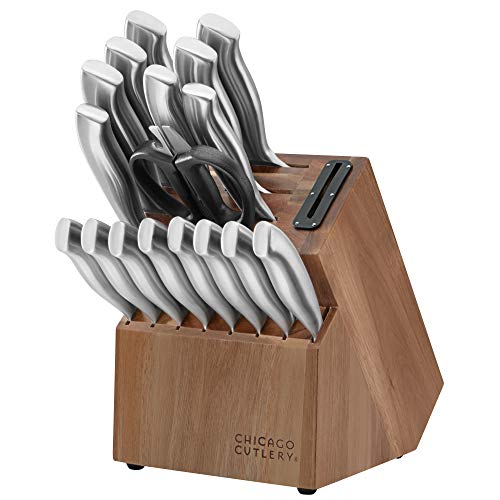
Chicago Cutlery Fusion Knife Set
The entry case: coverage and coherence pros arrive at the gentlest commitment, which is exactly what first kitchens need. The cons concentrate in edge longevity and finish — pieces at this tier ask the kindest treatment and the most frequent honing. As a teaching set that builds real habits — wash individually, dry, store in the block — it demonstrates the category’s pros honestly before any premium money is risked.
The Safety Ledger, Both Sides
Safety deserves its own accounting because it appears in both columns. In the set’s favour: designed storage gives every blade a separated, protected home, ending the loose-drawer hazard that dulls edges and cuts reaching hands; matched handles behave predictably across cooks; and a visible block makes a missing knife obvious at a glance, a quiet form of accountability after washing up. Against the set: it concentrates edges in one place, so the storage must be positioned out of children’s reach without exception; more pieces mean more washing events, each one a moment where a blade left hidden in a sink of soapy water can hurt the next person; and guests unfamiliar with the system may handle pieces carelessly.
The net judgement from households that run sets well is that the format is safer than the drawer-of-knives chaos it usually replaces — provided the rules are absolute: store in a block, sheath or magnetic strip, never loose; wash individually; dry and put away immediately; cut away from the body on a stable board. The con side of the safety ledger is really a discipline requirement, and households should count it as one when deciding.
The Money Ledger, Both Sides
Money arguments for the set: bundling prices coverage kindly; one purchase ends the drip of small, ill-researched knife buys; included storage removes a separate spend; and a maintained set’s long service life spreads its cost across thousands of meals. Money arguments against: filler slots are paid for and unused; the averaged budget means the main blade is not the best your money could buy alone; a neglected set depreciates as a group, so the loss is total rather than partial; and the block’s footprint can carry a real cost in a small kitchen where counter space is the scarcest resource.
The tiebreaker is usage honesty. Price the set per piece you will use weekly and the pro column usually wins for cooking households; price it per headline piece and you are using the manufacturer’s favourite arithmetic. Households that entertain should count the table pieces as used; households that do not should not let a dozen steak knives flatter the deal.
The Daily-Life Ledger
Beyond safety and money sits the texture of daily life, where sets quietly win or lose. Winning looks like this: the right knife is always in the same place, keen, and familiar in the hand; washing up follows one calm pattern; the counter looks intentional. Losing looks like this: a block slightly too big for its corner, slots that gather crumbs nobody cleans, a honing steel nobody uses, and a slow household negotiation about whose turn it is to deal with the knives. The difference between those kitchens is rarely the set itself — it is whether the household adopted the system or just bought the objects.
This is why experienced owners advise deciding the routine before the product: where the block or strip lives, who hones and when, which towels are the knife towels, how the block gets its monthly slot clean. A household that can picture those details vividly will land on the pro side of nearly every section of this page. A household that cannot picture them should buy smaller, simpler and more forgiving — a compact set or individual sheathed knives — and let the routine grow before the collection does.
How the Cons Age
An under-discussed point in the set’s favour: most of its cons shrink with time, while most of its pros persist. Filler stops mattering once you stop seeing it — the working core becomes simply ‘the knives’. The footprint becomes furniture. The upkeep becomes muscle memory, a few unthinking minutes after each meal. Even the one-maker compromise fades as your hands learn the handles and your technique adapts to the weight. What does not fade is the coverage, the coherence and the storage — the pros are structural, the cons are largely transitional.
The exception is the quality-averaging con for the cook whose skills grow into their tools. A cook who starts on a set and develops serious technique may, in a few years, genuinely outgrow the main blade — and the graceful path is the hybrid one: keep the set as the household system, upgrade the chef’s slot individually, and let the set’s original main knife become the household’s second blade. Planned that way, even outgrowing a set is a pro in disguise: the set taught the cook what they wanted.
Pro: Resale, Regifting and Household Redistribution
A maintained set holds practical value beyond its first kitchen: it can equip a grown child’s first flat, a holiday home or a relative’s upgrade, complete with storage and a care routine the giver can teach in five minutes. That redistributability is a genuine pro in the ledger — few kitchen categories hand down this gracefully — and it depends entirely on the con-defeating habits: hand-washing, drying, honing and protected storage keep a set giftable for years, while one neglected season can make it fit only for the bin.
Con: The Upgrade Path Is Awkward
Balanced against that, a set resists piecemeal upgrading: when one piece wears, chips or is simply outgrown, a matching replacement may not exist, and a non-matching one breaks the coherence that justified the set in the first place. Makers with strong open-stock ranges soften this con considerably, which is why it belongs on the buying checklist. Households that expect to evolve their tools piece by piece should weight this con heavily; households buying a system for a decade can safely discount it.
Pro: Predictability for Guests and Occasional Cooks
Homes are cooked in by more people than their owners: partners, parents, teenagers, guests helping with dinner. A set gives all of them a legible system — every knife visible in its home, every handle behaving the same way, the right tool findable without instruction. That legibility is a safety pro as much as a convenience one: predictable tools in known places are handled more carefully than a mystery drawer. The condition, as ever, is that the system’s rules are simple enough to state in one breath — wash individually, dry, back in the block, sheath or strip, never loose, never soaking hidden in the sink.
Con: Aesthetic Lock-In
A set is also a visual commitment: one handle material, one block finish, one look, for a decade, in the most visible corner of the kitchen. Kitchens get renovated around appliances more easily than around a block that no longer matches anything. Buyers who redecorate often should count this con honestly and lean toward neutral finishes; buyers who choose once and live with it will never notice the issue. It is the lightest con on the page and, for some households, the decisive one — the ledger respects both reactions.
Weighing the Ledger for Renters and Frequent Movers
Renters feel a specific subset of this ledger. The storage pro survives the move — a block travels, a sheathed set travels even better — while wall strips may be left behind with the wall. The footprint con changes shape: in a rental kitchen you cannot redesign around the block, so its size must fit the counter you are given, measured before purchase. The upkeep pros and cons travel unchanged, because care is portable. On balance the ledger favours sets for renters more than folklore suggests, provided the format is chosen for portability and the block is sized for the smallest plausible next kitchen, not the current largest one.
Weighing the Ledger for Confident Solo Cooks
The solo enthusiast is the profile the cons were written for: concentrated cooking, strong preferences, one pair of hands to fit. For them the averaging con and the one-maker con dominate, the coverage pro shrinks to the three blades they actually use, and the storage pro can be matched by a single strip. This page’s honest advice to that reader is to skip the set and buy individually — while noting that even enthusiasts often end up adding a modest set later, the day a partner, family or shared house enters the picture and the democratic argument for a shared system becomes their own.
Weighing the Ledger for Families with Young Children
For households with small children the safety entries dominate everything else, and they cut in the set’s favour when the system is run properly: blades consolidated in one known, out-of-reach home; a missing knife immediately obvious; no loose edges in drawers at child height; a washing routine — individually, never hidden in soapy water — that leaves nothing dangerous soaking or drying at a counter’s edge. The con side is vigilance load: more pieces to account for, more users to teach as children grow, and a block that must be repositioned as climbing ability develops. Families who accept that load get the safest version of a knife-owning kitchen; families who doubt their consistency should choose fewer knives, sheathed, in a high closed cupboard, until the household is older.
Weighing the Ledger for Keen Entertainers
Entertainers invert several standard weights. The table-service pro becomes a headline: matched steak knives and carving capacity are used weekly, not yearly, so compositions that look bloated to other households are honestly composed for this one. The footprint con shrinks because entertaining kitchens tend to be larger and the block reads as part of the theatre. The upkeep con grows quietly — more pieces used per event, more washing after guests leave tired — and is answered by the same routine, run the morning after if necessary, with knives rinsed and rested visibly on a towel rather than left soaking overnight. For this profile the pros win by the widest margin of any on this page.
The One-Pro-One-Con Summary Owners Give
Ask long-term owners for a single pro and a single con and the answers are remarkably consistent. The pro: ‘Everything is just there — sharp, in its place, ready.’ The con: ‘I use four of them.’ Those two sentences contain this entire page. The set succeeds by presence and system; it overreaches only in count. A buyer who internalises that summary will do the two things that decide the ledger in advance: choose the composition by the four working pieces, and let the storage and care system be designed as carefully as the purchase itself.
And the owners’ summary has a corollary worth ending on: nobody’s one con is ever about sharpness, steel or brands. The category’s hardware is good enough, across reputable lines and tiers, that the pros and cons that survive a year of ownership are all about fit — of composition to menu, of storage to kitchen, of upkeep to household. Fit is choosable. Choose it well and the ledger is not close.
Pro: A Set Teaches Knife Skills Faster
An under-credited pro: a set is a curriculum. Having the correct shape for each task teaches the hands what each shape is for — the paring knife’s control for detail, the serrated blade’s patience on crusts, the chef’s knife’s rhythm on the board — far faster than improvising every job with one compromise blade. Beginners on sets develop correct grip, clawed guiding hands and away-from-the-body cutting habits partly because the tools stop fighting them. The con hiding inside this pro is that a set can also teach dependence on specialty pieces where technique would serve; the balanced view is that tools first, refinement second is the right order for almost every home cook.
Con: Storage Becomes a Single Point of Failure
Balanced accounting requires naming this: concentrating every blade in one block or strip means one failure — a knocked-over block, a strip mounting giving way, a flooded drawer tray — involves every knife at once. Mitigations are mundane: stable blocks on stable surfaces, strips mounted into sound material at a height out of children’s reach, trays in dry drawers. The con is real but manageable, and it is the price of the organisation pro; scattered knives do not have a single point of failure because they are, in effect, failing diffusely all the time.
How Couples and Housemates Split the Ledger
In shared households the pros and cons are rarely felt equally by everyone, and naming the split prevents the quiet resentments that dull more sets than steel quality ever did. Typically one person values the coverage and coherence pros; another carries the upkeep con, because washing, drying and honing default to whoever cares most. The fix is constitutional, not metallurgical: agree the routine as a household rule — every user washes their knife individually, dries it and returns it to the block, sheath or strip — rather than as one person’s standard imposed on others. Sets maintained by constitution stay keen; sets maintained by a single volunteer eventually become that volunteer’s grievance with a block attached.
Housemates add a further wrinkle: differing risk tolerance around guests, children visiting, and knives left out during parties. The set’s storage discipline answers most of it — a block at the back of the counter, accounted pieces, nothing soaking hidden in the sink during a busy evening — but only if the household agrees it before the party, not during it.
The Environmental Column
Add one more column to the ledger, briefly. Pro: a durable set maintained for a decade or more is the low-waste choice, keeping steel in service through honing and occasional sharpening rather than replacement cycles. Con: a bloated set manufactures, ships and eventually landfills pieces that were never used — pure embedded waste wearing a bargain’s clothes. The environmental verdict therefore mirrors the practical one exactly: buy the composed set, maintain it properly, and the format is responsible; buy the maximal set and neglect it, and the format is wasteful. As with money and safety, the product matters less than the match.
Pro: One Warranty, One Maker, One Relationship
A small administrative pro closes this round: a set concentrates your dealings with one maker’s support, one care specification and one replacement channel. When a piece fails or is damaged, there is no archaeology about where it came from. Makers of sets also tend to support them with matching open-stock pieces, honing tools and guidance written for the line. It will never headline a buying decision, but over a decade of ownership these quiet conveniences accumulate into a real, if modest, entry on the pro side.
Pro: Standardised Sharpening and Maintenance
Because a set’s blades share a maker’s approach, their maintenance converges: one honing technique, one sharpening expectation, one care specification for every slot. Owners learn a single rhythm and apply it across the block, and sharpening services or home sessions can process the whole set in one sitting with one setup. Compare the mixed drawer, where every knife is a separate research project with its own preferences, and the pro is obvious — standardisation is what turns maintenance from a hobby into a habit, and habits are what keep edges alive.
Con: The Whole Set Shares One Fate
The mirror image deserves its sentence: whatever befalls the system befalls every piece. A household move that loses the block, a season of neglect, a single determined dishwasher-user — the damage is portfolio-wide. Individual collections diversify that risk by accident; sets concentrate it by design. The mitigation is the same discipline this page keeps returning to, but the con belongs in the ledger because it explains why neglected sets look so uniformly sad while neglected single knives merely look like one sad knife.
Pro: Better Knives for Occasional Cooks in the Household
Not every cook in a home cooks equally, and a set quietly upgrades the least experienced ones. The teenager making their first solo dinner, the partner who cooks twice a month, the parent visiting for a weekend — all of them reach into the same block and find a keen, appropriate, predictable knife instead of whatever the household’s odds and ends provided. Better tools make occasional cooks safer as well as happier: a sharp, balanced knife with a secure handle demands less force and behaves more predictably than the dull drawer knife it replaces. Households rarely list this pro when buying, and frequently list it when reviewing.
Con: Guilt, Clutter and the Cost of Keeping Everything
A softer con, but a real one: a set obliges you to house all of it, including the pieces you have privately written off. Drawer knives can be discarded without ceremony; a set’s passenger slots sit in the block as a small permanent exhibit of money not perfectly spent, and some owners feel it every time they cook. The cure is at the buying stage — composition discipline, again — because a set whose every slot earns its place produces no such exhibit. Bought well, this con never materialises; bought by count, it is the con that lingers longest after the others fade.
The Ledger Applied: Three Households, Three Verdicts
Watch the whole ledger decide three real-shaped cases. Household one: two keen cooks, a toddler, a medium kitchen, nightly dinners. Coverage, coherence and table pros all fire; the safety cons are answered by a back-of-counter block and a strict wash-individually constitution; upkeep is shared by constitution. Verdict: set, mid-to-premium, and the ledger is not close. Household two: one minimalist cook, tiny kitchen, three dinners a week, one beloved chef’s knife already owned. Averaging, footprint and one-maker cons dominate; coverage pro is nearly worthless to them. Verdict: no set — a paring knife, a serrated knife and a strip complete their kitchen better.
Household three: a family of five, mixed enthusiasm, big counter, Sunday roasts and weekday chaos. The pros fire on coverage, table service and predictability for many hands; the cons fire on upkeep multiplication and shared fate. The deciding factor is not the product but the constitution: if the household adopts the routine together, the set wins clearly; if care will default to one resentful volunteer, a compact set plus lower expectations wins instead. Three households, three verdicts, one ledger — which is exactly what a pros and cons page is for.
Pro: Confidence for Learning Cooks
There is a confidence curve in every kitchen, and a set flattens it kindly. A learning cook equipped with the correct, keen tool for each task attributes early successes correctly — to growing skill rather than lucky improvisation — and attempts the next technique sooner. The right blade also forgives beginner errors more safely than the wrong one: less force is needed, the cut goes where intended, and the guiding hand stays clear because the knife is not being muscled through food it was never shaped for. Households consistently report that new cooks ‘took off’ after a set arrived; the mechanism is not magic, it is friction removed at exactly the stage where friction discourages practice.
Con: One Size Fits Nobody Perfectly
The final honest con is anthropometric: a set’s handles are designed for an average hand that nobody quite has. Very small and very large hands both compromise — the small hand on weight and grip diameter, the large hand on handle length and knuckle clearance. Individual buying solves this by fitting each piece; sets ask the outliers to adapt. Most hands are near enough the average that the compromise is invisible, but buyers at the extremes should handle the chef’s knife with particular care before committing, because in a set, one fit decision echoes through every slot in the block.
How to Argue with This Page
A pros and cons page earns its keep only if readers can argue with it, so here is the argument kit. If your household’s experience contradicts an entry here, trust the experience — ledgers describe patterns, not laws, and your kitchen is the final jurisdiction. If an entry feels true but trivial, weight it trivially; the ledger’s power is in the weighting, which only you can supply. And if the page has done its job, you now hold something more valuable than a verdict: a list of the exact questions — composition, storage, upkeep, fit, safety — whose answers decide the matter for your household. Argue with the entries, answer the questions, and the purchase, whichever way it falls, will be yours rather than the market’s.
A Closing Note on Deciding Under Disagreement
Sometimes the household itself splits on this ledger — one cook reads the pros, another reads the cons, and both are right about their own experience. The workable compromises are known: a compact set rather than a flagship, satisfying coverage without the footprint and filler the sceptic fears; a set for the household plus one individual treasure for the enthusiast; or a trial season with an entry set, honestly maintained, after which the household re-reads this page with data instead of opinions. Disagreement about a knife set is rarely about knives — it is about space, money and whose habits govern shared tools — and naming that turns an argument about products into a solvable conversation about the household.
Beyond the Ledger: Seven Days of Living With the Knife set
Treat this diary as the practical sequel to the ledger above: for one ordinary week, note each time the knife set delights you and each time it irritates you, in the moment rather than from memory at the end. Record the jobs where the advantages felt largest, because a strength that only appears on tasks you rarely do is worth less than the summary tables suggest. Record the irritations with equal honesty, and mark whether each one came from the product itself, from your space, or from a habit you could change once and forget. Pay attention to the setup and put-away minutes, since trade-offs that look trivial on paper become the deciding factor when they repeat twice a day for years.
Note who else used the knife set during the week and what they struggled with, because a drawback that only affects the most patient person in the house is easy to underestimate. Watch for the workaround you invent by day three, and judge it fairly: a painless workaround retires a con, while a fiddly one confirms it. Where a shortlist names specific examples, such as Wüsthof Classic Knife Set, run these same checks against that listing line by line rather than assuming the general verdict transfers unchanged. Apply the identical test to Victorinox Fibrox Pro Knife Set as well, on the same day and under the same conditions, because a fair comparison needs one ruler rather than two moods.
- Log delights and irritations as they happen
- Time the setup and the put-away honestly
- Test the worst job, not the easiest one
- Note the workaround you invent by day three
- Ask a second user for their verdict
- Write the sentence you would tell a friend
If Chicago Cutlery Fusion Knife Set is also in contention, give it the same worksheet and let the three sets of answers sit side by side before anyone reaches for a checkout button. Test the loudest, messiest, or slowest mode at the time of day you would actually use it, not at a forgiving hour chosen to make the product look good. Check the cleaning burden after the worst realistic job rather than the easiest one, since the honest version of that chore is the one you will live with. Notice whether the headline strength survives ordinary ingredients, ordinary timing, and an ordinary tired evening, because strengths that need perfect conditions are narrower than they appear.
Write down any benefit you had not expected, since unlisted advantages discovered in use are often the ones that keep a product in the house for a decade. Write down any drawback that no review mentioned, and consider whether it is specific to your space, your water, your power supply, or your household size. Compare the week against the tool or appliance the knife set replaced, task by task, instead of against an idealised version of what ownership would feel like. Ask whether the cons cluster at the start of each session, in the middle of the work, or in the cleanup, because that pattern tells you whether habit can fix them.
Decide which single con you would pay to remove and which single pro you would refuse to give up, since that pair of answers is the real verdict of the week. If the diary shows the balance tilting on one recurring job, re-read the sections above with that job in mind rather than averaging your impressions across everything. Finish the week by writing the sentence you would say to a friend who asked about the knife set, and check whether it sounds like the summary you believed before the diary began. Keep the diary somewhere you will find it before a future replacement decision, because your own recorded week outweighs any general verdict, including the ones in this guide.
Notice, too, whether your standards moved during the week: some apparent cons are simply the feeling of a new routine replacing an old one, and they fade on their own. Mark the moment you stopped thinking about the trade-offs and just got on with the task at hand, because that moment is when the balance quietly settled itself. If no such moment arrived, that absence is data as well, and it usually points at one specific friction worth naming precisely rather than blaming the whole product. Whatever the category, photograph your intended spot with the neighbouring items in place, because a picture exposes crowding that measurements alone politely ignore.
Keep every measurement, tally, and note from these checks in one place, ideally with the receipt, so the next decision in this category starts from your evidence rather than from scratch. Involve the household early where the product is shared, since a decision everyone helped measure is a decision nobody relitigates at the first inconvenience. Prefer the option that fits your existing routine with the fewest new habits, because each new habit is a small tax collected every single day. Be wary of solving a storage problem by creating a carrying problem, since distance between storage and use is where good equipment goes to be forgotten.
Frequently Asked Questions
What is the biggest disadvantage of a knife set?
For most buyers it is filler: pieces included to raise the headline count rather than to serve your cooking, which dilute the budget away from the chef’s knife and add storage and cleaning load. The close second is multiplied upkeep — every slot needs hand-washing, drying, honing and proper storage. Both disadvantages are manageable: buy by composition rather than count, choose the storage format that fits your kitchen, and keep the simple care rhythm. Buyers who do those things mostly experience the pros; buyers who chase the biggest box meet the cons first.
Do knife sets stay sharp as long as individual knives?
Sharpness life depends on steel type, use and care, not on whether a knife arrived in a set. A set piece that is honed regularly to realign its edge, sharpened when honing stops restoring the bite, hand-washed and stored in a block, sheath or strip will hold its performance for years. Set knives dull faster in practice only when the multiplied upkeep gets skipped or when edges bang together in loose drawer storage. Individual knives suffer identically under the same neglect, so the honest comparison is care routine against care routine.
Are knife sets good for small kitchens?
They can be, when the storage format is chosen for the space. Compact sets, sheath-based sets for organised drawer trays, and sets paired with a wall-mounted magnetic strip all deliver full coverage with little or no counter footprint. The classic failure is a large counter block bought without measuring, which then gets exiled and the knives stored loose. Measure first, keep the storage out of children’s reach, and a small kitchen gets the coverage and coherence pros without the footprint con dominating.
Is a knife set a good gift?
It is one of the most practical kitchen gifts, because it solves coverage and storage in one box and suits new households particularly well. Choose a sensibly composed mid-tier set rather than the largest count, since recipients experience filler as clutter. If you know the recipient cooks seriously and selectively, a single excellent chef’s knife plus a sheath can be the better gift. Either way, a set’s coherence and included block make it present well and work immediately, which is why it remains a registry staple.
Can you mix a set with individual knives later?
Yes, and many cooks do: the set provides coverage while a later individual purchase upgrades the hardest-working slot, usually the chef’s knife, or adds a specialty shape the set lacked. Store the addition with the same discipline — block slot, sheath or strip — and maintain it with the same routine. Mixing works best when the set was bought for its core quality in the first place; a set bought purely on count tends to be replaced wholesale rather than built upon.
Do professionals use knife sets?
Working cooks more often assemble personal kits around individual knives in rolls and cases, chosen piece by piece for their station and hand. That said, several lines in this category — including workhorse sets from makers with professional roots — are bought precisely because they behave like a ready-made kit: sensible shapes, secure grips, no filler. The home lesson is not to copy the format but the priorities: grip security, shapes that match the work, and storage that protects edges in transit and at rest.
Related Reading
- knife set buying guide
- how to clean knife set pieces
- is a knife set worth it
- knife set review
- knife set reviews
- best end grain cutting boards
- best knife storage for small kitchens
- best Wusthof knife set options
- best knife sets for home kitchens


