Disclosure: As an Amazon Associate, topratedkitchenware.com earns from qualifying purchases. Links on this page are affiliate links; they cost you nothing extra. Prices and availability change often, so check the current Amazon listing before you buy.
This nonstick cookware set buying guide is built to be used with a listing open beside it. It explains the types on the market, the criteria that actually separate a good set from a padded one, and how to prioritise when your household’s needs pull in different directions, all without a single static price, because listings change faster than any guide can.
You will find top picks at a glance by tier, mini-reviews of example lines, question-led criteria chapters on capacity, bases, handles and care, and a first-use routine that sets a new set up for a long life. Keep your own week of cooking in mind as the reference standard; every recommendation here is really an instruction to match the set to that week.
Key Takeaways
- Types differ by body and coating family; hard-anodized aluminium with a classic coating is the sensible default for most kitchens.
- Compare core cooking pieces, not headline counts: two skillets, two saucepans, a stockpot and a deep lidded skillet cover most homes.
- Induction needs an explicitly magnetic base; never assume it from a photo.
- Handles, lids and rims are the daily-feel details that separate finalists.
- Care guidance from the maker, for the specific line, outranks every general rule in this guide.
In this guide
Nonstick Cookware Set Buying Guide: What a Set Does and the Main Types
A set is a coordinated fleet for release cooking: frying, saucing, simmering and reheating with minimal sticking and minimal washing-up. The types divide by body material and coating family, and each division predicts how the set will cook and age.
A nonstick surface is a coating bonded to a metal pan body, and almost everything about how a set behaves follows from that pairing. The coating is what lets eggs slide, fish lift cleanly and sauces release without soaking, while the body underneath decides how evenly heat spreads and how the pan feels in the hand. When people say a set feels flimsy or reassuring, they are usually describing the body, not the coating. When they say food started sticking after a year or two, they are usually describing the coating and how it was treated. Keeping those two layers separate in your mind makes every buying decision in this guide easier, because you can judge the metal on weight, flatness and handle quality, and judge the coating on how realistically it matches the way you actually cook on a tired weeknight.
Hard-anodized aluminium is the body material behind most respected nonstick sets, and for good reason. The anodizing process hardens the surface of the aluminium, giving the pan a tougher, more corrosion-resistant shell than plain aluminium while keeping the metal’s best trait: fast, even heat response without the weight of cast iron or thick stainless steel. A hard-anodized pan warms predictably, cools quickly when you pull it off the heat, and rarely develops the stubborn hot ring that thin, cheap pans show over a burner. It is not indestructible, and the coating on top of it still decides the pan’s working life, but as a foundation it is the sensible default. If a set description leads with hard-anodized construction, that is a meaningful signal rather than decoration.
Coating language on listings can sound like alphabet soup, so anchor on behaviour instead of branding. Traditional smooth coatings prioritise maximum slipperiness and are at their best with eggs, fish and other delicate work at gentle heat. Textured or reinforced coatings trade a whisper of that glassy release for better tolerance of everyday knocks and slightly bolder cooking. Ceramic-style coatings, which are a different technology despite sharing the nonstick label, tend to feel wonderfully slick when new and are often chosen by buyers who prefer their look and feel, though their release arc over time differs from classic coatings. None of these families is universally best; the right one is the one whose strengths match your most-cooked meals. Judge by your menu, keep heat habits gentle regardless of family, and let the maker’s own care guidance for that specific line settle any remaining questions.
Two pans with the same coating can behave very differently because of how the body was formed. Thicker, forged or heavy-gauge bodies resist warping, sit flat on glass and induction-style flat tops, and hold a steadier temperature when cold food lands in them. Thin, spun bodies are lighter and cheaper, but they are the ones that rock on the hob, develop a domed centre that pools oil at the edges, and lose their flat base after repeated thermal shock. You cannot always see gauge in a product photo, so judge by heft in hand where possible, by the flatness of the base, and by whether the maker describes the body plainly. A set that will be used daily deserves bodies that stay flat, because a warped nonstick pan cooks unevenly and wears its coating unevenly too.
Top Picks at a Glance
Four example lines mark out the tiers. Best Overall thinking favours balanced bodies and contents; the entry pick favours honest value; the premium pick favours a more tolerant brief; and the classic pick favours traditional shapes that many cooks already know and love.
Read listings like a sceptic and you will buy better. Lead claims describe the best piece in the best light, so scroll to the plain contents list, the base description and the care instructions, where the durable facts live. Note what the maker does not say: silence about induction usually means no magnetic base, and silence about oven use usually means limited oven ambitions. Treat included utensils and bonus items as padding until proven otherwise. Compare sets by their core cooking pieces, body construction and handle design rather than by headline counts. And remember that availability and pricing move constantly, so any number printed in a guide like this one would be stale on arrival; the current listing, checked at the moment you buy, is the only reliable source for what a set costs today.
Money logic in this category is about cost per year of good cooking, not about the number on the box. An entry-tier set that cooks beautifully for its working life and is replaced without pain can be better value than a premium set whose owner resents every scratch. Equally, a mid-tier set with heavier bodies may outlast two flimsy sets and feel better every single day it is used. Think about which pieces you will use daily, because value concentrates there, and be sceptical of paying for sprawling piece counts you will store rather than cook with. There is no static price advice worth printing here, because listings change constantly; the durable advice is to buy the heaviest, flattest, best-handled set within the tier you are comfortable replacing, and to check the current listing when you are ready.
How Much Capacity Do You Actually Need?
Capacity questions are household questions in disguise. Count the mouths, the batch-cooking habits and the biggest regular meal, then size the stockpot and wide skillet to that reality rather than to the largest gathering of the year.
Pan sizes matter more than pan counts. A small skillet suits single eggs and reheating a portion, a mid-size skillet handles most weeknight proteins for two, and a genuinely wide skillet is what lets a family batch brown instead of steam. Saucepans follow the same logic: a small one for sauces and reheating, a larger one for grains and soups-for-two, and a stockpot sized to your biggest regular job rather than to a once-a-year feast. Check diameters against your burners, because an oversized pan on a small burner heats unevenly at the edges, and check depths if you toss food rather than stir it. The right set feels like it was measured against your stove and your household, not assembled to hit an impressive number on the box.
Family cooking changes the maths on size and duplication. A wide skillet that fits four fillets at once prevents batch cooking and the first batch going cold, a generous stockpot swallows pasta for everyone plus tomorrow’s lunch, and saucepans in two sizes mean rice and sauce can happen simultaneously without negotiation. Families also wash pans constantly, so easy release is not a luxury but a time budget, and lids that control splatter keep the hob cleaner between deep cleans. Consider, too, who else cooks: teenagers making eggs, a partner reheating leftovers, a grandparent helping at weekends. A forgiving set makes the kitchen more shareable. The wear will come faster in a busy household, which argues for a tier you can renew calmly and for teaching the house rules, soft tools and no empty-pan blasting, as shared kitchen manners.
Batch cooking and meal preparation put a set through a distinctive workload: large volumes, long simmers and a parade of reheats across the week. A generous stockpot and a deep, lidded skillet cover most of it, and nonstick’s easy release keeps the Sunday session’s clean-up from eating the afternoon. Coatings actually fare well in this pattern, because so much batch cooking is moist, lidded and moderate in heat, the gentlest regime a pan can work in. The watch-outs are volume-related: do not fill a stockpot so full that lifting it becomes unsafe, and let big batches cool before refrigerating them in proper containers rather than in the pan. For households that cook ahead, a set chosen for its two largest pieces, and judged kindly on its smallest, is usually the right way round.
Which Base and Body Should You Choose?
The body decides evenness, stability and hob compatibility. Heavy, flat bases cook calmly and sit still; magnetic bases unlock induction; smooth bases keep glass tops unmarked. This is the chapter to reread if you only skim one.
Stovetop compatibility is the quiet deal-breaker in this category. Classic aluminium nonstick pans do not work on induction hobs unless they carry a bonded magnetic base, and many otherwise excellent sets are gas-and-electric only. Before anything else, match the set to your hob: hold a magnet to the base of any pan you already own if you are unsure how induction behaves, and read the set’s base description for explicit induction language rather than assuming. Glass and ceramic tops reward flat, smooth bases that will not scratch, while open gas grates reward stable, wide bases that do not tip when a spoon rests in the pan. A set that is perfect on paper and unusable on your stove is not a bargain at any tier, so this check comes first, before coatings, colours or piece counts.
Glass and ceramic hobs reward a particular kind of care from nonstick owners. Bases should be smooth and clean before the pan goes down, because grit trapped between pan and glass can scratch the hob as the pan moves, and pans should be lifted rather than dragged for the same reason. Flat bases matter doubly here, since a rocking pan on glass is both inefficient and noisy, and the flat contact is what these hobs need for even heating. The good news is that hard-anodized sets generally suit glass tops well, being lighter than cast iron and smooth-based by design. Add the habit of wiping the base of a pan that has been stored on a dusty shelf, and your hob will stay unmarked while the pans cook evenly. Small courtesies between pan and stove repay both appliances.
Weight is a Goldilocks variable in nonstick cookware. Very light pans heat fast and suit cooks who toss food or have wrist and grip considerations, but they can feel skittish on the hob and are likelier to warp or scorch at a hot spot. Heavy pans feel planted and cook evenly, yet a full large saucepan still has to be lifted to the sink by a real person at the end of a long day. The sweet spot for most households is a body with noticeable substance that you can still manoeuvre one-handed when it is loaded with food. Balance matters as much as raw weight: a pan whose handle counterweights its body feels lighter than it is, while a nose-heavy skillet tires the wrist during the constant small tilts that saucing and omelette work involve.
What Makes Handles, Lids and Rims Worth Paying Attention To?
Daily feel lives in the fittings. Handles that balance a full pan, lids that fit across pieces, and rims that pour without dribbling are unglamorous, permanent pleasures that outlast any headline feature.
Handles are where a set proves itself every single day. A good handle stays comfortable when the pan is full, balances the load so your wrist is not fighting the pan, and attaches with a joint that does not loosen into a wobble after months of use. Riveted attachments feel reassuringly permanent but leave small interior bumps that need a wipe; welded or coated-over attachments clean more easily. Silicone-wrapped handles grip well and feel kind straight from the stove, while bare metal handles suit cooks who move pans in and out of the oven and prefer to use a mitt as a matter of habit. Test the mental picture: lifting a full saucepan of pasta water one-handed to drain it. If the handle shape in the photo looks like it would twist or bite, believe that instinct and look elsewhere.
Lids deserve more attention than they usually get. Tempered glass lids let you watch rice, sauces and simmering vegetables without lifting and losing steam, which is a genuine daily convenience, and they make splatter control easy during shallow frying. Their trade-offs are weight, storage bulk and rims that trap wash water if they are not dried properly. Solid metal lids are tougher and often oven-friendlier, but they hide the food. Look at how lids are shared across the set: a lid that fits both a saucepan and a skillet quietly reduces clutter and increases the odds you will actually use it. Check knob material and comfort too, because you will lift lids with a cloth or mitt hundreds of times, and a knob that is awkward with a mitt becomes a small daily irritation.
Small design details separate sets that are pleasant daily from sets that are merely adequate. Tapered or rolled rims pour sauces and scrambled eggs without the dribble down the pan’s side that has to be wiped off the hob. Interior measurement marks in saucepans, when present, save a jug for small jobs. A helper handle opposite the main handle on the largest skillet and stockpot turns a two-handed lift into a controlled one. Hanging holes in handles matter if your storage is a rail. None of these details appears in headline claims, and none of them will rescue a thin, warping body, but between two well-built sets they are exactly the differences you will feel every day. When you compare finalists, spend your attention here, on the unglamorous geometry of daily use.
How Should You Judge Coatings and Care Demands?
Judge a coating by the cooking it suits and the care it asks, then check that your household will actually give that care. A slightly less slick but more forgiving surface often serves a busy family better than a delicate champion.
Heat discipline is the single biggest factor in how long a nonstick set stays nonstick. Coatings age fastest under sustained high heat, and they age especially fast when a pan sits empty over a strong burner, because an empty pan’s temperature climbs far faster than a loaded one. Build three habits and the set will repay you: add food or a little cooking fat as the pan warms rather than parking it empty, do most cooking in the low-to-medium band where nonstick genuinely excels, and let the burner size roughly match the pan base so flames or elements are not licking up the sides. None of this is fussy once it is habit. It is simply cooking the way the material asks to be cooked, and it separates owners whose sets last for years from owners shopping again next spring.
Utensil choice is the second half of coating care. Wooden spoons, silicone spatulas and nylon tools glide over the surface without gouging it, and they are pleasant to use in their own right: quiet, kind to pan edges and comfortable in saucy, scrape-the-corner cooking. Metal utensils are the classic coating killer, not always in one dramatic scratch but in hundreds of small abrasions that roughen the surface until eggs start catching at the same worn spots. Make the switch completely rather than mostly, because the one metal fish slice that stays in the drawer is the one that gets used in a hurry. Keep a small crock of wood and silicone tools beside the stove so the safe choice is also the nearest choice, and retire any tool with melted, sharp or fraying edges before it starts marking the pan.
Washing up decides more about coating life than most owners expect. The golden sequence is simple: let the pan cool on the stove until it is safe and comfortable to handle, then wash it in warm water with a soft sponge or cloth and ordinary washing-up liquid. Cooling first matters because plunging a hot pan under cold water stresses the bond between coating and body and can warp thinner bases over time. A soft sponge matters because scouring pads, however satisfying on a stuck saucepan, are abrasives working directly against the surface you are trying to preserve. Most nonstick messes release easily after a short soak, which is the coating doing its job. Dry pans fully before stacking, and your future self, cooking breakfast in a hurry, will find a surface that still behaves like it did when it was new.
How to Prioritise by Use Case
Four profiles recur: the first kitchen, the family kitchen, the confident cook upgrading, and the small kitchen. Each should rank capacity, body quality, tier and compactness differently, and this section shows the rankings.
For a first kitchen, a nonstick set solves several problems at once, which is why it is such a common starting point. It covers eggs, grains, sauces, reheating and gentle frying with one coordinated group of pans, it forgives the timing mistakes every new cook makes, and it keeps washing-up light while routines are still forming. The sensible first-flat approach is to choose a set whose contents match simple, real meals rather than aspirational ones, add one good wooden spoon and one silicone spatula, and cook with it for a few months before buying anything else. Gaps reveal themselves honestly through cooking: perhaps a bigger stockpot, perhaps a roasting tray, perhaps nothing at all. Starting with a forgiving set and learning your own habits is cheaper and calmer than trying to predict a lifetime of cooking in a single purchase.
Small kitchens make the strongest case for a well-chosen set and the weakest case for a sprawling one. When cupboard space is measured in centimetres, every piece must justify its footprint, lids must stack or hang sensibly, and pans that nest without grinding against each other’s surfaces are worth real preference. A compact set built around two skillets, two saucepans and one stockpot covers the overwhelming majority of home cooking, and the discipline of a small kitchen often produces better buying: fewer, better pieces, chosen against actual meals. Measure your cupboard and your hob before ordering, check the largest pan’s diameter against your biggest burner and your storage shelf, and be honest about whether a specialty piece will be used monthly or yearly. In a small kitchen, the best set is the one that disappears into daily life.
The weeknight test is the only review that ultimately counts. It is half past six, people are hungry, the recipe is half-remembered, and the cookware either lowers the temperature of the whole endeavour or raises it. A good nonstick set lowers it: the pan heats quickly and predictably, the protein releases when it should, the sauce does not catch while someone answers the door, and the washing-up is a two-minute epilogue rather than a second shift. Judge every set you consider against that scene rather than against a fantasy of weekend project cooking. If a set’s skillets are the right sizes, its saucepans cover grains and sauces, and its care demands fit inside a tired person’s routine, it will be loved. Features that only shine in elaborate cooking matter far less than grace under ordinary pressure.
Mini-Reviews: The Example Lines in Detail
Here the four example sets get their honest paragraphs: who each suits, who should skip it, and the strengths and trade-offs that matter once the novelty of new pans wears off and Tuesday arrives.
The real value of a nonstick set shows up in small, repeated moments rather than in any single impressive dinner. It is the Tuesday omelette that takes minutes and washes up in seconds. It is the sauce that does not leave a burnt ring to soak overnight. It is the new cook in the household succeeding at fish without a pep talk, and the experienced cook choosing the easy pan because the day has already been long. Multiply those moments across hundreds of meals and the set’s worth becomes obvious in a way a feature list cannot capture. This is also why the category suits households in transition: first flats, new babies, downsized kitchens and anyone rebuilding confidence at the stove all benefit from cookware that forgives small mistakes and cleans without a fight.
Saucepans are the under-sung half of any nonstick set, and they earn that status through liquid cooking. Rice that releases from the corners, porridge that does not weld to the base, custards and cheese sauces that wipe clean, reheated soups that do not catch: these are daily mercies. Lidded, moist cooking is also the gentlest environment a coating ever works in, which is why nonstick saucepans commonly outlast the fry pans from the same set by a wide margin. When comparing sets, weigh saucepan sizes against your real grain and sauce habits, check that lids fit snugly enough to hold a true simmer, and notice whether the smallest saucepan is genuinely small, because a tiny pan for melting, reheating a single portion or making a pan sauce is one of the most-used pieces in many kitchens.
First Setup and Care Essentials for a New Set
Unbox kindly: wash every piece warm and soft before first use, retire the metal utensils from the pan drawer, set up protected storage, and cook the first meals gently while the household learns the new pans’ temperaments.
A small evening routine keeps a nonstick set young. As you plate up, move the empty pan off the hot burner so residual heat does not keep baking the coating. After eating, when the pan has cooled, give it its warm wash with a soft sponge, dry it rather than leaving it to drain at an angle where water sits in it, and put it away with a protector if it stacks. Once in a while, check handles for the first hint of looseness and bases for the first hint of rocking, because both are easier to accept early than to discover mid-recipe. None of this takes more than a couple of minutes, and it is best understood not as fussiness but as the same care you would give a good knife: brief, habitual and repaid in performance every time you cook.
Storage is the silent source of coating damage in tidy kitchens. Stacking nonstick pans directly on top of each other lets the base of one pan grind against the cooking surface of the one below every time the cupboard is opened, and the wear shows up as dull patches and sticking long before owners connect the cause. The fixes are cheap and simple: nest a soft cloth, a paper towel or a purpose-made pan protector between stacked pieces, hang pans from a rail if your kitchen allows it, or store the most-used skillet separately where it slides in and out without contact. Lids stored rim-down between pans can mark surfaces too. Treat the cooking surface the way you would treat a good knife edge, as the working part of the tool that deserves a small amount of deliberate protection.
Many nonstick sets are described as dishwasher safe, and the honest reading of that phrase is that the dishwasher will not destroy the pan today, not that it is the best place for it. Dishwasher detergents are harsher than hand-washing liquids, cycles run long and hot, and pans knock against racks and other items in ways that chip edges and dull surfaces over months. Hand-washing a nonstick pan is genuinely quick work, because the surface is designed to release food, so the convenience gap is smaller than it first appears. A sensible compromise used by many owners is to hand-wash the fry pans and skillets that carry the cooking surface they care about most, and let the dishwasher handle lids and less critical pieces. Whatever you choose, choose it knowingly rather than discovering the difference a year later.
Mistakes to Avoid When Buying and Breaking In a Set
The expensive errors are buying counts instead of contents, assuming induction, blasting empty pans, and letting the first month set sloppy habits that the coating then pays for all year.
The classic mistakes with a new nonstick set are all understandable, which is why they are worth naming plainly. Seasoning-style rituals borrowed from cast iron do not apply here. Cooking sprays with propellants and additives can build a sticky film on coatings over time, so a little ordinary oil or butter applied with a brush or paper is the cleaner habit. Aerosol film is also the hidden culprit behind many pans that seem to lose their release in patches while looking undamaged. Overcrowding the skillet steams food and tempts cooks to raise the heat, compounding the problem. Cutting food in the pan, sliding pans across gritty hobs, and stacking without protection round out the usual list. Every one of these is a habit, not a character flaw, and each is fixable the moment it is noticed.
Set piece counts are marketing arithmetic, and learning to decode them saves real disappointment. Lids are usually counted as pieces, utensils are sometimes counted as pieces, and a large set can still lack the one pan you reach for most. Read the contents list literally, item by item, and picture each piece in your week: the small fry pan for eggs, the larger skillet for family portions, the saucepans for grains and sauces, the stockpot for soup and pasta water, and whatever saute or Dutch-oven style piece anchors bigger meals. Then ask what is missing and what duplicates a pan you already love. A modest set whose every piece earns its cupboard space beats a sprawling set padded with lids and tools, because cupboard space, washing-up volume and daily friction are the real costs of pieces you never use.
A short pre-purchase checklist prevents most regrets in this category. Confirm hob compatibility first, including induction if it applies to you. Read the contents list piece by piece and match it to your actual week of cooking. Check the largest skillet against your biggest regular meal and your largest burner. Read the maker’s care and oven guidance for the specific line, not for nonstick in general. Decide your utensil situation honestly and budget a wooden spoon and silicone spatula into the plan if your drawer is full of metal. Think about storage: where each piece will live, and whether stacked pans will get protectors. Finally, sanity-check the set against what you already own, so you are buying coverage for gaps rather than duplicates of favourites. A set that passes those checks rarely disappoints.
Some cooks should honestly skip a nonstick set, and saying so protects them from a mismatched purchase. If your cooking centres on high-heat searing, broiler finishing and stovetop-to-oven roasting several nights a week, stainless steel, cast iron or enamelled cast iron will serve you better as a primary fleet. If you strongly prefer buy-it-for-life durability and dislike the idea of any cooking surface being a wear item, a nonstick set will frustrate you on principle. If your kitchen already owns two excellent skillets and a full saucepan set, a boxed set duplicates rather than upgrades. And if nobody in the household will change utensil or washing habits, the coating will wear early and the purchase will disappoint through no fault of the pans. In each case the better buy is a smaller, targeted addition rather than a full set.
Example Sets Covered in This Guide
Each example below is presented prose-only, with a pick slot marker where a verified product link and image will be placed at publishing. Judge every one by contents, construction and fit for your kitchen, and check the current Amazon listing when you are ready to buy.

Calphalon Classic Nonstick Cookware Set — Best Overall Example
This is a hard-anodized line with a measured, kitchen-neutral feel, dual-layer style release surfaces and a shape language that suits cooks who want one calm, coordinated set rather than a statement piece. It sits in the mid tier of the market, which frames how to judge it: not against every set ever made, but against the expectations of its own class and the way you actually cook.
Balanced bodies, sane contents and calm manners make this the shape of a best-overall answer for most homes. In daily use, the questions that matter are the ordinary ones: do the skillets cover breakfast and weeknight proteins, do the saucepans match your grain and sauce habits, do the handles stay comfortable when a pan is full, and will the household’s real utensil and washing habits suit the coating? Judge this set by those answers, follow the maker’s own care guidance for the line, and check the current Amazon listing when you are ready to buy, since listings change often.
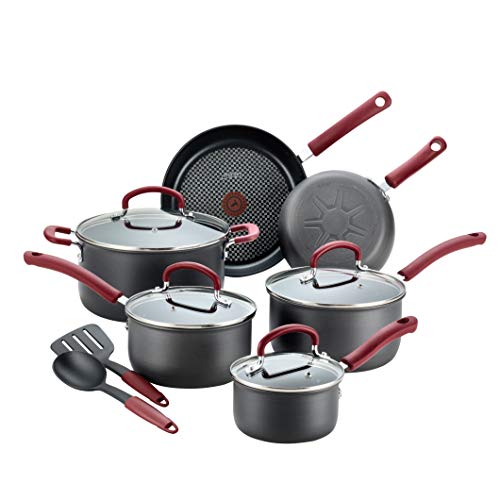
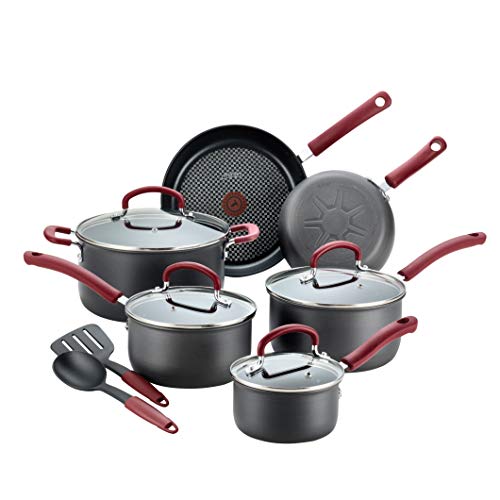
T-fal Ultimate Hard Anodized Nonstick Cookware Set — Best for Everyday Families
This is a hard-anodized aluminium line built around everyday release cooking, with a heat indicator in the fry pans that many home cooks find genuinely helpful while they are learning timing. It sits in the entry-to-mid tier of the market, which frames how to judge it: not against every set ever made, but against the expectations of its own class and the way you actually cook.
A set in this mould covers breakfast through batch cooking without demanding ceremony from anyone. In daily use, the questions that matter are the ordinary ones: do the skillets cover breakfast and weeknight proteins, do the saucepans match your grain and sauce habits, do the handles stay comfortable when a pan is full, and will the household’s real utensil and washing habits suit the coating? Judge this set by those answers, follow the maker’s own care guidance for the line, and check the current Amazon listing when you are ready to buy, since listings change often.
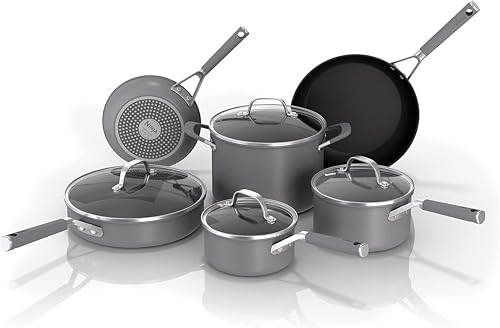
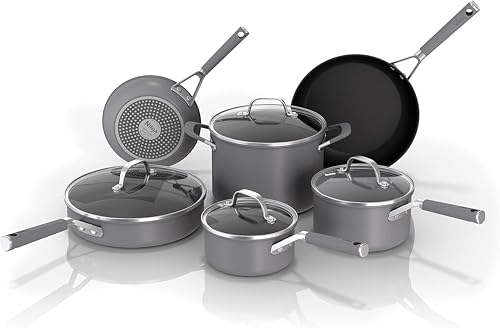
Ninja NeverStick Premium Hard-Anodized Nonstick Cookware Set — Best Premium Example
This is a premium-positioned hard-anodized line marketed around a textured, plasma-bonded style surface and a more sear-tolerant brief than classic delicate coatings. It sits in the premium tier of the market, which frames how to judge it: not against every set ever made, but against the expectations of its own class and the way you actually cook.
For cooks who want the most tolerant brief and the heaviest feel, this is the premium reference point. In daily use, the questions that matter are the ordinary ones: do the skillets cover breakfast and weeknight proteins, do the saucepans match your grain and sauce habits, do the handles stay comfortable when a pan is full, and will the household’s real utensil and washing habits suit the coating? Judge this set by those answers, follow the maker’s own care guidance for the line, and check the current Amazon listing when you are ready to buy, since listings change often.
Tramontina Nonstick Cookware Set — Best Entry Example
This is a value-minded line from a maker with deep cookware roots, typically chosen by cooks who want honest everyday performance and easy replacement economics if a single pan wears first. It sits in the entry tier of the market, which frames how to judge it: not against every set ever made, but against the expectations of its own class and the way you actually cook.
Honest, light and easy to renew, this tier is the right first set for new kitchens. In daily use, the questions that matter are the ordinary ones: do the skillets cover breakfast and weeknight proteins, do the saucepans match your grain and sauce habits, do the handles stay comfortable when a pan is full, and will the household’s real utensil and washing habits suit the coating? Judge this set by those answers, follow the maker’s own care guidance for the line, and check the current Amazon listing when you are ready to buy, since listings change often.

Cuisinart Chef’s Classic Nonstick Hard-Anodized Cookware Set — Best Classic Shapes Example
This is a classic hard-anodized line with tapered rims and a traditional saucepan-and-skillet balance that suits cooks who learned on conventional shapes and want to keep them. It sits in the mid tier of the market, which frames how to judge it: not against every set ever made, but against the expectations of its own class and the way you actually cook.
Traditional proportions and tapered rims suit cooks who learned on conventional pans and want to keep that feel. In daily use, the questions that matter are the ordinary ones: do the skillets cover breakfast and weeknight proteins, do the saucepans match your grain and sauce habits, do the handles stay comfortable when a pan is full, and will the household’s real utensil and washing habits suit the coating? Judge this set by those answers, follow the maker’s own care guidance for the line, and check the current Amazon listing when you are ready to buy, since listings change often.
Related reading from the same kitchen: how to choose a nonstick cookware set how to clean a nonstick cookware set is a nonstick cookware set worth it best nonstick cookware sets for beginners best non-stick cookware reviews best T-fal cookware sets
More Practical Notes for Nonstick Owners
Simmering is a skill a good set quietly teaches. A snug lid, a heavy-enough base and a burner turned lower than instinct suggests will hold a sauce at the lazy bubble that melds flavours without scorching the bottom or reducing too fast. Nonstick helps because the base of a simmering sauce is where catching starts, and a surface that releases lets you simmer grains, lentils and creamy sauces with occasional rather than constant stirring. Learn your own stove’s true low setting, since dials lie and every hob has a different temperament, and use the smallest burner that matches the pan for the gentlest jobs. The payoff is a whole register of cooking, braises, porridges, custards and pan sauces, that becomes calm and repeatable instead of anxious and scrape-heavy.
Tomato sauces, wine-based braises and citrusy pan sauces come up often in questions about nonstick, and the practical answer is reassuringly ordinary. Normal home cooking of acidic foods in a sound, undamaged nonstick pan is a routine part of how these sets are used, and simmering a tomato sauce is exactly the kind of lidded, liquid cooking that coatings handle comfortably. The habits that matter are the usual ones: do not store food in the pan overnight in the fridge, where any pan, nonstick or not, is the wrong container; transfer leftovers to a proper storage box; and avoid parking a pan of sauce at a fierce boil. If a coating is already worn, scratched through or flaking, retire the piece on performance grounds rather than cooking around its condition. Sound pan, ordinary cooking, no drama required.
A nonstick set is a classic gift for first homes, weddings and students, and choosing it well is an act of genuine thoughtfulness. The safest gift set is a mid-tier, hard-anodized one whose contents suit simple real meals, paired, if you want to be truly kind, with a wooden spoon and a silicone spatula so the recipient starts with the right habits from day one. Avoid assuming the recipient’s hob type: ask, or choose a set whose base suits the stove they actually have, especially if induction is involved. Include the maker’s care guidance in your card’s spirit if not its text, because the gift lasts years longer when the first month sets gentle habits. A set chosen that carefully says something generous: many easy meals ahead.
Before You Order: A Fit-and-Routine Worksheet for the Nonstick cookware set
Start this worksheet with the space, not the product page: measure the exact spot where the nonstick cookware set will live, including the clearance above it, the swing or reach you need in front of it, and the route you will take to move it for cleaning. Write down the largest item you realistically expect to use with it, because that single measurement settles more sizing arguments than any capacity figure printed in a listing headline. Check the nearest outlet and be honest about whether a cord will cross a walkway, a sink edge, or another appliance that also needs that socket on busy mornings. Count the people the nonstick cookware set must serve on an ordinary weekday, then count again for the busiest gathering you host in a typical year, and notice whether those two numbers point to the same size.
List the three jobs you will ask of it every week and the one job you will ask only a few times a year, because the weekly jobs should drive the decision and the rare job should not. Decide where the accessories, attachments, and spare parts will be stored before you order, since a nonstick cookware set whose extras live in a distant cupboard quietly becomes a nonstick cookware set with fewer features. Where a shortlist names specific examples, such as Calphalon Classic Nonstick Cookware Set, run these same checks against that listing line by line rather than assuming the general verdict transfers unchanged. Apply the identical test to T-fal Ultimate Hard Anodized Nonstick Cookware Set as well, on the same day and under the same conditions, because a fair comparison needs one ruler rather than two moods.
- Measure the working spot and the clearance around it
- Count weekday servings and the biggest gathering
- List the three weekly jobs in writing
- Decide storage for every accessory in advance
- Name the one compromise you accept knowingly
- Set the return deadline in your calendar
If Ninja NeverStick Premium Hard-Anodized Nonstick Cookware Set is also in contention, give it the same worksheet and let the three sets of answers sit side by side before anyone reaches for a checkout button. Think about who else in the household will use it, including anyone shorter, anyone with less grip strength, and anyone who will clean it without reading the manual first. Note the surfaces it will touch in normal use and whether heat, moisture, weight, or vibration from the nonstick cookware set could mark, stain, or stress those surfaces over months of daily contact. Plan the cleaning position as carefully as the working position, because a nonstick cookware set that is awkward to carry to the sink or to open fully will be cleaned less often than it should be.
Frequently Asked Questions
What is the best type of nonstick cookware set for most homes?
A hard-anodized aluminium set with a classic coating family is the default recommendation: even heating, moderate weight, forgiving release and sane replacement economics. Cooks with induction hobs should choose the same style with an explicitly magnetic base, and cooks wanting a different feel can consider ceramic-style coatings with open eyes about their different wear arc.
How do I compare two sets with different piece counts?
Ignore the headline numbers and list the core cooking pieces side by side: skillets, saucepans, stockpot and any deep lidded pan. Lids and utensils are padding in the count. The set whose core pieces match your meals better is the bigger set for you, whatever the box claims.
Do I need an induction-ready nonstick set?
Only if your hob is induction, in which case it is non-negotiable: the pans need magnetic bases. If you cook on gas, electric coil or a radiant glass top, standard hard-anodized bases work well. If a move or new hob is likely soon, induction-ready pans also work on other hobs, which makes them the flexible choice.
What size stockpot and skillet should a family set include?
Size both to your biggest regular meal, not your biggest imaginable one. The skillet should fit a full family portion of fillets or a whole frittata without crowding, and the stockpot should swallow a family pasta night or batch soup with headroom for safe lifting when full.
How much should I expect to spend on a good set?
Listings change constantly, so this guide prints no prices on purpose. Think in tiers instead: entry sets buy easy years cheaply, mid-tier sets buy noticeably better bodies and balance, premium lines buy tolerance and feel. Check the current listing for the set you choose, and judge it as cost per year of daily cooking.
What should I do on the first day with a new set?
Wash every piece in warm water with a soft sponge, dry it fully, and set up its storage with protection between stacked pans. Move soft utensils to the front of the drawer. Cook something forgiving first, eggs or pancakes, at gentle heat, and read the maker’s care guidance for your specific line before the week is out.
Related Guides
Related reading from the same kitchen: nonstick cookware set pros and cons nonstick cookware set review nonstick cookware set reviews best nonstick cookware sets for beginners best non-stick cookware reviews