Disclosure: As an Amazon Associate, topratedkitchenware.com earns from qualifying purchases. Links on this page are affiliate links; they cost you nothing extra. Prices and availability change often, so check the current Amazon listing before you buy.
A fair account of nonstick cookware set pros and cons has to resist two temptations: the sales pitch that sees only slippery eggs, and the purist dismissal that sees only a coating with a lifespan. The truth is a genuine trade, excellent daily cooking now in exchange for gentle handling and eventual renewal, and this guide prices both sides honestly.
We will take the pros one by one, then the cons with the same seriousness, then translate the balance into what it means for different households. A comparison with the main alternatives, a smart-buying chapter and a care chapter that shrinks the cons follow, so the bottom line, when it arrives, is one you can trust.
Key Takeaways
- The headline pro is repeatability: delicate food releases and clean-up takes minutes, every day.
- The headline con is finitude: the coating is a wear surface with a lifespan measured in years.
- Heat, utensil and storage discipline decide which side of the ledger dominates your experience.
- Nonstick complements rather than replaces heavy pans for high-heat searing work.
- For most weeknight households the pros win; for searing-led or permanence-first cooks, they may not.
In this guide
Nonstick Cookware Set Pros and Cons: The Pros in Full
Seven advantages recur in real kitchens, and each one compounds daily. Release for delicate foods, forgiving cooking for mixed-ability households, light clean-up, lighter pans, gentle reheating, saucy one-pan cooking and a short learning curve together explain the category’s staying power.
Eggs are the nonstick pan’s home turf and the quickest honest test of any set. A fried egg should release with a nudge, a folded omelette should roll rather than tear, and scrambled eggs should leave a pan that rinses almost clean. If you cook eggs several times a week, the small and mid-size skillets in a set will do more work than every other piece combined, so judge a set first by those pans: their slope, their balance when you tilt and swirl, and how the handle feels during the little wrist flick that moves an omelette. Egg cooking also teaches heat discipline painlessly, because eggs reward gentle, patient heat and punish a ripping-hot pan with rubbery whites. A set that makes your morning eggs calm and repeatable has already justified a large share of its cupboard space.
Delicate fish, dumplings, pancakes and quesadillas share one trait: they punish sticking and reward release. Skin-on fillets that would weld themselves to stainless steel lift cleanly from a healthy nonstick surface, potstickers crisp and then let go in one piece, and the first pancake of the batch behaves like the third. For cooks who make these foods often, nonstick is not a convenience but the difference between a recipe being weeknight-realistic and weekend-only. The technique notes are gentle ones: dry the surface of fish before it goes in, give dumplings their steam-and-crisp rhythm without forcing them early, and let pancakes set before the first turn. The pan does the releasing; your job is patience. Sets earn their keep in exactly these moments, which is why release performance, not searing drama, is the right headline metric for this category.
The real value of a nonstick set shows up in small, repeated moments rather than in any single impressive dinner. It is the Tuesday omelette that takes minutes and washes up in seconds. It is the sauce that does not leave a burnt ring to soak overnight. It is the new cook in the household succeeding at fish without a pep talk, and the experienced cook choosing the easy pan because the day has already been long. Multiply those moments across hundreds of meals and the set’s worth becomes obvious in a way a feature list cannot capture. This is also why the category suits households in transition: first flats, new babies, downsized kitchens and anyone rebuilding confidence at the stove all benefit from cookware that forgives small mistakes and cleans without a fight.
Nonstick has the shortest learning curve of any cookware family, which is a real part of its value. New cooks succeed early because the surface forgives timing errors that would mean stuck, torn food in other pans, and early success is what turns occasional cooks into regular ones. The skills it does ask for are few and learnable in a week: preheat gently, match burner to base, use soft tools, and resist the urge to solve every problem with more heat. Experienced cooks benefit differently, not from forgiveness but from delegation, because a nonstick skillet can be handed to any helper in the kitchen with confidence. If your household includes people still building cooking confidence, a forgiving set is not a compromise purchase; it is the purchase most likely to result in more home-cooked meals, which is the outcome that actually matters.
Pro in Focus: Clean-Up and Weeknight Calm
It is worth isolating the advantage owners mention most. A set that turns washing-up into a two-minute epilogue changes whether dinner gets cooked at all on hard days, and that behavioural effect dwarfs any single recipe triumph.
The weeknight test is the only review that ultimately counts. It is half past six, people are hungry, the recipe is half-remembered, and the cookware either lowers the temperature of the whole endeavour or raises it. A good nonstick set lowers it: the pan heats quickly and predictably, the protein releases when it should, the sauce does not catch while someone answers the door, and the washing-up is a two-minute epilogue rather than a second shift. Judge every set you consider against that scene rather than against a fantasy of weekend project cooking. If a set’s skillets are the right sizes, its saucepans cover grains and sauces, and its care demands fit inside a tired person’s routine, it will be loved. Features that only shine in elaborate cooking matter far less than grace under ordinary pressure.
A small evening routine keeps a nonstick set young. As you plate up, move the empty pan off the hot burner so residual heat does not keep baking the coating. After eating, when the pan has cooled, give it its warm wash with a soft sponge, dry it rather than leaving it to drain at an angle where water sits in it, and put it away with a protector if it stacks. Once in a while, check handles for the first hint of looseness and bases for the first hint of rocking, because both are easier to accept early than to discover mid-recipe. None of this takes more than a couple of minutes, and it is best understood not as fussiness but as the same care you would give a good knife: brief, habitual and repaid in performance every time you cook.
Reheating is unglamorous, constant and perfectly suited to nonstick. Last night’s rice revives with a splash of water under a lid instead of welding to the pan, a portion of curry warms without a scorched ring, and leftover pancakes or quesadillas crisp again in a dry skillet in a way a microwave cannot imitate. Small saucepans and mid-size skillets do most of this work, which is another reason those everyday sizes matter more than exotic extra pieces. Gentle heat is the whole technique: give leftovers a few patient minutes rather than blasting them, stir sauces once or twice, and let the coating make the clean-up trivial. Households that cook once and eat twice, which is most households, get a quiet daily dividend from a set that reheats this gracefully.
The Cons: The Honest Other Side
The disadvantages are equally concrete. The surface wears. Fierce heat ages it and limits searing ambitions. It asks for soft tools, kind washing and protected storage. And a set can pad its count with pieces you never use. None of these is hidden; all of them belong in the decision.
Set honest expectations about lifespan and you will be happier with whatever you buy. A nonstick coating is a working surface with a finite life, measured in years of good service rather than decades, and its decline is gradual: first a faint loss of slipperiness at the hottest spot, then eggs needing a touch more fat, then a pan that is merely easy-clean rather than truly nonstick. Daily use, high heat, metal tools and harsh washing shorten that arc; gentle heat, soft tools and kind washing stretch it. Many households treat the fry pans as the wear items and the saucepans as near-permanent, since lidded, liquid-based cooking is far gentler on coatings. Buying a set with that arc in mind, at a tier you can replace without resentment, is the grown-up economics of this category.
Honest guidance about nonstick has to include the searing conversation. A deep, hard crust on a thick steak or a skin-on chicken thigh is high-heat work, and high-heat work is where nonstick coatings age fastest and where heavier pans shine. Many owners keep one stainless or cast iron skillet for exactly those jobs and let the nonstick set handle the other ninety percent of cooking, and that mixed fleet is not a failure of the set but a sensible kitchen. Within the nonstick set itself, choose moderate browning jobs: salmon fillets, chicken pieces that finish gently, halloumi, mushrooms given room to release their moisture. If your cooking identity is built around aggressive searing several nights a week, weight that honestly in your decision, because no coating changes the physics of what it is made from.
Set piece counts are marketing arithmetic, and learning to decode them saves real disappointment. Lids are usually counted as pieces, utensils are sometimes counted as pieces, and a large set can still lack the one pan you reach for most. Read the contents list literally, item by item, and picture each piece in your week: the small fry pan for eggs, the larger skillet for family portions, the saucepans for grains and sauces, the stockpot for soup and pasta water, and whatever saute or Dutch-oven style piece anchors bigger meals. Then ask what is missing and what duplicates a pan you already love. A modest set whose every piece earns its cupboard space beats a sprawling set padded with lids and tools, because cupboard space, washing-up volume and daily friction are the real costs of pieces you never use.
Con in Focus: Lifespan and the Replacement Rhythm
The deepest con is philosophical as much as practical: this is cookware you renew. Owners at peace with that rhythm, the way knife owners accept sharpening, stay happy. Owners who wanted permanence feel the decline as a broken promise, which is why expectations belong in the buying decision.
Knowing when a pan is done prevents months of quietly worsening breakfasts. Retire a piece when the coating is visibly scratched through in patches, when the surface flakes or blisters, when food sticks stubbornly at the same spots despite gentle heat and enough fat, or when the base has warped enough to spin or rock on a flat top. A pan in that state is not dangerous in normal home use, but it has stopped doing the job it exists for, and persisting with it teaches bad habits, like cranking the heat to compensate, that then damage its replacement. Replace the single worn piece if the line sells open-stock pans, or accept the moment as the set’s natural renewal point. Either way, let performance, not sentiment or stubbornness, make the call.
Eventually every nonstick pan reaches the end of its working life, and handling that moment well is part of owning the category responsibly. Check whether your local recycling scheme or the maker offers cookware take-back or metal recycling routes, since rules vary widely by place and the pan’s mixed construction means it rarely belongs in ordinary household recycling without guidance. Before it goes, a worn pan can sometimes serve a short second life for messy utility jobs outside food cooking, but once the decision is made, replace it promptly rather than letting a dead surface linger and frustrate every breakfast. Planning for renewal, financially and practically, is simply part of the category’s rhythm, in the same way that resharpening is part of owning good knives and re-seasoning is part of owning cast iron.
Warranties in this category are best read as statements about manufacturing defects rather than promises about coating immortality. A warranty typically covers a pan that arrives flawed or fails because something was wrong in its making; it does not usually promise that a surface used daily will release eggs forever, because no honest maker can promise that about a wear surface. Read the terms once, keep your proof of purchase somewhere findable, and judge a brand more by the clarity of its care guidance and the availability of open-stock replacement pieces than by the boldness of its warranty headline. A line that happily sells you a single replacement skillet years later is, in practice, more valuable to most owners than a dramatic guarantee with narrow conditions.
What the Trade-Offs Mean for You
Translate the ledger into profiles. Families and new cooks gain the most and feel the cons least. Searing-led cooks feel the central con weekly. Small kitchens gain doubly from easy pieces but must be strict about counts. Batch cookers gain on clean-up and lose little, since their cooking is gentle by nature.
Family cooking changes the maths on size and duplication. A wide skillet that fits four fillets at once prevents batch cooking and the first batch going cold, a generous stockpot swallows pasta for everyone plus tomorrow’s lunch, and saucepans in two sizes mean rice and sauce can happen simultaneously without negotiation. Families also wash pans constantly, so easy release is not a luxury but a time budget, and lids that control splatter keep the hob cleaner between deep cleans. Consider, too, who else cooks: teenagers making eggs, a partner reheating leftovers, a grandparent helping at weekends. A forgiving set makes the kitchen more shareable. The wear will come faster in a busy household, which argues for a tier you can renew calmly and for teaching the house rules, soft tools and no empty-pan blasting, as shared kitchen manners.
For a first kitchen, a nonstick set solves several problems at once, which is why it is such a common starting point. It covers eggs, grains, sauces, reheating and gentle frying with one coordinated group of pans, it forgives the timing mistakes every new cook makes, and it keeps washing-up light while routines are still forming. The sensible first-flat approach is to choose a set whose contents match simple, real meals rather than aspirational ones, add one good wooden spoon and one silicone spatula, and cook with it for a few months before buying anything else. Gaps reveal themselves honestly through cooking: perhaps a bigger stockpot, perhaps a roasting tray, perhaps nothing at all. Starting with a forgiving set and learning your own habits is cheaper and calmer than trying to predict a lifetime of cooking in a single purchase.
Batch cooking and meal preparation put a set through a distinctive workload: large volumes, long simmers and a parade of reheats across the week. A generous stockpot and a deep, lidded skillet cover most of it, and nonstick’s easy release keeps the Sunday session’s clean-up from eating the afternoon. Coatings actually fare well in this pattern, because so much batch cooking is moist, lidded and moderate in heat, the gentlest regime a pan can work in. The watch-outs are volume-related: do not fill a stockpot so full that lifting it becomes unsafe, and let big batches cool before refrigerating them in proper containers rather than in the pan. For households that cook ahead, a set chosen for its two largest pieces, and judged kindly on its smallest, is usually the right way round.
Small kitchens make the strongest case for a well-chosen set and the weakest case for a sprawling one. When cupboard space is measured in centimetres, every piece must justify its footprint, lids must stack or hang sensibly, and pans that nest without grinding against each other’s surfaces are worth real preference. A compact set built around two skillets, two saucepans and one stockpot covers the overwhelming majority of home cooking, and the discipline of a small kitchen often produces better buying: fewer, better pieces, chosen against actual meals. Measure your cupboard and your hob before ordering, check the largest pan’s diameter against your biggest burner and your storage shelf, and be honest about whether a specialty piece will be used monthly or yearly. In a small kitchen, the best set is the one that disappears into daily life.
Context: Nonstick Against the Alternatives
Against stainless steel, nonstick wins release and forgiveness and loses searing and permanence. Against cast iron it wins weight and ease and loses high-heat authority. Against ceramic-style coatings it is a different wear story with a different feel. Most complete kitchens end up mixed, which reframes the question from which material wins to which jobs each takes.
Coating language on listings can sound like alphabet soup, so anchor on behaviour instead of branding. Traditional smooth coatings prioritise maximum slipperiness and are at their best with eggs, fish and other delicate work at gentle heat. Textured or reinforced coatings trade a whisper of that glassy release for better tolerance of everyday knocks and slightly bolder cooking. Ceramic-style coatings, which are a different technology despite sharing the nonstick label, tend to feel wonderfully slick when new and are often chosen by buyers who prefer their look and feel, though their release arc over time differs from classic coatings. None of these families is universally best; the right one is the one whose strengths match your most-cooked meals. Judge by your menu, keep heat habits gentle regardless of family, and let the maker’s own care guidance for that specific line settle any remaining questions.
A nonstick surface is a coating bonded to a metal pan body, and almost everything about how a set behaves follows from that pairing. The coating is what lets eggs slide, fish lift cleanly and sauces release without soaking, while the body underneath decides how evenly heat spreads and how the pan feels in the hand. When people say a set feels flimsy or reassuring, they are usually describing the body, not the coating. When they say food started sticking after a year or two, they are usually describing the coating and how it was treated. Keeping those two layers separate in your mind makes every buying decision in this guide easier, because you can judge the metal on weight, flatness and handle quality, and judge the coating on how realistically it matches the way you actually cook on a tired weeknight.
Hard-anodized aluminium is the body material behind most respected nonstick sets, and for good reason. The anodizing process hardens the surface of the aluminium, giving the pan a tougher, more corrosion-resistant shell than plain aluminium while keeping the metal’s best trait: fast, even heat response without the weight of cast iron or thick stainless steel. A hard-anodized pan warms predictably, cools quickly when you pull it off the heat, and rarely develops the stubborn hot ring that thin, cheap pans show over a burner. It is not indestructible, and the coating on top of it still decides the pan’s working life, but as a foundation it is the sensible default. If a set description leads with hard-anodized construction, that is a meaningful signal rather than decoration.
How to Buy Smart If the Pros Win for You
Buy the bodies as much as the coating: heavy, flat, well-handled pans in contents that match your meals, at a tier whose renewal you can shrug about. Verify hob compatibility, read the maker’s care guidance for the line, and plan the soft utensils in the same purchase.
A short pre-purchase checklist prevents most regrets in this category. Confirm hob compatibility first, including induction if it applies to you. Read the contents list piece by piece and match it to your actual week of cooking. Check the largest skillet against your biggest regular meal and your largest burner. Read the maker’s care and oven guidance for the specific line, not for nonstick in general. Decide your utensil situation honestly and budget a wooden spoon and silicone spatula into the plan if your drawer is full of metal. Think about storage: where each piece will live, and whether stacked pans will get protectors. Finally, sanity-check the set against what you already own, so you are buying coverage for gaps rather than duplicates of favourites. A set that passes those checks rarely disappoints.
Read listings like a sceptic and you will buy better. Lead claims describe the best piece in the best light, so scroll to the plain contents list, the base description and the care instructions, where the durable facts live. Note what the maker does not say: silence about induction usually means no magnetic base, and silence about oven use usually means limited oven ambitions. Treat included utensils and bonus items as padding until proven otherwise. Compare sets by their core cooking pieces, body construction and handle design rather than by headline counts. And remember that availability and pricing move constantly, so any number printed in a guide like this one would be stale on arrival; the current listing, checked at the moment you buy, is the only reliable source for what a set costs today.
Money logic in this category is about cost per year of good cooking, not about the number on the box. An entry-tier set that cooks beautifully for its working life and is replaced without pain can be better value than a premium set whose owner resents every scratch. Equally, a mid-tier set with heavier bodies may outlast two flimsy sets and feel better every single day it is used. Think about which pieces you will use daily, because value concentrates there, and be sceptical of paying for sprawling piece counts you will store rather than cook with. There is no static price advice worth printing here, because listings change constantly; the durable advice is to buy the heaviest, flattest, best-handled set within the tier you are comfortable replacing, and to check the current listing when you are ready.
Stovetop compatibility is the quiet deal-breaker in this category. Classic aluminium nonstick pans do not work on induction hobs unless they carry a bonded magnetic base, and many otherwise excellent sets are gas-and-electric only. Before anything else, match the set to your hob: hold a magnet to the base of any pan you already own if you are unsure how induction behaves, and read the set’s base description for explicit induction language rather than assuming. Glass and ceramic tops reward flat, smooth bases that will not scratch, while open gas grates reward stable, wide bases that do not tip when a spoon rests in the pan. A set that is perfect on paper and unusable on your stove is not a bargain at any tier, so this check comes first, before coatings, colours or piece counts.
Setup and Care That Reduce the Cons
Almost every con shrinks under the same short routine: gentle preheats, no empty-pan blasting, soft tools only, warm soft washing after cooling, full drying, protected storage, and one heavy pan kept for violent jobs. The cons do not vanish, but they retreat to the edges of ownership.
Heat discipline is the single biggest factor in how long a nonstick set stays nonstick. Coatings age fastest under sustained high heat, and they age especially fast when a pan sits empty over a strong burner, because an empty pan’s temperature climbs far faster than a loaded one. Build three habits and the set will repay you: add food or a little cooking fat as the pan warms rather than parking it empty, do most cooking in the low-to-medium band where nonstick genuinely excels, and let the burner size roughly match the pan base so flames or elements are not licking up the sides. None of this is fussy once it is habit. It is simply cooking the way the material asks to be cooked, and it separates owners whose sets last for years from owners shopping again next spring.
Utensil choice is the second half of coating care. Wooden spoons, silicone spatulas and nylon tools glide over the surface without gouging it, and they are pleasant to use in their own right: quiet, kind to pan edges and comfortable in saucy, scrape-the-corner cooking. Metal utensils are the classic coating killer, not always in one dramatic scratch but in hundreds of small abrasions that roughen the surface until eggs start catching at the same worn spots. Make the switch completely rather than mostly, because the one metal fish slice that stays in the drawer is the one that gets used in a hurry. Keep a small crock of wood and silicone tools beside the stove so the safe choice is also the nearest choice, and retire any tool with melted, sharp or fraying edges before it starts marking the pan.
Washing up decides more about coating life than most owners expect. The golden sequence is simple: let the pan cool on the stove until it is safe and comfortable to handle, then wash it in warm water with a soft sponge or cloth and ordinary washing-up liquid. Cooling first matters because plunging a hot pan under cold water stresses the bond between coating and body and can warp thinner bases over time. A soft sponge matters because scouring pads, however satisfying on a stuck saucepan, are abrasives working directly against the surface you are trying to preserve. Most nonstick messes release easily after a short soak, which is the coating doing its job. Dry pans fully before stacking, and your future self, cooking breakfast in a hurry, will find a surface that still behaves like it did when it was new.
Storage is the silent source of coating damage in tidy kitchens. Stacking nonstick pans directly on top of each other lets the base of one pan grind against the cooking surface of the one below every time the cupboard is opened, and the wear shows up as dull patches and sticking long before owners connect the cause. The fixes are cheap and simple: nest a soft cloth, a paper towel or a purpose-made pan protector between stacked pieces, hang pans from a rail if your kitchen allows it, or store the most-used skillet separately where it slides in and out without contact. Lids stored rim-down between pans can mark surfaces too. Treat the cooking surface the way you would treat a good knife edge, as the working part of the tool that deserves a small amount of deliberate protection.
Example Sets Read Through the Pros-and-Cons Lens
Read the example lines by the ledger. The balanced sets maximise pros per unit of care; the premium line softens the heat con; the entry line softens the replacement con by making renewal painless. Your own weighting of the ledger picks between them.
Saucepans are the under-sung half of any nonstick set, and they earn that status through liquid cooking. Rice that releases from the corners, porridge that does not weld to the base, custards and cheese sauces that wipe clean, reheated soups that do not catch: these are daily mercies. Lidded, moist cooking is also the gentlest environment a coating ever works in, which is why nonstick saucepans commonly outlast the fry pans from the same set by a wide margin. When comparing sets, weigh saucepan sizes against your real grain and sauce habits, check that lids fit snugly enough to hold a true simmer, and notice whether the smallest saucepan is genuinely small, because a tiny pan for melting, reheating a single portion or making a pan sauce is one of the most-used pieces in many kitchens.
One-pan dinners are where a good saute pan or deep skillet earns hero status. Browning aromatics, simmering a sauce, wilting greens and finishing pasta in the same vessel means fewer pans, a calmer hob and a washing-up bowl that stays manageable on a weeknight. Nonstick suits the saucy middle act of these meals especially well, because starches and cheese sauces release instead of crusting. The habits that make it work are sequencing and restraint: give ingredients room rather than piling the pan, let liquids come to a gentle simmer instead of a rolling boil against the coating, and finish with the lid when you want steam to do the work. A set that includes one genuinely deep, lidded skillet covers a whole family of these recipes, so check for that piece when you compare contents lists.
Vegetables reward nonstick in ways new owners do not always expect. Mushrooms given space and patience will brown as their moisture leaves, courgettes and aubergines soften without drinking pools of oil, and delicate greens wilt in the residual heat of the pan with barely a slick of fat. The coating also helps with the sticky end of vegetable cooking: caramelised onions that release instead of carbonising onto the base, glazes that coat the vegetables rather than the pan, and frittatas packed with roasted vegetables that turn out whole. Use enough heat to drive off moisture but stay in the pan’s comfortable band, avoid crowding, which steams instead of browning, and let pieces sit undisturbed long enough to colour. The result is vegetable cooking that feels lighter in every sense, including the washing-up afterwards.
Bottom Line
For a household whose cooking is weeknight-led, delicate-food-friendly and clean-up-averse, the pros are not close. For a household built on fierce heat and forever purchases, the cons are decisive. Everyone else should buy with the care routine in mind and enjoy the easiest cooking in the kitchen.
Some cooks should honestly skip a nonstick set, and saying so protects them from a mismatched purchase. If your cooking centres on high-heat searing, broiler finishing and stovetop-to-oven roasting several nights a week, stainless steel, cast iron or enamelled cast iron will serve you better as a primary fleet. If you strongly prefer buy-it-for-life durability and dislike the idea of any cooking surface being a wear item, a nonstick set will frustrate you on principle. If your kitchen already owns two excellent skillets and a full saucepan set, a boxed set duplicates rather than upgrades. And if nobody in the household will change utensil or washing habits, the coating will wear early and the purchase will disappoint through no fault of the pans. In each case the better buy is a smaller, targeted addition rather than a full set.
Glass and ceramic hobs reward a particular kind of care from nonstick owners. Bases should be smooth and clean before the pan goes down, because grit trapped between pan and glass can scratch the hob as the pan moves, and pans should be lifted rather than dragged for the same reason. Flat bases matter doubly here, since a rocking pan on glass is both inefficient and noisy, and the flat contact is what these hobs need for even heating. The good news is that hard-anodized sets generally suit glass tops well, being lighter than cast iron and smooth-based by design. Add the habit of wiping the base of a pan that has been stored on a dusty shelf, and your hob will stay unmarked while the pans cook evenly. Small courtesies between pan and stove repay both appliances.
Small design details separate sets that are pleasant daily from sets that are merely adequate. Tapered or rolled rims pour sauces and scrambled eggs without the dribble down the pan’s side that has to be wiped off the hob. Interior measurement marks in saucepans, when present, save a jug for small jobs. A helper handle opposite the main handle on the largest skillet and stockpot turns a two-handed lift into a controlled one. Hanging holes in handles matter if your storage is a rail. None of these details appears in headline claims, and none of them will rescue a thin, warping body, but between two well-built sets they are exactly the differences you will feel every day. When you compare finalists, spend your attention here, on the unglamorous geometry of daily use.
Example Sets Covered in This Guide
Each example below is presented prose-only, with a pick slot marker where a verified product link and image will be placed at publishing. Judge every one by contents, construction and fit for your kitchen, and check the current Amazon listing when you are ready to buy.
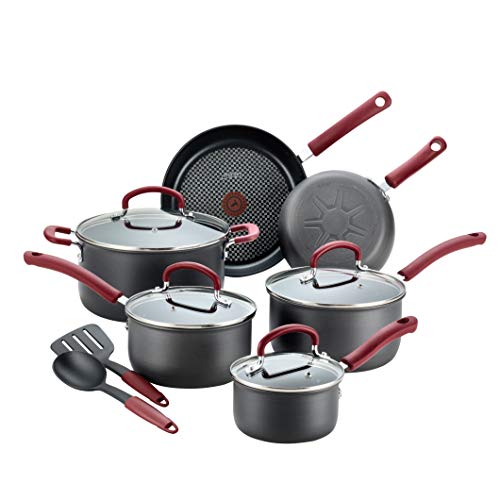
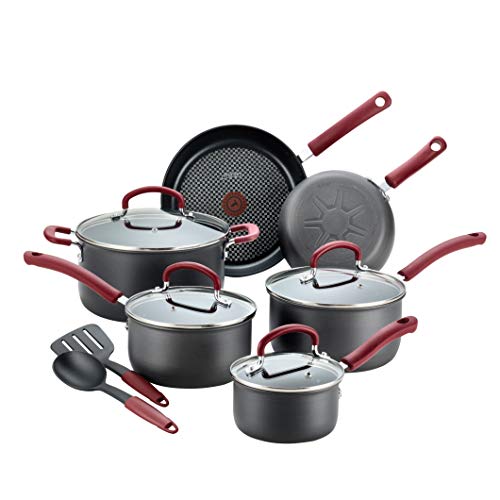
T-fal Ultimate Hard Anodized Nonstick Cookware Set — Balanced Ledger Example
This is a hard-anodized aluminium line built around everyday release cooking, with a heat indicator in the fry pans that many home cooks find genuinely helpful while they are learning timing. It sits in the entry-to-mid tier of the market, which frames how to judge it: not against every set ever made, but against the expectations of its own class and the way you actually cook.
This line’s everyday manners show the pros at their most routine, which is where they matter. In daily use, the questions that matter are the ordinary ones: do the skillets cover breakfast and weeknight proteins, do the saucepans match your grain and sauce habits, do the handles stay comfortable when a pan is full, and will the household’s real utensil and washing habits suit the coating? Judge this set by those answers, follow the maker’s own care guidance for the line, and check the current Amazon listing when you are ready to buy, since listings change often.
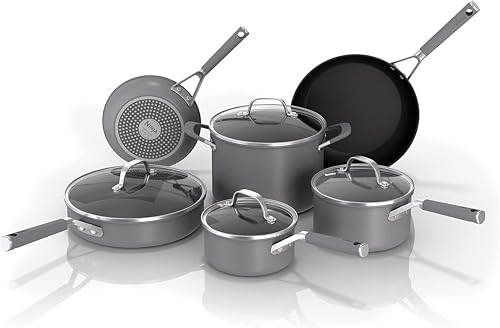
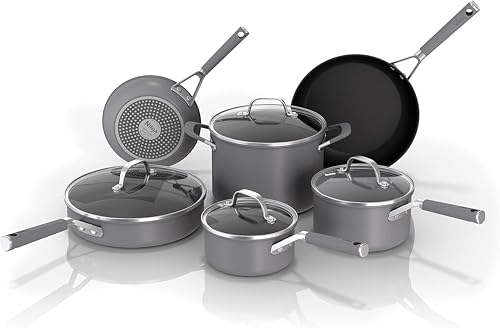
Ninja NeverStick Premium Hard-Anodized Nonstick Cookware Set — Cons-Softening Premium Example
This is a premium-positioned hard-anodized line marketed around a textured, plasma-bonded style surface and a more sear-tolerant brief than classic delicate coatings. It sits in the premium tier of the market, which frames how to judge it: not against every set ever made, but against the expectations of its own class and the way you actually cook.
A more tolerant brief narrows the heat limitation that heads the cons list. In daily use, the questions that matter are the ordinary ones: do the skillets cover breakfast and weeknight proteins, do the saucepans match your grain and sauce habits, do the handles stay comfortable when a pan is full, and will the household’s real utensil and washing habits suit the coating? Judge this set by those answers, follow the maker’s own care guidance for the line, and check the current Amazon listing when you are ready to buy, since listings change often.
Tramontina Nonstick Cookware Set — Renewal-Friendly Entry Example
This is a value-minded line from a maker with deep cookware roots, typically chosen by cooks who want honest everyday performance and easy replacement economics if a single pan wears first. It sits in the entry tier of the market, which frames how to judge it: not against every set ever made, but against the expectations of its own class and the way you actually cook.
Painless replacement economics turn the lifespan con into a shrug for first kitchens. In daily use, the questions that matter are the ordinary ones: do the skillets cover breakfast and weeknight proteins, do the saucepans match your grain and sauce habits, do the handles stay comfortable when a pan is full, and will the household’s real utensil and washing habits suit the coating? Judge this set by those answers, follow the maker’s own care guidance for the line, and check the current Amazon listing when you are ready to buy, since listings change often.

Calphalon Classic Nonstick Cookware Set — Family Ledger Example
This is a hard-anodized line with a measured, kitchen-neutral feel, dual-layer style release surfaces and a shape language that suits cooks who want one calm, coordinated set rather than a statement piece. It sits in the mid tier of the market, which frames how to judge it: not against every set ever made, but against the expectations of its own class and the way you actually cook.
For households washing pans constantly, this tier’s balance of pros is hard to argue with. In daily use, the questions that matter are the ordinary ones: do the skillets cover breakfast and weeknight proteins, do the saucepans match your grain and sauce habits, do the handles stay comfortable when a pan is full, and will the household’s real utensil and washing habits suit the coating? Judge this set by those answers, follow the maker’s own care guidance for the line, and check the current Amazon listing when you are ready to buy, since listings change often.
Related reading from the same kitchen: how to choose a nonstick cookware set how to clean a nonstick cookware set is a nonstick cookware set worth it best nonstick cookware sets for beginners best non-stick cookware reviews best T-fal cookware sets
Beyond the Ledger: Seven Days of Living With the Nonstick cookware set
Treat this diary as the practical sequel to the ledger above: for one ordinary week, note each time the nonstick cookware set delights you and each time it irritates you, in the moment rather than from memory at the end. Record the jobs where the advantages felt largest, because a strength that only appears on tasks you rarely do is worth less than the summary tables suggest. Record the irritations with equal honesty, and mark whether each one came from the product itself, from your space, or from a habit you could change once and forget. Pay attention to the setup and put-away minutes, since trade-offs that look trivial on paper become the deciding factor when they repeat twice a day for years.
Note who else used the nonstick cookware set during the week and what they struggled with, because a drawback that only affects the most patient person in the house is easy to underestimate. Watch for the workaround you invent by day three, and judge it fairly: a painless workaround retires a con, while a fiddly one confirms it. Where a shortlist names specific examples, such as T-fal Ultimate Hard Anodized Nonstick Cookware Set, run these same checks against that listing line by line rather than assuming the general verdict transfers unchanged. Apply the identical test to Ninja NeverStick Premium Hard-Anodized Nonstick Cookware Set as well, on the same day and under the same conditions, because a fair comparison needs one ruler rather than two moods.
- Log delights and irritations as they happen
- Time the setup and the put-away honestly
- Test the worst job, not the easiest one
- Note the workaround you invent by day three
- Ask a second user for their verdict
- Write the sentence you would tell a friend
If Tramontina Nonstick Cookware Set is also in contention, give it the same worksheet and let the three sets of answers sit side by side before anyone reaches for a checkout button. Test the loudest, messiest, or slowest mode at the time of day you would actually use it, not at a forgiving hour chosen to make the product look good. Check the cleaning burden after the worst realistic job rather than the easiest one, since the honest version of that chore is the one you will live with. Notice whether the headline strength survives ordinary ingredients, ordinary timing, and an ordinary tired evening, because strengths that need perfect conditions are narrower than they appear.
Write down any benefit you had not expected, since unlisted advantages discovered in use are often the ones that keep a product in the house for a decade. Write down any drawback that no review mentioned, and consider whether it is specific to your space, your water, your power supply, or your household size. Compare the week against the tool or appliance the nonstick cookware set replaced, task by task, instead of against an idealised version of what ownership would feel like. Ask whether the cons cluster at the start of each session, in the middle of the work, or in the cleanup, because that pattern tells you whether habit can fix them.
Frequently Asked Questions
What is the biggest advantage of a nonstick cookware set?
Repeatable ease. Delicate foods release, sauces do not catch, reheating behaves and clean-up takes minutes, and those small wins repeat across hundreds of meals. Owners consistently say the set changes how often they cook at home, which is a larger benefit than any single dish it makes possible.
What is the biggest disadvantage of a nonstick cookware set?
The coating is a wear surface. It will decline over years of use, faster under high heat, metal utensils and harsh washing, and the pans will eventually need renewal. If that rhythm is unacceptable, stainless steel or cast iron, maintained differently, will suit you better as a primary fleet.
Can a nonstick set replace all my other pans?
For many households it covers the great majority of cooking, but most owners keep one heavy stainless or cast iron pan for aggressive searing and oven-heavy work. That division protects the coating and gives every job its best tool. Treat the set as the daily fleet, not necessarily the entire navy.
Do the pros still win for experienced cooks?
Often, yes, for a different reason: delegation and speed. Experienced cooks hand nonstick pans to helpers confidently, reheat precisely and save their heavy pans for the work only those pans can do. The learning-curve pro matters less; the clean-up and release pros matter just as much.
How can I make the cons smaller?
Keep heat gentle, never park an empty pan over a strong burner, use wood or silicone tools, let pans cool before a warm soft wash, dry fully and store with protectors between pieces. Those habits stretch the coating’s good years and are the entire practical answer to the lifespan con.
Are nonstick sets a good choice for a first kitchen?
They are the classic first-kitchen choice for good reason: forgiving, coordinated and light on washing-up while routines form. Choose contents for simple real meals, add soft utensils from day one, and expect to learn your gaps by cooking. The pros are at their strongest exactly there.
Related Guides
Related reading from the same kitchen: nonstick cookware set buying guide nonstick cookware set review nonstick cookware set reviews best nonstick cookware sets for beginners best non-stick cookware reviews