Disclosure: As an Amazon Associate, topratedkitchenware.com earns from qualifying purchases. Links on this page are affiliate links; they cost you nothing extra. Prices and availability change often, so check the current Amazon listing before you buy.
This nonstick cookware set review takes the category itself as the product under the microscope: what a modern hard-anodized nonstick set promises, where it delivers in real daily use, and where it honestly falls short. If you want one clear-eyed verdict before you compare individual lines, start here, because a nonstick cookware set review should judge the idea as rigorously as any single box.
We will move from design and build through performance across the foods that matter, eggs, fish, sauces, grains and reheats, into strengths and trade-offs, comparisons with rival materials, and the care essentials that decide how long the verdict stays favourable. Example lines appear throughout as reference points, presented prose-only, so the focus stays on behaviour rather than links.
Key Takeaways
- Verdict: an excellent daily fleet for release cooking, clean-up and mixed-ability households.
- Build quality lives in the bodies: hard-anodized, flat, substantial pans are the ones that satisfy.
- Performance peaks with eggs, fish, sauces and reheats; aggressive searing belongs to other pans.
- The coating is a wear surface, so the review’s praise comes with a lifespan asterisk.
- Best for weeknight-led homes; skip as a primary fleet if your cooking is high-heat led.
In this guide
Nonstick Cookware Set Review: What a Set Is and Where It Fits
A set is a coordinated group of coated pans covering frying, saucing, simmering and reheating, positioned as the forgiving daily fleet of a kitchen. It does not try to be the searing station or the lifetime heirloom, and reviewing it fairly means judging it on its own brief.
A nonstick surface is a coating bonded to a metal pan body, and almost everything about how a set behaves follows from that pairing. The coating is what lets eggs slide, fish lift cleanly and sauces release without soaking, while the body underneath decides how evenly heat spreads and how the pan feels in the hand. When people say a set feels flimsy or reassuring, they are usually describing the body, not the coating. When they say food started sticking after a year or two, they are usually describing the coating and how it was treated. Keeping those two layers separate in your mind makes every buying decision in this guide easier, because you can judge the metal on weight, flatness and handle quality, and judge the coating on how realistically it matches the way you actually cook on a tired weeknight.
The real value of a nonstick set shows up in small, repeated moments rather than in any single impressive dinner. It is the Tuesday omelette that takes minutes and washes up in seconds. It is the sauce that does not leave a burnt ring to soak overnight. It is the new cook in the household succeeding at fish without a pep talk, and the experienced cook choosing the easy pan because the day has already been long. Multiply those moments across hundreds of meals and the set’s worth becomes obvious in a way a feature list cannot capture. This is also why the category suits households in transition: first flats, new babies, downsized kitchens and anyone rebuilding confidence at the stove all benefit from cookware that forgives small mistakes and cleans without a fight.
Nonstick has the shortest learning curve of any cookware family, which is a real part of its value. New cooks succeed early because the surface forgives timing errors that would mean stuck, torn food in other pans, and early success is what turns occasional cooks into regular ones. The skills it does ask for are few and learnable in a week: preheat gently, match burner to base, use soft tools, and resist the urge to solve every problem with more heat. Experienced cooks benefit differently, not from forgiveness but from delegation, because a nonstick skillet can be handed to any helper in the kitchen with confidence. If your household includes people still building cooking confidence, a forgiving set is not a compromise purchase; it is the purchase most likely to result in more home-cooked meals, which is the outcome that actually matters.
Design, Build and Setup
The best sets share a build signature: hard-anodized bodies with real substance, flat bases, balanced handles, lids that fit across pieces and rims that pour cleanly. Setup is a wash, a utensil audit and a storage plan; five minutes that predict years of behaviour.
Hard-anodized aluminium is the body material behind most respected nonstick sets, and for good reason. The anodizing process hardens the surface of the aluminium, giving the pan a tougher, more corrosion-resistant shell than plain aluminium while keeping the metal’s best trait: fast, even heat response without the weight of cast iron or thick stainless steel. A hard-anodized pan warms predictably, cools quickly when you pull it off the heat, and rarely develops the stubborn hot ring that thin, cheap pans show over a burner. It is not indestructible, and the coating on top of it still decides the pan’s working life, but as a foundation it is the sensible default. If a set description leads with hard-anodized construction, that is a meaningful signal rather than decoration.
Two pans with the same coating can behave very differently because of how the body was formed. Thicker, forged or heavy-gauge bodies resist warping, sit flat on glass and induction-style flat tops, and hold a steadier temperature when cold food lands in them. Thin, spun bodies are lighter and cheaper, but they are the ones that rock on the hob, develop a domed centre that pools oil at the edges, and lose their flat base after repeated thermal shock. You cannot always see gauge in a product photo, so judge by heft in hand where possible, by the flatness of the base, and by whether the maker describes the body plainly. A set that will be used daily deserves bodies that stay flat, because a warped nonstick pan cooks unevenly and wears its coating unevenly too.
Handles are where a set proves itself every single day. A good handle stays comfortable when the pan is full, balances the load so your wrist is not fighting the pan, and attaches with a joint that does not loosen into a wobble after months of use. Riveted attachments feel reassuringly permanent but leave small interior bumps that need a wipe; welded or coated-over attachments clean more easily. Silicone-wrapped handles grip well and feel kind straight from the stove, while bare metal handles suit cooks who move pans in and out of the oven and prefer to use a mitt as a matter of habit. Test the mental picture: lifting a full saucepan of pasta water one-handed to drain it. If the handle shape in the photo looks like it would twist or bite, believe that instinct and look elsewhere.
Small design details separate sets that are pleasant daily from sets that are merely adequate. Tapered or rolled rims pour sauces and scrambled eggs without the dribble down the pan’s side that has to be wiped off the hob. Interior measurement marks in saucepans, when present, save a jug for small jobs. A helper handle opposite the main handle on the largest skillet and stockpot turns a two-handed lift into a controlled one. Hanging holes in handles matter if your storage is a rail. None of these details appears in headline claims, and none of them will rescue a thin, warping body, but between two well-built sets they are exactly the differences you will feel every day. When you compare finalists, spend your attention here, on the unglamorous geometry of daily use.
Performance in Real Use: Breakfast and Delicate Work
Breakfast is the home fixture: eggs in every form, pancakes and reheats, all handled with a calm that other materials cannot match at this effort level. Delicate fish and dumplings confirm the same story at dinner, release doing the work that technique does in fussier pans.
Eggs are the nonstick pan’s home turf and the quickest honest test of any set. A fried egg should release with a nudge, a folded omelette should roll rather than tear, and scrambled eggs should leave a pan that rinses almost clean. If you cook eggs several times a week, the small and mid-size skillets in a set will do more work than every other piece combined, so judge a set first by those pans: their slope, their balance when you tilt and swirl, and how the handle feels during the little wrist flick that moves an omelette. Egg cooking also teaches heat discipline painlessly, because eggs reward gentle, patient heat and punish a ripping-hot pan with rubbery whites. A set that makes your morning eggs calm and repeatable has already justified a large share of its cupboard space.
Delicate fish, dumplings, pancakes and quesadillas share one trait: they punish sticking and reward release. Skin-on fillets that would weld themselves to stainless steel lift cleanly from a healthy nonstick surface, potstickers crisp and then let go in one piece, and the first pancake of the batch behaves like the third. For cooks who make these foods often, nonstick is not a convenience but the difference between a recipe being weeknight-realistic and weekend-only. The technique notes are gentle ones: dry the surface of fish before it goes in, give dumplings their steam-and-crisp rhythm without forcing them early, and let pancakes set before the first turn. The pan does the releasing; your job is patience. Sets earn their keep in exactly these moments, which is why release performance, not searing drama, is the right headline metric for this category.
Breakfast is the meal that sells nonstick sets and the meal that wears them out, so it deserves its own honest paragraph. Eggs in their many forms, pancakes, French toast, hash browns, breakfast potatoes and reheated anything all pass through the same one or two skillets, often cooked by the household’s least patient cook at the day’s least patient hour. That reality argues for two things: choosing a set whose small and mid-size skillets are genuinely good, since they will carry the heaviest load, and establishing the gentle habits, warm rather than blast the pan, reach for the silicone spatula, wash and protect, as household routine rather than one person’s fussiness. When those habits hold, the breakfast pans stay slick for years, and the most repeated meal of the day stays the easiest one.
Performance in Real Use: Sauces, Grains and One-Pan Dinners
The saucepan half of the set is the quiet star. Rice, porridge, cheese sauces and custards release and rinse; one-pan dinners simmer without catching; the stockpot turns batch day clean-up from a soak into a rinse. This is where long-term owners say the set truly earns its place.
Saucepans are the under-sung half of any nonstick set, and they earn that status through liquid cooking. Rice that releases from the corners, porridge that does not weld to the base, custards and cheese sauces that wipe clean, reheated soups that do not catch: these are daily mercies. Lidded, moist cooking is also the gentlest environment a coating ever works in, which is why nonstick saucepans commonly outlast the fry pans from the same set by a wide margin. When comparing sets, weigh saucepan sizes against your real grain and sauce habits, check that lids fit snugly enough to hold a true simmer, and notice whether the smallest saucepan is genuinely small, because a tiny pan for melting, reheating a single portion or making a pan sauce is one of the most-used pieces in many kitchens.
One-pan dinners are where a good saute pan or deep skillet earns hero status. Browning aromatics, simmering a sauce, wilting greens and finishing pasta in the same vessel means fewer pans, a calmer hob and a washing-up bowl that stays manageable on a weeknight. Nonstick suits the saucy middle act of these meals especially well, because starches and cheese sauces release instead of crusting. The habits that make it work are sequencing and restraint: give ingredients room rather than piling the pan, let liquids come to a gentle simmer instead of a rolling boil against the coating, and finish with the lid when you want steam to do the work. A set that includes one genuinely deep, lidded skillet covers a whole family of these recipes, so check for that piece when you compare contents lists.
The stockpot in a nonstick set lives a double life. On cooking days it boils pasta, simmers soup and blanches vegetables in generous water, jobs where the coating is a pleasant bonus rather than the point. On clean-up day it reveals its real value, because porridge-thick soups, bean chilis and cheese-topped pasta bakes rinse out of a nonstick stockpot with a fraction of the soaking a bare metal pot demands. Size it to your household’s biggest regular job, a family pasta night or a batch-cooking Sunday, rather than to a fantasy feast, and check that its handles feel secure when you imagine it full of water, because a full stockpot is the heaviest lift in the set. A lid that also fits the wide skillet is a quiet bonus worth noticing when you compare contents.
Simmering is a skill a good set quietly teaches. A snug lid, a heavy-enough base and a burner turned lower than instinct suggests will hold a sauce at the lazy bubble that melds flavours without scorching the bottom or reducing too fast. Nonstick helps because the base of a simmering sauce is where catching starts, and a surface that releases lets you simmer grains, lentils and creamy sauces with occasional rather than constant stirring. Learn your own stove’s true low setting, since dials lie and every hob has a different temperament, and use the smallest burner that matches the pan for the gentlest jobs. The payoff is a whole register of cooking, braises, porridges, custards and pan sauces, that becomes calm and repeatable instead of anxious and scrape-heavy.
Performance in Real Use: Vegetables, Reheats and the Edges of the Brief
Vegetables brown kindly when given room, leftovers revive under a lid, and the brief’s edges appear exactly where expected: sustained fierce searing and oven-led roasting, which belong to heavier pans. Within its brief, performance is not merely adequate; it is the easiest in the kitchen.
Vegetables reward nonstick in ways new owners do not always expect. Mushrooms given space and patience will brown as their moisture leaves, courgettes and aubergines soften without drinking pools of oil, and delicate greens wilt in the residual heat of the pan with barely a slick of fat. The coating also helps with the sticky end of vegetable cooking: caramelised onions that release instead of carbonising onto the base, glazes that coat the vegetables rather than the pan, and frittatas packed with roasted vegetables that turn out whole. Use enough heat to drive off moisture but stay in the pan’s comfortable band, avoid crowding, which steams instead of browning, and let pieces sit undisturbed long enough to colour. The result is vegetable cooking that feels lighter in every sense, including the washing-up afterwards.
Reheating is unglamorous, constant and perfectly suited to nonstick. Last night’s rice revives with a splash of water under a lid instead of welding to the pan, a portion of curry warms without a scorched ring, and leftover pancakes or quesadillas crisp again in a dry skillet in a way a microwave cannot imitate. Small saucepans and mid-size skillets do most of this work, which is another reason those everyday sizes matter more than exotic extra pieces. Gentle heat is the whole technique: give leftovers a few patient minutes rather than blasting them, stir sauces once or twice, and let the coating make the clean-up trivial. Households that cook once and eat twice, which is most households, get a quiet daily dividend from a set that reheats this gracefully.
Honest guidance about nonstick has to include the searing conversation. A deep, hard crust on a thick steak or a skin-on chicken thigh is high-heat work, and high-heat work is where nonstick coatings age fastest and where heavier pans shine. Many owners keep one stainless or cast iron skillet for exactly those jobs and let the nonstick set handle the other ninety percent of cooking, and that mixed fleet is not a failure of the set but a sensible kitchen. Within the nonstick set itself, choose moderate browning jobs: salmon fillets, chicken pieces that finish gently, halloumi, mushrooms given room to release their moisture. If your cooking identity is built around aggressive searing several nights a week, weight that honestly in your decision, because no coating changes the physics of what it is made from.
Strengths and Trade-Offs
Strengths: release for delicate food, forgiving cooking for every ability level, fast clean-up, light handling, gentle reheating and a short learning curve. Trade-offs: a finite coating life, heat discipline required, soft utensils required, and searing limits that a mixed fleet solves better than denial does.
The weeknight test is the only review that ultimately counts. It is half past six, people are hungry, the recipe is half-remembered, and the cookware either lowers the temperature of the whole endeavour or raises it. A good nonstick set lowers it: the pan heats quickly and predictably, the protein releases when it should, the sauce does not catch while someone answers the door, and the washing-up is a two-minute epilogue rather than a second shift. Judge every set you consider against that scene rather than against a fantasy of weekend project cooking. If a set’s skillets are the right sizes, its saucepans cover grains and sauces, and its care demands fit inside a tired person’s routine, it will be loved. Features that only shine in elaborate cooking matter far less than grace under ordinary pressure.
Weight is a Goldilocks variable in nonstick cookware. Very light pans heat fast and suit cooks who toss food or have wrist and grip considerations, but they can feel skittish on the hob and are likelier to warp or scorch at a hot spot. Heavy pans feel planted and cook evenly, yet a full large saucepan still has to be lifted to the sink by a real person at the end of a long day. The sweet spot for most households is a body with noticeable substance that you can still manoeuvre one-handed when it is loaded with food. Balance matters as much as raw weight: a pan whose handle counterweights its body feels lighter than it is, while a nose-heavy skillet tires the wrist during the constant small tilts that saucing and omelette work involve.
How It Compares With Rival Materials
Against stainless steel, the set wins daily ease and loses drama and permanence. Against cast iron it wins weight and loses high-heat authority. Against ceramic-style coatings it offers the classic release feel with a different, generally longer wear story. The comparison that matters is by job, not by loyalty.
Coating language on listings can sound like alphabet soup, so anchor on behaviour instead of branding. Traditional smooth coatings prioritise maximum slipperiness and are at their best with eggs, fish and other delicate work at gentle heat. Textured or reinforced coatings trade a whisper of that glassy release for better tolerance of everyday knocks and slightly bolder cooking. Ceramic-style coatings, which are a different technology despite sharing the nonstick label, tend to feel wonderfully slick when new and are often chosen by buyers who prefer their look and feel, though their release arc over time differs from classic coatings. None of these families is universally best; the right one is the one whose strengths match your most-cooked meals. Judge by your menu, keep heat habits gentle regardless of family, and let the maker’s own care guidance for that specific line settle any remaining questions.
Stovetop compatibility is the quiet deal-breaker in this category. Classic aluminium nonstick pans do not work on induction hobs unless they carry a bonded magnetic base, and many otherwise excellent sets are gas-and-electric only. Before anything else, match the set to your hob: hold a magnet to the base of any pan you already own if you are unsure how induction behaves, and read the set’s base description for explicit induction language rather than assuming. Glass and ceramic tops reward flat, smooth bases that will not scratch, while open gas grates reward stable, wide bases that do not tip when a spoon rests in the pan. A set that is perfect on paper and unusable on your stove is not a bargain at any tier, so this check comes first, before coatings, colours or piece counts.
Glass and ceramic hobs reward a particular kind of care from nonstick owners. Bases should be smooth and clean before the pan goes down, because grit trapped between pan and glass can scratch the hob as the pan moves, and pans should be lifted rather than dragged for the same reason. Flat bases matter doubly here, since a rocking pan on glass is both inefficient and noisy, and the flat contact is what these hobs need for even heating. The good news is that hard-anodized sets generally suit glass tops well, being lighter than cast iron and smooth-based by design. Add the habit of wiping the base of a pan that has been stored on a dusty shelf, and your hob will stay unmarked while the pans cook evenly. Small courtesies between pan and stove repay both appliances.
Who Should Buy It and Who Should Skip It
Buy if your week is weeknight-led, your household cooks at mixed ability, and clean-up decides whether dinner happens. Skip as a primary fleet if your identity is searing, broiling and oven finishing, or if renewal offends you on principle; buy a single skillet instead.
Some cooks should honestly skip a nonstick set, and saying so protects them from a mismatched purchase. If your cooking centres on high-heat searing, broiler finishing and stovetop-to-oven roasting several nights a week, stainless steel, cast iron or enamelled cast iron will serve you better as a primary fleet. If you strongly prefer buy-it-for-life durability and dislike the idea of any cooking surface being a wear item, a nonstick set will frustrate you on principle. If your kitchen already owns two excellent skillets and a full saucepan set, a boxed set duplicates rather than upgrades. And if nobody in the household will change utensil or washing habits, the coating will wear early and the purchase will disappoint through no fault of the pans. In each case the better buy is a smaller, targeted addition rather than a full set.
Family cooking changes the maths on size and duplication. A wide skillet that fits four fillets at once prevents batch cooking and the first batch going cold, a generous stockpot swallows pasta for everyone plus tomorrow’s lunch, and saucepans in two sizes mean rice and sauce can happen simultaneously without negotiation. Families also wash pans constantly, so easy release is not a luxury but a time budget, and lids that control splatter keep the hob cleaner between deep cleans. Consider, too, who else cooks: teenagers making eggs, a partner reheating leftovers, a grandparent helping at weekends. A forgiving set makes the kitchen more shareable. The wear will come faster in a busy household, which argues for a tier you can renew calmly and for teaching the house rules, soft tools and no empty-pan blasting, as shared kitchen manners.
For a first kitchen, a nonstick set solves several problems at once, which is why it is such a common starting point. It covers eggs, grains, sauces, reheating and gentle frying with one coordinated group of pans, it forgives the timing mistakes every new cook makes, and it keeps washing-up light while routines are still forming. The sensible first-flat approach is to choose a set whose contents match simple, real meals rather than aspirational ones, add one good wooden spoon and one silicone spatula, and cook with it for a few months before buying anything else. Gaps reveal themselves honestly through cooking: perhaps a bigger stockpot, perhaps a roasting tray, perhaps nothing at all. Starting with a forgiving set and learning your own habits is cheaper and calmer than trying to predict a lifetime of cooking in a single purchase.
Example Lines as Reference Points
The reference lines map the market’s shape: a balanced all-rounder, a calm mid-tier family set, a premium line with a more tolerant brief, and an entry line whose honesty is its charm. Compare any candidate against these four shapes and its tier will identify itself.
Read listings like a sceptic and you will buy better. Lead claims describe the best piece in the best light, so scroll to the plain contents list, the base description and the care instructions, where the durable facts live. Note what the maker does not say: silence about induction usually means no magnetic base, and silence about oven use usually means limited oven ambitions. Treat included utensils and bonus items as padding until proven otherwise. Compare sets by their core cooking pieces, body construction and handle design rather than by headline counts. And remember that availability and pricing move constantly, so any number printed in a guide like this one would be stale on arrival; the current listing, checked at the moment you buy, is the only reliable source for what a set costs today.
Money logic in this category is about cost per year of good cooking, not about the number on the box. An entry-tier set that cooks beautifully for its working life and is replaced without pain can be better value than a premium set whose owner resents every scratch. Equally, a mid-tier set with heavier bodies may outlast two flimsy sets and feel better every single day it is used. Think about which pieces you will use daily, because value concentrates there, and be sceptical of paying for sprawling piece counts you will store rather than cook with. There is no static price advice worth printing here, because listings change constantly; the durable advice is to buy the heaviest, flattest, best-handled set within the tier you are comfortable replacing, and to check the current listing when you are ready.
Setup, Care and Maintenance Essentials
The care verdict is short enough to memorise: gentle heat, no empty-pan blasting, wood and silicone tools, cool before a warm soft wash, dry fully, store protected. Follow it and the performance chapters above stay true for years; ignore it and no set at any tier will save you.
Heat discipline is the single biggest factor in how long a nonstick set stays nonstick. Coatings age fastest under sustained high heat, and they age especially fast when a pan sits empty over a strong burner, because an empty pan’s temperature climbs far faster than a loaded one. Build three habits and the set will repay you: add food or a little cooking fat as the pan warms rather than parking it empty, do most cooking in the low-to-medium band where nonstick genuinely excels, and let the burner size roughly match the pan base so flames or elements are not licking up the sides. None of this is fussy once it is habit. It is simply cooking the way the material asks to be cooked, and it separates owners whose sets last for years from owners shopping again next spring.
Utensil choice is the second half of coating care. Wooden spoons, silicone spatulas and nylon tools glide over the surface without gouging it, and they are pleasant to use in their own right: quiet, kind to pan edges and comfortable in saucy, scrape-the-corner cooking. Metal utensils are the classic coating killer, not always in one dramatic scratch but in hundreds of small abrasions that roughen the surface until eggs start catching at the same worn spots. Make the switch completely rather than mostly, because the one metal fish slice that stays in the drawer is the one that gets used in a hurry. Keep a small crock of wood and silicone tools beside the stove so the safe choice is also the nearest choice, and retire any tool with melted, sharp or fraying edges before it starts marking the pan.
Washing up decides more about coating life than most owners expect. The golden sequence is simple: let the pan cool on the stove until it is safe and comfortable to handle, then wash it in warm water with a soft sponge or cloth and ordinary washing-up liquid. Cooling first matters because plunging a hot pan under cold water stresses the bond between coating and body and can warp thinner bases over time. A soft sponge matters because scouring pads, however satisfying on a stuck saucepan, are abrasives working directly against the surface you are trying to preserve. Most nonstick messes release easily after a short soak, which is the coating doing its job. Dry pans fully before stacking, and your future self, cooking breakfast in a hurry, will find a surface that still behaves like it did when it was new.
Storage is the silent source of coating damage in tidy kitchens. Stacking nonstick pans directly on top of each other lets the base of one pan grind against the cooking surface of the one below every time the cupboard is opened, and the wear shows up as dull patches and sticking long before owners connect the cause. The fixes are cheap and simple: nest a soft cloth, a paper towel or a purpose-made pan protector between stacked pieces, hang pans from a rail if your kitchen allows it, or store the most-used skillet separately where it slides in and out without contact. Lids stored rim-down between pans can mark surfaces too. Treat the cooking surface the way you would treat a good knife edge, as the working part of the tool that deserves a small amount of deliberate protection.
A small evening routine keeps a nonstick set young. As you plate up, move the empty pan off the hot burner so residual heat does not keep baking the coating. After eating, when the pan has cooled, give it its warm wash with a soft sponge, dry it rather than leaving it to drain at an angle where water sits in it, and put it away with a protector if it stacks. Once in a while, check handles for the first hint of looseness and bases for the first hint of rocking, because both are easier to accept early than to discover mid-recipe. None of this takes more than a couple of minutes, and it is best understood not as fussiness but as the same care you would give a good knife: brief, habitual and repaid in performance every time you cook.
Final Verdict
As a category, the modern nonstick set does exactly what it promises and fails only where it never claimed to succeed. Reviewed on its brief, it is the easiest cooking most households will ever own, and that ease, repeated daily, is a serious thing.
Set honest expectations about lifespan and you will be happier with whatever you buy. A nonstick coating is a working surface with a finite life, measured in years of good service rather than decades, and its decline is gradual: first a faint loss of slipperiness at the hottest spot, then eggs needing a touch more fat, then a pan that is merely easy-clean rather than truly nonstick. Daily use, high heat, metal tools and harsh washing shorten that arc; gentle heat, soft tools and kind washing stretch it. Many households treat the fry pans as the wear items and the saucepans as near-permanent, since lidded, liquid-based cooking is far gentler on coatings. Buying a set with that arc in mind, at a tier you can replace without resentment, is the grown-up economics of this category.
A short pre-purchase checklist prevents most regrets in this category. Confirm hob compatibility first, including induction if it applies to you. Read the contents list piece by piece and match it to your actual week of cooking. Check the largest skillet against your biggest regular meal and your largest burner. Read the maker’s care and oven guidance for the specific line, not for nonstick in general. Decide your utensil situation honestly and budget a wooden spoon and silicone spatula into the plan if your drawer is full of metal. Think about storage: where each piece will live, and whether stacked pans will get protectors. Finally, sanity-check the set against what you already own, so you are buying coverage for gaps rather than duplicates of favourites. A set that passes those checks rarely disappoints.
Small kitchens make the strongest case for a well-chosen set and the weakest case for a sprawling one. When cupboard space is measured in centimetres, every piece must justify its footprint, lids must stack or hang sensibly, and pans that nest without grinding against each other’s surfaces are worth real preference. A compact set built around two skillets, two saucepans and one stockpot covers the overwhelming majority of home cooking, and the discipline of a small kitchen often produces better buying: fewer, better pieces, chosen against actual meals. Measure your cupboard and your hob before ordering, check the largest pan’s diameter against your biggest burner and your storage shelf, and be honest about whether a specialty piece will be used monthly or yearly. In a small kitchen, the best set is the one that disappears into daily life.
Example Sets Covered in This Guide
Each example below is presented prose-only, with a pick slot marker where a verified product link and image will be placed at publishing. Judge every one by contents, construction and fit for your kitchen, and check the current Amazon listing when you are ready to buy.
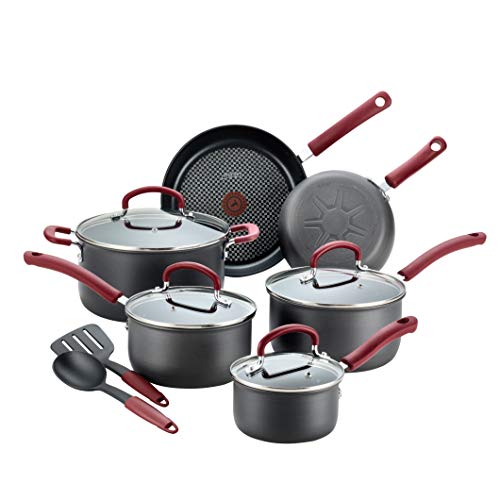
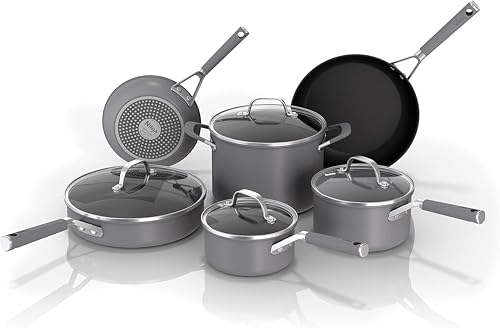
T-fal Ultimate Hard Anodized Nonstick Cookware Set — Reference All-Rounder
This is a hard-anodized aluminium line built around everyday release cooking, with a heat indicator in the fry pans that many home cooks find genuinely helpful while they are learning timing. It sits in the entry-to-mid tier of the market, which frames how to judge it: not against every set ever made, but against the expectations of its own class and the way you actually cook.
The balanced shape against which other sets in this review are measured. In daily use, the questions that matter are the ordinary ones: do the skillets cover breakfast and weeknight proteins, do the saucepans match your grain and sauce habits, do the handles stay comfortable when a pan is full, and will the household’s real utensil and washing habits suit the coating? Judge this set by those answers, follow the maker’s own care guidance for the line, and check the current Amazon listing when you are ready to buy, since listings change often.

Calphalon Classic Nonstick Cookware Set — Reference Family Set
This is a hard-anodized line with a measured, kitchen-neutral feel, dual-layer style release surfaces and a shape language that suits cooks who want one calm, coordinated set rather than a statement piece. It sits in the mid tier of the market, which frames how to judge it: not against every set ever made, but against the expectations of its own class and the way you actually cook.
Coordinated, calm and built for constant use and constant washing-up. In daily use, the questions that matter are the ordinary ones: do the skillets cover breakfast and weeknight proteins, do the saucepans match your grain and sauce habits, do the handles stay comfortable when a pan is full, and will the household’s real utensil and washing habits suit the coating? Judge this set by those answers, follow the maker’s own care guidance for the line, and check the current Amazon listing when you are ready to buy, since listings change often.
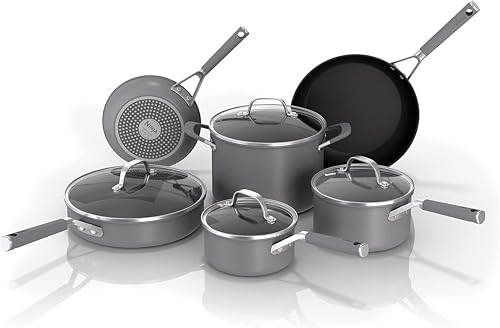
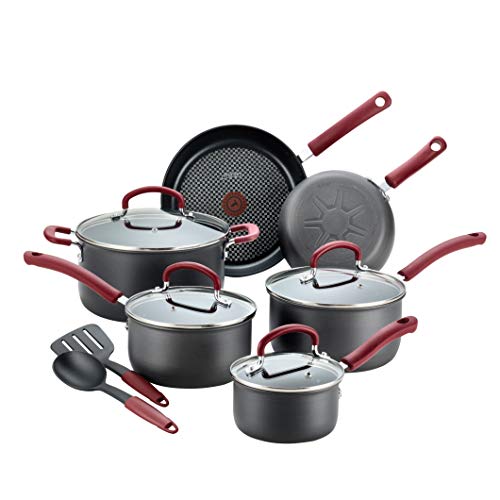
Ninja NeverStick Premium Hard-Anodized Nonstick Cookware Set — Reference Premium Line
This is a premium-positioned hard-anodized line marketed around a textured, plasma-bonded style surface and a more sear-tolerant brief than classic delicate coatings. It sits in the premium tier of the market, which frames how to judge it: not against every set ever made, but against the expectations of its own class and the way you actually cook.
The more tolerant brief and heavier feel mark the top of the category’s range. In daily use, the questions that matter are the ordinary ones: do the skillets cover breakfast and weeknight proteins, do the saucepans match your grain and sauce habits, do the handles stay comfortable when a pan is full, and will the household’s real utensil and washing habits suit the coating? Judge this set by those answers, follow the maker’s own care guidance for the line, and check the current Amazon listing when you are ready to buy, since listings change often.
Tramontina Nonstick Cookware Set — Reference Entry Line
This is a value-minded line from a maker with deep cookware roots, typically chosen by cooks who want honest everyday performance and easy replacement economics if a single pan wears first. It sits in the entry tier of the market, which frames how to judge it: not against every set ever made, but against the expectations of its own class and the way you actually cook.
Proof that the category’s core virtues survive at the honest end of the market. In daily use, the questions that matter are the ordinary ones: do the skillets cover breakfast and weeknight proteins, do the saucepans match your grain and sauce habits, do the handles stay comfortable when a pan is full, and will the household’s real utensil and washing habits suit the coating? Judge this set by those answers, follow the maker’s own care guidance for the line, and check the current Amazon listing when you are ready to buy, since listings change often.
Related reading from the same kitchen: how to choose a nonstick cookware set how to clean a nonstick cookware set is a nonstick cookware set worth it best non-stick cookware reviews best T-fal cookware sets best Tramontina cookware sets
Frequently Asked Questions
Are nonstick cookware sets good quality overall?
The good ones are, and quality lives in the bodies: hard-anodized construction, flat substantial bases and well-fitted handles separate satisfying sets from flimsy ones. The coating on any set is a wear surface, so judge quality by build and by how the set cooks in its first year, not by promises of permanence.
What foods does a nonstick set handle best?
Eggs in every form, delicate fish, dumplings, pancakes, sauces, grains, porridge and reheated leftovers are its home territory. Saucy one-pan dinners and gentle simmering also play to its strengths. Its weakest ground is sustained high-heat searing, which is better handed to stainless steel or cast iron.
How long does a nonstick cookware set last in real use?
Years of good service is the honest expectation, with skillets ageing faster than lidded saucepans because their work is hotter and drier. Gentle heat, soft utensils, hand-washing and protected storage stretch the arc. When the main skillet sticks despite good habits, renewing that piece usually restores the set.
Can a nonstick set go in the oven?
Many lines allow some oven use, but limits differ by piece and by line, and handle materials matter as much as coatings. Treat the maker’s guidance for your specific set as the only authority, read it before first use, and keep the stovetop as the pans’ primary home.
Is a nonstick set suitable for induction hobs?
Only sets with magnetic bases are. Standard aluminium bodies will not respond to induction. Look for explicit induction language in the base description of the specific line, and when in doubt, the magnet test on a pan tells you how the technology behaves.
What is the single best habit for keeping a set performing?
Heat discipline. Preheat gently, cook mostly in the low-to-medium band, and never leave an empty pan over a strong burner. That one habit protects the coating more than any product you can buy, and it is the common thread in every long-lived set this review is based on.
Related Guides
Related reading from the same kitchen: nonstick cookware set buying guide nonstick cookware set pros and cons nonstick cookware set reviews best nonstick cookware sets for beginners best non-stick cookware reviews