Disclosure: As an Amazon Associate, topratedkitchenware.com earns from qualifying purchases. Links on this page are affiliate links; they cost you nothing extra. Prices and availability change often, so check the current Amazon listing before you buy.
This tea kettle buying guide is written for one job: to help you choose a stovetop tea kettle you will still be pleased with after a year of mornings, not just on the day it arrives shiny. A tea kettle looks like the simplest object in the kitchen — a pot that whistles — and yet the differences that decide daily satisfaction are real: whether the base suits your hob, whether the handle stays comfortable under a full load, whether the whistle can be heard from your sofa, whether the lid opening admits your hand for cleaning, and whether the material matches the way your household actually handles things. This guide explains the types, puts a shortlist of honest representatives at each tier in front of you early, then walks through the criteria as questions, because the right kettle is the one that answers your kitchen’s questions, not the one with the longest feature list.
Key Takeaways
- Match the base to your hob first: induction needs a magnetic base, glass hobs prefer flat, smooth bottoms, gas forgives almost anything.
- Capacity follows your largest daily round, not your largest party; a kettle boiled near full heats and pours best.
- Stainless is the durable default, enamel adds colour at the price of chip care, glass must be explicitly stovetop-rated.
- Handle, lid opening and whistle are daily-use features — judge them as seriously as the material.
- Every pick here is presented prose-first at a stated tier; check the current listing for finish and configuration before buying.
What a Tea Kettle Does and the Main Types
A stovetop tea kettle heats water on a hob and announces, usually by whistle, when that water has boiled. It does not brew tea itself — the pot or cup does that, which is why this guide sits naturally beside teapot buying guide — but it decides the water’s speed, temperature moment and pour, and those three things decide more of the cup than most drinkers realise. Within that simple job, the category splits into recognisable types.
Classic Whistling Kettles
The mainstream type: a steel or enamel body, a spout capped with a whistle, a handle above or behind, in sizes from a personal kettle to a family one. This is the type most households should buy, because it balances speed, durability, audibility and price of effort across every hob. The shortlist below is drawn from this family, and the roundup in best stovetop tea kettles surveys it in depth.
Enamel Kettles
Steel at the core, colour on the surface. Enamel kettles are chosen by households that keep the kettle permanently on the hob and want it to look like furniture rather than equipment. They boil exactly as their steel siblings do; they differ in care, asking their owners to avoid hard knocks and thermal shock, and in presence, which they have in abundance.
Glass Stovetop Kettles
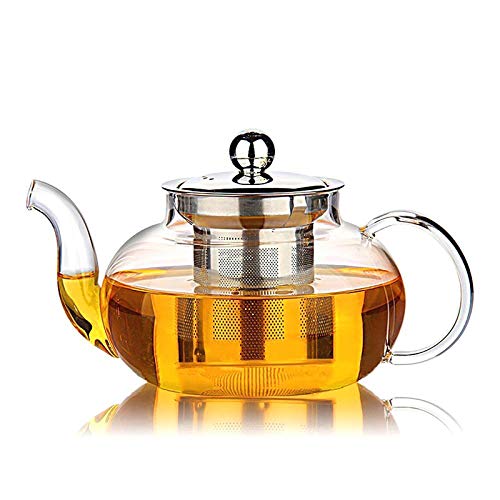
The smallest and most specialised type: borosilicate kettles made and rated for the hob, bought by drinkers who love watching water come to the boil. They are beautiful, flavour-neutral and honest about their fragility. Only ever buy one whose maker states plainly that it is stovetop-safe, keep it off the largest, fiercest burner, and read the care notes in how to clean tea kettle before its first descale. The wider glass family is gathered in best glass tea kettles.
Gooseneck and Pouring Kettles
A neighbouring type that swaps the whistle and capacity for a long, thin spout built for slow, circular pouring over coffee grounds. If your boiling is mostly for pour-over coffee, this type may serve you better than a classic kettle; if your boiling is mostly for tea, it will frustrate you with its small capacity and quiet voice. Its stove-top representatives appear in gooseneck kettles for pour over coffee.
In this guide
Tea Kettle Buying Guide: Top Picks at a Glance
Five kettles represent the tiers of this category honestly. Each is treated in prose, with its tier stated in words and no link pretending to certainty this page does not have; detailed, model-by-model verdicts live in tea kettle reviews and the single deep assessment in tea kettle review.
| Pick | Badge | Tier | Why it is here |
|---|---|---|---|
| Le Creuset Enamel on Steel Whistling Kettle | Best for the Permanent Hob | Premium | Colour, presence and a clear whistle in an enamel finish that anchors a kitchen. |
| Alessi Michael Graves Kettle | Best Design | Premium | The bird-whistle icon: a kettle bought for beauty that also boils beautifully. |
| OXO Brew Classic Tea Kettle | Best Ergonomics | Mid-range | A handle and spout lever designed for real, wet, hurried hands. |
| Cuisinart Aura Stovetop Tea Kettle | Best All-Rounder | Mid-range | Classic stainless consistency for tea, coffee water and cooking alike. |
| Mr. Coffee Flintshire Stainless Steel Tea Kettle | Best Entry Point | Entry | The fundamentals covered honestly for first kitchens and spare kettles. |
Which Hob Do You Cook On?
This question comes first because it can disqualify a kettle outright. Induction hobs need a magnetic base: most modern stainless kettles qualify, enamel on steel qualifies through its core, plain glass and some decorative metals do not, and the listing should say so in words — if it does not, choose another kettle rather than gamble. Gas is the most forgiving surface and the traditional home of the kettle, asking only that the base is wide enough to sit stable and that flames lick the base rather than the sides, which wastes heat and can discolour or damage handles. Electric coil and radiant hobs suit flat-based kettles and punish warped or rounded bottoms with slow, uneven heating. Smooth glass-ceramic hobs add one caution: drag nothing across them, lift the kettle instead, and prefer smooth, flat bases that will not scratch. Answer this question honestly and a third of any catalogue quietly removes itself, which is what a good first question is for.
How Much Capacity Do You Need?
Capacity is where most buyers overspend in size. A kettle heats fastest and pours best when it is boiled reasonably full, so the right size is the one that matches your largest daily round — a pot for the household’s morning tea, a press and a mug, a cooking pot’s head start — filled most of the way, most days. A single drinker or a couple usually lives happily in the compact to mid sizes. A family that brews a big pot and refills it, or a cook who constantly starts grains and pasta with kettle water, earns the large sizes. The oversized kettle bought for a twice-a-year gathering spends the other days heating slowly, pouring heavily and occupying a burner like furniture. Buy for the routine; let the saucepan cover the festival.
How Loud, and How Clear, Should the Whistle Be?
The whistle is the kettle’s only instrument, and households differ in what they need from it. A clear, carrying whistle suits open-plan homes, garden doors left open, and anyone who starts water and goes to dress a child. A softer whistle suits small flats, thin walls and households where someone sleeps days. Judge a whistle on two qualities: pitch that cuts through household noise without startling, and honesty — it should sound at a true boil, not wheeze early or late. Remember the standing rule that runs through this whole cluster: the whistle informs, it does not supervise. Choose the kettle whose voice reaches the rooms you actually occupy, then stay within its reach anyway. The care that keeps a whistle honest — descaling its airway, seating its cap — is covered in how to clean tea kettle.
What Will You Grip, Lift and Clean Every Day?
Handles, lids and openings are the features your hands will grade daily. A handle should stay comfortable under the kettle’s full weight, keep knuckles clear of the hot body, and — on lever designs — open the spout with the same hand that pours, so the other hand never goes near the steam. Test the idea in words before buying: full kettle, wet hand, mug in the other hand — does the design still make sense? The lid should remove without a wrestle and the opening beneath it should admit your hand or at least a bottle brush, because a kettle you cannot clean inside is a kettle with an expiry date set by your water. A water gauge you can read at a glance, inside or out, prevents the twin sins of boiling air and overfilling — and overfilling matters beyond waste, because water filled past the maximum line surges at the boil and leaves through the spout, which is a scald risk as well as a mess. Handles and bodies get hot regardless of marketing language, so plan on a mitt living near the hob, and keep the kettle’s handle turned out of the walkway as a standing habit.
Materials: What the Kettle Is Made Of Changes How It Behaves
Stainless steel is the category’s default for good reason. It is light for its strength, resists rust, tolerates every common hob type including induction in its magnetic grades, and asks for nothing more exotic than a wash and an occasional descale. Its weaknesses are cosmetic and thermal: polished steel shows fingerprints and water spots, and a thin steel body loses heat quickly once it leaves the burner, which matters if you pour a second round ten minutes later.
Enamel on steel wraps that same steel core in a glassy coloured coat. The enamel brings colour, a wipe-clean exterior and a surface that does not hold the taste of yesterday’s strong brew, and it is why enamel kettles become the visual anchor of a kitchen. The trade is fragility of a specific kind: enamel is hard but brittle, so a hard knock against a tap or a drop onto tiles can chip it, and a chipped kettle still works but has lost both its looks and its rust shield at that spot. Glass kettles, usually borosilicate, offer the pleasure of watching water come to the boil and leaves swirl if you brew in the kettle, and they never hold flavours; they ask in return for stovetop confirmation — only glass kettles explicitly made for the hob belong on one — and for handling that accepts glass is glass. Copper and copper-finished kettles are the traditionalists’ choice, heating responsively and looking magnificent, at the cost of polishing to keep the shine and a premium tier. None of these materials makes a kettle good or bad on its own. The right question is which set of habits you already have: the careful handler can enjoy glass or enamel for decades, while the hurried household that knocks its kettle weekly will be happier in plain steel.
How to Prioritise by Use Case
The tea-first household should weight whistle clarity, a pour that suits a pot, and a capacity matched to its biggest daily brew; the OXO and Cuisinart profiles below are its natural shortlist. The design-led household, keeping its kettle permanently on display, should weight finish and presence and accept enamel’s care rules with open eyes; Le Creuset and Alessi are its shortlist. The first kitchen and the spare kettle should weight honesty and simplicity over refinement; the Flintshire exists precisely for them. The mixed household — tea, coffee water, cooking water, bottles — should weight capacity and an all-hob base, and treat the whistle as a household utility rather than a tea accessory. In every profile, the discipline is the same: rank your own criteria before you look at kettles, or the prettiest kettle in the catalogue will rank them for you.
The Picks in Detail
Le Creuset Enamel on Steel Whistling Kettle
The Le Creuset enamel on steel whistling kettle is the colour-led classic of this category: a steel body under a glossy enamel finish, sold in the deep, kitchen-defining colours the brand is known for, with a clear two-tone whistle that carries through a house without shouting. The enamel is the point and the caveat at once. It resists rust and does not hold flavours, it wipes clean on the outside, and it makes the kettle a permanent piece of stove-top decoration rather than an appliance to hide. It also asks for reasonable care: enamel can chip if the kettle is knocked hard against a tap or dropped, and it prefers not to be left boiling dry. For a household that keeps a kettle on the hob all day and wants it to earn that place visually, this is the benchmark the rest of the category is measured against.
Best for: kitchens that keep the kettle on the hob permanently and want it to look like it belongs there
Not suited for: households that knock, drop and hustle their cookware hard
Strengths
- Enamel finish resists rust and wipes clean
- A clear whistle that carries through a home
- Colours that make the kettle a kitchen anchor
Trade-offs
- Enamel can chip under hard knocks
- Premium tier, and it asks for premium care
Tier: premium. Check price on Amazon.

Alessi Michael Graves Kettle
The Alessi kettle designed by Michael Graves is the design icon of the group, recognised instantly by the small bird perched on its spout — a bird that sings when the water boils, turning the whistle into the kettle’s most charming feature rather than its loudest. The wide, conical stainless body heats a family round efficiently and pours with a balance that feels considered rather than accidental, and the handle and detailing carry the playful postmodern character Graves brought to kitchen objects. It is bought by people who care how the objects on their stove look and feel, and it rewards them daily. The compromises are the premium tier it sits in and the care a polished finish deserves if you want it to stay mirror-bright.
Best for: design lovers who want the kettle to be the most beautiful object on the stove
Not suited for: buyers ranking pure value over character
Strengths
- The bird whistle is charming and unmistakable
- Wide body heats a family round efficiently
- A genuine design classic that holds its appeal
Trade-offs
- Polished finish rewards gentle handling
- Premium tier for what is, at heart, a kettle
Tier: premium. Check price on Amazon.
OXO Brew Classic Tea Kettle
The OXO Brew Classic tea kettle is the ergonomics pick. OXO built its reputation on handles and grips designed for real hands, including hands that are wet, hurried or less strong than they once were, and that thinking shows here: a comfortable, heat-resistant handle, a spout lever that opens with a natural motion as you lift and pour, and a brushed stainless body that hides fingerprints better than a polished one. The whistle is clear, the lid opening is generous enough to fill and clean without a fight, and the whole kettle feels designed by people who watched beginners and grandparents use kettles and took notes. For shared households and anyone who pours one-handed while holding a mug, it is the thoughtful choice.
Best for: shared households, older hands, and anyone who pours one-handed
Not suited for: minimalists who want the plainest possible silhouette
Strengths
- Handle and lever designed around real grips
- Brushed finish forgives fingerprints and spots
- Generous opening makes cleaning straightforward
Trade-offs
- Styling is practical rather than decorative
- Still needs descaling like any steel kettle
Tier: mid-range. Check price on Amazon.

Cuisinart Aura Stovetop Tea Kettle
The Cuisinart Aura is the polished all-rounder of this shortlist: a stainless stovetop kettle with a traditional silhouette, a clear whistle, and the kind of weight and finish that feel reassuring without tipping into heirloom pricing. Cuisinart’s strength in this category is consistency — the lid fits as it should, the handle stays where your hand expects it, and the pour is controlled rather than splashy. It suits households that want one dependable kettle for tea, coffee water and cooking water alike, and that prefer a classic look that will not date. It does not chase novelty, and that restraint is exactly why it appears on so many shortlists year after year.
Best for: households wanting one classic kettle for every kind of boiled water
Not suited for: buyers chasing a distinctive design statement
Strengths
- Consistent, proven all-round behaviour
- Classic looks that will not date
- Weight and fit that feel reassuring daily
Trade-offs
- Polished steel shows water spots sooner
- No novelty features — deliberately
Tier: mid-range. Check price on Amazon.
Mr. Coffee Flintshire Stainless Steel Tea Kettle
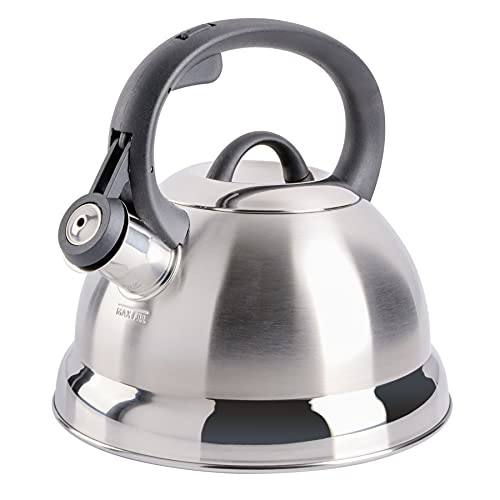
The Mr. Coffee Flintshire is the honest entry point of the group: a stainless steel whistling kettle from a brand built on affordable kitchen basics, aimed at first kitchens, student houses, spare kettles for a caravan or office, and anyone who wants the stovetop ritual without a premium commitment. It covers the fundamentals — a clear whistle, a stay-cool style handle and spout lever, a body that works across common hob types — and it is honest about its tier in the fineness of its finish and the lightness of its build. Treated as what it is, a working kettle at an entry tier rather than an heirloom, it makes a great deal of sense, and many households happily run one for years.
Best for: first kitchens, students, spares and caravans
Not suited for: buyers seeking an heirloom or a showpiece
Strengths
- Covers the fundamentals at an entry tier
- Light and easy to handle
- A clear whistle for its class
Trade-offs
- Finish and build are honest rather than fine
- Not the kettle to hand down
Tier: entry. Check price on Amazon.
First Setup and Care Essentials
A new kettle needs three things before its first tea: a wash in warm soapy water to remove factory residues, a full boil of fresh water thrown away, and a minute spent reading its maker’s notes on hob types and maximum fill. After that, care is rhythm rather than effort — rinse after the day’s use, dry with the lid ajar, descale on your water’s schedule, and never let it boil dry, which is the single act that ages every material fastest. The complete routine, including whistles, filters and exteriors, is the whole subject of how to clean tea kettle.
Safety First: Steam, Boiling Water and Hot Metal
A tea kettle’s whole job is to bring water to boiling point, so respect for that water is not a footnote to using one — it is the skill the rest of the routine hangs on. Steam and boiling water scald faster than most people expect, and the classic kettle injuries are all variations on the same few moments: a face bent over a just-boiled kettle as the lid lifts, a hand passing through the steam plume above the spout, a kettle filled past its limit surging as it boils, a hot body grabbed without a mitt because it looked like only the handle gets hot.
Work to a few fixed habits and those moments mostly disappear. Never fill past the maximum line marked inside or on the gauge — the space above the water is not wasted capacity, it is the room the water needs to boil without pushing out of the spout. Open lids and spout caps away from your face and hands, tilting the lid so the steam escapes at the far side, and keep your free hand out of the plume above the spout when you pour. Treat the whistle as information, never as supervision: a whistling kettle still needs a person in earshot who will actually come, and no kettle, however trustworthy its whistle, should be left boiling while you leave the house or fall asleep. Handles and bodies both get hot — on many designs the body is the hottest part of all — so lift and carry with a mitt or a dry cloth as a default, not as a rescue. Keep the kettle stable on a burner sized to its base, set it back from the edge of the hob, and turn the handle out of the walkway and away from other burners, so sleeves, children and passing elbows never meet it by accident. Let a kettle cool before you refill it, clean it or put it away, and descale regularly on the rhythm your water demands: a scaled kettle boils less predictably, spits more, and tempts its owner into exactly the impatient handling that causes scalds.
Mistakes to Avoid
The common buying mistakes are few and avoidable. Buying a base your hob cannot heat — above all a non-magnetic kettle for an induction hob — because the silhouette charmed you. Buying capacity for guests instead of for Tuesdays. Ignoring the lid opening until the first descale reveals you cannot reach the floor of your own kettle. Assuming a whistle means you can leave the house. Assuming glass is stovetop-safe because it is sold near kettles. And buying on finish alone in a household whose handling is cheerfully rough, then blaming enamel for chipping. Every one of these is a question this guide has already asked; the kettle that survives your answers is the right one, and the verdict on whether the purchase itself is justified at all sits in is a tea kettle worth it.
Reading a Listing Like an Inspector: What to Check Before You Commit
Catalogue pages for kettles are written to be admired, but a buyer who knows what to look for can inspect a kettle thoroughly without touching it, because the facts that predict satisfaction are almost always present — scattered, minimised, but present. Start with the base: find the hob statement in words. A listing that names the hob types it suits, including induction where relevant, is a listing written by a maker who expects to be checked; a listing that shows the kettle on four kinds of hob in photographs while naming none in text is telling you something else. Move to the capacity, and read it as two numbers rather than one: the total volume, which is marketing, and the maximum fill, which is the kettle you will actually use — the difference between them is the headspace a safe boil requires, and a kettle whose usable fill is much smaller than its headline size will disappoint a family that bought the headline. Then the lid: look for photographs of the opening with the lid off, and judge whether your hand or your brush fits the mouth you see. Then the whistle: a removable cap, stated or shown, predicts a whistle that can be descaled and therefore a whistle that still works in year three.
Handles deserve the same forensic reading. A handle’s photograph at rest tells you little; look for its position relative to the body, the clearance a knuckle would have, and whether the spout opens by lever from the handle or by a separate cap the other hand must approach through steam. Weight matters more than listings admit: a kettle’s empty weight, plus the water it is designed to carry, is the load your wrist will manage at arm’s length over a teapot, several times a day, and households with any grip concerns should do that small sum honestly rather than discover it. Finally, read the care instructions before the feature list. A maker who tells you plainly how to descale, what not to scour and which finishes need drying is a maker whose kettle was designed to be kept; a maker whose care section is a single line is selling a kettle designed to be replaced. None of this requires expertise — it requires reading the page as an inspector rather than as an audience, which is the entire discipline this guide exists to teach.
Apply the same reading to the reviews a listing collects, with one adjustment: weight the complaints by type. Complaints about a whistle weakening, a lid loosening or a finish marking are reports about maintenance and handling, and they predict your experience only if your water and your habits match the writer’s. Complaints about a base that never heated on induction, a handle that crowds the body, or an opening too small to clean are reports about design, and design does not change between households. A buyer who sorts criticism that way can extract real signal from a noisy page — and will notice that the kettles in this guide’s shortlist attract the first kind of complaint far more than the second, which is not an accident.
The Second Kettle: Spares, Gifts and Special Cases
Most buying guides pretend every purchase is a household’s first and only kettle, but a large share of real purchases are second kettles, and they follow different logic. The spare — for a caravan, a cabin, a workshop, an office kitchenette with a portable hob — should be bought for indifference to conditions: plain stainless, a clear whistle, no finish that a rough shelf or a borrowed burner can ruin, at a tier whose loss would be an annoyance rather than a grief. The entry profile in this guide’s shortlist exists for exactly this duty, and households often report that the spare, bought without ceremony, becomes the most fondly regarded kettle they own, because it is associated with holidays and unhurried mornings. The gift kettle inverts the logic entirely: since the giver cannot know the recipient’s water, handling or hob with certainty, the safe gifts are the forgiving ones — stainless over enamel, a generous lid opening, a whistle of moderate voice — while the enamel and design-led kettles make magnificent gifts only when the giver genuinely knows the kitchen they are going to, its hob type included. A beautiful kettle that cannot heat on the recipient’s induction hob is not a gift but a returning errand.
Special cases deserve their paragraph. Households with a member whose grip or strength is limited should treat handle design as the first criterion and capacity as a constraint to buy down, because a smaller kettle filled twice is a kinder tool than a large one filled once and feared. Households with a wood burner or a range that is always warm often keep a kettle on it permanently as a source of ready hot water, and for them heat retention and a body that tolerates constant gentle heat matter more than whistle or speed. Households equipping a first rental kitchen should buy the kettle before almost any other heated appliance, on the arithmetic this cluster’s worth-it analysis sets out: no other object in the kitchen will be used as often for as long. In every special case the method is unchanged — rank the household’s real criteria first, then let the catalogue answer them — but the ranking itself belongs to the household’s circumstances, and a guide that ranks for you, however confident its tone, has quietly stopped being a guide.
And there is the replacement purchase, the commonest of all, made when an old kettle finally retires. Replacement buyers hold an advantage no first-time buyer has: a decade of evidence about their own household. They know their water’s speed at scaling, their whistle’s necessary reach, the capacity their routine actually used and the handle style their hands preferred. The discipline for them is to buy from that evidence rather than from the catalogue’s novelties — to replace the kettle they had, improved at exactly the points where the old one taught them something, instead of being upsold into a different category of object by a shiny page. A kettle replaced knowingly is usually the last kettle a household buys for a very long time.
After the Purchase: the First Fortnight With a New Kettle
A buying guide’s duty does not end at the till, because the fortnight after a kettle arrives is when the purchase is actually graded — and when a good purchase can be spoiled by habits imported from the old one. Begin with the setup the care section prescribes: a wash, a discarded boil, a minute with the maker’s hob notes. Then spend the first days learning the kettle as an individual. Every design has its own voice, its own moment of first murmur, its own pour rate at full weight, and its own honest fill line as judged by your eye rather than its markings. Learn them deliberately, the way you would learn a new car’s braking, because the household that learns its kettle in week one stops thinking about it in week three, which is the true beginning of ownership. Test the whistle from the rooms you actually occupy. Test the pour at the weight you actually lift. Test whether the lid and your brush are going to be friends. A kettle that fails one of those tests fails it while return is still possible, which is the entire point of testing promptly.
The fortnight is also when the household’s standing habits should be set, before improvisation sets them for you. Decide where the kettle lives and which burner is its own. Put the mitt where the hand will look for it, not where it looks tidy. Turn the handle out of the walkway as a rule from the first boil, and fill to the line as a rule from the first fill, because rules adopted in week one cost nothing and rules adopted after the first scald or the first surge cost exactly that. Write the purchase date somewhere, and with it the first descale’s due date as your water suggests; the household that starts its kettle’s diary on day one never has to reconstruct it from memory in month nine. None of this is elaborate. All of it is the difference between a kettle that integrates into a kitchen and one that merely resides in it.
Finally, the fortnight is when to resist the catalogue’s last temptation: the immediate upgrade. New owners, suddenly literate in kettles, notice the tier above theirs with new eyes and begin to suspect they bought one step too low. Almost always they did not. The differences between adjacent tiers are refinements of fit and finish that reveal themselves across years, not across a fortnight, and the kettle in your kitchen, learned and habit-formed, is worth more to your mornings than the marginally finer stranger in the listing. Live with the choice for a season. If, a season later, a specific, nameable shortcoming still bothers you daily — a whistle too soft for your house, a handle your hands dislike, a capacity your routine outgrew — then you have earned an upgrade with evidence, and the guide will still be here. Until then, the kettle you have is the kettle this guide intended: the one your household’s answers chose.
A Worked Example: Three Kitchens, Three Correct Answers
Guides persuade in the abstract; kitchens decide in the concrete, so this guide closes its argument with three households and the kettles this page’s own criteria choose for them. The first kitchen belongs to a couple in a small flat with an induction hob, one of whom drinks green tea most mornings while the other cooks elaborate dinners on all four zones. The criteria speak in order: the base must be magnetic, which removes glass and several decorative metals at a stroke; the footprint must be modest and the kettle must be content living on the counter-side ledge rather than a burner, which argues for a compact capacity; the green tea argues for a clear whistle and a kettle that rests gracefully, since its water will be boiled and rested daily. The criteria converge on a compact stainless kettle with an honest whistle — the ergonomic profile in this guide’s shortlist, in its smaller form — and the couple’s remaining decision is only a finish. The second kitchen is a farmhouse with a wide gas range, four tea drinkers, a kettle that will never leave the hob and a cook who fills it from a jug because the tap is across the room. Capacity and presence lead here: a family size, a lid opening that takes a jug’s pour without spilling, a whistle that reaches the garden door, and a finish that earns its permanent place. The enamel profile answers every line of that brief, and the household should buy it knowing its care rules the way it knows its range’s moods — as part of the house’s operating knowledge.
The third kitchen is a first rental, equipped from nothing by a single person whose boiling is tea at night, coffee in the morning and pasta twice a week, on a hob of unknown temperament in a building of unknown water. The criteria here are humility and forgiveness: an all-hob base, a size matched to one person’s rounds with a guest’s margin, a finish that will not punish a beginner’s handling while the habits in this guide are still being learned, and a tier that leaves money for the teapot, the press and the tea itself. The entry profile in stainless answers it completely, and the guide’s advice to that buyer is the advice this whole page has been building toward: buy the forgiving kettle, learn your water and your whistle across a year of mornings, and let the second kettle — if a second is ever wanted — be bought from evidence no catalogue can give you. Three kitchens, three kettles, one method. The method is the product this guide is actually selling, and it is free.
The Guide in One Breath
For the reader who has absorbed the criteria and wants their order restored before facing a catalogue, the whole guide compresses to this. Match the base to your hob before anything charms you. Size the kettle to your largest daily round and no larger. Choose the material your household’s hands will treat kindly for years. Judge the handle, the lid opening and the whistle as the daily features they are. State your tier honestly, inspect the listing like an inspector, and set the kettle’s habits in its first fortnight. A kettle chosen in that order will not be the most exciting purchase of your year. It will very likely be, a decade from now, among the most satisfactory — which is the only ranking this guide has ever cared about.
Before You Order: A Fit-and-Routine Worksheet for the Tea kettle
Start this worksheet with the space, not the product page: measure the exact spot where the tea kettle will live, including the clearance above it, the swing or reach you need in front of it, and the route you will take to move it for cleaning. Write down the largest item you realistically expect to use with it, because that single measurement settles more sizing arguments than any capacity figure printed in a listing headline. Check the nearest outlet and be honest about whether a cord will cross a walkway, a sink edge, or another appliance that also needs that socket on busy mornings. Count the people the tea kettle must serve on an ordinary weekday, then count again for the busiest gathering you host in a typical year, and notice whether those two numbers point to the same size.
List the three jobs you will ask of it every week and the one job you will ask only a few times a year, because the weekly jobs should drive the decision and the rare job should not. Decide where the accessories, attachments, and spare parts will be stored before you order, since a tea kettle whose extras live in a distant cupboard quietly becomes a tea kettle with fewer features. Where a shortlist names specific examples, such as Le Creuset Enamel on Steel Whistling Kettle, run these same checks against that listing line by line rather than assuming the general verdict transfers unchanged. Apply the identical test to Alessi Michael Graves Kettle as well, on the same day and under the same conditions, because a fair comparison needs one ruler rather than two moods.
- Measure the working spot and the clearance around it
- Count weekday servings and the biggest gathering
- List the three weekly jobs in writing
- Decide storage for every accessory in advance
- Name the one compromise you accept knowingly
- Set the return deadline in your calendar
If OXO Brew Classic Tea Kettle is also in contention, give it the same worksheet and let the three sets of answers sit side by side before anyone reaches for a checkout button. Think about who else in the household will use it, including anyone shorter, anyone with less grip strength, and anyone who will clean it without reading the manual first. Note the surfaces it will touch in normal use and whether heat, moisture, weight, or vibration from the tea kettle could mark, stain, or stress those surfaces over months of daily contact. Plan the cleaning position as carefully as the working position, because a tea kettle that is awkward to carry to the sink or to open fully will be cleaned less often than it should be.
Write the three questions you still cannot answer from listings and guides, and treat those unanswered questions as your shortlist filter rather than as details to discover after delivery. Compare the footprint against the appliance or tool it replaces, and decide in advance what leaves the room if the new arrival is larger than the old one. Consider the noise, steam, heat, or light it produces in use and whether that output lands in a room where someone sleeps, works, or studies at the same hours. Check how it behaves at the smallest task, not only the largest, because many households abandon oversized gear that feels clumsy for the quick everyday job.
Think through the second week of ownership, when the novelty has faded, and ask which features you will still touch daily and which were only interesting in the showroom sense. Decide what good enough looks like in writing: the result you would accept without complaint, the result that would delight you, and the result that would send the box back. Look at the controls with fresh eyes and imagine using them with wet hands, greasy hands, or gloves, depending on the work, because small controls punish exactly those moments. Ask how the tea kettle fails gracefully: whether a worn part, a lost attachment, or a single broken control ends its usefulness or merely removes one mode you rarely used.
Frequently Asked Questions
What is the best material for a stovetop tea kettle?
For most households, stainless steel: it is durable, light, rust-resistant, works on every hob type in its magnetic grades, and asks for nothing beyond washing and descaling. Enamel on steel adds colour and presence and suits careful households that keep the kettle on display. Glass suits only buyers who choose it deliberately, with a kettle explicitly rated for the stovetop. The best material is the one whose care rules your household will actually keep.
How do I know if a kettle will work on induction?
Look for the maker’s own statement that the kettle is induction suitable, and prefer listings that say it in plain words rather than implying it. At home, the quick check is a fridge magnet against the cold base: a firm hold means the base is magnetic and the hob will heat it. Enamel on steel works through its steel core. Plain glass and some decorative metals do not work at all, however beautiful they look on the shelf.
Should I buy a whistling or a silent kettle?
Buy the whistle unless your household has a specific reason to avoid sound, such as a day sleeper in a small flat. The whistle is the kettle’s way of calling you back, and it prevents more forgotten boils and dry kettles than any other feature. Judge it by clarity rather than volume: a clear, carrying tone you can hear from the next room, sounding at a true boil. Remember it informs rather than supervises — stay within earshot regardless.
What size kettle should a family buy?
Size for the largest round you make on an ordinary day: a full pot for the family’s morning tea, plus a mug or two, is the typical honest answer, and it points most families at the larger end of the mid sizes rather than the very largest kettles. A kettle boiled reasonably full heats faster and pours better than a giant boiled a third full, and the rare gathering can be covered by a second boil or the saucepan you already own.
Are expensive kettles actually better, or just prettier?
Both, in different proportions. Premium kettles genuinely tend to bring better fit — lids that seat true, handles that stay comfortable, whistles that sound honestly — and finishes that age more gracefully. They do not boil water to a higher standard; boiled is boiled. The mid tiers in this guide cover the fundamentals completely, so a premium purchase should be made for fit, finish and the pleasure of the object, with open eyes that those are the things being bought.
Can one kettle serve tea, coffee and cooking?
Yes, and most households use theirs exactly that way. A classic whistling kettle pours well enough for a French press, fills pans and bottles safely, and serves the teapot all day. The one specialist exception is pour-over coffee, which rewards the thin, slow spout of a gooseneck kettle; if pour-over is a daily ritual rather than an occasional one, that neighbouring type deserves its own look alongside the classic kettle rather than instead of it.