Disclosure: As an Amazon Associate, topratedkitchenware.com earns from qualifying purchases. Links on this page are affiliate links; they cost you nothing extra. Prices and availability change often, so check the current Amazon listing before you buy.
These tea kettle reviews exist to do one thing well: place the stovetop kettles that define the current category side by side, judge each on the work a kettle actually does, and match each to the household it serves best. Five models are covered — an enamel classic, a design icon, an ergonomic favourite, a polished all-rounder and an honest entry point — because those five profiles are the real choice in this category. Materials, whistles, handles and cleaning are graded as seriously as time to boil, because owners live with all of them daily and with the boil for three minutes. Every model is presented prose-first with its tier in words; the single deep assessment of the design as a whole sits in tea kettle review, and the choosing framework that turns these verdicts into a purchase sits in tea kettle buying guide.
Key Takeaways
- Best all-round: the Cuisinart Aura, for classic stainless consistency across every kind of boiling.
- Best ergonomics: the OXO Brew Classic, whose handle and lever were designed for real hands.
- Best for the permanent hob: the Le Creuset enamel kettle, bought for colour and kept for decades.
- Best design: the Alessi Michael Graves kettle, whose bird whistle is the category’s signature.
- Best entry point: the Mr. Coffee Flintshire, covering the fundamentals honestly at its tier.
How These Reviews Judged the Kettles
Each kettle was judged on the same five grounds, in the order owners feel them. Heating: time and composure to a true boil on a matched burner, and behaviour near full. Pouring: control at full weight, cleanliness of start and stop, and whether the free hand stays out of the steam. Voice: the whistle’s clarity, honesty and reach across a lived-in house. Handling: handle comfort, lid fit, the width of the opening, and the honesty of the maximum line. Keeping: how the kettle cleans, how it descales, and how its finish ages under a normal household’s care, following the routines in how to clean tea kettle. No kettle here wins all five grounds, and the reviews below say plainly which grounds each one concedes — that pattern of concessions, matched to your household, is the whole value of a roundup.
In this guide
The Kettles, Reviewed One by One

Cuisinart Aura Stovetop Tea Kettle
The Cuisinart Aura is the polished all-rounder of this shortlist: a stainless stovetop kettle with a traditional silhouette, a clear whistle, and the kind of weight and finish that feel reassuring without tipping into heirloom pricing. Cuisinart’s strength in this category is consistency — the lid fits as it should, the handle stays where your hand expects it, and the pour is controlled rather than splashy. It suits households that want one dependable kettle for tea, coffee water and cooking water alike, and that prefer a classic look that will not date. It does not chase novelty, and that restraint is exactly why it appears on so many shortlists year after year.
Best for: households wanting one classic kettle judged excellent at everything and exceptional at nothing — in the best sense
Not suited for: buyers who want their kettle to make a statement
Strengths
- Heating and pouring both composed and predictable
- Classic build quality that inspires long ownership
- A whistle that is clear without being theatrical
Trade-offs
- Polished finish rewards a drying cloth
- Design will not turn heads — deliberately
Tier: mid-range. Check price on Amazon.
OXO Brew Classic Tea Kettle
The OXO Brew Classic tea kettle is the ergonomics pick. OXO built its reputation on handles and grips designed for real hands, including hands that are wet, hurried or less strong than they once were, and that thinking shows here: a comfortable, heat-resistant handle, a spout lever that opens with a natural motion as you lift and pour, and a brushed stainless body that hides fingerprints better than a polished one. The whistle is clear, the lid opening is generous enough to fill and clean without a fight, and the whole kettle feels designed by people who watched beginners and grandparents use kettles and took notes. For shared households and anyone who pours one-handed while holding a mug, it is the thoughtful choice.
Best for: shared households, grandparents, and anyone who has ever poured one-handed with a child on a hip
Not suited for: sculpture-first buyers
Strengths
- The kindest handle and spout action in this roundup
- Brushed steel hides the evidence of daily use
- Cleaning access that respects hard-water owners
Trade-offs
- Utilitarian looks beside the premium pair
- Ergonomics cost a little more than plain steel
Tier: mid-range. Check price on Amazon.
Le Creuset Enamel on Steel Whistling Kettle
The Le Creuset enamel on steel whistling kettle is the colour-led classic of this category: a steel body under a glossy enamel finish, sold in the deep, kitchen-defining colours the brand is known for, with a clear two-tone whistle that carries through a house without shouting. The enamel is the point and the caveat at once. It resists rust and does not hold flavours, it wipes clean on the outside, and it makes the kettle a permanent piece of stove-top decoration rather than an appliance to hide. It also asks for reasonable care: enamel can chip if the kettle is knocked hard against a tap or dropped, and it prefers not to be left boiling dry. For a household that keeps a kettle on the hob all day and wants it to earn that place visually, this is the benchmark the rest of the category is measured against.
Best for: kitchens where the kettle never leaves the hob and is part of the room’s design
Not suited for: households whose cookware lives a rough life
Strengths
- Enamel colour and presence unmatched in this group
- A whistle with genuine carrying power
- An interior that keeps water tasting clean for years
Trade-offs
- Chips are forever — handling must be reasonable
- Premium tier, with care rules to match
Tier: premium. Check price on Amazon.

Alessi Michael Graves Kettle
The Alessi kettle designed by Michael Graves is the design icon of the group, recognised instantly by the small bird perched on its spout — a bird that sings when the water boils, turning the whistle into the kettle’s most charming feature rather than its loudest. The wide, conical stainless body heats a family round efficiently and pours with a balance that feels considered rather than accidental, and the handle and detailing carry the playful postmodern character Graves brought to kitchen objects. It is bought by people who care how the objects on their stove look and feel, and it rewards them daily. The compromises are the premium tier it sits in and the care a polished finish deserves if you want it to stay mirror-bright.
Best for: design lovers, gift buyers, and anyone who smiles at a kettle that sings through a bird
Not suited for: strict value calculators
Strengths
- An icon that also happens to boil and pour very well
- Wide body suits family rounds
- The most enjoyable whistle in the category
Trade-offs
- Mirror finish shows work and wants gentle care
- You are paying for design, knowingly
Tier: premium. Check price on Amazon.
Mr. Coffee Flintshire Stainless Steel Tea Kettle
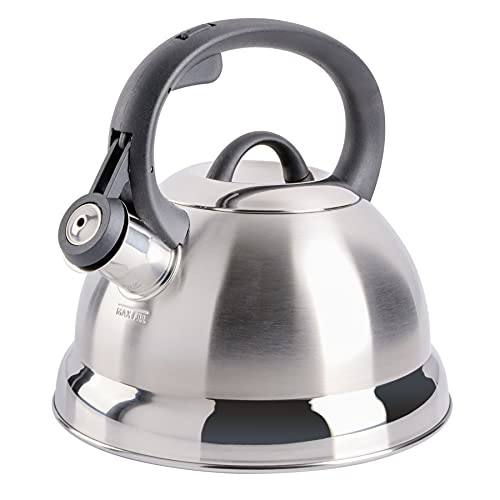
The Mr. Coffee Flintshire is the honest entry point of the group: a stainless steel whistling kettle from a brand built on affordable kitchen basics, aimed at first kitchens, student houses, spare kettles for a caravan or office, and anyone who wants the stovetop ritual without a premium commitment. It covers the fundamentals — a clear whistle, a stay-cool style handle and spout lever, a body that works across common hob types — and it is honest about its tier in the fineness of its finish and the lightness of its build. Treated as what it is, a working kettle at an entry tier rather than an heirloom, it makes a great deal of sense, and many households happily run one for years.
Best for: first kitchens, students, renters, spare-kettle buyers and caravan shelves
Not suited for: heirloom hunters
Strengths
- All the fundamentals present and working
- Light, simple and undemanding on any hob
- The roundup’s easiest purchase to justify
Trade-offs
- Finish and feel are a tier below the rest here
- Not built to be handed down
Tier: entry. Check price on Amazon.
Head to Head: Where the Five Actually Differ
At the boil, the five are closer than their tiers suggest: matched for water and burner, all reach a true boil in a similar window, and all announce it. The differences owners feel are elsewhere. In the hand, the OXO separates itself immediately — its grip and lever are a generation ahead of conventional handles — while the Alessi’s balance makes its larger body pour lighter than it looks. At the sink, the brushed OXO and the classic Cuisinart forgive the most, the enamel Le Creuset rewards gentleness with the best-kept looks over years, and the Flintshire asks and gives the least in equal measure. In the room, the Le Creuset and Alessi earn their permanent places visually in a way the other three do not attempt. And in the ledger, the Flintshire’s honesty reframes the premium pair: you are never paying for hotter water, only for fit, finish, character and time — which are legitimate things to buy, provided the roundup has made clear that that is what is being bought. The alternative family that competes with all five at once is compared directly in tea kettle vs electric tea kettle.
Which Kettle for Which Household
The multi-tea family, boiling from breakfast to evening, should shortlist the Cuisinart for duty and the Le Creuset if the kettle will live on display between boils. The solo drinker in a small kitchen should look hardest at the OXO, whose handling flatters small spaces and one-handed routines, in the compact end of its range. The design-led renovator has exactly one conversation to have, between the Alessi’s theatre and the Le Creuset’s colour, and should choose with the heart, because the hands will be equally served. The first-kitchen buyer should buy the Flintshire without a flicker of embarrassment and spend the difference on tea; the roundup’s respect for it is genuine. The grandparent household, or any household where grip strength is a real consideration, should treat the OXO’s ergonomics as a safety feature and rank it first regardless of looks. Households still deciding whether the category itself fits their life should settle that question first in is a tea kettle worth it — the best kettle in this roundup is still the wrong purchase for a household that needs an appliance to switch itself off.
Materials: What the Kettle Is Made Of Changes How It Behaves
Stainless steel is the category’s default for good reason. It is light for its strength, resists rust, tolerates every common hob type including induction in its magnetic grades, and asks for nothing more exotic than a wash and an occasional descale. Its weaknesses are cosmetic and thermal: polished steel shows fingerprints and water spots, and a thin steel body loses heat quickly once it leaves the burner, which matters if you pour a second round ten minutes later.
Enamel on steel wraps that same steel core in a glassy coloured coat. The enamel brings colour, a wipe-clean exterior and a surface that does not hold the taste of yesterday’s strong brew, and it is why enamel kettles become the visual anchor of a kitchen. The trade is fragility of a specific kind: enamel is hard but brittle, so a hard knock against a tap or a drop onto tiles can chip it, and a chipped kettle still works but has lost both its looks and its rust shield at that spot. Glass kettles, usually borosilicate, offer the pleasure of watching water come to the boil and leaves swirl if you brew in the kettle, and they never hold flavours; they ask in return for stovetop confirmation — only glass kettles explicitly made for the hob belong on one — and for handling that accepts glass is glass. Copper and copper-finished kettles are the traditionalists’ choice, heating responsively and looking magnificent, at the cost of polishing to keep the shine and a premium tier. None of these materials makes a kettle good or bad on its own. The right question is which set of habits you already have: the careful handler can enjoy glass or enamel for decades, while the hurried household that knocks its kettle weekly will be happier in plain steel.
What These Reviews Cannot Tell You
Honesty about method belongs in a roundup. Comparative reviewing can judge design, behaviour and the logic of each kettle’s compromises, but it cannot live five parallel decades, and the verdicts that matter in year twenty — the enamel that stayed glossy, the handle that never loosened — rest on predictors rather than prophecies: simplicity of construction, the maker’s record, and the owner’s habits. Hold the long-term claims here with that confidence level. What can be stated firmly is the pattern: in this category, the kettles that age best are the ones that can be cleaned completely, handled kindly and descaled on schedule, and every model above was chosen partly because its design permits all three. Your own first week is the final round of testing — whistle reach, pour at full weight, lid and brush access — and it takes place in the only kitchen whose verdict is guaranteed to apply to you.
Descaling: the Maintenance That Decides How Long a Kettle Lives
Scale is the pale mineral crust that hard water leaves behind on a kettle’s floor, walls and whistle. It is not dirt and it is not dangerous, but it is not harmless either: it insulates the base so the kettle heats more slowly and noisily, it flakes into cups, it clouds glass, it narrows the whistle’s airway until the whistle weakens, and in an enamel kettle it can stain around the waterline. How fast it forms is a property of your tap water, not of your diligence — a hard-water household may see it within weeks, a soft-water household across a season.
The remedy is an acid soak, kept qualitative here because kettles and waters vary: fill the kettle partway with a mixture of water and plain white vinegar, or water with citric acid, warm it gently without a hard boil, then leave it to stand until the crust softens and lifts. Empty it, rinse well, wipe any loosened residue with a soft cloth, and boil a kettle of fresh water and discard it before the next brew, repeating that rinse boil if any taste lingers. Never scrape scale with metal, never use abrasive pads on enamel or polished steel, and keep descaling solution off exterior finishes by wiping drips as they happen. The full step-by-step, including stained exteriors and clogged whistles, is set out in how to clean tea kettle. Done on schedule, descaling is a few quiet minutes; left for a year, it becomes the project that makes people replace kettles that were never actually worn out.
Safety First: Steam, Boiling Water and Hot Metal
A tea kettle’s whole job is to bring water to boiling point, so respect for that water is not a footnote to using one — it is the skill the rest of the routine hangs on. Steam and boiling water scald faster than most people expect, and the classic kettle injuries are all variations on the same few moments: a face bent over a just-boiled kettle as the lid lifts, a hand passing through the steam plume above the spout, a kettle filled past its limit surging as it boils, a hot body grabbed without a mitt because it looked like only the handle gets hot.
Work to a few fixed habits and those moments mostly disappear. Never fill past the maximum line marked inside or on the gauge — the space above the water is not wasted capacity, it is the room the water needs to boil without pushing out of the spout. Open lids and spout caps away from your face and hands, tilting the lid so the steam escapes at the far side, and keep your free hand out of the plume above the spout when you pour. Treat the whistle as information, never as supervision: a whistling kettle still needs a person in earshot who will actually come, and no kettle, however trustworthy its whistle, should be left boiling while you leave the house or fall asleep. Handles and bodies both get hot — on many designs the body is the hottest part of all — so lift and carry with a mitt or a dry cloth as a default, not as a rescue. Keep the kettle stable on a burner sized to its base, set it back from the edge of the hob, and turn the handle out of the walkway and away from other burners, so sleeves, children and passing elbows never meet it by accident. Let a kettle cool before you refill it, clean it or put it away, and descale regularly on the rhythm your water demands: a scaled kettle boils less predictably, spits more, and tempts its owner into exactly the impatient handling that causes scalds.
Five Kettles, Three Budgets of Effort: Grouping the Roundup Differently
Roundups are usually grouped by tier, and this one is no exception above — but owners do not experience tiers, they experience effort, and regrouping the same five kettles by the effort they ask of a household tells a second, equally true story. In the lowest-effort group sit the OXO and the Flintshire, for opposite reasons. The OXO minimises effort per use: the kindest grip, the easiest clean, the finish that forgives a skipped drying. The Flintshire minimises effort per decision: there is almost nothing to configure, protect or fuss over, and its loss or damage would be the least consequential in the group. A busy household choosing between them is really choosing where its effort is scarcest — in the daily handling or in the caring — and either answer is respectable. In the middle sits the Cuisinart, the roundup’s median in every sense: standard effort, standard rewards, the kettle against which effort and return are most evenly matched, and therefore the one this page recommends to readers who recognise themselves in no special profile.
In the highest-effort group sit the two premium kettles, and the roundup should be precise about what their effort buys, because it is not performance. The Le Creuset asks for gentle handling and rewards it with colour, presence and an interior that stays sweet for decades; the Alessi asks for a drying cloth and gentle treatment of a polished icon and rewards it with the daily pleasure of a beautiful object that sings through a bird. Households that enjoy the care of objects — and they exist in large numbers, and their enjoyment is real — will find that effort pleasurable rather than costly, in the way gardeners find weeding pleasurable. Households that experience all maintenance as tax should read the same facts as a warning and buy down the effort scale with confidence. The roundup’s deepest conviction is that matching a kettle to its owner’s attitude toward care matters more than matching it to their budget, because the budget is spent once and the attitude is spent daily.
This regrouping also explains the pattern of long-term satisfaction that product pages never capture. Disappointed kettle owners are rarely people who bought a bad kettle; they are people whose kettle’s effort profile mismatched their household — an enamel icon in a boisterous kitchen, a plain workhorse in a design-led one, a giant in a one-person flat. Delighted owners are mismatches in the happy direction just as often: the spare bought carelessly for a caravan that turned out to suit its owners perfectly. A roundup cannot eliminate that luck, but it can shrink it, by insisting — as this one has, at some length — that the reader’s own habits are the specification sheet that matters, and the five kettles are merely five different answers to it.
The Roundup Revisited: Second Opinions and Changing Verdicts
A responsible roundup should say which of its verdicts it holds firmly and which it holds loosely, because readers deserve to know where the ice is thin. Held firmly: the OXO’s ergonomic lead, which is a matter of geometry and can be verified by any hand in any shop; the Flintshire’s honesty at its tier, which is a matter of expectations correctly set; and the category-wide finding that time to boil clusters closely across good kettles, which is physics rather than taste. Held loosely: the ordering of the two premium kettles, which reverses depending on whether a household grades colour above theatre, and on which the roundup’s own reviewers, if it had several, would cheerfully split. Also held loosely: every longevity projection in this piece, which rests on construction and reputation rather than on decades personally witnessed, and which the passage of time will grade more accurately than any reviewer can. Readers should weight their decisions toward the firm verdicts and treat the loose ones as invitations to their own judgement — particularly in the premium tier, where the heart’s vote is not a bias to be corrected but data about how the kettle will be treated, and therefore about how long it will last.
Verdicts also change as households do, and the roundup’s last service is to predict its own obsolescence in the reader’s kitchen. The Flintshire verdict expires the day its owner falls in love with the ritual and wants the object to match the feeling. The OXO verdict strengthens with every year a household’s hands age. The Le Creuset verdict is hostage to a single dropped kettle, and the Alessi verdict to a single house move into a kitchen where icons are impractical. None of this makes the verdicts worthless; it makes them what all honest reviewing is — a map drawn at a moment, for a traveller whose journey continues. The kettles will stay what they are. The households will move. The best a roundup can do, and the thing this one has tried to do throughout, is to describe the kettles so accurately that a reader whose life has changed can re-derive a new verdict from the same descriptions, without needing a new roundup at all.
That standard — could a changed reader re-decide from these words alone? — is also the fairest test of the five profiles above. Each was written to expose not just what its kettle is, but why it is that way and for whom that reasoning holds. If, a year from now, your household has grown, moved or mellowed, return to the profiles rather than to the badges: the badges will have dated, and the reasoning, if this roundup has done its work, will not have.
How to Use This Roundup in a Shop, a Listing and a Kitchen
A roundup is only useful if it survives contact with an actual purchase, so this closing section translates its verdicts into a procedure a reader can run in ten minutes anywhere. In a shop, ignore the shelf order and run the handling tests in the order your hands will grade them for years: lift each candidate filled if the shop allows, or judge its empty balance and imagine the water honestly; work the lid; find the opening and measure it against your own hand; look for the whistle cap’s removal with your eyes, not the assistant’s assurance. The kettle that wins your hands in the shop is very rarely the wrong kettle, because hands, unlike eyes, cannot be marketed to. On a listing, run the inspector’s reading the buying guide in this cluster teaches: hob statement in words, usable fill rather than headline capacity, care instructions written by someone who expects the kettle to be kept. Treat any page that will not state its hob types as a page that has answered the question.
In the kitchen, the roundup’s final test is the first week, and it should be run as a test rather than as a honeymoon. Boil from your usual rooms and grade the whistle’s reach honestly. Pour at full weight, one-handed if that is your life, and grade the start and stop of the stream. Fill the biggest vessel your routine actually fills and grade the capacity against the routine rather than the brochure. Look inside at the week’s end and begin your water’s diary while the evidence is fresh. A kettle that passes the week has passed the only examination whose results are guaranteed to apply to you, and the roundup’s role ends there, with its profiles serving afterwards as the explanation of why the kettle you chose behaves as it does — and as the map, should your household change, to the profile you should read next.
That is the use this page asks to be put to: not as a ranking to be obeyed, but as a set of descriptions accurate enough to decide from, twice if necessary. The five kettles will not change. Your household will. Keep the descriptions, revisit the verdicts, and let the roundup earn its place the same way it asks its kettles to earn theirs — by still being useful long after the day it arrived.
A Note on Tiers, Gifts and the Kettles People Actually Keep
One pattern in this category deserves recording before the roundup closes, because it contradicts the assumption most buyers bring to it. The kettles people keep longest are not reliably the most expensive ones they have owned. They are the ones whose size matched the household that used them, whose handle suited the hands that lifted them, and whose care matched the temperament of the person doing the caring. Tier predicts finish; fit predicts tenure. This is why the roundup has spent its length matching profiles to households rather than ranking objects on a single ladder, and why its entry-tier verdict is written with the same respect as its premium ones. A Flintshire in the right kitchen will out-serve an icon in the wrong one, and outlast it too, because tenure is a relationship and relationships fail on fit long before they fail on quality.
Gifts follow the same law with the variables hidden, which is what makes kettle-giving a small art. The giver who knows the recipient’s hob, water and hands can give the premium kettles with confidence and give real decades of pleasure. The giver who does not know should give forgiveness: stainless over enamel, a generous opening, a moderate voice, a size that suits a household rather than a banquet. And every giver should include, unglamorously and essentially, the one piece of knowledge no kettle ships with — that it must be attended, descaled and never filled past its line — because a gift whose safety habits travel with it is a gift that keeps giving in the right direction. The roundup can think of no better summary of its whole philosophy than that: the kettle is simple, the fit is everything, and the habits are the warranty.
Before the Badges: How to Disagree With This Roundup
Every badge in this roundup is an argument, and arguments invite disagreement — so the roundup’s final section explains how to disagree with it productively, because a reader who overturns one of its verdicts for stated reasons has used the page better than a reader who obeys all of them without thought. Begin by identifying which of the roundup’s five grounds your household weights differently. If your hands are young, strong and unbothered, the OXO’s ergonomic lead shrinks toward irrelevance and the Cuisinart’s classic balance may rightly take its place at the head of your list. If your kitchen is photographed more than it is cooked in, the premium pair’s presence is not a luxury line but the main specification, and the roundup’s mid-tier recommendation should be set aside without guilt. If your water is soft, the cleaning-access grades that shaped several verdicts loosen, and finishes that this page treated cautiously become safer choices. Each of these is the roundup working as intended: its descriptions were written to be re-weighted, and its badges were only ever the weighting its own imagined household applied.
The disagreements this page would defend itself against are of a different kind: disagreements based on the grounds it deliberately excluded. A kettle should not be promoted in any household’s ranking for boiling a laboratory litre a few seconds faster, because no morning in the roundup’s experience has ever turned on those seconds. It should not be demoted for lacking features the category does not have — no stovetop kettle switches itself off, and grading them down for their nature merely re-litigates the comparison with the electric side, which this cluster conducts separately and fairly. And it should never be ranked by the loudness of other people’s enthusiasm, because enthusiasm in this category tracks novelty, and novelty is the one variable guaranteed to expire. Disagree on weightings, on households, on water and on hands, and the roundup salutes you. Disagree on those excluded grounds, and the roundup respectfully suggests the argument is no longer about kettles. Either way, the five profiles stand ready to be re-read under your own weightings — which is, in the end, the only immortality a roundup can honestly ask for.
The Shortlist, Pinned Above the Sink
Roundups end, in real kitchens, as a single line of advice taped somewhere near the kettle’s future home, and this one is content to be reduced to exactly that. Buy the Cuisinart if you want the classic executed well. Buy the OXO if your hands do the household’s pouring. Buy the Le Creuset if the kettle will live on the hob and be looked at daily. Buy the Alessi if you want to smile at a boiling kettle, which is a more serious reason than it sounds. Buy the Flintshire if the kitchen is new, the budget is spoken for, or the kettle is a spare — and buy any of them only after the category itself has passed the worth-it test in your own household’s month. Pin that above the sink, and the five thousand words behind it have done their work: not to be reread, but to have made the one line trustworthy. The kettles will do the rest, every morning, for years — which is more than most roundups, or most purchases, can promise.
The Roundup’s Own Scores, With the Working Shown
For readers who want the roundup’s judgements in their most compressed form before they go, here they are, each with its reason attached so the compression does not become a distortion. On heating, the field is level enough that no badge was awarded, and any roundup that awards one is selling something. On pouring, the OXO leads on ergonomics and the Alessi surprises with its balance, while the Cuisinart’s classic competence sets the standard the others are measured against. On voice, the Le Creuset carries furthest and the Alessi charms most, and both verdicts reverse in a small flat, which is why this page grades whistles by household rather than by decibel. On keeping, the brushed and classic finishes forgive the most, the enamel rewards the gentlest, and the entry kettle asks the least because it promises the least. On tenure, fit beats tier in every profile the roundup examined. Those five sentences are the roundup. Everything else in these pages is the evidence for them, kept on record so that any reader, in any kitchen, in any year, can check the working and reach a different sum if their household’s numbers differ — which is all that honest reviewing has ever been.
Envoi: Five Kettles, One Hob, Your Call
It is fitting to end a roundup by returning its subjects to the place they will actually live. Picture the hob in your kitchen as it is tonight — its size, its type, the pans that contest it, the hands that will lift whatever sits on it, the rooms its whistle must reach and the water that will fur its floor. One of the five kettles in these pages belongs on that hob, or none of them does, and by now the descriptions have given you everything needed to know which sentence is true. If it is one of them, you also know its tier, its care and its character, and the purchase can be made in the calm this roundup has been aiming at all along: not the calm of a shopper who has found a perfect object, but of a household that has found its fit. If it is none of them, the roundup counts that as a success too, and points you, without a flicker of disappointment, toward the electric shelf or the teapot cluster or simply toward better tea. The kettles are patient. They have, all five of them, nowhere else to be — and decades, in the right kitchens, to be there in.
Tea Kettle Reviews: the One-Paragraph Version
For the reader who has stayed with this roundup to its final page and wants its whole argument in a single breath before deciding, here it is. Five kettles, five honest profiles: a classic that does everything well, an ergonomic design that treats hands kindly, an enamel piece that anchors a kitchen for decades, an icon that makes boiling water a small daily pleasure, and an entry kettle that covers the fundamentals without pretence. None of them boils water better than the others in any way a cup can detect. All of them will serve for years if they are attended, descaled and filled to their lines. Choose by your hob, your hands, your water and your temperament, in that order, and the roundup’s work is done — the kettle you choose will take it from there, one whistle at a time.
The First-Week Scorecard: Testing This Tea kettle at Home
Use this scorecard during the first week, while changing your mind is still easy, and run the same ordinary jobs you bought the tea kettle for rather than showcase tasks chosen to flatter it. Score setup first: how long the box-to-ready journey took, whether the instructions answered the question you actually had, and whether anything needed a tool the box did not mention. Score the core job on a normal weekday portion, with your usual ingredients and timing, and write the result down before you try any advanced mode or accessory. Score consistency by repeating that same job on another day and comparing the two outcomes side by side, since repeatability is the quality that separates a good example from a lucky one.
Score the controls under real conditions, with damp hands, low light, or a timer running elsewhere, because that is the environment the tea kettle will actually be judged in. Score cleaning honestly by timing it once, including the drying and reassembly, and by noting any corner, seam, or crevice that needed a second attempt. Where a shortlist names specific examples, such as Cuisinart Aura Stovetop Tea Kettle, run these same checks against that listing line by line rather than assuming the general verdict transfers unchanged. Apply the identical test to OXO Brew Classic Tea Kettle as well, on the same day and under the same conditions, because a fair comparison needs one ruler rather than two moods.
- Time the box-to-ready setup
- Repeat the core job on two separate days
- Time the full clean including drying
- Watch a second user try without coaching
- Deliberately make the common mistake once
- File the scorecard with the receipt
If Le Creuset Enamel on Steel Whistling Kettle is also in contention, give it the same worksheet and let the three sets of answers sit side by side before anyone reaches for a checkout button. Score the storage reality: whether the tea kettle and its parts return to their spot without a rearrangement ritual, and whether anything migrates to a counter because it has no home. Score the noise, heat, steam, or vibration against the room it lives in, at the hour you most often use it, and note whether anyone in the household comments unprompted. Score the small parts: lids, seals, trays, attachments, and fasteners, because in long ownership the small parts are where satisfaction quietly leaks away.
Score the documentation by looking up one real question mid-task and timing how long the answer takes to find, in the booklet or on the maker’s support pages. Score the fit against the measurements you took before ordering, and note any surprise, generous or otherwise, while the details are still fresh enough to help another buyer. Score the second user experience by watching someone else in the household use the tea kettle without coaching, and noting exactly where they hesitate or guess. Score the worst job, not the best: the largest load, the trickiest ingredient, or the latest tired evening, because that score predicts your feelings in month six.
Score the recovery: deliberately make the common mistake, such as overfilling, mis-seating a part, or choosing the wrong setting, and judge how obvious and forgiving the fix is. Add the scores without weighting them, then read the lowest two again, because those are the entries that decide whether this example stays in your house. If a low score surprises you, repeat that single test once before concluding anything, since first attempts often measure the operator rather than the product. Keep the finished scorecard with the receipt and warranty details, so a future claim, resale, or replacement decision starts from evidence rather than from a fading impression.
Revisit the card after a month and change only the scores that genuinely moved, because the difference between week one and month one is the learning curve made visible. Note which score you would check first if you were buying a second tea kettle as a gift, since that priority usually reveals what the product is really about. Finish by writing one sentence describing who should not buy this example, because a clear exclusion is the most useful line in any honest assessment. Whatever the category, photograph your intended spot with the neighbouring items in place, because a picture exposes crowding that measurements alone politely ignore.
Frequently Asked Questions
Which tea kettle in this roundup is best for most people?
The Cuisinart Aura, on the plain ground that it does everything a household asks of a kettle — heating, pouring, announcing, cleaning — consistently well, in a classic form that suits any kitchen, at a mid tier. Households with a specific priority should follow that priority instead: the OXO Brew Classic for handling, the Le Creuset for a permanent display kettle, the Alessi for design, and the Mr. Coffee Flintshire for an honest first kettle.
Are the premium kettles in these reviews worth their tier?
Worth it for what they actually sell, which is fit, finish and character rather than performance at the boil. The Le Creuset’s enamel and the Alessi’s design are daily pleasures in kitchens that keep a kettle on the hob, and both are built to be kept for many years. If those pleasures are not part of your kitchen’s life, the mid and entry tiers in this roundup cover every functional need, and the honest saving should be taken without hesitation.
Which kettle here is easiest to clean?
The OXO Brew Classic, by design: a generous lid opening that admits a brush and a hand, a brushed finish that hides water spots between washes, and parts that come apart without a fight. The Cuisinart follows closely. The enamel and polished premium models clean perfectly well but ask for gentler handling — no abrasives, drips of descaler wiped at once — which is a temperament question as much as a design one in hard-water homes.
Which kettle has the best whistle?
Best depends on the house. The Le Creuset’s whistle has the carrying power for larger, open-plan homes. The Alessi’s bird whistle is the most distinctive and, for many owners, the most enjoyable sound in the category. The OXO and Cuisinart whistles are clear and workmanlike. All of them weaken if scale narrows the airway, so the best whistle over years belongs to whichever kettle’s owner descales on schedule — technique the cleaning guide in this cluster covers fully.
Stainless or enamel — which do these reviews recommend?
Stainless for most households, enamel for careful ones that keep the kettle on display. Stainless forgives knocks, hides or shrugs off the marks of work depending on its finish, and asks for the least technique to maintain. Enamel brings colour and a flavour-neutral interior that wipes clean, and repays reasonable handling with decades of good looks. The reviews grade neither above the other in the abstract; they match each to the handling it will actually receive.
What if none of these kettles fits my kitchen?
Then the category, rather than the models, may be the mismatch — and that is a useful result. If your household needs unattended shut-off or preset temperatures, the electric family compared in this cluster is the right shelf. If your boiling is mostly for pour-over coffee, a gooseneck design serves it better. And if you are equipping the other half of a tea corner, the pot that receives the water is reviewed in the companion cluster, starting from the teapot buying guide.