Disclosure: As an Amazon Associate, topratedkitchenware.com earns from qualifying purchases. Links on this page are affiliate links; they cost you nothing extra. Prices and availability change often, so check the current Amazon listing before you buy.
The tea kettle vs electric tea kettle question is the most useful argument in the boiling-water aisle, because both sides are genuinely good at the same job and genuinely different in how they do it. The stovetop tea kettle heats water on a hob, whistles, pours beautifully and contains nothing that can wear out invisibly. The electric tea kettle heats water on a powered base, switches itself off, and on tea-focused models holds precise temperatures for delicate leaves. Choose the stovetop side if you boil daily, stay near your kitchen and want an object for years; choose the electric side if you need unattended boiling, preset temperatures or a kettle that lives away from a hob. This comparison argues both sides fairly, criterion by criterion, because a verdict that only fits one household is not a verdict — it is an advertisement.
Key Takeaways
- Quick verdict: stovetop for longevity, pour and independence; electric for unattended boiling, speed and temperature presets.
- The deciding question is attention: a stovetop kettle must be heard and fetched, an electric kettle can be left.
- For black tea and general boiling the two are equal in the cup; for delicate teas, presets give electric a real edge.
- Stovetop wins on lifespan and repairability; electric wins on convenience features and placement anywhere with a socket.
- Many households honestly end up owning both, one for the ritual and one for the rush.
Tea Kettle Vs Electric Tea Kettle: Side by Side
| Criterion | Stovetop tea kettle | Electric tea kettle |
|---|---|---|
| How it heats | On any hob or flame, through its base | On a powered base, through a built-in element |
| Switching off | Never — it whistles and waits for you | Automatically, at the boil or the set temperature |
| Temperature control | Boiling, plus resting and blending technique for cooler water | Presets for tea families on tea-focused models |
| Pour | Shaped spout, balanced body, excellent control | Good on tea models, variable on basic ones |
| Placement | Lives on or beside the hob; no counter or cord | Anywhere with a socket; claims counter and cord |
| Working life | Years to decades; nothing hidden to fail | Shorter; element and electronics set the limit |
| Care | Descale, rinse, dry with lid ajar | Descale, rinse, keep the base dry, never immerse |
| Power cut | Works on gas or a camp stove regardless | Waits for the power to return |
Read the table as a map of the sections that follow. No row is a trick: the electric side’s advantages are as real as the stovetop side’s, and each section below ends with a criterion verdict that names a winner for a stated kind of household rather than a winner in the abstract.
In this guide
Speed and the Shape of a Morning
Electric kettles are, model for model, the faster way to boil a given amount of water, because their element puts its heat directly into the water with little lost to the room, and induction hobs narrow that gap considerably while gas widens it. But speed at the boil is only part of a morning. The stovetop kettle’s water is ready when its whistle calls, wherever you are in the house; the electric kettle’s water is ready silently, at the counter, whether or not anyone heard it click. Households that boil and immediately pour feel the electric edge. Households that boil and dress, feed, tidy and return feel the stovetop whistle’s edge, because water that announces itself is water that gets used at its best moment. Criterion verdict: electric, for raw speed and for boil-and-return-to-it-later convenience; stovetop, for households whose mornings are spent moving around the house.
Temperature: Presets Against Technique
This is the electric side’s strongest ground and this comparison concedes it cleanly. Green and white teas are genuinely better in water well below boiling, and a tea-focused electric kettle delivers that water at a button press, repeatably, while also holding it warm for the second cup. The stovetop answer is technique: boil and rest the lidded kettle, blend cold water into the pot, or lift the kettle before the boil by its changing sound. Those methods are centuries old, they work, and after a week of practice they are consistent enough for most drinkers — but they are attention spent on every brew, and they will never match a preset for a single delicate tea judged critically each morning. For black teas, herbal blends and coffee water, the contest vanishes: both sides deliver boiling or just-off-boiling water equally well. Criterion verdict: electric, clearly, for delicate-tea specialists; a draw for everyone else, which is most households.
Attention and Safety: the Whistle Against the Switch
The safety comparison is more even-handed than either camp admits. The stovetop kettle’s risks are visible and mechanical: a body and lid that get thoroughly hot, steam at the spout and lid, water that surges if the kettle is filled past its maximum line, and a boil that continues until a person arrives — because whistling is not a substitute for supervision, and a kettle left to an empty house is a kettle misused. Its safe habits are fixed and learnable: fill to the line, open lids away from face and hands, lift with a mitt, keep the kettle stable with its handle out of the walkway, and stay within earshot. The electric kettle removes the forgotten-boil risk with its automatic shut-off, and then introduces its own discipline: the base and its contacts must be kept dry, the kettle should be unplugged when filling at the principle level of treating water and electricity as strangers, the jug must never be immersed or placed on a hob, cords must be routed away from edges and small hands, and a kettle that boils dry, smells of hot plastic or trips the electrics is retired, not coaxed. Neither side is the safe choice in the abstract; each is safe in the hands of a household that keeps its particular habits. Criterion verdict: electric, for households that cannot promise a listener; stovetop, equal in practiced hands, with risks that are at least entirely visible.
The Pour and the Ritual
Pouring is the stovetop side’s home ground. A stovetop kettle is shaped around a single act — moving boiling water accurately — and the best of them pour with a control that general electric jugs rarely match, though tea-focused electric models with proper spouts narrow the gap honestly. The ritual belongs in this section too, because it is a real difference in daily experience rather than a soft extra. The stovetop sequence — fill, light, listen, pour — builds a pause into the day that many owners protect fiercely. The electric sequence — fill, press, return — removes that pause just as deliberately, and many owners value the removal just as fiercely. Neither preference is more sophisticated than the other; they are different relationships with the same three minutes. Criterion verdict: stovetop, for pour quality and for households that want the pause; electric, for households that want the minutes back.
Lifespan, Care and What Wears Out
A stovetop kettle contains nothing that fails invisibly, so its working life is set by visible, gradual wear and by its owner’s habits: attended and descaled, it is a years-to-decades object, and its care is a rinse, a dry and a descale on the water’s schedule, set out in full in how to clean tea kettle. An electric kettle’s life is set by its element, its switch and its electronics — parts that work perfectly until they do not — and its realistic span is correspondingly shorter, though its care is otherwise similar: descale the chamber on the same mineral schedule, wipe rather than soak, and keep the base dry at all times, because the base is the one part of either system that water can genuinely ruin. Over a long horizon the stovetop side also wins on waste and repair: a whistle cap can be replaced, a kettle can be recycled as plain metal, and nothing in it is proprietary. Criterion verdict: stovetop, clearly, for lifespan and repairability; electric only for households that accept appliance lifespans as a normal cost of convenience.
Space, Placement and the Rest of the Kitchen
The stovetop kettle claims a burner or the space beside it, permanently, and asks for no counter, no socket and no cord. The electric kettle claims counter and a socket, permanently, and asks for no burner. Which claim is cheaper depends entirely on the kitchen: a wide range cooker with a contested counter favours the stovetop side; a compact hob in a kitchen with generous counters favours the electric side; a desk, a workshop, a bedside or an office with no hob at all settles the question outright, because only one side can live there. Portability splits similarly — the stovetop kettle travels to caravans, cabins and camp stoves, while the electric kettle travels anywhere a mains socket waits. Criterion verdict: a true draw, decided by measuring your own kitchen rather than by argument.
Strengths and Trade-Offs of Each Side
Stovetop — strengths: longevity measured in years to decades; an excellent, controlled pour; complete independence from sockets and power cuts. Stovetop — trade-offs: it never switches itself off; delicate-tea temperatures are technique, not settings; the whole body runs hot and claims hob space. Electric — strengths: automatic shut-off and unattended boiling; genuine temperature presets and keep-warm on tea models; placement anywhere with a socket, at speed. Electric — trade-offs: a shorter, electronics-set working life; counter, cord and a base that must be kept dry; a pour that varies from excellent on tea models to ordinary on basic ones.
Who Each Option Suits, and Who Should Skip Each
The stovetop kettle suits daily boilers who cook at home, stay within earshot, drink across the tea shelf, brew coffee by hand, and enjoy keeping objects for a long time; it should be skipped by households that start water and leave rooms, by day-sleeping households in small flats, and by delicate-tea specialists who want repeatability without technique. The electric kettle suits busy households that boil between other tasks, offices and desks, drinkers of green and white teas who judge them closely, and anyone whose kitchen has counter to spare and burners it cannot; it should be skipped by buyers who resent appliance lifespans, kitchens with no spare counter or socket, and anyone equipping a cabin, caravan or power-cut-prone home as their main water boiler. The fuller worth-it reasoning for the stovetop side is in is a tea kettle worth it, and its balanced ledger is in tea kettle pros and cons.
How to Decide: Questions That Settle It
Answer five questions from your last month, not your imagined one. Is someone reliably within earshot while water boils? If not, electric, and the comparison is over. Do you drink delicate teas critically and often? If yes, electric presets earn their place. Do you want this object to still be working in ten years? If yes, stovetop. Is your counter or your hob the scarcer surface? Buy the side that claims the abundant one. Do you love or resent the three-minute ritual? Answer honestly, because you will live it daily. Households whose answers split evenly are the ones that end up, quite rationally, with both: the electric kettle for weekday speed and delicate teas, the stovetop kettle for weekends, pots and power cuts — a combination this comparison blesses rather than mocks.
Where to Buy: Representatives of Each Side
Each side is represented below in prose, at stated tiers, with the models this cluster’s reviews judged most characteristic. The stovetop verdicts in full are in tea kettle reviews; the electric shelf for tea is surveyed in best electric kettles for tea and the wider field in best electric kettles.
OXO Brew Classic Tea Kettle
The OXO Brew Classic tea kettle is the ergonomics pick. OXO built its reputation on handles and grips designed for real hands, including hands that are wet, hurried or less strong than they once were, and that thinking shows here: a comfortable, heat-resistant handle, a spout lever that opens with a natural motion as you lift and pour, and a brushed stainless body that hides fingerprints better than a polished one. The whistle is clear, the lid opening is generous enough to fill and clean without a fight, and the whole kettle feels designed by people who watched beginners and grandparents use kettles and took notes. For shared households and anyone who pours one-handed while holding a mug, it is the thoughtful choice.
Best for: the stovetop side’s case for shared households and daily duty
Not suited for: households that have already decided they need a shut-off
Strengths
- Ergonomic handling that makes the attended boil easy
- Durable steel with nothing inside to fail
- A clear whistle as its only notification system
Trade-offs
- It will never switch itself off
- It claims its place on the hob
Tier: mid-range. Check price on Amazon.
Le Creuset Enamel on Steel Whistling Kettle
The Le Creuset enamel on steel whistling kettle is the colour-led classic of this category: a steel body under a glossy enamel finish, sold in the deep, kitchen-defining colours the brand is known for, with a clear two-tone whistle that carries through a house without shouting. The enamel is the point and the caveat at once. It resists rust and does not hold flavours, it wipes clean on the outside, and it makes the kettle a permanent piece of stove-top decoration rather than an appliance to hide. It also asks for reasonable care: enamel can chip if the kettle is knocked hard against a tap or dropped, and it prefers not to be left boiling dry. For a household that keeps a kettle on the hob all day and wants it to earn that place visually, this is the benchmark the rest of the category is measured against.
Best for: the stovetop side’s case for longevity and presence
Not suited for: households that would rather replace than maintain
Strengths
- Decades-grade build in a display-worthy finish
- Complete independence from sockets and power
- Water path you can see and clean entirely
Trade-offs
- Enamel asks for careful handling
- Premium tier for the long view
Tier: premium. Check price on Amazon.
Cuisinart PerfecTemp Electric Kettle
The Cuisinart PerfecTemp represents the electric side at its most tea-serious: labelled presets for the main tea families instead of a single boil, a keep-warm hold for the second cup, and a cordless jug on a powered base. It is the electric kettle this comparison uses as its reference because it answers the stovetop kettle’s strongest argument — control of temperature for delicate leaves — with buttons rather than patience. Its compromises are the electric side’s compromises in miniature: a base and cord claiming counter space, electronics that will age faster than a steel pot, and a body that must never meet a hob.
Best for: the electric side’s case for delicate-tea drinkers and busy households
Not suited for: buyers who want a decades object
Strengths
- Labelled presets end temperature guesswork
- Keep-warm holds the second cup ready
- Automatic shut-off suits boil-and-leave routines
Trade-offs
- Electronics set its lifespan
- Base and cord claim counter, and the base must stay dry
Tier: premium. Check price on Amazon.
COSORI Electric Kettle
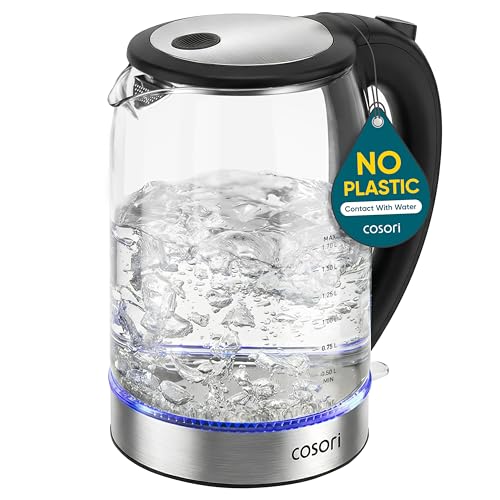
The COSORI electric kettle represents the straightforward electric mainstream: a glass or stainless jug on a swivel base, a fast boil, an automatic shut-off, and no pretence of being anything other than a quick, convenient way to heat water. In glass form it lets you watch the boil arrive, which many tea drinkers enjoy, and it shows scale early, which is either a flaw or a free reminder to descale. It stands in this comparison for the many honest electric kettles that trade the stove-top ritual and indefinite lifespan for speed and a button press.
Best for: the electric side’s case for straightforward speed at a mid tier
Not suited for: stovetop loyalists and hob-centred kitchens
Strengths
- Fast, simple boiling with automatic shut-off
- Watch-the-boil glass on the common configuration
- No hob needed — any socket serves
Trade-offs
- No whistle, no ritual, no power-cut service
- Descaling still applies, and the base must stay dry
Tier: mid-range. Check price on Amazon.
Final Recommendation by Use Case
For the daily tea household that cooks at home: stovetop, and choose it by handling from the shortlist above. For the delicate-tea specialist: electric with presets, without apology, and keep the technique of resting and blending for the days you visit a stovetop kitchen. For the busy household that boils between tasks: electric, for the shut-off alone. For the long-view buyer furnishing a kitchen for a decade: stovetop, at whatever tier your handling habits justify, using tea kettle buying guide to choose it. For the office, desk or bedsit: electric, because there is no hob to argue about. And for the household that recognises itself in both columns: both, bought at honest tiers, each doing the work it is genuinely better at — the most common ending to this comparison in real kitchens, and a perfectly respectable one.
The Household Diary Test: Both Kettles Across One Real Week
Criteria are clean; weeks are messy, and the fairest test of this comparison is to walk both kettles through the same seven days of an ordinary household and record where each one actually won. Monday begins rushed: the electric kettle boils while its owner is in the shower, clicks off, and waits — a clear electric win, because the stovetop kettle’s whistle would have demanded a presence nobody had. Tuesday is a work-from-home day of successive teas, and the stovetop kettle, living on the hob and refilled without thought, wins on rhythm: no counter trips, no base, just a kettle that is simply there. Wednesday brings a green-tea drinker to stay, and the electric kettle’s preset produces the cup the guest praises — the stovetop’s rested water was good, and honestly graded as good, but the preset’s cup was the one asked about. Thursday is a cooking day, grains and blanching and a bain-marie, and the stovetop kettle pours all afternoon without once being thought of as a drinks appliance at all. Friday evening takes the power out for two hours, and the stovetop kettle on gas makes the tea, fills the bottles and wins the day outright, while the electric kettle sits as a handsome ornament. Saturday is a garden day: the stovetop kettle is filled and forgotten by a household outside, rescued by its whistle through an open door — scored as a warning rather than a win, because a closed door would have made it a dry boil — while the electric kettle, filled later, simply waits to be found ready. Sunday is slow, and the stovetop ritual frames the morning in the way its owners bought it for.
The diary’s lesson is not that the week was a draw, though it nearly was. It is that the wins cluster by kind of day rather than by quality of kettle. Rushed, absent and specialist days belong to the electric side. Present, rhythmic and cooking days belong to the stovetop side. A household deciding between them should therefore audit its own week rather than its own preferences: count the rushed mornings against the slow ones, the guests who drink green tea against the afternoons of cooking, the power cuts remembered against the showers taken while water boiled. Most households find their week leans clearly one way once it is written down, and the minority whose weeks are genuinely mixed have discovered, in the diary itself, the honest case for owning both — each kettle taking the days it was built for, neither being asked to impersonate the other on the days it was not.
One more entry belongs in the diary, a year later, and it is the entry the comparison tables cannot show. In that entry the electric kettle of the house has been joined, in many real households, by a small history: a descale remembered or forgotten, a base wiped dry as a habit, perhaps a first hint of a switch growing tired. The stovetop kettle’s entry is shorter: descaled, whistling, there. Neither entry is an argument by itself. Together they are the shape of ownership on each side — one a appliance’s familiar arc, the other an object’s long, uneventful tenure — and households choosing between them are, in the end, choosing which of those two stories they would rather live inside.
What Each Side’s Owners Get Wrong About the Other
Comparisons are usually written by partisans, so this one ends its argument by correcting both camps, in the interest of the reader who belongs to neither yet. Stovetop loyalists claim electric kettles make worse tea, and they are wrong: the water is the same water, and on delicate teas the preset electric kettle makes the better cup more often than the rested stovetop one. They claim electric kettles are wasteful throwaway objects, and they are half wrong: a well-kept electric kettle serves for years, and its shorter life is a design trade for genuine conveniences, not a conspiracy. They claim the ritual is the whole point, and they are wrong in the way of all people who mistake their own pleasure for a universal law — for the household boiling between a shower and a school run, the absence of ritual is the entire point, and it is a point well made. Electric loyalists, in turn, claim stovetop kettles are slow, and they are wrong on induction and overstated everywhere else, because the gap at family volumes is measured in moments rather than minutes. They claim the whistle is a quaint substitute for a switch, and they are wrong about the direction of the comparison: a switch serves the kettle’s convenience, but a whistle serves the household’s awareness, and there are mornings when awareness is the more valuable service. They claim nobody needs an object that lasts decades, and the rising number of households tired of replacing small appliances stands as the correction.
What both camps get wrong together is more interesting than either list. Both speak as if the other side’s buyers were mistaken, when the evidence of real kitchens is that the two objects are answers to two different questions that happen to share the words hot water. One question is how a household wants to feel while its water heats, and how long it wants the answer to last. The other is how a household wants its mornings to run, and how much attention it can spare. A comparison that understands this stops trying to crown a winner and starts trying to match a question — which is what the criterion verdicts throughout this article have attempted, and why they so often end by naming a household rather than a kettle. The reader who has followed the argument this far no longer needs the article’s permission to decide; they need only to recognise which of the two questions is theirs.
And if the recognition is that both questions are theirs, on different days, then the comparison’s final word is the one it has been holding back for honesty’s sake: the two-kettle household is not an indecisive household. It is a household that read the comparison correctly, noticed that its week contains both kinds of day, and equipped itself accordingly — the electric kettle by the socket for the rush and the delicate leaf, the stovetop kettle on the hob for the ritual, the cooking and the dark evenings when the power fails. Plenty of kitchens in the world run exactly that arrangement without ever having read a word of comparison. This article’s ambition is merely to let its readers arrive there, or at either single side, on purpose.
The Tie-Breakers: Small Questions for Households Still Split
Some households finish the main criteria exactly level, and for them this comparison keeps a reserve of smaller questions — not lesser truths, but the ones that only surface once the large ones have cancelled out. Ask about noise: a whistle is a household sound, pitched to carry, and in a small flat with a sleeping baby or a night-shift worker it can be the loudest regular event of the day, while an electric kettle’s click is a whisper by comparison — households for whom sound is scarce and precious should weight this more than they expect. Ask about water taste in your own home: some owners of electric kettles with plastic water windows or lids report a taint when the appliance is new that fades with use, while a stovetop kettle’s all-metal water path never raises the question; households sensitive to taste, or simply unwilling to manage the question, may find the stovetop’s plain interior the quieter choice. Ask about the second location: a kettle that will divide its life between a kitchen and a caravan, a house and a workshop, can only be the stovetop one, while a kettle that will divide its life between a kitchen and a desk can only be the electric one, and households with two-location lives should let geography break their tie without further agonising.
Ask about the people who will use it when you are not there. A visiting parent, a new partner, a teenager making their first solo tea: the electric kettle explains itself to a stranger in one glance and forgives their inattention with its switch, while the stovetop kettle asks to be taught — its fill line, its whistle’s meaning, its hot body — and repays teaching with an object that cannot be damaged by any single act of ignorance short of a dry boil. Households that host often, or that are entering the years of teaching children to cook, will feel this question’s weight in opposite directions, and both feelings are correct. Ask, finally, about failure’s timing. The electric kettle will one day fail on a morning when it is needed, without warning, and the household’s character in that moment — replace it by lunchtime, or resent the errand for a week — is a genuine datum. The stovetop kettle will essentially never present that morning. Households that know they are the resenting kind should let that self-knowledge vote, because a comparison that ignores temperament has ignored the material the decision will be lived in.
Level households sometimes ask for a coin-flip recommendation, and this comparison will give one, with its reasoning attached so it can be disagreed with intelligently. When every criterion ties, choose the stovetop kettle — not because it is better, but because its disadvantages are knowable in advance and its advantages compound with time, while the electric kettle’s chief advantage, convenience, is worth most to households whose weeks lean rushed, and a household whose week leaned rushed would not have tied. A tie is itself evidence: evidence of a household present enough, settled enough and unhurried enough that the attention the stovetop kettle asks for is a price it will barely notice paying. Households that recognise that description may take the recommendation. Households that bristle at it have learned something equally valuable, and should buy the electric kettle with this article’s complete blessing.
The Cost of the Decade: Owning Each Side Across Ten Years
One comparison remains that the criterion sections only touched: what each side costs, in the broadest sense, across a decade of ownership — the horizon on which the two designs differ most. The stovetop decade is front-loaded and then quiet. The purchase is made once, at whatever tier the household’s handling justifies. The running costs are a household’s own: the fuel of its hob, which it was burning anyway; vinegar or citric acid at intervals; perhaps one whistle cap across the decade; and the steady, small tax of attention that this article has never hidden. At the decade’s end the kettle is, in the normal case, still there — marked by its service, worth what it was worth, available for a second decade on the same terms. The electric decade is smoother at the start and busier throughout. The purchase is typically gentler, the mornings easier, the delicate teas better. But the decade contains, in the normal case, the appliance’s whole life: a descale rhythm of its own, a base kept dry through ten years of wet kitchens, and at some unchosen point a failure — element, switch or board — followed by a replacement purchase and a second, younger kettle learning the household from the beginning. Neither decade is cheaper in any sense that can be stated without knowing the household’s prices for money, time and errands. What can be stated is their shape: one purchase and a long quiet, against a lighter beginning and a mid-decade interruption that arrives, as interruptions do, on the morning the kettle was most needed.
Households should choose their shape consciously, because it interacts with everything else in this comparison. The household that hates errands and loves continuity has its answer in the shape alone, whatever the criteria said. The household that treats appliances as consumables and budgets for their replacement as a utility has its answer too, and loses nothing by it. The households that suffer are the ones that buy one shape while expecting the other: the electric buyer who resents the replacement as a betrayal, though the design never promised otherwise; the stovetop buyer who resents the attention as an imposition, though the whistle announced the terms from the first day. This comparison’s whole labour — its tables, its criterion verdicts, its diary, its corrections of both camps — reduces, in the end, to preventing those two resentments. Read the shapes, recognise your household, and buy the decade you actually want to live in.
Postscript: the Comparison, Settled at the Counter
Stand, finally, at the counter where the decision will actually be lived, and let the comparison take its shortest honest form. If your mornings are rushed, your teas delicate and your attention spoken for, the electric kettle will serve you faithfully and ask almost nothing — keep its base dry, descale its chamber, and replace it without resentment when its years are done. If your days are spent near your kitchen, your boiling is constant and your objects are kept, the stovetop kettle will serve you longer than anything else that heats in your home — fill it to its line, stay within its whistle’s reach, and descale it when its voice begins to change. If your life contains both kinds of day in real proportion, the two-kettle kitchen is not excess but accuracy. The comparison crowns no champion because the contest was never between two kettles. It was between two descriptions of a household — and the reader, who is the world’s leading authority on one particular household, has been the judge all along.
The Comparison at a Glance, for the Reader in a Hurry
Everything argued at length in this article survives compression into the handful of sentences a hurried reader actually needs, and it is a point of honour with this comparison that the compression changes nothing. The electric kettle is faster, silent about its readiness, kind to delicate teas and finished when its electronics are. The stovetop kettle is slower by moments, loud with useful information, dependent on technique for delicate teas and finished, in any practical sense, never. The electric kettle frees your attention and charges your counter. The stovetop kettle charges your attention and frees your counter. Each is safe in the hands that keep its habits and risky in the hands that do not. Choose by your week, your water’s favourite leaf, your kitchen’s spare surface and your household’s honest relationship with being summoned — and if those four witnesses disagree among themselves, own both and let each take the days it was built for. The long argument exists for readers who want the reasoning. The short one exists so that nobody, however hurried, has to buy either kettle on a slogan.
Envoi: the Sound and the Silence
Every comparison in this article can be heard, in the end, as a choice between two sounds. One kitchen is punctuated by a whistle: a rising note that crosses rooms, interrupts conversations kindly, and means that water, and therefore tea, is ready and someone is coming. The other kitchen is marked by a click so quiet it is mostly felt as an absence — the sound of a task completed without witnesses, of water that waited patiently to be noticed. Neither sound is better. They are the acoustics of two different domestic philosophies, one that likes its appliances to announce themselves and be answered, one that likes them to serve in silence and be found ready. Households know, usually instantly, which sound belongs in their home — and when they do, the tables and criteria and decades in this article fall into place behind that knowledge like evidence gathered after a verdict the heart had already reached. Trust it. Then read the safety sections once more, whichever side you chose, because both sounds end the same way: with a person, a mitt, and a kettle of boiling water that deserves their full attention for the minute it takes to pour.
A Last Word on Hybrids and Habits
One pattern deserves a final mention because so many households discover it by accident: the hybrid routine, in which a single kettle of either kind is used with the other side’s habits. The stovetop kettle filled the night before and set on its burner, ready for a match and a sleepy hand, borrows the electric side’s preparation. The electric kettle watched, poured with two hands’ worth of care and descaled like a family heirloom borrows the stovetop side’s respect. Habits, it turns out, are portable in a way hardware is not, and households that understand both sides of this comparison tend to run whichever kettle they own unusually well — because they know what the other side would have done, and they have consciously chosen, or consciously compensated. That understanding, more than either appliance, is what this long comparison was really selling. The kettles are just where it gets practised.
Still Torn? Practical Tie-Breakers for This Decision
Run these tie-breaker checks in your own space before the decision hardens, because the differences between the two sides of this comparison behave differently in every household. Start with the tape measure: write the working footprint and the storage footprint for each option, including the clearance each one needs to open, cool, drain, or be carried safely. List your five most frequent jobs and mark, for each one, which option you would reach for without thinking, since that instinctive tally usually predicts long-term satisfaction. Consider the second user in your household and which option they would operate correctly without a briefing, because shared tools are judged by their least confident user.
Compare the cleanup after the same messy job done both ways, counting minutes and pieces to wash rather than impressions, and let that arithmetic speak plainly. Compare the failure modes: what a worn seal, a lost part, or a tired motor does to each option, and which failure you could live with for a month while arranging a fix. Where a shortlist names specific examples, such as OXO Brew Classic Tea Kettle, run these same checks against that listing line by line rather than assuming the general verdict transfers unchanged. Apply the identical test to Le Creuset Enamel on Steel Whistling Kettle as well, on the same day and under the same conditions, because a fair comparison needs one ruler rather than two moods.
- Measure working and storage footprints for both
- Tally five frequent jobs by instinct
- Time the same messy cleanup both ways
- Run the ordinary Tuesday test in your head
- Run the busiest-day test in your head
- Write the deciding sentence before ordering
If Cuisinart PerfecTemp Electric Kettle is also in contention, give it the same worksheet and let the three sets of answers sit side by side before anyone reaches for a checkout button. Compare the consumables and accessories each side quietly requires over a year, and whether those extras are ordinary items or single-source purchases. Compare how each option treats your smallest everyday task and your largest occasional one, and be suspicious of any option that only wins at the extreme you rarely visit. Compare the learning curve honestly by imagining a tired beginner, which might be you on a weekday evening, meeting each option for the first time.
Compare the exit costs: which option is easier to resell, gift, store as a spare, or demote to a second room if your needs change next year. Compare how each side fits the rest of your equipment, since compatibility with what you already own can outweigh a small difference in headline performance. Compare the noise, heat, and presence each option brings to the room at the hour you will use it most, and ask the other people who share that room for their vote. Run the holiday test in your head: the biggest, busiest session of your year, with helpers underfoot, and decide which option you would rather be operating then.
Run the ordinary Tuesday test as well, because most ownership is Tuesdays, and the option that wins the quiet weekday usually wins the year. If the tally stays level, choose by cleanup and storage rather than by peak performance, since daily friction compounds faster than occasional brilliance. Write the deciding sentence down before you order, naming the job and the household fact that settled it, so buyer’s remorse has something factual to argue with later. Revisit that sentence if your household changes, because a verdict built on real jobs expires when the jobs do, and the other option may deserve a second hearing then.
Notice which option you keep defending in conversation, and treat that defensiveness as information: people rarely argue for the choice they secretly expect to regret. Check whether either option forces a supporting purchase to work as described, and fold that requirement into the comparison before treating the headline difference as real. End by asking which option you would choose if both were already in the house and one had to leave, since that framing strips away novelty and sunk cost in one move. Whatever the category, photograph your intended spot with the neighbouring items in place, because a picture exposes crowding that measurements alone politely ignore.
Frequently Asked Questions
Is a stovetop kettle better than an electric kettle for tea?
For most tea, neither is better in the cup: black teas, herbal blends and coffee water come out identically from both. The differences are in the making. A stovetop kettle pours better, lasts far longer and works anywhere there is heat, but must be attended. An electric kettle switches itself off and, on tea-focused models, offers temperature presets that genuinely improve delicate green and white teas. Better, in this comparison, is a property of your household’s habits rather than of either kettle.
Which is cheaper to run, a stovetop or an electric kettle?
It depends on your hob and your habits more than on the kettle. An electric element heats water directly and wastes little; a gas flame loses heat around the kettle, while an induction hob driving a stovetop kettle is efficient and quick. The largest cost in both systems is boiling more water than you need, so the practical advice is identical on both sides: fill for the cups you are actually making, to the maximum line and never beyond it.
Can an electric kettle replace a stovetop kettle entirely?
In a home with reliable power and a household happy with appliance lifespans, yes — many kitchens run electric only and miss nothing they value. What is given up is specific: service during power cuts, use on camp stoves and wood burners, the decades-long lifespan, and the stovetop pour and ritual. If none of those is part of your life, replacement is complete. If any of them is, the electric kettle is a companion to the stovetop one rather than a successor.
Which kettle is safer?
Each is safe under its own discipline and risky outside it. A stovetop kettle demands respect for steam, hot metal and the maximum fill line, plus a person within earshot, because its whistle does not switch it off. An electric kettle demands a dry base, unplugging when filling as a matter of principle, no immersion, and retirement at the first sign of electrical misbehaviour. Households should choose the discipline they will actually keep, because that choice, not the appliance, is the safety decision.
Do electric kettles make green tea better than stovetop kettles?
They make it more repeatably, which for a critical drinker amounts to better. Green tea wants water well below boiling, and a preset delivers that water identically every morning, while the stovetop methods — resting the boiled kettle, blending in cold water, lifting it before the boil — deliver it by judgement that improves with practice. A household drinking green tea daily and judging it closely will feel the electric advantage; an occasional green tea drinker will not taste a difference worth reorganising a kitchen for.
Should I own both a stovetop and an electric kettle?
If your answers in this comparison split evenly, owning both is a rational outcome rather than an extravagance. The common pattern is an electric kettle for weekday speed, delicate teas and desks, and a stovetop kettle for weekends, big pots, cooking water and power cuts. Buy each at an honest tier for its role, keep both descaled on the same schedule, and let each do the work it is genuinely better at instead of forcing one to imitate the other.