Disclosure: As an Amazon Associate, topratedkitchenware.com earns from qualifying purchases. Links on this page are affiliate links; they cost you nothing extra. Prices and availability change often, so check the current Amazon listing before you buy.
The kitchenaid artisan vs professional question sounds like a simple trim-level choice, and for years it was: the Artisan was the 5-quart tilt-head machine for home bakers, and the Professional 600 was the 6-quart bowl-lift machine for people who baked like they meant it. Then KitchenAid retired the Professional 600 and rebuilt its heavy-duty end around new bowl-lift models, which means the comparison you actually need today is three-sided: the Artisan against the Professional you may find used or still boxed in a warehouse, and the Artisan against the current bowl-lift successors that inherited the Professional’s job. This guide covers all three honestly. It explains what the Professional line was built to do, where its design genuinely outperforms the Artisan, where the Artisan remains the smarter buy for most kitchens, and which current model deserves your money if the Professional’s capabilities are the ones you need.
Kitchenaid Artisan Vs Professional: The Quick Verdict
Choose the Artisan if your baking centres on cakes, cookies, frostings, whipped components, and the occasional loaf: it is easier to live with, easier to access mid-mix, and entirely sufficient for that workload. Choose the Professional class, meaning a bowl-lift machine, if you regularly knead large or stiff dough batches, mix double batches as a matter of routine, or bake in near-commercial rhythm. The bowl-lift frame does not tilt, its drive is built for sustained torque, and its larger bowls swallow quantities that make the Artisan strain and wander. Because the Professional 600 itself is discontinued, most buyers today should compare the Artisan against the current 5.5-quart and 7-quart bowl-lift models linked later in this guide, and treat a Professional 600 as a used-market or old-stock decision judged by the criteria in the section on buying one safely.
In this guide
The Professional Name: What It Was, and What Replaced It
The Professional 600, model family KP26M1X, was KitchenAid’s flagship home machine for many years: a 6-quart bowl-lift mixer with an all-metal gear transmission, a powerful motor rated for heavy dough work, and a lift mechanism that raised the bowl to the fixed head rather than tilting the head back. It earned a loyal following among serious bread bakers and became the default recommendation for anyone outgrowing a tilt-head. When we verified products for this guide through the retail catalogue, the Professional 600 mixer itself no longer appeared as a current listing; only its accessories, bowls, beaters, and hooks remain on sale, which is the signature of a discontinued platform being supported rather than sold.
Its role passed to a new generation of bowl-lift machines, principally a 5.5-quart model and a 7-quart model with modern controls, more speeds including a gentle half-speed for folding, and accessory bundles in the box. These successors are the Professional’s true heirs: same bowl-lift architecture, same heavy-duty brief, updated execution. Throughout this comparison, “Professional class” means that bowl-lift lineage, old and new, and where a claim applies only to the retired 600 or only to the current models, the text says so. Shoppers who want the whole family laid out in one place will find it in our complete KitchenAid mixer comparison.
Side by Side: The Two Architectures
| Attribute | Artisan | Professional class (bowl-lift) |
|---|---|---|
| Design | Tilt-head; head tips back for access | Bowl-lift; bowl rises to a fixed head |
| Typical bowl | 5-quart stainless with handle | 5.5 to 7 quarts on current models; 6 quarts on the retired 600 |
| Speeds | 10 speeds | 10 on the retired 600; 11 including a half speed on current models |
| Drive character | Built for versatility and everyday loads | Built for sustained torque and heavy dough |
| Access mid-mix | Excellent; head tilts, bowl lifts out easily | Good; bowl lowers and unclips, head stays put |
| Counter behaviour | Can flex and walk slightly under stiff dough | Stays planted; the frame absorbs the torque |
| Height profile | Taller with the head raised | Fixed tall profile; needs its full height always |
| Best habitat | General home baking | Bread-heavy and high-volume baking |
Every row of that table flows from one mechanical decision: whether the head moves or the bowl moves. Tilt the head and you get access and friendliness at the cost of a hinge that can flex under torque. Fix the head and lift the bowl and you get a rigid column that shrugs at stiff dough, at the cost of a machine that is taller, heavier, and slightly more deliberate to use. Neither is better in the abstract; each is better at a different kitchen’s work. Our dedicated explainer on tilt-head versus bowl-lift mixers goes deeper into the mechanics if you want the engineering view before deciding.
Capacity in Real Batches, Not Quart Labels
Quart figures mislead because the binding constraint is rarely the bowl’s volume; it is how much flour the drive can work before the dough climbs, strains, or stalls the action. On the Artisan, comfortable dough batches sit in the range of a standard loaf or a modest double batch of rolls, using the flour quantities the manual recommends for its power class. Cookie dough, which is dense but not elastic, can run larger, and cake batters are limited mostly by the bowl itself. On the Professional class, the combination of a bigger bowl and a torque-oriented drive roughly doubles the comfortable dough batch, which is the difference between baking for a family dinner and baking for a bake sale without splitting the work into shifts.
The practical test is your own recipe file. If your most demanding regular recipe already fits the Artisan’s envelope, the Professional’s extra capacity is insurance you will rarely claim. If you routinely double recipes, mill through holiday production, or keep a sourdough schedule that produces multiple loaves a week, capacity stops being a luxury and becomes the deciding specification. Bakers in that second group should also read our specialist roundup of stand mixers built for bread dough, where the heavy-duty field is compared on dough work alone.
Dough Performance: Where the Professional Earns Its Name
Kneading is the task that separates these architectures most clearly, because dough fights back. A developing dough mass pulls at the hook with every revolution, and the machine’s frame, gearing, and motor control determine whether that fight is a workout or a walkover. The Artisan kneads competently within its batch limits: the hook folds and stretches, the head nods slightly with the rhythm, and a standard loaf emerges properly developed. Push beyond those limits with a stiff, low-hydration dough and the symptoms arrive in order: the head flexes more, the machine creeps on the counter, the motor note labours, and eventually the dough climbs the hook instead of folding.
The bowl-lift design answers each symptom structurally. The head cannot flex because it does not move. The bowl is cradled on lift arms pinned to a rigid column, so torque goes into the dough rather than into rocking the machine. The drive is specified for sustained low-speed torque, which is exactly what kneading is: not fast, not dramatic, just relentless. Current bowl-lift models add a half-speed setting that folds delicate ingredients without developing them, a small feature that bread bakers also use for gently incorporating preferments. If dough is your main event, this section is the comparison; the rest is commentary. If dough is an occasional guest in your kitchen, weigh the next sections just as heavily, because the Artisan wins several of them outright.
Everyday Baking: Where the Artisan Fights Back
Most home baking is not dough. It is creaming butter for cookies, beating a sponge, whipping cream for a pavlova, folding a mousse, mixing a meatloaf, shredding chicken with the paddle for a weeknight shortcut. Across that workload the Artisan is not merely adequate; it is the more pleasant machine. The tilting head makes adding ingredients mid-task effortless, the bowl lifts out with one hand for scraping into a pan, and the whole interaction feels casual in a way the bowl-lift’s deliberate lift-and-unclip routine does not. The Artisan’s ten speeds cover the same practical range, its planetary action reaches the same touchpoints around its bowl, and for batters and whipped work there is no performance gap to buy your way out of.
There is also a subtle ergonomic point about bowl handles and pouring. The Artisan’s handled bowl pours batter cleanly and carries securely when full of something heavy and sloshy. Bowl-lift bowls are larger, sit deeper on their arms, and are marginally more awkward to manoeuvre to the sink. None of this matters during a bread marathon; all of it matters during the two hundred ordinary tasks between marathons. Buyers who are honest that their baking is ninety percent everyday work should let that honesty steer them, which is why our broader guide to choosing a stand mixer starts with workload rather than specifications.
Noise, Feel, and Counter Behaviour
The two architectures sound and feel different in ways owners notice daily. The Artisan has a lighter, brighter working note and a slight liveliness in the head under load. The Professional class runs deeper and more planted, with the current models’ electronic speed control holding a steadier note as load changes. Under stiff dough the difference becomes physical: an Artisan on a polished stone counter may need a hand rested on its head or a mat beneath its feet, while a bowl-lift machine mostly just gets on with it. Weight follows the same pattern; the bowl-lift machines are the heavier lift onto the counter, and both families are heavy enough that a permanent home beats daily cupboard trips for either. Measure your under-cabinet height with the Artisan’s head raised and the bowl-lift’s fixed height in mind, because the two designs fail the tape measure in different ways, as our notes for stand mixers in small kitchens detail.
Attachments, Bowls, and the Ecosystem
Both families share the same powered front hub, so the celebrated attachment range, pasta rollers, grinders, mills, spiralizers and the rest, fits and runs on either. That parity ends at the bowl. Bowl-mounted tools are size-specific: beaters, hooks, and whips are made for a bowl class and a head geometry, so Artisan tools and bowl-lift tools do not interchange, and the retired Professional 600 has its own tool fitments again. Owners upgrading from a 600 to a current bowl-lift model should expect to adopt the new machine’s included tools rather than carry the old set across. Second bowls, similarly, must match the machine. Our survey of stand mixer attachments worth owning separates the hub attachments, which travel freely across the family, from the bowl-specific tools, which do not.
The Artisan, Considered as a Pick
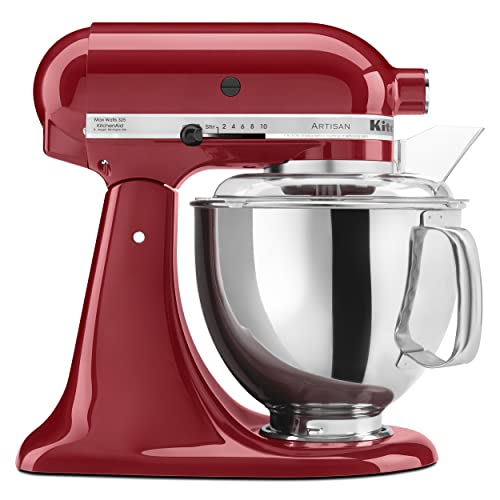
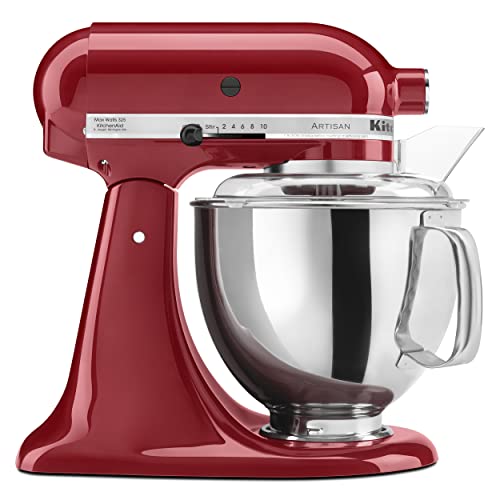
At a glance: KitchenAid Artisan 5-quart tilt-head stand mixer (KSM150PS), 10 speeds, handled stainless bowl, pouring shield included in the verified listing, flat beater, dough hook, and wire whip in the box.
As one side of this comparison the Artisan needs no apology: it is the best-selling configuration in the family because it matches the median kitchen’s workload almost exactly. Its colour range also remains the widest in the line, which matters for a machine that lives on display.
Strengths
- Friendliest daily ergonomics in the family, with tilt access and a handled bowl
- Full hub-attachment compatibility and the widest colour choice
- Entirely sufficient power for cakes, cookies, whipping, and standard loaves
Trade-offs
- Head flex and counter creep under oversized stiff dough batches
- Smaller comfortable dough capacity than any bowl-lift model
- Raised-head height can clash with low wall cabinets
Best for: general home bakers whose dough work is occasional and standard-sized. Not suited for: high-volume or stiff-dough specialists.
The 5.5-Quart Bowl-Lift: The Professional’s Direct Heir
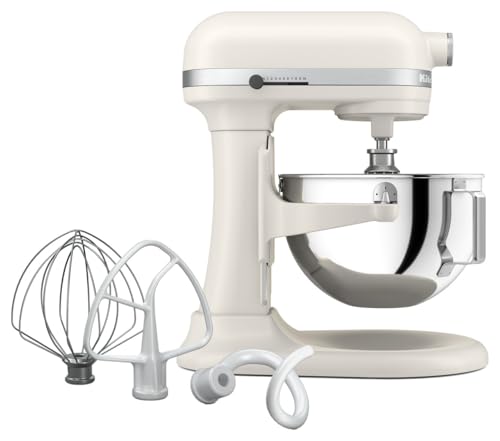
At a glance: KitchenAid 5.5-quart bowl-lift stand mixer (KSM55 family), 11 speeds including a half speed for folding, stainless bowl, flat beater, dough hook, and wire whip included in the verified listing.
This is the machine a Professional 600 shopper should test first today. It keeps the bowl-lift rigidity and torque-first character in a slightly smaller footprint than the old flagship, and the added half speed fixes the one complaint owners used to make about big mixers being clumsy with delicate folding. For most bread-leaning households it is the sweet spot of the heavy-duty branch.
Strengths
- Rigid bowl-lift frame that stays planted through stiff dough
- Half-speed folding that big mixers historically lacked
- Capacity headroom for double batches without flagship bulk
Trade-offs
- Less casual to access mid-mix than a tilt-head
- Fixed tall profile demands permanent counter space
- Tools and bowls are specific to this bowl class
Best for: bread-regular bakers stepping up from tilt-head limits. Not suited for: cooks who mostly whip and cream in small batches.

The 7-Quart Bowl-Lift: The Full-Volume Option
At a glance: KitchenAid 7-quart bowl-lift stand mixer (KSM70 family), 11 speeds with a half speed, accessory bundle in the verified listing including a double flex-edge beater among five accessories.
The largest home bowl-lift in the current line is the true successor to the Professional brief at full scale: big batches, sustained dough work, and production baking for gatherings, fundraisers, and freezer stocking. The bundled accessory set in the verified listing is unusually complete, which softens the step-up cost for bakers who would otherwise equip a big machine piece by piece.
Strengths
- The family’s largest home capacity for dough and double batches
- Accessory bundle that covers most tools a serious baker needs
- Half-speed control keeps a big machine usable for delicate work
Trade-offs
- The bulkiest footprint and heaviest lift in the home range
- Small batches sit low in a big bowl and mix less eagerly
- Premium tier pricing within the family
Best for: production bakers, large households, and committed bread schedules. Not suited for: small kitchens or mostly-small-batch cooking.
Buying a Professional 600 Today: Old Stock and Used-Market Rules
Because the 600 was sold for so long and built sturdily, examples circulate in resale channels and occasionally as old retail stock, and a fair number of readers arrive at this comparison holding exactly that opportunity. Judge it like any used heavy appliance. Ask about its dough history, because a decade of weekly stiff dough is a different machine from a decade of birthday cakes, even at identical appearance. Run it through every speed with the bowl empty and listen for grinding, hunting, or a speed that surges; the all-metal gearbox is durable but not immortal, and its sound tells the truth. Check the lift mechanism for smooth travel and the bowl’s locking pins for wear, since the bowl must sit dead secure under torque. Confirm the included tools match the 600’s fitments, because a missing dough hook in the correct fitment is an extra purchase, though the accessory listings that remain on sale make replacements findable. Finally, price it against the current 5.5-quart bowl-lift rather than against nostalgia: if a used 600 approaches the street price of its modern heir with a fresh warranty, the heir wins, and the 600 only makes sense at a clear discount for its age and unknown history.
How to Knead on Each Design: A Practical Routine
Whichever side of this comparison you land on, dough technique adapts to the architecture, and a few habits protect both machines.
On the Artisan: mix the dough shaggy at stir speed, rest it ten minutes so the flour hydrates and the dough’s demands drop, then knead with the hook at speed 2 only. Keep the batch at or below the manual’s flour guidance, add flour gradually rather than all at once, and rest a hand lightly on the head during the stiffest phase rather than letting the machine walk. If the dough climbs the hook, stop, push it down, and consider that the batch is telling you its size limit.
On a bowl-lift model: the same hydration rest pays off, and the hook work can proceed at the same low speeds with larger batches. Use the half speed to incorporate a preferment or soaker gently before the main knead. The rigid frame tolerates stiffer dough, but tolerance is not invitation: even here, gradual flour addition and respect for the bowl’s working capacity produce better gluten development and a quieter machine than brute-force loading.
On either: judge doneness by the dough, not the timer. A properly kneaded dough is smooth, elastic, and pulls a thin, translucent window when stretched gently. Under-kneaded dough tears dull; overworked dough turns slack and shiny and bakes up tight. The machine is a tool for reaching that window reliably, and the architecture you choose mainly decides how large a batch can reach it in one go.
Decision Guide by Baker Profile
The celebration baker. Cakes, cupcakes, frostings, and the occasional cookie marathon. Artisan, without hesitation; its ergonomics serve every task on your list and its capacity covers your biggest day.
The weekend sourdough keeper. One or two loaves weekly, plus ordinary baking. This is the genuine border zone. A single standard loaf sits inside the Artisan’s comfort; two loaves at once, or a stiff bagel dough, argues for the 5.5-quart bowl-lift. Count your loaves honestly and choose once.
The production baker. Bake sales, big family gatherings, freezer stocking, market stalls. The 7-quart bowl-lift is your machine, and the Artisan would spend its life being worked around rather than worked with.
The small-kitchen realist. Limited counter, low cabinets, modest batches. Neither flagship serves you as well as the family’s smaller models; start from your measurements and read our roundup of the best KitchenAid stand mixers with a tape measure in hand.
The upgrader from a hand mixer. Everything will feel like a revelation, so choose by workload trajectory: if bread curiosity is growing, buy the bowl-lift once rather than the Artisan first and the bowl-lift later.
Cost of Ownership Over a Decade
Sticker comparisons flatter whichever machine is on promotion that week, so consider the decade instead. Both families share hub attachments, so that spending is neutral. The differences accumulate elsewhere: bowl-lift owners buy larger-capacity bowls and tools at slightly higher tiers; Artisan owners who outgrow their machine face the costliest outcome of all, a second purchase. Energy use is trivial for both. Serviceability favours longevity across the family, with the retired 600 demonstrating the point by remaining repairable and accessorisable years after production ended. The cheapest machine is the one that matches your workload the first time, which is why this guide keeps returning to your recipe file rather than to specifications. A Professional-class machine bought for Artisan-level work is not wasted money exactly, but it is counter space, weight, and budget committed to capacity that will spend a decade as headroom. An Artisan bought for Professional-level work is the reverse error, paid for in strained batches and an early replacement. Match the machine to the work and either choice is the economical one.
A Brief History of the Professional Line, and Why It Still Matters
KitchenAid’s heavy-duty branch grew out of commercial equipment: the company’s mixers descend from Hobart’s early twentieth-century machines, and the bowl-lift format is the commercial format, scaled down. Through successive generations the home heavy-duty line carried names like Professional 5 Plus and Professional 600, each iteration refining the same formula of fixed head, lifting bowl, and metal gearing. That lineage explains the 600’s durability reputation: it was engineered by a company whose other customers run bakeries, and its design brief assumed daily work rather than occasional enthusiasm.
The current bowl-lift generation marks the line’s modernisation rather than its abandonment. Electronic speed control replaced purely mechanical regulation, the half-speed setting answered decades of feedback that big mixers were blunt instruments for folding, and accessory bundles in the box acknowledged that serious bakers equip a machine as a system. Readers weighing a used 600 against a new successor are really weighing proven mechanical simplicity against refinement and warranty, which is a legitimate either-way decision. What the history rules out is treating the Professional badge as marketing trim. In this family, unusually, the heavy-duty name described a genuinely different machine, and the Artisan-versus-Professional choice was always an architecture choice wearing a trim choice’s clothing.
Speeds and Control in Practice
Both families advertise speed counts, and both counts conceal the more important variable, which is how the machine behaves at the bottom of the range. Dough work and flour incorporation live at the lowest speeds, and a mixer whose slowest setting is still brisk will punish you with dust clouds and overworked dough. The Artisan’s stir speed is properly gentle, and its ten settings are spaced for the generalist’s tasks. The retired 600 matched it setting for setting in count while holding its speeds more stubbornly under load, a function of its drive and gearing. The current bowl-lift models add the half speed below stir, and in practice that setting earns its place weekly: folding whipped egg whites into a batter without deflating them, incorporating a soaker into a dough without tearing it, and starting a bowl of flour in near silence. It is a small specification that signals the new generation was designed by listening to bakers rather than only to engineers.
At the top of the range the machines converge again. Whipping is whipping: both families spin a wire whip fast enough to build meringue and cream with authority, and the limiting factor becomes the bowl’s cleanliness and the cook’s attention rather than the motor. Where the bowl-lift’s size cuts the other way is in small whipped quantities, where a single cup of cream sits shallow in a seven-quart bowl and the whip skims rather than builds. Serious bakers with big machines keep a smaller bowl or accept the Artisan-sized jobs on the occasions they arise; households whose whipped work is mostly small should count that as a real point for the Artisan rather than a footnote.
Cleaning, Maintenance, and the Decade View in Detail
Daily cleaning is a draw: bowls and coated tools wash up similarly, exteriors wipe down, and both designs collect batter in predictable crevices that a brush handles. The differences appear in periodic care. The Artisan’s hinge deserves an occasional check for pin drift and a wipe of the joint where flour dust migrates; its beater clearance adjusts with a screw in the hinge, a two-minute job with the manual’s coin test. Bowl-lift machines ask instead for attention to the lift arms and the bowl’s mounting pins, which must stay clean and true for the bowl to sit without rocking under torque, and their greater weight makes the annual deep clean a two-person or counter-based affair rather than a sink-side one.
Long-term parts support is strong across the family and unusually relevant to this comparison because the retired machine is part of it. The 600’s bowls, hooks, beaters, and whips remain listed and purchasable, which keeps used examples viable as working tools rather than orphans. Current models are supported as a matter of course. The practical maintenance rule for either architecture is unglamorous: keep the machine clean, keep batches within the design envelope, listen for changes in its sound, and treat a new noise as information rather than ambience. Machines maintained that way, in both families, measure their service in decades, and the secondhand market’s confidence in the Professional name rests on exactly that record.
What Commercial Kitchens Use, and Why It Only Partly Transfers
Readers sometimes ask why they should not simply buy what bakeries buy. The honest answer is that commercial planetary mixers are bowl-lift machines of twenty quarts and upward, floor-standing, wired for premises power, and priced like the equipment they are. The format transfers; the scale does not. What the home Professional class borrows from that world is the architecture and the duty philosophy: rigid frame, torque at low speed, bowls sized for production. What it sensibly leaves behind is everything that makes commercial equipment miserable in a home: the weight, the footprint, the service contracts. The Artisan, for its part, borrows from the domestic tradition of the tilt-head, optimised for access and variety. Neither home line is a failed commercial machine or a toy; they are two translations of mixing into different domestic dialects, and the comparison resolves the moment you know which dialect your kitchen speaks.
Three Baking Days, Walked Through on Both Machines
The birthday cake day
A two-layer cake with buttercream, whipped cream for a trifle, and a batch of cookies for the freezer. On the Artisan this day is effortless theatre: tilt, add, tilt, mix, lift the bowl out and pour, with the handled bowl making every transfer clean. On a bowl-lift machine the same day works perfectly well but with a fraction more ceremony at each bowl change, and the big bowl feels oversized for the cookie batch’s creaming stage until the flour goes in. Verdict for the day: Artisan, on ergonomics, with no quality difference in anything that reaches the table.
The sourdough Saturday
Two loaves of country bread, a batch of bagels, and pizza dough for the evening. On the bowl-lift this is a production line: the big bowl takes the doubled country dough in one knead, the bagel dough’s stiffness registers as a deeper motor note rather than a protest, and the machine stays where you put it. On the Artisan the same day is possible but negotiated: batches split, the stiffest dough gets a hand resting on the head, and by the pizza dough you are managing the machine as much as the baking. Verdict: the Professional class, decisively, which is precisely the workload it was designed around.
The holiday production weekend
Fruitcakes, enriched panettone-style doughs, meringues, and gift cookies in rotation. Enriched doughs are the interesting middle case: buttery and demanding, but kneaded long and gently rather than stiffly. Both machines handle them; the bowl-lift’s capacity wins when recipes double, and its half speed folds fruit and nuts without tearing the dough, while the Artisan’s friendlier access wins during the many small intermediate tasks, the syrups, glazes, and whipped toppings that fill the gaps. Households that live this weekend twice a year should weight it lightly; households that live it monthly should weight it heavily, and in the heavy direction the bowl-lift takes the comparison.
Counter Planning: Giving Either Machine a Proper Home
Both machines reward a planned home and punish an improvised one. The Artisan needs depth for its bowl and swing, plus the raised-head height clearance discussed earlier; a pull-out board or a low equipment shelf inside a base cabinet suits owners who must store it away, though its weight argues for leaving it out. The bowl-lift needs its full fixed height at all times and a touch more depth for the lift handle’s travel, and it is the heavier machine to relocate, so its home should be chosen once and chosen well. In both cases, position the machine near the flour storage and the oven’s landing zone, because the path between mixer and oven is walked with hot, heavy bowls. A heatproof mat under either machine protects stone counters from both heat and the slow creep of vibration marks. These are small decisions, but they are the difference between a machine that gets used daily and a machine that gets admired, and they apply with equal force to a secondhand Professional 600, which deserves the same considered placement as its modern heirs.
Motor Control: The Quiet Revolution in the Newer Machines
One technical shift separates the retired Professional from its successors more than any other, and it deserves explanation because it changes how the machines feel. Older heavy-duty home mixers regulated speed mechanically, which meant the actual speed sagged as dough resistance rose and recovered as it fell; experienced bakers learned to read that sag as information about their dough. The current bowl-lift generation uses electronic control that senses load and feeds power to hold the selected speed steadier, which makes timings and techniques more repeatable between batches and removes a variable when a recipe says to knead at a set speed for a set number of minutes. The half-speed setting is a child of the same electronics, since holding a genuinely slow, stable speed under varying load is something mechanical regulation did poorly.
The Artisan’s control is simpler, and for its workload that simplicity is proportionate: batters and creams do not fight the motor the way dough does, so speed sag is rarely part of its story. This is a useful lens on the whole comparison. The Professional class’s sophistication is concentrated exactly where its workload demands it, in sustained torque under changing resistance, and the Artisan’s engineering budget is spent instead on access, colour, and everyday ease. Neither allocation is wrong; each is a bet about what the machine will spend its life doing, and your recipe file tells you which bet matches your kitchen.
The Secondhand Market for Both Machines
Because both families last, both circulate secondhand, and the comparison extends naturally into that market. Used Artisans are plentiful, which keeps their prices honest and their colour selection surprisingly broad; the checks are the hinge pin, the speed lever’s positive feel at each setting, and the condition of the bowl’s locking plate. Used Professional 600s are fewer and priced by reputation, so discipline matters more: the premium for the name should never exceed the discount the machine’s age and unknown dough history deserve. In both cases, factor the cost of any missing tools in the correct fitment before comparing against a new machine’s promotional price, because a cheap mixer missing its hook, whip, and bowl is not cheap. A machine that passes its checks, from either family, is one of the safer secondhand purchases in the kitchen, which is more than can be said for most small appliances and is itself a verdict on how both were built.
Warranty, Support, and What Breaks First
Support expectations should be calibrated to how these machines actually age. In both families the common service events are peripheral rather than catastrophic: a speed lever that loses its crispness, a hinge pin that drifts on the tilt-head, lift-arm wear on the bowl-lift, a beater whose coating eventually chips and gets replaced as the consumable it is. Gearboxes and motors, the expensive heart of either machine, are the parts least often at issue when batches stay within the design envelope, and the retired 600’s continued presence in working kitchens is the long-run evidence. Current models carry the manufacturer’s standard warranty for new purchases; used purchases carry whatever confidence your inspection earned, which is why the inspection routine earlier in this guide is written the way it is. For either family, registering a new machine, keeping its model code recorded, and buying tools in the correct fitment from the start will cover nearly every support interaction an owner ever has.
The Final Recommendation, Stated Plainly
Strip the comparison to its frame and it reads like this. The Artisan is the better mixer for the way most people bake most of the time: friendlier, sufficient, and joyful in daily use. The Professional class, yesterday’s 600 and today’s bowl-lift successors alike, is the better mixer for the way serious bread and volume bakers bake: rigid, capacious, and unstrained by the work that makes a tilt-head negotiate. The mistake is not choosing either; the mistake is choosing by the badge’s prestige rather than by your own recipe file. Read your last twenty bakes, count how many of them pressed against capacity or dough stiffness, and let that count cast the deciding vote. Fewer than a handful, and the Artisan will delight you for a decade. A steady drumbeat, and the bowl-lift will feel less like an upgrade than like a relief. Either way, you are choosing between two honest machines, which is the best kind of decision a kitchen ever asks for.
And if, after all of this, you remain genuinely torn, choose by the constraint you cannot change. Cabinet height, counter depth, and the size of your household’s appetite are fixed facts; preferences about colour and ceremony are negotiable ones. A machine that fits its space and its workload gets used, and a used machine justifies itself every week, while a theoretically superior machine that fights its kitchen becomes expensive sculpture. The bakers who love their mixers a decade on are rarely the ones who bought the most impressive specification. They are the ones whose machine, Artisan or Professional, quietly matched the life it was bought into, batch after batch, year after year.
Flour Capacity: The Number That Actually Governs Dough Batches
KitchenAid once published a flour-power rating for its mixers, expressing in cups of flour the largest dough batch each machine was designed to work, and although the marketing has moved on, the concept remains the most useful way to think about capacity in this comparison. Bowl quarts measure volume; flour capacity measures work. A bowl can physically contain a dough whose flour quantity the drive cannot develop properly, and the gap between those two numbers is where strained motors and disappointing loaves live. The Artisan’s flour envelope suits the standard home repertoire: a loaf, a pizza batch, a tray of rolls. The Professional class’s envelope extends to doubled and stiffened versions of all three, which is why its bowls are bigger: the bowl grew to serve the drive’s capacity, not the other way around.
Home bakers can apply the concept without any published figure. Your machine’s flour envelope announces itself through behaviour: dough that folds and clears the bowl’s sides at speed 2 without the head straining is inside the envelope; dough that climbs the hook, stalls the fold, or sets the machine creeping is outside it, whatever the bowl’s quart label says. When a recipe exceeds the envelope, splitting the batch is not a failure of technique but the correct professional response; bakeries divide dough as a matter of course. Choose your machine so that your regular recipes sit comfortably inside its envelope rather than at its edge, and both the Artisan and the Professional class will feel powerful, because in their proper work, they are.
What Comes in the Box, Generation by Generation
Box contents trace the line’s evolution usefully. The Artisan’s standard box is the generalist’s kit: the handled bowl, a pouring shield in the listing we verified, and the three core tools, beater, hook, and whip, that between them cover the machine’s whole repertoire. The retired 600’s box was sparer in spirit, a big bowl and its three tools, reflecting an era when the buyer was assumed to be equipping a working kitchen deliberately. The current bowl-lift models have moved toward abundance: the 7-quart’s verified listing bundles five accessories including a double flex-edge beater, which quietly acknowledges that at this level the machine is bought as a system. For the comparison’s purposes the lesson is to inventory any specific offer rather than assume: a used 600 missing its hook is a different proposition from a complete one, and a current model’s bundle can close much of the value gap with a discounted rival. Count the tools, confirm their fitment, and let the arithmetic join the architecture in making your decision.
Colour and Finish at the Heavy-Duty End
A final, lighter difference deserves its paragraph because it genuinely influences purchases. The Artisan is the family’s fashion line, with a rotating palette that treats the mixer as kitchen jewellery. The Professional class has always dressed more conservatively: the 600 came in a short list of serious finishes, and the current bowl-lift models, while offering more colour than their ancestor did, still trail the Artisan’s range. For some buyers this settles nothing; for others, who have designed a kitchen around a particular finish and bake bread twice a week, it creates a real tension between the machine they want to look at and the machine their dough wants them to own. Our advice is to let the dough win and solve the aesthetics with placement and a good cover, because you will forgive a colour every day more easily than you will forgive a strained knead every Saturday. Machines earn their counter space by working; the finish is the frame, not the picture.
One More Consideration: The Household’s Second Cook
Comparisons are usually written for a single decision-maker, but mixers are shared, and the second cook’s experience differs by architecture in ways worth a paragraph. The Artisan forgives the occasional user: its tilt, its lever, and its lifted bowl explain themselves to a partner, a teenager, or a grandparent without instruction, which makes it the better household citizen. The bowl-lift asks its second cook for a short apprenticeship, the lift, the unclip, the seating of the bowl, after which it is equally simple but never quite self-evident. In households where the machine will be used by many hands with varying confidence, that teachability is a genuine point for the tilt-head, to be weighed alongside dough and capacity rather than beneath them. A machine that only its purchaser can operate confidently is a machine half owned, whatever its frame can knead.
And if the second cook in your household is the one who bakes most, let their hands cast the deciding vote in the shop, because architecture is a bodily experience before it is a specification, and the machine that fits the baker’s habits will be used with pleasure while the machine that merely fits the spreadsheet will be used with tolerance. Pleasure compounds over a decade; tolerance merely accumulates.
Frequently Asked Questions
Is the KitchenAid Professional 600 still worth buying?
As a used or old-stock purchase at a sensible discount, it can be: the platform was durable, its all-metal gearing has a strong track record, and its bowls and tools remain available. Judge the individual machine by its sound, its lift mechanism, and its dough history, and compare its price against the current 5.5-quart bowl-lift with a fresh warranty. At price parity, the new machine is the rational buy.
What replaced the Professional 600?
KitchenAid’s current bowl-lift generation, principally the 5.5-quart and 7-quart models, inherited the Professional brief: fixed head, lifting bowl, torque-first drive, and large capacities. The newer machines add refinements the 600 lacked, notably a half-speed setting for folding and modern electronic speed control, while keeping the same fundamental architecture.
Can the Artisan really not handle bread dough?
It handles standard home loaves perfectly well, and claims otherwise exaggerate. Its limits are specific: large batches and stiff, low-hydration doughs make the tilting head flex and the machine work at the edge of its design. Occasional and moderate bread bakers are well served; bakers whose routine is heavy dough in quantity are the ones the Professional class exists for.
Do Artisan and Professional attachments interchange?
Hub attachments do, completely, because both families share the same powered front hub. Bowl-mounted tools do not: beaters, hooks, whips, and bowls are made for specific bowl classes and head geometries, so an Artisan beater does not fit a bowl-lift machine and the retired 600 has its own fitments. Budget for the included tool set of whichever machine you buy.
Which is louder, the Artisan or a bowl-lift model?
They differ more in character than in volume. The Artisan sounds lighter and brighter, with audible head movement under load; bowl-lift machines run deeper and steadier, and their electronic control holds speed more evenly as dough resistance changes. In an open-plan kitchen at full whip speed, either will announce itself; at dough speeds, the bowl-lift is the calmer presence.
If I can only buy one, which is the safer long-term choice?
The safer choice is the one matched to the heavier end of your realistic workload. If your baking might plausibly grow into regular bread, the 5.5-quart bowl-lift is the buy-once answer, accepting slightly less casual ergonomics for everyday tasks. If your baking is firmly in cake-and-cookie territory with loaves as guests, the Artisan is the safer and happier long-term machine, and its decade of daily pleasantness is its own form of insurance.