Disclosure: As an Amazon Associate, topratedkitchenware.com earns from qualifying purchases. Links on this page are affiliate links; they cost you nothing extra. Prices and availability change often, so check the current Amazon listing before you buy.
The kitchenaid classic vs artisan mini pairing is the small end of the family arguing with itself, and it is a more interesting argument than the one-quart difference on the spec sheet suggests. The Classic is the line’s traditional entry point: a 4.5-quart tilt-head machine with ten speeds, plain finishes, and decades of service behind it. The Artisan Mini is the newer idea: a 3.5-quart machine built to Artisan standards of finish and colour, shrunk in every dimension for kitchens where counter space is the scarcest ingredient. One is the budget classic, the other is the premium compact, and which of them belongs in your kitchen depends on whether your constraint is money, space, or batch size. This comparison measures both machines against all three constraints, walks through the batches each handles gracefully, and ends with a clear recommendation for the households each design quietly targets.
Kitchenaid Classic Vs Artisan Mini: The Verdict in Advance
If your kitchen has room for it, the Classic is the value answer: more bowl, the same ten speeds and planetary action, and a lower tier of pricing, in exchange for plain styling and a shorter colour list. If your counter is genuinely small, your cabinets low, or your household cooks in small batches by preference rather than by compromise, the Artisan Mini is the better machine for your life despite its smaller bowl, because a mixer that fits gets used and a mixer that fights its space gets resented. The sections below exist to help you decide which of those households is yours, with measurements rather than impressions. Readers still orienting themselves in the family should start with our full KitchenAid mixer comparison and return here for the small-machine detail.
In this guide
The Two Machines at a Glance
| Attribute | Classic (K45SS) | Artisan Mini (KSM3316) |
|---|---|---|
| Bowl | 4.5-quart stainless steel | 3.5-quart stainless steel |
| Design | Tilt-head | Tilt-head |
| Speeds | 10 | 10 |
| Mixing action | 59 touchpoints around the bowl | Planetary action sized to the smaller bowl |
| Tools included | Flat beater, dough hook, wire whip | Flat beater, dough hook, wire whip |
| Attachment hub | Yes, full compatibility | Yes, full compatibility |
| Finishes | A short, practical list | A wide, Artisan-style colour range |
| Footprint character | Full-size tilt-head frame | Noticeably smaller and lighter in every dimension |
| Natural owner | Value-first general baker | Space-first small-batch baker |
The table’s most important row is the last one. These machines overlap so heavily in capability that the choice is really about which scarcity governs your kitchen. The Classic spends its design budget on capacity per unit of cost. The Mini spends its on centimetres and finish. Neither spending pattern is wrong, and confusing them is how buyers end up with a bargain that does not fit or a jewel that cannot swallow their favourite recipe.
Footprint, Height, and Weight: The Mini’s Home Ground
Stand mixers fail kitchens in two dimensions: the counter area they occupy and the vertical space they demand with the head raised. The Classic, despite being the family’s modest model, is a full-size tilt-head machine in frame terms, sharing the general stance of its larger siblings. It needs a proper stretch of counter, real clearance above it when the head tips back, and a certain commitment when it is time to move it, because it is built with the metal construction its listing advertises and carries the weight to match.
The Mini was engineered against exactly those complaints. It is smaller in height, depth, and width, and meaningfully lighter, which changes its daily reality: it slides out from under a cabinet with less negotiation, fits counters where a full-size machine would crowd the kettle off the edge, and can be lifted into a cupboard by owners who would not attempt it with a heavier machine. In studio flats, small rental kitchens, caravan and boat galleys, and the downsized homes of cooks who refuse to downsize their baking, those centimetres are not a preference but the whole decision. Our roundup of stand mixers for small kitchens shows how the Mini’s dimensions compare with the wider compact field, tape-measure figures included in spirit: measure your space first, because no review can do that part for you.
Power and Mixing Action: More Alike Than the Sizes Suggest
Both machines run ten speeds through a planetary action, and the Classic’s listing specifies the same 59-point touchpoint pattern around its bowl that the larger Artisan advertises. In practical terms both cream, beat, whip, and knead with the family technique: a slow stir that respects flour, a working middle range, and top speeds that build meringue without drama. The Mini’s smaller bowl concentrates its action, which flatters small batches: a modest quantity of butter and sugar sits deep enough for the beater to engage fully, where the same quantity in a large bowl can smear thinly across the base and ask for extra scraping.
Where the Classic pulls ahead is load tolerance over time. Its larger frame and bowl accept bigger, heavier batches with less sense of occasion, and its dough work covers the standard home loaf with room to spare. The Mini kneads honestly but in miniature: a small loaf, a pizza base, a batch of rolls sized for two. Ask it for a doubled sandwich loaf and you have left its design brief, not discovered a defect. Power in this comparison is therefore best understood as batch-scaled rather than absolute: each machine is properly powered for the quantities its bowl implies, and trouble only arrives when owners read the bowl’s size as a suggestion.
Batch Maths: What Each Bowl Actually Holds in Recipes
Quarts become real when translated into food. The Classic’s 4.5-quart bowl handles a standard cake batter with headroom for folding, a full batch of cookie dough in the dozens, a family loaf of bread, and mashed potatoes for a holiday table without sloshing. The Mini’s 3.5-quart bowl handles a standard cake in its single-layer and modest two-layer forms, cookie batches in the couple-of-dozen range, a small loaf or a set of rolls, and whipped components for desserts serving four to six. Holiday-scale and bake-sale ambitions overflow the Mini not at the mixing stage but at the doubling stage, which is why its natural owner is the household that bakes fresh and small rather than in production runs.
There is a countervailing truth that big-bowl owners learn slowly: minimum batches are real too. A single egg white, a half cup of cream, a small glaze, these sit awkwardly in a large bowl where the whip barely reaches. The Mini’s compact bowl is genuinely better at the small end of the recipe book, and cooks for one or two, who live at that end, feel the advantage weekly. The Classic occupies the sensible middle: small enough to manage modest batches with a scrape or two, large enough that most standard recipes need no adjustment at all. If your recipe file is written in standard quantities and you bake for three to five people, the Classic’s bowl is the one that asks nothing of you. If your file is full of halves and your household is one or two, the Mini asks nothing instead.
Bowls, Tools, and the Details That Differ
Both machines arrive with the same trio of tools, flat beater, dough hook, and wire whip, sized to their bowls, and both drive the full hub attachment range, so pasta ambitions and grinding projects are equally available to either owner. The differences live in the details. The Classic’s bowl is a plain stainless bowl in the traditional style, functional and unadorned, while the Mini’s presentation follows the Artisan line’s polish, with the machine itself offered in the kind of colour range that treats the mixer as a design object. Owners who display their machine tend to care about that more than they expect to at purchase; owners who store theirs away rarely think of it again.
Tool fitments are bowl-specific, as everywhere in this family, so a second bowl or a replacement beater must match the model. The Mini’s smaller ecosystem of bowls is a touch narrower than the Classic’s, which benefits from the enormous installed base of the 4.5-quart class across several model generations. Neither machine accepts the other’s bowl, and neither accepts the 5-quart Artisan’s, a point worth fixing in memory before ordering accessories during a sale. Our guide to stand mixer attachments and tools maps which accessories are universal to the hub and which are married to a bowl size.

The Classic, Considered as a Pick
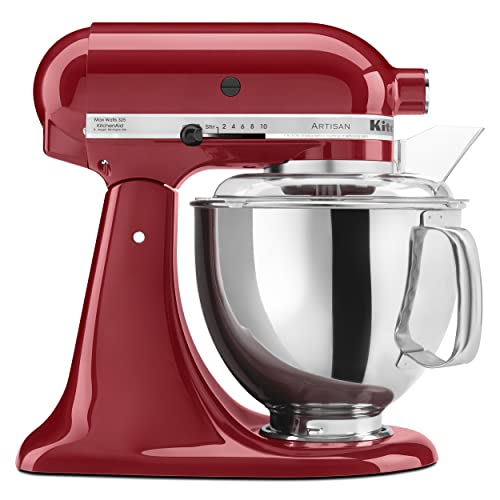
At a glance: KitchenAid Classic Series 4.5-quart tilt-head stand mixer (K45SS), 10 speeds, durable metal construction, 59 touchpoints, in Onyx Black in the verified listing.
The Classic is the family’s honest workhorse: no theatre, no palette of finishes to agonise over, just the core KitchenAid experience at the most accessible tier. For a first stand mixer, a cottage kitchen, or a second machine for a holiday home, its proposition is hard to argue with.
Strengths
- The most bowl and capability per unit of cost in the family
- Full ten speeds, planetary action, and hub compatibility
- Enormous installed base keeps bowls and tools easy to source
Trade-offs
- Plain presentation and a short colour list
- Full-size frame despite the modest bowl
- Bowl in the traditional plain style rather than a handled design
Best for: value-first bakers with normal counter space and standard recipes. Not suited for: genuinely tight kitchens or cooks who bake in small batches only.
The Artisan Mini, Considered as a Pick
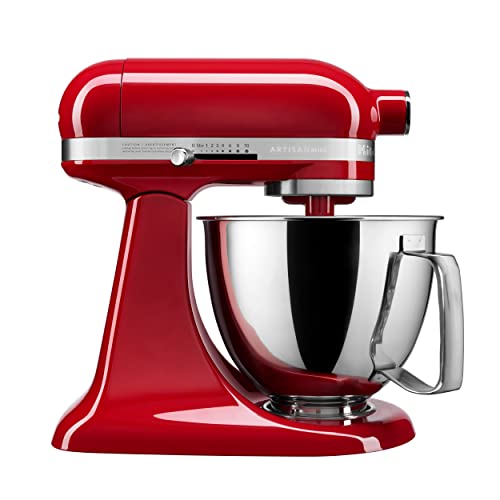
At a glance: KitchenAid Artisan Mini 3.5-quart tilt-head stand mixer (KSM3316 family), 10 speeds, three accessories included, in Empire Red in the verified listing.
The Mini is a distillation rather than a dilution: the Artisan experience, its finish quality and colour choice included, compressed into a machine sized for the way small households actually cook. Its smaller bowl is a feature at the small-batch end of the recipe book, not merely a compromise at the large end.
Strengths
- The family’s smallest footprint and lightest lift
- Artisan-grade finishes and a wide colour range
- Superior small-batch behaviour in its compact bowl
Trade-offs
- 3.5-quart ceiling on doubled and holiday batches
- Premium tier pricing for its size class
- Dough work is honest but small-scale
Best for: small kitchens, households of one or two, and fresh-and-small bakers. Not suited for: production baking or growing families who double everything.
Cooking for One or Two: The Mini’s Quiet Case
Recipe culture assumes a household of four, but a large share of real kitchens cook for one or two, and their baking has a shape the Mini fits unusually well. Halved cake recipes, six muffins, a small loaf that will be eaten while fresh rather than frozen in slices, whipped cream for two desserts: these are the Mini’s native quantities, and it handles them without the scrape-and-coax routine that small amounts in big bowls demand. There is also a freshness argument. Small households that bake in small batches bake more often, because each bake is quick and nothing goes stale, and a machine sized to encourage that rhythm earns its counter space in use rather than in specifications. The Classic can serve this household too, and many do, but it serves it the way a family car serves a solo commuter: perfectly well, with capacity that spends most journeys empty.
The Growing-Household Question
The counter-argument deserves equal honesty. Households change: a couple becomes a family, a hobby becomes a bake-sale sideline, a bread habit grows from monthly to weekly. A mixer is a decade-scale purchase, and the Classic’s extra quart is cheap insurance against that growth, bought once at the family’s lowest tier. The Mini bought by a household on the edge of expansion can become the machine that gets replaced, which is the most expensive outcome in this entire comparison. Our advice is to project two years, not ten: if your household’s size and ambitions are stable on that horizon, buy for the kitchen you have; if change is visibly coming, buy the Classic’s headroom and accept its larger stance in the meantime. The guide on how to choose a stand mixer generalises this thinking across the whole category.
Scaling Recipes Down and Up: A Practical Method
Whichever machine you choose, batch scaling is a skill worth having, and the small end of this family rewards it most.
Halving: halve every ingredient by weight where possible, because volume measures of flour and cocoa scale sloppily. Keep mixing times similar but watch earlier, since small masses cream and whip faster. Eggs are the awkward unit: beat a whole egg and use half by weight for precision in delicate bakes, or choose recipes written in small batches to begin with.
Doubling: the Classic accepts most standard doubles of batters and cookie doughs; the Mini accepts doubles only of light batters, and doughs should be split and kneaded in sequence rather than forced. When in doubt, mix the wet base as one batch and divide before the flour goes in, which keeps each machine’s kneading inside its envelope.
Whipping minimums: in the Mini, a half cup of cream whips reliably; in the Classic, plan on a cup for the whip to engage without splashing patience. Egg whites follow the same pattern at two whites and three respectively, as working minimums rather than guarantees.
These are the numbers that decide real satisfaction with a small mixer, and they favour whichever machine’s bowl matches the quantities you actually make, which has been this comparison’s refrain from its first table.
Recipe by Recipe: Where Each Machine Shines
Layer cakes and sponges
A standard two-layer cake asks a mixer to cream butter and sugar thoroughly, incorporate eggs without curdling, and fold flour gently. Both machines do this beautifully at standard scale, and the Mini’s smaller bowl actually creams a half batch more convincingly than any large machine. The Classic’s advantage appears with tall celebration cakes and double batches for tiered projects, where its extra quart swallows the batter without crowding the beater’s arc. For the birthday-cake-a-term household there is nothing to choose between them; for the household that has discovered tiered cakes as a hobby, the Classic is the safer long-term tool.
Cookies and bars
Cookie dough is dense, and density is where bowl size quietly matters. A full recipe of chocolate chip cookie dough, with its butter, sugars, flour, and heavy mix-ins, fills the Mini’s bowl to a level where the final additions must be folded with care, while the Classic takes the same recipe in stride. Halved recipes reverse the verdict, mixing more evenly in the Mini. Bars and traybakes, mixed in a single bowl and spread in a pan, follow the same pattern. The honest summary is that cookie bakers should count their typical batch, not their biggest or smallest, and buy the bowl that fits the typical one.
Bread and pizza dough
Both machines knead with the hook at low speed, and both produce properly developed dough within their batch envelopes. The Classic’s envelope covers the standard home loaf and a family pizza night. The Mini’s covers a small loaf, two pizza bases, or a set of rolls, and it does so with a neatness that suits households baking bread little and often, where each bake is eaten fresh. Stiff doughs at either scale deserve respect: keep hydration sensible, add flour gradually, and let the hook’s slow work do what hand-kneading would. Households whose bread ambitions are the centre of their baking should be reading beyond this pair entirely, toward the bowl-lift machines discussed in our artisan versus professional comparison.
Whipped work: cream, whites, and mousses
Whipping exposes bowl geometry more than any other task. Too large a bowl and the whip skims the surface of a small quantity; too small and a generous meringue climbs toward the head. The Mini whips small quantities with real authority, a half cup of cream or two whites, which makes it the better dessert machine for couples. The Classic handles the family-scale versions, a full pavlova base or the whites for a large angel cake, without crowding. Both demand the same discipline: a scrupulously clean, grease-free bowl, because no motor can whip whites that fat has compromised.
Savoury work
Stand mixers earn weekday keep on savoury tasks more often than buyers expect: meatloaf and meatball mixtures that stay tender because the paddle mixes without the heat of hands, shredded chicken for salads and tacos, mashed potatoes in holiday quantity, and softened compound butters. The Classic’s bowl suits the family-scale versions of all of these. The Mini covers the same list at couple scale and is arguably the better meatball machine, since small savoury batches in large bowls tend to smear rather than mix. Neither machine replaces a food processor, and both households should resist the sales pitch that any single appliance does everything.
Storage Stories: Where Small Machines Actually Live
The brochure version of mixer ownership has the machine enthroned on an open counter. The real version, in small homes, involves appliance garages, deep drawers, the top of the fridge, and the cupboard above the oven that requires a stool. The Mini’s lighter weight and smaller stance make all of those addresses plausible, which multiplies the kitchens it can honestly serve. A machine that lives in a cupboard gets used when the lift is easy; a machine whose lift is a commitment gets used on occasions, and occasions are not what stand mixers are for. The Classic, heavier and larger, realistically needs either permanent counter residence or a low, accessible shelf, and buyers should decide its address before purchase rather than after the first hernia joke.
There is a second storage story, which is the second home: the holiday cottage, the student flat, the granny annex, the narrowboat. In those kitchens the Mini’s virtues compound, because space is scarce, batches are small, and the machine may be carried between addresses seasonally. The Classic’s counter-argument is durability per unit of cost in a primary kitchen that bakes constantly. Both stories are true; they are simply about different houses, and this comparison cannot choose your house for you.
Noise, Neighbours, and Early Mornings
Small homes have thin walls and shared hours, so a word on noise is practical rather than decorative. Both machines are audible at whip speed and modest at working speeds, with the Mini’s smaller motor and mass producing a slightly lighter note. Neither will wake a house at stir speed during an early dough start, which is the scenario that actually matters for bakers who proof overnight and mix at dawn. In flats, placing either machine on a folded towel or mat during use softens the counter-borne hum that travels to the flat below, a courtesy worth the five seconds it takes. If your baking happens while a baby sleeps in the next room, both machines pass the test at low speeds and neither passes it at full whip, which is a law of physics rather than a product difference.
Care and Maintenance for Both Machines
Small mixers ask for the same light care as their larger siblings, with a couple of size-specific notes. The tilt hinge on both should be kept free of the flour paste that forms when dust meets a drip of batter; a soft brush after messy jobs prevents the stiffness that owners later mistake for mechanical wear. Beater clearance matters more, not less, in small bowls, because a beater set a fraction too high leaves a visible unmixed layer in a shallow batch, while one set too low strikes the bowl and chips its coating. The coin test from the manual, run once when the machine is new and again if mixing behaviour changes, keeps both machines honest. Bowls should be dried before storage to protect the finish, and tools stored in the bowl want a cloth between them to prevent the rattling marks that accumulate over years.
The Mini’s lighter construction invites one specific misuse: being carried by its head or tilted by its bowl. Lift it by its base, as with any mixer, and it will repay you with the same longevity as its heavier relatives. The Classic’s corresponding misuse is neglect born of its workhorse image; metal construction is durable, not invulnerable, and its speed lever and hinge deserve the same occasional attention. Neither machine asks for oiling, belt service, or any of the rituals of older appliances, which is part of why this family dominates its category: the ownership contract is simply to keep it clean, keep batches in its envelope, and listen to it.
The Gift, the First Flat, and the Wedding Registry
These two models meet many buyers as gifts, and the comparison reads differently from the giver’s chair. The Classic is the generous, practical gift: the lowest-cost route into the family’s full capability, in finishes that offend nobody, for a recipient whose kitchen you may not have measured. The Mini is the considered gift: for the recipient whose small kitchen you know intimately, whose cooking-for-two habits you have watched, and who will read the colour choice as the compliment it is. Registries sharpen the same logic. Couples registering from a small flat should register the Mini without apologising for its size, because the full-size machine their relatives think they should want will spend its life in a box in a hallway. Couples with a house and a garden and plans should register the Classic or above and let the headroom wait patiently for the life that fills it. In gift-giving as in buying, the model code on the listing is the giver’s friend, confirming that the machine in the cart is the machine in the comparison.
When Neither Machine Is the Answer
A comparison earns trust by naming its own limits. If your baking is a few batters a year and your kitchen is truly tiny, a good hand mixer and a strong arm may serve you better than either of these machines, at a fraction of the cost and none of the storage. If your household bakes at family scale weekly and your counter can take it, the 5-quart Artisan above both of these models is the natural step, buying capacity and colour in one move. If bread rules your kitchen, the bowl-lift branch is your country, as the comparison with the Professional class explains. The Classic and the Mini divide the small, sensible middle of the market between them: value on one side, compactness on the other. Everything outside that middle belongs to other machines, and choosing one of those instead is not a failure of this comparison but its proper use.
The Cost Picture Over Five Years
Neither machine asks much of its owner financially after purchase: no consumables, no subscriptions, no filters, just the occasional replacement tool if a coating wears or a bowl meets a hard floor. The realistic five-year extras are the same for both: a second bowl for the keen, a flex-edge style beater where available for the model, and perhaps a hub attachment discovered through a new hobby. The Classic’s tools and bowls benefit from the scale of its installed base and are correspondingly easy to find; the Mini’s are a smaller market but fully supported. Energy costs are negligible at household duty. The dominant financial variable is not running cost but replacement risk, which is why the growing-household section above matters more than any price comparison: the cheapest mixer is the one you buy once, sized for the life you are actually about to live. On that measure both machines can be the economical choice, and each can be the expensive mistake, depending entirely on the household that chooses it.
Accessibility and Ergonomics: An Underrated Difference
Weight is not only a storage question; it is an accessibility one. Cooks with limited grip strength, arthritis, or a shoulder that complains will feel the difference between these machines in their bodies, not their spreadsheets. The Mini’s lighter body, smaller bowl, and more manageable tools make it the kinder machine to lift, carry, wash, and store at waist height. Its bowl, full of batter, is a one-hand carry where the Classic’s full bowl can be a two-hand negotiation. The tilt action on both is light, the speed levers are simple and positive, and neither machine hides its controls in a menu, which suits cooks who value mechanical directness. Households choosing a mixer for an older baker, or for anyone whose strength is a real variable, should weight this section heavily: the best mixer is the one its owner can use without planning around it, and for a meaningful number of cooks that is the Mini’s strongest argument, stronger even than its footprint.
The Downsizing Story, Told Properly
There is a particular reader this comparison quietly serves: the experienced baker moving from a family house to a smaller home, whose full-size mixer has served for years and whose skills vastly exceed the Mini’s spec sheet. The fear is that a smaller machine means a smaller baking life. The evidence of owners who have made the move is kinder: batch sizes shrink to match the household, freshness improves because nothing is baked in surplus, and the techniques of a lifetime transfer intact, because the machine’s action, speeds, and tools are the family’s own, merely scaled. What does not transfer is production capacity, and the honest downsizer plans the two or three annual production days, the Christmas baking, the charity stall, around either a borrowed big machine, a split-batch rhythm, or the Classic kept for the purpose. For the other fifty weeks, the Mini’s fit in a smaller kitchen is not a compromise at all. It is the correct machine, and this comparison’s sympathy lies with the cook wise enough to choose it.
Workflow: Second Bowls, Tool Swaps, and Baking Two Things at Once
Serious small-batch bakers develop a two-bowl workflow: one bowl for the fat-based mixture, one kept pristine for whites, with tools swapped and rinsed between. Both machines support the workflow; the Classic’s second bowls are marginally easier to source given its class’s popularity, while the Mini’s smaller bowls wash and dry faster and store in less cupboard. Tool swaps on both are the same tilt, release, swap, lower rhythm, and owners become quick at it within a few bakes. The practical ceiling on either machine is not the mixing but the oven, which is worth remembering when a recipe day feels constrained: in most small kitchens the oven’s single shelf, not the mixer’s bowl, is the true bottleneck, and both of these machines will wait patiently while it clears.
A Speed Guide Calibrated to Small Bowls
Small bowls change how speeds behave, and owners of either machine benefit from adjusting their instincts. Flour incorporates faster in a compact bowl because the mass is concentrated, so the stir speed needs only a few seconds before the cloud risk passes. Creaming reaches its pale, fluffy stage sooner for the same reason, and recipes’ suggested minutes should be treated as ceilings rather than targets. Whipping is where small bowls shine and bite in equal measure: the whip engages small volumes beautifully, but the margin between soft peaks and over-whipped is measured in seconds, so stay at the machine and watch the trail the whip leaves. Dough at small scale hydrates quickly; a short rest after the shaggy stage, the same autolyse habit recommended for big machines, improves the Mini’s and Classic’s kneading alike. None of this is difficult, but all of it rewards the cook who treats the first bake with a new machine as calibration rather than performance, noting what each speed did to a familiar recipe and adjusting the next batch accordingly.
Handing Down, Selling On, and the Second Life of Small Mixers
Small mixers have unusually happy second lives. The Classic, bought as a first machine, graduates to a child’s first flat, a holiday home, or a grateful resale buyer, and its plain durability makes it a low-risk gift years into its service. The Mini passes to downsizers, students in proper accommodation, and small households starting out, a chain of owners whose kitchens match its dimensions. Both machines hold their usefulness because the family’s parts and tools remain available, and because their mechanical simplicity means a used example can be assessed honestly: run the speeds, tilt the head, check the bowl’s lock, listen. Buyers of used examples should confirm the model code and the completeness of the tool trio, since a missing whip or hook in the correct fitment is a real cost. Sellers, for their part, will find that a clean machine with its tools photographs its way to a quick sale, a small final dividend from the family’s ubiquity.
The Decision, Reduced to Four Questions
If the preceding sections leave you undecided, four questions, answered honestly, settle this comparison for nearly every household. First, what does your tape measure say: does the Classic’s frame fit your counter and cabinets with room to work, or does only the Mini truly fit? Second, what does your recipe file say: are your typical batches standard and family-scaled, or halved and couple-scaled? Third, what does your household’s next two years say: stable, or visibly growing? Fourth, what does your heart say about a machine you will look at daily: plain and practical, or finished and coloured? The Classic wins the first three questions for the conventional household and loses the fourth for the design-minded; the Mini inverts that pattern exactly. Whichever machine your answers select, you are choosing inside a family whose floor is high, and the penalty for a close call is small. That is the comfortable truth underneath this entire comparison, and it is why both of these modest machines have devoted owners who would not trade them for the flagship.
What the Extra Quart Actually Buys
It is worth isolating the Classic’s single structural advantage and pricing it honestly, because one quart sounds trivial and is not. The extra capacity buys headroom at three specific moments. The first is the fold: batters with whipped whites folded in need volume beyond the batter’s own, and the Classic’s bowl accepts a full standard fold without threatening the rim. The second is the double: a doubled cookie or cake recipe, the most common form of batch growth in a real kitchen, fits the Classic and crowds the Mini past comfort. The third is the savoury load: a holiday quantity of mashed potatoes or a large meatloaf mix, where density and volume arrive together. If your cooking touches those three moments monthly, the quart is earning its keep. If it touches them annually, the quart is a spectator, and the Mini’s daily advantages in fit and handling outweigh it across the other three hundred days. Capacity decisions should be made at the frequency of the need, not at the drama of the need, which is the same advice this series gives at every size of the family, from these small machines to the seven-quart flagship.
One Small Kitchen, One Full Day of Baking
Picture the Mini’s natural habitat honestly: a flat kitchen with a metre of clear counter, a cook who bakes for two, and a Saturday that runs from pancakes to a small loaf to a birthday cake for friends coming to dinner. The machine slides forward in the morning, mixes the pancake batter at stir speed, and goes back against the wall for the hob to take over. At midday it kneads the little loaf, which proofs on the windowsill while the cook eats lunch. In the afternoon it creams, beats, and whips for the cake in three bowl-washes, each quick because the bowl is small, and by the time guests arrive it has been wiped and pushed back, leaving the counter clear for serving. Nothing in that day strained it, nothing required a bigger bowl, and its owner never once thought about the machine’s specifications. That invisibility is the product. The Classic writes the same day in a slightly larger kitchen with a family at the table, and its invisibility is the same product in a different size. Buy the invisibility that matches your Saturdays.
Colour, Finish, and the Honest Role of Looks
It would be priggish to pretend appearance plays no part in a purchase that will sit in view for a decade, and this pair divides on it cleanly. The Classic’s finishes are few and sober, chosen to disappear into a working kitchen. The Mini inherits the Artisan line’s wardrobe, with colours that invite the machine to be part of the room’s design, and owners consistently report that a colour they love keeps the machine out, visible, and therefore used. There is no virtue in either stance, but there is a forecasting error to avoid: do not buy the plain machine planning to hide it if your kitchen has nowhere to hide it, and do not pay the Mini’s premium for a colour if your machine will live in a cupboard regardless. Match the finish strategy to the storage reality you settled earlier, and the looks question resolves itself as a consequence rather than a dilemma. Kitchens are lived in, not photographed, and both of these machines, in their different dress, are built for the living.
A Note on Buying in Person Versus Online
Small mixers reward a hands-on inspection more than most appliances, because the deciding variables, weight, stance, and the feel of the tilt, are physical. If a shop allows it, lift both machines, tilt both heads, and lock and remove both bowls; five minutes of handling will tell a small-kitchen buyer more than five hours of reading, including this guide. Online buyers should compensate with the tape measure, the model code, and a returns policy they have actually read, since a mixer is an awkward parcel to send back and the cheapest listing is no bargain if returning it costs a morning. Either way, buy the complete box: bowl, beater, hook, and whip, all in the model’s own fitment, and photograph the trim band’s code when the machine arrives. That small administration, done once, makes every future accessory purchase and support conversation simple, for the Classic and the Mini alike, and it is the last piece of diligence this comparison asks of you before the baking starts.
There is a final, unfashionable consideration that belongs in a comparison of durable goods: repair culture. Both of these machines come from a line whose older examples are routinely kept running by independent repairers and handy owners, because the design is mechanical, the parts are identifiable, and the knowledge is public. That matters more at the small end of the market than at the flagship end, because small machines are the ones most often treated as disposable by their manufacturers’ rivals. A Classic or a Mini bought today joins an ecosystem that expects it to be repaired rather than replaced, and that expectation, honoured by owners who clean, adjust, and occasionally service their machines, is how a modest appliance becomes a twenty-year fixture. Choose either model in that spirit and the comparison will have served you well beyond its verdict.
Seasonal Peaks: Planning the Big Days on a Small Machine
Every small-machine household has three or four big days a year, and the trick is planning them rather than letting them ambush the bowl. Split doughs into sequential batches and let the first proof while the second kneads; the oven’s rhythm usually makes the stagger invisible. Make frostings and fillings a day ahead, since most keep beautifully and free the machine for the day’s fresh work. Borrow the neighbour’s big bowl energy where you can: many a Mini household survives December on a friendly arrangement with a friend who owns the flagship and bakes in July instead. And keep one genuinely large mixing bowl, the cheap stainless kind, for hand-folding the occasional oversized salad, slaw, or popcorn batch that never needed a motor at all. Planned this way, the peaks stop being arguments against the small machine and become what they should be: a few logistical days in a year of well-fitted ones.
One more thought for the undecided: visit your own kitchen at the hour you actually bake and look at the counter with honest eyes. The space a mixer may occupy is not the space visible in a tidy afternoon photograph; it is the space left when the kettle, the board, the fruit bowl, and the day’s clutter are all in residence. Measure that space, at that hour, and the Classic-versus-Mini question usually answers itself before any other argument is heard, because kitchens, unlike spec sheets, cannot be negotiated with. Bring the tape measure, write the numbers on the back of the shopping list, and let the kitchen cast the first vote; every section of this comparison after that is merely the kitchen’s reasoning, spelled out at length for the household that wants to hear it.
A closing word on confidence: buyers torn between these two often fear that the choice is more consequential than it is. Both machines will mix, knead, and whip a household’s repertoire for years; both will be cleaned, cursed at rarely, and relied on weekly; and both hold their value well enough that a genuinely wrong fit can be corrected through the secondhand market at modest cost. Choose by your kitchen’s measurements and your recipe file’s quantities, the two witnesses that cannot flatter you, and let the matter rest. The best small mixer is the one that disappears into your baking, and both of these, in the right home, disappear beautifully.
Frequently Asked Questions
Is the Artisan Mini less powerful than the Classic?
It is smaller, and its batches are smaller, but within those batches its mixing behaviour is the family’s standard: ten speeds, planetary action, and proper dough and whipping performance at its scale. The Classic tolerates larger and heavier loads because its frame and bowl are bigger. Think of the difference as capacity rather than quality, and choose by the quantities you cook.
Can the Artisan Mini knead bread dough?
Yes, in miniature: a small loaf, a pizza base, or a batch of rolls sits comfortably within its ability using the dough hook at low speed. What it will not do happily is a doubled family loaf or a stiff dough at full household scale. Bakers whose bread routine is small and frequent are well served; bakers scaling up should look at the Classic or beyond.
Do both machines use the same attachments?
Their powered front hubs are the same system, so hub attachments, pasta rollers, grinders, mills and the rest, fit and run on both. Bowl-mounted tools and bowls themselves are sized to each model and do not interchange, so order beaters and spare bowls by your exact model code.
Which is better for a first stand mixer?
For a first mixer in a normal-sized kitchen, the Classic is the safer recommendation: it covers standard recipes without adjustment, costs less to enter, and leaves headroom for growing ambitions. For a first mixer in a genuinely small kitchen, the Mini is better, because a first mixer that does not fit its kitchen teaches its owner to stop baking, which is the worst outcome of all.
How much counter space does the Artisan Mini really save?
Enough to matter in a small kitchen: it is smaller in every dimension than the Classic’s full-size frame and lighter to move, which translates into fitting under lower cabinets, sliding forward for use more easily, and being liftable into storage by owners who would leave a heavier machine out permanently. Measure your own space against both machines’ published dimensions before deciding, because the right answer is written in your kitchen, not in this guide.
Will a growing family outgrow the Artisan Mini?
Quite possibly, and that is the Mini’s one structural risk. Its 3.5-quart bowl caps doubled batches and holiday production, so a household expecting more mouths or bigger ambitions within a couple of years should weigh the Classic’s headroom seriously. Households stable in size, by contrast, rarely outgrow it, because its limits match small-household cooking almost exactly.