Disclosure: As an Amazon Associate, topratedkitchenware.com earns from qualifying purchases. Links on this page are affiliate links; they cost you nothing extra. Prices and availability change often, so check the current Amazon listing before you buy.
A kitchenaid mixer comparison should do one thing above all: turn a wall of similar-looking machines into a short, confident decision. KitchenAid’s range spans a plain 4.5-quart workhorse, a compact 3.5-quart jewel for small kitchens, the famous 5-quart Artisan, and a pair of bowl-lift heavyweights for serious dough, with retail variant names orbiting the standard models and confusing everyone. This guide lays the current family out in one place, model by verified model, explains the two architectures that divide it, and matches each machine to the household it was built for. Every linked model below was checked against the current retail catalogue before writing, and where the family’s marketing names and its engineering disagree, this guide sides with the engineering. If you already know your question is narrower, our pairwise comparisons go deeper: artisan versus professional, classic versus artisan mini, and tilt-head versus bowl-lift each take one fork of the family tree and walk it to the end.
Kitchenaid Mixer Comparison: The Lineup in One Table
| Model | Design | Bowl | Speeds | Built for |
|---|---|---|---|---|
| Classic (K45SS) | Tilt-head | 4.5 qt | 10 | Value-first general baking |
| Artisan Mini (KSM3316) | Tilt-head | 3.5 qt | 10 | Small kitchens, small batches |
| Artisan (KSM150PS) | Tilt-head | 5 qt | 10 | The all-round benchmark |
| Bowl-Lift 5.5 (KSM55) | Bowl-lift | 5.5 qt | 11 incl. half speed | Bread-regular households |
| Bowl-Lift 7 (KSM70) | Bowl-lift | 7 qt | 11 incl. half speed | Production and large batches |
Two decisions organise everything beneath that table. The first is architecture: tilt-head machines tip their heads back for access and dominate home kitchens for their friendliness, while bowl-lift machines fix the head and raise the bowl, trading a little ceremony for a rigid frame that shrugs at heavy dough. The second is scale: bowls from 3.5 to 7 quarts map onto households from solo cooks to production bakers. Choose the architecture by your dough habits and the scale by your batch sizes, and the model selects itself. The retail variants that orbit the standard line, bundle names applied by individual stores, are handled in this guide’s naming section, because they are packaging decisions rather than additional models.
In this guide
The Two Architectures, Explained Once
In a tilt-head mixer the motor lives in the head, the head hinges at the back of the pedestal, and a lever or latch lets it tip up so the bowl is fully open. The format’s virtues are intimacy and ease: adding ingredients mid-mix is trivial, the bowl lifts out one-handed, and the whole interaction suits the stop-start rhythm of cakes and cookies. Its cost appears under torque, when a stiff dough makes the hinged head flex and the machine ask for a steadying hand. In a bowl-lift mixer the head is a fixed bridge and the bowl rides on arms that a lever raises into working position. Nothing flexes, because nothing hinges; the frame takes the dough’s argument and wins it quietly, batch after batch. Its costs are a taller fixed profile, a slightly more deliberate bowl routine, and small batches sitting low in large bowls. Neither architecture is the advanced one. They are answers to different questions, and the family’s wisdom is that it offers both at full quality rather than forcing every baker through one door.

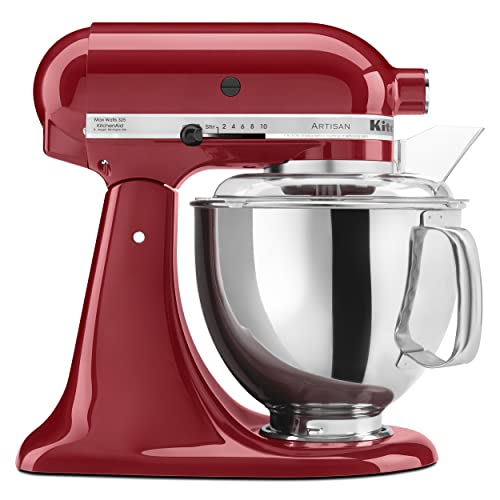
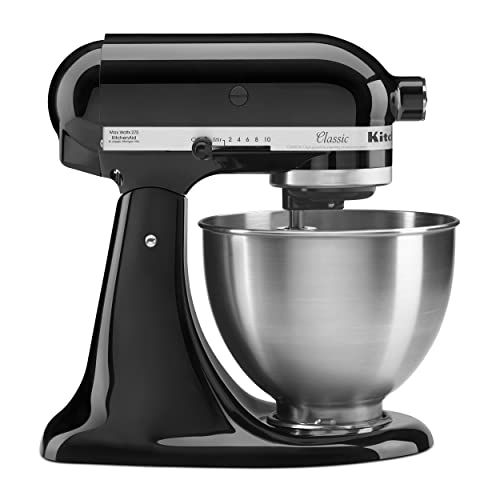
Classic Series 4.5-Quart — The Honest Entry Point
At a glance: KitchenAid Classic tilt-head stand mixer (K45SS), 10 speeds, metal construction, 59 touchpoints, full attachment compatibility, in Onyx Black in the verified listing.
The Classic is where the family’s value lives: the complete platform, planetary action, hub and all, at the lowest tier, in plain finishes. It covers the standard repertoire without adjustment and has done so for generations of first kitchens. What it withholds is theatre: few colours, no bundle extras, a bowl in the traditional plain style. For the buyer who bakes rather than displays, those withholdings are the point.
Strengths
- Full capability at the family’s most accessible tier
- Enormous installed base; parts and advice everywhere
- Standard recipes fit without scaling or splitting
Trade-offs
- Plain presentation and a short colour list
- Full-size frame despite the mid-size bowl
- No extras beyond the core tool trio
Best for: first mixers, value-first bakers, second homes. Not suited for: colour-led buyers or production bakers.
Artisan Mini 3.5-Quart — The Compact
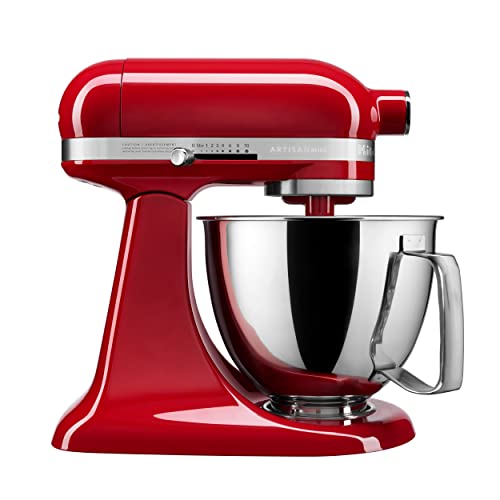
At a glance: KitchenAid Artisan Mini tilt-head stand mixer (KSM3316 family), 10 speeds, three accessories included, in Empire Red in the verified listing.
The Mini compresses the Artisan experience, finish and colour included, into the family’s smallest stance. Its 3.5-quart bowl is a genuine advantage at the small-batch end of the recipe book, where larger bowls smear modest quantities thin, and its lighter body suits cupboard storage and smaller cooks. Its ceiling is equally genuine: doubled and holiday batches overflow its brief.
Strengths
- Smallest footprint and lightest lift in the family
- Superior small-batch mixing behaviour
- Artisan-grade colours and finish
Trade-offs
- Capacity ceiling on doubled batches
- Premium pricing for its size
- Dough work is small-scale only
Best for: small kitchens and households of one or two. Not suited for: growing families or production baking.
Artisan Series 5-Quart — The Benchmark
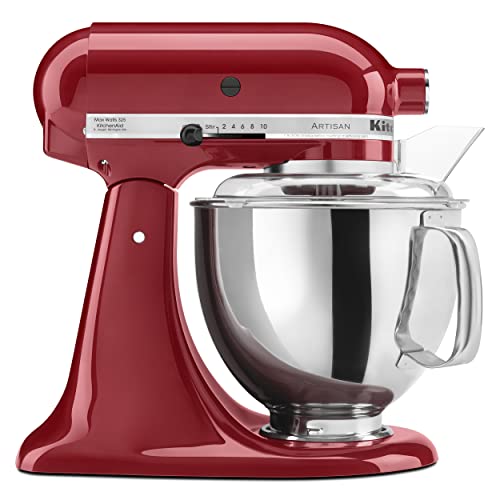
At a glance: KitchenAid Artisan tilt-head stand mixer (KSM150PS), 10 speeds, handled 5-quart bowl, pouring shield included in the verified listing, full hub compatibility.
The Artisan is the family’s centre of gravity and the category’s reference machine: the largest tilt-head bowl, the widest colour range in small appliances, and a balance of capability that has made it the default recommendation for a generation. It is not the dough champion and not the bargain; it is the machine against which both are measured, and for varied bakers it remains the safest long-term purchase in the line.
Strengths
- The tilt-head format at full size and full polish
- Unmatched colour range and accessory ecosystem
- Resale and parts support measured in decades
Trade-offs
- Premium tier within the tilt-head class
- Hinged head flexes under oversized stiff dough
- Tall with the head raised
Best for: varied bakers who want the complete, safe choice. Not suited for: dough specialists or the tightest budgets.

Bowl-Lift 5.5-Quart — The Bread-Regular Step Up
At a glance: KitchenAid 5.5-quart bowl-lift stand mixer (KSM55 family), 11 speeds including a half speed for folding, with flat beater, dough hook, and wire whip in the verified listing.
The smaller of the current bowl-lift pair inherits the retired Professional line’s brief in a footprint home kitchens can house. Its rigid frame and torque-first drive take the dough work that makes tilt-heads negotiate, while the half speed restores the delicacy big mixers used to lack. For households whose bread is weekly and whose batches double, this is the family’s sweet spot.
Strengths
- Planted, rigid performance through stiff dough
- Half-speed folding for delicate work
- Capacity headroom without flagship bulk
Trade-offs
- Less casual access than a tilt-head
- Fixed tall profile needs permanent space
- Model-specific bowls and tools
Best for: bread-regular bakers stepping up. Not suited for: small-batch dessert specialists.

Bowl-Lift 7-Quart — The Production Flagship
At a glance: KitchenAid 7-quart bowl-lift stand mixer (KSM70 family), 11 speeds with half speed, supplied in the verified listing with an accessory bundle including a double flex-edge beater among five accessories.
The largest home machine in the line is built for volume: doubled and tripled batches, bake-sale production, freezer stocking, and households that cook like small institutions. Its bundled accessory set equips it as a system from day one. Its costs are presence and price, and a small batch’s loneliness in a large bowl. Buyers who need it know exactly why; buyers who merely admire it should admire the 5.5 instead.
Strengths
- The family’s largest home capacity
- Complete accessory bundle in the box
- Flagship rigidity and drive for sustained work
Trade-offs
- The bulkiest, heaviest machine in the home line
- Small batches mix less eagerly in the big bowl
- Premium tier pricing
Best for: production bakers and large households. Not suited for: small kitchens or modest batches.
The Naming Fog: Variants, Bundles, and Retired Names
No comparison of this family is complete until it clears the fog around its names. Retailers sell bundle variants of the standard models under names like Artisan Plus and Deluxe, assembled for individual stores and seasons; when we verified this guide, catalogue searches for those names returned the standard models themselves, because the variants are packaging programmes rather than separate machines. The retired Professional 600, once the flagship, now survives as a respected used purchase whose accessories remain on sale while the mixer itself has been succeeded by the bowl-lift pair above. The defence against all of this fog is a single habit: shop by model code. KSM150 means the Artisan platform, K45SS the Classic, KSM3316 the Mini, KSM55 and KSM70 the current bowl-lifts. Codes are printed on trim bands and boxes, assigned by the manufacturer, and immune to marketing. Names are weather; codes are climate. Our guide to the best KitchenAid stand mixers applies the same discipline to shortlisting within the line.
Choosing Within the Family: The Three-Question Method
Question one: how does your dough live? Rarely and softly, and any tilt-head serves you. Weekly and standard, and the Artisan is your ceiling of need. Weekly and stiff, doubled, or production-scaled, and only the bowl-lift branch answers honestly.
Question two: how big is your typical batch, not your biggest? Halved and couple-scaled points to the Mini. Standard and family-scaled points to the Classic or Artisan. Doubled as a routine points up the bowl-lift branch. Buy for the typical, and plan the exceptional with split batches and sequencing, as experienced bakers have always done.
Question three: what does your kitchen permit? Measure the counter and the cabinet height before falling in love, because the family’s machines divide by stance as much as by spec: the Mini fits where others cannot, the tilt-heads need raised-head clearance, and the bowl-lifts need their full height permanently. Our roundup for stand mixers in small kitchens exists because this question eliminates more favourites than any other.
Answer the three in order and the family resolves into a single recommendation for nearly every household, which is what a comparison owes its readers: not a ranking of machines in the abstract, but a mapping from lives to models.
Speeds and Controls Across the Family
Speed counts look like a ladder and behave like a language. The tilt-head trio share a ten-speed vocabulary spoken through a simple lever: stir for beginnings, the middle for work, the top for air. The vocabulary is sufficient because the tasks are finite, and owners of all three machines develop the same instincts within a month. The bowl-lift pair speak eleven speeds, and the extra word matters: the half speed below stir folds whipped whites into batter, incorporates a soaker into dough, and starts a full bowl of flour in near silence, tasks at which big machines were historically clumsy. Electronic control in the current bowl-lift generation also holds the chosen speed steadier as dough resistance changes, which makes timed kneading recipes more repeatable. None of this makes the tilt-heads deficient; it makes the family’s division of labour explicit. Delicacy at scale is the bowl-lift’s refinement, purchased with its size, while the tilt-heads’ delicacy is native and small-scale. Choose the delicacy your batches need.
Bowls, Tools, and the Fitment Map
The family’s one genuine complication is fitment, and a comparison that glosses it fails its readers. Every model ships with its bowl and the core trio, flat beater, dough hook, wire whip, sized to that bowl and head geometry. Those tools do not travel: a Classic beater does not fit an Artisan, an Artisan bowl does not mount a bowl-lift, and the retired Professional’s tools belong to its own class. Second bowls, flex-edge beaters, and replacement tools must all be ordered against the model code. The hub is the family’s universal joint, and everything mounted there, pasta, grinding, milling, spiralizing, and the rotating cast of seasonal tools, fits every machine in this guide. The practical consequence is a two-part accessory strategy: invest freely in hub attachments, which survive any future upgrade within the family, and buy bowl-specific tools precisely, which do not. Households contemplating an upgrade path should weight that asymmetry, because a shelf of hub attachments is an argument for staying in the family, while a shelf of bowl tools is an argument for choosing the right bowl the first time.
Design Editions and the Colour Question
Above the standard models, KitchenAid periodically releases design-led editions, sculptural machines with premium materials and finishes that sit at the top of the tilt-head range. They mix exactly as their platforms mix; what they sell is presence, and in kitchens composed as carefully as living rooms that presence is a legitimate specification. The mainstream colour story belongs to the Artisan, whose rotating palette has made the mixer a design object for a generation, with the Mini inheriting a generous share of that wardrobe. The Classic dresses soberly, the bowl-lifts conservatively, and the family’s gradient from workhorse to jewel is deliberate: every buyer can locate their own ratio of utility to theatre. Our advice is to set that ratio consciously rather than accidentally, because the machine will be looked at roughly ten thousand times for every hundred times its specifications are consulted.
Upgrading Within the Family: Paths That Make Sense
Owners rarely stay with their first machine forever, and the family’s internal paths are worth mapping. The commonest journey runs from Classic to Artisan, driven by capacity and colour, and it is painless except for the bowl tools left behind. The second runs from any tilt-head to a bowl-lift, driven by dough, and it is the journey with the clearest before and after: batches that were negotiations become routines. The third, rarer and happier, runs downward, from a flagship to a Mini, when a household downsizes and discovers that the small machine fits its new life better than the big one fit the old. Each path is eased by the shared hub ecosystem, which follows the owner across every move. The path that makes no sense is sideways, between standard models and their retail bundle variants, because nothing is gained that a separately bought accessory would not provide. Buy the architecture and scale your life needs, accessorise deliberately, and let the family’s internal logic carry you when life changes.
How to Read Any KitchenAid Listing: A Buyer’s Field Guide
The family’s fog of names makes listing literacy a genuine skill, so here is the method this guide used, offered for your own shopping. Start with the model code and place the machine in the family tree before reading a single claim. Confirm the bowl’s capacity and material from the specifications, not the photograph, because images are shared across variants with cheerful abandon. Inventory the box from the listing’s own contents list, marking hub attachments and bowl tools separately, since the first kind adds lasting value and the second merely completes the kit. Compare the price only against the same model’s street price elsewhere on the same day, never against a different model’s promotion. Finally, check the colour against the code’s suffix when the finish matters, because colour names drift between channels while codes do not. Five habits, applicable to every machine in this comparison and every variant orbiting it, and together they are worth more than any single model’s review, because they transfer to the next purchase and the one after that.
Ownership Costs Across the Family
The family’s running costs are admirably flat: no consumables, no subscriptions, and wear concentrated in the same few items at every level, beater coatings, bowls that meet floors, shields that crack. The differences are in the price of the parts, which rises gently with the machine’s tier, and in the cost of a wrong first choice, which dwarfs all of them. A household that buys a Mini and replaces it in two years with an Artisan has paid the family’s highest effective price; a household that buys a 7-quart flagship for a life of small batches has paid in counter space instead, daily. The comparison’s three questions exist to minimise both errors. Beyond them, budget a small, cheerful allowance for the accessory habit the hub encourages, because few owners escape it entirely, and the pasta roller bought in year two is, by the testimony of many kitchens, the best money the machine ever attracts.
The Commercial Line, and Why It Stays Out of This Guide
KitchenAid also sells commercial machines, including an 8-quart bowl-lift model certified for professional use, and readers occasionally ask why a complete comparison omits it. The answer is that it answers a different question: it is built, warranted, and priced for premises that bake for paying customers, with the service expectations to match. Home bakers whose production has genuinely become a business should absolutely consider it, as a business purchase, with a business’s advice. Everyone else will find its domestic translation in the 7-quart home flagship in this guide, which carries the same architecture’s virtues without the commercial apparatus. Keeping the boundary clear is part of a comparison’s honesty: the home family’s ceiling is high, and pretending otherwise to sell a bigger machine would ill serve the kitchens this guide is written for.
Five Households, Five Answers
The first flat, furnished from scratch
Budget finite, ambitions real, counter modest. The Classic, bought on promotion, with the savings spent on ingredients and a scale. If the flat is truly tiny, the Mini, chosen without apology, because a machine that fits a small life gets used in it.
The family kitchen in full production
Birthdays monthly, cookies by the tray, a loaf when the mood strikes. The Artisan, in the colour the family chooses together, because it will be photographed at every celebration for a decade and its bowl swallows the repertoire whole.
The sourdough household
Two loaves a week, a levain with a name, opinions about hydration. The 5.5-quart bowl-lift, whose frame treats the schedule as routine, with the 7-quart reserved for the day the bake sale becomes a market stall.
The downsized kitchen, experienced cook
Skills undiminished, household halved, counter quartered. The Mini, whose small-batch excellence flatters fresh-and-often baking, and whose lightness respects the cook’s hands as the big machines never learned to.
The wedding registry, written honestly
A couple who bake together and entertain generously. The Artisan for most, the bowl-lift for the bread-devoted, registered by model code so that generosity lands on the intended machine. The registry is a comparison the guests should not have to make; make it for them.
Care Across the Family: One Routine, Five Machines
Maintenance in this family is mercifully uniform. Keep every machine clean at the hinge or the lift arms, where batter migrates; keep bowls and tools washed and dried; verify beater clearance with the manual’s coin test when behaviour changes; store tools in the bowl with a cloth between them; and listen, because a change in a familiar machine’s sound is information offered early and cheaply. The tilt-heads add a hinge pin to the checklist, the bowl-lifts add lift-arm pins and a bowl seating check, and the design editions add a soft cloth where their finishes are concerned. None of it exceeds ten minutes a month, and all of it compounds into the decades of service this family is known for. A comparison can rank machines; only ownership, lightly maintained, can vindicate the ranking.
Sound Across the Family
Noise in this family is a function of architecture and load more than of model. The tilt-heads share a bright, mechanical working voice that deepens under dough and rises at the whip; the bowl-lifts speak lower and steadier, their electronic control smoothing the note as resistance changes, and at dough speeds they are the calmer presence in an open-plan home. The Mini, smallest in mass, is the most easily forgiven at dawn; the 7-quart at full production is a sound with intent behind it, appropriate to its work. Placement governs more than purchase: a mat under the feet, a solid counter, and distance from a hollow cabinet’s resonant side will civilise any of the five. Households with sleeping infants and thin walls should plan their whipping for waking hours whichever model they choose, because physics, unlike marketing, does not offer a quiet flagship.
The Family Secondhand: A Market That Rewards Knowledge
Every model in this guide circulates used, and the family’s fitment discipline becomes the secondhand buyer’s protection. A used machine should be run through its speeds, tilted or lifted through its motion, and inspected at its bowl’s locking points; its tools should be inventoried against its model code, because a cheap machine missing its hook and whip in the right fitment is not cheap. The Classic and Artisan dominate the used market’s volume and are correspondingly easy to price. The Mini commands loyal money from the small-kitchen crowd. The bowl-lifts, newer in their current generation, appear less often and hold their value firmly, while the retired Professional 600 remains the market’s elder statesman, priced by condition and history rather than by badge. Buyers who bring the model-code habit to this market will find it the friendliest in small appliances, because the family’s machines were built to be assessed honestly: what you hear and feel in five minutes is very close to what you own.
Common Mistakes Inside This Family
Buying the flagship for a small life. The 7-quart is a magnificent machine that will make a couple’s weekly baking feel like operating a plant. Capacity is a fit, not a virtue.
Buying the Mini for a growing life. The reverse error, and the commoner one, because the Mini is charming. Charm does not double a batch.
Choosing by colour before architecture. Colour is the last decision, made inside the architecture and scale your dough and batches selected. The family’s palette is generous enough to reward patience at every level.
Treating variant names as models. The fog section above exists because this mistake is expensive: buyers pay model premiums for packaging programmes. Codes, contents, same-day prices.
Ignoring the raised-head measurement. More tilt-heads have been returned for cabinet collisions than for any mixing failure. The tape measure is part of the comparison, and it votes first.
Assuming attachments will transfer. Hub tools will; bowl tools will not. Upgrade plans that ignore the fitment map become expensive surprises, and this guide has flagged the map at every relevant turn, including the specialist roundup of stand mixer attachments explained.
The Family as a System: Why One Brand Covers So Much Ground
Step back from the five models and a design philosophy comes into focus. KitchenAid does not sell a mixer; it sells a matrix, two architectures crossed with a scale ladder, wrapped in a single accessory ecosystem and a century of parts support. The matrix is why comparisons within the family feel simultaneously easy and confusing: easy because every machine is good at its brief, confusing because the briefs overlap at their edges and the names multiply through retail. The system’s strength for the buyer is that a correct choice is available at every intersection of dough habit, batch size, kitchen dimension, and budget, and that the choice remains supported for decades. Its weakness is the one this guide has worked against throughout: a matrix cannot be browsed casually, and shoppers who approach it as a shelf of near-identical machines will choose by colour or by fog. Approach it as a matrix, answer the three questions, read codes instead of names, and the system resolves into the single machine that was always yours.
A Decade With Each: Owner Archetypes Revisited
Comparisons are written at the moment of purchase, but their truth is audited over years, so it is worth imagining each model’s decade. The Classic’s decade is quiet competence: it teaches one household to bake, moves to a cottage or a child’s flat, and is still mixing when its replacements in other categories have cycled twice. The Mini’s decade is intimacy: a small kitchen’s daily rhythm, fresh batches, a machine that is lifted, used, and put away without ceremony three hundred days a year. The Artisan’s decade is the family album: birthdays, holidays, the pasta attachment era, the bread era, all photographed against the same coloured silhouette on the same counter. The 5.5 bowl-lift’s decade is the sourdough era made permanent, a machine whose frame never once made its owner negotiate. The 7-quart’s decade is production: fundraisers, market stalls, a freezer that is never empty, and a household that cooks at institutional joy. None of these decades is the best decade. Each is the right decade for a particular life, and the comparison’s whole labour has been to help you recognise yours before you buy the machine that will live it with you.
Materials and the Long Ledger
Across all five models, the family’s material philosophy is constant: metal where stress lives, construction that anticipates repair, and parts catalogues that treat age as normal. That philosophy is why this comparison can speak of decades without embarrassment and why the family’s secondhand market behaves like a tool market rather than a junk market. The responsible purchase inside such a family is the one that will not be replaced for inadequacy, and inadequacy is always relational: too small, too large, wrong architecture for the dough. Get the relation right, using the three questions and the fitment map and the tape measure, and the machine you buy joins the long ledger of appliances that were purchased once and used for a generation. Get it wrong and even the finest machine in this guide becomes an interim step, which is the only true waste the family makes possible.
Gifts and Registries Across the Family
The family is a registry institution, and its internal comparison matters to givers as much as to buyers. The Artisan is the registry’s centre because it fits the widest range of futures a couple can plausibly have, and its colour choice lets the gift feel personal. The Classic is the registry’s honest economy, freeing guests’ budgets for the rest of the kitchen without giving up the platform. The Mini belongs on registries written by couples who know their square footage and their household size and are tired of being advised to plan for a life they are not living. The bowl-lifts belong on the registries of couples whose bread habit is already established, because a machine bought for an imagined hobby is a machine stored. Givers, for their part, should buy the registered model by its code and resist the generous upgrade, since the couple’s research encodes facts about their kitchen that generosity cannot see. A comparison’s last gift is that sentence, offered to every wedding guest who has ever stood in an appliance aisle improvising.
The Comparison, Closed
Five machines, two architectures, one ecosystem. The Classic for value, the Mini for small lives, the Artisan for the great middle, the 5.5 for the bread-regular, the 7-quart for production. Behind them, a fog of variant names that codes dissolve, a retired flagship that honours its successors, and a fitment map that rewards the careful. If this guide has done its work, you are no longer comparing mixers in the abstract; you are recognising the one whose brief matches your baking, your batches, and your kitchen’s measured facts. Buy that one, in the colour that survives the architecture decision, and let the comparison end the way all good comparisons should: with a machine at work and a question that never needs asking again.
Power Claims Within the Family, Translated
Shoppers comparing inside one brand often expect the wattage figures to rank the machines neatly, and this family’s figures refuse to cooperate, because the numbers are measured under different conditions across architectures and generations and because mixing authority lives in gearing and frame as much as in consumption. The bowl-lift’s superiority at dough is visible in its structure and its behaviour, not in a headline number; the tilt-heads’ sufficiency for their repertoire is equally a matter of design matched to task. The translation rule is simple: within this family, choose by architecture and bowl, and let the electrical figures go unread. A generation of owners has kneaded, creamed, and whipped happily without knowing any of the numbers, and the machines have never once asked them to learn.
How This Comparison Was Verified
Method matters in a family this fogged by names, so here is ours, briefly. Each of the five linked models was checked against the current retail catalogue on the brand’s own sales channel data before writing, and the reviews above quote the verified listings’ own capacities, speeds, and included tools. The variant names discussed in the fog section were searched the same way, and their absence as distinct listings is reported as a finding rather than assumed. The retired Professional’s status was established the same way, by the presence of its accessories and the absence of the machine. Behavioural claims, about dough, access, sound, and ownership, rest on the accumulated record of each design’s long production life. Readers shopping live listings should expect colours and bundles to vary around the verified cores, and should close the loop with the model-code habit this guide recommends at every turn.
An Accessory Strategy for Each Model
Because the hub is universal and the bowl tools are not, each model invites a slightly different accessory plan, and a comparison should say so. Classic owners should buy the flex-edge beater in their fitment first and a second bowl second, the two upgrades that transform daily use, and then let hobbies dictate hub purchases. Mini owners should prize the second bowl above all, because small-batch workflows live on bowl swaps, and should choose hub attachments whose own scale suits small households. Artisan owners hold the family’s most accessorisable machine and should buy hub tools by hobby in the order the hobbies actually arrive, resisting the bundle temptation that fills cupboards with futures. Bowl-lift owners should equip for production: the second large bowl, the tools their dough rotation needs, and hub attachments chosen for volume. In every case the discipline is the same, buy for the baking you do, in the fitment you own, and let the ecosystem’s depth be a comfort rather than a shopping list.
Energy and Everyday Running Costs
Running a stand mixer costs very little in electricity at household duty, a few minutes of intermittent work per bake, and the family’s models differ by amounts too small to budget. The real running costs are the ones this guide has already itemised: replacement tools at long intervals, the occasional bowl, and the accessory habit. There is one more, rarely counted: the cost of counter space in kitchens where space is the binding constraint, which is paid daily by oversized machines and never by right-sized ones. By that accounting the Mini is the cheapest machine in the family for a small flat and the 7-quart the most expensive for the same address, whatever their tickets say, and the comparison’s insistence on measuring first is an economic argument as much as a practical one.
And so the family’s comparison ends where it began, with a matrix that resolves into a machine. Somewhere in the five models above is the mixer whose architecture matches your dough, whose bowl matches your batches, whose stance matches your kitchen, and whose ecosystem matches your ambitions. It has a model code. Find it, verify it, and buy it once, and this long comparison will have earned its length the first time you tip a head or raise a bowl and feel the machine agree with the life you bought it for.
When to Buy: The Family’s Promotional Rhythm
Timing a purchase inside this family follows the retail calendar’s familiar swell: the standard models are promoted in waves through the year, with the deepest activity around the gift seasons and the spring registry period, and the patient buyer who has already chosen a model can let the calendar do the negotiating. Two cautions keep the patience honest. First, compare street prices on the same day across channels, because the family’s fog extends to pricing, and a headline discount on one model can coexist with a quieter, better price on the same model elsewhere. Second, do not let a promotion move you between models: a discounted flagship is still the wrong machine for a small-batch life, and the savings will be spent in years of mild resentment. Choose the machine by the three questions, then choose the week by the calendar, in that order, and the family’s comparison will have saved you money twice, once at the till and once across the decade.
A Note for Readers Upgrading From Another Brand
Some readers arrive at this family from rival machines, carrying habits and sometimes attachments that will not transfer. The habits transfer better than the hardware: speeds map closely enough across planetary machines that a month recalibrates the instincts, and dough judgement, once learned, is portable for life. The hardware mostly does not transfer, because every brand’s bowl fitments and hub systems are its own, and the honest budget for a switch includes re-equipping the tools you actually use. What the switch buys, and what this comparison has tried to price fairly, is entry into the deepest support and accessory ecosystem in the category, with a model at every scale your future might need. Switchers should choose their entry point by the same three questions as first-time buyers, with one addition: buy for the baker you have already become, not the one you were when the old machine was purchased, because the family’s matrix has a machine for the current version of you and no obligation to honour the past.
One last assurance for the reader who has absorbed the whole matrix and still feels the pull of indecision: within this family, the cost of a near miss is unusually low. The Classic bought by a future Artisan owner becomes the cottage machine or the gift that starts someone else’s baking life. The Artisan bought by a future bowl-lift owner becomes the household’s beloved second machine, the one that handles the whipped and creamed work while its bigger sibling kneads. Even the Mini, outgrown, finds the small kitchen that was always its destiny. Machines this durable and this liquid do not punish honest mistakes the way sealed, disposable appliances do. So decide with the evidence, decide without dread, and know that the family’s depth, the very thing that made the comparison long, is also what makes its wrong answers survivable and its right answers last for decades.
The Comparison’s One-Page Summary
For the reader who arrived with ten minutes rather than an hour, the family in a single passage. Two architectures divide it: tilt-head for access and everyday grace, bowl-lift for dough and volume. Five standard models populate it: the Classic, plain and complete at the lowest tier; the Mini, the Artisan experience compressed for small kitchens and small batches; the Artisan, the full-size benchmark with the colours and the ecosystem; the 5.5-quart bowl-lift, the bread-regular’s sweet spot with a half speed for delicate work; and the 7-quart bowl-lift, the production flagship with its tools bundled. Around them orbit retail bundle names that are packaging rather than models, and behind them stands a retired flagship whose successors carry its brief. Choose by dough first, batches second, cabinets third, colour last, verify by model code always, and the family, for all its fog, will hand you exactly one machine. That machine, whichever it is, will serve for decades, which is why the choosing deserved a guide this long.
What to Do the Day the Machine Arrives
Close the comparison with a beginning. When your chosen model arrives, photograph its trim band, register it, wash its bowl and tools, and run the beater clearance check before the first ingredient is measured. Make the first bake a recipe you know by heart, so the machine is the only new variable, and pay attention to the three things no guide can tell you about your unit: its sound at your speeds, its stance on your counter, and the height of its head or bowl against your cabinets. Note the accessory you reach for and do not have, because that note, written in the first week, is the most honest shopping list you will ever make for the ecosystem. Then put the machine to work and let the comparison recede, as all good comparisons should, into the background of a kitchen where things are being made.
And one small, practical blessing on the purchase, whichever model it is: unbox it on a day when you can bake something immediately, because a machine that has already made one cake is a member of the household, while a machine still in its carton after a fortnight is a decision still quietly being relitigated. Bake first, share the result with whoever will share the machine’s decade, and let the comparison be over. The family will take it from there, as it has taken it for generations of kitchens before yours.
Frequently Asked Questions
Which KitchenAid mixer is best overall?
For the widest range of households, the Artisan: full-size tilt-head convenience, the deepest ecosystem, and capability that covers the standard repertoire with headroom. “Overall” hides the exceptions, though: the Classic beats it on value, the Mini on size, and the bowl-lifts on dough. Best is a function of your kitchen, and the three-question method above is this guide’s honest answer.
What is the difference between tilt-head and bowl-lift KitchenAids?
Access and rigidity. A tilt-head’s head hinges back for effortless bowl access, at the cost of some flex under heavy dough torque. A bowl-lift’s head is fixed and its bowl rises to meet it, giving a rigid frame for large, stiff batches at the cost of a taller, more deliberate machine. Cakes and cookies favour the first; production bread favours the second; most households live happily with either.
Is the Professional 600 still part of the range?
Not as a current model. The Professional 600 was retired and its role inherited by the current bowl-lift generation, the 5.5-quart and 7-quart machines in this guide. Used 600s remain worthwhile purchases when sound and sensibly priced, and their bowls and tools are still sold, but new buyers should compare the Artisan against the current bowl-lift pair.
Do all KitchenAid mixers use the same attachments?
Hub attachments, yes: the powered front hub is common across the family, so pasta, grinding, milling, and the rest of the range fits every model here. Bowls and bowl-mounted tools are model-class specific and do not interchange between sizes or architectures. Buy spares by model code, a habit our stand mixer attachments guide explains in full.
Which model is best for bread?
Within this family, the bowl-lift models, with the 5.5-quart the sweet spot for weekly home bread and the 7-quart for production. The Artisan kneads standard loaves perfectly well and is the right answer for occasional bread in a varied repertoire. Bakers comparing beyond the family will find the dough specialists in our kitchenaid alternatives guide.
What do names like Artisan Plus and Deluxe mean?
They are retail bundle names applied by individual stores to variants of the standard models, with contents and finishes set by each programme. They do not denote separate machines with separate specifications, which is why catalogue searches for them return the standard models. Judge any such offer by its model code and its listed contents against the standard model’s price on the same day.
How do I decide between two models when both seem to fit my baking?
Run one honest test on paper: write down the largest batch you actually made in the past year, the tallest storage space the mixer can occupy, and the one job you most often postpone because it is tedious by hand. Score each candidate against those three facts only, and ignore capabilities you have not needed in twelve months of real cooking. In most households one model wins two of the three tests clearly, and that pattern is a more reliable guide than any general ranking, because it reflects your kitchen rather than an average household that may bake nothing like you do.