Disclosure: As an Amazon Associate, topratedkitchenware.com earns from qualifying purchases. Links on this page are affiliate links; they cost you nothing extra. Prices and availability change often, so check the current Amazon listing before you buy.
Shoppers comparing kitchenaid artisan vs artisan plus usually expect a tidy spec-sheet fight, and the first useful thing this comparison can tell you is that the fight is not really between two different machines. The Artisan is KitchenAid’s long-running 5-quart tilt-head stand mixer, sold everywhere under model numbers in the KSM150 family. The Artisan Plus name appears at certain big-box retailers as a bundle variant of that same platform, packaged with a different mix of included accessories. That single fact reorganises the whole decision: instead of asking which mixer is better, you should be asking which box contents are worth more to you, because the motor, the bowl size, the speeds, and the mixing action underneath the name are the Artisan platform either way. This guide walks through what is genuinely shared, what actually differs from one retail bundle to another, how to read a listing so you know exactly which machine is in the box, and who should simply buy the standard Artisan without a second thought.
Kitchenaid Artisan Vs Artisan Plus: The Quick Verdict
If you want the conclusion first: buy the standard Artisan unless a specific Artisan Plus bundle includes an accessory you were already planning to purchase separately, such as a flex-edge beater, and the bundle’s total cost beats buying the mixer and that accessory apart. The underlying mixer is the same tilt-head machine with the same 5-quart bowl class, the same ten-speed control, and the same attachment hub, so there is no performance gap to pay for. Where the Plus name does sometimes signal something real is in the box: an extra beater style, a different bowl finish, or a bundled attachment offer, depending on the retailer and the season. Because those bundles change, the rest of this comparison focuses on how to evaluate any given Plus listing against the standard Artisan rather than pretending one fixed Plus specification exists. Readers who want the wider family picture can also browse our full KitchenAid mixer comparison, which places the Artisan among its siblings.
In this guide
What the Artisan Plus Name Actually Means
KitchenAid’s own model system is the ground truth here, and it is worth understanding before any comparison makes sense. The Artisan line sold through most channels carries model numbers beginning KSM150, with suffix letters encoding colour. When we searched Amazon’s catalogue through the retailer’s own product data for this guide, every result for the Artisan Plus name resolved to those same KSM150 Artisan listings; there is no separate Plus model with its own Amazon listing, its own bowl size, or its own motor. The Plus branding lives at the retail layer, where warehouse clubs and big-box stores negotiate exclusive bundles and need a shelf name that distinguishes their box from the standard one.
This pattern is common across appliances and it is not a trick so much as a merchandising habit, but it has one sharp consequence for buyers: two boxes both labelled Artisan Plus at two different retailers may not contain identical extras, and a Plus bundle from one season may differ from the next. The specification that never changes is the machine itself. So the honest comparison table below lists the platform specs once, for both names, and then treats the bundle contents as the variable you must verify on the specific listing in front of you. Anything a retailer claims beyond the platform specs, such as a special-edition finish, should be checked against the model number printed on the box or the trim band of the mixer itself.
The Shared Platform: Specifications That Do Not Change
| Specification | Artisan (KSM150 family) | Artisan Plus (retail bundle) |
|---|---|---|
| Design | Tilt-head stand mixer | Same tilt-head platform |
| Bowl | 5-quart stainless steel bowl with handle | Same 5-quart class bowl; finish can vary by bundle |
| Speeds | 10 speeds, from a gentle stir to a fast whip | Same 10-speed control |
| Mixing action | 59-point planetary touchpoints around the bowl | Same planetary action |
| Core tools | Flat beater, dough hook, wire whip | Core tools included; extras vary by bundle |
| Attachment hub | Powered front hub for KitchenAid attachments | Same hub, same attachment compatibility |
| Colours | A wide rotating colour range | Colour selection set by the retailer |
Read that table carefully and its message is plain: capacity, power delivery, and versatility are identical because the machine is identical. Any buying guide that scores these two names differently on mixing performance is scoring the same mixer twice. The sections that follow therefore spend their time where real differences can exist: what is in the box, how the bundles are priced as a value proposition, and how to verify a specific offer. If you are still deciding whether the Artisan platform itself suits your baking, our guide on how to choose a stand mixer covers the underlying questions of size, power, and design.
Where Bundles Differ: The Box Contents
The flex-edge beater question
The extra that appears most often in Plus-style bundles, and the one most worth having, is a flex-edge beater: a flat beater with a flexible silicone edge that sweeps the bowl sides as it turns, reducing the need to stop and scrape. For creaming butter and sugar, folding batters, and mixing anything that clings, it is a genuine quality-of-life upgrade rather than a gimmick. If a Plus bundle includes one and you bake cakes or cookies weekly, that inclusion alone can justify choosing the bundle, because the standard Artisan box leaves you to buy the same tool separately later. If the bundle instead pads the box with items you will never use, the maths reverses just as quickly.
Bowls, shields, and the second-bowl temptation
Some retail bundles swap or supplement the standard polished stainless bowl: a brushed finish, a pouring shield added or omitted, occasionally a second smaller bowl. The pouring shield matters more than its simplicity suggests, because adding flour to a running mixer without one is how kitchens get dusted. A second bowl is the sleeper upgrade for bakers who make meringue-topped or multi-component recipes, since egg whites refuse to whip in a bowl carrying traces of fat, and washing and drying mid-recipe is a momentum killer. Judge these inclusions by your actual recipe habits rather than by the count of items on the box, because a long list of pieces you never touch is not value.
Attachment offers and rebate bundles
Warehouse bundles sometimes fold in a hub attachment, most often a pasta roller or a food grinder, or a mail-in offer toward one. This is where a Plus package can leap ahead in value for the right household, since a single attachment can represent a substantial separate purchase. It is equally where value evaporates for the wrong household: a pasta roller in the cupboard of a family that buys fresh pasta is decoration. Our overview of stand mixer attachments explained can help you decide which attachments earn their storage space before you let one steer a mixer purchase.
Performance in the Kitchen: Identical, and Here Is What That Means
Because the platform is shared, everything known about the Artisan’s behaviour applies to both names, and it is worth stating plainly what that behaviour is. The tilt-head design gives easy access to the bowl: the head tips back, the beater lifts clear, and adding ingredients mid-mix is simple, which is why this format dominates home kitchens. The ten speeds span a genuinely slow stir that will not sling flour across the counter when it starts in a bowl of dry ingredients, up to a whip speed that handles cream and egg whites briskly. The planetary action, with its dozens of touchpoints around the bowl, means less unmixed residue at the base than cheaper single-beater designs leave behind.
Dough is the Artisan’s honest boundary. It kneads a standard loaf batch comfortably, and the dough hook’s push-and-fold action suits enriched and lean doughs alike at moderate quantities. Very stiff, low-hydration doughs in maximum-size batches make the head work hard and can cause the machine to walk slightly on a smooth counter, a trait shared by tilt-head mixers generally rather than a flaw of this model. Bakers whose weekly routine is multiple heavy loaves should be looking at the bowl-lift end of the family instead, a fork in the road we explore in tilt-head versus bowl-lift designs. For cakes, cookies, whipped components, frostings, and a loaf or two at a time, the Artisan platform sits squarely in its comfort zone, under either name on the box.
Size, Storage, and Living With the Mixer
Both names sit on the same footprint, so the storage conversation is shared too. A tilt-head mixer needs vertical clearance twice over: enough room under wall cabinets to sit on the counter, and enough additional height for the head to tip back when you change tools or remove the bowl. In kitchens where the mixer lives under a cabinet, sliding it forward for use becomes part of the routine, and the machine’s substantial weight makes that a deliberate act rather than a casual one. Compact kitchens should measure before buying, a point we press in our roundup of stand mixers for small kitchens. The Artisan Mini exists precisely for households that measure and find the standard machine too tall or too deep, and it is a better answer to a space problem than hoping a full-size mixer will somehow fit.
Day to day, ownership is undemanding. The bowl and the coated tools handle the dishwasher for most owners, the exterior wipes clean, and the machine asks for little beyond keeping the hub cap in place and the trim band free of dried batter. Parts support is one of the platform’s quiet strengths: because the KSM150 family has been sold in volume for years, beaters, bowls, and shields remain easy to source, and the attachment ecosystem is the deepest in the category. A retail bundle name changes none of that; servicing and accessorising a Plus-badged machine is servicing an Artisan.
How to Read a Listing and Know Exactly What You Are Getting
Since the Plus name guarantees nothing by itself, use this short verification routine on any listing, in a store or online, before money moves.
Find the model number. Look for the KSM code on the box end, the product page specifications, or the trim band under the head of a display unit. KSM150-family codes confirm the standard Artisan platform. A different code means a genuinely different machine, whatever the shelf signage says.
List the box contents explicitly. Write down every tool and accessory named in the listing, then mark which ones you would otherwise buy. The bundle’s real premium is the price of those marked items, no more.
Confirm the bowl. Check the bowl’s capacity and material in the specifications rather than the hero photograph, because bundles occasionally pair the machine with a bowl variant and photographs are often shared across a retailer’s whole Artisan range.
Check the colour against the code. Colour suffixes are part of the model code, and marketplace listings occasionally pair a colour name with the wrong photograph. The code wins.
Compare against the standard listing the same day. Bundle value is relative and seasonal. The standard Artisan is discounted so frequently across the year that a Plus bundle only wins when its included extras beat the standard machine’s current street price plus the cost of those same extras bought separately. Our list of the best KitchenAid stand mixers tracks the family members worth shortlisting when you are ready to compare live listings.
The Standard Artisan, Up Close
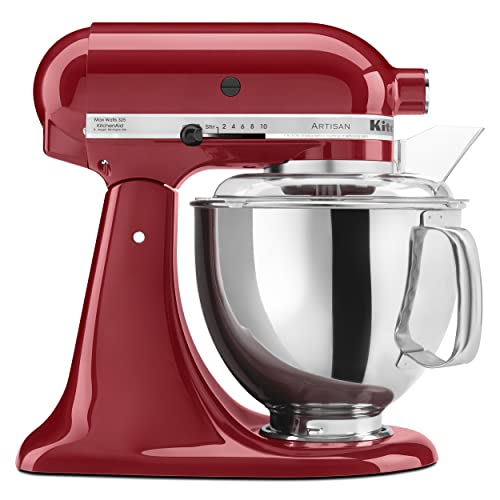
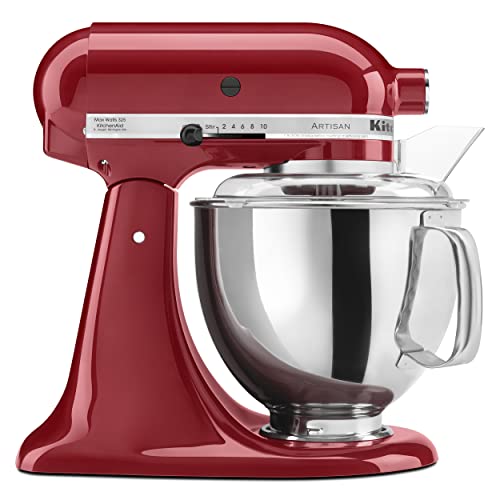
At a glance: KitchenAid Artisan 5-quart tilt-head stand mixer (KSM150PS), 10 speeds, stainless steel bowl with handle, pouring shield included in the verified listing below, with flat beater, dough hook, and wire whip.
This is the reference machine for the whole comparison, and the listing we verified for this guide includes the pouring shield that some bundles treat as an extra, which is a useful reminder to check the standard box before assuming a bundle adds anything. In Empire Red it is also the colour most often used in retailer photography for both names, another reason to shop by model code rather than by picture.
Strengths
- The deepest colour range and widest availability of any mixer in its class
- Pouring shield, bowl with handle, and the three core tools in the standard box
- Full compatibility with the KitchenAid hub attachment range
Trade-offs
- No flex-edge beater in the standard box; it is a separate purchase
- Tilt-head design is tall with the head raised and heavy to slide daily
- Serious daily bread bakers will outgrow its dough comfort zone
Best for: the majority of home bakers, who get the complete platform with the fewest unknowns. Not suited for: anyone who has measured their cabinet gap and found it wanting; look at the Mini instead.
Who Should Buy Which
Buy the standard Artisan if you shop online, want a specific colour, or found the standard listing on one of its frequent promotions. You receive the entire platform, and you can add a flex-edge beater later for less than the typical bundle premium when it is not on offer.
Buy an Artisan Plus bundle if you are standing in the warehouse store anyway, the box verifiably includes a flex-edge beater or an attachment you already intended to own, and the bundle premium is smaller than those items cost separately. Verify with the model code, photograph the box contents panel for your records, and the purchase is a sound one.
Buy neither if your baking is dominated by large, stiff dough batches, in which case the bowl-lift branch of the family is the correct tool, or if your counter space is genuinely tight, in which case the smaller Mini platform will make you happier than either 5-quart option. The name on the box should be the last thing that decides this purchase; the dough in your bowl and the height of your cabinets should be the first.
First Week With the Mixer: A Short Ownership Routine
Whichever box comes home, the first week sets habits that protect the machine. Register the model code from the trim band rather than the retail name, because warranty and parts lookups run on the code. Wash the bowl and tools before first use, run the machine empty through its speeds to learn its sounds at each setting, and make your first bake something forgiving, a batch of cookies or a simple cake, so you can learn the stir speed’s gentleness and the beater adjustment with low stakes. Check the beater-to-bowl clearance with the classic dime test described in the manual if ingredients linger at the base. Store the tools in the bowl with a cloth between them to prevent rattling marks, and keep the hub cover on whenever no attachment is mounted. These small routines apply identically to both names, which is, in the end, the thesis of this entire comparison.
A Short History of the Artisan Name, and Why Retailers Build on It
The Artisan occupies a particular place in the stand mixer market: it is the model that turned a utilitarian appliance into a countertop fixture people choose by colour and leave out on display. KitchenAid has sold tilt-head mixers for generations, but the Artisan branding, paired with an expanding palette of finishes and the now-familiar silhouette, is what made the machine a wedding-registry staple and a benchmark against which rivals are measured. That popularity is precisely why retailers build bundle names on top of it. A warehouse club cannot easily differentiate a commodity product that every competitor also sells, so it differentiates the box: an exclusive finish, an extra beater, an attachment in the carton, and a name, Plus, that signals more without obliging anyone to redesign a machine.
Understanding this history protects you from two opposite mistakes. The first is assuming the Plus must be an upgraded machine because its name sits higher in the alphabet of marketing. The second is assuming bundles are always poor value because the machine is unchanged. Both errors come from judging the name instead of the contents. Retail-exclusive bundles in this category have, at various times, included genuinely desirable extras at premiums smaller than the extras’ separate cost, particularly during seasonal promotions when warehouse pricing is aggressive. They have also, at other times, amounted to the standard box with a renamed carton. The verification routine earlier in this guide exists because the name alone cannot tell you which situation you are in this season.
Inside the Platform: Motor, Drive, and Mixing Action Explained
Since both names share a machine, its engineering deserves a proper explanation, because it determines what the mixer does well for the next decade of ownership. The Artisan uses a tilt-head layout in which the motor sits in the head and drives the beater shaft directly above the bowl. That head carries a planetary gearbox: the beater spins on its own axis while that axis orbits the bowl, which is how the machine reaches dozens of touchpoints around the bowl’s interior in a single revolution. The practical result is that ingredients are folded from the sides toward the centre continuously, and dead zones are smaller than on mixers whose beaters merely spin in place.
The speed control is a simple lever with ten marked settings, and its simplicity is a feature. The lowest setting, stir, is slow enough to incorporate flour without a dust cloud when the bowl is covered or the shield is fitted, and the progression up to the top speed gives a genuinely wide working range, from folding whipped cream into a mousse to whipping egg whites to firm peaks. Experienced owners tend to live at three speeds: stir for starting dry ingredients, the middle range for creaming and batters, and the top two for whipping. The dough hook work happens at the low end by design, because kneading is a slow, forceful action, and running dough at high speed heats the motor and throws the batch against the bowl rather than developing it.
Heat and load behaviour are the honest constraints. Under a heavy dough load the head can flex slightly on its hinge and the machine may rock on a slick surface, which is physics rather than defect: the torque has to go somewhere, and a tilt-head frame is less rigid than a bowl-lift column. Placing the mixer on a mat, keeping batches within the flour quantities the manual specifies, and letting the hook work at its intended speed keep the machine in its envelope. Owners who respect that envelope routinely keep these mixers for many years, and the platform’s long production run means service knowledge and spare parts are unusually accessible for a consumer appliance.
A Speed and Task Guide for the Shared Platform
New owners often ask which speed does what, and because the answer is identical for both names, it belongs in this comparison as part of the practical layer.
Stir and speed 2: starting dry ingredients, mashing soft vegetables, kneading dough with the hook, and any task where splashing is the enemy. Most dough work should never leave this range.
Speeds 4 to 6: the working heart of the machine. Creaming butter and sugar, beating cake batters, mixing cookie doughs after the flour is incorporated, and preparing frostings all live here. Cookie doughs with heavy mix-ins finish best with a short burst at the lower end of this range once the base is combined.
Speeds 8 to 10: whipping territory. Cream, egg whites, and meringues need the top speeds and a scrupulously clean bowl. Work quickly and watch the bowl rather than the clock, because whipped cream passes from soft peaks to over-whipped in well under a minute at full speed.
Two habits protect results across all speeds. Add ingredients gradually through the shield’s chute or at the bowl’s edge with the head running at stir, rather than dumping and surging. And stop to scrape once during creaming and once after adding flour, even with a flex-edge beater fitted, because no beater reaches the very centre dimple of the bowl where a spoonful of unmixed butter loves to hide. If you bake bread often enough that dough behaviour dominates your thinking, our dedicated guide to stand mixers for bread dough compares how different designs handle that workload.
Ownership Over Years: Care, Adjustment, and Common Fixes
A comparison that stops at the purchase misses where these machines actually differ from cheaper rivals, which is in year five rather than week one. The Artisan platform’s care routine is light. Wipe the head and pedestal after messy jobs, because dried batter migrates into the hinge area and makes the head stiff to tilt. Wash the bowl and tools promptly after egg-white work, since dried meringue is oddly tenacious. Keep the hinge pin checked: on heavily used machines the pin can drift slightly, producing a small head wobble that a gentle tap back into place resolves. Beater clearance is adjustable with a screw on the hinge, and the dime test in the manual, placing a coin in the empty bowl and confirming the flat beater just grazes it at stir speed, keeps mixing thorough without the beater striking the bowl.
The faults owners actually report are mundane and mostly preventable. A burning smell during the first heavy dough batch is usually the motor working near its limit on an oversized, stiff dough; reduce batch size rather than forcing the issue. Flour dust inside the speed lever area responds to a soft brush, not compressed air, which drives dust deeper. A machine that walks during kneading wants a mat under its feet and a batch within spec. None of these behaviours differ between the Artisan and any Plus bundle, for the by-now familiar reason that the machine is one and the same, and a buyer reassured by the platform’s track record can extend that reassurance to either name without reservation.
When the Standard Artisan Is Not the Right Answer Either
Honesty about the platform’s edges matters more than the name debate. If your kitchen’s reality is a weekly bake of two large sourdough loaves, the tilt-head Artisan will do the work but will not love it, and you will not love the noise, the flex, or the batch-splitting. The bowl-lift branch of the family, with its fixed head and lifting bowl mechanism, exists for that cook, and stepping up is wiser than hoping a bundle name changes the physics. If your reality is a galley kitchen with low cabinets and a single clear stretch of counter, the Artisan’s raised-head height will fight you daily, and the Mini’s smaller frame is the grown-up solution. And if your baking is genuinely occasional, a couple of cakes a year and holiday cookies, even the standard Artisan may be more machine than you need; the Classic, the family’s simpler 4.5-quart model, covers that ground at a lower tier, a trade-off we examine directly in deluxe and classic models compared. The Plus question only becomes relevant once the Artisan platform itself has passed those three tests: right size, right duty, right budget tier.
Value, Analysed Properly: A Worksheet for Any Bundle
Because bundle contents rotate, the durable skill is the audit, not a verdict on this month’s box. Work through it in order and you will never overpay for a name.
Step one: price the platform. Note the current street price of the standard Artisan in a colour you would accept, from a mainstream listing, on the day you shop. The Artisan is promoted so frequently that its promotional price, not its list price, is the honest baseline; buying any variant against the list price flatters the variant.
Step two: price the extras you marked. From the box-contents list you made earlier, keep only the items you would genuinely buy within the next year, and note what each costs separately. A flex-edge beater you will use weekly counts at full value. An attachment you might use someday counts at a steep discount, or not at all, because someday purchases have a way of staying in the cupboard.
Step three: do the only subtraction that matters. Bundle price minus standard street price equals the bundle premium. If the premium is smaller than your step-two total, the bundle wins. If it is larger, the standard machine plus separate extras wins, with the bonus that you choose each extra yourself. If the premium is roughly equal, let colour availability and the convenience of one box decide, and stop optimising; your time has value too.
Step four: sanity-check the warranty and returns. Retail bundles carry the manufacturer’s standard warranty for the machine, but confirm the retailer’s return window, because a warehouse purchase and an online purchase differ in how easily a large appliance goes back if the colour disappoints in your kitchen’s light. Keep the model code and receipt together; both names file their paperwork under the code.
Worked through honestly, this worksheet resolves most Artisan versus Plus encounters in about five minutes, which is exactly the scale of decision the question deserves. The machine underneath will serve for years; the name on the carton will be recycled within the week.
What Standard-Artisan Owners Upgrade First, and What That Tells Bundle Shoppers
There is useful evidence in what existing owners buy after the fact, because it reveals which extras carry real value and which were shelf dressing. The flex-edge beater tops the list by a wide margin, purchased by bakers who tire of stopping to scrape during creaming. A second bowl follows, usually bought by people who discovered the egg-white problem mid-recipe exactly once. The pasta attachments come next among households that cook Italian food weekly, with the roller earning far more use than novelty attachments bought on ambition. Replacement pouring shields, lost or cracked, form a steady tail of purchases, which tells you the shield is used constantly and valued when missing.
Notice what is absent from that pattern: nobody upgrades the motor, the speeds, or the mixing action, because the platform already covers the need. That is the deepest confirmation of this comparison’s thesis. When a Plus bundle’s extras align with the top of the owners’ upgrade list, the bundle is selling tomorrow’s purchases at today’s discount, and it deserves serious consideration. When its extras align with nobody’s upgrade list, it is selling shelf count. Your own baking habits, honestly assessed, will tell you which kind of bundle you are looking at faster than any review can.
Counter Space, Colour, and the Display Question
One under-discussed factor genuinely can differ between the standard channel and a retail bundle: colour availability at the moment you buy. The standard Artisan’s palette is a living thing, with finishes rotating seasonally and a handful of long-running staples. Retailers stock a narrow slice of that palette, chosen for their floor, plus the occasional exclusive finish negotiated for their chain. If your kitchen design hinges on a particular finish, the standard channel’s breadth usually wins, and waiting for a promotion on your colour beats settling for a bundle in the wrong one, because this machine will sit in your sightline for years. Owners consistently underestimate how much a countertop appliance’s colour affects their pleasure in a kitchen; the mixer is furniture as much as tool, and it is the rare appliance people photograph. Choose the finish you want to look at, then run the bundle worksheet within that constraint, rather than letting a bundle talk you into a colour you tolerate. Tolerated colours get hidden in cupboards, and hidden mixers, whatever their name, do not get used.
Ergonomics in Daily Use: Weight, Noise, and the Flour-Dust Reality
Specifications rarely capture how a mixer feels at seven in the morning, so here is the lived-experience layer, identical under both names. The machine is heavy enough that moving it is a two-hand decision; most owners give it a permanent home and design around it. The tilt action itself is light and positive, with a locking feel at the top of the travel, and the bowl locks onto its clamping plate with a short twist that becomes automatic within a week. Noise is moderate and characterful: a purposeful gear note under load rather than a shriek, loud enough to hear from the next room at whip speeds, quiet enough at stir to hold a conversation beside it. Under heavy dough the note deepens and the head works visibly, which experienced owners read as the machine communicating its load rather than complaining.
The flour-dust reality deserves a sentence of its own, because it shapes technique. Any stand mixer will puff flour if started fast in a dry bowl; the Artisan’s defence is its genuinely slow stir speed plus the pouring shield, and owners who use both stay clean, while owners who skip the shield and start at speed four redecorate. The shield’s chute also accepts liquids without splashing, which matters for gradually adding eggs to a creaming mixture. None of this is glamorous, and all of it is the substance of a decade of Saturday mornings, which is why this comparison keeps returning to the platform: the platform is what you will actually live with, whichever name brought it home.
Longevity, Resale, and the Refurbished Route
The Artisan platform’s long production run creates a healthy ecosystem that bundle shoppers inherit automatically. Used machines circulate widely, manufacturer-refurbished units appear through official channels, and parts from beaters to hinge pins remain orderable because the installed base is enormous. Resale values hold up better than for most small appliances, precisely because buyers trust the platform’s serviceability. If budget is the binding constraint in your decision, a refurbished standard Artisan deserves a place in the comparison alongside any new bundle: it delivers the identical machine, typically with a shorter warranty, at a tier below both new options. Judge it by the same model-code discipline, confirm which tools are included since refurbished boxes vary, and the route is a rational one rather than a compromise.
Longevity also reframes the bundle question one final time. Over a ten-year ownership span, the difference between two boxes bought on the same day shrinks to the extras that survived contact with your habits: the flex-edge beater still in weekly service, the second bowl still earning its shelf, or the attachment still in its packaging in year three. Buy for the decade, audit for the box contents, and the Artisan versus Artisan Plus question answers itself with unusual clarity for a product comparison. It was never really a contest between machines. It is a small exercise in reading a box carefully, and now you have the method.
Gift, Registry, and Household-Sharing Considerations
A surprising share of these mixers arrive as gifts or registry items, and the naming confusion follows them there. If you are buying for someone else, the standard Artisan is the safer gift: its colour range lets you match the recipient’s kitchen, its box contents are the known quantity, and returns or exchanges run through ordinary channels if the finish misses the mark. A warehouse bundle can still be the right gift when you know the recipient’s habits well enough to be sure the extras will be used, a keen cake baker receiving a flex-edge beater being the model case. Registries add one more wrinkle: the model code on a registry listing is the only reliable way to confirm that the machine you purchase is the machine the couple asked for, since registry platforms sometimes substitute retail-variant listings with similar names. Check the code, and the gift lands as intended.
For households where two cooks share one machine, the platform’s simplicity pays off in a way spec sheets never mention. A single lever, ten numbered speeds, and tools that store in the bowl mean the second cook needs no induction into a settings menu, and the machine behaves identically for both. Bundle extras that complicate storage, by contrast, get quietly exiled to high shelves by whichever cook did not choose them. Shared kitchens should weight simplicity in the worksheet: the standard box, plus the one extra both cooks agree on, tends to outlast a maximal bundle in actual daily use.
The Environmental Footnote: One Machine, Long Service
It is worth saying, briefly, that the most sustainable version of this purchase is the one you keep. A stand mixer is a durable good with a metal drivetrain, a serviceable design, and a manufacturer that still sells parts for older units, which puts it in a different class from sealed, disposable appliances. Choosing the platform once, in the colour you actually want, with the accessories you will actually use, and then maintaining it with the light routine described earlier is better economics and better stewardship than cycling through cheaper machines. The bundle audit serves this goal too: extras that go unused are waste wearing a discount’s clothing, while a machine matched to its household tends to be the one still mixing in fifteen years, under whichever name it was bought.
A Note on Model Codes You May Meet While Shopping
Because the code is your compass in this comparison, a brief field guide helps. Codes beginning KSM150 denote the Artisan tilt-head platform in its standard form, with the letters after the number identifying the finish. KSM160-family codes belong to a related tilt-head variant sold in some channels with a glass bowl option, which is a genuinely different box and should be compared on its own merits rather than assumed identical. Codes in the KSM3316 family are the Artisan Mini, a smaller machine altogether. Bowl-lift models carry entirely different prefixes, including the KSM55 and KSM70 families that appear elsewhere in this series of comparisons. When a listing’s headline name and its model code disagree, believe the code every time: names are written by marketers and retailers, while codes are assigned by the manufacturer and printed on the machine itself. Photographing the code on a display unit takes five seconds and settles arguments that no amount of signage-reading will.
Armed with that guide, the shopper’s task shrinks to its proper size. Confirm the code, list the contents, price the extras you marked, and subtract. The Artisan and its Plus-badged retail sibling will take care of the mixing either way, for years, in whichever colour you chose on purpose.
Three Shopper Scenarios, Resolved
The weekend cake baker. You bake most weekends, cream a lot of butter, and have never made your own pasta. A Plus bundle built around a flex-edge beater is aimed at you; run the worksheet and it will likely pass. An attachment-led bundle is not aimed at you, however large its headline value looks, because an unused roller contributes nothing to a cake.
The new homeowner with an empty kitchen. You need everything and own nothing, which makes bundles seductive and dangerous in equal measure. Your marked-extras list is legitimately long, so bundles score well for you, but protect the colour and code checks with extra care: this machine will anchor your counter for years, and a starter kitchen is exactly where a wrong finish or a misread box gets lived with longest.
The upgrader replacing a dead mixer. You already own beaters, perhaps a second bowl, and strong opinions. Most bundle extras duplicate your shelves, so the standard Artisan, bought on promotion, is almost always your answer, and your worksheet will show it in one pass. Spend the savings on the one upgrade your old machine taught you to want.
One last practical note belongs in any honest version of this comparison: availability itself is a difference, even when the machine is not. The standard Artisan can be ordered in a few minutes in most colours, delivered, and returned through mature channels. A retail bundle exists only where that retailer stocks it, in the colours that retailer chose, while that promotion runs. If your worksheet ends in a near-tie, availability and return convenience are legitimate tiebreakers, and they usually favour the standard machine. Decide with the worksheet, break ties with logistics, and then go and bake something; the mixer, under either name, is ready when you are.
A Final Distinction: Buying the Machine Versus Buying the Offer
If this comparison leaves one durable idea behind, let it be the distinction between a machine and an offer. The machine is the Artisan platform: fixed, knowable, and identical in every carton that carries its model code. The offer is everything wrapped around the machine by a channel: a name, a bundle, a colour subset, a price that lives for a season. Machines are compared by specification; offers are compared by arithmetic; and nearly every confused purchase in this category comes from applying the wrong comparison to the wrong object, scoring an offer as though it were a machine or pricing a machine as though it were an offer. Keep the two apart and the Artisan-versus-Plus question, in all its retail costumes, stays as small and manageable as it truly is.
Frequently Asked Questions
Is the Artisan Plus more powerful than the Artisan?
No. The Plus name is applied at the retail level to bundle variants of the same KSM150-family tilt-head platform, with the same motor class, the same ten speeds, and the same mixing action. When we checked the major online catalogue for this guide, searches for the Plus name returned the standard Artisan listings themselves. Any difference between two specific offers lives in the included accessories, not in performance.
What accessories should a good Artisan Plus bundle include to be worth it?
The flex-edge beater is the headline item, because it improves everyday mixing and is the piece standard owners most often buy afterwards. After that, value depends on your habits: a second bowl for multi-component baking, a pouring shield if the standard listing you are comparing against lacks one, or a hub attachment you genuinely plan to use. Count only the items you would otherwise purchase, and compare their separate cost with the bundle premium.
Can Artisan Plus machines use the same attachments as the Artisan?
Yes, completely, because they are the same platform with the same powered front hub. Pasta rollers, food grinders, grain mills, and the rest of the hub range fit and run identically. Bowl-mounted tools such as beaters are sized to the 5-quart tilt-head bowl, so keep that fitment in mind when buying extras for either name.
How can I tell which model a store display unit really is?
Read the model code on the trim band beneath the head or on the underside label, and match it against the box. KSM150-family codes identify the Artisan platform regardless of the signage above the shelf. If a display unit carries a different code family, it is a different machine wearing promotional naming, and its specifications should be judged on their own terms.
Is the Artisan big enough for bread dough?
For a standard home loaf or a batch of rolls, yes, comfortably, using the dough hook at the low speeds the manual specifies. The platform’s limits appear with large batches of stiff, low-hydration dough, where a bowl-lift machine’s rigid frame and stronger drive earn their keep. Occasional bread bakers are well served by the Artisan under either name; daily artisan-loaf bakers should shop the bowl-lift range.
Does the colour range differ between Artisan and Artisan Plus?
The standard Artisan is offered in one of the widest colour ranges in small appliances, rotating finishes in and out over time. Retail bundles typically stock a short list of colours chosen by that retailer, sometimes including an exclusive finish. If a particular colour matters to you, the standard channel usually gives you the better chance of finding it, and the model code’s suffix confirms the exact finish before you buy.
What should I check first if a bundle arrives with the wrong bowl or beater?
Stop before the first mix and compare every piece against the packing list printed inside the box, not the retailer’s web description, because bundle contents are packed to that list. Photograph any mismatch, keep all packaging, and contact the seller while the return window is fully open rather than washing and using the parts, which can complicate an exchange. If the bowl size or beater type differs from the list itself, you have received a different configuration than the one sold, and a like-for-like replacement, not a workaround accessory purchase, is the correct remedy.