Disclosure: As an Amazon Associate, topratedkitchenware.com earns from qualifying purchases. Links on this page are affiliate links; they cost you nothing extra. Prices and availability change often, so check the current Amazon listing before you buy.
Of all the comparisons in this family, kitchenaid deluxe vs classic is the one most likely to be decided by a salesperson’s sentence rather than by any fact, because the two machines share a bowl size, a tilt-head design, ten speeds, and a platform. The Classic is the standard 4.5-quart model sold everywhere, plainly finished and honestly priced. The Deluxe is a retail-channel variant of that same 4.5-quart class, dressed more richly and bundled with extras that change from programme to programme. Shoppers deserve a comparison that separates the myths from the measurable, so this guide is organised as an audit: each claim made for the Deluxe is tested against the Classic’s known specification, the genuine differences are priced rather than praised, and the verdict is given as a rule you can apply to whatever Deluxe offer you actually meet. When we verified products for this guide through the retail catalogue, the Deluxe produced no distinct listing of its own; searches returned the Classic and the Artisan, which is why the Classic carries this comparison’s purchase link and the Deluxe is handled as a proposition to evaluate.
Kitchenaid Deluxe Vs Classic: The Rule Before the Detail
Here is the whole comparison in one rule: a Deluxe is worth its premium over the Classic only to the extent that its box contains specific extras you would otherwise buy, or a finish you demonstrably prefer, because the mixing machine inside both cartons belongs to the same 4.5-quart tilt-head class. If the premium exceeds the value of those extras and that preference, buy the Classic and assemble the difference yourself for less. If the premium is smaller, the Deluxe is a legitimate bargain wearing a confusing name. Everything below exists to help you run that rule with confidence: what the platform both machines share, which differences are real, which are theatre, and how the two feel across years of ownership. For the family’s full map, see our complete KitchenAid mixer comparison; for the Deluxe’s other neighbour, see the deluxe versus artisan comparison.
In this guide
Myth One: “The Deluxe Is a Stronger Machine”
This is the claim to retire first. Nothing in the Deluxe’s retail history indicates a different motor tune, gearbox, or speed map from the 4.5-quart class it belongs to, and the class’s behaviour is well documented through the Classic: ten speeds from a gentle stir to a brisk whip, planetary action with dozens of touchpoints around the bowl, and a dough envelope sized for standard home batches. A Deluxe creams, beats, whips, and kneads as a Classic does, because at the level of engineering they are the same recipe. If a shelf talker or a listing implies superior power for the Deluxe, the correct response is to ask which specification expresses it: bowl size is identical, speeds are identical, and no published figure separates them. Treat the claim as decoration and move your attention to the differences that can be verified, which are finish, contents, channel, and price.
Myth Two: “The Classic Is the Stripped-Down Compromise”
The opposite myth undersells the Classic just as unfairly. The Classic’s plainness is a pricing decision, not a capability cut: it keeps the metal construction its listing advertises, the full ten speeds, the complete hub compatibility that unlocks the family’s attachment range, and the same mixing action as its class. What it omits is presentation and bundled extras. For a buyer who bakes in a working kitchen, stores the machine away, and prefers to choose accessories individually, the Classic is not the compromise at all; it is the rational configuration, and the Deluxe is the one that must justify itself. Framing matters because it reverses the burden of proof. The Classic is the baseline of full capability. The Deluxe is an offer to pay extra for specific things. Judge it as an offer, and you will judge it well.
The Differences That Are Real
Finish and presentation
The Deluxe programmes consistently dress the machine beyond the Classic’s plain finishes, with richer colours and more deliberate trim. On a counter where the machine lives in view, this is a real difference with daily value, and dismissing it as vanity ignores how much of a stand mixer’s life is spent as kitchen furniture. The Classic’s finishes are sober and few. If both machines were priced identically, most buyers would take the Deluxe’s presentation; the comparison exists because they are not priced identically, and the finish must be weighed in money.
Box contents
The Classic’s box is the core trio: flat beater, dough hook, wire whip, with the bowl. Deluxe boxes add to that foundation according to their programme, most valuably when the addition is a flex-edge beater, the accessory owners of this class most often buy afterwards because it reduces scraping during creaming and batter work. Other programmes have emphasised bowls, shields, or seasonal extras. The contents are the Deluxe’s strongest honest argument, and they must be read off the specific listing, because the name guarantees none of them.
Channel and availability
The Classic can be bought anywhere, any week, in its standard finishes, with mature return channels. The Deluxe exists where its retailer puts it, while its programme runs. That asymmetry has practical consequences: replacement under a return policy is simpler for the Classic, price comparison is possible for the Classic, and the Classic’s street price is disciplined by constant competition. The Deluxe’s price is disciplined only by your audit.
Price behaviour
The Classic is promoted so frequently that its promotional price is its real price, and any Deluxe comparison should be made against that figure, not the ticket. Deluxe pricing, set by one retailer, can undercut that discipline during its own promotions or float above it in quiet weeks. Same-day, street-price comparison is the only honest method, a point this series makes about every variant in the family, including the one examined in our artisan versus artisan plus comparison.
The Platform Both Machines Share, in Working Detail
It is worth describing the shared machine properly, because it is a good one and its goodness is the reason the variant game is played on top of it. The tilt-head format gives the most intuitive access in the category: tip the head, and the bowl is open for adding, scraping, and tasting; lower it, and the planetary action goes to work, the beater orbiting the bowl so ingredients are swept from the walls toward the centre rather than merely stirred in place. Ten speeds cover the repertoire honestly. The low end incorporates flour without weather; the middle creams and beats; the top whips cream and whites with authority. The dough hook, used at the low speeds as intended, develops standard loaves and pizza doughs with the slow persistence the task wants.
The platform’s limits are equally shared. The hinged head flexes slightly under stiff, oversized dough, and the machine may creep on a polished counter during its hardest work; batches beyond the bowl’s flour envelope should be split rather than forced. These are class traits, present in both cartons, and no Deluxe badge suspends them. Bakers whose ambitions exceed the class should look to the bowl-lift branch entirely, as mapped in our artisan versus professional comparison, rather than hoping a variant name changes the physics of a hinge.

The Classic, Considered as a Pick
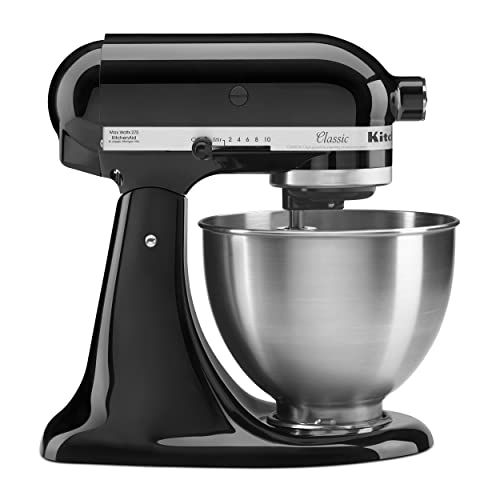
At a glance: KitchenAid Classic Series 4.5-quart tilt-head stand mixer (K45SS), 10 speeds, durable metal construction, 59 touchpoints, compatible with the full attachment range, in Onyx Black in the verified listing.
As this comparison’s anchor, the Classic’s case is completeness at the class’s lowest tier: nothing about its mixing is held back, and its omissions are the kind an owner can remedy individually, in their own order, at street prices. It is also the machine against which every Deluxe premium should be measured, because it is what the premium buys its way out of.
Strengths
- Full platform capability at the family’s most accessible tier
- Sold everywhere, with constant promotional pricing discipline
- Deep parts and accessory support from an enormous installed base
Trade-offs
- Plain finishes and the family’s shortest colour list
- No bundled extras beyond the core tool trio
- The 4.5-quart ceiling it shares with the Deluxe
Best for: value-first bakers, first-time buyers, and anyone assembling accessories individually. Not suited for: buyers who want dressed-up presentation in the box.
A Deluxe Offer, Audited in Public
To make the method concrete, imagine the two encounters this comparison most often resolves. In the first, a warehouse store offers a Deluxe whose box lists a flex-edge beater among its contents, priced at a modest step above the Classic’s current promotional figure. The audit marks the beater as a genuine would-buy, prices it separately, finds the premium smaller than the beater’s cost, and approves the Deluxe without ambivalence: the buyer gets the platform, the presentation, and the tool, for less than assembling them. In the second encounter, a Deluxe is priced within a whisker of the Artisan’s street price on the strength of its finish alone, its box holding the standard trio. The audit finds no marked extras, notes that the same money buys the Artisan’s larger bowl and broader support, and declines. Same name, opposite verdicts, and the difference was never the machine. It was the arithmetic, performed on the day, with the contents read from the box rather than the banner.
Ownership: Years With Either Badge
Long ownership erases most of the differences this comparison has catalogued, which is itself a finding. Both machines ask for the same light care: a hinge kept clean, a pin checked if a wobble appears, beater clearance verified with the manual’s coin test when mixing behaviour drifts, tools washed promptly and stored without rattling. Both machines’ wear items are the platform’s: a beater coating that eventually retires, a shield that cracks if dropped, parts that remain orderable because the class is everywhere. The Deluxe’s finer finish asks for a softer cloth; the Classic’s plainness forgives a harder life. After five years, owners of both describe the same machine in the same words, reliable, sufficient, familiar, and the badge on the trim band has become the least interesting thing about it. Buyers should therefore weight the first-year differences, contents and price and finish, exactly as this guide has priced them, and expect the long years to be a draw.
Myth Three: “A Variant Name Means a Variant Machine Underneath”
Shoppers reasonably assume that a different name on an appliance signals different engineering, because in cars and phones it usually does. In stand mixers, retail naming runs ahead of engineering: the same platform can wear a standard badge in one channel and a variant badge in another, with the differences confined to trim, finish, and carton. The reliable identifier is never the name but the model code, printed on the trim band and the box, which places the machine in its true family. A Deluxe whose code places it in the 4.5-quart tilt-head class is that class’s machine, whatever the banner above the shelf proclaims; a machine with a genuinely different code deserves to be judged as a different machine even if its shelf name sounds familiar. This single habit, reading codes instead of names, dissolves most of the confusion this comparison exists to address, and it transfers to every other variant in the family and, frankly, to most of the appliance aisle.
Myth Four: “The Classic Will Be Outgrown in a Year”
The fear of outgrowing a first mixer pushes many buyers up the ladder prematurely, so it deserves a direct answer. A 4.5-quart tilt-head mixer covers the standard repertoire of home baking without apology: cakes as published, cookies as published, a loaf, a pizza night, whipped work for a family dessert. Outgrowing it requires a specific change in life: doubling as a habit, bread as a weekly production, or a household that grows. Those changes are visible on a two-year horizon for most people, and buyers who see them coming should indeed buy above this class entirely, toward the Artisan’s bowl or the bowl-lift’s frame, rather than sideways to a Deluxe, which offers no capacity insurance at all. Buyers who do not see them coming should let the fear go. The Classic’s ceiling is the standard recipe book’s ceiling, and most bakers live their whole baking lives beneath it happily.
The Finish Question, Priced Honestly
Since presentation is the Deluxe’s most consistent real difference, it deserves a fair hearing rather than a dismissive one. A stand mixer is among the most visible objects in a kitchen, present in every photograph of every family gathering that happens near the counter, and its finish contributes to the room the way a kettle’s or a toaster’s never quite does. Owners who chose a finish they love report a small, real pleasure that recurs daily, and pleasures that recur daily are not trivial in a home. The Classic’s defence is that its plainness is also a kind of finish: sober, workmanlike, and invisible in the best way in a busy kitchen, with the added virtue of hiding the evidence of work. The honest method is to price your own preference. If the Deluxe’s finish would give you daily pleasure and its premium is modest, the purchase is rational on those terms alone, provided you make it knowingly rather than under the impression that you bought a stronger machine. What this guide objects to is not paying for beauty; it is paying for beauty while believing you paid for power.
An In-Store Checklist for Any Deluxe Offer
Carry this sequence into the shop and the comparison resolves itself in minutes. First, find the model code on the box or the machine and confirm the 4.5-quart tilt-head class. Second, read the contents panel completely and list every item. Third, mark the items you would buy separately within a year, with the flex-edge beater the usual candidate. Fourth, check the Classic’s current price on your phone, from a mainstream listing, promotional figure and all. Fifth, subtract: the Deluxe’s price minus the Classic’s street price is the premium; the marked items’ separate cost is the value; buy the Deluxe only if value exceeds premium, or if the finish alone is worth the difference to you and you are honest that it is the finish you are buying. Sixth, confirm the return window in writing, because variant programmes rotate and a discontinued shelf line can complicate exchanges later. Six steps, one decision, no myths required.
The Class at Work: A Recipe Tour
Abstract equivalence becomes convincing when it is walked through a recipe book. Begin with the sponge cake: both machines cream butter and sugar to the same pale ribbon, take eggs at the same unhurried pace, and fold flour at stir speed without deflating the work, because the action and speeds doing it are the class’s own. Move to the chocolate chip cookie, the densest common batter: both bowls accept the full published recipe, both beaters work the mix-ins through at low speed, and both ask for the same single scrape midway. Take the sandwich loaf: both hooks knead it at speed two to the same smooth windowpane, in the same unhurried minutes, with the same slight nod of the head as the dough gathers strength. Finish with the pavlova: both whips build the same glossy peaks in bowls that must be, in both cases, scrupulously clean. At no point in the tour does the badge intervene. That is the empirical heart of this comparison, and any reader who doubts it is invited to find the recipe where a Deluxe and a Classic, same class, same bowl, same speeds, produce different results. The tour’s lesson is that your choice between them will be made in the shop, on price and contents and finish, and not one moment of it will be regretted or celebrated at the bowl.
Ergonomics and the Daily Ten Minutes
Both machines are used in short, frequent bursts, and their ergonomics are the class’s ergonomics: a head that tips with a light action, a bowl that twists on and off its plate, a speed lever positioned for the thumb of the hand that steadies the bowl. The differences an owner actually feels between the two cartons are the bowl’s detailing and the finish’s feel under a cloth, nothing more. Weight is the class’s weight, substantial enough that both machines deserve a permanent home or a low shelf, and the raised-head clearance is the same measurement errand for both. Households with cooks of different heights will find the tilt-head’s open bowl equally kind at either badge. If ergonomics is your deciding anxiety, relax it: in this comparison, uniquely, the machines tie completely, and your diligence is better spent on placement, a mat beneath the feet, a home near the flour, than on the nameplate.
The Secondhand Deluxe: Opportunity and Caution
Variant models reach the secondhand market with a particular pattern: because their names are less universally understood than the Classic’s, they are sometimes priced below their platform’s worth by sellers who cannot explain them, and sometimes priced above it by sellers trading on the grander word. Both errors favour the informed buyer this guide is trying to create. Inspect any used example as a machine first: run all ten speeds, tilt and lock the head, seat and remove the bowl, listen for grinding or hesitation, and check the beater’s coating and the bowl’s locking plate for wear. Then inventory the contents against what the badge promises, because used bundles shed their extras. Finally, price it against a used Classic of similar age and condition, and let the platform, not the name, set the number. A sound Deluxe bought at Classic money is one of the used market’s quiet bargains; a tired one bought at a premium for its badge is the same market’s quiet lesson.
Gifts and Registries at This Rung
At this end of the ladder, gift-giving has its own logic. The Classic is the safe, generous standard: it gives the whole platform, it is available at the last minute from almost anywhere, and its plain finish cannot clash with a kitchen you have not seen. The Deluxe is the considered gift for a recipient whose taste you know: a richer finish, perhaps the beater they would not buy themselves, in a box that feels like an occasion. Registry advice mirrors the split. Couples furnishing a first home together should register the Classic without embarrassment and spend their guests’ generosity on the wider kitchen; couples who bake seriously and know their style can register the Deluxe where it is stocked, or step to the Artisan for its bowl. In every case the giver’s friend is the model code, which confirms that the machine purchased is the machine compared here, and the recipient’s friend is the return window, which should be confirmed before the wedding rather than after the honeymoon.
If You Already Own the Classic
Owners of the Classic sometimes read comparisons like this one with a suspicion that they bought the wrong machine. They did not, and the Deluxe’s existence does not indict their purchase. Everything the Deluxe adds can be added to a Classic individually: the flex-edge beater is sold separately in this class’s fitment, bowls and shields are orderable, and the finish you own has the virtue of already being paid for. The rational upgrade path from a Classic runs not sideways to a variant but upward, when and if your baking outgrows the class, to the Artisan’s capacity or the bowl-lift’s authority, a decision our how to choose a stand mixer guide frames for the whole category. Until that day, the Classic in your kitchen is the complete platform this comparison keeps describing, and the Deluxe on the shelf is the same platform in a different outfit, priced by a method you now understand. Knowledge, in this case, is contentment.
Sound, Vibration, and Neighbours
Because the platform is shared, so is the soundtrack: a purposeful mechanical note that brightens at whip speed and deepens under dough, moderated more by placement than by any other variable. A mat under the feet, a position away from a hollow cabinet’s drum-like side, and a counter that is not acting as a sounding board will do more for peace in an open-plan home than any choice between these badges can. At dough speeds both machines are considerate; at full whip both announce themselves, and households with sleeping infants learn to schedule meringues accordingly. None of this divides the comparison, and that is worth stating, because shoppers sometimes hunt for a quieter variant that does not exist. In this class, quiet is a placement decision, not a purchase decision.
Parts, Repairs, and the Class’s Deep Ecosystem
One of the strongest arguments for this entire class, under either badge, is the ecosystem that surrounds it. The 4.5-quart tilt-head platform has been manufactured in large numbers for a long time, and the consequences compound: bowls, beaters, hooks, whips, and shields are stocked by many sellers; independent repairers know the machine’s habits; instructional material for every adjustment, from beater clearance to hinge pins, is abundant and free. A Deluxe owner benefits fully from this ecosystem because the variant’s identity is retail-deep only; its model code files it under the platform, and every part and procedure follows. This matters most at year seven, when a chipped beater coating or a cracked shield is the difference between a small order and a new appliance. Machines from obscure lines fail that test routinely. These do not, and a buyer choosing between the Deluxe and the Classic can strike longevity anxiety from the list of deciding factors entirely. Both will be supported. Both will be repairable. The choice is about the box and the finish and the price, exactly as the rule at the top of this guide said it would be.
Stepping Up From This Class, When the Time Comes
If your baking does outgrow the 4.5-quart tilt-heads, the step up should be chosen by which limit you hit. If the limit was bowl volume, doubled batters crowding the rim, folds that threatened to escape, the Artisan’s 5-quart bowl is the direct answer, keeping every habit you have learned. If the limit was dough authority, stiff batches flexing the head and setting the machine creeping, no tilt-head will cure it, and the bowl-lift branch is the honest destination, as the Professional comparison in this series explains. If the limit was neither but merely the desire for a finer object, the family’s design-led editions scratch that itch without changing your baking at all. Notice what is absent from the list: the Deluxe is not a step up from the Classic in any capability dimension, and the Classic is not a step down from the Deluxe. They are the same step, differently dressed, and recognising that is the graduation this comparison offers. Everything after it is shopping for your actual future rather than for a grander word.
The Decision, Summarised Without a Table
Buy the Classic if you found this guide before meeting any Deluxe offer, bake at standard scale, and prefer to choose your own extras; it is the complete platform at the honest price, and it will not be outgrown by any life you can currently foresee. Buy the Deluxe if the specific offer in front of you, audited by the checklist, contains marked extras worth more than its premium, or wears a finish you have honestly priced and chosen. Decline the Deluxe if its case rests on implied power, implied capacity, or a comparison against the Classic’s ticket price rather than its street price, because all three are theatre. And whichever you buy, record the model code, keep the core trio in good order, and expect the machine to become invisible in the best way: a tool so adequate to its work that the only time you think about it again is when a comparison like this one reminds you how much quiet engineering sits inside a name.
A Speed Guide for the Shared Platform
New owners of either badge ask the same question in their first week, so the practical layer of this comparison answers it once, for both. Stir is for beginnings: flour meeting liquid, ingredients being combined without violence, and the gentle fold that finishes a batter. Speed two is the dough gear and the mash gear, where the hook does its slow work and the paddle breaks down soft vegetables without spraying them. The middle speeds, four and six, are where cakes are born: butter and sugar creamed to paleness, batters beaten smooth, frostings whipped to spreadable clouds, cookie doughs finished after their flour is in. The top speeds belong to air: cream, whites, and meringues, watched closely because the distance between perfect and overdone is short at full tilt. Two disciplines apply at every speed and under both badges. Add dry ingredients gradually and at the low end, or wear them. And stop the machine to scrape at the moments recipes suggest, because the planetary action is thorough but the bowl’s centre dimple keeps a spoonful of secrets that only a spatula can collect. Master those habits and the badge on the trim band becomes what it always was: the least important specification you own.
Seasonal Production on a 4.5-Quart Machine
The class’s ceiling is felt most at the festive peaks, so a word on surviving them gracefully applies to both badges equally. The strategy is sequencing. Doughs that proof for hours should be mixed first and in rotation, so the machine is never the bottleneck the oven is not already imposing. Frostings, fillings, and curds keep well and should be made the day before, freeing the machine for fresh work. Cookies bake in sheets while the next batch mixes, a rhythm the tilt-head’s quick bowl access serves beautifully. Where a recipe must be doubled beyond the bowl’s comfort, split it at the flour stage: mix the base as one, divide, and finish each half with its own flour, which preserves both texture and the machine’s dignity. Households that plan this way discover that the class’s ceiling is higher in practice than in specification, because time, unlike volume, can be subdivided indefinitely. The bakers who suffer at the peaks are those who meet them unplanned, and no badge, Deluxe or otherwise, insures against that.
Teaching a New Baker on This Class of Machine
There is a reason so many bakers learned on a machine of this class, and it is worth naming for households where the purchase doubles as a teaching tool. The controls could not be simpler: one lever, ten detents, no menus, no modes to misunderstand. The tilt of the head is a gesture a child can be taught safely with the machine unplugged, and the bowl’s twist is equally legible. Feedback is immediate and physical: you can watch a batter change, hear the motor’s note shift as a dough gathers, and learn the craft’s cues through the machine rather than despite it. Between the two badges, teaching is a tie with one footnote: a Deluxe bundle’s flex-edge beater forgives the beginner’s forgotten scrape, while the Classic’s plain kit teaches the scrape as a habit from the first bake. Either pedagogy produces bakers. Choose the household’s temperament, and know that the machine, under either name, has been starting baking lives for generations and shows no sign of stopping.
Materials and Build, Without the Brochure Language
The Classic’s listing advertises durable metal construction, and the phrase deserves translation. In this class it means a machine whose body and drivetrain are built to be worked and, if necessary, opened and repaired, rather than sealed and discarded. The Deluxe shares that construction because it shares the platform; its additional spend is on surface, not skeleton. Practically, this is why both machines feel dense and planted in the hand, why their hinges and levers operate with a machined positivity that cheaper rivals do not imitate, and why the secondhand market treats decade-old examples as working tools rather than curiosities. It is also why the weight is what it is, and why this guide keeps advising a permanent home or a low shelf: honest materials are heavy, and the heaviness is the receipt for the durability. Buyers who lift both machines in a shop will feel the class’s character in five seconds, and that feeling, identical under both badges, is the platform’s oldest argument.
Counter Culture: Living With a Full-Size Tilt-Head
Both badges sit on the same full-size stance, so the domestic advice is shared and brief. Give the machine a home with the raised-head clearance it needs, on a surface that will not drum, within reach of the flour and the oven’s landing zone. If it must travel to a cupboard, let the cupboard be low and the path short. Keep its tools in its bowl, its hub capped, and its trim band wiped, because dried batter in the hinge is the class’s one recurring nuisance and it is entirely preventable. The Deluxe’s finish earns it the display position in homes that have a choice; the Classic’s plainness is indifferent to position, which is its own freedom. Either way, a machine with a settled home gets used, and a used machine justifies every paragraph of comparisons written about it, including this one.
What This Comparison Cannot Tell You
Honesty about a guide’s limits is part of its usefulness. This comparison cannot tell you the contents of next season’s Deluxe programme, because nobody outside the retailer can; it cannot tell you whether your household will grow into doubling as a habit, because that is a fact about your future; and it cannot tell you how much a particular finish will please you in your kitchen’s particular light, because taste is not a specification. What it can do, and has tried to do, is fix the variables that are knowable: the shared platform, the real differences, the audit that prices them, and the myths that inflate them. The rest is yours, and it is the enjoyable part: standing in the shop, reading a box like an inspector rather than a audience, and choosing a machine that will spend a decade making cakes while nobody thinks about its name at all.
The One-Page Version, for the Shopper in the Aisle
If you are reading this on a phone with a trolley in your other hand, here is the comparison compressed to its working essence. The Classic and the Deluxe are the same 4.5-quart tilt-head platform with the same speeds, the same mixing action, and the same attachment hub. The Classic is plain, complete, and sold everywhere at a price disciplined by constant promotion. The Deluxe is a store variant with a richer finish and a bundle whose contents are printed on its box and nowhere else. Read the box. If it contains a flex-edge beater or another extra you would buy anyway, and the premium over the Classic’s price on your phone is less than that extra costs alone, take the Deluxe and feel pleased. If the box holds only the standard tools, take the Classic and buy the beater yourself with the change. If the Deluxe’s price is flirting with the Artisan’s, walk away from both and take the Artisan’s bigger bowl. Then go home and bake something, because the machine you chose, under either badge, has been ready for that all along.
And one parting thought for the aisle: the salesperson is not your enemy in this transaction, merely a narrator with a script written by the programme that commissioned the variant. Ask the questions the checklist gives you, kindly and precisely, and you will usually find the answers are available and honest. The myths this guide retired were never lies exactly; they were emphases, and emphasis dissolves under specific questions. Model code, contents, street prices, return window: four specifics, and the grandest name on the shelf becomes a simple, purchasable machine.
A Brief Word on the Word “Deluxe” Itself
It is worth pausing on the word, because words do quiet work in an aisle. “Deluxe” promises a superior version of a known thing, and in much of retail it delivers exactly that: more features, better materials, a higher specification. The shopper’s habit of trusting it is therefore reasonable, and the disappointment this comparison guards against is not that the Deluxe is a poor machine, it is an excellent platform in a handsome outfit, but that the word invites a specific expectation of superior capability which the platform does not encode. The Classic, meanwhile, suffers from the opposite word: “classic” reads as basic to modern ears, when in this family’s usage it means the original, complete article. Two names, each misleading in opposite directions, attached to substantially the same machine: it is a small masterpiece of retail language, and the only defence is the one this guide has practised throughout, which is to read codes, contents, and prices, and let names entertain rather than inform. Do that, and both words lose their power over the decision, leaving the machine, the box, and the arithmetic in charge, where they belonged from the start.
Energy, Longevity, and the Quiet Ledger
A final consideration belongs to the long ledger rather than the shop floor. Both machines are durable, repairable, metal-bodied tools with no consumables, and a household that keeps either for fifteen years has made a better decision, by every measure that compounds, than a household that cycles through lesser machines at any badge. The environmental and financial difference between the Deluxe and the Classic across that span is negligible; the difference between keeping and replacing is enormous. So buy the one your audit approves, maintain it with the light routine this family asks, pass it on when your baking changes rather than binning it, and let the comparison end where it should: not with a winner, but with two honest machines and a reader who can no longer be confused by the space between their names.
How the Two Machines Age in Photographs and in Fact
Spend time in owners’ forums and a pattern emerges that showrooms cannot show you: the Classic ages into invisibility, its plain finish absorbing a decade of kitchen life without complaint, while dressed-up variants age into character, their richer finishes recording the years in small marks that owners read as patina or as wear depending on temperament. Neither trajectory is a defect. They are the two honest ways a working object can grow old, and choosing between them is choosing which story you want your counter to tell. The machines underneath the finishes, meanwhile, age identically and slowly, which is the deepest sense in which this comparison is a tie. A buyer who understands that will spend their deliberation where deliberation pays, on the box, the price, and the fit with their own baking, and will leave the showroom with a machine whose name they may forget and whose work they will rely on for years.
To close the comparison where it began: the sentence a salesperson offers you about these two machines will be short, confident, and organised around the name. You now hold the longer, duller, truer version, organised around the platform, the box, and the price. Dull truths are the ones that survive contact with a decade of baking, and a machine bought on a dull truth will be mixed, kneaded, and whipped on long after the sentence in the shop is forgotten. That is the outcome this guide was written to produce, for the Classic’s buyers and the Deluxe’s alike.
The Thought Experiment That Settles It
If the checklist and the myths leave any residue of doubt, one thought experiment clears it. Imagine both machines stripped of their badges, finished identically, and priced identically, on a bench in front of you. In that world there is nothing to choose, because there is nothing different to choose between, and the experiment’s emptiness is precisely the information: every real difference between the Deluxe and the Classic lives in the layers the experiment removed, the finish, the contents, the channel, the price. Restore those layers one at a time and price each as it returns, and the comparison performs itself. This is not a trick to diminish the Deluxe, whose layers can be worth real money, nor to inflate the Classic, whose plainness is itself a layer priced at zero. It is simply the discipline of knowing what you are paying for, which is the whole art of buying durable goods in a market that names things for a living.
One last assurance for the shopper still hovering between the two cartons: the downside of a close call here is unusually small. Both machines will be supported, accessorised, and understood by every repairer in the country for the whole of their long lives, and both will mix a standard repertoire to a standard no guest at your table could fault. The audit exists to capture the few hundred decisions where the badges genuinely diverge in value; everywhere else, buy either with a light heart and bake something the same afternoon.
Frequently Asked Questions
What is the actual difference between the Deluxe and the Classic?
Presentation, box contents, sales channel, and price behaviour. The Deluxe is a retail variant of the same 4.5-quart tilt-head class, typically with richer finishes and bundled extras that vary by programme. The Classic is the standard model, plainly finished, with the core tool trio, sold everywhere. Mixing capability, bowl size, speeds, and attachment compatibility are the class’s, shared by both.
Is the Deluxe worth the extra money?
Only when its specific extras, honestly marked as items you would buy anyway, are worth more than its premium over the Classic’s current street price, or when its finish matters enough to you to pay for presentation knowingly. Run the audit on the specific offer; the name alone cannot answer the question, because Deluxe contents change between programmes.
Why can I not find the Deluxe on the main online stores?
Because it is a retail-channel variant rather than a standard catalogue model. When we verified products for this guide, catalogue searches for the Deluxe returned the Classic and Artisan listings. You will meet the Deluxe in the stores and programmes that commissioned it, which is why judging it by model code and box contents matters more than searching for reviews of a fixed specification that does not exist.
Do Deluxe and Classic bowls and tools interchange?
They belong to the same 4.5-quart class, so fitments are class-based, but always confirm by model code before buying spares, because bowl and tool fitments are specified per model across the family. Hub attachments are universal to both, as they are across the whole range.
Which should a first-time buyer choose?
The Classic, unless a specific Deluxe offer passes the audit at the moment of purchase. A first-time buyer benefits from the Classic’s availability, its disciplined pricing, and the freedom to add accessories as their baking reveals which ones matter. If a Deluxe on the shelf includes the flex-edge beater at a small premium that week, taking it is not a mistake; it is the audit working as intended.
Can both machines handle bread dough equally?
Yes, because the capability belongs to the shared platform: standard loaves, rolls, and pizza dough knead properly with the hook at low speed in either carton. Their shared limit is the class’s limit, large or stiff batches, and the remedy in both cases is the same: split the batch, or step up to a bowl-lift machine if such batches are your routine.
What is the most common mistake shoppers make when comparing these two in a shop?
Judging the machines by the display finish and the size of the promotional sign, then assuming the prettier unit must also be the stronger one. Both mistakes are easy to correct on the spot: find the model code on the trim band, note the bowl size and the exact tools included in that specific offer, and write those three facts down before comparing any asking figure. A Classic offer with a genuinely useful extra bowl can serve a baker better than a Deluxe offer whose premium buys only a finish, so the written facts, not the shelf presentation, should decide between them.